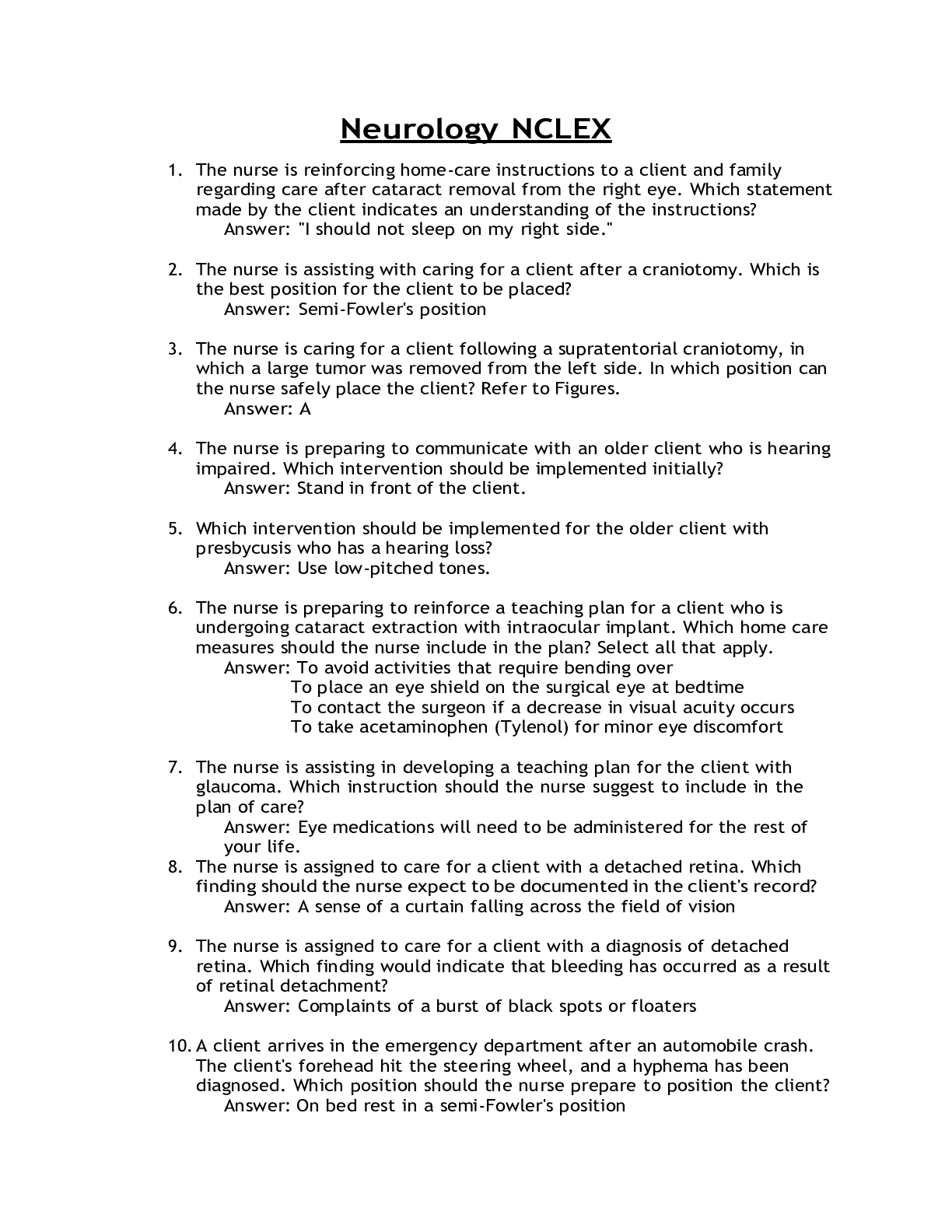
2018 Exam 1 and
Rationales
1. A client with a diagnosis of passive-aggressive personality disorder
is seen at the local mental health clinic. A common characteristic
of
persons with passive-aggressive personality di
...
2018 Exam 1 and
Rationales
1. A client with a diagnosis of passive-aggressive personality disorder
is seen at the local mental health clinic. A common characteristic
of
persons with passive-aggressive personality disorder is:
❍ A. Superior intelligence
❍ B. Underlying hostility
❍ C. Dependence on others
❍ D. Ability to share feelings
2. The client is admitted for evaluation of aggressive behavior and
diagnosed with antisocial personality disorder. A key part of the
care of such clients is:
❍ A. Setting realistic limits
❍ B. Encouraging the client to express remorse for behavior
❍ C. Minimizing interactions with other clients
❍ D. Encouraging the client to act out feelings of rage
3. An important intervention in monitoring the dietary compliance of
a client with bulimia is:
❍ A. Allowing the client privacy during mealtimes
❍ B. Praising her for eating all her meal
❍ C. Observing her for 1–2 hours after meals
❍ D. Encouraging her to choose foods she likes and to eat
in moderation
4. Assuming that all have achieved normal cognitive and emotional
development, which of the following children is at greatest risk for
accidental poisoning?
❍ A. A 6-month-old
❍ B. A 4-year-old
❍ C. A 12-year-old
❍ D. A 13-year-old
01_0789737043_ch01.qxd 10/29/07 3:48 PM Page 1
5. Which of the following examples represents parallel play?
❍ A. Jenny and Tommy share their toys.
❍ B. Jimmy plays with his car beside Mary, who is playing with
her doll.
❍ C. Kevin plays a game of Scrabble with Kathy and Sue.
❍ D. Mary plays with a handheld game while sitting in her
mother’s lap.
6. The nurse is ready to begin an exam on a 9-month-old infant. The child
is sitting in his mother’s lap. Which should the nurse do first?
❍ A. Check the Babinski reflex
❍ B. Listen to the heart and lung sounds
❍ C. Palpate the abdomen
❍ D. Check tympanic membranes
7. In terms of cognitive development, a 2-year-old would be expected to:
❍ A. Think abstractly
❍ B. Use magical thinking
❍ C. Understand conservation of matter
❍ D. See things from the perspective of others
8. Which of the following best describes the language of a 24-month-old?
❍ A. Doesn’t understand yes and no
❍ B. Understands the meaning of words
❍ C. Able to verbalize needs
❍ D. Asks “why?” to most statements
9. A client who has been receiving urokinase has a large bloody bowel movement. Which action would be best for the nurse to take immediately?
❍ A. Administer vitamin K IM
❍ B. Stop the urokinase
❍ C. Reduce the urokinase and administer heparin
❍ D. Stop the urokinase and call the doctor
2 Chapter 1
01_0789737043_ch01.qxd 10/29/07 3:48 PM Page 2
10. The client has a prescription for a calcium carbonate compound to neutralize stomach acid. The nurse should assess the client for:
❍ A. Constipation
❍ B. Hyperphosphatemia
❍ C. Hypomagnesemia
❍ D. Diarrhea
11. Heparin has been ordered for a client with pulmonary embolis. Which
statement, if made by the graduate nurse, indicates a lack of understanding of the medication?
❍ A. “I will administer the medication 1-2 inches away from the
umbilicus.”
❍ B. “I will administer the medication in the abdomen.”
❍ C. “I will check the PTT before administering the medication.”
❍ D. “I will need to aspirate when I give Heparin.”
12. The nurse is caring for a client with peripheral vascular disease. To correctly assess the oxygen saturation level, the monitor may be placed on the:
❍ A. Hip
❍ B. Ankle
❍ C. Earlobe
❍ D. Chin
13. While caring for a client with hypertension, the nurse notes the following
vital signs: BP of 140/20, pulse 120, respirations 36, temperature
100.8°F. The nurse’s initial action should be to:
❍ A. Call the doctor
❍ B. Recheck the vital signs
❍ C. Obtain arterial blood gases
❍ D. Obtain an ECG
14. The nurse is preparing a client with an axillo-popliteal bypass graft for
discharge. The client should be taught to avoid:
❍ A. Using a recliner to rest
❍ B. Resting in supine position
❍ C. Sitting in a straight chair
❍ D. Sleeping in right Sim’s position
2018 Exam 1 and Rationales
01_0789737043_ch01.qxd 10/29/07 3:48 PM Page 3
15. The doctor has ordered antithrombolic stockings to be applied to the
legs of the client with peripheral vascular disease. The nurse knows
antithrombolic stockings should be applied:
❍ A. Before rising in the morning
❍ B. With the client in a standing position
❍ C. After bathing and applying powder
❍ D. Before retiring in the evening
16. The nurse has just received the shift report and is preparing to make
rounds. Which client should be seen first?
❍ A. The client with a history of a cerebral aneurysm with an
oxygen saturation rate of 99%
❍ B. The client three days post–coronary artery bypass graft with
a temperature of 100.2°F
❍ C. The client admitted 1 hour ago with shortness of breath
❍ D. The client being prepared for discharge following a femoral
popliteal bypass graft
17. A client with a femoral popliteal bypass graft is assigned to a semiprivate
room. The most suitable roommate for this client is the client with:
❍ A. Hypothyroidism
❍ B. Diabetic ulcers
❍ C. Ulcerative colitis
❍ D. Pneumonia
18. The nurse is teaching the client regarding use of sodium warfarin. Which
statement made by the client would require further teaching?
❍ A. “I will have blood drawn every month.”
❍ B. “I will assess my skin for a rash.”
❍ C. “I take aspirin for a headache.”
❍ D. “I will use an electric razor to shave.”
19. The client returns to the recovery room following repair of an abdominal
aneurysm. Which finding would require further investigation?
❍ A. Pedal pulses regular
❍ B. Urinary output 20mL in the past hour
❍ C. Blood pressure 108/50
❍ D. Oxygen saturation 97%
4 Chapter 1
01_0789737043_ch01.qxd 10/29/07 3:48 PM Page 4
20. The nurse is doing bowel and bladder retraining for the client with paraplegia. Which of the following is not a factor for the nurse to consider?
❍ A. Diet pattern
❍ B. Mobility
❍ C. Fluid intake
❍ D. Sexual function
21. A 20-year-old is admitted to the rehabilitation unit following a motorcycle
accident. Which would be the appropriate method for measuring the
client for crutches?
❍ A. Measure five finger breadths under the axilla
❍ B. Measure 3 inches under the axilla
❍ C. Measure the client with the elbows flexed 10°
❍ D. Measure the client with the crutches 20 inches from the side
of the foot
22. The nurse is caring for the client following a cerebral vascular accident.
Which portion of the brain is responsible for taste, smell, and hearing?
❍ A. Occipital
❍ B. Frontal
❍ C. Temporal
❍ D. Parietal
23. The client is admitted to the unit after a motor vehicle accident with a
temperature of 102°F rectally. The most likely explanations for the elevated temperature is that:
❍ A. There was damage to the hypothalamus.
❍ B. He has an infection from the abrasions to the head and face.
❍ C. He will require a cooling blanket to decrease the temperature.
❍ D. There was damage to the frontal lobe of the brain.
24. The client is admitted to the hospital in chronic renal failure. A diet low in
protein is ordered. The rationale for a low-protein diet is:
❍ A. Protein breaks down into blood urea nitrogen and other
waste.
❍ B. High protein increases the sodium and potassium levels.
❍ C. A high-protein diet decreases albumin production.
❍ D. A high-protein diet depletes calcium and phosphorous.
2018 Exam 1 and Rationales 5
01_0789737043_ch01.qxd 10/29/07 3:48 PM Page 5
25. The client who is admitted with thrombophlebitis has an order for
heparin. The medication should be administered using a/an:
❍ A. Buretrol
❍ B. Infusion controller
❍ C. Intravenous filter
❍ D. Three-way stop-cock
26. The nurse is taking the blood pressure of the obese client. If the blood
pressure cuff is too small, the results will be:
❍ A. A false elevation
❍ B. A false low reading
❍ C. A blood pressure reading that is correct
❍ D. A subnormal finding
27. A 4-year-old male is admitted to the unit with nephotic syndrome. He is
extremely edematous. To decrease the discomfort associated with scrotal
edema, the nurse should:
❍ A. Apply ice to the scrotum
❍ B. Elevate the scrotum on a small pillow
❍ C. Apply heat to the abdominal area
❍ D. Administer an analgesic
28. The client with an abdominal aortic aneurysm is admitted in preparation
for surgery. Which of the following should be reported to the doctor?
❍ A. An elevated white blood cell count
❍ B. An abdominal bruit
❍ C. A negative Babinski reflex
❍ D. Pupils that are equal and reactive to light
29. If the nurse is unable to elicit the deep tendon reflexes of the patella, the
nurse should ask the client to:
❍ A. Pull against the palms
❍ B. Grimace the facial muscles
❍ C. Cross the legs at the ankles
❍ D. Perform Valsalva maneuver
6 Chapter 1
01_0789737043_ch01.qxd 10/29/07 3:48 PM Page 6
30. The physician has ordered atropine sulfate 0.4mg IM before surgery. The
medication is supplied in 0.8mg per milliliter. The nurse should administer how many milliliters of the medication?
❍ A. 0.25mL
❍ B. 0.5mL
❍ C. 1.0mL
❍ D. 1.25mL
31. The nurse is evaluating the client’s pulmonary artery pressure. The nurse
is aware that this test evaluates:
❍ A. Pressure in the left ventricle
❍ B. The systolic, diastolic, and mean pressure of the pulmonary
artery
❍ C. The pressure in the pulmonary veins
❍ D. The pressure in the right ventricle
32. A client is being monitored using a central venous pressure monitor. If
the pressure is 2cm of water, the nurse should:
❍ A. Call the doctor immediately
❍ B. Slow the intravenous infusion
❍ C. Listen to the lungs for rales
❍ D. Administer a diuretic
33. The nurse identifies ventricular tachycardia on the heart monitor. The
nurse should immediately:
❍ A. Administer atropine sulfate
❍ B. Check the potassium level
❍ C. Prepare to administer an antiarrhythmic such as lidocaine
❍ D. Defibrillate at 360 joules
34. The doctor is preparing to remove chest tubes from the client’s left chest.
In preparation for the removal, the nurse should instruct the client to:
❍ A. Breathe normally
❍ B. Hold his breath and bear down
❍ C. Take a deep breath
❍ D. Sneeze on command
2018 Exam 1 and Rationales 7
01_0789737043_ch01.qxd 10/29/07 3:48 PM Page 7
35. The doctor has ordered 80mg of furosemide (Lasix) two times per day.
The nurse notes the patient’s potassium level to be 2.5meq/L. The nurse
should:
❍ A. Administer the Lasix as ordered
❍ B. Administer half the dose
❍ C. Offer the patient a potassium-rich food
❍ D. Withhold the drug and call the doctor
36. Which of the following lab studies should be done periodically if the
client is taking warfarin sodium (Coumadin)?
❍ A. Stool specimen for occult blood
❍ B. White blood cell count
❍ C. Blood glucose
❍ D. Erthyrocyte count
37. The client has an order for heparin to prevent post-surgical thrombi.
Immediately following a heparin injection, the nurse should:
❍ A. Aspirate for blood
❍ B. Check the pulse rate
❍ C. Massage the site
❍ D. Check the site for bleeding
38. The client with AIDS tells the nurse that he has been using acupuncture
to help with his pain. The nurse should question the client regarding this
treatment because acupuncture uses:
❍ A. Pressure from the fingers and hands to stimulate the energy
points in the body
❍ B. Oils extracted from plants and herbs
❍ C. Needles to stimulate certain points on the body to treat pain
❍ D. Manipulation of the skeletal muscles to relieve stress
and pain
39. The nurse is taking the vital signs of the client admitted with cancer of
the pancreas. The nurse is aware that the fifth vital sign is:
❍ A. Anorexia
❍ B. Pain
❍ C. Insomnia
❍ D. Fatigue
8 Chapter 1
01_0789737043_ch01.qxd 10/29/07 3:48 PM Page 8
40. The 84-year-old male has returned from the recovery room following a
total hip repair. He complains of pain and is medicated with morphine
sulfate and promethazine. Which medication should be kept available for
the client being treated with opoid analgesics?
❍ A. Naloxone (Narcan)
❍ B. Ketorolac (Toradol)
❍ C. Acetylsalicylic acid (aspirin)
❍ D. Atropine sulfate (Atropine)
41. The doctor has ordered a patient-controlled analgesia (PCA) pump for
the client with chronic pain. The client asks the nurse if he can become
overdosed with pain medication using this machine. The nurse demonstrates understanding of the PCA if she states:
❍ A. “The machine will administer only the amount that you need
to control your pain without any action from you.”
❍ B. “The machine has a locking device that prevents overdosing.”
❍ C. The machine will administer one large dose every 4 hours to
relieve your pain.”
❍ D. The machine is set to deliver medication only if you need it.”
42. The doctor has ordered a Transcutaneous Electrical Nerve Stimulation
(TENS) unit for the client with chronic back pain. The nurse teaching the
client with a TENS unit should tell the client:
❍ A. “You may be electrocuted if you use water with this unit.”
❍ B. “Please report skin irritation to the doctor.”
❍ C. “The unit may be used anywhere on the body without fear
of adverse reactions.”
❍ D. “A cream should be applied to the skin before applying
the unit.”
43. The nurse asked the client if he has an advance directive. The reason for
asking the client this question is:
❍ A. She is curious about his plans regarding funeral
arrangements.
❍ B. Much confusion can occur with the client’s family if he does
not have an advanced directive.
❍ C. An advanced directive allows the medical personnel to make
decisions for the client.
❍ D. An advanced directive allows active euthanasia to be carried
out if the client is unable to care for himself.
2018 Exam 1 and Rationales 9
✓
01_0789737043_ch01.qxd 10/29/07 3:48 PM Page 9
44. A client who has chosen to breastfeed tells the nurse that her nipples
became very sore while she was breastfeeding her older child. Which
measure will help her to avoid soreness of the nipples?
❍ A. Feeding the baby during the first 48 hours after delivery
❍ B. Breaking suction by placing a finger between the baby’s
mouth and the breast when she terminates the feeding
❍ C. Applying hot, moist soaks to the breast several times per day
❍ D. Wearing a support bra
45. The nurse is performing an assessment of an elderly client with a total
hip repair. Based on this assessment, the nurse decides to medicate the
client with an analgesic. Which finding most likely prompted the nurse to
decide to administer the analgesic?
❍ A. The client’s blood pressure is 130/86.
❍ B. The client is unable to concentrate.
❍ C. The client’s pupils are dilated.
❍ D. The client grimaces during care.
[Show More]



.png)




![Preview of [eBook] [PDF] Clinical Nursing Calculations 3rd Edition By Susan Sienkiewicz, Sandra Meg](https://browseimages.nyc3.digitaloceanspaces.com/paper-images/2025/Jul/04/4jF14r9I2025-07-04-05-586867ec3011731.png)




 With 850 Questions And Answers Guaranteed 100% Grade A.png)
.png)