NCLEX Exam 2
Cardiac
A client admitted to the hospital with chest pain and a history of type 2 diabetes mellitus is
scheduled for cardiac catheterization. Which medication would need to be withheld for 24 hours
befor
...
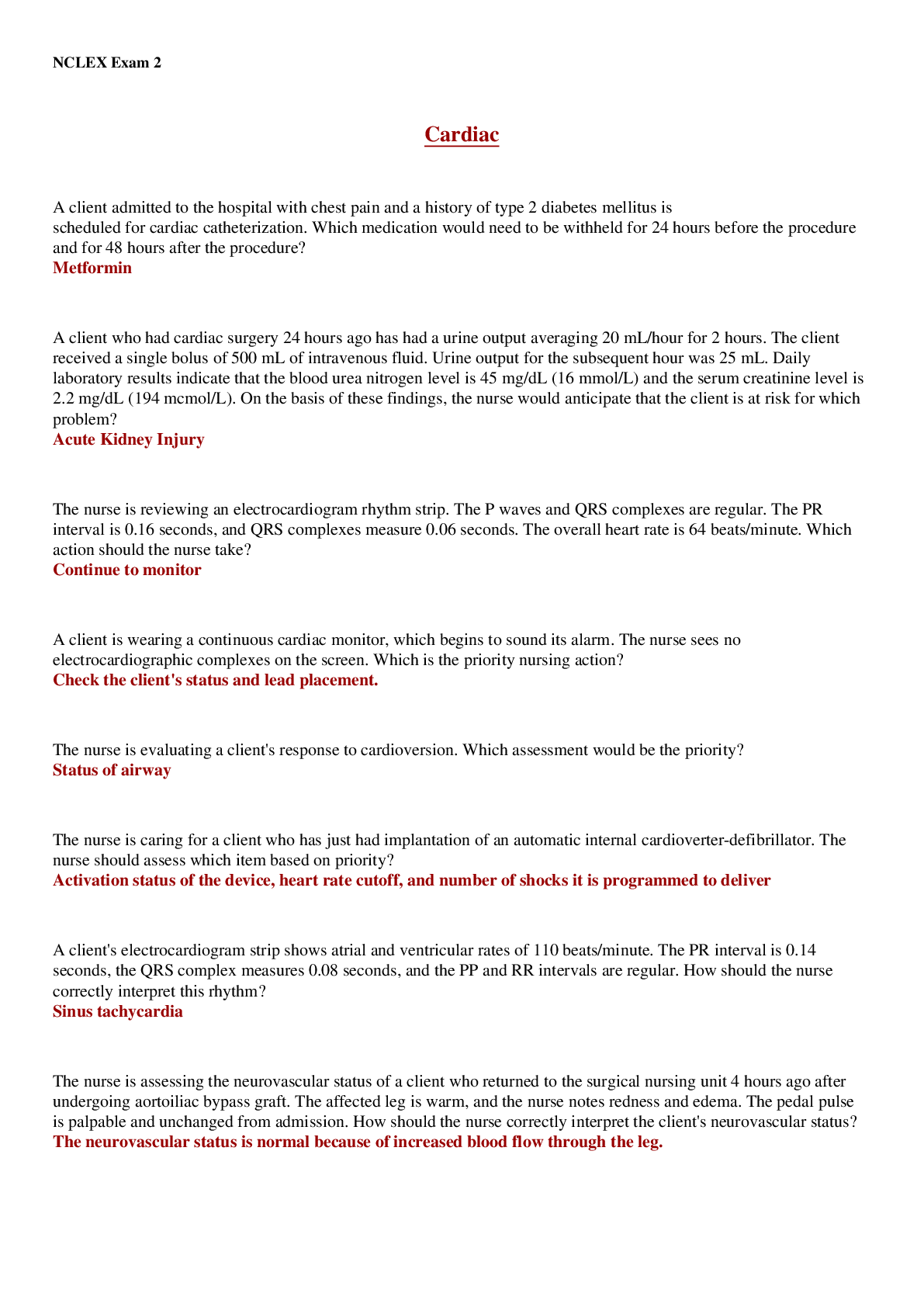
NCLEX Exam 2
Cardiac
A client admitted to the hospital with chest pain and a history of type 2 diabetes mellitus is
scheduled for cardiac catheterization. Which medication would need to be withheld for 24 hours
before the procedure and for 48 hours after the procedure?
Metformin
A client who had cardiac surgery 24 hours ago has had a urine output averaging 20 mL/hour for
2 hours. The client received a single bolus of 500 mL of intravenous fluid. Urine output for the
subsequent hour was 25 mL. Daily laboratory results indicate that the blood urea nitrogen level
is 45 mg/dL (16 mmol/L) and the serum creatinine level is 2.2 mg/dL (194 mcmol/L). On the
basis of these findings, the nurse would anticipate that the client is at risk for which problem?
Acute Kidney Injury
The nurse is reviewing an electrocardiogram rhythm strip. The P waves and QRS complexes
are regular. The PR interval is 0.16 seconds, and QRS complexes measure 0.06 seconds. The
overall heart rate is 64 beats/minute. Which action should the nurse take?
Continue to monitor
A client is wearing a continuous cardiac monitor, which begins to sound its alarm. The nurse
sees no electrocardiographic complexes on the screen. Which is the priority nursing action?
Check the client's status and lead placement.
The nurse is evaluating a client's response to cardioversion. Which assessment would be the
priority?
Status of airway
The nurse is caring for a client who has just had implantation of an automatic internal
cardioverter-defibrillator. The nurse should assess which item based on priority?
Activation status of the device, heart rate cutoff, and number of shocks it is programmed
to deliver
A client's electrocardiogram strip shows atrial and ventricular rates of 110 beats/minute. The PR
interval is 0.14 seconds, the QRS complex measures 0.08 seconds, and the PP and RR
intervals are regular. How should the nurse correctly interpret this rhythm?
Sinus tachycardia
The nurse is assessing the neurovascular status of a client who returned to the surgical nursing
unit 4 hours ago after undergoing aortoiliac bypass graft. The affected leg is warm, and the
nurse notes redness and edema. The pedal pulse is palpable and unchanged from admission.
How should the nurse correctly interpret the client's neurovascular status?
The neurovascular status is normal because of increased blood flow through the leg.
The nurse is evaluating the condition of a client after pericardiocentesis performed to treat
cardiac tamponade. Which observation would indicate that the procedure was effective?
A rise in blood pressure
A client with variant angina is scheduled to receive an oral calcium channel blocker twice daily.
Which statement by the client indicates the need for further teaching?
"My spouse told me that since I have developed this problem, we are going to stop
walking in the mall every morning."
The nurse is monitoring a client with acute pericarditis for signs of cardiac tamponade. Which
assessment finding indicates the presence of this complication?
Muffled or distant heart sounds
The home care nurse is providing instructions to a client with an arterial ischemic leg ulcer about
home care management and self-care management. Which statement, if made by the client,
indicates a need for further instruction?
"I need to be sure that I elevate my leg above the level of my heart for at least an hour
every day."
The nurse is providing instructions to a client with a diagnosis of hypertension regarding highsodium items to be avoided. The nurse instructs the client to avoid consuming which item?
Antacids
The nurse is preparing discharge instructions for a client with Raynaud's disease. The nurse
should plan to provide which instruction to the client?
Stop smoking because it causes cutaneous blood vessel spasm
The nurse is developing a plan of care for a client with varicose veins in whom skin breakdown
occurred over the varicosities as a result of secondary infection. Which is a priority intervention?
Elevate the legs higher than the heart
The nurse in the medical unit is reviewing the laboratory test results for a client who has been
transferred from the intensive care unit (ICU). The nurse notes that a cardiac troponin T assay
was performed while the client was in the ICU. The nurse determines that this test was
performed to assist in diagnosing which condition?
Myocardial infarction
The nurse is caring for a client with cardiac disease who has been placed on a cardiac monitor.
The nurse notes that the client has developed atrial fibrillation and has a rapid ventricular rate of
150 beats/minute. The nurse should next assess the client for which finding?
Hypotension
The nurse is performing an assessment on a client with a diagnosis of left-sided heart failure.
Which assessment component would elicit specific information regarding the client's left-sided
heart function?
Listening to lung sounds
The nurse is participating in a class on rhythm strip interpretation. Which statement by the nurse
indicates an understanding of a PR interval of 0.20?
"This is a normal finding."
The nurse in the medical unit is assigned to provide discharge teaching to a client with a
diagnosis of angina pectoris. The nurse is discussing lifestyle changes that are needed to
minimize the effects of the disease process. The client continually changes the subject during
the teaching session. The nurse interprets that this client's behavior is most likely related to
which problem?
An attempt to ignore or deny the need to make lifestyle changes
A home care nurse is visiting a client to provide follow-up evaluation and care of a leg ulcer. On
removing the dressing from the leg ulcer, the nurse notes that the ulcer is pale and deep and
that the surrounding tissue is cool to the touch. The nurse should document that these findings
identify which type of ulcer?
An arterial ulcer
The nurse is developing a plan of care for a client who will be admitted to the hospital with a
diagnosis of deep vein thrombosis (DVT) of the right leg. The nurse develops the plan,
expecting that the health care provider (HCP) will most likely prescribe which option?
Maintain activity level as prescribed.
A client with a diagnosis of varicose veins is scheduled for treatment by sclerotherapy and is
receiving education about the procedure from the nurse. Which statement by the client indicates
that the teaching has been effective?
"It involves injecting an agent into the vein to damage the vein wall and close it off."
A client calls the nurse at the clinic and reports that ever since the vein ligation and stripping
procedure was performed, she has been experiencing a sensation as though the affected leg is
falling asleep. The nurse should make which response to the client?
"Your health care provider needs to be contacted to report this problem."
The registered nurse (RN) is educating a new RN about the use of oxygen for clients with
angina pectoris. Which statement by the new nurse indicates that the teaching has been
effective?
"The pain of angina pectoris occurs because of a decreased oxygen supply to heart
cells."
A client with a diagnosis of angina pectoris is hospitalized for an angioplasty. The client returns
to the nursing unit after the procedure, and the nurse provides instructions to the client
regarding home care measures. Which statement, if made by the client, indicates an
understanding of the instructions?
"I need to adhere to my dietary restrictions."
The nurse is caring for a client with a diagnosis of myocardial infarction (MI) and is assisting the
client in completing the diet menu. Which beverage should the nurse instruct the client to select
from the menu?
Raspberry juice
The nurse is performing an admission assessment on a client with a diagnosis of angina
pectoris who takes nitroglycerin for chest pain at home. During the assessment the client
complains of chest pain. The nurse should immediately ask the client which question?
"Where is the pain located?"
The nurse has provided dietary instructions to a client with coronary artery disease. Which
statement by the client indicates an understanding of the dietary instructions?
"I should use polyunsaturated oils in my diet."
A client is admitted to the visiting nurse service for assessment and follow-up after being
discharged from the hospital with new-onset heart failure (HF). The nurse teaches the client
about the dietary restrictions required with HF. Which statement by the client indicates that
further teaching is needed?
"I'm going to have a ham and cheese sandwich and potato chips for lunch.
The nurse is performing a health screening on a 54-year-old client. The client has a blood
pressure of 118/78 mm Hg, total cholesterol level of 190 mg/dL (4.9 mmol/L), and fasting blood
glucose level of 184 mg/dL (10.2 mmol/L). The nurse interprets this to mean that the client has
which modifiable risk factor for coronary artery disease (CAD)?
Glucose intolerance
The nurse is trying to determine the ability of the client with myocardial infarction (MI) to manage
independently at home after discharge. Which statement by the client is the strongest indicator
of the potential for difficulty after discharge?
"I don't have anyone to help me with doing heavy housework at home."
The home care nurse has taught a client with a problem of inadequate cardiac output about
helpful lifestyle adaptations to promote health. Which statement by the client best demonstrates
an understanding of the information provided?
"I will eat enough daily fiber to prevent straining at stool."
A client has been experiencing difficulty with completion of daily activities because of underlying
cardiovascular disease, as evidenced by exertional fatigue and increased blood pressure.
Which observation by the nurse best indicates client progress in meeting goals for this
problem?
Ambulates 10 feet (3 meters) farther each day
The health care provider (HCP) has written a prescription for a client to have an
echocardiogram. Which action should the nurse take to prepare the client for the procedure?
Tells the client that the procedure is painless and takes 30 to 60 minutes
A client with coronary artery disease is scheduled to have a diagnostic exercise stress test.
Which instruction should the nurse plan to provide to the client about this procedure?
Wear loose clothing with a shirt that buttons in front.
A client is scheduled for a cardiac catheterization to diagnose the extent of coronary artery
disease. The nurse places the highest priority on telling the client to report which sensation
during the procedure?
Chest pain
A client recovering from pulmonary edema is preparing for discharge. What should the nurse
plan to teach the client to do to manage or prevent recurrent symptoms after discharge?
Weigh self on a daily basis.
A client is scheduled to undergo cardiac catheterization for the first time, and the nurse provides
instructions to the client. Which client statement indicates an understanding of the
instructions?
"I probably will feel tired after the test from lying on a hard x-ray table for a few hours."
A client admitted to the hospital with coronary artery disease complains of dyspnea at rest. The
nurse caring for the client uses which item as the best means to monitor respiratory status on an
ongoing basis?
Oxygen saturation monitor
Ear
The nurse is performing an otoscopic examination on a client with mastoiditis. On examination
of the tympanic membrane, which finding should the nurse expect to observe?
A red, dull, thick, and immobile tympanic membrane
A client is diagnosed with a disorder involving the inner ear. Which is the most common
client complaint associated with a disorder involving this part of the ear?
Tinnitus
The nurse is caring for a client following craniotomy for removal of an acoustic neuroma.
Assessment of which cranial nerve would identify a complication specifically associated
with this surgery?
Cranial nerve VII, facial nerve
The nurse notes that the health care provider has documented a diagnosis of
presbycusis on a client's chart. Based on this information, what action should the nurse
take?
Speak at normal tone and pitch, slowly and clearly.
A client with Ménière's disease is experiencing severe vertigo. Which instruction should
the nurse give to the client to assist in controlling the vertigo?
Avoid sudden head movements.
The nurse is caring for a hearing-impaired client. Which approach will facilitate
communication?
Speak at a normal volume.
Endocrine
A client is brought to the emergency department in an unresponsive state, and a
diagnosis of hyperosmolar hyperglycemic syndrome is made. The nurse would
immediately prepare to initiate which anticipated health care provider's prescription?
Intravenous infusion of normal saline
An external insulin pump is prescribed for a client with diabetes mellitus. When the
client asks the nurse about the functioning of the pump, the nurse bases the response
on which information about the pump?
It administers a small continuous dose of short-duration insulin
subcutaneously. The client can self-administer an additional bolus dose from
the pump before each meal.
A client with a diagnosis of diabetic ketoacidosis (DKA) is being treated in the
emergency department. Which findings support this diagnosis? Select all that apply.
Comatose state, Deep, rapid breathing, Elevated blood glucose level
The nurse teaches a client with diabetes mellitus about differentiating between
hypoglycemia and ketoacidosis. The client demonstrates an understanding of the
teaching by stating that a form of glucose should be taken if which symptom or
symptoms develop? Select all that apply.
Shakiness, Palpitations, Lightheadedness
A client with diabetes mellitus demonstrates acute anxiety when admitted to the
hospital for the treatment of hyperglycemia. What is the appropriate intervention to
decrease the client's anxiety?
Convey empathy, trust, and respect toward the client.
The nurse provides instructions to a client newly diagnosed with type 1 diabetes mellitus. The
nurse recognizes accurate understanding of measures to prevent diabetic ketoacidosis when
the client makes which statement?
"I will notify my health care provider (HCP) if my blood glucose level is higher than 250
mg/dL (14.2 mmol/L)."
A client is admitted to a hospital with a diagnosis of diabetic ketoacidosis (DKA). The initial
blood glucose level is 950 mg/dL (54.2 mmol/L). A continuous intravenous (IV) infusion of shortacting insulin is initiated, along with IV rehydration with normal saline. The serum glucose level
is now decreased to 240 mg/dL (13.7 mmol/L). The nurse would next prepare to administer
which medication?
IV fluids containing dextrose
The nurse is monitoring a client newly diagnosed with diabetes mellitus for signs of
complications. Which sign or symptom, if exhibited in the client, indicates that the client is at risk
for chronic complications of diabetes if the blood glucose is not adequately managed?
Polyuria
The nurse is preparing a plan of care for a client with diabetes mellitus who has hyperglycemia.
The nurse places priority on which client problem?
Inadequate fluid volume
The home health nurse visits a client with a diagnosis of type 1 diabetes mellitus. The client
relates a history of vomiting and diarrhea and tells the nurse that no food has been consumed
for the last 24 hours. Which additional statement by the client indicates a need for further
teaching?
"I need to stop my insulin."
The nurse is caring for a client after hypophysectomy and notes clear nasal drainage from the
client's nostril. The nurse should take which initial action?
Test the drainage for glucose.
The nurse is admitting a client who is diagnosed with syndrome of inappropriate antidiuretic
hormone secretion (SIADH) and has serum sodium of 118 mEq/L (118 mmol/L). Which health
care provider prescriptions should the nurse anticipate receiving? Select all that apply.
Initiate an infusion of 3% NaCl
Restrict fluids to 800 mL over 24 hours
Administer a vasopressin antagonist as prescribed
A client is admitted to an emergency department, and a diagnosis of myxedema coma is made.
Which action should the nurse prepare to carry out initially?
Maintain a patent airway.
The nurse is caring for a client admitted to the emergency department with diabetic ketoacidosis
(DKA). In the acute phase, the nurse plans for which priority intervention?
Administer short-duration insulin intravenously.
A client with type 1 diabetes mellitus calls the nurse to report recurrent episodes of
hypoglycemia with exercising. Which statement by the client indicates an adequate
understanding of the peak action of NPH insulin and exercise?
"The best time for me to exercise is after breakfast."
The nurse is completing an assessment on a client who is being admitted for a diagnostic
workup for primary hyperparathyroidism. Which client complaint would be characteristic of this
disorder? Select all that apply.
Polyuria, Headache, Nervousness
The nurse is teaching a client with hyperparathyroidism how to manage the condition at home.
Which response by the client indicates the need for additional teaching?
"I should limit my fluids to 1 liter per day."
A client with a diagnosis of Addisonian crisis is being admitted to the intensive care unit. Which
findings will the interprofessional healthcare team focus on? Select all that apply.
Hypotension, Hyperkalemia
The nurse is monitoring a client who was diagnosed with type 1 diabetes mellitus and is being
treated with NPH and regular insulin. Which manifestations would alert the nurse to the
presence of a possible hypoglycemic reaction? Select all that apply
Tremors, irritability, nervousness
The nurse is performing an assessment on a client with pheochromocytoma. Which assessment
data would indicate a potential complication associated with this disorder?
A heart rate that is 90 beats/minute and irregular
The nurse is monitoring a client diagnosed with acromegaly who was treated with
transsphenoidal hypophysectomy and is recovering in the intensive care unit. Which findings
should alert the nurse to the presence of a possible postoperative complication? Select all that
apply.
Leukocytosis
urinary output of 800mL/hr
Clear drainage on nasal dripper pad
[Show More]






.png)





 With 850 Questions And Answers Guaranteed 100% Grade A.png)
.png)