1
Package title: Solomons Test Bank
Course Title: Solomons 11e
Chapter Number: 11
Question type: Multiple choice
1) What is the relationship between alcohols I and II?
I II
OH
OH
They are:
a) different conforma
...
1
Package title: Solomons Test Bank
Course Title: Solomons 11e
Chapter Number: 11
Question type: Multiple choice
1) What is the relationship between alcohols I and II?
I II
OH
OH
They are:
a) different conformations of the same compound.
b) constitutional isomers.
c) enantiomers.
d) diastereomers.
e) identical.
C
Topic: Structure and Nomenclature
Section: 5.3 and 11.1
Difficulty Level: Easy
2) What is the relationship between alcohols I and II?
I II
OH
OH
They are:
a) different conformations of the same compound.
b) constitutional isomers.
c) enantiomers.
d) diastereomers.
e) identical.
C
2
Topic: Structure and Nomenclature
Section: 5.3 and 11.1
Difficulty Level: Easy
3) What is the relationship between alcohols I and II?
I II
OH
OH
They are:
a) different conformations of the same compound.
b) constitutional isomers.
c) enantiomers.
d) diastereomers.
e) identical.
E
Topic: Structure and Nomenclature
Section: 5.3 and 11.1
Difficulty Level: Easy
4) What is the relationship between alcohols I and II?
They are:
a) different conformations of the same compound.
b) constitutional isomers.
c) enantiomers.
d) diastereomers.
e) identical.
B
3
Topic: Structure and Nomenclature
Section: 5.3 and 11.1
Difficulty Level: Easy
5) What is the relationship between alcohols I and II?
They are:
a) different conformations of the same compound.
b) constitutional isomers.
c) enantiomers.
d) diastereomers.
e) identical.
A
Topic: Structure and Nomenclature
Section: 5.3 and 11.1
Difficulty Level: Easy
6) What is the relationship between alcohols I and II?
CH3
HO
I II
CH3
OH
They are:
a) different conformations of the same compound.
b) constitutional isomers.
c) enantiomers.
d) diastereomers.
e) identical.
B
4
Topic: Structure and Nomenclature
Section: 5.3, 5.12 and 11.1
Difficulty Level: Easy
7) What is the relationship between alcohols I and II?
CH3
OH
CH3
HO
I II
They are:
a) different conformations of the same compound.
b) constitutional isomers.
c) enantiomers.
d) diastereomers.
e) identical.
C
Topic: Structure and Nomenclature
Section: 5.3, 5.12 and 11.1
Difficulty Level: Medium
8) What is the relationship between alcohols I and II?
They are:
a) constitutional isomers.
b) enantiomers.
c) conformers
d) diastereomers.
e) identical.
B
5
Topic: Structure and Nomenclature
Section: 5.3, 5.12 and 11.1
Difficulty Level: Medium
9) What is the relationship between alcohols I and II?
They are:
a) constitutional isomers.
b) enantiomers.
c) conformers
d) diastereomers.
e) identical.
D
Topic: Structure and Nomenclature
Section: 5.3, 5.12 and 11.1
Difficulty Level: Medium
10) What is the relationship between alcohols I and II?
CH3
OH
HO CH3
I II
They are:
a) constitutional isomers.
b) enantiomers.
c) conformers
d) diastereomers.
e) identical.
C
6
Topic: Structure and Nomenclature
Section: 5.3, 5.12 and 11.1
Difficulty Level: Medium
11) What is the relationship between alcohols I and II?
OH OH
I II
They are:
a) constitutional isomers.
b) enantiomers.
c) conformers
d) diastereomers.
e) identical.
B
Topic: Structure and Nomenclature
Section: 5.3, 5.12 and 11.1
Difficulty Level: Medium
12) What is the relationship between alcohols I and II?
They are:
a) constitutional isomers.
b) enantiomers.
c) conformers
d) diastereomers.
e) identical.
7
A
Topic: Structure and Nomenclature
Section: 5.3, 5.12 and 11.1
Difficulty Level: Medium
13) What is the relationship between alcohols I and II?
I II
CH3
OH
CH3
OH
They are:
a) different conformations of the same compound.
b) constitutional isomers.
c) enantiomers.
d) diastereomers.
e) identical.
C
Topic: Structure and Nomenclature
Section: 5.3, 5.12 and 11.1
Difficulty Level: Medium
14) What is the relationship between alcohols I and II?
I II
OH OH
They are:
a) conformers.
b) constitutional isomers.
8
c) enantiomers.
d) diastereomers.
e) identical.
C
Topic: Structure and Nomenclature
Section: 5.3, 5.12 and 11.1
Difficulty Level: Medium
15) What is the relationship between alcohols I and II?
They are:
a) conformers.
b) constitutional isomers.
c) enantiomers.
d) diastereomers.
e) identical.
D
Topic: Structure and Nomenclature
Section: 5.3, 5.12 and 11.1
Difficulty Level: Medium
16) What is the relationship between alcohols I and II?
I II
CH3
OH
OH
CH3
9
They are:
a) different conformations of the same compound.
b) constitutional isomers.
c) enantiomers.
d) diastereomers.
e) identical.
C
Topic: Structure and Nomenclature
Section: 5.3, 5.12 and 11.1
Difficulty Level: Medium
17) What is the relationship between alcohols I and II?
H
CH3
OH
H
CH3
H
H
OH
I II
They are:
a) different conformations of the same compound.
b) constitutional isomers.
c) enantiomers.
d) diastereomers.
e) identical.
C
Topic: Structure and Nomenclature
Section: 5.3, 5.12 and 11.1
Difficulty Level: Medium
18) What is the relationship between alcohols I and II?
H
CH3
OH
H
H
CH3
H
OH
I II
10
They are:
a) different conformations of the same compound.
b) constitutional isomers.
c) enantiomers.
d) diastereomers.
e) identical.
D
Topic: Structure and Nomenclature
Section: 5.12 and 11.1
Difficulty Level: Medium
19) What is the relationship between alcohols I and II?
CH3
HO
I II
CH3
HO
They are:
a) different conformations of the same compound.
b) constitutional isomers.
c) enantiomers.
d) diastereomers.
e) identical.
D
Topic: Structure and Nomenclature
Section: 5.12 and 11.1
Difficulty Level: Medium
20) What is the relationship between alcohols I and II?
11
I II
CH3
OH
CH3
OH
They are:
a) different conformations of the same compound.
b) constitutional isomers.
c) enantiomers.
d) diastereomers.
e) identical.
D
Topic: Structure and Nomenclature
Section: 5.12 and 11.1
Difficulty Level: Medium
21) What is the relationship between alcohols I and II?
They are:
a) conformers.
b) constitutional isomers.
c) enantiomers.
d) diastereomers.
e) identical.
D
Topic: Structure and Nomenclature
Section: 5.3, 5.12 and 11.1
Difficulty Level: Medium
12
22) What is the relationship between alcohols I and II?
They are:
a) conformers.
b) constitutional isomers.
c) enantiomers.
d) diastereomers.
e) identical.
C
Topic: Structure and Nomenclature
Section: 5.3, 5.12 and 11.1
Difficulty Level: Medium
23) What is the relationship between alcohols I and II?
They are:
a) conformers.
b) constitutional isomers.
c) enantiomers.
d) diastereomers.
e) identical.
D
13
Topic: Structure and Nomenclature
Section: 5.3, 5.12 and 11.1
Difficulty Level: Medium
24) What is the relationship between alcohols I and II?
They are:
a) conformers.
b) constitutional isomers.
c) enantiomers.
d) diastereomers.
e) identical.
E
Topic: Structure and Nomenclature
Section: 5.3, 5.12 and 11.1
Difficulty Level: Medium
25) What is the relationship between alcohols I and II?
They are:
a) conformers.
b) constitutional isomers.
c) enantiomers.
d) diastereomers.
e) identical.
14
C
Topic: Structure and Nomenclature
Section: 5.3, 5.12 and 11.1
Difficulty Level: Medium
26) What is the relationship between alcohols I and II?
They are:
a) conformers.
b) constitutional isomers.
c) enantiomers.
d) diastereomers.
e) identical.
E
Topic: Structure and Nomenclature
Section: 5.3, 5.12 and 11.1
Difficulty Level: Medium
27) What is the relationship between alcohols I and II?
They are:
15
a) conformers.
b) constitutional isomers.
c) enantiomers.
d) diastereomers.
e) identical.
E
Topic: Structure and Nomenclature
Section: 5.3, 5.12 and 11.1
Difficulty Level: Medium
28) Which of the following can be described as “optically active, primary alcohol”?
a) CH3CH2CH2CH2CH2OH
b) (CH3)2CHCH2CH2OH
c) CH3CH2CH(CH3)CH2OH
d) (CH3)2CHCHOHCH3
e) Two of these choices.
C
Topic: Structure, Nomenclature
Section: 5.3, 5.12 and 11.1
Difficulty Level: Medium
29) What is the relationship between (1R,2S)-2-methylcyclopentanol and (1S,2R)-2-
methylcyclopentanol? They are:
a) constitutional isomers.
b) enantiomers.
c) conformers
d) diastereomers.
e) identical.
B
Topic: Structure and Nomenclature
Section: 5.3, 5.12 and 11.1
Difficulty Level: Hard
30) What is the relationship between (1R,2R)-2-methylcyclohexanol and (1R,2S)-2-
methylcyclohexanol? They are:
16
a) constitutional isomers.
b) enantiomers.
c) conformers
d) diastereomers.
e) identical.
D
Topic: Structure and Nomenclature
Section: 5.3, 5.12 and 11.1
Difficulty Level: Hard
31) What is the relationship between (1S,2R)-2-methylcyclohexanol and (1R,2S)-2-
methylcyclohexanol? They are:
a) constitutional isomers.
b) enantiomers.
c) conformers
d) diastereomers.
e) identical.
B
Topic: Structure and Nomenclature
Section: 5.3, 5.12 and 11.1
Difficulty Level: Hard
32) What is the relationship between (1S,3R)-3-methylcyclohexanol and (1R,2R)-2-
methylcyclohexanol? They are:
a) constitutional isomers.
b) enantiomers.
c) conformers
d) diastereomers.
e) identical.
A
Topic: Structure and Nomenclature
Section: 5.3, 5.12 and 11.1
Difficulty Level: Hard
17
33) What is the relationship between (1R,2S)-2-methylcyclopentanol and (1S,2S)-2-
methylcyclopentanol? They are:
a) constitutional isomers.
b) enantiomers.
c) conformers
d) diastereomers.
e) identical.
D
Topic: Structure and Nomenclature
Section: 5.3, 5.12 and 11.1
Difficulty Level: Hard
34) What is the relationship between (1R,2S)-2-methylcycloheptanol and (1S,2R)-2-
methylcycloheptanol? They are:
a) constitutional isomers.
b) enantiomers.
c) conformers
d) diastereomers.
e) identical.
B
Topic: Structure and Nomenclature
Section: 5.3, 5.12 and 11.1
Difficulty Level: Hard
35) What is the relationship between (1R,2S)-2-methylcycloheptanol and (1R,2R)-2-
methylcycloheptanol? They are:
a) constitutional isomers.
b) enantiomers.
c) conformers
d) diastereomers.
e) identical.
D
Topic: Structure and Nomenclature
Section: 5.3, 5.12 and 11.1
Difficulty Level: Hard
18
36) What is the correct IUPAC name for the following compound?
CH3
CH3CHOHCHCHCH(CH3)2
CH3
a) 4-isopropyl-3,4-dimethyl-2-butanol
b) 2,3,4-trimethyl-4-pentanol
c) 1,1,2,3-tetramethyl-4-pentanol
d) 3,4,5-trimethyl-2-hexanol
e) 3,4,5,5-tetramethyl-2-pentanol
D
Topic: Nomenclature
Section: 11.1
Difficulty Level: Easy
37) A correct IUPAC name for isobutyl alcohol is:
a) 2-Methyl-1-propanol
b) 2-Methyl-1-butanol
c) 1-Methyl-1-propanol
d) 1,1-Dimethyl-1-ethanol
e) 3-Methyl-1-propanol
A
Topic: Nomenclature
Section: 11.1
Difficulty Level: Easy
38) The IUPAC name of compound
CH3CH2COH
CH2CH3
CH2CH3
is:
a) 1,1,1-Triethylmethanol
b) 1,1-Diethyl-1-propanol
c) 2-Ethyl-3-pentanol
d) 3-Ethyl-3-pentanol
e) tert-Heptanol
19
D
Topic: Nomenclature
Section: 11.1
Difficulty Level: Easy
39) What is the correct IUPAC name for the following compound?
CH3CH2C=CCH2CH3
CH3
CH2CH2OH
a) 3-methyl-4-ethyl-3-hexen-6-ol
b) 4-ethyl-3-methyl-3,6-hexenol
c) 3-ethyl-4-methyl-3-hexen-1-ol
d) 3-methyl-4-(2-hydroxyethyl)-3-hexene
e) 3-(2-hydroxyethyl)- 3-methyl-3-hexene
C
Topic: Nomenclature
Section: 11.1
Difficulty Level: Medium
40) What is a correct IUPAC name for the following compound?
HO OH
a) 1,2-butanediol
b) isopropanol
c) 1-propanol
d) 1,2-propanediol
e) Ethylene glycol
D
Topic: Nomenclature
Section: 11.1
Difficulty Level: Medium
20
41) What is a correct IUPAC name for the following compound?
HO OH
a) 1,2-butanediol
b) isopropanol
c) 1-proanol
d) Propylene glycol
e) 1,2-ethanediol
E
Topic: Nomenclature
Section: 11.1
Difficulty Level: Medium
42) The correct IUPAC name for tert-butyl alcohol is:
a) 1-Butanol
b) 2-Methyl-1-propanol
c) 2-Methyl-2-propanol
d) 2-Butanol
e) 1,1-Dimethyl-1-ethanol
C
Topic: Nomenclature
Section: 11.1
Difficulty Level: Medium
43) 2,2-Dimethyl-1-propanol has the common name:
a) Isoamyl alcohol
b) Isopentyl alcohol
c) tert-Pentyl alcohol
d) Neopentyl alcohol
e) 2-Methylisobutyl alcohol
D
Topic: Nomenclature
Section: 11.1
21
Difficulty Level: Medium
44) Which of these, though often used, is an incorrect common name for CH3CHOHCH3?
a) Isopropyl alcohol
b) sec-Propyl alcohol
c) 2-Propanol
d) Isopropanol
e) More than one of these choices.
D
Topic: Nomenclature
Section: 11.1
Difficulty Level: Medium
45) Which of these, though often used, is an incorrect common name for (CH3)3COH?
a) tert-Butyl alcohol
b) tert-Butanol
c) 2-Methyl-2-propanol
d) More than one is incorrect.
e) Each is a correct name.
B
Topic: Nomenclature
Section: 11.1
Difficulty Level: Medium
46) Select the structure of benzyl methyl ether.
22
CH3 O CH3
CH3O
CH3 O CH2
CH
CH3
O CH
CH3
CH3 CH2 O CH2 CH3
I
II
III
IV
V
a) I
b) II
c) III
d) IV
e) V
C
Topic: Nomenclature
Section: 11.1
Difficulty Level: Medium
47) Which is a correct IUPAC name for CH3CH2OCH2CH2CH2OCH2CH3?
a) 1,4-Dioxane
b) Ethylene glycol diethyl ether
c) 1,3-Diethoxypropane
d) 1,2-Diethoxyethane
e) 1,2-Diethoxymethane
C
Topic: Nomenclature
Section: 11.1
Difficulty Level: Medium
48) The correct IUPAC substitutive name for
OH
is:
23
a) 4-Penten-2-methyl-2-ol
b) 4-Methyl-1-penten-2-ol
c) 2-Methyl-4-penten-2-ol
d) 4-Methyl-1-penten-4-ol
e) 4-Hydroxy-4-methyl-1-pentene
C
Topic: Nomenclature
Section: 11.1
Difficulty Level: Hard
49)
OH
OH
is properly named:
a) cis-1,2-Cyclopentanediol
b) meso-1,2-Cyclopentanediol
c) (1R,2R)-1,2-Cyclopentanediol
d) (1R,2S)-1,2-Cyclopentanediol
e) (1S,2S)-1,2-Cyclopentanediol
C
Topic: Nomenclature
Section: 11.1
Difficulty Level: Hard
50)
OH
OH
is properly named:
a) 1,2-Cyclopentanediol
b) 1,5-Cyclopentanediol
c) (1R,2R)-1,2-Cyclopentanediol
d) (1R,2S)-1,2-Cyclopentanediol
e) (1S,2S)-1,2-Cyclopentanediol
D
Topic: Nomenclature
Section: 11.1
24
Difficulty Level: Hard
51)
OH
OH
is properly named:
a) cis-1,2-Cyclohexanediol
b) meso-1,2-Cyclohexanediol
c) (1R,2R)-1,2-Cyclohexanediol
d) (1R,2S)-1,2-Cyclohexanediol
e) (1S,2S)-1,2-Cyclohexanediol
C
Topic: Nomenclature
Section: 11.1
Difficulty Level: Hard
52) is properly named:
a) cis-1,2-Cyclohexanediol
b) meso-1,2-Cyclohexanediol
c) (1R,2R)-1,2-Cyclohexanediol
d) (1R,2S)-1,2-Cyclohexanediol
e) (1S,2S)-1,2-Cyclohexanediol
C
Topic: Nomenclature
Section: 11.1
Difficulty Level: Hard
53) is properly named:
25
a) cis-1,2-Cyclohexanediol
b) meso-1,2-Cyclohexanediol
c) (1R,2R)-1,2-Cyclohexanediol
d) (1R,2S)-1,2-Cyclohexanediol
e) (1S,2S)-1,2-Cyclohexanediol
C
Topic: Nomenclature
Section: 11.1
Difficulty Level: Hard
54)
OH
OH
is properly named:
a) 1,2-Cyclohexanediol
b) 1,6-Cyclohexanediol
c) (1R,2R)-1,2-Cyclohexanediol
d) (1R,2S)-1,2-Cyclohexanediol
e) (1S,2S)-1,2-Cyclohexanediol
D
Topic: Nomenclature
Section: 11.1
Difficulty Level: Hard
55) is properly named:
a) 1,2-Cyclohexanediol
b) 1,6-Cyclohexanediol
c) (1R,2R)-1,2-Cyclohexanediol
d) (1R,2S)-1,2-Cyclohexanediol
e) (1S,2S)-1,2-Cyclohexanediol
D
26
Topic: Nomenclature
Section: 11.1
Difficulty Level: Hard
56) is properly named:
a) 1,2-Cyclohexanediol
b) 1,6-Cyclohexanediol
c) (1R,2R)-1,2-Cyclohexanediol
d) (1R,2S)-1,2-Cyclohexanediol
e) (1S,2S)-1,2-Cyclohexanediol
D
Topic: Nomenclature
Section: 11.1
Difficulty Level: Hard
57)
OH
OH is properly named:
a) 1,3-Cyclopentanediol
b) 1,4-Cyclopentanediol
c) (1R,3R)-1,3-Cyclopentanediol
d) (1R,3S)-1,3-Cyclopentanediol
e) (1S,3S)-1,3-Cyclopentanediol
C
Topic: Nomenclature
Section: 11.1
Difficulty Level: Hard
27
58)
HO
OH
is properly named:
a) 1,3-Cycloheptanediol
b) 1,4- Cycloheptanediol
c) (1R,3R)-1,3- Cycloheptanediol
d) (1R,3S)-1,3- Cycloheptanediol
e) (1S,3S)-1,3- Cycloheptanediol
C
Topic: Nomenclature
Section: 11.1
Difficulty Level: Hard
59)
HO
OH is properly named:
a) 1,4-Cycloheptanediol
b) 1,5-Cycloheptanediol
c) (1R,4R)-1,4-Cycloheptanediol
d) (1R,4S)-1,4-Cycloheptanediol
e) (1S,4S)-1,4-Cycloheptanediol
D
Topic: Nomenclature
Section: 11.1
Difficulty Level: Hard
60) A correct name for the following Fischer projection formula is:
28
OH
H
H3C C C CH3
a) (R)-3-Pentyn-2-ol
b) (S)-3-Pentyn-2-ol
c) (R)-2-Pentyn-4-ol
d) (S)-2-Pentyn-4-ol
e) (S)-2-Hydroxy-3-pentyne
B
Topic: Nomenclature
Section: 11.1
Difficulty Level: Hard
61) is properly named:
a) 2-butanol
b) Cyclobutanol
c) bicyclo[1.1.1]butan-2-ol
d) bicyclo[1.1.0]butan-2-ol
e) bicyclo[1.1.0]butan-1-ol
D
Topic: Nomenclature
Section: 11.1
Difficulty Level: Hard
62) is properly named:
a) bicyclo[1.1.1]pentan-2-ol
b) Cyclopentanol
c) 1-pentanol
d) bicyclo[1.1.0] pentan-2-ol
e) bicyclo[1.1.0] pentan-1-ol
29
A
Topic: Nomenclature
Section: 11.1
Difficulty Level: Hard
63) is properly named:
a) (2S)-bicyclo[1.1.1]octan-2-ol
b) (2S)-bicyclo[2.2.2]octan-2-ol
c) (2R)-bicyclo[2.2.2]octan-2-ol
d) (1S)-bicyclo[2.2.2]octan-1-ol
e) (2S)-bicyclo[2.2.1]octan-2-ol
B
Topic: Nomenclature
Section: 11.1
Difficulty Level: Hard
64) is properly named:
a) (2S)-bicyclo[1.1.1]octan-2-ol
b) (2S)-bicyclo[2.2.2]octan-2-ol
c) (2R)-bicyclo[2.2.2]octan-2-ol
d) (1S)-bicyclo[2.2.2]octan-1-ol
e) (2S)-bicyclo[2.2.1]octan-2-ol
C
Topic: Nomenclature
Section: 11.1
Difficulty Level: Hard
30
65) is properly named:
a) bicyclo[2.2.1]heptan-6-ol
b) bicyclo[2.2.2]heptan-2-ol
c) bicyclo[2.2.1]heptan-2-ol
d) bicyclo[2.2.1]heptan-7-ol
e) bicyclo[1.2.2]heptan-7-ol
D
Topic: Nomenclature
Section: 11.1
Difficulty Level: Hard
66) What is the most accurate name for the molecule represented by the following Fischer
projection formula?
H
OCH3
CH3
H3CH2C
a) sec-Butyl methyl ether
b) Isobutyl methyl ether
c) tert-Butyl methyl ether
d) (R)-2-Methoxybutane
e) (S)-2-Methoxybutane
E
Topic: Nomenclature
Section: 11.1
Difficulty Level: Hard
67) What is the total number of pentyl alcohols, including stereoisomers?
a) 7
b) 8
c) 9
d) 10
e) 11
31
E
Topic: Isomerism, Stereoisomers
Section: 11.1
Difficulty Level: Medium
68) The number of primary alcohols corresponding to the formula C5H12O, counting
stereoisomers separately, is:
a) 1
b) 2
c) 3
d) 4
e) 5
E
Topic: Isomerism, Stereoisomers
Section: 11.1
Difficulty Level: Medium
69) The number of tertiary alcohols corresponding to the formula C5H12O, counting
stereoisomers separately, is:
a) 1
b) 2
c) 3
d) 4
e) 5
A
Topic: Isomerism, Stereoisomers
Section: 11.1
Difficulty Level: Medium
70) The number of secondary alcohols corresponding to the formula C5H12O, counting
stereoisomers separately, is:
a) 1
b) 2
c) 3
32
d) 4
e) 5
E
Topic: Isomerism, Stereoisomers
Section: 11.1
Difficulty Level: Medium
71) The total number of secondary alcohols corresponding to the formula C4H10O, counting
stereoisomers separately, is:
a) 1
b) 2
c) 3
d) 4
e) No secondary alcohols can be made from this formula
B
Topic: Isomerism, Stereoisomers
Section: 11.1
Difficulty Level: Medium
72) The total number of secondary alcohols corresponding to the formula C6H14O, counting
stereoisomers separately, is:
a) 6
b) 8
c) 10
d) 12
e) 14
E
Topic: Isomerism, Stereoisomers
Section: 11.1
Difficulty Level: Medium
73) The total number of secondary alcohols corresponding to the formula C6H14O, ignoring
stereoisomers, is:
a) 2
33
b) 4
c) 6
d) 8
e) 10
C
Topic: Isomerism, Stereoisomers
Section: 11.1
Difficulty Level: Medium
74) The total number of primary alcohols corresponding to the formula C6H14O, counting
stereoisomers separately, is:
a) 2
b) 4
c) 6
d) 8
e) 10
E
Topic: Isomerism, Stereoisomers
Section: 11.1
Difficulty Level: Medium
75) The total number of primary alcohols corresponding to the formula C6H14O, ignoring
stereoisomers, is:
a) 4
b) 5
c) 6
d) 7
e) 18
D
Topic: Isomerism, Stereoisomers
Section: 11.1
Difficulty Level: Medium
76) The total number of ethers corresponding to the formula C5H12O, counting stereoisomers
separately, is:
34
a) 4
b) 5
c) 6
d) 7
e) 8
D
Topic: Isomerism, Stereoisomers
Section: 11.1
Difficulty Level: Medium
77) The number of optically active pentyl alcohols (C5H11OH), i.e., the total number of
individual enantiomers, is:
a) 0
b) 2
c) 3
d) 4
e) 6
E
Topic: Isomerism, Stereoisomers
Section: 11.1
Difficulty Level: Medium
78) Which of the compounds listed below would you expect to have the highest boiling point?
(They all have approximately the same molecular weight.)
a) CH3CH2CH2CH2CH3
b) CH3CH2CH2CH2OH
c) CH3CH2CH2OCH3
d) CH3CH2CH2Cl
e) CH3CH2OCH2CH3
B
Topic: Physical Properties, Comparison
Section: 11.2
Difficulty Level: Easy
35
79) Which compound would have the highest boiling point?
a) CH3CH2CH2CH3
b) CH3CH2OCH3
c) CH3CH2CH2OH
d) (CH3)2CHOH
e) HOCH2CH2OH
E
Topic: Physical Properties, Comparison
Section: 11.2
Difficulty Level: Easy
80) Which compound would have the lowest boiling point?
a) CH3CH2CH2CH3
b) CH3CH2OCH2CH3
c) CH3CH2CH2OH
d) (CH3)2CHOH
e) HOCH2CH2OH
A
Topic: Physical Properties, Comparison
Section: 11.2
Difficulty Level: Easy
81) Which compound would have the highest boiling point?
a) CH3CH2CH2CH3
b) CH2(OH)CH(OH)CH2OH
c) CH3CH2CH2OH
d) (CH3)2CHOH
e) HOCH2CH2OH
B
Topic: Physical Properties, Comparison
Section: 11.2
Difficulty Level: Easy
82) Which compound would have the lowest solubility in water?
36
a) Diethyl ether
b) Methyl propyl ether
c) 1-Butanol
d) 2-Butanol
e) Pentane
E
Topic: Physical Properties, Comparison
Section: 11.2
Difficulty Level: Easy
83) Which compound would have the greatest solubility in water?
a) Diethyl ether
b) Methyl propyl ether
c) 1-Butanol
d) 1,2-Butanediol
e) Pentane
D
Topic: Physical Properties, Comparison
Section: 11.2
Difficulty Level: Easy
84) Which compound would have the lowest boiling point?
I II III IV V
O
OH OH CH2OH OH
a) I
b) II
c) III
d) IV
e) V
A
Topic: Physical Properties, Comparison
Section: 11.2
37
Difficulty Level: Easy
85) Which compound would have the lowest boiling point?
a) I
b) II
c) III
d) IV
e) V
A
Topic: Physical Properties, Comparison
Section: 11.2
Difficulty Level: Easy
86) Which compound would have the highest boiling point?
I II III
IV V
O
O
OH
OH
O
OH
O O O O
a) I
b) II
c) III
d) IV
38
e) V
E
Topic: Physical Properties, Comparison
Section: 11.2
Difficulty Level: Easy
87) Which of the following statements is NOT true of ethers?
a) Ethers are generally unreactive molecules toward reagents other than strong acids.
b) Ethers generally have lower boiling points than alcohols of a corresponding molecular weight.
c) Ethers generally have much lower water solubilities than alcohols with a corresponding
molecular weight.
d) Ethers can generally be cleaved by heating them with strong acids.
e) Ethers form peroxides when allowed to stand in the presence of oxygen.
C
Topic: Ether Reactivity
Section: 11.2
Difficulty Level: Easy
88) Which product(s) would you expect to obtain from the following sequence of reactions?
CH3
CH3
OH
CH3
OH
CH3 H3C CH2OH
O
OH
+
enantiomer
+
enantiomer
+
enantiomer
I II III IV V
1. BH3-THF
2. H2O2, NaOH
?
a) I
b) II
c) III
d) IV
e) V
C
39
Topic: Alcohol Synthesis
Section: 11.4
Difficulty Level: Easy
89) Select the structure of the major product formed from the following reaction.
CH3
CH3
OH
CH3
OH
CH2OH HO CH3 CH3
OH
I II III IV V
1. Hg(OOCCH3)2
THF, H2O
2. NaBH4, NaOH
?
a) I
b) II
c) III
d) IV
e) V
D
Topic: Alcohol Synthesis
Section: 11.4
Difficulty Level: Easy
90) Anti-Markovnikov hydration of the carbon-carbon double bond occurs when an alkene reacts
with:
a) BH3:THF; then H2O2/OHb) BH3:THF; then CH3COOH
c) Hg(OAc)2, THF, H2O; then NaBH4, OHd) Hg(OAc)2, THF, CH3OH; then NaBH4, OHe) Hg(OAc)2, THF, H2O; then BH3:THF
A
Topic: Alcohol Synthesis
Section: 11.4
Difficulty Level: Easy
40
91) Which would be the best way to carry out the following synthesis?
CH3CH2CHCH3
Br CH3CH2CH2CH2OH
?
a) (1) HA, heat; (2) H3O+, H2O, heat
b) (1) (CH3)3COK / (CH3)3COH; (2) BH3:THF, then H2O2, OHc) (1) (CH3)3COK / (CH3)3COH; (2) H3O+, then H2O, heat
d) (1) KOH, C2H5OH; (2) BH3:THF, then H2O2, OHe) (1) KOH, C2H5OH; (2) HA, heat; (3) H3O+, H2O, heat
B
Topic: Alcohol Synthesis
Section: 11.4
Difficulty Level: Medium
92) Select the potential energy diagram that best represents the following reaction:
H+
H2O
OH
41
a) I
b) II
c) III
d) IV
e) V
D
Topic: Alcohol Synthesis, Mechanisms
Section: 11.4
Difficulty Level: Medium
93) Which reaction can accomplish the following transformation in good yield:
?
OH
a) H+/H2O
b) oxymercuration/demercuation
c) hydroboration/oxidation
d) Reaction with NaOH
e) None of these choices
42
B
Topic: Alcohol Synthesis
Section: 11.4
Difficulty Level: Medium
94) The hydroboration-oxidation procedure can be successfully employed for synthesis of
deuterated derivatives, by using BD3 instead of BH3. What product would you expect from the
following reaction?
CH3
CH3
HO D
H CH3
H D
H CH3
BD2 D
H CH3
D OH
H CH3
H BD2
D
1. (BD3)2
2. H2O2/NaOH
?
+
enantiomer
I
+
enantiomer
II
+
enantiomer
III
+
enantiomer
IV
+
enantiomer
V
a) I
b) II
c) III
d) IV
e) V
A
Topic: Alcohol Synthesis, Isotope Labeling
Section: 11.4
Difficulty Level: Medium
95) The oxymercuration-demercuration procedure can be successfully employed for synthesis of
deuterated derivatives, by using NaBD4 instead of NaBH4 in the second step. What product
would you expect from the following reaction?
43
1. Hg(OAc)2/H2O
2. NaBD4, NaOH
?
OH
OH D
D
OH
OH D OH
I II III IV V
a) I
b) II
c) III
d) IV
e) V
C
Topic: Alcohol Synthesis, Isotope Labeling
Section: 11.4
Difficulty Level: Medium
96) Which of the following would be a reasonable synthesis of 2-butanol?
a) 1-Butene
RCOOH
b)
1-Butene
2. H2O2, NaOH
1. BH3-THF
c)
1-Butene
2. NaBH4, NaOH
1. Hg(OAc)2, THF, H2O
d)
1-Butene
1. Ha(OAc)2/CH3OH
2. NaBH4, NaOH
e) None of these choices.
44
C
Topic: Alcohol Synthesis
Section: 11.4
Difficulty Level: Medium
97) Which of the following would be a reasonable synthesis of CH3CH2CH2CH2OH?
a) 1-Butene
H3O+, heat
b)
1-Butene
2. H2O2, NaOH
1. BH3-THF
c)
1-Butene
2. NaBH4, NaOH
1. Hg(OAc)2, THF, H2O
d)
1-Butene
1. Ha(OAc)2/CH3OH
2. NaBH4, NaOH
e) None of these choices.
B
Topic: Alcohol Synthesis
Section: 11.4
Difficulty Level: Medium
98) Which would be the major product of the reaction shown?
CH2CH3
H
OH
CH2CH3
H
OH
CH2CH3
H
H
H
H
CH2CH2OH
H
H
H
CH2CH3
OH
CH2CH3
H
2. NaBH4, NaOH
1. Hg(OAc)2, THF, H2O
?
O
I II III IV V
a) I
b) II
c) III
45
d) IV
e) V
B
Topic: Alcohol Synthesis
Section: 11.4
Difficulty Level: Medium
99) What is the major product of the reaction:
i) BH3, THF
ii) H2O2,NaOH
CH3
CH3
OH OH
CH3
I II III IV
CH3
OH
?
+
enantiomer
+
enantiomer
a) I
b) II
c) III
d) IV
e) Both III and IV
D
Topic: Alcohol Synthesis
Section: 11.4
Difficulty Level: Medium
100) Oxymercuration-demercuration of 3-methylcyclopentene produces this/these product(s):
I II III IV
HO CH3 CH2OH CH3 CH3
OH
OH
a) I
b) II
46
c) III
d) IV
e) Both III and IV
E
Topic: Alcohol Synthesis
Section: 11.4
Difficulty Level: Medium
101) What is the major product of the reaction when (R)-3-methylcyclohexene is subjected to the
hydroboration-oxidation sequence?
a) (1R,2R)-2-methylcyclohexanol + (1S,2R)-2-methylcyclohexanol
b) (1S,2R)-2-methylcyclohexanol + (1S,2S)-2-methylcyclohexanol
c) (1R,3R)-3-methylcyclohexanol + (1S,3R)-3-methylcyclohexanol
d) (1S,3R)-3-methylcyclohexanol (1S,3S)-3-methylcyclohexanol
e) Two of these choices
E
Topic: Alcohol Synthesis
Section: 11.4
Difficulty Level: Hard
102) Which would be the best method for converting 3,3-dimethyl-1-pentene into 3,3-dimethyl-
2-pentanol?
a) H3O+, heat
b) BH3:THF; then H2O2, OHc) concd. H2SO4; then H2O, heat
d) Hg(OAc)2/THF-H2O; then NaBH4,OHe) HBr; then NaOH/H2O
D
Topic: Alcohol Synthesis
Section: 11.4
Difficulty Level: Hard
103) Assuming an overall exothermic process, select the potential energy diagram that best
represents the following reaction:
47
H+
H2O
HO
a) I
b) II
c) III
d) IV
e) V
E
Topic: Alcohol Synthesis, Mechanisms
Section: 11.4
Difficulty Level: Hard
104) Select the structure of the major product formed from the following reaction.
48
H3O+
?
OH
OH
OH
OH
OH
I
II III
IV V
a) I
b) II
c) III
d) IV
e) V
C
Topic: Alcohol Synthesis
Section: 11.4
Difficulty Level: Hard
105) Select the structure of the major product formed from the following reaction.
49
H3O+
OH
OH
OH
OH
OH
I
II III
IV IV
?
a) I
b) II
c) III
d) IV
e) V
C
Topic: Alcohol Synthesis
Section: 11.4
Difficulty Level: Hard
106) Which of the alcohols listed below would you expect to react most rapidly with HBr,
assuming the reaction pathway is predominantly SN1?
a) CH3CH2CH2CH2CH2CH2OH
b) (CH3CH2)2CH2CH2OH
c) (CH3)2CHCH2CHOHCH3
d) CH3CH2CH2CH2CH2OH
e) (CH3CH2)2C(CH3)OH
E
Topic: Alcohol Reaction Rates
Section: 11.8
Difficulty Level: Easy
50
107) Which of the alcohols listed below would you expect to react most rapidly with PBr3?
a) CH3CH2CH2CH2CH2CH2OH
b) (CH3CH2)2CH(OH)CH2CH3
c) (CH3CH2)2CHOHCH3
d) (CH3CH2)3COH
e) (CH3CH2)2C(CH3)OH
A
Topic: Alcohol Reaction Rates
Section: 11.9
Difficulty Level: Easy
108) Which alcohol would undergo acid-catalyzed dehydration most rapidly?
a) 3,3-dimethyl-1-butanol
b) 2,2-dimethyl-1-butanol
c) 3,3-dimethyl-2-butanol
d) 2-methyl-2-butanol
e) All would undergo dehydration equally rapidly.
D
Topic: Alcohol Reaction Rates
Section: 11.8
Difficulty Level: Medium
109) Assuming the mechanistic pathway for each of the following reactions is predominately
SN1, which of these alkyl halide syntheses is predicted to occur at the greatest rate?
a) CH3CH2CH2CH2OH + HI
b) (CH3)2CHCH2OH + HBr
c) CH3CHOHCH2CH3 + HCl
d) CH3CHOHCH2CH3 + HBr
e) (CH3)3COH + HI
E
Topic: Alcohol Reaction Rates
Section: 11.8
Difficulty Level: Easy
51
110) The following reaction,
CH3CH2CH2CH2OH heat
3CH2CH2CH2Br + H2O
HBr
is probably:
a) an SN1-type reaction involving the protonated alcohol as the substrate.
b) an SN2-type reaction involving the protonated alcohol as the substrate.
c) an E1-type reaction involving the protonated alcohol as the substrate.
d) an E2-type reaction involving the protonated alcohol as the substrate.
e) an epoxidation reaction.
B
Topic: Reaction Mechanisms
Section: 11.8
Difficulty Level: Easy
111) Which statement is true concerning the formation of alcohols by the hydroborationoxidation sequence?
a) Overall, the process results in syn addition and anti-Markovnikov orientation.
b) Overall, the process results in anti addition and anti-Markovnikov orientation.
c) Overall, the process results in syn addition and Markovnikov orientation.
d) Overall, the process results in anti addition and Markovnikov orientation.
e) The stereochemistry and orientation are unpredictable.
A
Topic: Reaction Mechanisms
Section: 11.4
Difficulty Level: Easy
112) What is the electrophilic species involved in the initial step of the reaction below?
OH
HgOAc Hg(OAc)2
THF, H2O
a) +OH
b) +HgOAc
c) H3O+
d) THF
52
e) the THF/H2O complex
B
Topic: Reaction Mechanisms
Section: 8.6 and 11.4
Difficulty Level: Medium
113) What is the nucleophilic species involved in the initial step of the reaction below?
OH
HgOAc Hg(OAc)2
THF, H2O a) -OH
b) Hg(OAc)2
c) H2O
d) cyclopentene
e) the THF/H2O complex
D
Topic: Reaction Mechanisms
Section: 8.6 and 11.4
Difficulty Level: Medium
114) The reaction between 1-pentanol and HBr to yield 1-bromopentanol is probably:
a) an SN1-type reaction involving the protonated alcohol as the substrate.
b) an SN2-type reaction involving the protonated alcohol as the substrate.
c) an E1-type reaction involving the protonated alcohol as the substrate.
d) an E2-type reaction involving the protonated alcohol as the substrate.
e) an epoxidation reaction.
B
Topic: Reaction Mechanisms
Section: 11.8
Difficulty Level: Medium
115) The reaction between 2-methyl-2-pentanol and HBr to yield 2-bromo-2-methylpentane is
probably:
53
a) an SN1-type reaction involving the protonated alcohol as the substrate.
b) an SN2-type reaction involving the protonated alcohol as the substrate.
c) an E1-type reaction involving the protonated alcohol as the substrate.
d) an E2-type reaction involving the protonated alcohol as the substrate.
e) an epoxidation reaction.
A
Topic: Reaction Mechanisms
Section: 11.8
Difficulty Level: Medium
116) The reaction between 2-methyl-2-pentanol and HBr to yield 2-methyl-2-pentene is
probably:
a) an SN1-type reaction involving the protonated alcohol as the substrate.
b) an SN2-type reaction involving the protonated alcohol as the substrate.
c) an E1-type reaction involving the protonated alcohol as the substrate.
d) an E2-type reaction involving the protonated alcohol as the substrate.
e) an epoxidation reaction.
C
Topic: Reaction Mechanisms
Section: 11.8
Difficulty Level: Medium
117) The reaction between 4-methyl-1-pentanol and HBr to yield 4-methyl-1-pentene is
probably:
a) an SN1-type reaction involving the protonated alcohol as the substrate.
b) an SN2-type reaction involving the protonated alcohol as the substrate.
c) an E1-type reaction involving the protonated alcohol as the substrate.
d) an E2-type reaction involving the protonated alcohol as the substrate.
e) an epoxidation reaction.
D
Topic: Reaction Mechanisms
Section: 11.8
Difficulty Level: Medium
118) The following reaction,
54
2 CH3CH2CH2CH2OH (CH3CH2CH2CH2)2O + H2O
H2SO4
heat
is probably:
a) an SN1-type reaction involving the protonated alcohol as the substrate.
b) an SN2-type reaction involving the protonated alcohol as the substrate.
c) an E1-type reaction involving the protonated alcohol as the substrate.
d) an E2-type reaction involving the protonated alcohol as the substrate.
e) an epoxidation reaction.
B
Topic: Reaction Mechanisms
Section: 11.11
Difficulty Level: Medium
119) Assuming an overall exothermic process, select the potential energy diagram that best
represents the following reaction:
OH
H+
heat
(-H2O)
55
a) I
b) II
c) III
d) IV
e) V
B
Topic: Alcohol Reactions, Mechanisms
Section: 11.8
Difficulty Level: Medium
120) Which of the following could not be used to synthesize 2-bromopentane efficiently?
a) 1-Pentene + HBr
b) 2-Pentene + HBr
c) 2-Pentanol + HBr
d) 2-Pentanol + PBr3
e) All of these choices would afford good yields of 2-bromopentane.
B
56
Topic: Alcohol Reactions
Section: 11.8
Difficulty Level: Easy
121) Which of the following could be used to synthesize 2-bromobutane?
a) CH3CH2CHCH2 + Br2 (aq)
b) CH3CH2CCH3 + HBr
c) CH3CH2CCH + HBr
d) CH3CH2CCH + Br2
e) More than one of these choices.
B
Topic: Alcohol Reactions
Section: 11.8
Difficulty Level: Medium
122) Which of the following could be used to synthesize 2-bromobutane?
a)
b)
c)
d)
e) More than one of these choices.
B
Topic: Alcohol Reactions
Section: 11.8
Difficulty Level: Medium
123) Which of the following could be used to synthesize 2-iodobutane?
a) CH3CH2CHCH2 + I2 (aq)
b) CH3CH2CCH3 + HI
57
c) CH3CH2CCH + HI
d) CH3CH2CCH + I2
e) None of these choices.
B
Topic: Alcohol Reactions
Section: 11.8
Difficulty Level: Medium
124) Which of the following could be used to synthesize 2-chlorobutane?
a) CH3CH2CHCH2 + Cl2 (aq)
b) CH3CH2CCH3 + HCl
c) CH3CH2CCH + HCl
d) CH3CH2CCH + Cl2
e) None of these choices.
B
Topic: Alcohol Reactions
Section: 11.8
Difficulty Level: Medium
125) Which of the following could be used to synthesize 2-chlorobutane?
a)
b)
c)
d)
e) None of these choices.
B
Topic: Alcohol Reactions
Section: 11.8
Difficulty Level: Medium
58
126) Which of the following could be used to synthesize 1-bromobutane efficiently?
a) CH3CH2CH=CH2 + HBr
b) CH3CH2CH2CH2OH + PBr3
c) CH3CH2CH2(OH)CH3 + HBr
d) CH3CH2CH2CH2OH + Br2
e) None of these choices.
B
Topic: Alcohol Reactions
Section: 11.9
Difficulty Level: Medium
127) Which of the following could be used to synthesize 1-bromopentane?
a) CH3CH2CH2CH=CH2 + HBr
b) CH3CH2CH2CH2CH2OH + PBr3
c) CH3CH2CH2CH2CH2OH + NaBr
d) CH3CH2CH2CH2CH2OH + Br2
e) CH3CH2CH2CH=CH2 + Br2
B
Topic: Alcohol Reactions
Section: 11.9
Difficulty Level: Medium
128) The conversion of
CH CH CH3
OH
H3C
CH3
to CH CH CH3
Br
H3C
CH3
is best
achieved through use of which of these reagents in a low temperature reaction?
a) Concd. HBr
b) Br2
c) NaBr, H2SO4
d) PBr3
e) HBr, peroxide
D
59
Topic: Alcohol Reactions
Section: 11.9
Difficulty Level: Medium
129) The conversion of 3-methyl-1-octanol to 1-chloro-3-methyloctane is best achieved through
use of which of these reagents?
a) Concd. HCl
b) SO2Cl2
c) NaCl, H2SO4
d) PCl3
e) POCl3
D
Topic: Alcohol Reactions
Section: 11.9
Difficulty Level: Medium
130) The reaction between 4-methyl-1-pentanol and PBr3 to yield 1-bromo-4-methylpentane is
probably:
a) an SN1-type reaction involving the protonated alkyl dibomophosphite of the alcohol as the
substrate.
b) an SN2-type reaction involving the protonated alkyl dibomophosphite of the alcohol as the
substrate.
c) an E1-type reaction involving the protonated alkyl dibomophosphite of the alcohol as the
substrate.
d) an E2-type reaction involving the protonated alkyl dibomophosphite of the alcohol as the
substrate.
e) an epoxidation reaction.
B
Topic: Reaction Mechanisms
Section: 11.9
Difficulty Level: Medium
131) Which of the following reactions would serve as a synthesis of butyl bromide?
a) CH3CH2CH2CH2OH + HBr reflux
b) CH3CH2CH2CH2OH + PBr3
60
c) CH3CH2CH2CH2OH + NaBr reflux
d) CH3CH2CH2CH2OH + Br2
e) Two of these choices.
E
Topic: Alcohol Reactions
Section: 11.8 and 11.9
Difficulty Level: Medium
132) Which reagent(s) would transform propyl alcohol into propyl bromide?
a) Concd. HBr and heat
b) PBr3
c) NaBr/H2O and heat
d) More than one of these choices.
e) All of these choices.
D
Topic: Alcohol Reactions
Section: 11.8 and 11.9
Difficulty Level: Medium
133) What is the product of the reaction of propyl alcohol with (CH3)3SiCl in the presence of a
tertiary amine?
a) CH3CH2CH2Si(CH3)3
b) (CH3)2CHSi(CH3)3
c) CH3CH2CH2OSi(CH3)3
d) (CH3)2CHOSi(CH3)3
e) (CH3CH2CH2)3SiOH
C
Topic: Alcohol Reactions
Section: 11.11
Difficulty Level: Medium
134) What would be the major product of the following reaction sequence?
61
H H
OH
CH3
H H
I
CH3
I H
H
CH3
H I
I
CH3
H H
OSO2I
CH3
CH3SO2Cl
base
mesylate
NaI
ethanol
?
I II III IV
a) I
b) II
c) III
d) IV
e) An equimolar mixture of I and II.
B
Topic: Alcohol Reactions
Section: 11.10
Difficulty Level: Hard
135) What would be the major product of the following reaction sequence?
OH
H
CH3
H
CH3SO2Cl
base
mesylate
NaI
ethanol
?
H H
CH3
I
I H
CH3
H
H I
CH3
I
H H
CH3
SO2I
I II III IV
a) I
b) II
c) III
d) IV
62
e) An equimolar mixture of I and II.
A
Topic: Alcohol Reactions
Section: 11.10
Difficulty Level: Hard
136) What would be the major product of the following reaction sequence?
OH
H
CH3
H
pCH3C6H4SO2Cl
base
tosylate
NaI
ethanol
?
H H
CH3
I
I H
CH3
H
H I
CH3
I
H H
CH3
SO2C6H4CH3
I II III IV
a) I
b) II
c) III
d) IV
e) An equimolar mixture of I and II.
B
Topic: Alcohol Reactions
Section: 11.10
Difficulty Level: Hard
137) What would be the major product of the following reaction sequence?
63
OH
H
CH3
H
pCH3C6H4SO2Cl
base
tosylate
NaBr
ethanol
?
H H
CH3
Br
Br
H
CH3
H
H
Br
CH3
Br
H H
CH3
SO2C6H4CH3
I II III IV
a) I
b) II
c) III
d) IV
e) An equimolar mixture of II and III.
C
Topic: Alcohol Reactions
Section: 11.10
Difficulty Level: Hard
138) What would be the major product of the following reaction sequence?
OH
H
CH3
H
pCH3C6H4SO2Cl
base
tosylate
NaOH
?
H H
CH3
OH
OH
H
CH3
H
H
OH
CH3
OH
H H
CH3
SO2C6H4CH3
I II III IV
H2O
a) I
64
b) II
c) III
d) IV
e) An equimolar mixture of I and II.
A
Topic: Alcohol Reactions
Section: 11.10
Difficulty Level: Hard
139) cis-3-Methylcyclopentanol is treated with CH3SO2Cl in the presence of a base. The product
of the reaction then is allowed to react with KI in methanol. What is the final product?
a) trans-1-Iodo-3-methylcyclopentane
b) cis-1-Iodo-3-methylcyclopentane
c) 1-Methylcyclopentene
d) 2-Methylcyclopentene
e) 3-Methylcyclopentene
A
Topic: Alcohol Reactions
Section: 11.10
Difficulty Level: Hard
140) The major product of the following reaction would be:
CH3SO2Cl
base
Product ?
I II III
C2H5
H OH
CH3
CH3CO2-
C2H5
H3CCO2 H
CH3
C2H5
H O2CCH3
CH3
C2H5
H3CCO2 OSO2CH3
CH3
a) I
b) II
65
c) III
d) Equal amounts of I and II.
e) None of these choices.
A
Topic: Alcohol Reactions
Section: 11.10
Difficulty Level: Hard
141) trans-3-Methylcyclopentanol is treated with CH3SO2Cl in the presence of base. The product
of this reaction is then heated with KI in methanol. What is the final product?
a) trans-1-Iodo-3-methylcyclopentane
b) cis-1-Iodo-3-methylcyclopentane
c) 1-Methylcyclopentene
d) 2-Methylcyclopentene
e) 3-Methylcyclopentene
B
Topic: Alcohol Reactions
Section: 11.10
Difficulty Level: Hard
142) Methanesulfonic acid,
S O
OH,
O
CH3
is treated, in turn, with PCl5 and (R)-2-butanol.
Which of the following Fischer formulas is a stereochemically correct representation of the final
product?
66
CH3
CH2CH3
MsO H
H
CH2CH3
MsO CH3
H
CH2CH3
S CH3
O O
H3C
CH3
CH2CH3
S H
O O
H3C
CH3
CH2CH3
S Cl
O O
H3C
I II III
IV V
a) I
b) II
c) III
d) IV
e) V
A
Topic: Alcohol Reactions/Stereochemistry
Section: 11.10
Difficulty Level: Hard
143) The major industrial process in use today for the production of methanol is the:
a) hydration of ethyne.
b) distillation of wood.
c) hydrogenation of carbon dioxide.
d) reduction of methanal.
e) catalytic reduction of carbon monoxide.
E
Topic: General
Section: 11.3
Difficulty Level: Easy
144) Today, most industrial ethanol is made in the U.S. by the:
a) fermentation of grain.
67
b) hydrolysis of ethyl bromide.
c) hydration of ethylene.
d) reduction of acetaldehyde.
e) hydration of acetylene.
C
Topic: General
Section: 11.3
Difficulty Level: Easy
145) Which compound is a tosylate?
CH3 S O
O O
CH3 Br S O
O O
CH2 CH3 S O
O
CH3
CH3 S CH3
O
CH3 S
O O
CH3
CH3
O
I II III
IV V
a) I
b) II
c) III
d) IV
e) V
A
Topic: General
Section: 11.10
Difficulty Level: Easy
146) Which compound is a mesylate?
68
a) I
b) II
c) III
d) IV
e) V
C
Topic: General
Section: 11.10
Difficulty Level: Easy
147) Which is the best way to prepare 3-methoxypentane via the Williamson method?
a) CH3OH + CH3CH2CHOHCH2CH3 + H2SO4, 140C
b) CH3OH + (CH3)2CHCH2CH2OH + H2SO4, 140C
c) CH3ONa + (CH3CH2)2CHBr
d) CH3I + (CH3CH2)2CHONa
e) CH3I + (CH3)2CHCH2CH2ONa
D
Topic: Ether Synthesis
Section: 11.11
Difficulty Level: Medium
148) Which method would provide the best synthesis of ethyl isopropyl ether?
a) (CH3)2CHONa + CH3CH2Br
b) CH3CH2ONa + (CH3)2CHBr
c) CH3CH2OH + (CH3)2CHOH
H2SO4, 140 oC
69
d) CH3CH2OH + (CH3)2CHOH
H2SO4, 180 oC
e) CH3CH2ONa + (CH3)2CHOH
A
Topic: Ether Synthesis
Section: 11.11
Difficulty Level: Medium
149) Which is the best method for the synthesis of tert-butyl methyl ether?
a) CH3ONa + (CH3)3CBr
b) (CH3)3CONa + CH3I
c)
d) (CH3)3CONa + CH3OCH3
e) CH3ONa + (CH3)3COH
B
Topic: Ether Synthesis
Section: 11.11
Difficulty Level: Medium
150) Which is the best method to prepare 2-ethoxy-5-methylhexane?
a) C2H5ONa + (CH3)2CHCH2CH2Br
b) C2H5ONa + (CH3)2CHCH2CH2CH2CH2Br
c) C2H5ONa + (CH3)2CHCH2CH2CHBrCH3
d) C2H5Br + (CH3)2CHCH2CH2CH(CH3)ONa
e)
D
Topic: Ether Synthesis
Section: 11.11
Difficulty Level: Hard
151) When 3-methyl-2-pentene is treated with mercuric acetate, Hg(O2CCH3)2, in a THF-ethanol
mixture and the resulting product reacted with NaBH4 in basic solution, the principal product
formed is which of these?
70
a) 3-methyl-3-pentanol
b) 3-ethoxy-3-methylpentane
c) 3-methyl-2-pentanol
d) 2-ethoxy-3-methylpentane
e) 1-ethoxy-3-methylpentane
B
Topic: Ether Synthesis
Section: 11.11
Difficulty Level: Hard
152) When 3-methyl-2-pentene is treated with mercuric acetate, Hg(O2CCH3)2, in a THF-t-butyl
alcohol mixture and the resulting product reacted with NaBH4 in basic solution, the principal
product formed is which of these?
a) 3-methyl-3-pentanol
b) 3-t-butoxy-3-methylpentane
c) 3-methyl-2-pentanol
d) 2- t-butoxy -3-methylpentane
e) 1- t-butoxy -3-methylpentane
B
Topic: Ether Synthesis
Section: 11.11
Difficulty Level: Hard
153) The product of the following reaction
71
1. Hg(OAc)2, (CH3)3COH, THF
2. NaBH4, -OH
is:
I II
IV
O
O
III
OH
O
V
O
a) I
b) II
c) III
d) IV
e) V
A
Topic: Ether Synthesis
Section: 11.11
Difficulty Level: Hard
154) Which of these ethers is most resistant to peroxide formation on exposure to atmospheric
oxygen?
a) CH3OCH2CH3
b) CH3CH2OCH2CH3
c) (CH3)2CHOCH(CH3)2
d) (CH3)2CHOCH2CH3
e) CH3OC(CH3)3
E
Topic: Ether Reaction Rates
72
Section: 11.3
Difficulty Level: Easy
155) Which of these ethers is least likely to undergo significant cleavage by hot aqueous H2SO4?
I
CH3OCH3 II
CH3OCH(CH3)2 III
(CH3)2CHOCH(CH3)2
IV V
(CH3)3COC(CH3)3 O
a) I
b) II
c) III
d) IV
e) V
A
Topic: Ether Reaction Rates
Section: 11.12
Difficulty Level: Easy
156) Which of the reagents listed below would serve as the basis for a simple chemical test to
distinguish between
O
and ?
a) AgNO3 in alcohol
b) NaOH in H2O
c) Br2 in CCl4
d) Cold conc. H2SO4
e) KMnO4 in H2O
D
Topic: Chemical Tests
Section: 11.12
73
Difficulty Level: Medium
157) Which of the reagents listed below would serve as the basis for a simple chemical test to
distinguish between
O
and
Br
?
a) AgNO3 in C2H5OH
b) Dilute HCl
c) Br2 in CCl4
d) NaOH in H2O
e) KMnO4 in H2O
A
Topic: Chemical Tests
Section: 11.12
Difficulty Level: Medium
158) The product(s) of the following reaction
O
excess HBr
heat
is/are:
O OH and Br
OH and Br
Br Br
O
Br
I II
III
IV
a) I
b) II
c) III
d) IV
e) None of these choices.
74
C
Topic: Ether Reactions
Section: 11.12A
Difficulty Level: Medium
159) The product(s) of the following reaction
O
excess HI
heat
is/are:
O OH and I
OH and I
I I
O
I
I II
III
IV
a) I
b) II
c) III
d) IV
e) None of these choices.
C
Topic: Ether Reactions
Section: 11.12
Difficulty Level: Medium
160) The product(s) of the following reaction
75
O
1 equiv. HI
heat
is/are:
O OH and I
OH
I
O
I
I II
III
IV
a) I
b) II
c) III
d) IV
e) None of these choices.
C
Topic: Ether Reactions
Section: 11.12
Difficulty Level: Medium
161) The product(s) of the following reaction
76
O
1 equiv. HI
heat
is/are:
O OH
I
O
I
I
II
III
IV
OH
I
a) I
b) II
c) III
d) IV
e) None of these choices.
B
Topic: Ether Reactions
Section: 11.12
Difficulty Level: Medium
162) The product(s) of the following reaction
77
a) I
b) II
c) III
d) IV
e) None of these choices.
C
Topic: Ether Reactions
Section: 11.12
Difficulty Level: Medium
163) The product(s) of the following reaction
78
a) I
b) II
c) III
d) IV
e) None of these choices.
C
Topic: Ether Reactions
Section: 11.12
Difficulty Level: Medium
164) The product(s) of the following reaction
O
1 equiv. HI
heat
is/are:
O OH
I
O
I
I
II
III
IV
OH
I
79
a) I
b) II
c) III
d) IV
e) None of these choices.
C
Topic: Ether Reactions
Section: 11.12
Difficulty Level: Medium
165) The product(s) of the following reaction
1 equiv. HI
heat
is:
O OH
I
II
III
IV
I
O
HO
O
OH
I
a) I
b) II
c) III
d) IV
e) None of these choices.
C
Topic: Ether Reactions
Section: 11.12
Difficulty Level: Medium
166) The product(s) of the following reaction
80
1 equiv. HBr
heat
is:
O OH
I
II
III
IV
Br
O
HO
O
OH
Br
a) I
b) II
c) III
d) IV
e) None of these choices.
C
Topic: Ether Reactions
Section: 11.12
Difficulty Level: Medium
167) What would be the major product(s) of the following reaction
C6H5CH2OCH3 ? heat
Concd. HBr
(xs)
a) C6H5Br + CH3OH
b) C6H5CH2Br + CH3Br
c) C6H5CH2OH + CH3Br
d) C6H5CH2Br + CH3OH
e) C6H5CH2CH2Br
B
Topic: Ether Reactions
Section: 11.12
81
Difficulty Level: Medium
168) What would be the major product(s) of the following reaction
O 1 equiv. HBr(conc)
?
heat
a) C6H5Br + CH3OH
b) C6H5CH2Br + CH3Br
c) C6H5CH2OH + CH3Br
d) C6H5CH2Br + CH3OH
e) C6H5CH2CH2Br
D
Topic: Ether Reactions
Section: 11.12
Difficulty Level: Medium
169) Heating 2-ethoxyhexane with excess concentrated HBr would produce:
a) CH3CH2OCH2CH2CH2CH2CH2CH2Br
b) BrCH2CH2OCH2CH2CH2CH2CH2CH3
c) CH3CH2OH and CH3CH2CH2CH2CHBrCH3
d) CH3CH2Br and CH3CH2CH(OH)CH2CH2CH3
e) CH3CH2Br and CH3CH2CH2CH2CHBrCH3
E
Topic: Ether Reactions
Section: 11.14
Difficulty Level: Medium
170) Heating 2-ethoxyhexane with one equivalent of concentrated HBr would produce:
a) CH3CH2OCH2CH2CH2CH2CH2CH2Br
b) BrCH2CH2OCH2CH2CH2CH2CH2CH3
c) CH3CH2OH and CH3CH2CH2CH2CHBrCH3
d) CH3CH2Br and CH3CH2CH(OH)CH2CH2CH3
e) CH3CH2Br and CH3CH2CH2CH2CH(OH)CH3
82
E
Topic: Ether Reactions
Section: 11.14
Difficulty Level: Medium
171) Heating 2-ethoxyhexane with one equivalent of concentrated HI would produce:
a) CH3CH2OCH2CH2CH2CH2CH2CH2I
b) ICH2CH2OCH2CH2CH2CH2CH2CH3
c) CH3CH2OH and CH3CH2CH2CH2CHICH3
d) CH3CH2I and CH3CH2CH(OH)CH2CH2CH3
e) CH3CH2I and CH3CH2CH2CH2CH(OH)CH3
E
Topic: Ether Reactions
Section: 11.14
Difficulty Level: Medium
172) Select the potential energy diagram that best represents the following reaction:
OCH3
HI
I
+ CH3OH
83
a) I
b) II
c) III
d) IV
e) V
E
Topic: Ether Reactions, Mechanisms
Section: 11.12
Difficulty Level: Medium
173) Assuming an overall exothermic process, select the potential energy diagram that best
represents the following reaction:
O
HI
OH + CH3I
84
a) I
b) II
c) III
d) IV
e) V
A
Topic: Ether Reactions, Mechanisms
Section: 11.12
Difficulty Level: Medium
174) If cis-2-butene is treated with meta-chloroperbenzoic acid what is the final product?
O
H3C CH3
H H
O
H3C H
H CH3
O
H3C H
H3C H
O
H3CH2C H
H H
I II III IV
a) I
b) II
c) III
85
d) IV
e) None of these choices.
A
Topic: Epoxide Synthesis
Section: 11.13
Difficulty Level: Medium
175) If trans-2-butene is treated with meta-chloroperbenzoic acid what is the final product?
O
H3C CH3
H H
O
H3C H
H CH3
O
H3C H
H3C H
O
H3CH2C H
H H
I II III IV
a) I
b) II
c) III
d) IV
e) None of these choices.
B
Topic: Epoxide Synthesis
Section: 11.13
Difficulty Level: Medium
176) If (Z)-2-pentene is treated with meta-chloroperbenzoic acid what is the final product?
O
H3CH2C CH3
H H
O
H3CH2C H
H CH3
O
H3CH2C H
H3C H
I II III
a) I
b) II
c) III
d) All of these choices.
e) None of these choices.
A
Topic: Epoxide Synthesis
Section: 11.13
86
Difficulty Level: Medium
177) If (e)-2-pentene is treated with meta-chloroperbenzoic acid what is the final product?
O
H3CH2C CH3
H H
O
H3CH2C H
H CH3
O
H3CH2C H
H3C H
I II III
a) I
b) II
c) III
d) All of these choices.
e) None of these choices.
B
Topic: Epoxide Synthesis
Section: 11.13
Difficulty Level: Medium
178) If trans-2-bromocyclohexanol is treated with sodium hydroxide what is the major product?
a) I
b) II
c) III
d) IV
e) None of these choices.
C
Topic: Epoxide Synthesis
Section: 11.11
Difficulty Level: Medium
179) If trans-2-bromocyclopentanol is treated with sodium hydroxide what is the major product?
87
O
OH
OH
Br
I II III IV
a) I
b) II
c) III
d) IV
e) None of these choices.
B
Topic: Epoxide Synthesis
Section: 11.11
Difficulty Level: Medium
180) The major product expected from the sequential reaction of cyclopentene with Br2/H2O,
followed by sodium hydroxide is:
a) I
b) II
c) III
d) IV
e) None of these choices.
B
Topic: Epoxide Synthesis
Section: 11.11
Difficulty Level: Medium
181) The major product expected from the sequential reaction of cyclopentene with Br2/H2O,
88
followed by sodium hydroxide is:
a) I
b) II
c) III
d) IV
e) None of these choices.
C
Topic: Epoxide Synthesis
Section: 11.11
Difficulty Level: Medium
182) Select the structure of the major product formed in the following reaction.
CH3CH
O
CH2 HA
H218O
?
a) CH3CH2CH218OH
b)
CH3CHCH3
18OH
c)
CH3CHCH2OH
18OH
d)
CH3CH
OH
CH2
18OH
e)
CH3CHCH218OH
18OH
C
Topic: Epoxide Reactions, Isotope Labeling
Section: 11.14
Difficulty Level: Medium
89
183) Epoxidation followed by reaction with aqueous base converts cyclopentene into which of
these?
I II III IV
H
OH
H
OH
H
OH
OH
H
H
OH
H
OH
OH
H
a) I
b) II
c) III
d) IV
e) Equal amounts of III and IV
E
Topic: Epoxide Reactions
Section: 11.14
Difficulty Level: Medium
184) What would be the major product of the following reaction sequence?
O
?
CH3OCH3OH
OH OCH3 OCH3 OCH3 OCH3 OH OH OH
I II III IV
H3O+
a) I
b) II
c) III
d) IV
e) Equal amounts of II and IV
A
Topic: Epoxide Reactions
Section: 11.14
90
Difficulty Level: Medium
185) What would be the major product of the following reaction sequence?
O
H+ ?
CH3OH
OH OCH3 OCH3 OCH3 OCH3 OH OH OH
I II III IV
a) I
b) II
c) III
d) IV
e) Equal amounts of II and IV
C
Topic: Epoxide Reactions
Section: 11.14
Difficulty Level: Medium
186) Which compound (or compounds) would be produced when trans-2-butene is treated first
with a peroxy acid to form an epoxide, and then the epoxide is subjected to acid-catalyzed
hydrolysis?
C C
HO CH3
H CH3
H
OH
I
C C
HO H
HO CH3
CH3
H
II
C C
H OH
H3C H
CH3
OH
III
a) An equimolar mixture of I and II
b) An equimolar mixture of II and III
c) I alone
91
d) II alone
e) III alone
E
Topic: Epoxide Reactions
Section: 11.15
Difficulty Level: Hard
187) Which compound (or compounds) would be produced when cis-2-butene is treated first
with a peroxy acid to form an epoxide, and then the epoxide is subjected to acid-catalyzed
hydrolysis?
C C
HO CH3
H CH3
H
OH
I
C C
HO H
HO CH3
CH3
H
II
C C
H OH
H3C H
CH3
OH
III
a) An equimolar mixture of I and II
b) An equimolar mixture of II and III
c) I alone
d) II alone
e) III alone
A
Topic: Epoxide Reactions
Section: 11.15
Difficulty Level: Hard
188) What would be the final product?
H3CC CH2
CH3
RCOOH
O
product CH3OH, HA final product
a) (CH3)2CHCH2OCH3
b)
(CH3)2CCH3
OCH3
92
c)
(CH3)2CCH2OH
OCH3
d)
(CH3)2CCH2OCH3
OH
e)
(CH3)2CCH2OCH3
OCH3
C
Topic: Epoxide Synthesis /Reactions
Section: 11.13 and 11.14
Difficulty Level: Medium
189) What would be the major product of the following reaction sequence?
?
I II III IV
RCOOOH NH3
O OH OH OH NH2 NH2 OH
a) I
b) II
c) III
d) IV
e) Equal amounts of II and IV
C
Topic: Epoxide Synthesis/Reactions
Section: 11.13 and 11.14
Difficulty Level: Medium
190) cis-3-Hexene is treated with meta-chloroperbenzoic acid and the product is then subjected
to acid-catalyzed hydrolysis. What is the final product?
93
CH2CH3
CH2CH3
H H
H OH
I II
CH2CH3
CH2CH3
H H
HO H
CH2CH3
CH2CH3
H OH
HO H
III IV
CH2CH3
CH2CH3
HO H
H OH
V
CH2CH3
CH2CH3
H OH
H OH
a) equal amounts I and II
b) equal amounts I, II and V
c) equal amounts III, IV and V
d) equal amounts III and IV
e) Only V
D
Topic: Epoxide Synthesis/Reactions
Section: 11.13 and 11.14
Difficulty Level: Hard
191) trans-3-Hexene is treated with meta-chloroperbenzoic acid and the product is then subjected
to acid-catalyzed hydrolysis. What is the final product?
CH2CH3
CH2CH3
H H
H OH
I II
CH2CH3
CH2CH3
H H
HO H
CH2CH3
CH2CH3
H OH
HO H
III IV
CH2CH3
CH2CH3
HO H
H OH
V
CH2CH3
CH2CH3
H OH
H OH
a) equal amounts I and II
b) equal amounts I, II and V
c) equal amounts III, IV and V
d) equal amounts, III and IV
e) Only V
E
Topic: Epoxide Synthesis/Reactions
Section: 11.13 and 11.14
Difficulty Level: Hard
192) What is the correct IUPAC name for the following compound?
94
O
O
O
O
O
a) 15-crown-5
b) 15-crown-4
c) 5-crown-15
d) 15-crown-15
e) Cyclopentadecane pentaether
A
Topic: Ether Nomenclature
Section: 11.16
Difficulty Level: Hard
193) A correct IUPAC name for the following compound is?
a) 6-crown-2
b) 6-crown-3
c) 3-crown-6
d) 2-crown-6
e) oxabenzene
B
Topic: Ether Nomenclature
Section: 11.16
Difficulty Level: Hard
194) What is the correct IUPAC name for the following compound?
95
O
O
O
O
a) 12-crown-5
b) 12-crown-4
c) 4-crown-12
d) 12-crown-12
e) Cyclododecane tetraether
B
Topic: Ether Nomenclature
Section: 11.16
Difficulty Level: Hard
Question type: Molecular Drawing
195) Draw structures for all possible ethers having the formula C4H10O
C4H10O: ethers
O O O
Topic: Isomers
Section: 11.1
Difficulty Level: Easy
196) Draw all of the ethers corresponding to the formula C5H12O, including stereoisomers.
96
O
O
O
O
O
H
O
H
O
Topic: Isomers
Section: 11.1
Difficulty Level: Medium
197) Draw all of the primary alcohols corresponding to the formula C5H12O, including
stereoisomers.
OH OH
OH OH
H
OH
H
Topic: Isomers
Section: 11.1
Difficulty Level: Medium
198) Draw all of the enantiomeric forms corresponding to the formula C5H12O.
OH OH
H H HO H HO H
HO H HO H
Topic: Isomers
Section: 11.1
Difficulty Level: Medium
97
199) Draw all the enantiomeric forms of ethers with the formula C5H12O.
O
H
O
H
Topic: Isomers
Section: 11.1
Difficulty Level: Medium
Question type: Essay
200) Give the correct IUPAC name corresponding to the following structure:
OH
(R)-3-ethyl-2-methyl-3-hexanol
Topic: Nomenclature
Section: 11.1
Difficulty Level: Hard
201) Give the correct IUPAC name corresponding to the following structure:
CH3
OH
Br H
(1R,2R)-2-bromo-1-methylcyclopentanol
Topic: Nomenclature
Section: 11.1
Difficulty Level: Hard
202) Give the correct IUPAC name corresponding to the following structure:
98
OH
6-cyclohexyl-2,7-dimethyl-3-octanol
Topic: Nomenclature
Section: 11.1
Difficulty Level: Hard
203) Give the correct IUPAC name corresponding to the following structure:
O O
1,3-diethoxyhexane
Topic: Nomenclature
Section: 11.1
Difficulty Level: Hard
Question type: fill-in-the-blank
204) Long-term storage of ethers can be dangerous, because most ethers react slowly with
oxygen by a radical process called ___. This process forms peroxides and hydroperoxides which
are dangerously ___.
autooxidation, explosive
Topic: Ether Reactivity
Section: 11.3
Difficulty Level: Easy
205) We have learned three different methods to convert alkenes into alcohols.
a) The method that takes place with Markovnikov regioselectivity but is prone to rearrangement
is ___.
b) The method that takes place with Markovnikov regioselectivity and does not lead to
rearrangement is ___.
c) The method that takes place with anti-Markovnikov regioselectivity and syn stereoselectivity
is ___.
99
a) acid-catalyzed hydration; b) oxymercuration-demercuration; c) hydroborationoxidation
Topic: General, Alcohol Synthesis
Section: 11.4
Difficulty Level: Easy
Question type: Essay
206) What reaction is needed to accomplish the following transformation:
H3O+
OH
0xymercuration/demurcuration
Topic: Alcohol Synthesis/Mechanism
Section: 11.4
Difficulty Level: Medium
207) Propose a mechanism for the following transformation:
H3O+
OH
Topic: Alcohol Synthesis/Mechanism
Section: 11.4
Difficulty Level: Hard
100
208) Draw the structures of all the products formed when (3R)-3-methylcyclopentene is
subjected to the hydroboration-oxidation sequence.
The alkene is symmetrically substituted: thus, Markovnikov rule does not apply. Hence,
all four products shown below are likely to be formed in roughly equal proportions.
H3C H
(3R)-3-methylcyclopentene
hydroboration-oxidation
H3C H H3C H H3C H H3C H
OH OH
OH OH
+ + +
Topic: Alcohol Synthesis
Section: 11.4
Difficulty Level: Hard
209) Draw the products formed from the oxymercuration-demercuration of 3-
methylcyclopentene.
OH
OH
and
Topic: Alcohol Synthesis
Section: 11.4
Difficulty Level: Hard
210) Reactions of alcohols can be broadly categorized into three types.
a) Those that utilize the hydroxyl oxygen as ___.
b) Those that utilize the hydroxyl proton as ___.
c) Those that convert the hydroxyl group into ___.
a) nucleophile or base; b) an acid; c) a leaving group
101
Topic: General, Alcohol Reactions
Section: 11.5
Difficulty Level: Easy
211) Finish the following acid-base reaction and predict if it will proceed in the forward
direction:
OH + NaNH2
OH + NaNH2 ONa + NH3
pKa = 18 pKa = 35
Yes
Topic: Alcohol as Acids
Section: 11.6
Difficulty Level: Easy
212) Finish the following acid-base reaction and predict if it will proceed in the forward
direction:
OH + Na+ C CH
OH + Na+ C CH ONa + HC CH
pKa = 18
pKa = 25
Yes
Topic: Alcohol as Acids
Section: 11.6
Difficulty Level: Easy
213) Finish the following acid-base reaction and predict if it will proceed in the forward
direction:
102
OH + CH3COONa
OH + CH3COONa ONa + CH3COOH
pKa = 18
pKa = 5
No
Topic: Alcohol as Acids
Section: 11.6
Difficulty Level: Easy
Question type: fill-in-the-blank
214) Three-membered ring cyclic ethers are called ___ or ___.
oxiranes; epoxides
Topic: General
Section: 11.13
Difficulty Level: Easy
215) The SN2 reaction between an alkoxide and an alkyl halide is commonly referred to as the
___ synthesis.
Williamson
Topic: General
Section: 11.11
Difficulty Level: Easy
216) Stereochemically speaking, conversion of an alcohol into a tosylate occurs with ___ of
configuration.
retention
Topic: General
Section: 11.10
Difficulty Level: Easy
103
217) Generally the process of hydroboration-oxidation of an unsymmetrical substituted alkene
proceeds with ___ orientation.
anti-Markovnikov
Topic: General
Section: 11.10
Difficulty Level: Easy
218) When an alcohol in which the OH is attached to a stereogenic carbon reacts with thionyl
chloride (SOCl2) in the presence of a 3° amine, the resulting alkyl chloride is produced with ___
of configuration.
inversion
Topic: General
Section: 11.9
Difficulty Level: Medium
219) A reaction which leads to a product of particular stereoisomeric outcome, depending on the
stereochemistry of the reactant, is termed ___.
stereospecific
Topic: General
Section: 11.13
Difficulty Level: Medium
220) The development of a procedure called ___ has made the use of nonpolar solvents possible
in reactions involving polar reagents.
phase transfer catalysis
Topic: General
Section: 11.16
Difficulty Level: Medium
221) The relationship between a crown ether and the ion it transports is known as the ___
relationship.
104
guest-host
Topic: General
Section: 11.16
Difficulty Level: Medium
222) A compound or ion that prefers a nonpolar environment to an aqueous one is said to be ___.
lipophilic
Topic: General
Section: 11.16
Difficulty Level: Medium
Question type: Essay
223) Complete the following reaction sequence, giving structures for compounds C and D:
OH
DMF
CH3SO2Cl C CH3OH D
Na2CO3
C =
OMs
D
=
=
OCH3
Topic: Multistep Reactions
Section: 11.10
Difficulty Level: Medium
224) Supply the missing reagents A and B.
CH3
OH
CH3
OTs
A B
CH3
CN
Topic: Multistep Reactions
105
Section: 11.10
Difficulty Level: Medium
225) Supply the missing structures A and B.
Br2
H2O
KOH
Topic: Multistep Reactions
Section: 11.10
Difficulty Level: Medium
226) Supply the missing reagents A and B.
Topic: Multistep Reactions
Section: 11.10
Difficulty Level: Medium
227) Which is the most efficient way to prepare isopropyl methyl ether via the Williamson
method?
CH3I + (CH3)2CHONa
Topic: Ether Synthesis
Section: 11.11B
106
Difficulty Level: Easy
228) Propose a mechanism for the following transformation:
HO
Br -OH
O
O
Br
-OH
H O
Br
O
Topic: Ether Synthesis/Mechanism
Section: 11.11
Difficulty Level: Medium
229) Predict the product of the following reaction:
HO
Br -OH
O
Topic: Ether Synthesis
Section: 11.11
Difficulty Level: Medium
230) Predict the product of the following reaction:
HO
Br -OH
107
O
Topic: Ether Synthesis
Section: 11.11
Difficulty Level: Medium
231) Propose a mechanism for the following transformation:
HO Br -OH
O
O
-OH
O
H Br O Br
Topic: Ether Synthesis/Mechanism
Section: 11.11
Difficulty Level: Medium
232) Propose a mechanism for the following transformation:
HO
Br -OH
O
O
Br
-OH
H O
Br
O
Topic: Ether Synthesis/Mechanism
Section: 11.11
108
Difficulty Level: Medium
233) Propose a mechanism for the following transformation:
OH
Br
OH
O
O
Br
H OH
O
Br
O
Topic: Ether Synthesis/Mechanism
Section: 11.11
Difficulty Level: Medium
234) Which is the best method to prepare ethoxycyclopentane via the Williamson method?
ONa
I
O
+
Topic: Ether Synthesis
Section: 11.11
Difficulty Level: Medium
235) Propose a mechanism for the following transformation:
O
1 equiv. HI
heat
I
+ CH3OH
109
O
H I
O H
CH2
-CH3OH
II
Topic: Ether Synthesis/Mechanism
Section: 11.11
Difficulty Level: Medium
236) Complete the following reaction sequence, giving structures for compounds A and B:
A =
ONa
B
=
=
OCH3
Topic: Multistep Reactions
Section: 11.6 and 11.11
Difficulty Level: Medium
237) Complete the following reaction sequence, giving structures for compounds A, B, C and D:
Topic: Multistep Reactions
110
Section: 11.6 and 11.11
Difficulty Level: Medium
238) Supply the missing reagents A and B.
A B OC(CH3)3
A = Hg(OAc)2, THF, HOC(CH3)3 B = NaBH4
Topic: Multistep Reactions
Section: 11.11
Difficulty Level: Medium
239) Provide a reasonable synthetic strategy for the synthesis of trans-1,2-cyclohexanediol from
bromocyclohexane
Br OH
CH3ONa
m-CPBA H3O+
CH3OH
O
OH
+ enantiomer
Topic: Epoxide Synthesis and Reactions
Section: 11.13 and 11.14
Difficulty Level: Hard
240) Provide a reasonable synthetic strategy for the synthesis of trans-2-methoxycyclopentanol
from bromocyclopentane
CH3ONa
CH3OH
m-CPBA
Br
O
CH3ONa
CH3OH
OH
OCH3
+ enantiomer
Topic: Epoxide Synthesis and Reactions
111
Section: 11.13 and 11.14
Difficulty Level: Hard
241) Propose a mechanism for the following transformation:
Topic: Epoxide Synthesis/Mechanism
Section: 11.11
Difficulty Level: Medium
242) Propose a structure for the compound with the following formula that is consistent with the
IR and 1H NMR data shown:
C3H8O
IR – 3350cm-1, strong, broad
6H doublet at 1.3 , J = 7 Hz
1H singlet at 2.2 , (exchangeable)
1H septet at 4.0 , J = 7 Hz
OH
Topic: Spectroscopy of Alcohols
Section: 2.16 and 11.1
Difficulty Level: Medium
243) Propose a structure for the compound with the following formula that is consistent with the
112
IR and 1H NMR data shown:
C7H8O
IR – 3325cm-1, strong, broad
1H broad singlet at 2.3 (exchangeable)
2H singlet at 4.6
5H multiplet at 7.3
OH
Topic: Spectroscopy of Alcohols
Section: 2.16 and 11.1
Difficulty Level: Medium
244) A compound has the formula C6H14O. The 13C and 1H NMR spectral data for this
compound are:
13
C NMR
Broadband decoupled 13C NMR: 29.7, 29.8, 46.4, 60.0 δ
DEPT-90: no peaks
DEPT-135: positive peak at 29.8 δ; negative peaks at 29.7, 60.0 δ
1
H NMR
0.91 δ, singlet (9H)
1.53 δ, triplet (2H) J = 7.3Hz
2.13 δ, broad singlet (exchangeable, 1H)
3.70 δ, triplet (2H) J = 7.3Hz
OH
Topic: Spectroscopy of Alcohols
Section: 2.16 and 11.1
Difficulty Level: Hard
245) Propose a structure for the compound with the following formula that is consistent with the
IR and 1H NMR data shown:
113
C4H10O
IR – 1125cm-1, strong, broad
6H triplet at 1.2 , J = 7 Hz
4H quartet at 3.7 , J = 7 Hz
O
Topic: Spectroscopy of Ethers
Section: 2.16 and 11.1
Difficulty Level: Medium
246) Propose a structure for the compound with the following formula that is consistent with the
IR and 1H NMR data shown:
C6H14O
IR – 1120cm-1, strong, broad
6H triplet at 0.9
4H sextet at 1.5
4H triplet at 3.4
O
Topic: Spectroscopy of Ethers
Section: 2.16 and 11.1
Difficulty Level: Medium
247) Propose a structure for the compound with the following formula that is consistent with the
IR and 1H NMR data shown:
C6H14O
IR – 1120cm-1, strong, broad
3H triplet at 1.1
9H singlet at 1.15
2H quartet at 3.45
114
O
Topic: Spectroscopy of Ethers
Section: 9.2, 9.11, and 11.1
Difficulty Level: Hard
248) A compound has the formula C5H10, with the 13C and 1H NMR spectral data shown.
Propose structure that fits this data.
13
C NMR
Broadband decoupled 13C NMR: 23.5, 26.7, 68.9 δ
DEPT-90: no peaks
DEPT-135: no positive peaks; negative peaks at 23.5, 26.7, 68.9 δ
1
H NMR
1.7 δ, multiplet (6H)
3.72 δ, triplet (4H) J = 7Hz
O
Topic: Multistep Synthetic Strategy
Section: 8.13 and 11.4
Difficulty Level: Hard
249) Provide a reasonable synthetic strategy for the synthesis of a racemic mixture of (1R,2R)
and (1S,2S)-2-bromo-1-methylcyclopentanol from methylcyclopentane:
115
CH3
OH
Br H
CH3
Br
Br2
h
CH3ONa
CH3OH
heat
CH3
OH
Br H
+
Br
2, H2O
2-bromo-1-methylcyclopentanol
(1R,2R) (1S,2S)
CH3 CH3
Topic: Multistep Synthetic Strategy
Section: 8.13 and 11.4
Difficulty Level: Hard
250) Provide a reasonable synthetic strategy for the synthesis of a racemic mixture of (1R,2R)
and (1S,2S)-2-bromo-1-methylcyclopentanol from methylenecyclopentane:
HBr
Br
NaOCH3
HOCH3
OH
Br
H
+ enantiomer
Br2
H2O
Topic: Multistep Synthetic Strategy
Section: 8.15 and 11.4
Difficulty Level: Hard
251) Complete the following reaction sequence, giving structural details of all key intermediates:
i) Li, NH3
ii) KMnO4 ,OH, H2O
iii) H3O+
?
116
Li
NH3
i) KMnO4 ,OH, H2O
ii) H3O+
OH
OH
H
H
H
H
HO
HO
+
(2S,3S)-pentane-2,3-diol (2R,3R)-pentane-2,3-diol
Topic: Multistep Reactions
Section: 8.15 and 11.4
Difficulty Level: Hard
252) Complete the following reaction sequence, giving structural details of all key intermediates:
i) P-2, H2
ii) KMnO4 ,OH, H2O
iii) H3O+
?
P-2, H2
i) KMnO4 ,OH, H2O
ii) H3O+
OH
H
H
HO
H
OH
HO
H
+
(2S,3R)-pentane-2,3-diol (2R,3S)-pentane-2,3-diol
Topic: Multistep Reactions
Section: 8.15 and 11.4
Difficulty Level: Hard
253) Complete the following reaction sequence, giving structural details of all key intermediates:
i) Lindlar catalyst, H2
ii) KMnO4 ,OH, H2O
iii) H3O+
?
117
Lindlar catalyst
H2
i) KMnO4 ,OH, H2O
ii) H3O+
OH
H
H
HO
H
OH
HO
H
+
(2S,3R)-pentane-2,3-diol (2R,3S)-pentane-2,3-diol
Topic: Multistep Reactions
Section: 8.15 and 11.4
Difficulty Level: Hard
254) Complete the following reaction sequence, giving structural details of all key intermediates:
i) H2, Lindlar catalyst
ii) KMnO4 ,OH, H2O
iii) H3O+
?
i) KMnO4 ,OH, H2O
ii) H3O+ H H2
Lindlar
catalyst
Topic: Multistep Reactions
OH
H
HO
meso
Section: 8.15 and 11.4
Difficulty Level: Hard
255) Complete the following reaction sequence, giving structural details of all key intermediates:
i) H2, P-2
ii) KMnO4 ,OH, H2O
iii) H3O+ ?
118
i) KMnO4 ,OH, H2O
ii) H3O+
OH
H
H
HO
meso
H2, P-2
Topic: Multistep Reactions
Section: 11.13 and 11.14
Difficulty Level: Hard
256) Complete the following reaction sequence, giving structural details of all key intermediates:
i) Li, NH3
ii) m-CPBA
iii) H3O+, H2O ?
Li
NH3
H
OH
HO
H
OH
H
H
HO
+
i) m-CPBA
ii) H3O+, H2O
(2R,3S)-pentane-2,3-diol (2S,3R)-pentane-2,3-diol
Topic: Multistep Reactions
Section: 11.13 and 11.14
Difficulty Level: Hard
[Show More]


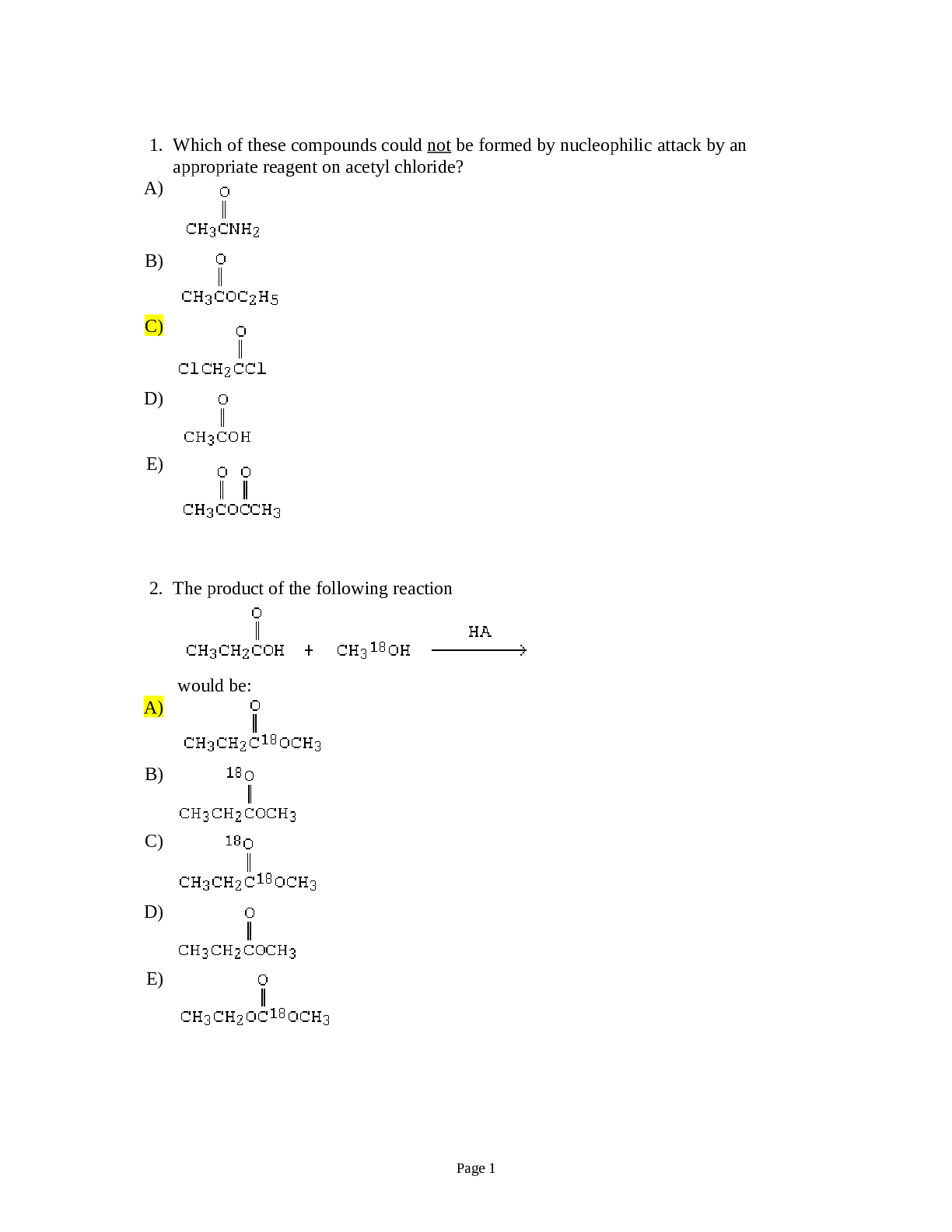
.png)