Pediatric Proctor (2016) (70/70 Questions)
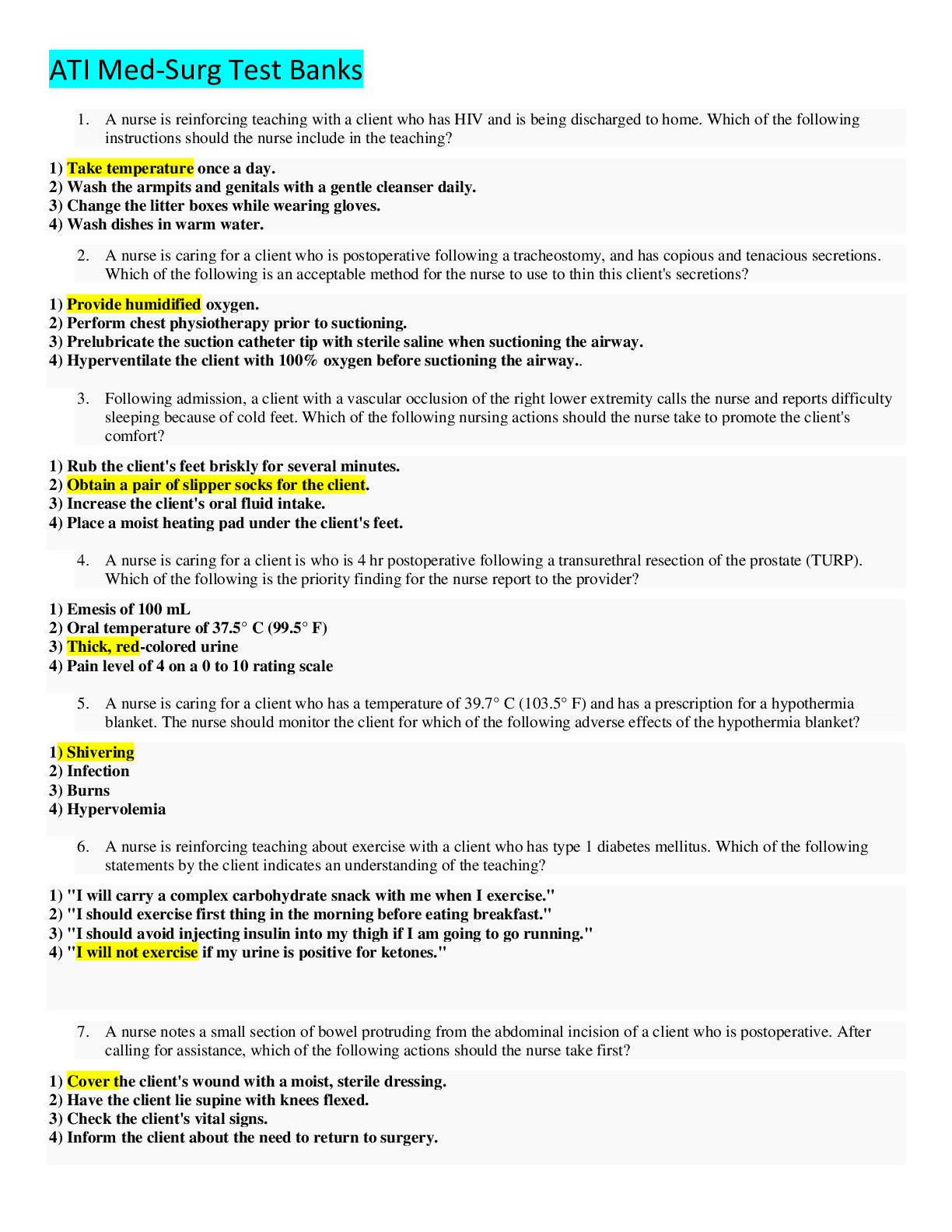
1. A nurse is preparing to assess a 4-year old child’s visual acuity. Which of the following
actions should the nurse plan first?
Use a tumbling E chart for the assessment
...
Pediatric Proctor (2016) (70/70 Questions)
1. A nurse is preparing to assess a 4-year old child’s visual acuity. Which of the following
actions should the nurse plan first?
Use a tumbling E chart for the assessment
Position the child 4.6 meters (15 feet) from the chart
Assess both eyes together first, then each eye separately
Test the child without glasses before testing with glasses
2. A nurse is providing discharge teaching to a parent of a child who has juvenile idiopathic
arthritis and a new prescription of prednisone/etarnecept. Which of the following
statement should the nurse include in the teaching?
“Discontinue this medication if gastrointestinal upset occurs.”
“Expect that this medication will stimulate a growth spurt.”
“Limit your child’s intake of potassium-rich foods.”
“Monitor your child for indications of infection.”
3. A nurse on a pediatric unit is caring for four children. The nurse should use droplet
precautions for which of the following children?
An adolescent who has hepatitis A
A toddler who has seasonal influenza
A preschool-age child who has pediculosis capitis
A school-age child who has viral conjunctivitis
4. A nurse is providing teaching to an adolescent who has vulvovaginitis. Which of the
following statements should the nurse include in the teaching?
“Apply a warm, moist compress three times per day.”
“Apply scented baby powder to absorb residual moisture.”
“Wear a feminine deodorant pad for vaginal drainage.”
“Wear nylon underwear at night.”
5. A nurse is creating a plan of care for a school-age child who has nephrotic syndrome.
Which of the following interventions should the nurse include? (Select all that apply)
Provide a low-sodium diet
Encourage increased fluid intake
Assess for protein in the urine
Initiate contact precautions
Obtain a daily weight
6. A nurse in a pediatric unit is caring for a school-age child following a cardiac
catheterization. Which of the following interventions would the nurse take? Maintain NPO status for 24 hrs. following the procedure
Administer meperidine for pain every 4 hrs.
Perform a sterile dressing change 8 hrs. after the procedure
Keep the affected extremity straight for 6 hrs.
7. A nurse is teaching a parent of a toddler about administering digoxin. Which of the
following statements by the parent indicates understanding of the teaching?
“I should mix the medication with 4 ounces of my child’s favorite juice.”
“I should give my child water after giving the medication.”
“I should give my child another dose if he vomits right after taking the
medication.”
“I should give the medication with foods that are high in fiber.”
8. A nurse is caring for a 9-year-old child who has major burns to her face and upper torso.
Which of the following actions should the nurse take first?
Administer a tetanus vaccine
Give pain medication
Begin enteral feedings
Initiate a crystalloid IV bolus
9. A nurse is planning care for a toddler who has developed oral ulcers in response to
chemotherapy. Which of the following should the nurse include in the plan of care?
Schedule routine oral care every 8 hrs.
Administer oral viscous lidocaine
Moisten the mucous with lemon glycerin swabs
Cleanse the gums with saline soaked gauze
10. A nurse in a community health clinic is assessing the needs of a single parent who has
three young children and works full time. Which of the following resources should the
nurse recommend?
12-step support group
Respite child care
Child home health care
Counseling for depression
11. A nurse is caring for a child who has a prescription for fluticasone and has developed
white patches and sores in his mouth. Which of the following is an appropriate action for
the nurse to take?
Encourage the use of a spacer
Withhold the medication until the lesions heal Obtain a prescription for oral prednisone
Collect a culture from the lesions
12. A nurse is providing teaching to the parents of a child who has impetigo. Which of the
following instructions should the nurse include in the teaching?
Seal soft toys in a plastic bag for 14 days
Apply bactericidal ointment to lesions
Administer acyclovir PO two times per day
Soak hairbrushes in boiling water for 10 min.
13. A nurse in an emergency department is caring for a child who has epiglottis. Which of the
following actions should the nurse take?
Provide nebulizer aerosol therapy
Administer IV antibiotics
Inspect the tonsils using a tongue depressor
Collect a throat culture
14. A nurse is planning care for a child who is placed in skin traction. Which of the following
is the priority action for the nurse to take?
Increase fluid intake
Maintain proper body alignment
Use an alternate pressure mattress
Monitor pedal pulses
15. A nurse is preparing to administer ondansetron 0.15 mg/kg IV to a child who is receiving
chemotherapy and weighs 29.4 kg. Available is ondansetron 4 mg/2 mL solution. How
many mL should the nurse administer? (Round the answer to the nearest tenth. Use a
leading zero if it applies. Do not use a trailing zero)
Answer: 2.2 mL
16. A nurse is performing a physical assessment of a school-age child who has acute
glomerulonephritis. Which of the following findings should the nurse expect?
Hypotension
Increased urinary output
Flushed skin
Facial edema
17. A nurse in an emergency department is assessing an adolescent who reports inhalation of
gasoline. Which of the following findings should the nurse expect?
Hypothermia
Pinpoint pupils
Hyperactive reflexes
Ataxia18. A nurse in the emergency department is assessing a toddler who has hyperpyrexia, severe
dyspnea, and is drooling. Which of the following actions should the nurse take first?
Prepare the toddler for nasotracheal intubation
Insert an IV catheter for the toddler
Obtain a blood culture from the toddler
Administer an antibiotic to the toddler
19. A nurse is caring for an infant who has a patent ductus arteriosus. The nurse should
identify that the defect is at which of the following locations of the heart? (You will find
hot spots to select in the artwork below. Select only the hot spot that corresponds to your
assessment)
Answer:
20. A nurse is caring for an infant who has hydrocephalus and ventriculoperitoneal shunt
malfunction. Which of the following assessment findings indicates that the infant is
experiencing increased intracranial pressure?
Increased appetite
Irritability
Flat fontanel
Tachycardia
21. A nurse is assessing an infant who has iron deficiency anemia. Which of the following
findings should the nurse expect?
Increased hemoglobin level
Hyperactive muscle tone
Bradycardia
Pale conjunctiva
22. A nurse is caring for a child who received partial thickness burns to over 50% of his body
10 days ago and has splints over his joints to prevent contractions. Which of the
following actions should the nurse take? (Select all that apply)
Provide a high-calorie diet
Administer analgesics IM
Remove splints during sleep
Change dressings using aseptic technique
Monitor intake and output23. A school nurse is assessing a 7-year-old student. The nurse should identify which of the
following findings as a potential indicator of physical abuse?
Bruising around the wrists
Abrasions on the knees
Weight in 45th percentile
Front deciduous teeth missing
24. A nurse is assessing an 18-month-old child during a well-child visit. Which of the
following findings should the nurse report to the provider?
The child crawls to navigate the room
The child has frequent temper tantrums
The child consistently throws items to the floor
The child scribbles on the wall with a crayon
25. A nurse is caring for an infant who has rotavirus. Which of the following findings
indicates that the infant is inadequately dehydrated?
Weight loss 7%
Capillary refill 1 second
Bradycardia
Respiratory rate 26/min
26. A nurse is providing teaching about injury prevention to the parents of a toddler. Which
of the following safety measures should the nurse include in the teaching?
Adjust the water heater temperature to 54° C (129.2° F)
Check clothing for loose buttons
Provide balloons for play
Place screens on all windows
27. A nurse is caring for a school-age child who is in 90°/90° skeletal traction. Which of the
following actions should the nurse take?
Release the traction to allow the child to bathe
Place the child on an alternating pressure mattress
Adjust the weights to allow the child to turn
Ensure that the pulley mechanism is attached to the skin
28. A nurse is caring for a child who has increased intracranial pressure and is unconscious
due to a closed head injury. Which of the following actions should the nurse take?
Maintain the child’s neck in a flexed position
Turn the child side to side every 2 hrs. Initiate seizure precautions
Perform chest percussion as needed
29. A nurse is providing teaching to the parents of a school-age child newly diagnosed with a
seizure disorder. The nurse should teach the parents to take which of the following
actions during a seizure?
Clear the area of hard objects
Minimize movement of the limbs
Insert a tongue blade between the teeth
Place the child in a prone position
30. A nurse is providing teaching to a parent of an infant who has diaper rash. Which of the
following statements by the parent indicates an understanding of the teaching?
“I will use antibacterial soap to wash the rash with each diaper change.”
“I will keep the area warm and moist.”
“I will use super-absorbent disposable diapers.”
“I will sprinkle talcum powder over the affected area twice daily.”
31. A nurse in a provider’s office is assessing the vital signs of a 1-year-old toddler. Which of
the following findings should the nurse report to the provider?
Blood pressure 88/42 mm Hg
Heart rate 110/min.
Respiratory rate 54/min.
Temperature 37.7° C (99.9° F)
32. A nurse is teaching about growth and development to a parent of a 12-year-old child. The
nurse should instruct the parent to expect the child to exhibit which of the following
characteristics during early adolescence?
Emotional separation from parents
Mood swings
Increased self-esteem
Decelerating growth rate
33. A nurse is caring for a child who is 2 hrs. postoperative. Which of the following actions
should the nurse take first? (Click the “exhibit” button for additional information about
the client. There are three tabs that contain separate categories of data)
Recheck the child’s temperature
Determine the child’s sedation level
Assess the child’s pain level Compare the child’s pedal pulses
34. A nurse is assessing an adolescent who has Cushing’s syndrome. Which of the following
findings should the nurse expect?
Potassium 4.2 mEq/L
Blood glucose 320 mg/dL
Advanced bone age
Cachectic appearance
35. A nurse is caring for a preschool-age child who is 2 hrs. postoperative following a
tonsillectomy and adenoidectomy. Which of the following manifestations should the
nurse report to the provider?
Tachycardia
Blood-tinged mucus
Dark brown emesis
Halitosis
36. A nurse is assessing a 6-month old infant who has respiratory syncytial virus. The nurse
should immediately report which of the findings to the provider?
Coughing
Tachypnea
Pharyngitis
Rhinorrhea
37. A nurse is admitting an infant who has GERD. Which of the following is the priority
assessment finding?
Weight loss
Excessive crying
Wheezing
Regurgitation
38. A nurse is planning care for a child who is experiencing sickle cell crisis. Which of the
following interventions should the nurse include in the plan of care?
Administer meperidine as needed for pain
Initiate bed rest
Limit fluid intake
Apply cold compresses to affected joints39. A nurse is providing teaching to a parent of a child who has cystic fibrosis and a new
prescription for dornase alfa. Which of the following instructions should the nurse
include in the teaching?
“Store the medication in the refrigerator.”
“Use a spacer with this medication.”
“Administer every 4 hours as needed for cough.”
“Mix the medication with albuterol solution prior to administration.”
40. A nurse is caring for a preschool-age child who has a terminal illness. Which of the
following findings should the nurse expect?
Believes the condition is a punishment
Expresses interests in the funeral arrangements
Accepts death is inevitable
Feels excessive anxiety about physical changes
41. A nurse is reviewing the laboratory values of a school-age child who has nephrotic
syndrome. Which of the following laboratory results should the nurse expect?
Serum sodium 144 mg/dL
Serum protein 4.2 g/dL
Hgb 12 g/dL
BUN 15 mg/dL
42. A nurse is planning care for a school-age child who has autism spectrum disorder. Which
of the following actions should the nurse include in the plan?
Give the child three options when making choices
Stay with the child for long periods of time
Explain procedures in detail to the child
Introduce the child to new situations slowly
43. A nurse is preparing to administer morphine 0.2 mg/kg IV to a child who is postoperative
and in pain. The child weighs 34 kg. Available is morphine 1 mg/mL solution. How many
mL should the nurse administer? (round the answer to the nearest tenth. Use a leading
zero if it applies. Do not use a trailing zero)
Answer: 6.8 mL
44. A nurse is providing teaching to a parent of an 11-month-old infant who has acute
diarrhea and dehydration. Which of the following fluids should the nurse instruct the
parent to provide to the infant?
Chicken broth
Oral electrolyte solution
Glucose water
Half-strength apple juice45. A nurse is providing teaching to a parent of a child who has HIV. Which of the following
statements by the parent indicates an understanding of the teaching?
“The risk of transmission decreases since my child is on zidovudine for 2 weeks.”
“My child will need to repeat his childhood immunizations since he is in
remission.”
“My child will need to double his medications for the next 6 months.”
“I will ensure that my child is tested for tuberculosis every year.”
46. A nurse is caring for a school-age child who has diabetes mellitus. Which of the
following findings should the nurse recognize as being consistent with hyperglycemia?
Pallor
Thirst
Sweating
Tremors
47. A nurse in an urgent care clinic is prioritizing care for four children. Which of the
following children should the nurse assess first?
A preschool-age child who has a muffled voice and no spontaneous cough
An adolescent who has Crohn’s disease and a recent weight loss of 5 kg (11 lbs.)
A toddler who has nephrotic syndrome and facial edema
A school-age child who has diabetes mellitus and a blood glucose of 200 mg/dL
48. A nurse is prioritizing care for four clients. Which of the following clients should the
nurse assess first?
An adolescent who has sickle cell anemia and slurred speech
A toddler who has a new diagnosis of osteomyelitis and is to receive an IV bolus
of nafcillin
An adolescent who is in skin traction and reports a pain level of 7 on a scale from
0 to 10
A toddler who has a partial-thickness burn on his right hand and requires a
dressing change
49. A nurse is preparing to administer immunizations to a 3-month-old infant. Which of the
following is an appropriate method to take to deliver atraumatic care?
Use a 20-gauge needle for the injections
Apply eutectic mixture of local anesthetics (EMLA) cream immediately before
the injections
Inject the immunizations into the deltoid muscle
Provide a pacifier coated with an oral sucrose solution prior to the injections50. A nurse is reviewing the laboratory results of a child who was recently admitted for
suspected rheumatic fever. The nurse should expect that which of the following
laboratory tests can contribute to confirming this diagnosis? (Select all that apply)
Antistreptolysin O (ASO) titer
Blood urea nitrogen (BUN)
Partial thromboplastin (PTT)
Erythrocyte sedimentation rate (ESR)
C-reactive protein (CRP)
51. A nurse is reviewing the laboratory report of a school-age child who has bacterial
pneumonia. Which of the following laboratory values should the nurse expect?
WBC 18,000/mm3
Ph. 7.40
Hgb 14 g/dL
Creatinine 0.5 mg/dL
52. A nurse is providing teaching about medication administration to the parents of a toddler
who has a new prescription for liquid ferrous sulfate. Which of the following instructions
should the nurse include in the teaching?
“Report tarry, green stools to the provider.”
“Administer the drops with milk.”
“Dilute the drops with water prior to administration.”
“Provide an antacid prior to administration.”
53. A nurse in an emergency department is caring for a child following an overdose of
acetylsalicylic acid. Which of the following medications should the nurse plan to
administer?
Flumazenil
Phytonadione
Midazolam
Naloxone
54. A nurse is planning care for a newly admitted child who has rotavirus. Which of the
following precautions should be implemented?
Airborne
Contact
Protective
Droplet
55. A nurse is developing a plan of care for a child who is dying. Which of the following
measures should the nurse implement to the child and his family?
Maintain consistent nursing staff assignments Ask the parents to leave the room for procedures
Select one family member to receive information
Limit the number of visitors in the client’s room
56. A nurse is planning to perform tracheostomy care for a toddler. Which of the following is
an appropriate action for the nurse to take?
Have the client flex his head when securing the ties
Place the child in Trendelenburg position when performing care
Clean around the stoma with full-strength hydrogen peroxide
Use clean technique to change the tracheostomy tube
57. A nurse in the emergency department is caring for a child who has a temperature of 39.1°
C (102.4° F) and a suspected diagnosis of bacterial meningitis. Which of the following
actions should the nurse take first?
Prepare the child for a lumbar puncture
Administer an antipyretic to the child
Dim the lights in the child’s room
Implement droplet precautions for the child
58. A nurse is caring for a toddler who has a short leg cast. Which of the following findings
should the nurse report to the provider?
Positive pedal pulse in the distal extremity
Pallor of the distal extremity
Mobility of the distal extremity
Warm temperature of the distal extremity
59. A nurse is caring for a newly admitted toddler who has acute diarrhea. Which of the
following actions should the nurse take first?
Initiate contact precautions
Administer an antibiotic
Obtain a stool specimen for culture
Give 0.9% sodium chloride IV bolus
60. A nurse is planning to teach an adolescent who is lactose intolerant about dietary
guidelines. Which of the following instructions should the nurse include in the teaching?
“You may tolerate plain milk better than chocolate milk.”
“You can drink milk on an empty stomach.”
“You can replace milk with nondairy sources of calcium.”
“You should consume flavored yogurt instead of plain yogurt.”61. A nurse is providing discharge teaching to the parents of a school-age child following
placement of a ventriculoperitoneal shunt. The nurse should determine that the teaching
was effective when the parents identify which of the following as an indicator the shunt
has been displaced?
Hyperactive bowel sounds
Elevated temperature
Increased sleeping
Decreased urine output
62. A nurse is providing teaching to a parent of a 2-month-old infant about immunization
schedules. Which of the following statements by the parent indicates an understanding of
the teaching?
“My child needs to get the MMR immunization when she’s 12 months old.”
“My child needs to get the varicella immunization when she’s 6 months old.”
“My child will receive the influenza immunization today.”
“My child will receive the hepatitis A immunization today.”
63. A nurse is performing a cranial nerve assessment on a school-age child. Which of the
following findings indicates proper functioning of the child’s trigeminal nerve?
The child maintains balance when standing with eyes closed
The child has symmetrical jaw strength when biting down
The child exhibits a gag reflex when stimulated with a tongue blade
The child correctly identifies specific scents
64. A nurse is planning care for a child immediately following the insertion of a chest tube
for continuous suction with a closed drainage system. Which of the following
interventions should the nurse include in the plan of care?
Ensure continuous bubbling is present in the suction control chamber
Report the presence of tiddling of fluid in the water seal chamber
Change the chest tube insertion site dressing every 12 hrs.
Record the amount of chest tube drainage every 2 hrs.
65. A nurse is educating an adolescent following the application of an arm cast. Which of the
following statements by the client indicates an understanding of the teaching?
“I will sprinkle baby powder into the cast if my arm itches.”
“I should limit the use of the fingers of my broken arm.”
“I will elevate my forearm on pillows at night.”
“I should expect my fingers to be swollen for several days.”66. A nurse in a community center is providing an in-service for parents about nutritional
guidelines. Which of the following guidelines should the nurse include in the teaching?
Encourage a 15-year-old to increase calcium intake
Provide 36 oz. of milk per day to a toddler
Offer 8 to 10 oz. of juice per day to a preschooler
Introduce popcorn as a healthy snack at 12 months of age
67. A nurse is caring for a school-age child who is experiencing pain. Which of the following
assessment teachings would be the most accurate information regarding the child’s pain?
Ask the child to use a FACES rating scale
Monitor the child’s involuntary movements
Observe the child’s facial expressions
Assess the child’s pulse and respirations
68. A nurse in an emergency department is assessing a school-age child who has asthma.
Which of the following should the nurse identify as the priority?
Decreased breath sounds
Hyperresonance on percussion
Nonproductive cough
Pulse rate 118/min
69. A nurse is caring for a child who is postoperative following surgical correction of
tetralogy of Fallot. Which of the following is a manifestation of heart failure?
Exercise intolerance
Bradycardia
Weight loss
Decreased respirations
70. A nurse is caring for a 4-year-old child who has meningitis and is receiving gentamycin.
Which of the following laboratory results should the nurse report to the provider?
Creatinine 1.4 mg/dL
BUN 12 mg/dL
BUN 6 mg/dL
Creatinine 0.2 mg/dL
[Show More]