*NURSING > EXAM REVIEW > Exam overview for patho Unit 1 (All)
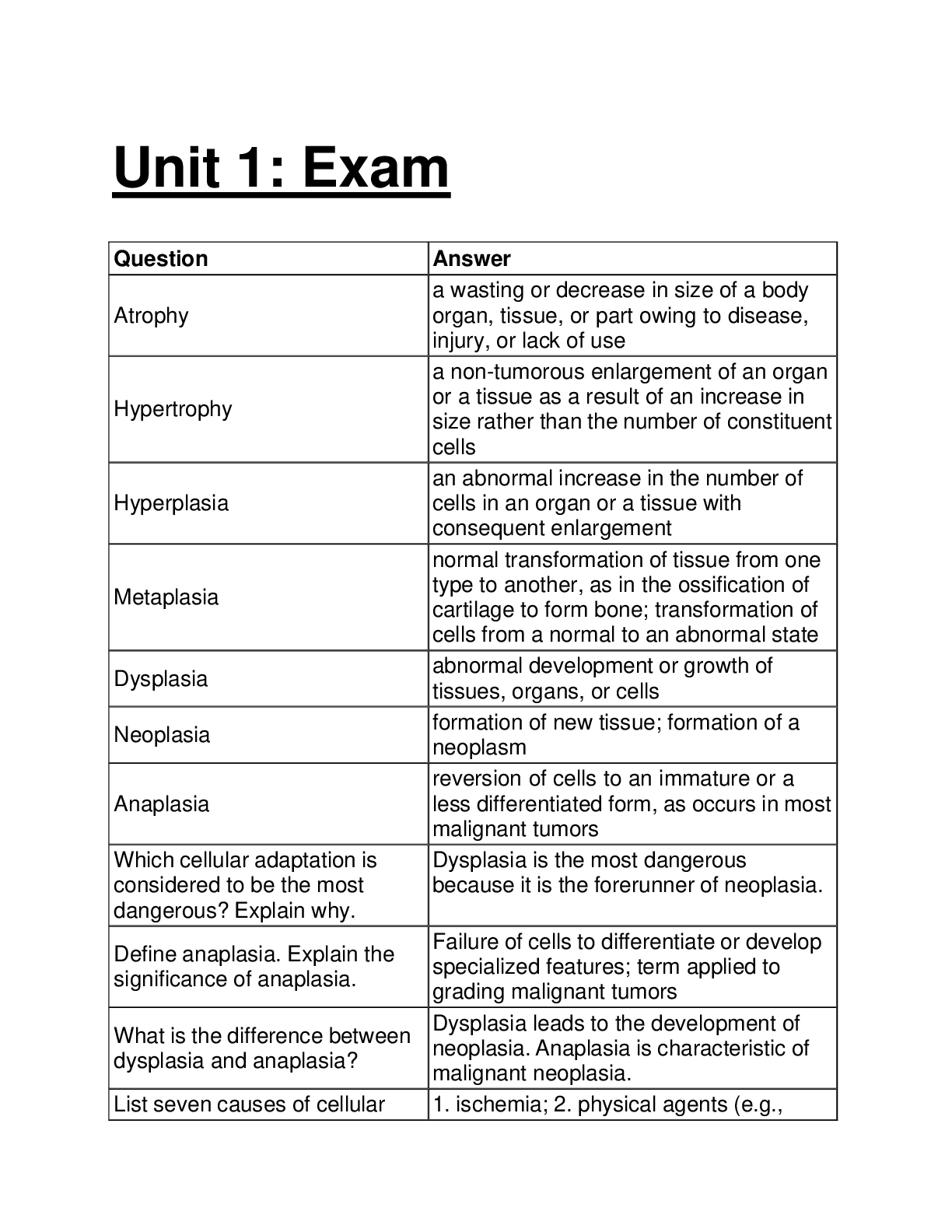
Unit 1: Exam Question Answer Atrophy a wasting or decrease in size of a body organ, tissue, or part owing to disease, injury, or lack of use Hypertrophy a non-tumorous enlargement of an org ... an or a tissue as a result of an increase in size rather than the number of constituent cells Hyperplasia an abnormal increase in the number of cells in an organ or a tissue with consequent enlargement Metaplasia normal transformation of tissue from one type to another, as in the ossification of cartilage to form bone; transformation of cells from a normal to an abnormal state Dysplasia abnormal development or growth of tissues, organs, or cells Neoplasia formation of new tissue; formation of a neoplasm Anaplasia reversion of cells to an immature or a less differentiated form, as occurs in most malignant tumors Which cellular adaptation is considered to be the most dangerous? Explain why. Dysplasia is the most dangerous because it is the forerunner of neoplasia. Define anaplasia. Explain the significance of anaplasia. Failure of cells to differentiate or develop specialized features; term applied to grading malignant tumors What is the difference between dysplasia and anaplasia? Dysplasia leads to the development of neoplasia. Anaplasia is characteristic of malignant neoplasia. List seven causes of cellular 1. ischemia; 2. physical agents (e.g., damage excessive temperature, radiation); 3. mechanical damage; 4. chemical toxins or foreign substances; 5. pathogens; 6. abnormal metabolites; 7. nutritional deficits or fluid or electrolyte imbalances Symptom a subjective indication of disease that can be known with certainty only by the affected person, such as blurry vision or headache Exacerbation an increase in the severity of disease Precipitation the triggering of an acute episode of a disease Incidence the number of new cases of a disease that appear in a population over a given time period Acute a short-term illness that develops very quickly with marked signs such as high fever or severe pain Idiopathic a disease that is of uncertain or unknown origin or cause Mortality the rate of death from a particular disease in a population Necrosis When a group of cells die; the process of cell death varies with the cause of the damage Sign an objective indication of disease that can be seen by any trained observer, such as a fever or skin lesion Exogenous originating from outside the body .................................................................Continued................................... [Show More]
Last updated: 3 years ago
Preview 1 out of 27 pages
Buy this document to get the full access instantly
Instant Download Access after purchase
Buy NowInstant download
We Accept:
Can't find what you want? Try our AI powered Search
Connected school, study & course
About the document
Uploaded On
Apr 08, 2021
Number of pages
27
Written in
All
This document has been written for:
Uploaded
Apr 08, 2021
Downloads
0
Views
65
Scholarfriends.com Online Platform by Browsegrades Inc. 651N South Broad St, Middletown DE. United States.
We're available through e-mail, Twitter, and live chat.
FAQ
Questions? Leave a message!
Copyright © Scholarfriends · High quality services·