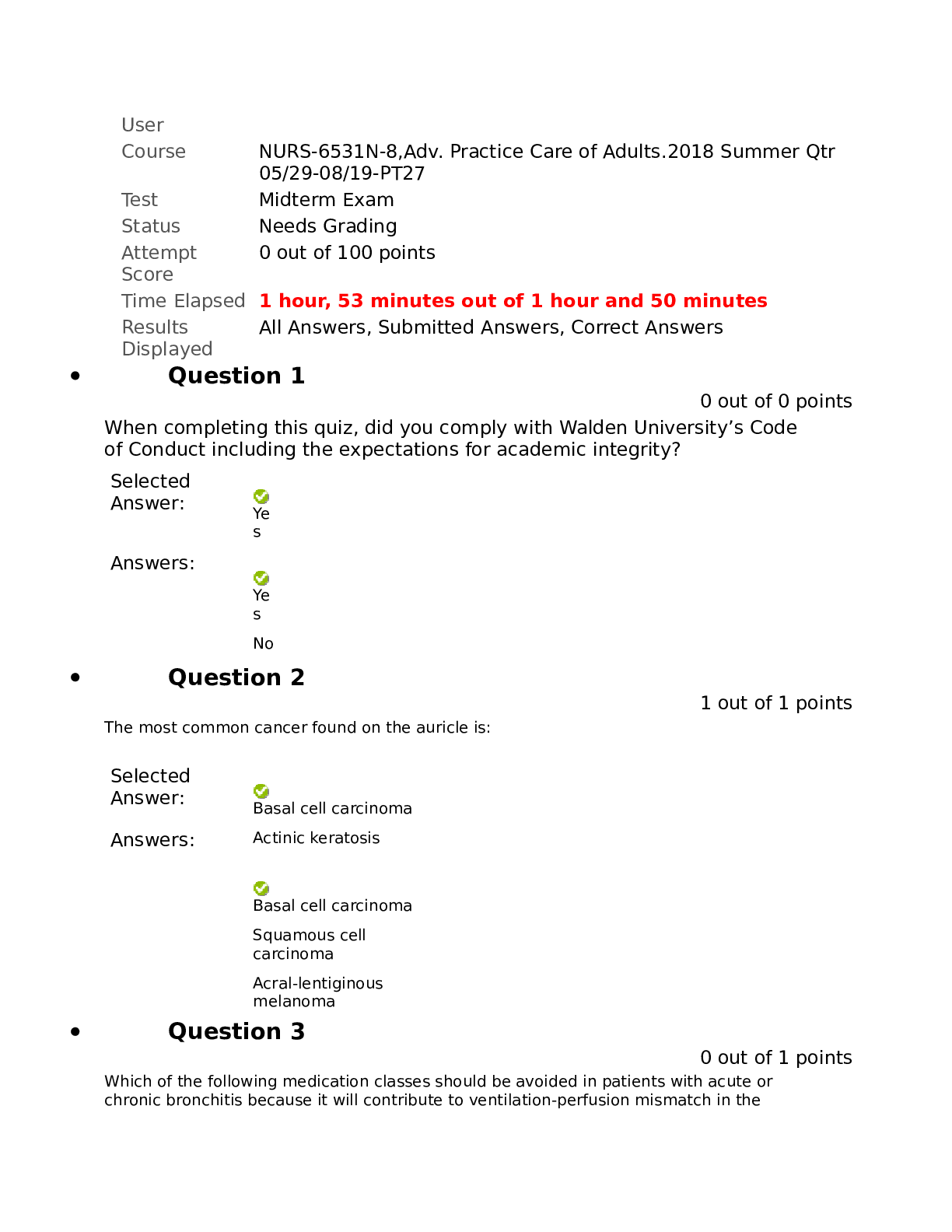
User
Course NURS-6531N-8,Adv. Practice Care of Adults.2018 Summer Qtr 05/29-08/19-PT27
Test Midterm Exam
Status Needs Grading
Attempt Score
0 out of 100 points
Time Elapsed 1 hour, 53 minutes out of 1 hour
...
User
Course NURS-6531N-8,Adv. Practice Care of Adults.2018 Summer Qtr 05/29-08/19-PT27
Test Midterm Exam
Status Needs Grading
Attempt Score
0 out of 100 points
Time Elapsed 1 hour, 53 minutes out of 1 hour and 50 minutes
Results Displayed
All Answers, Submitted Answers, Correct Answers
• Question 1
0 out of 0 points
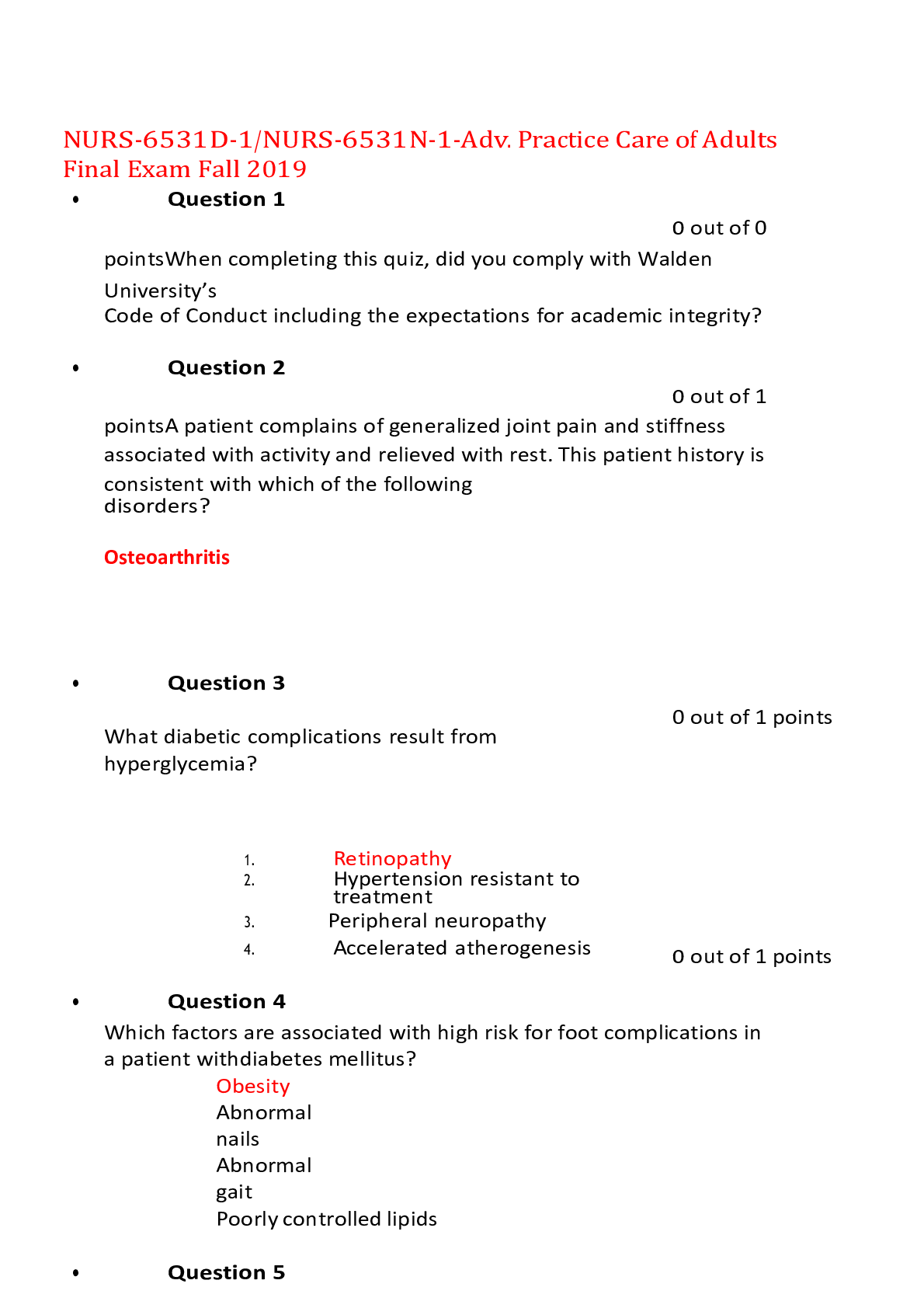
When completing this quiz, did you comply with Walden University’s Code of Conduct including the expectations for academic integrity?
Selected Answer: Ye
s
Answers:
Ye s
No
• Question 2
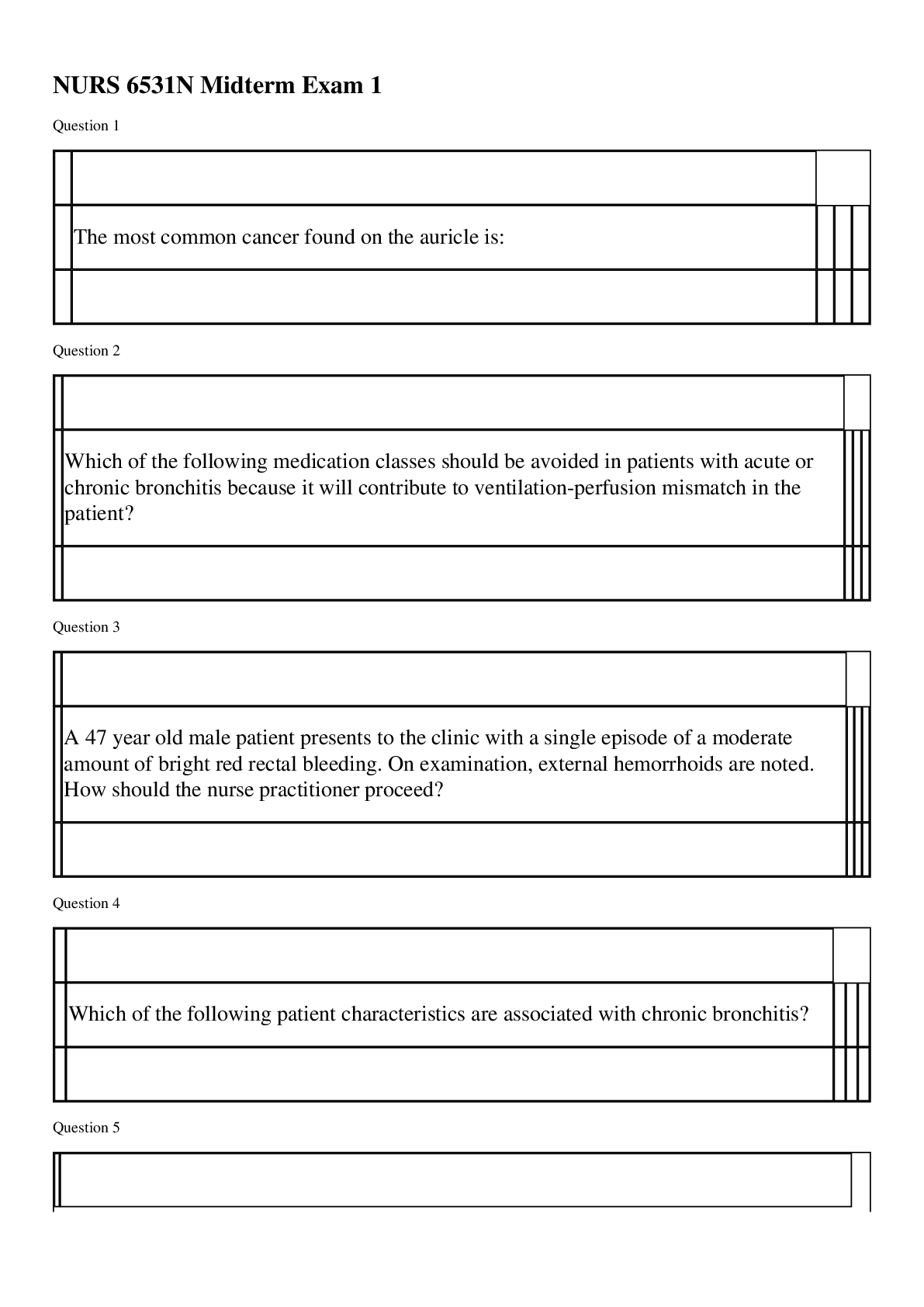
The most common cancer found on the auricle is:
Selected
Answer: Basal cell carcinoma
Answers: Actinic keratosis
Basal cell carcinoma
Squamous cell carcinoma
Acral-lentiginous melanoma
• Question 3
1 out of 1 points
0 out of 1 points
Which of the following medication classes should be avoided in patients with acute or chronic bronchitis because it will contribute to ventilation-perfusion mismatch in the
patient?
Selected
Answer: Anticholinerg ics
Answers: Xanthines
Antihistimine
s Steroids
Anticholinerg ics
• Question 4
0 out of 1 points
A 47 year old male patient presents to the clinic with a single episode of a moderate amount of bright red rectal bleeding. On examination, external hemorrhoids are noted. How should the nurse practitioner proceed?
Selected
Answer: Instruct the patient on measures to prevent hemorrhoids such as bowel habits and diet.
Answers: Instruct the patient on measures to prevent hemorrhoids such as bowel habits and diet.
Order a topical hemorrhoid cream along with a stool softener.
Refer the patient for a barium enema and sigmoidoscopy.
Refer the patient for a surgical hemorrhoidectomy.
• Question 5
0 out of 1 points
Which of the following patient characteristics are associated with chronic bronchitis?
Selected
Answer: Underweight, pink skin, and increased respiratory rate
Answers:
Overweight, cyanosis, and normal or slightly increased respiratory rate
Underweight, pink skin, and increased respiratory rate
Overweight, pink skin, and normal or slightly increased respiratory rate
Normal weight, cyanosis, and greatly increased respiratory rate
• Question 6
1 out of 1 points
A 65-year-old female with a past medical history of hypertension, hyperlipidemia, and polymyalgia rheumatica presents to urgent care with new onset left lower quadrant pain. Her current medications include omeprazole 20 milligrams po daily, lisinopril 20 milligrams po daily, simvastatin 20 milligrams po daily, and prednisone 12 milligrams po daily. The nurse practitioner suspects acute diverticulitis and possibly an abscess. The most appropriate diagnostic test for this patient at this time is:
Selected
Answer: CT scan
Answers: CBC/diff
Erythrocyte sedimentation rate
Abdominal ultrasound
CT scan
• Question 7
1 out of 1 points
A patient reports “something flew in my eye” about an hour ago while he was splitting logs. If there were a foreign body in his eye, the nurse practitioner would expect to find all except:
Selected
Answer: Purulent drainage
Answers:
Purulent drainage
Tearing Photophobia
A positive fluorescein stain
• Question 8
1 out of 1 points
A 21 year old college student presents to the student health center with copious, markedly purulent discharge from her left eye. The nurse practitioner student should suspect:
Selected
Answer: Gonococcal conjunctivitis
Answers: Viral conjunctivitis Common pink eye
Gonococcal conjunctivitis
Allergic conjunctivitis
• Question 9
0 out of 1 points
A 35 year old man presents with radicular pain followed by the appearance of grouped vesicles consisting of about 15 lesions across 3 different thoracic dermatomes. He complains of pain, burning, and itching. The nurse practitioner should suspect:
Selected
Answer: A complicated case of shingles and prescribe acyclovir, an analgesic, and a topical cortisone cream
Answers: A common case of shingles and prescribe an analgesic and an antiviral agent
A complicated case of shingles and prescribe acyclovir, an analgesic, and a topical cortisone cream
Herpes zoster and consider that this patient may be immunocompromised
A recurrence of chickenpox and treat the patient’s symptoms
• Question 10
Which type of lung cancer has the poorest prognosis?
Selected
Answer: Adenocarcinoma
Answers: Adenocarcinoma
Epidermoid carcinoma
Small cell carcinoma
Large cell carcinoma
• Question 11
0 out of 1 points
1 out of 1 points
An 83-year-old female presents to the office complaining of diarrhea for several days. She explains she has even had fecal incontinence one time. She describes loose stools 3– 4 times a day for several weeks and denies fever, chills, pain, recent antibiotic use. The history suggests that the patient has:
Selected
Answer: Chronic diarrhea
Answers: Acute diarrhea
Chronic diarrhea Irritable bowel
Functional bowel disease
• Question 12
1 out of 1 points
Margaret, age 32, comes into the office with painful joints and a distinctive rash in a butterfly distribution on her face. The rash has red papules and plaques with a fine scale. What do you suspect?
Selected
Answer: Systemic lupus erythematosus
Answers: An allergic reaction
Relapsing polychondritis
Lymphocytoma cutis
Systemic lupus
erythematosus
• Question 13
1 out of 1 points
Antibiotic administration has been demonstrated to be of little benefit to the treatment of which of the following disease processes?
Selected
Answer: Acute bronchitis
Answers: Chronic sinusitis
Acute bronchitis Bacterial pneumonia
Acute exacerbation of chronic
bronchitis
• Question 14
0 out of 1 points
Lisa, age 49, has daily symptoms of asthma. She uses her inhaled short-acting beta-2 agonist daily. Her exacerbations affect her activities and they occur at least twice weekly and may last for days. She is affected more than once weekly during the night with an exacerbation. Which category of asthma severity is Lisa in?
Selected
Answer: Mild persistent
Answers: Mild intermittent
Mild persistent
Moderate
persistent
• Question 15
0 out of 1 points
Which of the following is the most appropriate therapeutic regimen for an adult patient with no known allergies diagnosed with group A B-hemolytic strep?
Selected
Answer: None of the above
Answers:
Penicillin V 500 milligrams PO every 8 hours for 10 days
Ampicillin 250 milligrams PO twice a day for 10 days
Clarithromycin 500 milligrams po daily for 7 days
None of the above
• Question 16
0 out of 1 points
A cashier complains of dull ache and pressure sensation in her lower legs. It is relieved by leg elevation. She occasionally has edema in her lower legs at the end of the day. What is the most likely cause of these problems?
Selected
Answer: Arterial
insufficiency
Answers: Congestive heart failure
Varicose veins
Deep vein thrombosis
Arterial insufficiency
• Question 17
Which statement below is correct about pertussis?
Selected
Answer: It is also called whooping cough
1 out of 1 points
Answers:
It is also called whooping cough
It begins with symptoms like strep throat It lasts about 3 weeks
It occurs most commonly in toddlers and young children
• Question 18
0 out of 1 points
Which of the following is the most important diagnosis to rule out in the adult patient with acute bronchitis?
Selected
Answer: Asthma
Answers:
Pneumo nia
Asthma
Sinusitis
Pertussis
• Question 19
1 out of 1 points
A 70 year old patient presents with left lower quadrant (LLQ) abdominal pain, a markedly tender palpable abdominal wall, fever, and leukocytosis. Of the following terms, which correctly describes the suspected condition?
Selected
Answer: Diverticulit is
Answers: Diverticulo sis
Diverticula
Diverticulit is
Diverticulu m
• Question 20
1 out of 1 points
Sylvia, age 83, presents with a 3 day history of pain and burning in the left forehead. This morning she noticed a rash with erythematous papules in that site. What do you suspect?
Selected
Answer: Herpes zoster
Answers: Varicella
Herpes zoster
Syphilis Rubella
• Question 21
0 out of 1 points
A 33-year-old female is admitted with acute pancreatitis. The nurse practitioner knows that the most common cause of pancreatitis is:
Selected
Answer: Medicatio ns
Answers: Alcohol
Gallstone s
Medicatio ns
Pregnanc y
• Question 22
1 out of 1 points
When a patient presents with symptoms of acute gallbladder disease, what is the appropriate nurse practitioner action?
Selected
Answer: Order an abdominal ultrasound
Answers: Order abdominal x-rays
Order an abdominal ultrasound
Refer the patient to a surgeon for evaluation
Prescribe pain medication
• Question 23
A false-positive result with the fecal occult blood test can result from:
0 out of 1 points
Selected
Answer: stool that has been stored
before testing
Answers: ingestion of large amounts of vitamin C
a high dietary intake of rare cooked beef
a colonic neoplasm that is not bleeding
stool that has been stored before testing
• Question 24
0 out of 1 points
A 76-year-old male complains of weight loss, nausea, vomiting, abdominal cramping and pain. Physical findings include an abdominal mass and stool positive for occult blood. The nurse practitioner pain suspects a tumor in the small intestine. The best diagnostic test for this patient is:
Selected
Answer: Colonoscopy
Answers: Colonoscopy
Small bowel follow- through
Barium enema
CT abdomen
• Question 25
1 out of 1 points
A patient presents to urgent care complaining of dyspnea, fatigue, and lower extremity edema. The echocardiogram reveals and ejection fraction of 38%. The nurse practitioner knows that these findings are consistent with:
Selected
Answer: Systolic heart failure
Answers: Mitral regurgitation
Systolic heart failure
Cardiac myxoma
Diastolic heart failure
• Question 26
1 out of 1 points
Maxine, Age 76, has just been given a diagnosis of pneumonia. Which of the following is an indication that she should be hospitalized?
Selected
Answer: Multilobar involvement on chest x-ray with the inability to take oral medications
Answers:
Multilobar involvement on chest x-ray with the inability to take oral medications
Alert and oriented, slightly high but stable vital signs, and no one to take care of her at home
Sputum and gram positive organisms
A complete blood count showing leukocytosis
• Question 27
0 out of 1 points
A 55 year old man is diagnosed with basal cell carcinoma. The nurse practitioner correctly tells him:
Selected Answer:
“It is the most common cause of death in patients with skin cancer.”
Answers: “It is the most common cause of death in patients with skin cancer.”
“It can be cured with surgical excision or radiation therapy.”
“It is a slow growing skin cancer that rarely undergoes malignant changes.”
“It can be cured using 5-flurouracil cream twice daily for 2 to 4 weeks.”
• Question 28
1 out of 1 points
Expected spirometry readings when the patient has chronic emphysema include:
Selected
Answer: Increased total lung capacity (TLC)
Answers: Decreased residual volume (RV)
Increased vital capacity (VC)
Increased forced expiratory volume (FEV-1)
Increased total lung capacity (TLC)
• Question 29
1 out of 1 points
An 80-year-old male admits to difficulty swallowing during the review of systems. The nurse practitioner recognizes the differential diagnosis for this patient’s dysphagia is:
Selected
Answer: A and C
Answers: Esophageal cancer
Chest pain GERD
A and C
All of the above
• Question 30
0 out of 1 points
A 40 year old female with history of frequent sun exposure presents with a multicolored lesion on her back. It has irregular borders and is about 11mm in diameter. What should the nurse practitioner suspect?
Selected
Answer: Basal cell carcinoma
Answers: Squamous cell carcinoma
Malignant melanoma
A common nevus
Basal cell carcinoma
• Question 31
1 out of 1 points
Which of the following is not a goal of treatment for the patient with cystic fibrosis?
Selected
Answer: Replace water-soluble vitamins
Answers: Prevent intestinal obstruction
Provide adequate nutrition
Promote clearance of secretions
Replace water-soluble
vitamins
• Question 32
1 out of 1 points
The nurse practitioner is performing a physical exam on a middle-aged African-American man. Which of the following areas is a common site for melanomas in African-Americans and other dark-skinned individuals?
Selected
Answer: B and C
Answers: Scalp Nails
Feet
B and C
All of the above
• Question 33
1 out of 1 points
An adult presents with tinea corporis. Which item below is a risk factor for its development?
Selected
Answer: Topical steroid use
Answers:
Topical steroid use
Topical antibiotic use
A recent laceration
Cold climates
• Question 34
0 out of 1 points
A patient has experienced nausea and vomiting, headache, malaise, low grade fever, abdominal cramps, and watery diarrhea for 72 hours. His white count is elevated with a shift to the left. He is requesting medication for diarrhea. What is the most appropriate response?
Selected
Answer: Order stool cultures.
Answers: Prescribe loperamide (Immodium) or atropine-diphenoxylate (Lomotil) and a clear liquid diet for 24 hours.
Prescribe a broad-spectrum antibiotic such as ciprofloxacin (Cipro), and symptom management.
Offer an anti-emetic medication such as ondansetron (Zofran) and provide oral fluid and electrolyte replacement instruction.
Order stool cultures.
• Question 35
1 out of 1 points
Janine, age 29, has numerous transient lesions that come and go, and she is diagnosed with urticaria. What do you order?
Selected
Answer: Antihistami nes
Answers: Aspirin NSAIDs
Opioids
Antihistami nes
• Question 36
0 out of 1 points
Of the following signs and symptoms of congestive heart failure (CHF), the earliest clinical manifestation is:
Selected
Answer: Peripheral edema
Answers: Peripheral edema
Weight gain
Shortness of breath
Nocturnal dyspnea
• Question 37
1 out of 1 points
A 16 year old male presents with mild sore throat, fever, fatigue, posterior cervical adenopathy, and palatine petechiae. Without a definitive diagnosis for this patient, what drug would be least appropriate to prescribe?
Selected
Answer: Amoxicillin
Answers: Ibuprofen
Erythromyci n
Amoxicillin
Acetaminop hen
• Question 38
1 out of 1 points
A 70 year old man who walks 2 miles every day complains of pain in his left calf when he is walking. The problem has gotten gradually worse and now he is unable to complete his 2 mile walk. What question asked during the history, if answered affirmatively, would
suggest a diagnosis of arteriosclerosis obliterans?
Selected
Answer: “Is your leg pain relieved by rest?”
Answers: “Are you wearing your usual shoes?”
“Do you also have chest pain when you have leg pain?”
“Is your leg pain relieved by rest?”
“Do you ever have the same pain in the other leg?”
• Question 39
Which of the following statements about malignant melanomas is true?
Selected
Answer: They usually occur in older adult males
Answers: They usually occur in older adult males
The patient has no family history of melanoma They are common in blacks
The prognosis is directly related to the thickness of the lesion
• Question 40
0 out of 1 points
1 out of 1 points
Sheila, age 78, presents with a chief complaint of waking up during the night coughing. You examine her and find an S3 heart sound, pulmonary crackles that do not clear with coughing, and peripheral edema. What do you suspect?
Selected
Answer: Heart failure
Answers: Asthma Nocturnal
allergies
Valvular disease
Heart failure
• Question 41
0 out of 1 points
Which antibiotic would be the most effective in treating community acquired pneumonia (CAP) in a young adult without any comorbid conditions?
Selected
Answer: Doxycycline (Vibramycin)
Answers: Erythromycin
Clarithromycin (Biaxin)
Doxycycline (Vibramycin)
Penicillin
• Question 42
1 out of 1 points
Which of the following dermatologic vehicles are the most effective in absorbing moisture and decreasing friction?
Selected
Answer: Powde rs
Answers:
Powde rs
Gels
Cream s
Lotion
• Question 43
1 out of 1 points
A 70 year old patient presents with a slightly raised, scaly, erythematous patch on her forehead. She admits to having been a “sun worshiper.” The nurse practitioner suspects actinic keratosis. This lesion is a precursor to:
Selected
Answer: Squamous cell carcinoma
Answers:
Squamous cell carcinoma
Basal cell carcinoma
Malignant melanoma
Acne vulgaris
• Question 44
1 out of 1 points
An elderly patient is being seen in the clinic for complaint of “weak spells” relieved by sitting or lying down. How should the nurse practitioner proceed with the physical examination?
Selected
Answer: Compare the patient’s blood pressure lying first, then sitting, and then standing.
Answers: Assist the patient to a standing position and take her blood pressure.
Assess the patient’s cranial nerves.
Compare the patient’s blood pressure lying first, then sitting, and then standing.
Compare the amplitude of the patient’s radial and pedal pulses.
• Question 45
1 out of 1 points
What oral medication might be used to treat chronic cholethiasis in a patient who is a poor candidate for surgery?
Selected
Answer: Ursodiol
Answers:
Ursodiol Ibuprofen
Prednisone
Surgery is the only answer
• Question 46
0 out of 1 points
A 46-year-old female with a past medical history of diabetes presents with a swollen, erythematous right auricle and is diagnosed with malignant otitis externa. The nurse practitioner knows that the most likely causative organism for this patient’s problem is:
Selected
Answer: Staphylococcus aureus
Answers: Staphylococcus aureus
Group A beta hemolytic streptococcus
Haemophilus influenza
Pseudomonas aeruginosa
• Question 47
Which of the following is not a symptom of irritable bowel syndrome?
Selected
Answer: Painful diarrhea
Answers: Painful diarrhea Painful constipation
Cramping and abdominal pain
Weight loss
• Question 48
0 out of 1 points
1 out of 1 points
A patient comes in complaining of 1 week of pain in the posterior neck with difficulty turning the head to the right. What additional history is needed?
Selected
Answer: Any recent trauma
Answers:
Any recent trauma Difficulty swallowing
Stiffness in the right shoulder
Change in sleeping habits
• Question 49
0 out of 1 points
Marvin, age 56, is a smoker with diabetes. He has just been diagnosed as hypertensive. Which of the following drugs has the potential to cause the development of bronchial asthma and inhibit gluconeogenesis?
Selected
Answer: ACE Inhibitor
Answers: ACE Inhibitor
Beta Blocker
Calcium channel blocker
Diuretic
• Question 50
1 out of 1 points
The differential diagnosis for a patient complaining of a sore throat includes which of the following?
Selected
Answer: A, B, and C
Answers: Gonococcal infection
Thrush Leukoplakia B only
A, B, and C
• Question 51
0 out of 1 points
A patient presents to the primary care provider complaining of a rash on his right forehead that started yesterday and is burning and painful. The physical exam reveals an erythematous, maculopapular rash that extends over the patient’s right eye to his upper right forehead. Based on the history and examination, the most likely cause of this patient’s symptoms is:
Selected
Answer: Rhus dermatitis
Answers: Rhus dermatitis
Ophthalmic zoster
Chemosis
Optic neuritis
• Question 52
0 out of 1 points
Before initiating an HMG CoA-reductase inhibitor for hyperlipidemia, the nurse practitioner orders liver function studies. The patient’s aminotransferase (ALT) is elevated. What laboratory test(s) should be ordered?
Selected
Answer: Serum cholesterol with HDL and LDL
Answers:
Serologic markers for hepatitis Serum bilirubin
Serum cholesterol with HDL and LDL
A liver biopsy
• Question 53
1 out of 1 points
A patient with elevated lipids has been started on lovastatin. After 3 weeks of therapy, he calls to report generalized muscle aches. The nurse practitioner should suspect:
Selected
Answer: Rhabdomyolysis
Answers: A drug interaction
Hepatic dysfunction
Hypersensitivity to lovastatin
Rhabdomyolysis
• Question 54
Treatment of acute vertigo includes:
Selected
Answer: Bedrest and an antihistamine
1 out of 1 points
Answers:
Bedrest and an antihistamine
Fluids and a decongestant
A sedative and decongestant
Rest and a low sodium diet
• Question 55
Treatment of H.pylori includes which of the following?
Selected
Answer: A, B, and C
Answers: Proton pump inhibitor
Antibiotic therapy
Bismuth subsalicylate
A and B
1 out of 1 points
A, B, and C
• Question 56
1 out of 1 points
Carl, age 78, is brought to the office by his son, who states that his father has been unable to see clearly since last night. Carl reports that his vision is “like looking through a veil.” He also sees floaters and flashing lights but is not having any pain. What do you suspect?
Selected
Answer: Retinal detachment
Answers: Cataracts Glaucoma
Retinal detachment
Iritis
• Question 57
In order to decrease deaths from lung cancer:
Selected
Answer: Patients should be counseled to quit
smoking
Answers: All smokers should be screened annually
All patients should be screened annually
Only high risk patients should be screened routinely
Patients should be counseled to quit smoking
• Question 58
1 out of 1 points
1 out of 1 points
John, age 33, has a total cholesterol level of 188 mg/dL. How often should he be screened for hypercholesterolemia?
Selected
Answer: Every 5 years
Answers:
Every 5 years
Every 2 years Every year
Whenever blood work is done
• Question 59
1 out of 1 points
Mort is hypertensive. Which of the following factors influenced your choice of using an alpha blocker as the antihypertensive medication?
Selected
Answer: Mort has benign prostatic hyperplasia
Answers: Mort is black
Mort also has congestive heart failure
Mort has benign prostatic hyperplasia
Mort has frequent migraine headaches
• Question 60
1 out of 1 points
John, age 59, presents with recurrent, sharply circumscribed red papules and plaques with a powdery white scale on the extensor aspect of his elbows and knees. What do you suspect?
Selected
Answer: Psoriasis
Answers: Actinic keratosis Eczema
Psoriasis
Seborrheic dermatitis
• Question 61
1 out of 1 points
Harriet, a 79-year-old woman, comes to your office every 3 months for follow up on her hypertension. Her medications include one baby aspirin daily, Lisinopril 5mg daily, and Calcium 1500 mg daily. At today’s visit. Her blood pressure is 170/89. According to JNC VIII guidelines, what should you do next to control Harriet’s blood pressure?
Selected
Answer: Add a thiazide diuretic to the Lisinopril 5mg daily
Answers: Increase her Lisinopril to 20mg daily
Add a thiazide diuretic to the Lisinopril 5mg daily
Discontinue the Lisinopril and start a combination of ACE Inhibitor and calcium channel blocker
Discontinue the Lisinopril and start a diuretic
• Question 62
0 out of 1 points
An active 65-year-old man under your care has known acquired valvular aortic stenosis and mitral regurgitation. He also has a history of infectious endocarditis. He has recently been told he needs elective replacement of his aortic valve. When he comes into the office you discover that he has 10 remaining teeth in poor repair. Your recommendation would be to:
Selected
Answer: coordinate with his cardiac and oral surgeons to have the tooth extractions and valve replacement done at the same time to reduce the
risk of anesthetic complications.
Answers: defer any further dental work until his valve replacement is completed
instruct him to have dental extraction done cautiously, having no more than 2 teeth per visit removed.
suggest he consult with his oral surgeon about having all the teeth removed at once and receiving appropriate antibiotic prophylaxis
coordinate with his cardiac and oral surgeons to have the tooth extractions and valve replacement done at the same time to reduce the risk of anesthetic complications.
• Question 63
Appropriate therapy for peptic ulcer disease (PUD) is:
Selected
Answer: Dependent on cessation of NSAID
use
Answers: Primarily by eradication of infection
Based on etiology
Aimed at diminishing prostaglandin synthesis
Dependent on cessation of NSAID use
• Question 64
0 out of 1 points
1 out of 1 points
Shirley, age 58, has been a diabetic for 7 years. Her blood pressure is normal. Other than her diabetes medications, what would you prescribe today during her routine office visit?
Selected
Answer: An ACE Inhibitor
Answers: A calcium channel blocker
A beta blocker
An ACE Inhibitor
No hypertension medication
• Question 65
1 out of 1 points
Medicare is a federal program administered by the Centers for Medicare and Medicaid Services (CMS). The CMS has developed guidelines for Evaluation and Management coding, which all providers are expected to follow when coding patient visits for reimbursement. Which of the following is an important consideration regarding billing practices?
Selected
Answer: Failing to bill for billable services will lead to unnecessarily low revenues
Answers: It is important to “undercode” so that one does not get charged with Medicare fraud
The practice of “overcoding” is essential in this age of decreasing reimbursements
Failing to bill for billable services will lead to unnecessarily low revenues
Time spent with the patient is a very important determinant of billing
• Question 66
1 out of 1 points
A 2 year old presents with a white pupillary reflex. What is the most likely cause of this finding?
Selected
Answer: Retinoblastom a
Answers: Viral conjunctivitis
Glaucoma
Corneal abrasion
Retinoblastom
a
• Question 67
0 out of 1 points
Harvey has had Meniere’s disease for several years. He has some hearing loss but now has persistent vertigo. What treatment might be instituted to relieve the vertigo?
Selected
Answer: A labyrinthectomy
Answers: Pharmacological therapy
A labyrinthectomy
A vestibular neurectomy
Wearing an earplug in the ear with the most hearing loss
• Question 68
Which of the following is not a risk factor for coronary arterial insufficiency?
Selected
Answer: Hyperhomocystein emia
Answers: Hyperhomocystein emia
Smoking Genetic factors
Alcohol ingestion
• Question 69
0 out of 1 points
1 out of 1 points
An 18-year-old female presents to the urgent care center complaining of severe pruritus in both eyes that started 2 days ago. Associated symptoms include a headache and fatigue. On examination, the nurse practitioner notes some clear discharge from both
eyes and some erythema of the eyelids and surrounding skin. Which of the following is the most likely cause of this patient’s symptoms?
Selected
Answer: Allergic conjunctivitis
Answers:
Allergic conjunctivitis
Bacterial conjunctivitis
Gonococcal conjunctivitis
Viral conjunctivitis
• Question 70
0 out of 1 points
A 20 year old is diagnosed with mild persistent asthma. What drug combination would be most effective in keeping him symptom-free?
Selected
Answer: A long-acting bronchodilator
Answers: A long-acting bronchodilator
An inhaled corticosteroid and cromolyn
Theophylline and a short acting bronchodilator
A bronchodilator PRN and an inhaled
corticosteroid
• Question 71
0 out of 1 points
Acute rheumatic fever is an inflammatory disease which can follow infection with:
Selected
Answer: Β-hemolytic
Streptococcus
Answers:
Group A Streptococcus
Staphlococcus areus
Β-hemolytic Streptococcus
Streptococcus pyogenes
• Question 72
0 out of 1 points
A 60 year old male diabetic patient presents with redness, tenderness, and edema of the left lateral aspect of his face. His left eyelid is grossly edematous. He reports history of a toothache in the past week which “is better.” His temperature is 100°F and pulse is 102 bpm. The most appropriate initial action is to:
Selected
Answer: Start an oral antibiotic, mouth swishes with an oral anti-infective, and an analgesic
Answers: Start an oral antibiotic, refer the patient to a dentist immediately, and follow up within 3 days
Order mandibular x-rays and question the patient about physical abuse
Start an oral antibiotic, mouth swishes with an oral anti-infective, and an analgesic
Initiate a parenteral antibiotic and consider hospital admission
• Question 73
1 out of 1 points
If a patient presents with a deep aching, red eye and there is no discharge, you should suspect:
Selected
Answer: Iritis
Answers:
Iritis Allergic
conjunctivitis
Viral conjunctivitis
Bacterial conjunctivitis
• Question 74
1 out of 1 points
The National Cholesterol Education Program’s Adult Treatment Panel III recommends that the goal for low density lipoproteins in high risk patients be less than:
Selected
Answer: 100
mg/dL
Answers: 160
mg/dL
130
mg/dL
100
mg/dL
70
mg/dL
• Question 75
1 out of 1 points
A patient presents with classic symptoms of gastroesophageal reflux disease (GERD). He is instructed on life style modifications and drug therapy for 8 weeks. Three months later he returns, reporting that he was “fine” as long as he took the medication. The most appropriate next step is:
Selected
Answer: Investigation with endoscopy, manometry, and/or pH testing
Answers: Referral for surgical intervention such as a partial or complete fundoplication
Dependent upon how sever the practitioner believes the condition
To repeat the 8 week course of drug therapy while continuing lifestyle modifications
Investigation with endoscopy, manometry, and/or pH testing
• Question 76
0 out of 1 points
Group A β-hemolytic streptococcal (GABHS) pharyngitis is most common in which age group?
Selected
Answer: Under 3 years of age
Answers: Under 3 years of age
Preschool children
6 to 12 years of age
Adolescents
• Question 77
The most appropriate treatment for a child with mild croup is:
Selected
Answer: A decongestant
Answers: A bronchodilator An antibiotic
0 out of 1 points
A decongestant
A cool mist
vaporizer
• Question 78
0 out of 1 points
A child complains that his “throat hurts” with swallowing. His voice is very “throaty” and he is hyperextending his neck to talk. Examination reveals asymmetrical swelling of his tonsils. His uvula is deviated to the left. What is the most likely diagnosis?
Selected
Answer: Epiglottitis
Answers:
Peritonsillar abscess
Thyroiditis Mononucleosis
Epiglottitis
• Question 79
1 out of 1 points
Salmeterol (Servent) is prescribed for a patient with asthma. What is the most important teaching point about this medication?
Selected
Answer: It is not effective during an acute asthma
attack.
Answers:
It is not effective during an acute asthma attack.
It may take 2 to 3 days to begin working. This drug works within 10 minutes.
This drug may be used by patients 6
years and older.
• Question 80
0 out of 1 points
Which intervention listed below is safe for long term use by an adult with constipation?
Selected
Answer: Stool softeners
Answers:
Bulk-forming agents
Stool softeners Laxatives
Osmotic agents
• Question 81
1 out of 1 points
A 40 year old presents with a hordeolum. The nurse practitioner teaches the patient to:
Selected
Answer: Apply a topical antibiotic and warm
compresses.
Answers:
Apply a topical antibiotic and warm compresses.
Apply cool compresses and avoid touching the hordeolum.
Use an oral antibiotic and eye flushes.
Apply light palpation to facilitate drainage.
• Question 82
1 out of 1 points
Sarah has allergic rhinitis and is currently being bothered by nasal congestion. Which of the following meds ordered for allergic rhinitis would be most appropriate?
Selected
Answer: A decongestant nasal spray
Answers: An antihistamine intranasal spray
A decongestant nasal spray
Ipratropium
Omalizumab
• Question 83
What is the Gold standard for the diagnosis of asthma?
Selected
Answer: Spirometry
Answers: Patient’s perception of clogged
airways
Validated quality-of-life questionnaires
Bronchoscopy
Spirometry
• Question 84
1 out of 1 points
0 out of 1 points
A patient complains of “an aggravating cough for the past 6 weeks.” There is no physiological cause for the cough. Which medication is most likely causing the cough?
Selected
Answer: Methyldopa
Answers: Methyldopa
Enalapril Amlodipine
Hydrochlorothia zide
• Question 85
1 out of 1 points
Stacy, age 27, states that she has painless, white, slightly raised patches in her mouth. They are probably caused by:
Selected
Answer: Candidiasis
Answers: Herpes simplex
Aphthous ulcers
Candidiasis
Oral cancer
• Question 86
Risk factors for acute otitis media (AOM) include all of the following except:
Selected
Answer: African-American ethnicity
Answers: Household cigarette smoke
Group daycare attendance
Sibling history of acute otitis media
1 out of 1 points
African-American ethnicity
• Question 87
1 out of 1 points
Which of the following can result from chronic inflammation of a meibomian gland?
Selected Answer: A
chalazion
Answers:
A
chalazion Uveitis Keratitis
A
pterygiu m
• Question 88
0 out of 1 points
What conditions must be met for you to bill “incident to” the physician, receiving 100% reimbursement from Medicare?
Selected
Answer: You must initiate the plan of care for the patient
Answers: You must initiate the plan of care for the patient
The physician must be on-site and engaged in
patient care
You must be employed as an independent contractor
You must be the main health care provider who sees the patient
• Question 89
1 out of 1 points
Of the following choices, the least likely cause of cough is:
Selected
Answer: Acute pharyngitis
Answers: Asthma
Gastroesophageal reflux
Acute pharyngitis
Allergic rhinitis
• Question 90
1 out of 1 points
The most common correlate(s) with chronic bronchitis and emphysema is(are):
Selected
Answer: Cigarette smoking
Answers: Familial and genetic
factors
Cigarette smoking Air pollution
Occupational
environment
• Question 91
0 out of 1 points
Which choice below is least effective for alleviating symptoms of the common cold?
Selected
Answer: Topical decongestants
Answers:
Antihistamines
Oral decongestants
Topical decongestants
Antipyretics
• Question 92
0 out of 1 points
When teaching a patient with hypertension about restricting sodium, you would include which of the following instructions?
Selected
Answer: Diets with markedly reduced intakes of sodium may be associated with other beneficial effects beyond blood pressure control
Answers: Diets with markedly reduced intakes of sodium may be associated with other beneficial effects beyond blood pressure control
Sodium restriction can cause serious adverse effects
A goal of 3 g of sodium chloride or 1.2 g of sodium per day is easily achievable
Seventy-five of sodium intake is derived from processed foods
• Question 93
1 out of 1 points
Which of the following heart murmurs warrants the greatest concern?
Selected
Answer: Diastolic murmur
Answers: Systolic murmur
Venous hum murmur
Diastolic murmur
Flow murmur
• Question 94
1 out of 1 points
A patient presents with an inflamed upper eyelid margin. The conjunctiva is red and there is particulate matter along the upper eyelid. The patient complains of a sensation that “there is something in my eye.” What is the diagnosis and how should it be treated?
Selected
Answer: Blepharitis; treat with warm compresses and gentle debridement with a cotton swab
Answers: Hordeolum; treat with a topical antibiotic and warm compress Conjunctivitis; treat with topical antibiotic and warm compresses
Blepharitis; treat with warm compresses and gentle debridement with a cotton swab
Chalazion; refer to an ophthalmologist for incision and drainage
• Question 95
1 out of 1 points
A 57-year-old male presents to urgent care complaining of substernal chest discomfort for the past hour. The EKG reveals ST elevations in Leads II, III, and AVF. The nurse practitioner is aware that these changes are consistent with which myocardial infarction territory?
Selected
Answer: Inferior wall
Answers:
Inferior wall
Anterior wall
Apical wall Lateral
wall
• Question 96
0 out of 1 points
The nurse practitioner observes a tympanic membrane that is opaque, has decreased mobility, and is without bulging or inflammation. The least likely diagnosis for this patient is:
Selected
Answer: Otitis media with effusion
Answers:
Acute otitis media (AOM)
Otitis media with effusion
Mucoid otitis media
Serous otitis media
• Question 97
0 out of 1 points
Alan, age 54, notices a bulge in his midline every time he rises from bed in the morning. You tell him it is a ventral hernia, also known as:
Selected
Answer: incisional hernia
Answers: inguinal hernia
epigastric hernia
umbilical hernia
incisional
hernia
• Question 98
1 out of 1 points
A 58-year-old man is diagnosed with Barrett’s esophagus after an endoscopy. He has no known allergies. Which of the following medications is MOST appropriate to treat this patient’s disorder?
Selected
Answer: Omeprazole
Answers:
Omeprazole Ranitidine An antacid
None of the above
• Question 99
1 out of 1 points
Larry, age 66, is a smoker with hyperlipidemia and hypertension. He is 6 months post-MI. To prevent reinfarction, the most important behavior change that he can make is to:
Selected
Answer: Quit smoking
Answers:
Quit smoking
Maintain aggressive hypertension therapy
Stick to a low-fat, low-sodium diet
Continue with his exercise program
• Question 100
1 out of 1 points
Risk factors for acute arterial insufficiency include which of the following?
Selected
Answer: All of the above
Answers: Recent myocardial infarction
Atrial fibrillation Atherosclerosis
All of the above
• Question 101
Impetigo and folliculitis are usually successfully treated with:
Selected
Answer: Topical antibiotics
Answers: Systemic antibiotics
Topical antibiotics
Topical steroid creams
Cleansing and debridement
Saturday, July 7, 2018 4:56:17 PM EDT
1 out of 1 points
[Show More]







.png)




.png)


