Electrical Engineering  >  SOLUTIONS MANUAL  >  Florida Atlantic University - EEE 5425 Solutions to Selected Problems In: Detection, Estimation, and (All)

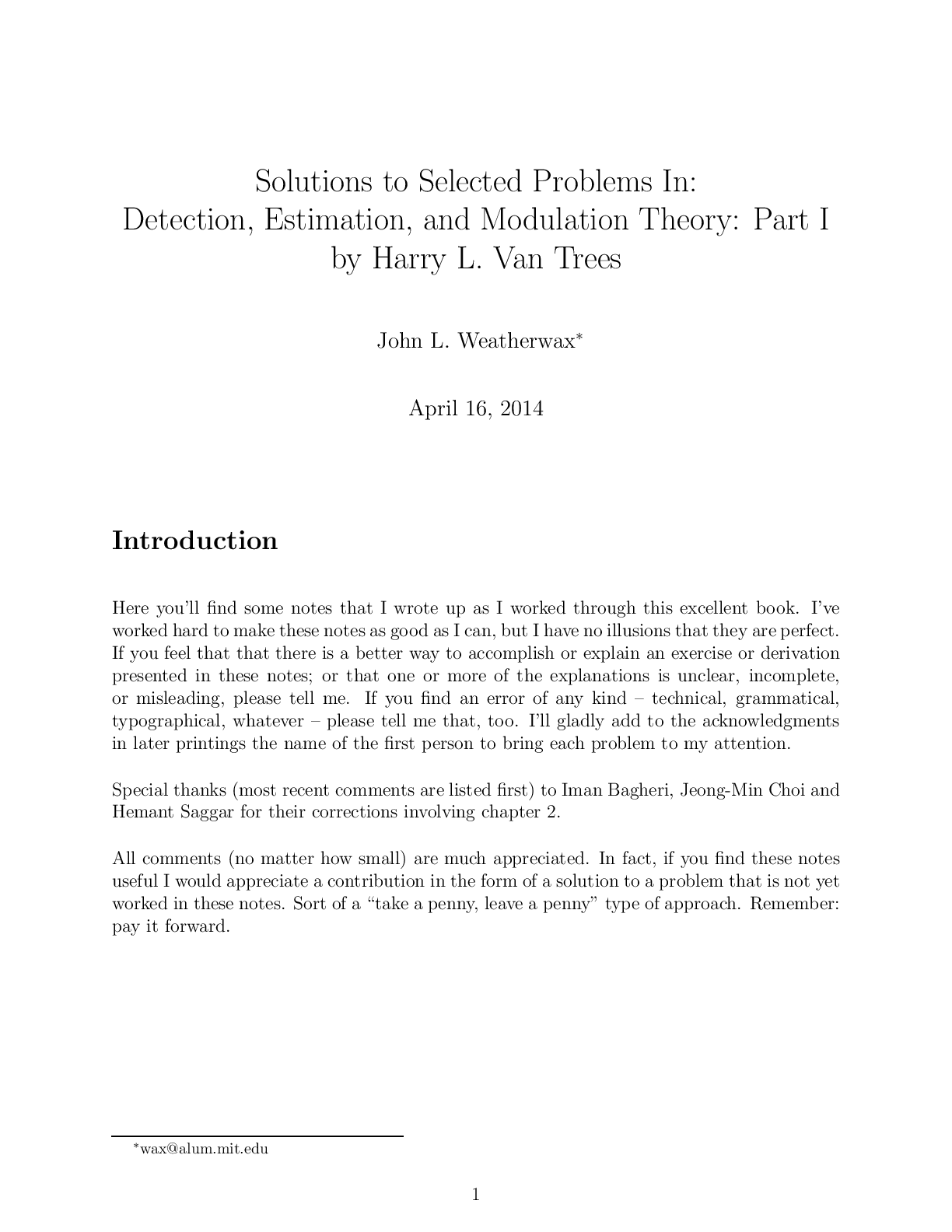
Florida Atlantic University - EEE 5425 Solutions to Selected Problems In: Detection, Estimation, and Modulation Theory: Part I by Harry L. Van Trees John L. Weatherwax

Document Content and Description Below

∗ April 16, 2014 Introduction Here you’ll find some notes that I wrote up as I worked through this excellent book. I’ve worked hard to make these notes as good as I can, but I have no illusi ... ons that they are perfect. If you feel that that there is a better way to accomplish or explain an exercise or derivation presented in these notes; or that one or more of the explanations is unclear, incomplete, or misleading, please tell me. If you find an error of any kind – technical, grammatical, typographical, whatever – please tell me that, too. I’ll gladly add to the acknowledgments in later printings the name of the first person to bring each problem to my attention. Special thanks (most recent comments are listed first) to Iman Bagheri, Jeong-Min Choi and Hemant Saggar for their corrections involving chapter 2. All comments (no matter how small) are much appreciated. In fact, if you find these notes useful I would appreciate a contribution in the form of a solution to a problem that is not yet worked in these notes. Sort of a “take a penny, leave a penny” type of approach. Remember: pay it forward. ∗[email protected] 1Chapter 2 (Classical Detection and Estimation Theory) Notes On The Text Notes on the Bayes’ Criterion Given the books Eq. 8 we have R = P0C00 ZZ0 p(R|H0)dR + P0C10 ZZ−Z0 p(R|H0)dR = P1C01 ZZ0 p(R|H1)dR + P1C11 ZZ−Z0 p(R|H1)dR . (1) We can use ZZ0 p(R|H0)dR + ZZ−Z0 p(R|H0)dR = 1 , to replace all integrals over Z − Z0 with (one minus) integrals over Z0. We get R = P0C00 ZZ0 p(R|H0)dR + P0C10 1 − ZZ0 p(R|H0)dR = P1C01 ZZ0 p(R|H1)dR + P1C11 1 − ZZ0 p(R|H1)dR = P0C10 + P1C11 + ZZ0 {P1(C01 − C11)p(R|H1) − P0(C10 − C00)p(R|H0)} dR (2) If we introduce the probability of false alarm PF, the probability of detection PD, and the probability of a miss PM, as defined in the book, we find that R given via Equation 1 becomes when we use RZ0 p(R|H0)dR + RZ1 p(R|H0)dR = RZ0 p(R|H0)dR + PF = 1 R = P0C10 + P1C11 + P1(C01 − C11)PM − P0(C10 − C00)(1 − PF) . (3) Since P0 = 1 − P1 we can consider R computed in Equation 3 as a function of the prior probability P1 with the following manipulations R(P1) = (1 − P1)C10 + P1C11 + P1(C01 − C11)PM − (1 − P1)(C10 − C00)(1 − PF) = C10 − (C10 − C00)(1 − PF) + P1 [−C10 + C11 + (C01 − C11)PM + (C10 − C00)(1 − PF)] = C00 + (C10 − C00)PF + P1 [C11 − C00 + (C01 − C11)PM − (C10 − C00)PF] = C00(1 − PF) + C10PF + P1 [(C11 − C10) + (C01 − C11)PM − (C10 − C00)PF] . (4) Recall that for the Bayes decision test our decision regions Z0 and Z1 are determined via Λ(R) > P0(C10 − C00) P1(C01 − C11) ,for H1. Thus if P0 changes the decision regions Z0 and Z1 change (via the above expression) and thus both PF and PM change since they depend on Z0 and Z1. Lets assume that we specify a decision boundary η that then defines classification regions Z0 and Z1. These decision regions correspond to a specific value of P1 denoted via P1∗. Note that P1∗ is not the true prior probability of the class H1 but is simply an equivalent prior probability that one could use in the likelihood ratio test to obtain the same decision regions Z0 and Z1. The book denotes RB(P1) to be the expression given via Equation 4 where PF and PM changes in concert with P1. The book denotes RF (P1) to be the expression given by Equation 4 but where PF and PM are fixed and are held constant as we change the value of P1. In the case where we do not fix PF and PM we can evaluate RB(P1) at its two end points of P1. If P1 = 0 then from Equation 4 RB(0) = C00(1 − PF) + C10PF . When we have P1 = 0 then we see that η ≡ P0(C10 − C00) P1(C01 − C11) → +∞ , for all R the function Λ(R) is always less than η, and all classifications are H0. Thus Z1 is the empty set and PF = 0. Thus we get RB(0) = C00. The other extreme is when P1 = 1. In that case P0 = 0 so η = 0 and we would have that Λ(R) > 0 for all R implying that all points are classified as H1. This implies that PM = 0. The expression for RB(P1) from Equation 4 is given by RB(1) = C00(1 − PF ) + C10PF + (C11 − C00) − (C10 − C00)PF = C11 , when we simplify. These to values for R(0) and R(1) give the end point conditions on RB(P1) seen in Figure 2.7. If we do not know the value of P1 then one can still design a hypothesis test by specifying values of PM and PF such that the coefficient of P1 in the expression for RF (P1) in Equation 4 vanishes. The idea behind this procedure is that this will make RF a horizontal line for all values of P1 which is an upper bound on the Bayes’ risk. To make the coefficient of P1 vanish requires that (C11 − C00) + (C01 − C11)PM − (C10 − C00)PF = 0 . (5) This is also known as the minimax test. The decision threshold η can be introduced into the definitions of PF and PM and the above gives an equation that can be used to determine its value. If we take C00 = C11 = 0 and introduce the shorthands C01 = CM (the cost of a miss) and C01 = CF (the cost of a false alarm) so we get our constant minimax risk of RF = CFPF + P1[CMPM − CF PF] = P0CFPF + P1CMPM . (6) Receiver operating characteristics: Example 1 (Gaussians with different means) Under H1 each sample Ri can be written as Ri = m+ni with ni a Gaussian random variable (with mean 0 and variance σ2). Thus Ri ∼ N(m, σ2). The statistic l which is the sum of individual random variables is also normal. The mean of l is given by the sum of the N means (multiplied by the scaling factor √Nσ 1 ) or √Nσ 1  (Nm) = √σN m ,and a variance given by the sum of the N variances (multiplied by the square of the scaling factor √Nσ 1 ) or Nσ 1 2  Nσ2 = 1 . These two arguments have shown that l ∼ N √σN m, 1. We now derive Pr(ǫ) for the case where we have measurements from Gaussians with different means (Example 1). To do that we need to note the following symmetry identity about erfc∗(X) function. We have that erfc∗(−X) ≡ Z−∞X √12π exp −x22  dx = 1 − Z−∞ −X √12π exp −x22  dx = 1 − ZX∞ √12π exp −x22  dx = 1 − erfc∗(X) . (7) Then using this result we can derive the given expression for Pr(ǫ) under the case when P0 = P1 = 1 2 and η = 1. We have Pr(ǫ) = 1 2 (PF + PM) since η = 1 this becomes = 1 2 erfc∗ d2 + 1 − PD = 1 2 erfc∗ d2 + 1 − erfc∗ −d2 = 1 2 erfc∗ d2 + 1 − 1 − erfc∗ d2 = erfc∗ d2 , (8) the expression given in the book. Receiver operating characteristics: Example 2 (Gaussians with σ02 6= σ12) Following the arguments in the book we end up wanting to evaluate the expression PF = Pr(r12 + r22 ≥ γ|H0). By definition this is just the integral over the region of r1 – r2 space [Show More]

Last updated: 2 years ago

Preview 1 out of 82 pages

Buy Now

Instant download

We Accept:

Payment methods accepted on Scholarfriends (We Accept)
Preview image of Florida Atlantic University - EEE 5425 Solutions to Selected Problems In: Detection, Estimation, and Modulation Theory: Part I by Harry L. Van Trees John L. Weatherwax document

Buy this document to get the full access instantly

Instant Download Access after purchase

Buy Now

Instant download

We Accept:

Payment methods accepted on Scholarfriends (We Accept)

Reviews( 0 )

$7.00

Buy Now

We Accept:

Payment methods accepted on Scholarfriends (We Accept)

Instant download

Can't find what you want? Try our AI powered Search

121
0

Document information


Connected school, study & course


About the document


Uploaded On

Apr 12, 2021

Number of pages

82

Written in

All

Seller


Profile illustration for Muchiri
Muchiri

Member since 4 years

209 Documents Sold

Reviews Received
19
5
1
1
6
Additional information

This document has been written for:

Uploaded

Apr 12, 2021

Downloads

 0

Views

 121

Document Keyword Tags


$7.00
What is Scholarfriends

Scholarfriends.com Online Platform by Browsegrades Inc. 651N South Broad St, Middletown DE. United States.

We are here to help

We're available through e-mail, Twitter, Facebook, and live chat.
 FAQ
 Questions? Leave a message!

Follow us on
 Twitter

Copyright © Scholarfriends · High quality services·