104a- Microbiology final Ocx. Biol 2421. Questions and Answers (GRADED A). CH-01Answer Key
1. Microorganisms are best defined as organisms that
A. can only be found growing in laboratories.
B. are too small to be seen
...
104a- Microbiology final Ocx. Biol 2421. Questions and Answers (GRADED A). CH-01Answer Key
1. Microorganisms are best defined as organisms that
A. can only be found growing in laboratories.
B. are too small to be seen with the unaided eye.
C. are infectious particles.
D. lack a cell nucleus.
E. cause human disease.
2. Which of the following are not considered microorganisms?
A. Fungi
B. Protozoa
C. Viruses
D. Bacteria
E.Mosquitoes
3. Helminths are ______.
A. molds
B.parasitic worms
C. bacteria
D. protozoa
E. infectious particles
4. Among the types of microorganisms, the ______ are noncellular.
A. protozoans
B. bacteria
C.viruses
D. helminths
*The replication cycles of viruses (lytic and lysogenic) differ among viruses and are determined by their unique
structures and genomes.
5. Studies of the immune response to an infection caused by microorganisms would be performed by a(n) ______.
A. hypersensitivity specialist
B.immunologist
C. geomicrobiologist
D. epidemiologist
Microorganisms, cellular and viral, can interact with both human and nonhuman hosts in beneficial, neutral or
detrimental ways.
6. Which of the following pairs of career descriptions and work tasks is not correctly matched?
A. Medical microbiologist -- identify the cause of a bladder infection at a hospital lab
B. Industrial microbiologist -- manipulate bacterial strains to be less pathogenic
C. Agricultural microbiologist -- identify bacterial causes of crop disease
D. Public health microbiologist -- track the incidence of AIDS in a population
Humans utilize and harness microorganisms and their products.
7. A scientist who studies the influence of microbes in the formation of caves is called a(n) ______.
A. astrobiologist
B. epidemiologist
C. geomicrobiologist
D. immunologist
Microbes are essential for life as we know it and the processes that support life (e.g., in biogeochemical cycles and plant and/or
animal microflora).
8. Astrobiology is considered a sub-discipline of microbiology because
A. life elsewhere in the universe is likely to be microbial.
B. microbes are known to exist on other planets.
C. all extraterrestrials known are microbial.
D. only microbes can reproduce under the extreme conditions in outer space.
Microorganisms are ubiquitous and live in diverse and dynamic ecosystems.
9. Which of the following does not indicate microbe involvement in energy and nutrient flow?
A. Decomposition of dead matter and wastes
B. Digestion of complex carbohydrates in animal diets
C. Formation of greenhouse gases, CO2 and methane
D.Thermal hot springs warmed by heat from earth's interior
Microorganisms are ubiquitous and live in diverse and dynamic ecosystems.
10. The microorganisms that recycle nutrients by breaking down dead matter and wastes are called ______.
A. fermenters
B. eukaryotes
C. decomposers
D. pathogens
E. prokaryotes
Bacteria and Archaea exhibit extensive, and often unique, metabolic diversity (e.g., nitrogen fixation, methane production, anoxygenic photosynthesis).
Microbes are essential for life as we know it and the processes that support life (e.g., in biogeochemical cycles and plant and/or animal microflora).
11. The majority of oxygen in earth's atmosphere is a product of photosynthesis by ______.
A. rain forests
B. microorganisms
C. green plants
D. agricultural lands
12. The three cell types discussed, eukaryotes, archaea, and bacteria, all derived from ______.
A. cells with a true nucleus
B. the last universal common ancestor
C. photosynthetic bacteria
D. archaea
13. The first cells appeared about ___ billion years ago.
A. 5
B. 4.5
C. 3.5
D. 2
E. 1
14. A hypothesis must be tested many times before it can be considered a theory.
TRUE
Ability to apply the process of science: Demonstrate an ability to formulate hypotheses and design experiments based on the scientific method.
15. Which area of biology states that living things undergo gradual structural and functional changes over long periods of time?
A. Evolution
B. Morphology
C. Phylogeny
D. Genetics
E. Transformation
The evolutionary relatedness of organisms is best reflected in phylogenetic trees.
16. When humans manipulate the genes of microorganisms, the process is called ______.
A. epidemiology
B. taxonomy
C. bioremediation
D. genetic engineering
E. immunology
Cell genomes can be manipulated to alter cell function.
Humans utilize and harness microorganisms and their products.
17. Which activity is an example of biotechnology?
A. Bacteria in the soil secreting an antibiotic to kill competitors
B. Public health officials monitoring diseases in a community
C. Egyptians using moldy bread on wounds
D. A microbiologist using the microscope to view bacteria
E. Escherichia coli producing human insulin
18. Which of the following is a traditional human use of microorganisms?
A. Baking bread
B. Cleaning up oil spills
C. Treating water and sewage
D. Mass-producing antibiotics
19. Using microbes to detoxify a site contaminated with heavy metals is an example of ______.
A. biotechnology
B. bioremediation
C. decomposition
D. epidemiology
E. immunology
20. Disease-causing microorganisms are called ______.
A. pathogens
B. decomposers
C. fermenters
D. bacteria
E. eukaryotes
21. The number one worldwide infectious diseases are ______.
A. AIDS-related diseases
B. malaria and other protozoan diseases
C. respiratory diseases
D. measles and other rash diseases
E. diarrheal diseases
22. Many chronic medical conditions have been found to be associated with microbial agents.
TRUE
23. The incidence of deaths from communicable disease is ______ in the United States compared to the entire world.
A. less
B. greater
C. about the same
24. In which way are bacteria and eukaryotes the same?
A. Contain a nucleus to hold DNA
B. Contain ribosomes for protein synthesis
C. Contain membrane-bound organelles
D. Have a cell wall for rigidity
25. In which way are archaea and eukaryotes the same?
A. Have a cell wall for rigidity
B. Can use flagella for movement
C. Contain mitochondria for energy production
D. Contain membrane-bound organelles
26. All bacteria and archaea are microorganisms, but only some eukaryotes are microorganisms.
TRUE
27. Which of the following is a unique characteristic of viruses that distinguishes them from the other major groups of
microorganisms?
A. Cannot be seen without a microscope
B. Contain genetic material
C. Cause human disease
D. Lack a nucleus
E. Lack cell structure
28. Organisms called parasites are ______.
A. the decomposers in ecosystems
B. always viruses
C. always harmful to their host
D. free-living
29. Which group of microorganisms is composed only of hereditary material wrapped in a protein covering?
A. Yeasts
B. Parasites
C. Viruses
D. Fungi
E. Bacteria
30. Eukaryotic cells are larger than bacterial or archaeal cells; all cells are larger than macromolecules. Where do viruses fit on this
scale?
A. Viruses are smaller than eukaryotic cells, but larger than bacterial or archaeal cells.
B. Viruses are smaller than macromolecules.
C. Viruses are larger than eukaryotic cells.
D. Viruses are smaller than bacterial or archaeal cells, but larger than macromolecules.
31. In general, eukaryotic cells are about ______ times larger than bacterial or archaeal cells.
A. 2
B. 10
C. 50
D. 1000
32. Archaeal cells are about ______ bacterial cells.
A. ten times smaller than
B. the same size as
C. ten times larger than
33. Many chronic infections are caused by microbes that associate in communities termed ______.
A. biofilms
B. virions
C. microbiota
D. sediments
34. Which of the following historical microbiologists is incorrectly paired with his contribution to the science?
A. Francesco Redi: tested spontaneous generation with meat exposed to the air or covered with cloth
B. Louis Pasteur: demonstrated that anthrax was caused by a bacterium
C. Joseph Lister: promoted disinfecting hands and air prior to surgery
D. Antonie van Leeuwenhoek: made and used quality magnifying lenses to observe and record microorganisms
35. In the experiments constructed by Pasteur to disprove spontaneous generation, swan-necked flasks were used. Why was this
shape of flask used in this experiment?
A. The shape of the glass neck allowed the bacteria into the flask and then into the media, but air could not enter.
B. The glass necks needed to be open to the air, yet constructed so that bacteria would settle in the lowest part of the
neck.
C. These flask shapes were the easiest and cheapest to produce.
D. Because the glass necks were stretched out, the heat used to sterilize the medium inside of the flask could not kill the
bacteria in the neck.
36. Koch's postulates are criteria used to establish that
A. microbes are found on dust particles.
B. a specific microbe should be classified in a specific kingdom.
C. microbes can be used to clean up toxic spills.
D. a specific microbe is the cause of a specific disease.
E. life forms can only arise from preexisting life forms.
37. Which of the following is NOT a recent discovery that has had a huge impact on the understanding of microbiology?
A. Restriction enzymes
B. PCR technique
C. Biofilms
D. Small RNAs
E. All are significant discoveries.
38. The sum total of all the microbes in a certain environment is termed the ______.
A. microbiome
B. microbial niche
C. domain
D. biofilm
E. phylogeny
39. Which of the following is not a process in the scientific method?
A. Systematic observation
B. Development of a theory
C. Laboratory experimentation
D. Formulation of a hypothesis
E. Belief in a preconceived idea
40. Experimentation
A. is the first step in the scientific method.
B. is designed to support an hypothesis.
C. provides a means to gather objective data.
D. is designed to refute an hypothesis.
E. provides a means to gather subjective data.
41. The scientific method includes all of the following except ______.
A. experimentation
B. hypothesis
42. The scientific method involves formulating a tentative explanation, called the hypothesis, to account for what has been
observed or measured.
TRUE
43. Caring for patients infected with a new virus requires safety precautions for medical personnel. Choosing appropriate
procedures is an example of a(n) ______ process.
A. pathogenic
B. deductive
C. hypothetical
D. inductive
44. Sterile refers to ______.
A. homogenized
B. absence of any life forms and viral particles
C. pathogen-free
D. pasteurized
E. absence of spores
lo
45. Taxonomy does not involve ______.
A. classification
B. a common name
C. nomenclature
D. identification
46. Which scientific field is involved in the identification, classification, and naming of organisms?
A. Nomenclature
B. Epidemiology
C. Taxonomy
D. Phylogeny
E. Pathology
47. The orderly arrangement of organisms into a hierarchy of taxa is called ______.
A. experimentation
B. biotechnology
C. classification
D. identification
E. nomenclature
48. Members of the same species share many more characteristics compared to those shared by members of the same kingdom.
TRUE
C. publication
D. observation
49. Which of the following is a taxon that contains all the other taxa listed?
A. Family
B. Genus
C. Kingdom
D. Species
E. Phylum
50. The smallest and most significant taxon is a ______.
A. kingdom
B. phylum
C. species
D. family
E. genus
51. Select the correct descending taxonomic hierarchy (left to right).
A. Class, phylum, order
B. Family, genus, species
C. Kingdom, domain, phylum
D. Family, order, class
E. Genus, species, family
52. A recently-developed mnemonic for remembering the taxonomic levels from Domain to Species is "Dumb Kids Prefer Candy
Over Fancy Green Salad." The word "candy" here is a reminder of the taxonomic level of _______.
A. chain
B. culture
C. category
D. colony
E. class
53. Which of the following is a scientific name?
A. Streptobacilli
B. Gram-positive streptococcus
C. Anthrax
D. Streptococcus pyogenes
54. When assigning a scientific name to an organism,
A. the species name is placed first.
B. the species name can be abbreviated.
C. both genus and species names are italicized or underlined.
D. both genus and species names are capitalized.
E. the species name is capitalized.
55. Which scientific name is written correctly?
A. S. aureus
B. Staphylococcus aureus
C. Staphylococcus Aureus
D. staphylococcus aureus
E. Staphylococcus aureus
56. The names of the three proposed domains are: Bacteria, Protista, and Eukarya.
FALSE
57. A diagram of the three domains (Bacteria, Archaea, Eukarya) proceeding from the Last Universal Common Ancestor would
show Archaea
A. branching off the Domain Bacteria.
B. branching off the Domain Eukarya.
C. as the original cells from which the others derived.
58. Analysis of the small subunit rRNAs from all organisms in the three current domains suggests that
A. the prokarytoes, archaea, and eukaryotes are not related.
B. the eukaryotes arose from prokaryotes.
C. the Archaea are more closely related to bacteria than eukaryotes.
D. all modern and extinct organisms on earth arose from a common ancestor.
59. The study of evolutionary relationships among organisms is called ______.
A. genetics
B. biotechnology
C. phylogeny
D. taxonomy
E. recombinant DNA
60. A scientist studying the sequence of nucleotides in the rRNA of a bacterial species is working on
A. recombinant DNA.
B. nomenclature.
C. determining evolutionary relatedness.
D. bioremediation.
E. determining if that species is the cause of a new disease.
61. Trees of life that illustrate the phylogenetic relationships of all organisms were traditionally based on ______; newer methods
for determining phylogeny rely on ______.
A. morphology; virology
B. nucleic acid sequences; morphology
C. morphology; nucleic acid sequences
D. nucleic acid sequences; microbiomes
E,morphology; nutritional requirements
CH-02:
1. An atom has gained an electron; it has been ______.
A. ionized
B. oxidized
C. neutralized
D. reduced
E. deionized
1. Anything that occupies space and has mass is called ______.
A. matter
B. energy
C. living
D. space
E. atomic
2. The electrons of an atom are
A. moving in pathways called orbitals.
B. used to determine atomic number.
C. positively charged.
D. always equal to the number of neutrons in an atom.
E. found in the nucleus.
3. The electrons of an atom are
A. used to determine the atomic weight.
B. always equal to the number of protons.
C. carrying a positive charge.
D. always in full orbitals.
E. used to determine the atomic number.
4. All of the following pertain to the atom Carbon-14 except it
A. has 14 neutrons.
B. is an isotope of carbon.
C. has 6 protons.
D. has 6 electrons.
5. The subatomic particles that surround the nucleus are the ______.
A. protons and neutrons
B. neutrons
C. electrons
D. protons
E. protons and electrons
B.
6. What is the maximum number of electrons in the second energy shell of an atom?
A. 2
B. 4
C. 8
D. 18
E. 32
7. What is the maximum number of electrons in the first energy shell of an atom?
A. 2
B. 4
C. 8
D. 18
E. 32
8. Protons and neutrons make up the atom's central core, which is referred to as its ______.
A. isotope
B. center of gravity
C. valence number
D. nucleus
9. The valence number is the
A. number of protons.
B. atomic weight.
C. number of neutrons.
D. number of electrons in the innermost orbital.
E. number of electrons in the outermost orbital.
10. Two or more atoms bonded together are called a(n) ______.
A. molecule
B. isotope
C. ion
D. electrolyte
E. element
11. What would be the valence number of electrons in the sulfur (S) atom? Its atomic number is 16.
A. 2
B. 6
C. 8
D. 16
E. 32
12. Polar molecules
A. always contain carbon.
B. have an equal charge distribution.
C. have an unequal charge distribution.
D. always involve oxygen.
E. are insoluble in water.
13. Organic chemicals always have a basic framework of the element _____ bonded to other atoms.
A. oxygen
B. phosphorous
C. nitrogen
D. hydrogen
E. carbon
14. C6H12O6 + C6H12O6 C12 H22O11 + H2O represents
A. the formation of a polysaccharide.
B. the formation of a peptide bond.
C. a decomposition reaction.
D. a denaturation reaction.
E. a dehydration synthesis.
15. Electrons that participate in chemical bonding are typically located closest to the nucleus.
FALSE
16. Substances that release ions when dissolved in water and conduct electricity are ______.
A. covalent
B. solvents
C. nonpolar
D. electrons
E. electrolytes
16. A capillary tube is used to acquire a small blood sample for CBC (complete blood count) analysis. Suction is not required to
transfer the blood from the fingertip prick to the tube in part due to
A. covalent bonding between the water molecules.
B. cohesive forces between the glass particles of the tube and the water molecules.
C. ionic bonding between the water molecules.
D. adhesive forces between the water molecules and the glass particles of the tube.
17. Polar molecules are composed of covalently bonded
A. carbon atoms.
B. ions.
C. identical atoms.
D. atoms of identical electronegativity.
E. atoms of different electronegativity.
18. Covalent bonds
A. result from gaining electrons.
B. are always nonpolar.
C. result from losing electrons.
D. are always polar.
E. result from sharing electrons.
19. Cations are
A. atoms without protons.
B. charged subatomic particles.
C. atoms that have gained electrons.
D. capable of forming ionic bonds with anions.
E. atoms that have gained neutrons.
20. A reaction where an electron is lost is called ______.
A. oxidation
B. reduction
C. ionization
D. decomposition
E. dissolution
21. Ionic bonds
A. result from like charge attraction.
B. result from transferring electrons.
C. are the weakest chemical bonds.
D. always involve carbon.
E. result from sharing electrons.
22. Hydrogen bonds
A. result from attractive forces between molecules with polar covalent bonds.
B. are the strongest bonds between molecules.
C. result from attractive forces between molecules with polar ionic bonds.
D. result from attractive forces between molecules with nonpolar ionic bonds.
E. result from attractive forces between molecules with nonpolar covalent bonds.
23. Atoms that gain or lose electrons become charged particles called ______.
A. ions
B. isotopes
C. anions
D. cations
24. Which of the following represents a synthesis reaction?
A. AB A + B
B. A + B AB
C. AB + XY AY + XB
D. AB + XY AY + XB
25. Which of the following represents a reversible reaction?
A. A + B AB
B. AB A + B
C. AB + XY AY + XB
D. AB + XY AY + XB
26. Ionic compounds
A. are basic in solution.
B. are acidic in solution.
C. are hydrophobic.
D. are hydrophilic.
E. always form salts in solution.
27. Water molecules are nonpolar molecules.
FALSE
28. Polar molecules have more reactivity compared to nonpolar molecules.
TRUE
29. A covalent bond is formed between an anion and a cation.
FALSE
30. The important solvent associated with living things is ______.
A. benzene
B. sodium chloride
C. water
D. carbon dioxide
E. ethyl alcohol
31. The concentration of a solution expresses the amount of solvent present.
FALSE
32. In the cell cytoplasm, molecules of ATP are a ______.
A. solute
B. solvent
33. Burning coal produces sulfur dioxide in the atmosphere. When combined with rain that falls into bodies of water, this leads to
A. a greater concentration of OH-
ions in the water.
B. a decrease in the pH level of the water.
C. an increase in pH level of the water.
D. no change in the pH level of the water.
34. Compared to a solution of pH 9, a solution of pH 7
A. is more basic.
B. has more H+
ions.
C. has a higher pH.
D. has no OH-
ions.
35. Compared to a solution of pH 9, a solution of pH 7 is
A. 20 times more basic.
B. 2 times more acidic.
C. 100 times more acidic.
D. 100 times more basic.
E. 20 times more acidic.
36. If solution A has a lower pH compared to solution B, then solution A is more acidic than solution B.
TRUE
37. One technique for staining bacteria for viewing under the microscope is called the Gram stain. In this technique, alcohol is
used as a decolorizer because it degrades the outer membrane found in some bacteria. What chemical component of the
cell does alcohol affect?
A. Protein
B. Lipid
C. Nucleic acids
D. Carbohydrate
38. What type of bond is formed by dehydration synthesis between two amino acids?
A. Ester
B. Peptide
C. Phosphate
D. Disulfide
E. Glycosidic
39. The purine ______ always hydrogen bonds with the pyrimidine ______ in double-stranded DNA.
A. cytosine; guanine
B. thymine; guanine
C. guanine; cytosine
D. adenine; guanine
40. The only part of an amino acid that differs from other amino acids is its R group.
TRUE
41. In what way would life be different if the element carbon was absent?
A. There would be no organic compounds.
B. There would be no inorganic compounds.
C. Life would not exist in any shape or form.
D. The concept of pH would not exist.
42. A student forgot to label a beaker containing a DNA solution and a beaker containing a glucose solution. If
chemical analysis was performed to identify the contents of each beaker, which of the following would be found
in the beaker of DNA but not in the beaker with glucose?
A. Nitrogen and phosphorus
B. Carbon atoms
C. Hydrogen and oxygen atoms
D. Fatty acids
E. Amino acids
43. All proteins are enzymes.
FALSE
44. Which of the following functional groups is mismatched to the organic compound in which it is typically found?
A. Carboxyl - fatty acids
B. Amino - proteins
C. Hydroxyl - alcohols
D. Sulfhydryl - proteins
E. Phosphate - carbohydrates
45. Most biochemical macromolecules are polymers, which are chains of ______.
A. hydrophobic molecules
B. hydrogen bonds
C. repeating carbohydrates
D. electrolytic molecules
E. repeating monomers
46. All of the following are monosaccharides except ______.
A. glycogen
B. fructose
C. glucose
D. deoxyribose
47. Which of the following would have glycosidic bonds?
A. Monosaccharides
B. Polypeptides
C. Triglycerides
D. ATP
E. Polysaccharides
48. Starch is the primary storage food for all of the following except ______.
A. algae
B. some fungi
C. green plants
D. animals
49. Select the statement that most accurately reflects the process of plant material digestion in humans.
A. It requires the action of enzymes called kinases.
B. It is linked to the digestion of glycogen.
C. It is a process that is dependent upon enzyme (cellulase) production by gut microbiota.
D. It is a very efficient process the produces very little undigested material in feces.
50. All of the following are lipids except ______.
A. wax
B. cholesterol
C. phospholipid
D. starch
E. triglyceride
51. What part of a phospholipid comprises the hydrophobic tail?
A. Alcohol
B. Hydroxyl
C. Phosphate
D. Glycerol
E. Fatty acids
52. A fat is called _____ if all carbons of the fatty acid chain are single-bonded to 2 other carbons and 2 hydrogens.
A. monounsaturated
B. unsaturated
C. polyunsaturated
D. saturated
53. The building blocks of an enzyme are ______.
A. nucleotides
B. monosaccharides
C. amino acids
D. glycerol and fatty acids
E. phosphate, glycerol, and fatty acids
54. An amino acid contains all of the following except a/n ______.
A. phosphate
B. carbon
C. carboxyl group
D. variable R group
E. amino group
55. An example of an amphipathic molecule found in living cells is ______.
A. phospholipid
B. nucleic acid
C. protein
D. ATP
E. glucose
56. The lipid group that serves as energy storage molecules is the ______.
A. triglycerides
B. prostaglandins
C. steroids
D. phospholipids
E. waxes
57. All of the following are polysaccharides except
A. dextran in some bacterial slime layers.
B. agar used to make solid culture media.
C. cellulose in certain cell walls.
D. sterols in cell membranes.
E. a cell's glycocalyx.
58. The lipid group that is the major component of cell membranes is the ______.
A. waxes
B. steroids
C. prostaglandins
D. triglycerides
E. phospholipids
59. Nucleic acids have primary, secondary, tertiary, and quaternary levels of organization.
FALSE
60. Which of the following statements is incorrect regarding protein structure?
A. Proteins, such as antibodies that are comprised of multiple polypeptide chains, have quaternary structure.
B. The folding of a protein to form its active site creates its tertiary structure.
C. Beta-pleated sheets are a type of protein secondary structure.
D. The sequence of nucleotides determines the primary structure of a protein.
61. Which of the following is not true about enzymes?
A. Enzymes are found in all cells.
B. Enzymes can be denaturated by heat and other agents.
C. Enzymes participate in the cell's chemical reactions.
D. Enzymes have high-energy bonds between phosphates.
E. Enzymes are catalysts.
62. The alpha () helix is a type of _____ protein structure.
A. primary
B. secondary
C. tertiary
D. quaternary
63. The most important outcome of polypeptide intrachain bonding and folding is the unique shape of the protein.
TRUE
64. ATP differs from the nucleotides found in DNA in the
A. use of phosphate instead of sulfate in the backbone.
B. use of phosphorus in the nitrogenous base portion of the molecule.
C. sugar portion of the molecule.
D. use of uracil in the nitrogenous base portion of the molecule.
E. use of adenosine instead of adenine.
65. A new organism was identified that contained arsenic in place of phosphate in its DNA double helix structure. Based upon
this information alone, it can be determined that this change will greatly alter the information encoded by this genetic
material.
FALSE
66. One nucleotide contains one
A. phosphate.
B. pentose sugar.
C. nitrogen base.
D. All of the choices are correct.
67. Purines and pyrimidines are components in the building block units of all ______.
A. amino acids
B. polysaccharides
C. carbohydrates
D. enzymes
E. nucleic acids
68. Which of the following is not a pyrimidine?
A. Adenine
B. Thymine
C. Cytosine
D. Uracil
69. Which pertains to DNA but not to RNA?
A. Contains ribose
B. Contains nucleotides
C. Contains thymine
D. Contains adenine
E. Contains uracil
70. Which of the following is a correct description of a component of the ATP molecule?
A. Sugar: deoxyribose
B. Sugar: ribose
C. Nitrogenous base: alanine
D. High energy bond: peptide bond
E. High energy bond: glycosidic bond
71. ATP is best described as
A. a double helix.
B. the energy molecule of cells.
C. an electron carrier.
D. an enzyme.
72. A culture of an organism believed to cause intestinal symptoms is viewed under the microscope, and the
microbiologist observes a cell membrane, flagella, mitochondria, and some dark unrecognizable structures
within each cell. The microbiologist notes that the cells are eukaryotic because
A. the dark structures must be the cell nuclei.
B. only eukaryotic cells have a cell membrane.
C. only eukaryotic cells have flagella.
D. only eukaryotic cells have mitochondria.
73. NASA has published a list of criteria for identifying fossil bacteria in samples from Mars, as part of a search for
evidence of life. Which of the following is good evidence for the presence of bacterial cells?
A. Three-dimensional organization of cells in a starburst pattern
B. No evidence of water in the surrounding mineral
C. Cell size of 0.5 to 2 microns
D. Absence of carbon in the material
74. Characteristics shared by all cells include
A. a membrane serving as a cell boundary.
B. the possession of genetic information.
C. the presence of cellular fluid.
D. All of the choices are correct.
75. All cells contain
A. uracil in their DNA.
B. ribosomes for protein synthesis.
C. cell walls made of cellulose.
D. organelles for compartmentalization.
E. mitochondria to generate ATP
CH-03: Micro
Multiple Choice Questions
1. A microbiologist inoculates Staphylococcus aureus into a culture medium. Following incubation, both
Staphylococcus aureus and Staphylococcus epidermidis are determined to be growing in this culture. What is
the most likely explanation?
A. The microbiologist used too much inoculum.
B. The culture medium was selective.
C. The culture medium was differential.
D. The culture was contaminated.
E. The incubation temperature was incorrect.
2. A microbiologist inoculates Staphylococcus epidermidis and Escherichia coli into a culture medium. Following
incubation, only the E. coli grows in the culture. What is the most likely explanation?
A. The culture medium was selective.
B. The culture medium was differential.
C. The microbiologist used too much inoculum.
D. The culture was contaminated.
E. The incubation temperature was incorrect.
3. Robert Koch and his colleagues first used agar in bacteriological media. Why was this ingredient an
improvement on previous materials used to culture bacteria?
A. Agar can convert from liquid to solid form, and back again, very easily.
B. Agar is a complete source of nutrients for most bacteria.
C. Bacteria growing on the solidified medium did not degrade or break down the agar.
D. Agar was less expensive than the nutrients that Koch was previously using in the lab.
4. The bacterium Neisseria gonorrhoeae causes the sexually-transmitted infection gonorrhea. Although it can
be isolated from the vagina, there are numerous normal biota in that location as well. To generate a pure
culture of this pathogenic bacterium, the best choice is a(n) ______.
A. differential medium
B. enrichment medium
C. selective medium
D. liquid medium
5. Thioglycolate medium contains the following: yeast extract, pancreatic digest of casein, glucose, L-cysteine,
sodium chloride, sodium thioglycolate, and agar. It is considered a complex medium because
A. depending on their oxygen utilization pattern, organisms will grow differently on it.
B. it has multiple ingredients for a broad range of nutrients.
C. both yeast extract and pancreatic digest of casein are not chemically defined.
D. thioglycolate has a carbon-sulfur bond that many microbes cannot break enzymatically.
6. Humans can see objects as small as 0.1 mm. Leeuwenhoek's best microscope could magnify objects to 300X.
Which of the following would be invisible using Leeuwenhoek's microscope?
A. Poliovirus, 30 nm
A. Red blood cell, 8 m
C. Escherichia coli, 1 m X 4 m
D. Pandora virus, 0.5 mm X 1 mm
7. Cells of Staphylococcus aureus are cocci measuring about 1 m in diameter. In a textbook image of S.
aureus, each cell measures about 1 cm. The magnification of the image on the page is ______.
A. 10,000X
B. 1,000X
C. 100X
D. 0.01X
E. 0.001X
F. 0.0001X
G. This is impossible to calculate without more information.
8. Table 3.6 in your textbook uses Paramecium to illustrate several types of light microscopy. Each image is
magnified 230X and measures about 4 cm. The actual size of a Paramecium is about ______.
A. 920 m
B. 0.2 m
C. 175 m
D. 57.5 m
E. 4,000 m
9. Your microscope has a resolving power of 0.15 m. The specimen that you will be observing has
bacterial cocci the size of 0.1 m in diameter. Which of the following statements is correct?
A. The cocci will appear much smaller than their actual size because of the low resolution.
B. The cocci will be fuzzy-looking and blend together.
C. The cocci will not be visible.
D. The cocci will be readily visible and distinct.
10. A microbiology student with a visual disability is viewing a sample of Bacillus endospores in a phase contrast
microscope that is linked to an iPad. By "stretching" the image on the iPad screen, the student can increase the
apparent size of the endospores. How does this manipulation affect resolution and contrast? (No software is
being used to alter the image!)
A. Only the magnification can be increased; resolution and contrast are unchanged.
B. Contrast will improve because the microscope is phase-contrast.
C. Both magnification and resolution increase; contrast is unchanged.
D. Resolution and magnification will decrease because the screen is not as good as the human eye.
11. Agar is an important component of media because
A. agar provides a solid surface for bacterial growth.
B. bacteria require agar as a source of carbon.
C. agar inhibits mold growth.
D. agar prevents contamination.
12. The Five I's of studying microorganisms include all of the following except ______.
A. identification
B. isolation
C. incubation
D. infection
E. inoculation
13. The term that refers to the purposeful addition of microorganisms into a laboratory nutrient medium is
______.
A. inoculation
B. contamination
C. infection
D. immunization
E. isolation
14. A pure culture contains
A. only bacteria.
B. only one identified species of microorganism.
C. a variety of species from the same genus.
D. microbes from a single source.
15. The correct microbiological term for the sample of specimen that is put into a nutrient medium to produce a
culture is ______.
A. loop
B. inoculum
C. streak
D. colony
16. Which isolation technique is most effective for the majority of applications and is most commonly used for
colony isolation in the laboratory?
A. Spread plate
B. Streak plate
C. Pour plate
D. Culture plate
E. Loop dilution
17. Which of the following is not an inoculating tool?
A. Pipette
B. Swab
C. Petri dish
D. Loop
E. Needle
18. What is the term for a culture made from one isolated colony?
A. Axenic
B. Mixed
C. Pure
D. Both axenic and mixed are correct.
E. Both axenic and pure are correct.
19. Newly inoculated cultures must be _____ at a specific temperature and time to encourage growth.
A. incubated
B. streaked
C. spread
D. poured
20. The procedures for culturing a microorganism require the use of a microscope.
FALSE
21. Some microbes are not capable of growing on artificial media as pure cultures.
TRUE
22. Mixed cultures are also referred to as contaminated cultures.
FALSE
23. Bacterial cultures are easily identified from their microscopic appearance.
FALSE
24. Which method often results in colonies developing down throughout the agar along with some colonies on the
surface?
A. Spread plate
B. Pour plate
C. Replica plate
D. Streak plate
25. All of the following are examples of different types of microbiological media except ______.
A. agar
B. enriched
C. broth
D. Petri dish
E. semisolid
26. Which of the following is essential for the development of discrete, isolated colonies?
A. Solid medium
B. Differential medium
C. Broth medium
D. Assay medium
E. Selective medium
27. Which of the following is produced by adding 1% to 5% agar to nutrient broth that is then boiled and cooled?
A. A pure culture
B. A contaminated medium
C. A liquid medium
D. A mixed culture
E. A solid medium
28. The three physical forms of laboratory media are ______.
A. solid, semisolid, and liquid
B. reducing, transport, and enumeration
C. a streak plate, a pour plate, and a broth
D. solid, liquid, and gas
29. Agar is a complex polysaccharide that comes from a/an ______.
A. bacterium
B. algae
C. fungus
D. marine invertebrate
E. green plant
30. Which of the following is not a benefit of agar as a solid medium?
A. Holds moisture
B. Flexibility
C. Solid at room temperature
D. Can be inoculated and poured at a temperature that is not harmful
E. Easily digested by most microbes
31. A medium that is gel-like has less agar in it compared to a solid medium.
TRUE
32. Which type of medium would be the best choice when shipping a sample of bacteria from a clinic to a
laboratory for testing?
A. Thioglycolate medium
B. Eosin-methylene blue agar
C. Transport medium
D. Blood agar
33. A common medium for culturing fastidious bacteria is ______.
A. trypticase soy agar
B. reducing medium
C. mannitol salt agar
D. blood agar
E. MacConkey medium
34. A reducing medium contains
A. sugars that can be fermented.
B. extra oxygen.
C. hemoglobin, vitamins, or other growth factors.
D. substances that remove oxygen.
E. inhibiting agents.
35. Which type of medium distinguishes different types of microorganisms based on an observable change in the
colonies or in the medium?
A. Enriched
B. Enumeration
C. Selective
D. Reducing
E. Differential
36. Differential media result in which of the following observable characteristics?
A. Differently colored colonies
B. Different media color after incubation
C. Chemical precipitates
D. Gas bubbles
E. All of the choices are correct.
37. A reducing medium is used to culture ______ organisms.
A. fastidious
B. pathogenic
C. anaerobic
D. aerobic
38. Mannitol salt agar is selective for organisms in which bacterial genus?
A. Salmonella
B. Staphylococcus
C. Escherichia
D. Neisseria
E. Streptococcus
39. A microbiologist must culture a patient's feces for intestinal pathogens. Which of the following components
would likely be present in a selective medium for this purpose?
A. Thioglycolic acid
B. Sheep red blood cells
C. Bile salts
D. Peptone
E. NaCl
40. Bacteria that require special growth factors and complex nutrients are termed ______.
A. fermentative
B. hemolytic
C. fastidious
D. aerobic
E. anaerobic
41. A selective medium contains one or more substances that inhibit growth of some microbes to facilitate the
growth of other desired microbes.
TRUE
42. Eosin-methylene blue agar, or EMB, is a commonly used bacteriological medium for growing gramnegative bacteria from complex environments. It contains two dyes, eosin and methylene blue, as well as
the sugar lactose. Eosin is a pH indicator that changes color when the medium is acidic, while methylene
blue inhibits the growth of most gram-positive bacteria. If an organism consumes lactose, acid will be
produced, causing the bacterial colonies to change color.
Based upon this description, this medium is ______.
A. reducing
B. for enrichment
C. selective
D. differential and selective
E. differential
43. A nutrient medium that has all of its chemical components identified and their precise concentrations known
and reproducible is termed ______.
A. reducing
B. enriched
C. complex
D. defined
44. A nutrient medium that contains at least one ingredient that is not chemically defined is termed ______.
A. enriched
B. complex
C. reducing
D. synthetic
45. All of the following are diameters of cells that would be resolved in a microscope with a limit of resolution of 0.2
µm except ______.
A. 0.2 mm
B. 0.1 µm
C. 2.0 µm
D. 0.2 µm
46. Who invented the first crude microscope by grinding glass?
A. Lister
B. Schultz and Schwann
C. Leeuwenhoek
D. Redi
E. Pasteur
47. The simple microscopes used by the earliest practitioners of microscopy contained which of the following?
A. Magnifying lens
B. Oil-immersion lens
C. Lamp
D. Ocular
E. Condenser
48. The _____ of the microscope holds and allows selection of the objective lenses.
A. ocular
B. condenser
C. stage
D. nosepiece
49. Which of the following parts of a microscope magnifies the specimen to produce a real image of the specimen?
A. Body
B. Condenser
C. Objective lens
D. Ocular lens
E. Nosepiece
50. Which of the following parts of the microscope magnifies the specimen to produce the virtual image of the
specimen?
A. Ocular lens
B. Objective lens
C. Condenser
D. Body
51. If a microbiologist is studying a specimen at a total magnification of 950X, what is the magnifying power of the
objective lens if the ocular lens is 10X?
A. 95X
B. 940X
C. 950X
D. 9500X
52. Magnification is achieved in a compound microscope through the initial magnification of the specimen by the
_____ lens. This image is then projected to the _____ lens that will further magnify the specimen to form a
virtual image received by the eye.
A. ocular; oil immersion
B. scanning; objective
C. ocular; objective
D. objective; ocular
53. Which term refers to the microscope's ability to show two separate objects as discrete and distinct?
A. Contrast
B. Magnification
C. Refraction
D. Resolution
54. The wavelength of light used and the numerical aperture governs ______.
A. resolution
B. contrast
C. illumination
D. size of the field
E. magnification
55. Scattering of peripheral light rays through the glass slide under very high magnification can be prevented by
______.
A. the condenser
B. the ocular
C. immersion oil
D. the cover slip
56. The type of microscopy in which you would observe brightly illuminated specimens against a black background
is ______.
A. dark-field
B. confocal
C. fluorescence
D. phase-contrast
E. electron
57. Which type of microscopy transforms the subtle variations in cell density into differences in light intensity,
allowing for increased internal detail without staining?
A. Electron
B. Fluorescence
C. Bright-field
D. Confocal
E. Phase-contrast
58. Which type of microscope shows cells against a white background?
A. Confocal
B. Electron
C. Bright-field
D. Fluorescence
E. Phase-contrast
59. All of the following pertain to the fluorescence microscope except
A. it is a type of compound microscope.
B. it is used to diagnose certain infections.
C. it uses electrons to produce a specimen image.
D. it requires the use of dyes like acridine or fluorescein.
E. it requires an ultraviolet radiation source.
60. A scanning confocal microscope
A. produces specimen images on electron micrographs.
B. uses dyes that emit visible light when excited by ultraviolet radiation.
C. uses ultraviolet light to form a specimen image.
D. scans narrow planes and can build a three-dimensional image of the specimen.
61. The specimen preparation technique that is best for viewing cell motility is the ______.
A. flagellar stain
B. Gram stain
C. negative stain
D. hanging drop
E. fixed, stained smear
62. The bending of light rays as they pass from one medium to another is called refraction.
TRUE
63. A differential interference contrast microscope uses dyes to give colored, three-dimensional images.
FALSE
64. Which type of microscope does not use light in forming the specimen image?
A. Electron
B. Dark-field
C. Phase-contrast
D. Bright-field
E. Fluorescence
65. Which type of microscope achieves the greatest resolution and highest magnification?
A. Bright-field
B. Fluorescence
C. Electron
D. Dark-field
E. Phase-contrast
66. Which type of microscope cannot image live specimens?
A. Differential interference
B. Bright-field
C. Electron
D. Dark-field
E. Phase-contrast
67. Which type of microscope bombards a whole, metal-coated specimen with electrons moving back and forth
over it?
A. Transmission electron
B. Differential interference contrast
C. Scanning electron
D. Phase-contrast
E. Fluorescence
68. Comparing transmission electron microscopy with scanning electron microscopy, the following statement is
true.
A. Transmission EM is used for internal detail of cells and subcellular structures.
B. Transmission EM gives detail of the external architecture of cells.
C. Transmission EM requires dyes.
D. Transmission EM can provide good images of bacteria but not viruses.
69. The purpose of staining cells on a microscope slide is to ______.
A. secure them to the slide
B. kill them
C. observe motility
D. enlarge the cells
E. add contrast to see them better
70. The Gram staining procedure is best described as a ______ staining technique.
A. negative
B. simple
C. selective
D. differential
71. What do the Gram stain, the acid-fast stain, and the endospore stain have in common?
A. They use heat to force the dye into cell structures.
B. The staining outcome varies with the charge of the cell wall.
C. They are used on a wet mount of the specimen.
D. They are differential stains.
E. They use a negative stain technique.
72. Basic dyes are
A. repelled by cells.
B. attracted to the acidic surface of bacterial cells.
C. used in negative staining.
D. dyes such as India ink and nigrosin.
E. anionic.
73. A microbiologist makes a fixed smear of bacterial cells and stains it with methylene blue. All cells appear blue
under the oil immersion lens. This is an example of ______.
A. simple staining
B. negative staining
C. capsule staining
D. the acid-fast stain
E. using an acidic dye
74. Fixed smears of specimens are required to perform the Gram stain or the endospore stain.
TRUE
75. Following a properly-performed Gram stain, gram-positive bacteria will appear as pink or red cells.
FALSE
CH-04: Test Bank Key
Multiple Choice Questions
1. E. coli has been isolated and cultured from three different individuals. Upon biochemical testing of these three
cultures, you find that there are differences in some reactions. What is the best explanation of these differences?
43. These represent three different species of E. coli.
B. This is normal genetic variation seen among strains of E. coli.
C. Two of the cultures are mutants of the other.
D. The other two cultures are not really E. coli.
E. Mistakes have been made in the test interpretation.
2. In which situation would a bacterium most likely have cytoplasmic inclusions?
A. When producing an endospore
B. When the cell is synthesizing flagella
C. When the cell is starved for nutrients
D. In a habitat abundant in nutrients
3. If you observe rod-shaped, pink cells on a slide that had just been Gram stained, you can assume that their cell
envelope contains endotoxin.
TRUE
2-20-13
4. You apply the acid-fast stain method to a patient's specimen, an aspirate from the lungs. Microscopic examination
reveals a large number of bright pink-red bacillus-shaped bacteria in the smear. Which statement is true?
A. This is the expected outcome for normal sputum.
B. The patient has pneumonia.
C. The patient has tuberculosis.
D. The patient has an HIV infection.
44. A patient has a serious respiratory infection. A sputum sample yielded a bacterium that did not have any
peptidoglycan. You hypothesize that the identity of this microbe could possibly be ______.
A. Streptococcus pneumoniae
B. Mycobacterium tuberculosis
C. Borrelia burgdorferi
45. Staphylococcus aureus
46. Mycoplasma pneumoniae
45. You have made a smear of a bacterial culture and have performed the Gram stain on it. Looking at the organism
under the microscope, you notice that the cells do not seem to be the dark blue-purple of a gram-positive reaction,
but instead are light purple. Your staining procedure was performed correctly. What is your best explanation as to
why the bacteria have stained this way?
A. The bacteria were taken from an inappropriate medium, and a chemical is interfering with proper staining of
the cells.
B. There is something in the wall of the bacteria that has affected the uptake of the crystal violet into the cell
wall, thereby staining it improperly.
C. The specimen did not undergo heat fixation before staining; therefore, the primary dye does not stick
properly to the wall.
D. These are mutant bacteria which cannot be stained like other bacteria.
46. You have found a mutant of Streptococcus pneumoniae that has lost the ability to produce a capsule. If you inject
this strain into a population of healthy mice, what prediction can you make about the consequences?
A. The mice will get a severe case of pneumonia and recover.
B. The mice will remain healthy.
C. The mice will die of pneumonia.
D. The infection will respond to antiviral medication.
46. You've just isolated a new bacterium in pure culture, and you culture it on a general purpose medium where its
cells have a coccobacillus morphology. When you examine the cells after culturing on a variety of differential
media, you find that in some cases, the cells appear as coccobacillus, but in others, they can be filamentous,
cocci, or club-shaped. The best explanation for this observation is that
A. the media were incubated at an incorrect temperature.
B. the differential media are contaminated.
C. the microscope is out of adjustment.
D. the bacterium is pleomorphic.
E. your culture has become contaminated.
47. You've just isolated a new bacterium in pure culture, and you culture it on a general purpose medium where its
cells have a rod-shape (bacillus) morphology. In addition to culturing it on solid media, you inoculate a slide to
grow it as a biofilm. When you use confocal microscopy to image the biofilm, you observe that there are several
cellular morphologies, ranging from coccus to coccobacillus to long bacillus. The best explanation for this
observation is that
47. the confocal microscope is out of adjustment.
48. the biofilm is no longer a pure culture of the microbe.
49. the biofilm culture was not incubated under the appropriate conditions.
50. the microenvironments within a biofilm promote structural variation.
10. A new drug is found to act by blocking the incorporation of subunits into sterol molecules for the cell membrane.
Which statement is true?
48. Only archaeal cells would be affected by this drug.
49. Only biofilms would be affected by this drug.
C. Most bacteria would be unaffected by this drug.
D. A drug with this mechanism would be an excellent antibiotic.
E. This kind of drug would destroy viruses only.
50. You need to determine if a pure culture of bacteria is gram-positive or gram-negative, but you've just spilled
your only solution of crystal violet so you can't do a Gram stain. You decide to try a lysozyme treatment on a
sample of each culture and then examine the samples under the microscope. The expected result is
A. gram-positives will lyse and appears as debris; gram-negatives will lyse but more slowly.
B. gram-positives will lyse and appears as debris; gram-negatives will be unaffected.
C. gram-positives will lyse and appears as debris; gram-negatives will lose cellular morphology and appear as
cocci.
D. gram-negatives will lyse and appears as debris; gram-positives will lose cellular morphology and appear as
cocci.
E. gram-negatives will lyse and appears as debris; gram-positives will be unaffected.
F. Researchers studying the rigidity and flexibility of the cell envelope used chemotaxis to measure the ability of
microbes to squeeze through tight spaces. E. coli, a gram-negative bacterium, was able to traverse narrower
channels than B. subtilis, a gram-positive microbe, even though both cells are the same size when grown
without restriction. E. coli has the more flexible cell envelope because
lipopolysaccharide has no charge.
it has fewer flagella.
it has only a single membrane.
there is less structural carbohydrate.
there are fewer protein receptors.
51. The process of sporangium formation and endospore maturation requires 6-8 hours. What is most likely to
result if the temperature of the environment was raised to 100°C about 2 hours after the process started?
A. The chromosome in the endospore would likely carry mutations.
B. The endospore would form more slowly and be heat resistant.
C. The endospore would form properly but would be unable to germinate.
D. The organism would be termed a hyperthermophile.
E. The endospore would not form properly because it is not yet heat resistant.
52. Archaea have been found in many microenvironments in the human body. Which of the following
microenvironments is most likely to fit with the designation of Archaea as "extremophiles?"
A. The inner ear can withstand increased pressure.
B. The surface of the tongue has salt receptors.
C. The gingiva and the gut are anaerobic.
D. The temperature of the testes is less than 37°C.
53. At present, the most accurate indicator of evolutionary relatedness among organisms is the
54. size of the bacterial chromosome.
55. similarities of cell membrane proteins.
56. sequence of the ribosomal small subunit RNA.
57. size of the ribosomes.
58. size of the periplasmic space.
E. Serological analysis for bacterial identification typically involves using
specific antibodies to the bacterial cell antigens.
a microscope to determine cell morphology.
the determination of guanine + cytosine base concentrations.
methods to identify cell enzymes.
the analysis of the appearance of colonies.
55. Which of the following bacteria is not closely related to the others?
A. Salmonella enterica subsp. enterica
B. Salmonella enterica subsp. indica
C. Salmonella bongori
56. Salmonella enterica subsp. Arizonae
57. Which of the following is mismatched?
A. Tenericutes - waxy, acid-fast cell walls
B. Gracilicutes - gram-negative cell walls
C. Mendosicutes - archaea cell walls
D. Firmicutes - gram-positive cell walls
58. A research laboratory that identifies the subspecies of bacterial isolates from a recent Salmonella epidemic
would refer to Bergey's Manual of ______ Bacteriology for guidance in identification.
A. Systematic
B. Classical
C. Evolutionary
59. A clinical laboratory that identifies the bacterial agents that cause human disease would refer to Bergey's
Manual of ______ Bacteriology for guidance in identification.
A. Systematic
B. Determinative
C. Classical
D. Evolutionary
E. Determinative
60. The reference for bacterial descriptions and classifications is _____ Manual of Systematic Bacteriology.
A. Leeuwenhoek's
B. Lister's
C. Koch's
D. Bergey's
E. Pasteur's
61. Which of the following is not a phenotypic trait of bacteria?
A. Cell shape
B. Biochemical reactions
C. rRNA sequence
62. Nutrient requirements
63. Archaea do not have the typical peptidoglycan structure found in bacterial cell walls.
TRUE
64. Which of the following is mismatched?
Psychrophiles - adapted to very low temperatures
Extreme halophiles - adapted to salty habitats
Methanogens - convert CO2 and H2 into methane
Hyperthermophiles - adapted to high temperatures
Thermoplasmas - adapted to warm-blooded animal environments
25. Halobacterium salinarum lives in and requires a high salt concentration. This is an example of an archaeon
described as a ______.
65. barophile
66. halophile
67. thermophile
68. psychrophile
66. The function of bacterial endospores is
A. to provide a protected site for photosynthesis.
B. storage of excess cellular building blocks.
C. protection of genetic material during harsh conditions.
D. reproduction and growth.
67. Chemical analysis of a bacterial cell detects dipicolinic acid. What is the identity of this structure?
A. Nucleoid
B. Cell wall
C. Biofilm
D. Capsule
E. Endospore
F. Endospores are
metabolically inactive.
resistant to heat and chemical treatments.
resistant to destruction by radiation.
living structures.
All of the choices are correct.
29. Bacterial endospores are produced by ______.
A. Entamoeba
68. Bacillus
C. Mycoplasma
70. Staphylococcus
71. All of the following occur during endospore germination except
A. the cell grows out of its protein coats.
B. binding of a small organic molecule to initiate germination.
C. dehydration of the cell components.
D. enzymes digest the endospore cortex.
72. All of the following structures contribute to the ability of pathogenic bacteria to cause disease except
______.
gram-negative outer membrane
inclusions
slime layer
capsule
fimbriae
C. Magnetosomes are
infoldings of the cell membrane.
found in all bacteria and some archaea.
responsible for the heat resistance of endospores.
also termed metachromatic granules.
composed of magnetic iron oxide particles.
F. Plasmids
are found in all bacteria.
are essential for survival.
are located in microcompartments.
cannot be passed between organisms.
E. often carry genes controlling pathogenicity.
73. Endospores of certain bacterial species can enter tissues in the human body, germinate, and cause an
infectious disease.
TRUE
74. Boiling water (100°C) can normally destroy endospores.
FALSE
75. All bacterial cells have ______.
an S-layer
flagella
the ability to produce endospores
capsules
a chromosome
76. Which of the following bacterial structures is incorrectly matched with a function?
A. Nucleoid - hereditary material
B. Plasmids - contain genes essential for growth and metabolism
C. Cytoplasm - dense, gelatinous solution
D. Ribosomes - protein synthesis
E. Inclusions - excess cell nutrients and materials
38. The site for ATP synthesis in bacterial cells is the ______.
A. cell membrane
B. mitochondrion
C. cell wall
D. microcompartment
E. ribosome
39. The most immediate result of destruction of a cell's ribosomes would be that
A. material would not cross the cell membrane.
B. the chromosome would unravel.
C. protein synthesis would stop.
D. holes would appear in the capsule.
E. glycogen inclusions would form.
40. The chromosome in bacteria and archaea
A. contains all the cell's plasmids.
B. is located in the cell membrane.
C. forms a single linear strand of DNA.
D. is part of the nucleoid
.
41.
The chemical components of ribosomes are proteins and ______.
A. mRNA
B. tRNA
C. rRNA
D. DNA
42. Some bacteria have a cytoskeleton of sterols to help maintain their shape.
FALSE
43. A bacterial genus that has waxy mycolic acid in the cell walls is ______.
A. Bacillus
B. Mycobacterium
C. Mycoplasma
D. Corynebacterium.
E. Streptococcus
44. Mycobacterium and Nocardia are different from most gram-positive bacteria in that their cell walls
A. contain a layer of lipopolysaccharide.
B. contain more peptidoglycan.
C. are easily decolorized during staining.
D. contain unique, waxy lipids.
45. Which of the following does not pertain to endotoxin?
A. Endotoxin can cause septic shock in the human body.
B. Endotoxin is found in acid-fast bacterial cell walls.
C. Endotoxin can stimulate fever in the human body.
D. Endotoxin is a bacterial cell wall lipid.
46. Lipopolysaccharide is an important cell envelope component of ______.
A. acid-fast bacteria
B. gram-positive bacteria
C. gram-negative bacteria
D. mycoplasmas
E. protoplasts
47. Which of the following is not true of the outer membrane?
A. The uppermost layer is made of lipopolysaccharide.
B. The lipid portion of the lipopolysaccharide layer is termed endotoxin.
C. Gram-positive bacteria have an outer membrane.
D. The innermost layer is a phospholipid bilayer.
E. Porins create channels through the outer membrane.
48. The cell envelope or its parts can interact with human tissue and cause disease.
TRUE
49. Peptidoglycan is a unique macromolecule found in bacterial ______.
A. slime layers
B. capsules
C. cell walls
D. cell membranes
E. inclusions
50. A bacterial cell wall that has primarily peptidoglycan with small amounts of teichoic acid and lipoteichoic acid is
______.
A. a spheroplast
B. acid-fast
C. gram-negative
D. gram-positive
E. a protoplast
51. The macromolecule containing alternating N-acetylglucosamine (NAG) and N-acetylmuramic acid (NAM)
chains cross-linked by short peptide fragments is ______.
A. lysozyme
B. lipopolysaccharide
C. mycolic acid
D. peptidoglycan
E. teichoic acid
52. Gram-negative bacteria
A. have a more complex cell envelope with a greater variation in chemical composition.
B. appear purple following the Gram stain.
C. are generally more susceptible to antibiotics than gram-positive bacteria.
D. include all pathogens.
.
53. If bacteria living in salty seawater were displaced to a freshwater environment, the cell structure that would
prevent the cells from rupturing is the ______.
A. slime layer
B. capsule
C. endospore
D. cell membrane
E. cell wall
54. The outcome of the Gram stain is based on differences in the ______.
A. cell membrane
B. flagella
C. cell wall
D. ribosomes
55. Which is the correct order for the application of reagents in the Gram stain?
A. Crystal violet, iodine, alcohol/acetone, safranin
B. Iodine, safranin, crystal violet, alcohol/acetone
C. Crystal violet, alcohol/acetone, iodine, safranin
D. Crystal violet, safranin, iodine, alcohol/acetone
E. Safranin, crystal violet, alcohol/acetone, iodine
56. The cell membrane, the cell wall, and the outer membrane comprise the ______.
A. cell envelope
B. slime layer
C. glycocalyx
D. S-layer
E. Peptidoglycan
57. During the Gram stain, the application of alcohol results in the decolorization of ______ cells.
A. gram-positive
B. gram-negative
C. all
D. pleomorphic
58. Mycobacterium and Nocardia are distinguished from other bacteria by the ______ stain.
A. endospore
B. basic
C. methylene blue
D. Gram
E. acid-fast
59. The chemical bonds in peptidoglycan can be hydrolyed by the enzyme _____, found in tears and saliva.
A. lysozyme
B. penicillinase
C. peptidase
D. kinase
60. Lysozyme is most effective against ______.
A. gram-positive organisms
B. archaea
C. mycoplasmas
D. cyanobacteria
E. gram-negative organisms
61. If the bacterial cells were viewed immediately after crystal violet was applied during the Gram stain procedure,
gram-positive cells would be purple but gram-negative cells would be colorless.
FALSE
62. The cell envelope of gram-positive bacteria has two layers: a thick cell wall and the cell membrane.
TRUE
63. Hot carbol fuchsin is the primary dye in the acid-fast stain.
TRUE
64. The region between the bacterial cell membrane and the cell wall is called the outer membrane.
FALSE
65. Both gram-positive and gram-negative cells have outer membranes.
FALSE
66. Chemotaxis refers to the ability of a cell to
A. move in response to light.
B. move in response to a chemical.
C. transport desired molecules into a cell.
D. halt movement in response to a chemical.
67. A nutrient binds to receptors near the flagellar basal body. This will result in
A. inhibition of flagella rotation.
B. numerous tumbles.
C. clockwise rotation of flagella.
D. counterclockwise rotation of flagella.
68. A bacterial cell exhibiting chemotaxis must have ______.
A. a capsule
B. flagella
C. thylakoids
D. metachromatic granules
E. fimbriae
69. Flagella move in a whip-like motion.
FALSE
70. Which external structure protects bacteria from phagocytosis?
A. Cell membrane
B. Capsule
C. Fimbriae
D. Slime layer
71. Two structures that allow bacteria to adhere to surfaces are ______ and ______.
A. actin filaments; phospholipid membranes
B. lipopolysaccharide; techoic acid
C. endospores; metachromatic granules
D. fimbriae; capsules
E. pili; ribosomes
72. Spirochetes are able to move due to ______.
A. cilia serving as walking feet
B. a membrane-bound flagellum
C. glycocalyx for gliding motility
D. a periplasmic flagellum
E. pseudopods
73. Two functions of bacterial appendages are ______ and ______.
A. attachment; motility
B. motility; energy production
C. antibiotic resistance; motility
D. attachment; energy production
74. The basal body of a flagellum is anchored into the ______.
A. hook
B. cell membrane
C. cell wall
D. peptidoglycan layer
E. outer membrane
75. The term that refers to the presence of flagella all over the cell surface is ______.
A. peritrichous
B. lophotrichous
C. monotrichous
D. atrichous
E. amphitrichous
76. The term that refers to the presence of a tuft of flagella emerging from a single site is ______.
A. amphitrichous
B. lophotrichous
C. atrichous
D. peritrichous
E. monotrichous
77. The term that refers to flagella at both poles of the cell is ______.
A. peritrichous
B. atrichous
C. monotrichous
D. amphitrichous
E. lophotrichous
78. The bacterial flagellum has three components. In order from the cytoplasm to the external environment, they
are ______.
A. hook, basal body, and filament
B. filament, hook, and basal body
C. filament, basal body, and hook
D. basal body, hook, and filament
E. basal body, filament, and hook
79. The short, numerous appendages used by some bacterial cells for adhering to surfaces are called ______.
A. periplasmic flagella (axial filaments)
B. flagella
C. fimbriae
D. cilia
E. pili
80. The transfer of genes during bacterial conjugation involves rigid, tubular appendages called ______.
A. periplasmic flagella (axial filaments)
B. fimbriae
C. sex pili
D. cilia
E. flagella
81. A slime layer gives bacterial cells greater pathogenicity than a capsule.
FALSE
82. When bacilli in a chain fold back upon each other like a hinge, this cellular arrangement is termed a
______.
A. strep
B. staph
C. sarcina
D. tetrad
E. palisade
83. An irregular cluster of spherical bacterial cells is termed ______.
A. staphylospirillum
B. streptobacillus
C. staphylobacillus
D. streptococcus E staphylococcus
84. A chain of rod-shaped cells would be called a ______.
A. palisade
B. Staphylobacillus
C. streptobacillus
D. staphylococcus
E. streptococcus
85. Which term is not used to describe bacterial cell shape?
A. Spirochete
B. Vibrio
C. Coccus
D. Bacillus
E. Tetrad
86. The term diplococcus refers to an irregular cluster of spherical bacterial cells.
FALSE
87. Bacterial cells could have any of the following appendages except ______.
A. cilia
B. fimbriae
C. periplasmic flagella (axial filaments)
D. flagella
E. pili
88. Which of the following is not a characteristic of bacteria?
A. Ribosomes are present as the site of protein synthesis.
B. Organelles termed mitochondria are the site of ATP production.
C. The cell wall is made of peptidoglycan or other distinct polysaccharides.
D. DNA is free in the cytoplasm.
89. The bacterial cell membrane is a site for many enzymes and metabolic reactions.
TRUE
90. Which of the following statements regarding chemotaxis is incorrect?
A. In a cell with peritrichous flagella, each flagellum moves individually but in a coordinated direction during a
run.
B. In a tumble, the flagellum reverses direction, causing the cell to stop moving and change course.
C. When a cell detects a nutrient gradient, it will increase the frequency of runs to move toward the nutrient.
D. The fuel for flagellar motion is not ATP, but a proton gradient.
91. Alcohol-based hand sanitizers specifically target lipids, making them most effective when trying to eliminate
______.
A. endospores
B. biofilms
C. gram-positives
D. viruses
E. gram-negatives
92. Which of the following properties are shared by both bacteria and archaea?
A. Single, circular chromosome
B. Method of DNA compaction
C. Cell wall polysaccharides
D. Ester linkages in fatty acids
93. The division of microbes termed the Mendosicutes have a cell wall type best described as ______.
A. lacking a cell wall
B. archaeal
C. gram-positive
D. gram-negative
94. The division of microbes termed the Firmicutes have a cell wall type best described as ______.
A. gram-positive
B. archaeal
C. lacking a cell wall
D. gram-negative
CH-05
Multiple Choice Questions
64. In the condition called athlete's foot, the fungus Trichophyton consumes the keratin protein found in hair, nails,
and dead skin. Which of the following descriptors does not apply to Trichophyton?
Eukaryote
Parasite
Saprobe
Heterotroph
65. Which of the following statements is correct?
All saprobes are heterotrophic, but only some are parasitic.
All heterotrophs are fungi, and include both parasites and saprobes.
All heterotrophs are parasites, but only some are saprobes.
All fungi, whether parasite or saprobe, are heterotrophs.
69. A saprobe differs from a parasite in that
A. a saprobe has the ability to undergo meiosis to produce sexual spores, but a parasite can only perform
mitosis to produce asexual spores.
B. a saprobe derives nutrients from dead plants and animals, but a parasite derives nutrients from living plants
and animals.
C. a saprobe has a pseudohyphae morphology, but a parasite has true hyphae.
D. a saprobe is a fungus, but a parasite is a protozoan.
67. Most fungi obtain nutrients from dead plants and animals. These fungi are called ______.
A. mutualistic
B. saprobes
C. free-living
D. parasites
E. antagonists
68. Endosymbiosis of cyanobacteria is widely accepted as an explanation for the development of chloroplasts. The
presence of endosymbiotic cyanobacteria provided a cell with the advantage of ______.
A. tolerance to oxygen
B. photosynthesis
C. an electron transport chain
D. simple, rapid gene transfer
E. a membrane-bound nucleus
G. The endosymbiotic theory says that precursor eukaryotic cells acquired cilia by endosymbiosis with a(n) _____
ancestor and others gained photosynthetic ability from endosymbiosis with a(n) _____ ancestor.
archaeal, cyanobacterial
protozoan, algal
spiral, cyanobacterial
helminth, algal
69. The endosymbiotic theory has been developed to explain the emergence of ______.
A. eukaryotes
B. prokaryotes
C. viruses
71.bacteria
E. archaea
72. Biologists have found evidence that eukaryotic cells evolved from prokaryotic organisms by a process of
intracellular ______.
A. commensalism
B. parasitism
C. symbiosis
D. mutualism
9. Select that statement that reflects evidence that directly supports the endosymbiotic theory.
A. The electron transport system is located in the cell membrane in bacteria, while in eukaryotes it is located in the
mitochondrial cristae.
B. Enzymes for photosynthesis are found embedded in membranes of the Golgi apparatus.
C. Lysosomes contain their own DNA in the form of plasmids.
D. Glycolysis occurs in the cytoplasm of bacterial cells.
73. Which of the following pairs is mismatched?
Protozoa; unicellular
Algae; multicellular
Fungi; multicellular
Protozoa; multicellular
Helminths; multicellular
Fungi; unicellular
D. Protists include ______.
yeasts and molds
algae and protozoa
helminths
D. viruses
G. bacteria
74. Which of the following is found in eukaryotic cells but not in bacterial cells?
A. Nucleus
B. Mitochondria
C. Endoplasmic reticulum
D. Lysosomes
E. All of the choices are correct.
13. You are observing an organism under the microscope and you note that it has a cell wall, no chloroplasts, and a
nucleus. Your prediction would be that this organism is a(n) ______.
A. alga
B. protozoan
C. bacterium
D. fungus
E. virus
14. You are observing an organism under the microscope, and it is clearly multicellular with no cell walls. Your
prediction is that this organism is a(n) ______.
A. alga
B. fungus
C. helminth
D. protozoan
E. bacterium
75. Eukaryotic flagella differ from bacterial flagella because only eukaryotic flagella
A. facilitate chemotaxis.
B. are used for cell motility.
C. are long, whip-like structures.
D. contain microtubules.
E. facilitate phototaxis.
16. Cilia are exhibited by certain ______.
76. fungi
77.protozoa
78.algae
79. viruses
77.bacteria
F. There are nine peripheral pairs and one central pair of _____ found inside eukaryotic flagella and cilia.
microtubules
active proteins
cilia
D. endoflagella
39. filaments
40. As part of their reproductive cycle, helminths produce egg and sperm cells. Both of these eukaryotic cell types
have an outer surface composed of polysaccharides known as the ______.
A. cell wall
B. microtubule
C. cell membrane
D. cyst
E. glycocalyx
41. The glycocalyx of a eukaryotic cell is
A. mostly polysaccharides.
B. also called the cell wall.
C. composed of many diverse proteins.
D. a protective mechanism against osmotic lysis.
42. the site where many metabolic reactions occur.
20. Which of the following is not a function of the eukaryotic glycocalyx?
43. Protection
44. Reception of chemical signals
45. Adherence
46. Movement
44. Which of the following organisms has a cell wall?
A. Candida albicans
B. Entamoeba histolytica
C. Enterobius vermicularis
D. Trypanosoma cruzi
22. Cell walls are not typically possessed by ______.
45.algae
46.protozoa
47. fungi
48.bacteria
46. Chitin is a chemical component of the cell walls of ______.
A. helminths
B. protozoa
C. algae
D. fungi
E. bacteria
F. The cell membranes of bacteria and eukaryotes are quite similar, differing only in
the presence of phospholipids.
being selectively permeable.
the ability to transport wastes out of the cell.
the presence of sterols.
the presence of proteins in the bilayer.
\
25. The eukaryotic cell membrane is composed of ______.
F. sterols
G. proteins
H. phospholipids
I. sterols, proteins, and phospholipids
E. sterols and phospholipids only
49. The eukaryotic cell membrane is a bilayer of sterols.
FALSE
50. The cell walls of fungi and algae are chemically identical to the bacterial cell wall.
FALSE
51. The site for ribosomal RNA synthesis is the ______.
A. Golgi apparatus
B. nucleus
C. ribosome
D. lysosome
E. nucleolus
29. When a eukaryotic cell is not undergoing mitosis, the DNA and its associated proteins appear as a visible, threadlike mass called ______.
52.nucleoplasm
53. the nuclear envelope
54. chromatin
55. the nucleolus
56. the nucleosome
E. Histones are
on the surface of rough endoplasmic reticulum.
found in polyribosomes.
enzymes found in lysosomes.
proteins of the cytoskeleton.
proteins associated with DNA in the nucleus.
54. The passageways in the nuclear envelope for movement of substances between the nucleus and cytoplasm
are called nuclear ______.
A. histones
B. pores
C. chromatin
D. endoplasmic reticulum
E. inclusions
55. In eukaryotic cells, which of the following organelles contain DNA?
A. Nucleus, nucleolus, and Golgi apparatus
B. Nucleus, chloroplast, and peroxisome
C. Nucleus, mitochondria, and Golgi apparatus
D. Nucleus, endoplasmic reticulum, and Golgi apparatus
E. Nucleus, chloroplast, and mitochondrion
56. Chromosomes are generally not visible by light microscopy unless the cell is undergoing nuclear division.
TRUE
F. The nuclear envelope is a single lipid layer.
FALSE
58. Which organelle is found in algae but not in protozoa or fungi?
A. Endoplasmic reticulum
B. Chloroplasts
C. Mitochondria
D. Golgi apparatus
E. Lysosomes
59. Chloroplasts are composed of membranous sacs called ______ that carry chlorophyll. Surrounding these sacs is
a ground substance called ______.
A. thylakoids; stroma
B. grana; stroma
C. cristae; matrix
D. cristae; stroma
E. thylakoid; matrix
60. Pfiesteria is a(n) ______ that produces a toxin harmful to humans.
A. endospore
B. protozoan
C. helminth
61. fungus
62.alga
F. All algae have chloroplasts.
TRUE
62. The plasma cells of the immune system are responsible for secreting protein antibodies into the bloodstream.
Within the plasma cell, the antibody moves through several organelles in what order?
Ribosomes, Golgi apparatus, endoplasmic reticulum, lysosome
Ribosomes, Golgi apparatus, endoplasmic reticulum, vesicles
Ribosomes, endoplasmic reticulum, nucleolus, Golgi apparatus, vesicles
Ribosomes, endoplasmic reticulum, Golgi apparatus, vesicles
Ribosomes, vesicles, endoplasmic reticulum, Golgi apparatus
63. Rough endoplasmic reticulum is studded with ribosomes.
TRUE
64. The series of tunnel-like membranes functioning in transport and storage are the ______.
chloroplasts
Golgi apparatus
endoplasmic reticulum
mitochondria
lysosomes
65. An organelle that is a stack of flattened, membranous sacs and functions to receive, modify, and package
proteins for secretion is the ______.
mitochondrion
endoplasmic reticulum
chloroplast
Golgi apparatus
lysosome
66. The vesicle that originates from the Golgi apparatus and contains a variety of digestive enzymes is the
______.
ribosome
magnetosome
C. centrosome
67. lysosome
68. inclusion
68. The eukaryotic cell organelle that most resembles a bacterial cell is the ______.
A. lysosome
B. Golgi apparatus
C. ribosome
D. nucleus
E. mitochondrion
69. Which organelle contains cristae where enzymes and electron carriers for aerobic respiration are found?
A. Endoplasmic reticulum
B. Golgi apparatus
C. Mitochondrion
D. Chloroplast
E. Lysosome
70. Mitochondria possess all of the following except ______.
cristae
70S ribosomes
enzymes for photosynthesis
electron carriers
metabolic enzymes
71. Eukaryotic mitochondria have their own 70S ribosomes and circular DNA.
TRUE
72. The size of a eukaryotic ribosome is ______.
A. 40S
B. 70S
C. 50S
D. 80S
E. 30S
73. In eukaryotic cells, ribosomes have two locations. They are scattered in the ______ and on the surface of
______.
A. nucleus; endoplasmic reticulum
B. nucleus; Golgi apparatus
C. cytoplasm; Golgi apparatus
D. cytoplasm; endoplasmic reticulum
74. The drug cytochalasin targets actin filaments in the cytoskeleton, preventing them from forming. Treatment of a
cell with cytochalasin would result in its inability to ______.
A. form cellular extensions
B. transport substances within the cell
C. form the nuclear envelope structure
D. prevent mutations in its chromosome
75. Choose the correct order of the three main types of cytoskeletal elements in increasing order of size.
A. Actin filaments, intermediate filaments, flagella
B. Actin filaments, intermediate filaments, microtubules
C. Microtubules, flagella, cilia
D. Microtubules, intermediate filaments, actin filaments
E. Microtubules, cilia, flagella
76. The cytoskeleton
A. anchors organelles.
B. provides architectural support.
C. functions in movements of the cytoplasm.
D. helps maintain cell shape.
E. All of the choices are correct.
77. When fungal buds remain attached in a row following cell division, the resulting chains of yeast cells are called
______.
A. mycelia
B. pseudohyphae
C. molds
D. dimorphic
E. septa
78. The long, thread-like branching cells of molds are called ______.
A. pseudohyphae
B. asci
C. conidiophores
D. septa
E. hyphae
55. All fungi can form hyphae.
FALSE
79. Fungi that grow as yeasts at one temperature but as molds at another temperature are called ______.
A. pseudohyphae
B. spores
C. dimorphic
D. parasites
E. saprobes
80. Which is not a characteristic of fungi?
A. Heterotrophic nutrition
B. Photosynthetic
C. Include single-cell and filamentous forms
D. Presence of cell walls
81. The intertwined mass of hyphae that constitutes the body of a mold is a ______.
A. rhizoid
B. bud
C. stock
D. mycelium
E. stem
82. Fungal asexual spores
A. produce offspring with different combinations of genes from the parent.
B. cannot be seen using a light microscope.
83.are produced when nutrients are limiting.
84.are the products of meiotic division by a single parent cell.
85.are used to identify fungi.
E. Fungi can reproduce both sexually and asexually.
TRUE
61. Fungi reproduce sexually less frequently than asexually. What might be the reason behind this infrequency of
sexual reproduction?
A. Sexual reproduction requires two genetically different strains of the fungus to come together.
B. Sexual reproduction is more energy-intensive than asexual reproduction.
C. In asexual reproduction, one parent divides.
D. All statements are true.
85. In producing beer and wine, humans have exploited the microbial ability to ferment sugar to alcohol. The
microbes responsible for this process are ______.
A. algae
B. bacteria
C. protozoans
D. fungi
86. Infections caused by fungi are called mycoses.
TRUE
F. In humans, fungi can only infect the skin.
FALSE
87. All fungi cause some kind of disease in plants or animals.
FALSE
66. Protozoan cells do not exhibit ______.
88. motility
B. a cell wall
89.heterotrophic nutrition
90. cyst formation
91.ectoplasm and endoplasm
90. There are no algae that can cause human disease.
FALSE
91. The motile, feeding stage of protozoa is called the ______.
A. oocyst
B. cyst
C. sporozoite
D. food vacuole
E. trophozoite
92. Protozoan endoplasm contains ______.
A. cilia
B. oral grooves
C. ectoplasm
D. flagella
E. mitochondria
93. Plankton are floating communities of helminths.
FALSE
94. Protozoa are classified into four groups based on ______.
A. their pathogenicity
B. how they move
C. their required nutrients
D. the resistance properties of their cysts
72. A protozoan having a flagellum would be classified in the genus ______.
A. Entamoeba
B. Toxoplasma
C. Trypanosoma
D. Enterobius
E. Plasmodium
73. A group of protozoa that are not motile are the ______.
A. Plasmodium sp.
B. ciliates
C. amoebas
D. dimorphics
E. trophozoites
95. Algae are classified into divisions based principally on their type of motility.
FALSE
75. A protozoan cyst differs from a helminth egg in that
A. a cyst is metabolically active, but an egg is not.
B. cysts have a uniform structure, but eggs have a wide variety of morphologies.
C. the cyst can germinate to form the organism but the egg must be fertilized.
D. the chromosome is free in the cytoplasm of a cyst, but enclosed in a nucleus in an egg.
76. During unfavorable growth conditions, many protozoa can convert to a resistant, dormant stage called a(n)
______.
A. seed
B. trophozoite
C. endospore
D. cyst
E. sporozoa
77. Protozoan cysts are
A. analogous to bacterial endospores.
B. part of all protozoan life cycles.
C. the primary form of replication.
D. necessary for transmission to a new host.
E. are produced by binary fission.
78. A specimen from a patient suffering diarrhea shows a one-celled organism in the microscope. The organism
moves very slowly by protruding its cytoplasm. You would predict that the patient has an infection caused by ______.
A. Entamoeba
B. Toxoplasma
C. Plasmodium
D. Trichomonas
E. Giardia
79. Which pair is mismatched?
A. Histoplasma - causes Ohio Valley fever
B. Giardia - transmitted by feces in drinking water
C. Trichomonas - sexually transmitted
D. Trypanosoma - causes African sleeping sickness
E. Plasmodium - causes Chagas disease
80. Amoebic dysentery is most commonly contracted through
A. contaminated blood products.
B. insect bites.
C. puncture wounds.
D. the fecal-oral route from contaminated food or water.
E. direct transmission from one host to another.
81. After returning from a trip to Africa, Tom feels tired and weak and has severe anemia. A blood smear reveals a
protozoan in his blood and the health care provider diagnoses malaria. Which of the following could be the
causative agent of this disease?
A. Plasmodium vivax
B. Giardia lamblia
C. Trichophyton rubrum
D. Taenia solium
E. HIV
82. You are attempting to identify the type of helminth that has been isolated from a patient stool sample. The most
important consideration to make this distinction is to
A. examine the sample to see if microscopic eggs are present.
B. ask the patient about recent food and water consumption.
C. look at the gross anatomy to determine if the body is segmented or not.
D. determine if the cells are eukaryotic or bacterial by looking for nuclei.
83. The two major groups of helminths are the ______ and the ______.
A. roundworms; pinworms
B. roundworms; flatworms
C. tapeworms; flukes
D. cestodes; trematodes
84. In humans, helminths generally infect the ______.
A. nervous system
B. gastrointestinal tract
C. skin
D. urinary tract
E. muscular system
85. All of the following are helminths except ______.
A. tapeworms
B. flukes
C. trypanosomes
D. roundworms
E. pinworms
86. Which of the following does not pertain to helminths?
A. Eggs and sperm used for reproduction
B. Often alternate hosts in complex life cycles
C. Parasitic worms
D. Members of Kingdom Protista
E. Have organ systems
87. Larvae and eggs are developmental forms of ______.
A. helminths
B. protozoa
C. fungi
D. yeasts
E. algae
88. Adulthood and mating of helminths occur in which host?
A. Primary host
B. Secondary host
C. Definitive host
D. Transport host
E. Mating occurs in all hosts.
89. Larval development of helminths occurs in which host?
A. Primary host
B. Intermediate host
C. Definitive host
D. Transport host
E. Larval development takes place in all hosts.
90. Parasitic helminths have a highly developed ______ system to enhance host transmission.
A. muscular
B. nervous
C. digestive
D. respiratory
E. reproductive
91. Eating undercooked meat can lead to food-borne disease via helminthic infection. What is the common host for
Taenia solium?
A. Ducks
B. Geese
C. Cows
D. Pigs
E. Chickens
92. In the life cycle of the pinworm Enterobius, a common pediatric infection, the child carries the adult worm in his/
her intestine. The adult worm releases eggs, which are transmitted out of the body in the feces. The child will scratch the
itching anal region, picking up the worm eggs and re-inserting them into his/her mouth. For this helminth life cycle, the
human is the ______ host.
A. intermediate
B. definitive
C. primary
D. intermediate and definitive
CH-06: micro
Multiple Choice Questions
1. Viruses exhibit all the following except ______.
39.definite shape
40. metabolism
41.genes
42.ability to infect host cells
43.ultramicroscopic size
ASM Objective: 04.04 The synthesis of viral genetic material and proteins is dependent on host cells.
ASM Topic: Module 03 Metabolic Pathways
ASM Topic: Module 04 Information Flow
Bloom's Level: 1. Remember
Learning Outcome: 06.02 Summarize arguments on both sides of the debate regarding the classification of viruses as living organisms.
Learning Outcome: 06.03 Identify effective terms to describe the behavior of viruses.
Learning Outcome: 06.04 Discuss the size of viruses relative to other microorganisms.
Section: 06.02
Topic: General Viral Properties
2. Host cells of viruses include ______.
F. humans and other animals
G. plants and fungi
H. bacteria
I. protozoa and algae
J. All of the choices are correct.
ASM Objective: 04.04 The synthesis of viral genetic material and proteins is dependent on host cells.
ASM Objective: 05.01 Microorganisms are ubiquitous and live in diverse and dynamic ecosystems.
ASM Topic: Module 04 Information Flow
ASM Topic: Module 05 Systems
Bloom's Level: 2. Understand
Learning Outcome: 06.02 Summarize arguments on both sides of the debate regarding the classification of viruses as living organisms.
Section: 06.02
Topic: General Viral Properties
41. Viruses ______.
A. cannot be seen in a light microscope
B. are prokaryotic
C. contain 70S ribosomes
D. undergo binary fission
ASM Objective: 02.01 The structure and function of microorganisms have been revealed by the use of microscopy (including bright field, phase contrast,
fluorescent, and electron).
ASM Topic: Module 02 Structure and Function
Bloom's Level: 2. Understand
Learning Outcome: 06.02 Summarize arguments on both sides of the debate regarding the classification of viruses as living organisms.
Learning Outcome: 06.03 Identify effective terms to describe the behavior of viruses.
Learning Outcome: 06.04 Discuss the size of viruses relative to other microorganisms.
Section: 06.03
Topic: General Viral Properties
42. Viral capsids are made from subunits called ______.
44.envelopes
45. spikes
46. capsomeres
47.prophages
48.peptones
ASM Objective: 02.01 The structure and function of microorganisms have been revealed by the use of microscopy (including bright field, phase contrast,
fluorescent, and electron).
ASM Topic: Module 02 Structure and Function
Bloom's Level: 1. Remember
Learning Outcome: 06.05 Describe the function and structure(s) of viral capsids.
Section: 06.03
Topic: Viral Structure
43. Helical and icosahedral are terms used to describe the shape of a viral ______.
47. spike
48. capsomere
49.envelope
50. capsid
51. core
ASM Objective: 02.01 The structure and function of microorganisms have been revealed by the use of microscopy (including bright field, phase contrast,
fluorescent, and electron).
ASM Topic: Module 02 Structure and Function
Bloom's Level: 2. Understand
Learning Outcome: 06.05 Describe the function and structure(s) of viral capsids.
Section: 06.03
Topic: Viral Structure
47. A/an _____ is the protein shell around the nucleic acid core of a virus.
A. capsomere
B. capsid
C. spike
D. envelope
E. monolayer
ASM Objective: 02.01 The structure and function of microorganisms have been revealed by the use of microscopy (including bright field, phase contrast,
fluorescent, and electron).
ASM Topic: Module 02 Structure and Function
Bloom's Level: 1. Remember
Learning Outcome: 06.05 Describe the function and structure(s) of viral capsids.
Section: 06.03
Topic: Viral Structure
7. One of the principal viral capsid shapes is a 20-sided figure with 12 evenly spaced corners referred to as a/an
_____ capsid.
48. spiked
49. complex
50. icosahedral
51.helical
52.buckeyball
ASM Objective: 02.01 The structure and function of microorganisms have been revealed by the use of microscopy (including bright field, phase contrast,
fluorescent, and electron).
ASM Topic: Module 02 Structure and Function
Bloom's Level: 1. Remember
Learning Outcome: 06.05 Describe the function and structure(s) of viral capsids.
Section: 06.03
Topic: Viral Structure
51. A naked virus only has a/an ______.
A. capsomere
B. nucleocapsid
C. envelope
D. antigenic surface
ASM Objective: 02.01 The structure and function of microorganisms have been revealed by the use of microscopy (including bright field, phase contrast,
fluorescent, and electron).
ASM Topic: Module 02 Structure and Function
Bloom's Level: 1. Remember
Learning Outcome: 06.06 Distinguish between enveloped and naked viruses.
Section: 06.03
Topic: Viral Structure
50. Which of the following is not a typical capsid shape?
A. Tetrahedral
B. Complex
C. Helical
D. Icosahedron
ASM Objective: 02.01 The structure and function of microorganisms have been revealed by the use of microscopy (including bright field, phase contrast,
fluorescent, and electron).
ASM Topic: Module 02 Structure and Function
Bloom's Level: 1. Remember
Learning Outcome: 06.05 Describe the function and structure(s) of viral capsids.
Section: 06.03
Topic: Viral Structure
51. All of the following pertain to virus envelopes except
A. gained as a virus leaves the host cell membrane.
B. gained as a virus leaves the nuclear membrane.
C. contain special virus proteins.
D. help the virus particle attach to host cells.
E. located between the capsid and nucleic acid.
ASM Objective: 02.05 The replication cycles of viruses (lytic and lysogenic) differ among viruses and are determined by their unique structures and
genomes.
ASM Topic: Module 02 Structure and Function
Bloom's Level: 2. Understand
Learning Outcome: 06.06 Distinguish between enveloped and naked viruses.
Section: 06.03
Topic: Viral Structure
G. Viral spikes
A. are always present on enveloped viruses.
B. attach the viral capsid and envelope.
52.allow bacteria to evade host defenses.
53. are derived from host proteins.
E. are for recognition among the various types of viruses.
ASM Objective: 02.05 The replication cycles of viruses (lytic and lysogenic) differ among viruses and are determined by their unique structures and
genomes.
ASM Topic: Module 02 Structure and Function
Bloom's Level: 2. Understand
Learning Outcome: 06.07 Explain the importance of viral surface proteins, or spikes.
Section: 06.03
Topic: Viral Structure
54. The core of every virus particle always contains ______.
A. DNA
B. capsomeres
C. enzymes
D. DNA and RNA
E. either DNA or RNA
ASM Objective: 02.05 The replication cycles of viruses (lytic and lysogenic) differ among viruses and are determined by their unique structures and
genomes.
ASM Topic: Module 02 Structure and Function
Bloom's Level: 1. Remember
Learning Outcome: 06.08 Compare and contrast the composition of a viral genome to that of a cellular organism's genome.
Section: 06.03
Topic: Viral Structure
59. Which of the following is not associated with every virus?
A. Envelope
B. Capsomeres
C. Capsid
D. Nucleic acid
E. Genome
ASM Objective: 02.05 The replication cycles of viruses (lytic and lysogenic) differ among viruses and are determined by their unique structures and
genomes.
ASM Topic: Module 02 Structure and Function
Bloom's Level: 1. Remember
Learning Outcome: 06.06 Distinguish between enveloped and naked viruses.
Section: 06.03
Topic: Viral Structure
60. Viral nucleic acid types include which of the following?
F. Double-stranded DNA
G. Single-stranded DNA
H. Double-stranded RNA
I. Single-stranded RNA
J. All of the choices are correct.
ASM Objective: 02.05 The replication cycles of viruses (lytic and lysogenic) differ among viruses and are determined by their unique structures and
genomes.
ASM Topic: Module 02 Structure and Function
Bloom's Level: 1. Remember
Learning Outcome: 06.09 Diagram the possible nucleic acid configurations exhibited by viruses.
Section: 06.03
Topic: Viral Structure
56. Reverse transcriptase synthesizes
A. a positive RNA strand from a negative RNA strand.
B. a negative RNA strand from a positive RNA strand.
C. viral RNA from DNA.
D. viral DNA from RNA.
ASM Objective: 02.05 The replication cycles of viruses (lytic and lysogenic) differ among viruses and are determined by their unique structures and
genomes.
ASM Objective: 04.04 The synthesis of viral genetic material and proteins is dependent on host cells.
ASM Topic: Module 04 Information Flow
Bloom's Level: 1. Remember
Learning Outcome: 06.08 Compare and contrast the composition of a viral genome to that of a cellular organism's genome.
Section: 06.03
Topic: Viral Replication
57. A negative RNA virus must first
A. synthesize a DNA copy of its genome.
B. synthesize a negative RNA copy of its genome.
C. synthesize a positive RNA copy of its genome.
D. transcribe reverse transcriptase.
E. transcribe RNA polymerase.
ASM Objective: 04.04 The synthesis of viral genetic material and proteins is dependent on host cells.
ASM Topic: Module 04 Information Flow
Bloom's Level: 2. Understand
Learning Outcome: 06.09 Diagram the possible nucleic acid configurations exhibited by viruses.
Section: 06.03
Topic: Viral Replication
58. Viruses with _____-sense RNA contain the correct message for translation, while viruses with _____-sense
RNA must first be converted into a correct message.
A. positive; negative
B. negative; positive
C. primary; secondary
D. secondary; primary
E. intermediate; primary
ASM Objective: 02.05 The replication cycles of viruses (lytic and lysogenic) differ among viruses and are determined by their unique structures and
genomes.
ASM Topic: Module 02 Structure and Function
Bloom's Level: 2. Understand
Learning Outcome: 06.09 Diagram the possible nucleic acid configurations exhibited by viruses.
Section: 06.03
Topic: Viral Replication
60. Classification of viruses into families involves determining all the following characteristics except
A. type of nucleic acid.
B. type of capsid.
C. presence of an envelope.
D. biochemical reactions.
E. number of strands in the nucleic acid.
ASM Objective: 04.04 The synthesis of viral genetic material and proteins is dependent on host cells.
ASM Topic: Module 04 Information Flow
Bloom's Level: 1. Remember
Bloom's Level: 2. Understand
Learning Outcome: 06.11 Demonstrate how family and genus names in viruses are written.
Section: 06.04
Topic: Viral Classification
59. Which of the following represents a virus family name?
A. Herpes simplex virus
B. Herpesviridae
61. Picornavirus
62. Enterovirus
63. Hepatitis B virus
ASM Objective: 01.05 The evolutionary relatedness of organisms is best reflected in phylogenetic trees.
ASM Topic: Module 01 Evolution
Bloom's Level: 1. Remember
Learning Outcome: 06.11 Demonstrate how family and genus names in viruses are written.
Section: 06.04
Topic: Viral Classification
62. Which of the following is not a viral order in the classification system?
A. Caudovirales
B. Vaccinia virus
F. Nidovirales
G. Mononegavirales
ASM Objective: 01.05 The evolutionary relatedness of organisms is best reflected in phylogenetic trees.
ASM Topic: Module 01 Evolution
Bloom's Level: 1. Remember
Learning Outcome: 06.11 Demonstrate how family and genus names in viruses are written.
Section: 06.04
Topic: Viral Classification
63. The correct sequence of events in viral multiplication is
A. penetration, uncoating, synthesis, adsorption, assembly, and release.
B. uncoating, penetration, synthesis, assembly, absorption, and release.
C. adsorption, penetration, uncoating, synthesis, assembly, and release.
D. assembly, synthesis, uncoating, release, penetration, and adsorption.
E. adsorption, release, synthesis, uncoating, assembly, and penetration.
ASM Objective: 02.05 The replication cycles of viruses (lytic and lysogenic) differ among viruses and are determined by their unique structures and
genomes.
ASM Topic: Module 02 Structure and Function
Bloom's Level: 1. Remember
Learning Outcome: 06.12 Diagram the six-step life cycle of animal viruses.
Section: 06.05
Topic: Viral Replication
65. Viruses acquire envelopes around their nucleocapsids during ______.
replication
assembly
adsorption
release
penetration
ASM Objective: 02.05 The replication cycles of viruses (lytic and lysogenic) differ among viruses and are determined by their unique structures and
genomes.
ASM Topic: Module 02 Structure and Function
Bloom's Level: 1. Remember
Learning Outcome: 06.06 Distinguish between enveloped and naked viruses.
Learning Outcome: 06.12 Diagram the six-step life cycle of animal viruses.
Section: 06.05
Topic: Viral Replication
66. In general, most DNA viruses multiply in the host cell's _____, while most RNA viruses multiply in the host cell's
_____.
nucleus; cytoplasm
cytoplasm; cell membrane
cell membrane; cytoplasm
cytoplasm; nucleus
nucleus; endoplasmic reticulum
ASM Objective: 02.05 The replication cycles of viruses (lytic and lysogenic) differ among viruses and are determined by their unique structures and
genomes.
ASM Topic: Module 02 Structure and Function
Bloom's Level: 2. Understand
Learning Outcome: 06.09 Diagram the possible nucleic acid configurations exhibited by viruses.
Learning Outcome: 06.12 Diagram the six-step life cycle of animal viruses.
Section: 06.05
Topic: Viral Replication
70. Host range is limited by the
A. type of nucleic acid in the virus.
B. age of the host cell.
C. type of host cell receptors on cell membrane.
D. size of the host cell.
ASM Objective: 02.05 The replication cycles of viruses (lytic and lysogenic) differ among viruses and are determined by their unique structures and
genomes.
ASM Topic: Module 02 Structure and Function
Bloom's Level: 2. Understand
Learning Outcome: 06.07 Explain the importance of viral surface proteins, or spikes.
Section: 06.05
Topic: Viral Replication
68. Oncogenic viruses include all the following except ______.
A. hepatitis B virus
B. measles virus
C. Papillomavirus
D. HTLV-I and HTLV-II viruses
69. Epstein-Barr virus
ASM Objective: 05.04 Microorganisms, cellular and viral, can interact with both human and nonhuman hosts in beneficial, neutral or detrimental ways.
ASM Topic: Module 05 Systems
Bloom's Level: 1. Remember
Learning Outcome: 06.14 Provide examples of persistent and transforming infections, describing their effects on the host.
Learning Outcome: 06.19 Analyze the relative importance of viruses in human infection and disease.
Section: 06.05
Topic: Viral Replication
H. Which of the following is/are type(s) of cytopathic effects?
Inclusions in the nucleus
Multinucleated giant cells
Inclusions in the cytoplasm
D. Rounding of cells
70. All of the choices are correct.
ASM Objective: 05.04 Microorganisms, cellular and viral, can interact with both human and nonhuman hosts in beneficial, neutral or detrimental ways.
ASM Topic: Module 05 Systems
Bloom's Level: 2. Understand
Learning Outcome: 06.13 Define the term cytopathic effect and provide one example.
Section: 06.05
Topic: Viral Replication
72. The envelope of enveloped viruses
A. is identical to the host plasma membrane.
B. is only composed of host endomembrane.
C. does not contain spikes.
D. is obtained by viral budding or exocytosis.
E. makes the virus very susceptible to drug therapy.
ASM Objective: 02.05 The replication cycles of viruses (lytic and lysogenic) differ among viruses and are determined by their unique structures and
genomes.
ASM Topic: Module 02 Structure and Function
Bloom's Level: 2. Understand
Learning Outcome: 06.06 Distinguish between enveloped and naked viruses.
Section: 06.03
Topic: Viral Classification
73. Viruses attach to their hosts via ______.
A. host glycoproteins
B. host phospholipids
C. viral phospholipids
D. viral flagella
E. carbohydrate attachments of the viral capsid
ASM Objective: 02.05 The replication cycles of viruses (lytic and lysogenic) differ among viruses and are determined by their unique structures and
genomes.
ASM Topic: Module 02 Structure and Function
Bloom's Level: 1. Remember
Learning Outcome: 06.07 Explain the importance of viral surface proteins, or spikes.
Section: 06.03
Topic: Viral Structure
74. Viral tissue specificities are called ______.
ranges
virions
receptacles
tropisms
uncoating
ASM Objective: 05.01 Microorganisms are ubiquitous and live in diverse and dynamic ecosystems.
ASM Topic: Module 05 Systems
Bloom's Level: 1. Remember
Learning Outcome: 06.07 Explain the importance of viral surface proteins, or spikes.
Section: 06.03
Topic: Viral Structure
E. The process of dissolving the envelope and capsid to release the viral nucleic acid is ______.
adsorption
penetration
uncoating
synthesis
assembly
ASM Objective: 02.05 The replication cycles of viruses (lytic and lysogenic) differ among viruses and are determined by their unique structures and
genomes.
ASM Objective: 04.04 The synthesis of viral genetic material and proteins is dependent on host cells.
ASM Topic: Module 02 Structure and Function
Bloom's Level: 1. Remember
Learning Outcome: 06.12 Diagram the six-step life cycle of animal viruses.
Section: 06.05
Topic: Viral Replication
H. Which of the following occurs during assembly?
The nucleocapsid is formed.
New viral nucleic acid is formed.
Viral spikes insert in host cell membrane.
The nucleocapsid is formed and viral spikes insert in host cell membrane.
E. The viral envelope and the host cell membrane fuse.
ASM Objective: 04.04 The synthesis of viral genetic material and proteins is dependent on host cells.
ASM Topic: Module 04 Information Flow
Bloom's Level: 1. Remember
Learning Outcome: 06.12 Diagram the six-step life cycle of animal viruses.
Section: 06.05
Topic: Viral Replication
75. Mammalian viruses capable of starting tumors are ______.
A. chronic latent viruses
B. oncoviruses
C. syncytia
D. inclusion bodies
ASM Objective: 05.04 Microorganisms, cellular and viral, can interact with both human and nonhuman hosts in beneficial, neutral or detrimental ways.
ASM Topic: Module 05 Systems
Bloom's Level: 1. Remember
Learning Outcome: 06.14 Provide examples of persistent and transforming infections, describing their effects on the host.
Section: 06.05
Topic: Viral Replication
76. Persistent viruses that can reactivate periodically are ______.
A. chronic latent viruses
B. oncoviruses
C. syncytia
D. inclusion bodies
E. cytopathic
ASM Objective: 05.04 Microorganisms, cellular and viral, can interact with both human and nonhuman hosts in beneficial, neutral or detrimental ways.
ASM Topic: Module 05 Systems
Bloom's Level: 1. Remember
Learning Outcome: 06.14 Provide examples of persistent and transforming infections, describing their effects on the host.
Section: 06.03
Topic: Viral Replication
80. Which of the following is not a characteristic of a transformed cell?
Viral nucleic acid integrated into host DNA
Decreased growth rate
Alterations in chromosomes
Changes in cell surface molecules
Capacity to divide indefinitely
ASM Objective: 05.04 Microorganisms, cellular and viral, can interact with both human and nonhuman hosts in beneficial, neutral or detrimental ways.
ASM Topic: Module 05 Systems
Bloom's Level: 2. Understand
Learning Outcome: 06.14 Provide examples of persistent and transforming infections, describing their effects on the host.
Section: 06.05
Topic: Viral Replication
78. New, nonenveloped virus release occurs by ______.
lysis
budding
exocytosis
both lysis and budding
both budding and exocytosis
ASM Objective: 02.05 The replication cycles of viruses (lytic and lysogenic) differ among viruses and are determined by their unique structures and
genomes.
ASM Topic: Module 02 Structure and Function
Bloom's Level: 1. Remember
Learning Outcome: 06.06 Distinguish between enveloped and naked viruses.
Learning Outcome: 06.12 Diagram the six-step life cycle of animal viruses.
Section: 06.05
Topic: Viral Replication
G. What structures are used by bacteriophages to attach to host cell receptors?
A. Viral sheaths
40. Tail fibers
C. Nucleic acids
D. Capsid heads
ASM Objective: 02.05 The replication cycles of viruses (lytic and lysogenic) differ among viruses and are determined by their unique structures and
genomes.
ASM Topic: Module 02 Structure and Function
Bloom's Level: 1. Remember
Learning Outcome: 06.07 Explain the importance of viral surface proteins, or spikes.
Section: 06.05
Topic: Viral Replication
41. Which of the following is incorrect about prophages?
A. Present when the virus is in lysogeny
B. Formed when viral DNA enters chromosome
C. Replicated with host DNA and passed on to progeny
D. Cause lysis of host cells
E. Occur when temperate phages enter host cells
ASM Objective: 02.05 The replication cycles of viruses (lytic and lysogenic) differ among viruses and are determined by their unique structures and
genomes.
ASM Topic: Module 02 Structure and Function
Bloom's Level: 2. Understand
Learning Outcome: 06.15 Provide a thorough description of lysogenic and lytic bacteriophage infections.
Section: 06.05
Topic: Bacteriophage Cycles
42. T-even phages ______.
A. include the poxviruses
B. infect Escherichia coli cells
C. enter host cells by engulfment
D. have helical capsids
ASM Objective: 02.05 The replication cycles of viruses (lytic and lysogenic) differ among viruses and are determined by their unique structures and
genomes.
ASM Topic: Module 02 Structure and Function
Bloom's Level: 1. Remember
Learning Outcome: 06.15 Provide a thorough description of lysogenic and lytic bacteriophage infections.
Section: 06.05
Topic: Bacteriophage Cycles
43. The event that occurs in bacteriophage multiplication that does not occur in animal virus replication is
A. adsorption to the host cells.
B. injection of only the viral nucleic acid into the host cell.
C. host cell synthesis of viral enzymes and capsid proteins.
D. assembly of nucleocapsids.
E. replication of viral nucleic acid.
ASM Objective: 02.05 The replication cycles of viruses (lytic and lysogenic) differ among viruses and are determined by their unique structures and
genomes.
ASM Topic: Module 02 Structure and Function
Bloom's Level: 2. Understand
Learning Outcome: 06.12 Diagram the six-step life cycle of animal viruses.
Learning Outcome: 06.15 Provide a thorough description of lysogenic and lytic bacteriophage infections.
Section: 06.05
Topic: Viral Replication
47. Viruses that cause infection resulting in alternating periods of activity with symptoms and inactivity without
symptoms are called ______.
latent
oncogenic
prions
viroids
delta agents
ASM Objective: 05.04 Microorganisms, cellular and viral, can interact with both human and nonhuman hosts in beneficial, neutral or detrimental ways.
ASM Topic: Module 05 Systems
Bloom's Level: 1. Remember
Learning Outcome: 06.14 Provide examples of persistent and transforming infections, describing their effects on the host.
Learning Outcome: 06.19 Analyze the relative importance of viruses in human infection and disease.
Section: 06.05
Topic: Viral Replication
45. Uncoating of viral nucleic acid
A. does not occur in bacteriophage multiplication.
B. involves enzymatic destruction of the capsid.
C. occurs during penetration in the multiplication cycle.
D. occurs before replication.
E. All of the choices are correct.
ASM Objective: 02.05 The replication cycles of viruses (lytic and lysogenic) differ among viruses and are determined by their unique structures and
genomes.
ASM Topic: Module 02 Structure and Function
Bloom's Level: 2. Understand
Learning Outcome: 06.12 Diagram the six-step life cycle of animal viruses.
Learning Outcome: 06.15 Provide a thorough description of lysogenic and lytic bacteriophage infections.
Section: 06.05
Topic: Viral Replication
49. In transduction, the viral genome
A. initiates lysis of the host.
B. includes DNA from the previous host.
C. is replicated in the cytoplasm.
D. is replicated in the nucleus.
ASM Objective: 04.04 The synthesis of viral genetic material and proteins is dependent on host cells.
ASM Topic: Module 06 Impact of Microorganisms
Bloom's Level: 2. Understand
Learning Outcome: 06.15 Provide a thorough description of lysogenic and lytic bacteriophage infections.
Section: 06.05
Topic: Bacteriophage Cycles
47. Lysogeny refers to
A. altering the host range of a virus.
B. the latent state of herpes infections.
C. virions exiting host cell.
D. the viral genome inserting into bacterial host chromosome.
ASM Objective: 02.05 The replication cycles of viruses (lytic and lysogenic) differ among viruses and are determined by their unique structures and
genomes.
ASM Objective: 04.04 The synthesis of viral genetic material and proteins is dependent on host cells.
ASM Topic: Module 02 Structure and Function
Bloom's Level: 2. Understand
Learning Outcome: 06.15 Provide a thorough description of lysogenic and lytic bacteriophage infections.
Section: 06.05
Topic: Bacteriophage Cycles
G. Viruses that infect bacteria are specifically called ______.
viroids
prions
bacteriophages
satellite viruses
ASM Objective: 05.04 Microorganisms, cellular and viral, can interact with both human and nonhuman hosts in beneficial, neutral or detrimental ways.
ASM Topic: Module 05 Systems
Bloom's Level: 1. Remember
Learning Outcome: 06.15 Provide a thorough description of lysogenic and lytic bacteriophage infections.
Section: 06.05
Topic: Bacteriophage Cycles
J. During lysogeny, an inactive prophage state occurs when the viral DNA is inserted into the host ______.
cytoplasm
nucleus
nucleolus
DNA
cell membrane
ASM Objective: 05.04 Microorganisms, cellular and viral, can interact with both human and nonhuman hosts in beneficial, neutral or detrimental ways.
ASM Topic: Module 05 Systems
Bloom's Level: 2. Understand
Learning Outcome: 06.15 Provide a thorough description of lysogenic and lytic bacteriophage infections.
Section: 06.05
Topic: Bacteriophage Cycles
50. What type of phage enters an inactive prophage stage?
Primary
Secondary
Temperate
Temporary
Transformed
ASM Objective: 05.04 Microorganisms, cellular and viral, can interact with both human and nonhuman hosts in beneficial, neutral or detrimental ways.
ASM Topic: Module 05 Systems
Bloom's Level: 1. Remember
Learning Outcome: 06.15 Provide a thorough description of lysogenic and lytic bacteriophage infections.
Section: 06.05
Topic: Bacteriophage Cycles
51. The activation of a prophage is called ______.
A. activation
B. lysogeny
C. transformation
D. induction
E. adsorption
ASM Objective: 05.04 Microorganisms, cellular and viral, can interact with both human and nonhuman hosts in beneficial, neutral or detrimental ways.
ASM Topic: Module 05 Systems
Bloom's Level: 1. Remember
Learning Outcome: 06.15 Provide a thorough description of lysogenic and lytic bacteriophage infections.
Section: 06.05
Topic: Bacteriophage Cycles
52. When a bacterium acquires a trait from its temperate phage, it is called ______.
A. transformation
B. lysogenic conversion
C. viral persistence
D. transcription
E. translation
ASM Objective: 05.04 Microorganisms, cellular and viral, can interact with both human and nonhuman hosts in beneficial, neutral or detrimental ways.
ASM Topic: Module 05 Systems
Bloom's Level: 2. Understand
Learning Outcome: 06.15 Provide a thorough description of lysogenic and lytic bacteriophage infections.
Section: 06.05
Topic: Bacteriophage Cycles
57. Which of the following will not support viral cultivation?
A. Live lab animals
B. Embryonated bird eggs
C. Primary cell cultures
D. Continuous cell cultures
E. All of the choices will support viral cultivation.
ASM Objective: 05.03 Microorganisms and their environment interact with and modify each other.
ASM Topic: Module 03 Metabolic Pathways
Bloom's Level: 1. Remember
Learning Outcome: 06.17 Describe three ways in which viruses are cultivated.
Section: 06.06
Topic: Viral Replication
F. Visible, clear, well-defined patches in a monolayer of virus-infected cells in a culture are called ______.
patches
buds
plaques
cytopathic effects
pocks
ASM Objective: 05.03 Microorganisms and their environment interact with and modify each other.
ASM Topic: Module 05 Systems
Bloom's Level: 2. Understand
Learning Outcome: 06.17 Describe three ways in which viruses are cultivated.
Section: 06.06
Topic: Viral Replication
55. Viral growth in bird embryos can cause discrete, opaque spots in the embryonic membranes called ______.
A. patches
B. buds
C. plaques
D. cytopathic effects
E. pocks
ASM Objective: 05.03 Microorganisms and their environment interact with and modify each other.
ASM Topic: Module 05 Systems
Bloom's Level: 1. Remember
Learning Outcome: 06.17 Describe three ways in which viruses are cultivated.
Section: 06.06
Topic: Viral Replication
56. Cells grown in culture form a/an ______.
A. monolayer
B. bilayer
C. aggregate
D. plaque
ASM Objective: 05.03 Microorganisms and their environment interact with and modify each other.
ASM Topic: Module 05 Systems
Bloom's Level: 1. Remember
Learning Outcome: 06.17 Describe three ways in which viruses are cultivated.
Section: 06.06
Topic: Viral Replication
53. Diagnosis of viral infections sometimes involves analyzing the patient's blood for specific _____ that the immune
system produces against the virus.
57.glycoproteins
58.antibodies
59. complement proteins
60.antigens
ASM Objective: 05.04 Microorganisms, cellular and viral, can interact with both human and nonhuman hosts in beneficial, neutral or detrimental ways.
ASM Topic: Module 05 Systems
Bloom's Level: 2. Understand
Learning Outcome: 06.19 Analyze the relative importance of viruses in human infection and disease.
Section: 06.06
Topic: Viral Replication
G. Freshly isolated animal tissue that is placed in a growth medium and allowed to produce a cell monolayer is
referred to as a/n _____ cell culture.
initial
primary
secondary
continuous
positive
ASM Objective: 05.03 Microorganisms and their environment interact with and modify each other.
ASM Topic: Module 05 Systems
Bloom's Level: 1. Remember
Learning Outcome: 06.17 Describe three ways in which viruses are cultivated.
Section: 06.06
Topic: Viral Replication
59. A common method for cultivating viruses in the lab is to use in vitro systems called _____ cultures.
A. embryo
B. cell
C. plaque
D. bacteriophage
E. egg
ASM Objective: 05.03 Microorganisms and their environment interact with and modify each other.
ASM Topic: Module 05 Systems
Bloom's Level: 1. Remember
Learning Outcome: 06.17 Describe three ways in which viruses are cultivated.
Section: 06.06
Topic: Viral Replication
60. Infectious protein particles are called ______.
A. viroids
B. phages
C. prions
D. oncogenic viruses
E. spikes
ASM Objective: 05.04 Microorganisms, cellular and viral, can interact with both human and nonhuman hosts in beneficial, neutral or detrimental ways.
ASM Topic: Module 05 Systems
Bloom's Level: 1. Remember
Learning Outcome: 06.18 List three noncellular infectious agents besides viruses.
Section: 06.07
Topic: Prions
61. Infectious naked strands of RNA that affect plants are called ______.
A. viroids
B. phages
C. prions
D. oncogenic viruses
E. spikes
ASM Objective: 05.04 Microorganisms, cellular and viral, can interact with both human and nonhuman hosts in beneficial, neutral or detrimental ways.
ASM Topic: Module 05 Systems
Bloom's Level: 1. Remember
Learning Outcome: 06.18 List three noncellular infectious agents besides viruses.
Section: 06.07
Topic: General Viral Properties
58. Creutzfeldt-Jacob disease is
63. caused by a chronic latent virus.
64. initiated by an oncogenic virus.
65. caused by a viroid.
66.a spongiform encephalopathy of humans.
67.also called "mad cow disease."
ASM Objective: 05.04 Microorganisms, cellular and viral, can interact with both human and nonhuman hosts in beneficial, neutral or detrimental ways.
ASM Topic: Module 05 Systems
Bloom's Level: 2. Understand
Learning Outcome: 06.18 List three noncellular infectious agents besides viruses.
Learning Outcome: 06.19 Analyze the relative importance of viruses in human infection and disease.
Section: 06.07
Topic: Prions
G. Satellite viruses are
also called viroids.
dependent on other viruses for replication.
the cause of spongiform encephalopathies.
significant pathogens of plants.
ASM Objective: 05.04 Microorganisms, cellular and viral, can interact with both human and nonhuman hosts in beneficial, neutral or detrimental ways.
ASM Topic: Module 05 Systems
Bloom's Level: 1. Remember
Learning Outcome: 06.18 List three noncellular infectious agents besides viruses.
Section: 06.07
Topic: General Viral Properties
60. Two noncellular agents, smaller than viruses, are infectious proteins called _____ and infectious RNA strands
called _____.
63.prions; capsomeres
64. virions; prions
65. viroids; phages
66.prions; phages
67.prions; viroids
ASM Objective: 05.04 Microorganisms, cellular and viral, can interact with both human and nonhuman hosts in beneficial, neutral or detrimental ways.
ASM Topic: Module 05 Systems
Bloom's Level: 2. Understand
Learning Outcome: 06.18 List three noncellular infectious agents besides viruses.
Section: 06.07
Topic: Prions
61. Who developed a rabies vaccine after realizing the disease was caused by something smaller than a bacterium?
64.Leeuwenhoek
65. Koch
66. Pasteur
67. Cohn
68. Ivanovski
ASM Objective: 02.01 The structure and function of microorganisms have been revealed by the use of microscopy (including bright field, phase contrast,
fluorescent, and electron).
ASM Topic: Module 02 Structure and Function
Bloom's Level: 1. Remember
Learning Outcome: 06.04 Discuss the size of viruses relative to other microorganisms.
Learning Outcome: 06.19 Analyze the relative importance of viruses in human infection and disease.
Section: 06.01
Topic: General Viral Properties
65. The primary purpose(s) of viral cultivation is/are to
isolate and identify viruses in clinical specimens.
prepare viruses for vaccines.
do detailed research on viral structure, lifestyle, genetics, and effects on host cells.
perform wide-scale harvesting of viruses.
All of the choices are correct.
ASM Objective: 05.03 Microorganisms and their environment interact with and modify each other.
ASM Topic: Module 03 Metabolic Pathways
Learning Outcome: 06.16 List the three principal purposes for cultivating viruses.
Section: 06.06
Topic: Viral Replication
True / False Questions
66. When a virus enters a host cell, the viral genes redirect the genetic and metabolic activities of the host cell.
TRUE
ASM Objective: 04.04 The synthesis of viral genetic material and proteins is dependent on host cells.
ASM Topic: Module 04 Information Flow
Bloom's Level: 2. Understand
Learning Outcome: 06.02 Summarize arguments on both sides of the debate regarding the classification of viruses as living organisms.
Learning Outcome: 06.03 Identify effective terms to describe the behavior of viruses.
Section: 06.05
Topic: Viral Replication
67. Viruses are used to produce vaccines for prevention of certain viral infections.
TRUE
ASM Objective: 06.03 Humans utilize and harness microorganisms and their products.
ASM Topic: Module 06 Impact of Microorganisms
Bloom's Level: 2. Understand
Learning Outcome: 06.16 List the three principal purposes for cultivating viruses.
Learning Outcome: 06.19 Analyze the relative importance of viruses in human infection and disease.
Section: 06.08
Topic: General Viral Properties
65. Viruses are considered ultramicroscopic because they range in size from 2 mm to 450 mm.
FALSE
ASM Objective: 02.01 The structure and function of microorganisms have been revealed by the use of microscopy (including bright field, phase contrast,
fluorescent, and electron).
ASM Topic: Module 02 Structure and Function
Bloom's Level: 1. Remember
Learning Outcome: 06.04 Discuss the size of viruses relative to other microorganisms.
Section: 06.03
Topic: General Viral Properties
69. A fully formed virus that can cause an infection in a host cell is called a virion.
TRUE
ASM Objective: 02.05 The replication cycles of viruses (lytic and lysogenic) differ among viruses and are determined by their unique structures and
genomes.
ASM Topic: Module 02 Structure and Function
Bloom's Level: 1. Remember
Learning Outcome: 06.03 Identify effective terms to describe the behavior of viruses.
Section: 06.03
Topic: General Viral Properties
69. Spikes are glycoproteins that can be found projecting from the viral capsid.
TRUE
ASM Objective: 02.05 The replication cycles of viruses (lytic and lysogenic) differ among viruses and are determined by their unique structures and
genomes.
ASM Topic: Module 02 Structure and Function
Bloom's Level: 1. Remember
Learning Outcome: 06.07 Explain the importance of viral surface proteins, or spikes.
Section: 06.03
Topic: Viral Structure
68. Each virus is classified into a genus based on its host, target tissue, and type of disease it causes.
FALSE
ASM Objective: 05.01 Microorganisms are ubiquitous and live in diverse and dynamic ecosystems.
ASM Topic: Module 05 Systems
Bloom's Level: 2. Understand
Learning Outcome: 06.11 Demonstrate how family and genus names in viruses are written.
Section: 06.06
Topic: Viral Classification
70. Animal viruses have the ability to attach to and enter almost any animal host cell.
FALSE
ASM Objective: 05.03 Microorganisms and their environment interact with and modify each other.
ASM Topic: Module 05 Systems
Bloom's Level: 2. Understand
Learning Outcome: 06.12 Diagram the six-step life cycle of animal viruses.
Section: 06.05
Topic: Viral Replication
71. Viral spikes are inserted into the host cell membrane before budding or exocytosis.
TRUE
ASM Objective: 02.01 The structure and function of microorganisms have been revealed by the use of microscopy (including bright field, phase contrast,
fluorescent, and electron).
ASM Topic: Module 02 Structure and Function
Bloom's Level: 2. Understand
Learning Outcome: 06.07 Explain the importance of viral surface proteins, or spikes.
Learning Outcome: 06.12 Diagram the six-step life cycle of animal viruses.
Section: 06.03
Topic: Viral Structure
72. Prophages can be activated into viral replication and enter the lytic cycle.
TRUE
ASM Objective: 02.05 The replication cycles of viruses (lytic and lysogenic) differ among viruses and are determined by their unique structures and
genomes.
ASM Topic: Module 02 Structure and Function
Bloom's Level: 2. Understand
Learning Outcome: 06.15 Provide a thorough description of lysogenic and lytic bacteriophage infections.
Section: 06.05
Topic: Bacteriophage Cycles
73. Bacteriophages do not undergo adsorption to specific host cell receptors prior to penetration.
FALSE
ASM Objective: 02.05 The replication cycles of viruses (lytic and lysogenic) differ among viruses and are determined by their unique structures and
genomes.
ASM Topic: Module 02 Structure and Function
Bloom's Level: 2. Understand
Learning Outcome: 06.15 Provide a thorough description of lysogenic and lytic bacteriophage infections.
Section: 06.05
Topic: Bacteriophage Cycles
74. Viruses are the most common cause of acute infections that do not result in hospitalization.
TRUE
ASM Objective: 05.04 Microorganisms, cellular and viral, can interact with both human and nonhuman hosts in beneficial, neutral or detrimental ways.
ASM Topic: Module 05 Systems
Bloom's Level: 2. Understand
Learning Outcome: 06.19 Analyze the relative importance of viruses in human infection and disease.
Section: 06.08
Topic: General Viral Properties
75. The adeno-associated virus (AAV) and the delta agent are prions.
FALSE
ASM Objective: 05.04 Microorganisms, cellular and viral, can interact with both human and nonhuman hosts in beneficial, neutral or detrimental ways.
ASM Topic: Module 05 Systems
Bloom's Level: 1. Remember
Learning Outcome: 06.18 List three noncellular infectious agents besides viruses.
Section: 06.08
Topic: Prions
76. Viruses are simple, noncellular, and lack mRNA.
TRUE
ASM Objective: 02.05 The replication cycles of viruses (lytic and lysogenic) differ among viruses and are determined by their unique structures and
genomes.
ASM Topic: Module 02 Structure and Function
Bloom's Level: 1. Remember
Learning Outcome: 06.02 Summarize arguments on both sides of the debate regarding the classification of viruses as living organisms.
Learning Outcome: 06.03 Identify effective terms to describe the behavior of viruses.
Section: 06.02
Topic: General Viral Properties
77. Viruses mutate, and some viruses have not been discovered.
TRUE
ASM Objective: 04.01 Genetic variations can impact microbial functions (e.g., in biofilm formation, pathogenicity and drug resistance).
ASM Topic: Module 04 Information Flow
Bloom's Level: 1. Remember
Learning Outcome: 06.16 List the three principal purposes for cultivating viruses.
Learning Outcome: 06.19 Analyze the relative importance of viruses in human infection and disease.
Section: 06.08
Topic: General Viral Properties
78. Viruses are not filterable.
FALSE
ASM Objective: 02.01 The structure and function of microorganisms have been revealed by the use of microscopy (including bright field, phase contrast,
fluorescent, and electron).
ASM Topic: Module 02 Structure and Function
Bloom's Level: 1. Remember
Learning Outcome: 06.01 Describe the significance of viruses being recognized as "filterable."
Section: 06.01
Topic: General Viral Properties
79. Viruses are unable to multiply outside of a host cell.
TRUE
ASM Objective: 04.04 The synthesis of viral genetic material and proteins is dependent on host cells.
ASM Topic: Module 04 Information Flow
Bloom's Level: 1. Remember
Bloom's Level: 4. Analyze
Learning Outcome: 06.02 Summarize arguments on both sides of the debate regarding the classification of viruses as living organisms.
Learning Outcome: 06.03 Identify effective terms to describe the behavior of viruses.
Section: 06.02
Topic: General Viral Properties
Multiple Choice Questions
79. A treatment for bacterial infections from the early 20th century has made a comeback; the use of bacterial viruses
to eliminate bacterial infections. Which explanation most accurately describes the mechanism of action behind this
treatment?
A. A wide variety of bacteria cause a large percentage of human infections, producing much sickness and death.
B. Viruses can infect bacteria, transferring pathogenic genes. The viral genes can then be suppressed, causing the
bacteria to not replicate viruses.
C. The attachment structures on the virus and the receptors on the host cells make for exquisite specificity of viruses
for particular bacterial species.
D. Antibiotic resistance in humans is on the increase, so using a different kind of therapy is more beneficial.
ASM Objective: 02.05 The replication cycles of viruses (lytic and lysogenic) differ among viruses and are determined by their unique structures and
genomes.
ASM Objective: 06.03 Humans utilize and harness microorganisms and their products.
ASM Topic: Module 02 Structure and Function
ASM Topic: Module 06 Impact of Microorganisms
Bloom's Level: 4. Analyze
Learning Outcome: 06.15 Provide a thorough description of lysogenic and lytic bacteriophage infections.
Learning Outcome: 06.19 Analyze the relative importance of viruses in human infection and disease.
Section: 06.08
Topic: Bacteriophage Cycles
80. Some animals can become infected with multiple influenza virus strains usually associated with other animals.
Which statement below describes the result of these infections?
A. A new novel strain of flu may be produced, for which the human population has no immunity.
B. Major genetic variations in the flu viruses can be reproduced.
C. The viral genomes within the host cells can become recombined.
D. All of the choices are correct.
ASM Objective: 04.01 Genetic variations can impact microbial functions (e.g., in biofilm formation, pathogenicity and drug resistance).
ASM Topic: Module 04 Information Flow
Bloom's Level: 3. Apply
Learning Outcome: 06.19 Analyze the relative importance of viruses in human infection and disease.
Section: 06.08
Topic: Viral Replication
81. How are viroids transmitted?
A. Respiratory secretions
B. Sex
C. Plant seeds
D. Blood products
82. Tamiflu is a common medication given for influenza treatment. It works by protecting and blocking sialic acid
molecules on the surfaces of host cells and influenza virus envelopes as they leave the cell. Which statement reflects the
mechanism of Tamiflu's action?
A. Tamiflu blocks protein synthesis of the viral genome.
B. Tamiflu interferes with the replication of +ssRNA from the -ssRNA genome of the flu
virus.
C. Tamiflu interferes with the release of the budding viruses from the infected host cells.
D. Tamiflu interferes with the metabolic properties of the virus.
Topic: Viral Replication
83. Successful anti-HIV drug therapies today work by blocking the action of viral reverse transcriptase. Select which
step of virus multiplication that would be directly blocked by this mechanism.
A. Adsorption
B. Penetration
C. Synthesis
D. Assembly
E. Release
Viral Properties
84. You are working in a laboratory that is studying a newly isolated virus. Your job is to culture the virus using in vitro
methods. Upon observing your inoculated tissue culture specimen one day, you notice clumps of cells growing on top of
the original monolayer of cells. Microscopic analysis of stained cells from the culture reveal an alteration in host cell
membrane protein content and chromosomal structure. Based upon this information, you hypothesize that the virus you
are studying is ______.
A. a bacteriophage
B. a prion
C. a viroid
D. an oncovirus
E. a satellite virus
85. Select the statement that most accurately describes the action of antimicrobial drugs today.
A. Antiviral drug treatment is more effective than vaccination against a viral disease.
B. Effective antiviral drugs have a long history of development and use.
C. Antiviral drugs often result in toxic side effects due to their inhibition of host cell activity.
D. The development of antiviral drug resistance has not been observed, as compared to the high rate of antibiotic
resistance seen today.
80. Sterilizing filters have a pore size of 0.22 m. Which of the following statements is true?
A.Bacterial cells are typically between 1,000-10,000 nm and pass through the filter, whereas most viruses are
between 20 and 200 nm and are therefore blocked.
B.Bacterial cells are typically between 1-10 m and pass through the filter, whereas most viruses are between 20
and 200 nm and are therefore blocked.
C. Bacterial cells are typically between 1-10 m and are blocked by the filter, whereas most
viruses are between 20 and 200 nm and therefore pass through.
D.Bacterial cells are typically between 1-10 nm and are blocked by the filter, whereas most viruses are
between 20 and 200 m and therefore pass through.
87. Compared to bacteria that have a typical size range between 1-10 m,
81. viruses range in size between 20-200 nm and are much larger than bacterial cells.
82. viruses have a much greater size range; between 22 nm and 1000 nm.
83.all viruses are 22 nm.
84. viruses are larger and are blocked by sterilizing filters.
Topic: General Viral Properties
82. In order to synthesize proteins, a virus with a genome comprised of single-stranded negative-sense RNA
A. can directly translate its negative-sense RNA strand into proteins.
B. must use reverse transcriptase to make a negative-sense DNA strand first.
C. must use DNA polymerase to make a positive-sense DNA strand first.
D. must use its negative-sense strand as a template to make a positive-sense RNA.
Topic: Viral Replication
83. In order to replicate within a host cell, a virus with a genome comprised of single-stranded positive-sense
RNA
must use its genomic strand as a template to make copies of negative-sense RNA for packaging.
must use its genomic strand as a template to make copies of positive-sense RNA for packaging.
C.must first use its genomic strand as a template to make a negative-sense RNA, which then serves as a template
to synthesize positive-sense RNA for packaging.
86. must first use its genomic strand as a template to make copies of DNA for packaging.
True / False Questions
F. Viral nomenclature uses the same system as living organisms; a genus and specific epithet is designated for
each virus.
FALSE
Topic: Viral Classification
Multiple Choice Questions
86. Viral classification has changed over the years and while they are given genus names, the use of species
names has not been widely accepted. This is because
A. viruses are not organisms.
B. viruses change over time making species characteristics difficult to stabilize.
C. viruses that could be classified into a single species may have many, but not all, properties in common.
D. All of the above are arguments against using species designations for viruses.
ASM Objective: 05.04 Microorganisms, cellular and viral, can interact with both human and nonhuman hosts in beneficial, neutral or detrimental ways.
ASM Topic: Module 05 Systems
Bloom's Level: 2. Understand
Learning Outcome: 06.10 Develop two arguments against assigning species names to viruses.
Section: 06.04
Topic: Viral Classification
True / False Questions
87. Using species names for viruses is controversial since viruses are not considered living organisms, and they
change over time so characteristics that may be used for speciation are unstable.
TRUE
ASM Objective: 05.04 Microorganisms, cellular and viral, can interact with both human and nonhuman hosts in beneficial, neutral or detrimental ways.
ASM Topic: Module 05 Systems
Bloom's Level: 2. Understand
Learning Outcome: 06.10 Develop two arguments against assigning species names to viruses.
Section: 06.04
Topic: Viral Classification
Multiple Choice Questions
G. Antiviral drugs are often difficult to develop, largely because
viruses are obligate intracellular parasites so the drugs must enter the host cell and often cause toxic side
effects in order to destroy the virus.
viruses are more abundant in the body than bacterial cells.
viruses are much smaller than bacterial cells.
viruses are more pathogenic than bacterial cells.
ASM Objective: 05.04 Microorganisms, cellular and viral, can interact with both human and nonhuman hosts in beneficial, neutral or detrimental ways.
ASM Topic: Module 05 Systems
Bloom's Level: 2. Understand
Learning Outcome: 06.20 Discuss the primary reason that antiviral drugs are more difficult to design than antibacterial drugs.
Section: 06.08
Topic: Viral Replication
88. A treatment for bacterial infections from the early 20th century has made a comeback; the use of bacterial
viruses to eliminate bacterial infections. Which explanation most accurately describes the reason for the return
of this treatment?
A wide variety of bacteria cause a large percentage of human infections, producing much sickness and
death.
Viruses can infect bacteria, transferring pathogenic genes; the viral genes can then be suppressed, causing
the bacteria to not replicate viruses.
The attachment structures on the virus and the receptors on the host cells make for exquisite specificity of
viruses for particular bacterial species.
D. Antibiotic resistance in bacteria is on the increase, so using a different kind of therapy offers an alternative to
traditional drugs.
ASM Objective: 05.04 Microorganisms, cellular and viral, can interact with both human and nonhuman hosts in beneficial, neutral or detrimental ways.
ASM Topic: Module 05 Systems
Bloom's Level: 3. Apply
Learning Outcome: 06.19 Analyze the relative importance of viruses in human infection and disease.
Learning Outcome: 06.20 Discuss the primary reason that antiviral drugs are more difficult to design than antibacterial drugs.
Section: 06.08
Topic: General Viral Properties
89. Which of the following is a true statement regarding lysogeny?
A. Once the phage genome is integrated into the host cell, it remains there permanently.
B. The host bacterial cell acquires new characteristics that are often detrimental to humans.
C. It halts the viral life cycle because the phage genes are no longer replicated.
The host bacterial cell is lysed once the phage genome is integrated.
92. Why do some animal viruses have an external envelope, while bacteriophages never do?
A. Some animal viruses bud out, taking part of the plasma membrane with them, whereas phages always lyse
the host bacterial cell when they exit.
B. When bacteriophages bud out, the plasma membrane is beneath the cell wall and therefore cannot be
removed.
C. When animal cells are lysed, part of the plasma membrane attaches to the virus; in bacterial cells, it is
covered by the cell wall.
D. When phages bud out of the host bacterial cell, they take with them part of the cell wall which forms the
capsid, not an envelope.
CH-07: Test Bank Key
Multiple Choice Questions
29. Many lakes in the United States are suffering from periodic algae blooms, which can be thought of as an
infection of the lake. Although the algae are naturally-occurring in the lake, when adjacent farm fields are overfertilized with diammonium phosphate, the run-off deposits these nutrients in the lake, allowing the algae to
grow without limit. Which of the following statements is incorrect regarding the overgrowth of algae?
A. Lakes have sufficient micronutrients for algae to grow.
B. The algae are heterotrophs.
C. The nitrogen in the fertilizer is in the ammonium form, the preferred nitrogen source of most microbes.
D. The phosphorus in the fertilizer is in the phosphate form, the preferred phosphorus source of most
microbes.
E. The carbon source for these algae is not limiting in lakes.
ASM Objective: 03.01 Bacteria and Archaea exhibit extensive, and often unique, metabolic diversity (e.g., nitrogen fixation, methane production,
anoxygenic photosynthesis).
ASM Objective: 03.03 The survival and growth of any microorganism in a given environment depends on its metabolic characteristics.
ASM Topic: Module 03 Metabolic Pathways
Blooms Level: 3. Apply
Learning Outcome: 07.01 List the essential nutrients of a bacterial cell.
Learning Outcome: 07.02 Differentiate between macronutrients and micronutrients.
Learning Outcome: 07.03 List and define four different terms that describe an organism's sources of carbon and energy.
Section: 07.01
30. Following the Deepwater Horizon accident in the Gulf of Mexico in 2010, bioremediation was used to eliminate
much of the oil from the contaminated water. To encourage the growth of oil-degrading microbes, "fertilizer"
including iron and nitrogen was added to the water. Which of the following statements regarding the growth of
these microbes is incorrect?
A. The concentration of sulfate in the Gulf of Mexico is sufficient for the growth of oil-degrading microbes.
B. Large amounts of iron were needed, as iron is a macronutrient for oil-degrading microbes.
C. Nitrogen gas (N2) present in air is not in a form that can be used by oil-degrading microbes.
D. The oil-degrading microbes used oil (hydrocarbons) as their carbon source.
ASM Objective: 03.01 Bacteria and Archaea exhibit extensive, and often unique, metabolic diversity (e.g., nitrogen fixation, methane production,
anoxygenic photosynthesis).
ASM Objective: 03.03 The survival and growth of any microorganism in a given environment depends on its metabolic characteristics.
ASM Topic: Module 03 Metabolic Pathways
Blooms Level: 3. Apply
Learning Outcome: 07.01 List the essential nutrients of a bacterial cell.
Learning Outcome: 07.02 Differentiate between macronutrients and micronutrients.
Section: 07.01
Topic: Microbial Ecology
Topic: Microbial Growth
Topic: Microbial Nutrition
31. Most of the dry weight of a microbial cell is from ______.
A. water
B. minerals
C. inorganic compounds
D. organic compounds
E. salts
ASM Objective: 03.03 The survival and growth of any microorganism in a given environment depends on its metabolic characteristics.
ASM Topic: Module 03 Metabolic Pathways
Blooms Level: 1. Remember
Learning Outcome: 07.01 List the essential nutrients of a bacterial cell.
Section: 07.01
Topic: Microbial Nutrition
32. Which compound has the highest concentration in a cell?
NH3
CO2
H2O
CH4
Glucose
ASM Objective: 03.03 The survival and growth of any microorganism in a given environment depends on its metabolic characteristics.
ASM Topic: Module 03 Metabolic Pathways
Blooms Level: 1. Remember
Learning Outcome: 07.01 List the essential nutrients of a bacterial cell.
Section: 07.01
Topic: Cellular Transport
33. Which of the following is not a major element of a microbial cell?
A. Oxygen
B. Carbon
C. Copper
D. Hydrogen
E. Nitrogen
ASM Objective: 03.03 The survival and growth of any microorganism in a given environment depends on its metabolic characteristics.
ASM Topic: Module 03 Metabolic Pathways
Blooms Level: 1. Remember
Learning Outcome: 07.01 List the essential nutrients of a bacterial cell.
Section: 07.01
Topic: Microbial Nutrition
34. An organic nutrient that cannot be synthesized by the organism and must be provided is called a(n)
______.
A. element
B. trace element
C. growth factor
D. macronutrient
E. compound
ASM Objective: 03.03 The survival and growth of any microorganism in a given environment depends on its metabolic characteristics.
ASM Topic: Module 03 Metabolic Pathways
Blooms Level: 1. Remember
Learning Outcome: 07.01 List the essential nutrients of a bacterial cell.
Section: 07.01
Topic: Microbial Nutrition
35. Calcium is required for bacteria because it
A. stabilizes the ribosomes.
B. stabilizes the cell wall.
C. maintains cellular pH.
D. makes strong cell walls.
E. stabilizes the nucleoid.
ASM Objective: 03.03 The survival and growth of any microorganism in a given environment depends on its metabolic characteristics.
ASM Topic: Module 03 Metabolic Pathways
Blooms Level: 1. Remember
Learning Outcome: 07.01 List the essential nutrients of a bacterial cell.
Section: 07.01
Topic: Microbial Nutrition
37. Growth factors
A. are inorganic.
B. are synthesized by the organism.
C. contain elemental oxygen.
D. cannot be synthesized by the organism.
E. All of the choices are correct.
ASM Objective: 03.03 The survival and growth of any microorganism in a given environment depends on its metabolic characteristics.
ASM Topic: Module 03 Metabolic Pathways
Blooms Level: 1. Remember
Learning Outcome: 07.01 List the essential nutrients of a bacterial cell.
Section: 07.01
Topic: Microbial Nutrition
True / False Questions
F. Inorganic nitrogen must be converted to ammonia to be used by a cell.
TRUE
ASM Objective: 03.03 The survival and growth of any microorganism in a given environment depends on its metabolic characteristics.
ASM Topic: Module 03 Metabolic Pathways
Blooms Level: 1. Remember
Learning Outcome: 07.01 List the essential nutrients of a bacterial cell.
Section: 07.01
Topic: Microbial Nutrition
Multiple Choice Questions
10. Microorganisms require large quantities of ______ for use in cell structure and metabolism.
38. water
B. growth factors
C. macronutrients
D. trace elements
E. electrolytes
ASM Objective: 03.03 The survival and growth of any microorganism in a given environment depends on its metabolic characteristics.
ASM Topic: Module 03 Metabolic Pathways
Blooms Level: 1. Remember
Learning Outcome: 07.02 Differentiate between macronutrients and micronutrients.
Section: 07.01
Topic: Microbial Nutrition
11.
Microorganisms require small quantities of ______ for enzyme function and maintenance of protein structure.
A. macronutrients
B. growth factors
C. electrolytes
D. trace elements
44. water
ASM Objective: 03.03 The survival and growth of any microorganism in a given environment depends on its metabolic characteristics.
ASM Topic: Module 03 Metabolic Pathways
Blooms Level: 1. Remember
Learning Outcome: 07.02 Differentiate between macronutrients and micronutrients.
Section: 07.01
Topic: Microbial Nutrition
40. An important mineral ion found in the cytochrome pigments of cellular respiration is ______.
A. zinc
B. magnesium
C. calcium
D. iron
E. potassium
ASM Objective: 03.03 The survival and growth of any microorganism in a given environment depends on its metabolic characteristics.
ASM Topic: Module 03 Metabolic Pathways
Blooms Level: 1. Remember
Learning Outcome: 07.02 Differentiate between macronutrients and micronutrients.
Section: 07.01
Topic: Microbial Nutrition
13. An important mineral ion that is a component of chlorophyll and serves as a stabilizer of membranes and
ribosomes is ______.
44. zinc
45. iron
46. calcium
47. magnesium
48.potassium
ASM Objective: 03.03 The survival and growth of any microorganism in a given environment depends on its metabolic characteristics.
ASM Topic: Module 03 Metabolic Pathways
Blooms Level: 1. Remember
Learning Outcome: 07.02 Differentiate between macronutrients and micronutrients.
Section: 07.01
Topic: Microbial Nutrition
True / False Questions
49. Phosphorus is one of the major elements needed in larger quantities by microorganisms.
TRUE
ASM Objective: 03.03 The survival and growth of any microorganism in a given environment depends on its metabolic characteristics.
ASM Topic: Module 03 Metabolic Pathways
Blooms Level: 1. Remember
Learning Outcome: 07.02 Differentiate between macronutrients and micronutrients.
Section: 07.01
Topic: Microbial Nutrition
Multiple Choice Questions
52. An organism that uses CO2 for its carbon needs and sunlight for its energy needs would be called a
______.
A. chemoheterotroph
B. halotroph
C. saprobe
D. photoautotroph
E. heterotroph
ASM Objective: 03.03 The survival and growth of any microorganism in a given environment depends on its metabolic characteristics.
ASM Topic: Module 03 Metabolic Pathways
Blooms Level: 1. Remember
Learning Outcome: 07.03 List and define four different terms that describe an organism's sources of carbon and energy.
Section: 07.01
Topic: Microbial Nutrition
48. The methanogens, producers of methane gas, require environments that
A. have abundant oxygen and CO2.
B. are directly exposed to sunlight.
C. are extremely cold.
D. are very acidic.
E. are anaerobic with hydrogen gas and CO2.
ASM Objective: 03.03 The survival and growth of any microorganism in a given environment depends on its metabolic characteristics.
ASM Objective: 05.01 Microorganisms are ubiquitous and live in diverse and dynamic ecosystems.
ASM Topic: Module 03 Metabolic Pathways
ASM Topic: Module 05 Systems
Blooms Level: 1. Remember
Learning Outcome: 07.03 List and define four different terms that describe an organism's sources of carbon and energy.
Section: 07.01
Topic: Microbial Nutrition
True / False Questions
53. Whether an organism is an autotroph or heterotroph depends on its source of nitrogen.
FALSE
ASM Objective: 03.03 The survival and growth of any microorganism in a given environment depends on its metabolic characteristics.
ASM Topic: Module 03 Metabolic Pathways
Blooms Level: 1. Remember
Learning Outcome: 07.03 List and define four different terms that describe an organism's sources of carbon and energy.
Section: 07.01
Topic: Microbial Nutrition
52. Whether an organism is a phototroph or a chemotroph depends on its source of energy.
TRUE
ASM Objective: 03.03 The survival and growth of any microorganism in a given environment depends on its metabolic characteristics.
ASM Topic: Module 03 Metabolic Pathways
Blooms Level: 1. Remember
Learning Outcome: 07.03 List and define four different terms that describe an organism's sources of carbon and energy.
Section: 07.01
Topic: Microbial Nutrition
51. Lithoautotrophs use inorganic nutrients for carbon and energy sources.
TRUE
ASM Objective: 03.03 The survival and growth of any microorganism in a given environment depends on its metabolic characteristics.
ASM Topic: Module 03 Metabolic Pathways
Blooms Level: 1. Remember
Learning Outcome: 07.03 List and define four different terms that describe an organism's sources of carbon and energy.
Section: 07.01
Topic: Microbial Nutrition
Multiple Choice Questions
20. This microbe is photosynthetic, but in the absence of light it can use organic compounds as an energy source.
Its carbon source is an organic compound. The appropriate classification for this organism would be ______.
A. chemoautotroph
B. lithotroph
C. photoautotroph
D. photoheterotroph
ASM Objective: 03.03 The survival and growth of any microorganism in a given environment depends on its metabolic characteristics.
ASM Topic: Module 03 Metabolic Pathways
Blooms Level: 3. Apply
Learning Outcome: 07.03 List and define four different terms that describe an organism's sources of carbon and energy.
Section: 07.01
Topic: Microbial Nutrition
52. A saprobe differs from a parasite in that
A. a saprobe is a fungus, but a parasite can be any type of microbe.
B. a saprobe cannot infect a human, but a parasite is always infectious.
C. a saprobe derive nutrients from dead plants and animals, but a parasite derives nutrients from living plants
and animals.
D. a saprobe does not harm a host that it lives on, whereas a parasite does harm a host.
ASM Objective: 03.03 The survival and growth of any microorganism in a given environment depends on its metabolic characteristics.
ASM Topic: Module 03 Metabolic Pathways
Blooms Level: 2. Understand
Learning Outcome: 07.04 Define saprobe and parasite, and provide microbial examples of each.
Section: 07.01
Topic: Microbial Ecology
H. Organisms that feed on dead organisms for nutrients are called ______.
lithoautotrophs
parasites
autotrophs
saprobes
phototrophs
ASM Objective: 03.03 The survival and growth of any microorganism in a given environment depends on its metabolic characteristics.
ASM Topic: Module 03 Metabolic Pathways
Blooms Level: 1. Remember
Learning Outcome: 07.04 Define saprobe and parasite, and provide microbial examples of each.
Section: 07.01
Topic: Microbial Ecology
Topic: Microbial Nutrition
True / False Questions
54. Obligate saprobes can adapt to a living host.
FALSE
ASM Objective: 03.03 The survival and growth of any microorganism in a given environment depends on its metabolic characteristics.
ASM Topic: Module 03 Metabolic Pathways
Blooms Level: 1. Remember
Learning Outcome: 07.04 Define saprobe and parasite, and provide microbial examples of each.
Section: 07.01
Topic: Microbial Nutrition
55. A saprobe with a cell wall will utilize extracellular digestion.
TRUE
ASM Objective: 05.03 Microorganisms and their environment interact with and modify each other.
ASM Topic: Module 05 Systems
Blooms Level: 2. Understand
Learning Outcome: 07.04 Define saprobe and parasite, and provide microbial examples of each.
Section: 07.01
Topic: Microbial Nutrition
61. Saprobes do not need a carbon source for growth and metabolism.
FALSE
ASM Objective: 05.03 Microorganisms and their environment interact with and modify each other.
ASM Topic: Module 05 Systems
Blooms Level: 1. Remember
Learning Outcome: 07.04 Define saprobe and parasite, and provide microbial examples of each.
Section: 07.01
Topic: Microbial Nutrition
Multiple Choice Questions
K. Contractile vacuoles are
used to expel excess water from cells.
found in bacterial cells.
important to certain organisms in hypertonic environments.
protein carriers in cell membranes.
used to bring solutes into a cell.
ASM Objective: 02.04 While microscopic eukaryotes (for example, fungi, protozoa, and algae) carry out some of the same processes as bacteria,
many of the cellular properties are fundamentally different.
ASM Topic: Module 02 Structure and Function
Blooms Level: 1. Remember
Learning Outcome: 07.05 Compare and contrast the processes of diffusion and osmosis.
Learning Outcome: 07.06 Identify the effects of isotonic, hypotonic, and hypertonic conditions on a cell.
Section: 07.01
Topic: Cellular Transport
57. The movement of molecules from an area of high concentration to an area of lower concentration is called
______.
A. osmosis
B. facilitated diffusion
C. endocytosis
D. active transport
E. diffusion
ASM Objective: 06.02 Microorganisms provide essential models that give us fundamental knowledge about life processes.
ASM Topic: Module 06 Impact of Microorganisms
Blooms Level: 1. Remember
Learning Outcome: 07.05 Compare and contrast the processes of diffusion and osmosis.
Learning Outcome: 07.07 Name two types of passive transport and three types of active transport.
Section: 07.01
Topic: Cellular Transport
58. Diffusion of water through a semipermeable membrane is called ______.
A. diffusion
B. osmosis
C. endocytosis
D. active transport
E. facilitated diffusion
ASM Objective: 06.02 Microorganisms provide essential models that give us fundamental knowledge about life processes.
ASM Topic: Module 06 Impact of Microorganisms
Blooms Level: 1. Remember
Learning Outcome: 07.05 Compare and contrast the processes of diffusion and osmosis.
Learning Outcome: 07.07 Name two types of passive transport and three types of active transport.
Section: 07.01
Topic: Cellular Transport
59. Bacteria living in a freshwater stream that are transferred to ocean water would
A. be in an isotonic solution.
B. gain water.
C. be in a hypotonic solution.
D. become dehydrated due to the loss of water.
ASM Objective: 06.02 Microorganisms provide essential models that give us fundamental knowledge about life processes.
ASM Topic: Module 06 Impact of Microorganisms
Blooms Level: 2. Understand
Learning Outcome: 07.06 Identify the effects of isotonic, hypotonic, and hypertonic conditions on a cell.
Section: 07.01
Topic: Cellular Transport
61. Which of the following microorganisms would find hypotonic conditions most damaging?
A. Bacteria
B. Protozoa
C. Algae
D. Cyanobacteria
E. Fungi
ASM Objective: 06.02 Microorganisms provide essential models that give us fundamental knowledge about life processes.
ASM Topic: Module 06 Impact of Microorganisms
Blooms Level: 3. Apply
Learning Outcome: 07.06 Identify the effects of isotonic, hypotonic, and hypertonic conditions on a cell.
Section: 07.01
Topic: Cellular Transport
60. The cell wall will help prevent the cell from bursting in ______ conditions.
A. hypotonic
B. mesotonic
C. hypertonic
D. isotonic
ASM Objective: 06.02 Microorganisms provide essential models that give us fundamental knowledge about life processes.
ASM Topic: Module 06 Impact of Microorganisms
Blooms Level: 1. Remember
Learning Outcome: 07.06 Identify the effects of isotonic, hypotonic, and hypertonic conditions on a cell.
Section: 07.01
Topic: Cellular Transport
32. You want to experiment with microbial growth in various nutrients, so you inoculate a loopful of E. coli into a
tube of honey. Which statement best describes what you expect to happen and why?
A. E. coli does not grow because it has been dehydrated by the honey.
B. E. coli will not grow because the excessive sugar is toxic.
C. E. coli grows well in the honey because fructose is a good carbon source.
D. E. coli do not grow because there is only sugar in the honey and no other nutrients.
ASM Objective: 03.04 The growth of microorganisms can be controlled by physical, chemical, mechanical, or biological means.
ASM Topic: Module 03 Metabolic Pathways
Blooms Level: 3. Apply
Learning Outcome: 07.06 Identify the effects of isotonic, hypotonic, and hypertonic conditions on a cell.
Section: 07.02
Topic: Microbial Growth
33. Which organism has a challenge to maintain cellular electrolyte and fluid balance in its environment?
A. A protozoan in a fresh water lake
B. A bacterium in a fresh-water lake
C. A bacterium in Great Salt Lake
D. All of the above have problems in maintaining electrolyte and fluid balance within the cell.
ASM Objective: 05.01 Microorganisms are ubiquitous and live in diverse and dynamic ecosystems.
ASM Topic: Module 05 Systems
Blooms Level: 3. Apply
Learning Outcome: 07.06 Identify the effects of isotonic, hypotonic, and hypertonic conditions on a cell.
Section: 07.01
Topic: Environmental Influences
Topic: Microbial Ecology
64. The movement of substances from lower to higher concentration across a semipermeable membrane via a
specific protein carrier and cell expenditure of energy is called ______.
A. osmosis
B. diffusion
C. active transport
D. endocytosis
E. facilitated diffusion
ASM Objective: 06.02 Microorganisms provide essential models that give us fundamental knowledge about life processes.
ASM Topic: Module 06 Impact of Microorganisms
Blooms Level: 1. Remember
Learning Outcome: 07.07 Name two types of passive transport and three types of active transport.
Section: 07.01
Topic: Cellular Transport
63. The movement of substances from higher to lower concentration across a semipermeable membrane via a
specific protein carrier but without energy expenditure is called ______.
A. facilitated diffusion
B. active transport
C. diffusion
D. endocytosis
E. osmosis
ASM Objective: 06.02 Microorganisms provide essential models that give us fundamental knowledge about life processes.
ASM Topic: Module 06 Impact of Microorganisms
Blooms Level: 1. Remember
Learning Outcome: 07.07 Name two types of passive transport and three types of active transport.
Section: 07.01
Topic: Cellular Transport
36. The process by which a cell uses ATP to enclose a substance in its membrane, by forming a vacuole and
engulfing it, is called ______.
64.active transport
65. facilitated diffusion
66.endocytosis
67.diffusion
68.osmosis
ASM Objective: 06.02 Microorganisms provide essential models that give us fundamental knowledge about life processes.
ASM Topic: Module 06 Impact of Microorganisms
Blooms Level: 1. Remember
Learning Outcome: 07.07 Name two types of passive transport and three types of active transport.
Section: 07.01
Topic: Cellular Transport
66. Which of the following require the cell to use energy?
Osmosis
Diffusion
Facilitated diffusion
Endocytosis
ASM Objective: 06.02 Microorganisms provide essential models that give us fundamental knowledge about life processes.
ASM Topic: Module 06 Impact of Microorganisms
Blooms Level: 1. Remember
Learning Outcome: 07.07 Name two types of passive transport and three types of active transport.
Section: 07.01
Topic: Cellular Transport
67. Nutrient absorption is mediated by the ______.
nuclear membrane
proteins in the periplasmic space
peptidoglycan layer
cell wall
cell membrane
ASM Objective: 02.03 Bacteria and Archaea have specialized structures (e.g., flagella, endospores, and pili) that often confer critical capabilities.
ASM Topic: Module 02 Structure and Function
Blooms Level: 1. Remember
Learning Outcome: 07.07 Name two types of passive transport and three types of active transport.
Section: 07.01
Topic: Cellular Transport
71. Facilitated diffusion is limited by
A. osmotic pressure.
B. the size of the pores in the membrane.
C. the size of the cell.
D. the substrate concentration.
E. carrier proteins in the membrane.
ASM Objective: 06.02 Microorganisms provide essential models that give us fundamental knowledge about life processes.
ASM Topic: Module 06 Impact of Microorganisms
Blooms Level: 1. Remember
Learning Outcome: 07.07 Name two types of passive transport and three types of active transport.
Section: 07.01
Topic: Cellular Transport
69. When whole cells or large molecules in solution are engulfed by a cell, this endocytosis is specifically termed
______.
A. facilitated diffusion
B. pinocytosis
C. facilitated transport
D. phagocytosis
E. exocytosis
ASM Objective: 03.04 The growth of microorganisms can be controlled by physical, chemical, mechanical, or biological means.
ASM Topic: Module 03 Metabolic Pathways
Blooms Level: 1. Remember
Learning Outcome: 07.07 Name two types of passive transport and three types of active transport.
Section: 07.01
Topic: Cellular Transport
70. Mediated transport of polar molecules and ions across the plasma membrane utilizes a(n) _____ carrier that
binds to the substance and causes a conformational change to allow its movement across the membrane.
A. porin
B. lipid
C. protein
D. enzyme
ASM Objective: 06.02 Microorganisms provide essential models that give us fundamental knowledge about life processes.
ASM Topic: Module 02 Structure and Function
Blooms Level: 1. Remember
Learning Outcome: 07.07 Name two types of passive transport and three types of active transport.
Section: 07.01
Topic: Cellular Transport
True / False Questions
I. Facilitated diffusion and active transport require a carrier protein to mediate the movement across the plasma
membrane.
TRUE
ASM Objective: 06.02 Microorganisms provide essential models that give us fundamental knowledge about life processes.
ASM Topic: Module 06 Impact of Microorganisms
Blooms Level: 1. Remember
Learning Outcome: 07.07 Name two types of passive transport and three types of active transport.
Section: 07.01
Topic: Microbial Nutrition
Multiple Choice Questions
43. Cultures of a bacterial strain were incubated in a refrigerator (5°C), on a lab bench (22°C), in a 37°C
incubator, and in a 50°C incubator. After incubation, there was no growth at 37°C and 50°C, slight growth in the
refrigerator, and abundant growth on the lab bench top. Which term best describes this organism?
71. Halophile
B. Psychrotroph
73. Capnophile
74. Mesophile
75. Anaerobe
ASM Objective: 03.03 The survival and growth of any microorganism in a given environment depends on its metabolic characteristics.
ASM Topic: Module 03 Metabolic Pathways
Blooms Level: 3. Apply
Learning Outcome: 07.08 List and define five terms used to express a microbe's optimal growth temperature.
Section: 07.02
Topic: Environmental Influences
74. A microorganism that has an optimum growth temperature of 37°C, but can survive short exposure to high
temperatures is called a(n) ______.
A. thermophile
B. psychrophile
C. thermoduric microbe
75.extremophile
76. facultative psychrophile
ASM Objective: 03.03 The survival and growth of any microorganism in a given environment depends on its metabolic characteristics.
ASM Topic: Module 03 Metabolic Pathways
Blooms Level: 1. Remember
Learning Outcome: 07.08 List and define five terms used to express a microbe's optimal growth temperature.
Section: 07.02
Topic: Environmental Influences
F. An organism that grows slowly in the cold but has an optimum growth temperature of 32°C is called a(n)
______.
thermophile
facultative psychrophile
psychrophile
thermoduric microbe
extremophile
ASM Objective: 03.03 The survival and growth of any microorganism in a given environment depends on its metabolic characteristics.
ASM Topic: Module 03 Metabolic Pathways
Blooms Level: 1. Remember
Learning Outcome: 07.08 List and define five terms used to express a microbe's optimal growth temperature.
Section: 07.02
Topic: Environmental Influences
I. An organism with a temperature growth range of 45°C to 60°C would be called a(n) ______.
psychrophile
extremophile
facultative psychrophile
thermophile
thermoduric microbe
ASM Objective: 03.03 The survival and growth of any microorganism in a given environment depends on its metabolic characteristics.
ASM Topic: Module 03 Metabolic Pathways
Blooms Level: 1. Remember
Learning Outcome: 07.08 List and define five terms used to express a microbe's optimal growth temperature.
Section: 07.02
Topic: Environmental Influences
76. Human pathogens fall into the group called ______.
A. halophiles
B. thermophiles
C. acidophiles
D. mesophiles
E. psychrophiles
ASM Objective: 03.03 The survival and growth of any microorganism in a given environment depends on its metabolic characteristics.
ASM Topic: Module 03 Metabolic Pathways
Blooms Level: 2. Understand
Learning Outcome: 07.08 List and define five terms used to express a microbe's optimal growth temperature.
Section: 07.02
Topic: Environmental Influences
48. Which statement is correct regarding microbial growth on food at refrigeration temperatures?
A. The absence of light in the refrigerator greatly reduces the growth of most microbial pathogens.
B. Most food does not have enough oxygen content for microorganisms to thrive.
C. There is no growth of microbes in food in the refrigerator; the cold temperature kills or inactivates microbial
cells.
D. The growth of microbes in food depends on their optimal growth temperature; some grow slowly and others
faster.
ASM Objective: 03.04 The growth of microorganisms can be controlled by physical, chemical, mechanical, or biological means.
ASM Topic: Module 03 Metabolic Pathways
Blooms Level: 3. Apply
Learning Outcome: 07.08 List and define five terms used to express a microbe's optimal growth temperature.
Section: 07.02
Topic: Environmental Influences
77. All of the following could find a location in or on human body tissues suitable for growth except ______.
A. capnophiles
B. mesophiles
C. anaerobes
D. psychrophiles
E. facultative anaerobes
ASM Objective: 03.03 The survival and growth of any microorganism in a given environment depends on its metabolic characteristics.
ASM Topic: Module 03 Metabolic Pathways
Blooms Level: 1. Remember
Learning Outcome: 07.08 List and define five terms used to express a microbe's optimal growth temperature.
Section: 07.02
Topic: Environmental Influences
81. The term obligate refers to
existing in a very narrow niche.
using chemicals for energy production.
the ability to exist in a wide range of conditions.
using oxygen for metabolism.
using light for energy production.
ASM Objective: 03.03 The survival and growth of any microorganism in a given environment depends on its metabolic characteristics.
ASM Topic: Module 03 Metabolic Pathways
Blooms Level: 1. Remember
Learning Outcome: 07.09 Summarize three ways in which microorganisms function in the presence of oxygen.
Section: 07.02
Topic: Environmental Influences
79. The term facultative refers to
using oxygen for metabolism.
using light for energy production.
existing in a very narrow niche.
the ability to exist in a wide range of conditions.
using chemicals for energy production.
ASM Objective: 03.03 The survival and growth of any microorganism in a given environment depends on its metabolic characteristics.
ASM Topic: Module 05 Systems
Blooms Level: 1. Remember
Learning Outcome: 07.09 Summarize three ways in which microorganisms function in the presence of oxygen.
Section: 07.02
Topic: Environmental Influences
52. Cultures of a bacterial strain were incubated in a standard incubator, in an anaerobic jar, and in a candle jar.
After incubation, there was moderate growth of cultures in the candle and anaerobic jars, but heavy growth of the
culture in the incubator. This species is a(n) ______.
H. facultative anaerobe
I. anaerobe
J. microaerophile
K. obligate aerobe
L. capnophile
ASM Objective: 03.03 The survival and growth of any microorganism in a given environment depends on its metabolic characteristics.
ASM Topic: Module 03 Metabolic Pathways
Blooms Level: 3. Apply
Learning Outcome: 07.09 Summarize three ways in which microorganisms function in the presence of oxygen.
Section: 07.02
Topic: Environmental Influences
41. A microorganism that does not have catalase or superoxide dismutase would find it difficult to live in an
environment with ______.
A. temperatures above 37° C
B. high salt
C. carbon dioxide
D. oxygen
E. high acidity
ASM Objective: 03.03 The survival and growth of any microorganism in a given environment depends on its metabolic characteristics.
ASM Topic: Module 03 Metabolic Pathways
Blooms Level: 2. Understand
Learning Outcome: 07.09 Summarize three ways in which microorganisms function in the presence of oxygen.
Section: 07.02
Topic: Environmental Influences
42. A microaerophile
A. grows with or without oxygen.
B. needs normal atmospheric levels of oxygen.
C. requires a small amount of oxygen but won't grow at normal atmospheric levels of oxygen.
D. grows best in an anaerobic jar.
ASM Objective: 03.03 The survival and growth of any microorganism in a given environment depends on its metabolic characteristics.
ASM Topic: Module 03 Metabolic Pathways
Blooms Level: 1. Remember
Learning Outcome: 07.09 Summarize three ways in which microorganisms function in the presence of oxygen.
Section: 07.02
Topic: Environmental Influences
43. The toxic superoxide ion is converted to harmless oxygen by two enzymes,
A. superoxide dismutase and hydrogen peroxidase.
B. superoxide dismutase and oxidase.
C. superoxide dismutase and catalase.
D. catalase and hydrogen peroxidase.
E. catalase and oxidase.
ASM Objective: 03.03 The survival and growth of any microorganism in a given environment depends on its metabolic characteristics.
ASM Topic: Module 03 Metabolic Pathways
Blooms Level: 1. Remember
Learning Outcome: 07.09 Summarize three ways in which microorganisms function in the presence of oxygen.
Section: 07.02
Topic: Environmental Influences
44. An organism that can use gaseous oxygen in metabolism and has the enzymes to process toxic oxygen
products is a(n) ______.
A. aerobe
B. microaerophile
C. facultative anaerobe
D. obligate anaerobe
ASM Objective: 03.03 The survival and growth of any microorganism in a given environment depends on its metabolic characteristics.
ASM Topic: Module 03 Metabolic Pathways
Blooms Level: 1. Remember
Learning Outcome: 07.09 Summarize three ways in which microorganisms function in the presence of oxygen.
Section: 07.02
Topic: Environmental Influences
48. An organism that can exist in both oxygen and oxygen-free environments is a(n) ______.
obligate anaerobe
microaerophile
facultative anaerobe
aerobe
obligate aerobe
ASM Objective: 03.03 The survival and growth of any microorganism in a given environment depends on its metabolic characteristics.
ASM Topic: Module 03 Metabolic Pathways
Blooms Level: 1. Remember
Learning Outcome: 07.09 Summarize three ways in which microorganisms function in the presence of oxygen.
Section: 07.02
Topic: Environmental Influences
46. An organism that cannot tolerate an oxygen environment is a(n) ______.
A. obligate anaerobe
B. obligate aerobe
C. facultative anaerobe
D. aerobe
E. microaerophile
ASM Objective: 03.03 The survival and growth of any microorganism in a given environment depends on its metabolic characteristics.
ASM Topic: Module 03 Metabolic Pathways
Blooms Level: 1. Remember
Learning Outcome: 07.09 Summarize three ways in which microorganisms function in the presence of oxygen.
Section: 07.02
Topic: Environmental Influences
50. An organism that cannot grow without oxygen is a(n) ______.
A. aerobe
B. obligate aerobe
C. facultative anaerobe
D. microaerophile
E. obligate anaerobe
ASM Objective: 03.03 The survival and growth of any microorganism in a given environment depends on its metabolic characteristics.
ASM Topic: Module 03 Metabolic Pathways
Blooms Level: 1. Remember
Learning Outcome: 07.09 Summarize three ways in which microorganisms function in the presence of oxygen.
Section: 07.02
Topic: Environmental Influences
48. What type of medium is used to demonstrate oxygen requirements of microbes?
A. Sodium chloride
B. Blood agar
C. Sulfite polymyxin sulfadiazine
D. Thioglycollate
ASM Objective: 08.02 Use pure culture and selective techniques to enrich for and isolate microorganisms.
ASM Topic: Module 08 Microbiology Skills
Blooms Level: 1. Remember
Learning Outcome: 07.09 Summarize three ways in which microorganisms function in the presence of oxygen.
Section: 07.02
Topic: Microbial Growth
True / False Questions
H. Anaerobes can be cultured in a CO2 environment.
TRUE
ASM Objective: 03.03 The survival and growth of any microorganism in a given environment depends on its metabolic characteristics.
ASM Topic: Module 03 Metabolic Pathways
Blooms Level: 2. Understand
Learning Outcome: 07.09 Summarize three ways in which microorganisms function in the presence of oxygen.
Section: 07.02
Topic: Environmental Influences
Multiple Choice Questions
62. A bacterium is inoculated into a tube of thioglycollate and incubated. After incubation, turbidity appears
throughout, top to bottom, with the greatest turbidty at the very top. This bacterium would be called a(n) ______.
A. microaerophile
B. psychrotroph
C. facultative anaerobe
D. aerotolerant microbe
E. obligate aerobe
ASM Objective: 03.03 The survival and growth of any microorganism in a given environment depends on its metabolic characteristics.
ASM Topic: Module 03 Metabolic Pathways
Blooms Level: 2. Understand
Learning Outcome: 07.09 Summarize three ways in which microorganisms function in the presence of oxygen.
Section: 07.02
Topic: Environmental Influences
63. You have inoculated a Clostridium species into a tube of media. After incubation, you observe that there is no
growth, and you remember that Clostridium is an obligate anaerobe. What is the best explanation for the observed lack
of growth?
A. There is not enough water in the environment for Clostridium to grow.
B. There is not enough oxygen for use when toxic oxygen is present.
C. Oxygen in the medium destroys the enzymes needed by Clostridium to undergo aerobic respiration.
D. Clostridium does not have enzymes to process toxic oxygen.
ASM Objective: 03.03 The survival and growth of any microorganism in a given environment depends on its metabolic characteristics.
ASM Topic: Module 03 Metabolic Pathways
Blooms Level: 3. Apply
Learning Outcome: 07.09 Summarize three ways in which microorganisms function in the presence of oxygen.
Section: 07.02
Topic: Environmental Influences
K. Microorganisms that live in severe habitats, such as very hot, acidic, or salty environments, are called
______.
halophiles
thermophiles
psychrophiles
barophiles
extremophiles
ASM Objective: 05.01 Microorganisms are ubiquitous and live in diverse and dynamic ecosystems.
ASM Topic: Module 05 Systems
Blooms Level: 1. Remember
Learning Outcome: 07.10 Identify three other physical factors that microbes must contend with in the environment.
Section: 07.02
Topic: Environmental Influences
Topic: Microbial Growth
51. A halophile would grow best in ______.
fresh water ponds
hot geyser springs
arid, desert soil
acid pools
salt lakes
ASM Objective: 05.01 Microorganisms are ubiquitous and live in diverse and dynamic ecosystems.
ASM Topic: Module 05 Systems
Blooms Level: 1. Remember
Learning Outcome: 07.10 Identify three other physical factors that microbes must contend with in the environment.
Section: 07.02
Topic: Environmental Influences
52. A barophile would grow best in ______.
A. acid pools
B. deep oceans
C. arid, desert soil
D. hot geyser springs
E. salt lakes
ASM Objective: 03.03 The survival and growth of any microorganism in a given environment depends on its metabolic characteristics.
ASM Topic: Module 03 Metabolic Pathways
Blooms Level: 1. Remember
Learning Outcome: 07.10 Identify three other physical factors that microbes must contend with in the environment.
Section: 07.02
Topic: Environmental Influences
True / False Questions
53. Most microorganisms can only grow in habitats that are similar to human body conditions.
FALSE
ASM Objective: 03.03 The survival and growth of any microorganism in a given environment depends on its metabolic characteristics.
ASM Topic: Module 03 Metabolic Pathways
Blooms Level: 1. Remember
Learning Outcome: 07.10 Identify three other physical factors that microbes must contend with in the environment.
Section: 07.01
Topic: Microbial Nutrition
58. The majority of microbes live and grow in habitats between pH 7 and 9.
FALSE
ASM Objective: 03.03 The survival and growth of any microorganism in a given environment depends on its metabolic characteristics.
ASM Topic: Module 03 Metabolic Pathways
Blooms Level: 1. Remember
Learning Outcome: 07.10 Identify three other physical factors that microbes must contend with in the environment.
Section: 07.02
Topic: Environmental Influences
Multiple Choice Questions
69. You inoculate a bacterium into three tubes of nutrient broth medium containing added salt: 0.5% NaCl, 5%
NaCl, and 15% NaCl. After incubation, you notice significant turbidity in the 15% NaCl medium and modest turbidity in
the 5% NaCl medium. There is no growth in the third tube. This organism would be termed ______.
A. osmophobic
B. halophilic
C. haloduric
D. barophilic
ASM Objective: 03.03 The survival and growth of any microorganism in a given environment depends on its metabolic characteristics.
ASM Topic: Module 03 Metabolic Pathways
Blooms Level: 3. Apply
Learning Outcome: 07.10 Identify three other physical factors that microbes must contend with in the environment.
Section: 07.02
Topic: Environmental Influences
70. After using jelly on a sandwich, you close the jar and place it on a room temperature shelf instead of in the
refrigerator. When you open the jar several weeks later, you notice microbial growth on the surface. What type of
organism is likely to grow in this environment?
A. Bacteria
B. Virus
C. Protozoa
D. Fungus
ASM Objective: 03.03 The survival and growth of any microorganism in a given environment depends on its metabolic characteristics.
ASM Topic: Module 03 Metabolic Pathways
Blooms Level: 3. Apply
Learning Outcome: 07.10 Identify three other physical factors that microbes must contend with in the environment.
Section: 07.02
Topic: Environmental Influences
G. Organisms called _____ live on or in the body of a host and cause some degree of harm.
aerobes
pathogens
commensals
mesophiles
halophiles
ASM Objective: 05.04 Microorganisms, cellular and viral, can interact with both human and nonhuman hosts in beneficial, neutral or detrimental ways.
ASM Topic: Module 05 Systems
Blooms Level: 1. Remember
Learning Outcome: 07.11 List and describe the five major types of microbial association.
Section: 07.02
Topic: Microbial Ecology
Topic: Microbial Nutrition
72. E. coli bacteria normally live in the human gut and produce vitamin K that the body uses. This is best termed a
______ relationship.
56. mutualistic
57. saprobic
58.parasitic
59.antagonistic
ASM Objective: 05.01 Microorganisms are ubiquitous and live in diverse and dynamic ecosystems.
ASM Objective: 05.03 Microorganisms and their environment interact with and modify each other.
ASM Topic: Module 05 Systems
Blooms Level: 1. Remember
Learning Outcome: 07.11 List and describe the five major types of microbial association.
Section: 07.02
Topic: Microbial Ecology
57. The production of antibiotics is a form of antagonism called ______.
A. symbiosis
B. synergism
C. antibiosis
D. mutualism
ASM Objective: 05.03 Microorganisms and their environment interact with and modify each other.
ASM Topic: Module 03 Metabolic Pathways
Blooms Level: 1. Remember
Learning Outcome: 07.11 List and describe the five major types of microbial association.
Section: 07.02
Topic: Microbial Ecology
61. When microbes live independently but cooperate and share nutrients, it is called ______.
A. symbiosis
B. synergism
C. mutualism
D. antibiosis
ASM Objective: 05.03 Microorganisms and their environment interact with and modify each other.
ASM Topic: Module 03 Metabolic Pathways
Blooms Level: 1. Remember
Learning Outcome: 07.11 List and describe the five major types of microbial association.
Section: 07.02
Topic: Microbial Ecology
H. When microbes are in a close nutritional relationship and one benefits but the other is not harmed, it is called
______.
mutualism
commensalism
synergism
symbiosis
ASM Objective: 05.03 Microorganisms and their environment interact with and modify each other.
ASM Topic: Module 05 Systems
Blooms Level: 1. Remember
Learning Outcome: 07.11 List and describe the five major types of microbial association.
Section: 07.02
Topic: Microbial Ecology
60. In a close relationship, a change in one partner that results from a change in the other partner is termed
______.
A. mutualism
B. symbiosis
C. synergism
D. coevolution
E. antibiosis
ASM Objective: 05.03 Microorganisms and their environment interact with and modify each other.
ASM Topic: Module 05 Systems
Blooms Level: 1. Remember
Learning Outcome: 07.11 List and describe the five major types of microbial association.
Section: 07.02
Topic: Microbial Ecology
True / False Questions
61. In a commensal relationship, the commensal benefits but the cohabitant is neither harmed nor benefited.
TRUE
ASM Objective: 05.03 Microorganisms and their environment interact with and modify each other.
ASM Topic: Module 05 Systems
Blooms Level: 1. Remember
Learning Outcome: 07.11 List and describe the five major types of microbial association.
Section: 07.02
Topic: Microbial Ecology
Multiple Choice Questions
78. What is the difference between mutualism and synergism?
A. In a synergistic relationship, both organisms benefit, but in a mutualistic relationship both organisms are
harmed.
B. In a mutualistic relationship, both organisms benefit, but in a synergistic relationship both organisms are
harmed.
C. In a synergistic relationship, the organisms cannot survive without each other.
D. In a mutualistic relationship, the organisms are dependent upon each other.
ASM Objective: 05.04 Microorganisms, cellular and viral, can interact with both human and nonhuman hosts in beneficial, neutral or detrimental ways.
ASM Topic: Module 05 Systems
Blooms Level: 2. Understand
Learning Outcome: 07.11 List and describe the five major types of microbial association.
Section: 07.02
Topic: Microbial Ecology
79. Termites are insects that require the protozoan Trichonympha in their gut to synthesize the enzyme cellulase to
degrade the cellulose in wood. The protozoan uses the end products of the cellulose breakdown (glucose). This is a(n)
______ relationship.
A. antagonistic
B. mutualistic
C. parasitic
D. commensualistic
ASM Objective: 05.03 Microorganisms and their environment interact with and modify each other.
ASM Topic: Module 05 Systems
Blooms Level: 3. Apply
Learning Outcome: 07.11 List and describe the five major types of microbial association.
Section: 07.02
Topic: Microbial Ecology
62. The biofilm that forms in your shower ("shower curtain scum") can tolerate exposure to hot water when you
shower and is resistant to desiccation between showers. The microbes in the biofilm are not endospores, so
what is the best explanation for their survival under these conditions?
A. Bioflms are composed of diverse microbes, and within each biofilm, there are certain to be endosporeformers and thermophiles.
B. The shower hasn't been thoroughly cleaned in a while, and when I really scrub it, the microbes will all be
killed.
C. Although some microbes will be killed, those embedded deeply within the biofilm are protected from
environmental challenges.
D. Dead skin cells continuously replenish the biofilm, and organic soaps provide a continuous carbon source.
ASM Objective: 05.02 Most bacteria in nature live in biofilm communities.
ASM Topic: Module 05 Systems
Blooms Level: 3. Apply
Learning Outcome: 07.12 Discuss characteristics of biofilms that differentiate them from planktonic bacteria and their infections.
Section: 07.02
Topic: Environmental Influences
Topic: Microbial Growth
68. Which of the following properties is likely to be found in a pioneer colonizer of a biofilm on an artificial joint
implant?
The ability to grow at thermophilic body temperature,(37 ºC)
Surface structures for attaching to tissue
The ability to use the titanium from the implant as an energy source
No susceptibility to reactive oxygen species like peroxides
ASM Objective: 03.03 The survival and growth of any microorganism in a given environment depends on its metabolic characteristics.
ASM Topic: Module 03 Metabolic Pathways
Blooms Level: 3. Apply
Learning Outcome: 07.12 Discuss characteristics of biofilms that differentiate them from planktonic bacteria and their infections.
Section: 07.02
Topic: Environmental Influences
Topic: Microbial Growth
H. Microbes in a biofilm use quorum sensing to
assess the size of a particular microbial population.
transfer genetic material among individual cells.
inactivate antibiotic molecules.
attach to surfaces.
ASM Objective: 05.02 Most bacteria in nature live in biofilm communities.
ASM Topic: Module 05 Systems
Blooms Level: 2. Understand
Learning Outcome: 07.12 Discuss characteristics of biofilms that differentiate them from planktonic bacteria and their infections.
Section: 07.02
Topic: Environmental Influences
Topic: Microbial Ecology
68. Which of the following is not a step in binary fission of bacterial cells?
Protein band forms in the center of the cell to mark the division site.
Chromosome is replicated.
Mitotic spindle segregates daughter chromosomes.
Septum formation separates the cytoplasm of the daughter cells.
ASM Objective: 03.03 The survival and growth of any microorganism in a given environment depends on its metabolic characteristics.
ASM Topic: Module 03 Metabolic Pathways
Blooms Level: 2. Understand
Learning Outcome: 07.13 Summarize the steps of cell division used by most bacteria; name another method used by fewer bacterial species.
Section: 07.03
Topic: Microbial Growth
69. As described in "A Note About Bacterial Reproduction -- and the "Culture Bias,"" the organism Epulopiscium
does not divide by binary fission. Rather, each cell increases in size and divides to produce multiple daughter
cells that are held within the original cell well. After lysis, those daughters are released to repeat the process.
Assuming Epulopiscium could be grown in pure culture in the laboratory in broth and on solid media (it currently
cannot), which method would be best for measuring the increase in biomass during growth?
The viable plate count; each colony derives from a single cell and the number of colonies equals the number
of cells.
Turbidity readings from a spectrophotometer; the increase in biomass will directly vary with the turbidity of
the culture.
Chemostat growth; it will prevent the culture from entering the death phase.
Direct microscopic count; the experimenter can directly count the number of cells and extrapolate to the
biomass.
ASM Objective: 03.03 The survival and growth of any microorganism in a given environment depends on its metabolic characteristics. ASM Objective:
08.04 Estimate the number of microorganisms in a sample (using, for example, direct count, viable plate count, and spectrophotometric methods).
ASM Topic: Module 03 Metabolic Pathways
ASM Topic: Module 08 Microbiology Skills
Blooms Level: 3. Apply
Learning Outcome: 07.13 Summarize the steps of cell division used by most bacteria; name another method used by fewer bacterial species.
Learning Outcome: 07.16 Identify one quantitative and one qualitative method used for analyzing bacterial growth.
Section: 07.03
Topic: Microbial Growth
66. Endospore-forming bacteria like Bacillus species begin the sporulation process with an asymmetric cell
division to produce two cells with different fates. One will differentiate into the endospore, and the other is
the sporangium that will ultimately lyse to release the mature endospore. (Review Process Figure 4.24.)
During this asymmetric cell division, one of the compartments does not receive an intact copy of the
chromosome. Which compartment can function with only part of the genome and why?
The sporangium; much of the genome is "junk DNA" and not required for endospore maturation.
The sporangium; it supports endospore development and then lyses.
The endospore; the endospore is built from the outside via the sporangium and not from the inside.
The endospore; it is a dormant stage and requires very little to maintain its dormancy.
ASM Objective: 03.03 The survival and growth of any microorganism in a given environment depends on its metabolic characteristics.
ASM Topic: Module 03 Metabolic Pathways
Blooms Level: 3. Apply
Learning Outcome: 07.13 Summarize the steps of cell division used by most bacteria; name another method used by fewer bacterial species.
Section: 07.03
Topic: Microbial Growth
True / False Questions
67. After binary fission, daughter cells will differ genetically.
FALSE
ASM Objective: 03.03 The survival and growth of any microorganism in a given environment depends on its metabolic characteristics.
ASM Topic: Module 03 Metabolic Pathways
Blooms Level: 1. Remember
Learning Outcome: 07.13 Summarize the steps of cell division used by most bacteria; name another method used by fewer bacterial species.
Section: 07.03
Topic: Microbial Growth
Multiple Choice Questions
68. The time interval from parent cell to two new daughter cells is called ______.
the generation time
the lag time
the culture time
binary fission
the death phase
ASM Objective: 03.03 The survival and growth of any microorganism in a given environment depends on its metabolic characteristics.
ASM Topic: Module 03 Metabolic Pathways
Blooms Level: 1. Remember
Learning Outcome: 07.14 Define doubling time, and describe how it leads to exponential growth.
Section: 07.03
Topic: Microbial Growth
True / False Questions
70. Bacteria like E. coli have an average generation time of 24 hours.
FALSE
ASM Objective: 03.03 The survival and growth of any microorganism in a given environment depends on its metabolic characteristics.
ASM Topic: Module 03 Metabolic Pathways
Blooms Level: 1. Remember
Learning Outcome: 07.14 Define doubling time, and describe how it leads to exponential growth.
Section: 07.03
Topic: Microbial Growth
70. The time it takes for a freshly inoculated agar culture to develop visible colonies is primarily governed by the
generation time of that species.
TRUE
ASM Objective: 03.03 The survival and growth of any microorganism in a given environment depends on its metabolic characteristics.
ASM Topic: Module 03 Metabolic Pathways
Blooms Level: 2. Understand
Learning Outcome: 07.14 Define doubling time, and describe how it leads to exponential growth.
Section: 07.03
Topic: Microbial Growth
Multiple Choice Questions
90. A loopful of bacteria containing 1000 bacterial cells is inoculated into a nutrient broth and incubated. After a
negligible lag phase, the culture goes into exponential growth for two hours. The generation time for the bacterium is
fifteen minutes. Which equation is the correct one to determine the number of cells present after two hours of log
phase growth?
A. 1000 X 2 X 2 X 15
B. 1000 X 28
C. 1000 X 16
D. 1000 X 22
ASM Objective: 03.03 The survival and growth of any microorganism in a given environment depends on its metabolic characteristics.
ASM Topic: Module 03 Metabolic Pathways
Blooms Level: 3. Apply
Learning Outcome: 07.14 Define doubling time, and describe how it leads to exponential growth.
Section: 07.03
Topic: Microbial Growth
71. The phase of the bacterial growth curve in which the rate of multiplication equals the rate of cell death is the
______.
A. stationary phase
B. lag phase
C. death phase
D. exponential phase
E. telophase
ASM Objective: 03.03 The survival and growth of any microorganism in a given environment depends on its metabolic characteristics.
ASM Topic: Module 03 Metabolic Pathways
Blooms Level: 1. Remember
Learning Outcome: 07.15 Compare and contrast the four phases of growth in a bacterial growth curve.
Section: 07.03
Topic: Microbial Growth
92. The phase of the bacterial growth curve in which newly inoculated cells are adjusting to their new environment,
metabolizing but not growing at an exponential rate, is the ______.
72. stationary phase
73.prophase
74.death phase
75. lag phase
76.exponential phase
ASM Objective: 03.03 The survival and growth of any microorganism in a given environment depends on its metabolic characteristics.
ASM Topic: Module 03 Metabolic Pathways
Blooms Level: 1. Remember
Learning Outcome: 07.15 Compare and contrast the four phases of growth in a bacterial growth curve.
Section: 07.03
Topic: Microbial Growth
73. The phase of the bacterial growth curve that shows the maximum rate of cell division is the ______.
A. death phase
B. lag phase
C. prophase
D. exponential phase
E. stationary phase
ASM Objective: 03.03 The survival and growth of any microorganism in a given environment depends on its metabolic characteristics.
ASM Topic: Module 03 Metabolic Pathways
Blooms Level: 1. Remember
Learning Outcome: 07.15 Compare and contrast the four phases of growth in a bacterial growth curve.
Section: 07.03
Topic: Microbial Growth
True / False Questions
74. A closed culture system is used to determine a population growth curve.
TRUE
ASM Objective: 03.03 The survival and growth of any microorganism in a given environment depends on its metabolic characteristics.
ASM Topic: Module 03 Metabolic Pathways
Blooms Level: 1. Remember
Learning Outcome: 07.15 Compare and contrast the four phases of growth in a bacterial growth curve.
Section: 07.03
Topic: Microbial Growth
Multiple Choice Questions
75. In the viable plate count method, a measured volume of a culture is evenly spread across an agar surface and
incubated. Each _____ represents one _____ from the original sample.
A. cell; colony
B. colony; cell
C. generation; cell
D. species; colony
E. cell; cell
ASM Objective: 08.04 Estimate the number of microorganisms in a sample (using, for example, direct count, viable plate count, and
spectrophotometric methods).
ASM Topic: Module 08 Microbiology Skills
Blooms Level: 1. Remember
Learning Outcome: 07.16 Identify one quantitative and one qualitative method used for analyzing bacterial growth.
Section: 07.03
Topic: Microbial Growth
76. When it is important to count the number of cells, determine cell size, and differentiate between dead and live
cells, a(n) ______ is used.
A. SEM
B. Coulter counter
C. methylene indicator dye
D. flow cytometer
E. spectrophotometer
ASM Objective: 08.04 Estimate the number of microorganisms in a sample (using, for example, direct count, viable plate count, and
spectrophotometric methods).
ASM Topic: Module 08 Microbiology Skills
Blooms Level: 2. Understand
Learning Outcome: 07.16 Identify one quantitative and one qualitative method used for analyzing bacterial growth.
Section: 07.03
Topic: Microbial Growth
True / False Questions
77. The degree of turbidity in a broth culture correlates to the amount of cell growth.
TRUE
ASM Objective: 03.03 The survival and growth of any microorganism in a given environment depends on its metabolic characteristics.
ASM Topic: Module 03 Metabolic Pathways
Blooms Level: 1. Remember
Learning Outcome: 07.16 Identify one quantitative and one qualitative method used for analyzing bacterial growth.
Section: 07.03
Topic: Microbial Growth
78. A Coulter counter can count viable cells as well as determine their size.
FALSE
CH-08: Test Bank Key
Multiple Choice Questions
1. The term used to describe all of the chemical reactions within a cell is ______.
53. catabolism
54. redox reactions
55.phosphorylation
56. metabolism
57. cellular respiration
ASM Objective: 03.03 The survival and growth of any microorganism in a given environment depends on its metabolic characteristics.
ASM Topic: Module 03 Metabolic Pathways
Bloom's Level: 1. Remember
Learning Outcome: 08.01 Describe the relationship among metabolism, catabolism, and anabolism.
Section: 08.01
Topic: Principles of Metabolism
49. Enzymes are
A. broken down in reactions that require energy input.
B. proteins that function as catalysts.
C. used up in chemical reactions.
D. not needed for catabolic reactions.
E. carbohydrate or protein in composition.
ASM Objective: 03.03 The survival and growth of any microorganism in a given environment depends on its metabolic characteristics.
ASM Topic: Module 03 Metabolic Pathways
Bloom's Level: 1. Remember
Learning Outcome: 08.02 Fully discuss the structure and function of enzymes.
Section: 08.01
Topic: Enzymes
54. The formation of peptide bonds between amino acids to build a polypeptide is an example of ______.
A. anabolism
B. phosphorylation
C. fermentation
D. catabolism
E. glycolysis
ASM Objective: 03.03 The survival and growth of any microorganism in a given environment depends on its metabolic characteristics.
ASM Topic: Module 03 Metabolic Pathways
Learning Outcome: 08.01 Describe the relationship among metabolism, catabolism, and anabolism.
Section: 08.01
Topic: Principles of Metabolism
53. Reactants are converted to products by
A. enzymes releasing energy.
B. breaking and forming bonds.
C. enzymes binding to products.
D. reactants always releasing energy.
ASM Objective: 03.03 The survival and growth of any microorganism in a given environment depends on its metabolic characteristics.
ASM Topic: Module 03 Metabolic Pathways
Bloom's Level: 2. Understand
Learning Outcome: 08.01 Describe the relationship among metabolism, catabolism, and anabolism.
Section: 08.01
Topic: Principles of Metabolism
52. Each of the following are true of enzymes except
A. they can be used over and over.
B. they may or may not require cofactors.
C. their active site is specific to the substrate.
D. they increase the activation energy of a reaction.
E. their action may involve minerals.
ASM Objective: 03.03 The survival and growth of any microorganism in a given environment depends on its metabolic characteristics.
ASM Topic: Module 03 Metabolic Pathways
Bloom's Level: 2. Understand
Learning Outcome: 08.02 Fully discuss the structure and function of enzymes.
Section: 08.01
Topic: Enzymes
53. The cell's metabolic reactions involve the participation of ______ that lower the activation energy needed for
the initiation of a reaction.
A. cofactors
B. vitamins
C. enzymes
D. ATP
E. coenzymes
ASM Objective: 03.03 The survival and growth of any microorganism in a given environment depends on its metabolic characteristics.
ASM Topic: Module 03 Metabolic Pathways
Bloom's Level: 1. Remember
Learning Outcome: 08.02 Fully discuss the structure and function of enzymes.
Section: 08.01
Topic: Enzymes
I. An apoenzyme is ______.
part of a simple enzyme
also called a coenzyme
the protein part of a holoenzyme
often an inorganic metal ion
an RNA molecule
ASM Objective: 03.03 The survival and growth of any microorganism in a given environment depends on its metabolic characteristics.
ASM Topic: Module 03 Metabolic Pathways
Bloom's Level: 1. Remember
Learning Outcome: 08.03 Differentiate between an apoenzyme and a holoenzyme.
Section: 08.01
Topic: Enzymes
55. A holoenzyme is a combination of a protein and one or more substances called ______.
A. substrates
B. apoenzymes
C. catalysts
D. cofactors
E. ribozymes
ASM Objective: 03.03 The survival and growth of any microorganism in a given environment depends on its metabolic characteristics.
Bloom's Level: 1. Remember
Learning Outcome: 08.03 Differentiate between an apoenzyme and a holoenzyme.
Section: 08.01
Topic: Enzymes
56. Important components of coenzymes are _______.
A. vitamins
B. metallic ions
C. active sites
D. substrates
E. ribozymes
ASM Objective: 03.03 The survival and growth of any microorganism in a given environment depends on its metabolic characteristics.
ASM Topic: Module 03 Metabolic Pathways
Bloom's Level: 1. Remember
Learning Outcome: 08.02 Fully discuss the structure and function of enzymes.
Learning Outcome: 08.03 Differentiate between an apoenzyme and a holoenzyme.
Section: 08.01
Topic: Enzymes
62. A type of cofactor would be ______.
A. vitamins
B. metallic ions
C. active sites
D. substrates
E. ribozymes
ASM Objective: 03.03 The survival and growth of any microorganism in a given environment depends on its metabolic characteristics.
ASM Topic: Module 03 Metabolic Pathways
Bloom's Level: 1. Remember
Learning Outcome: 08.02 Fully discuss the structure and function of enzymes.
Learning Outcome: 08.03 Differentiate between an apoenzyme and a holoenzyme.
Section: 08.01
Topic: Enzymes
L. Ribozymes are ______.
ribosomes which catalyze reactions
unique to prokaryotes
unique to eukaryotes
catalysts for RNA splicing
catalysts for DNA splicing
ASM Objective: 03.03 The survival and growth of any microorganism in a given environment depends on its metabolic characteristics.
ASM Topic: Module 03 Metabolic Pathways
Bloom's Level: 1. Remember
Learning Outcome: 08.02 Fully discuss the structure and function of enzymes.
Section: 08.01
Topic: Enzymes
58. Enzymes that are only produced when substrate is present are termed ______.
A. exoenzymes
B. endoenzymes
C. constitutive enzymes
D. induced enzymes
E. conjugated enzymes
ASM Objective: 03.03 The survival and growth of any microorganism in a given environment depends on its metabolic characteristics.
ASM Topic: Module 03 Metabolic Pathways
Bloom's Level: 1. Remember
Learning Outcome: 08.04 Differentiate between an endoenzyme and exoenzyme, and between constitutive and regulated enzymes.
Section: 08.01
Topic: Enzymes
13. Enzymes that catalyze the removal of electrons from one substrate and the addition of electrons to another are
called ______.
A. transferases
59.oxidoreductases
C. lyases
D. isomerases
60. ligases
ASM Objective: 03.03 The survival and growth of any microorganism in a given environment depends on its metabolic characteristics.
ASM Topic: Module 03 Metabolic Pathways
Bloom's Level: 1. Remember
Learning Outcome: 08.02 Fully discuss the structure and function of enzymes.
Section: 08.01
Topic: Enzymes
14. The bacterial genus Bacillus can utilize starch as a nutrient by splitting the starch molecule into smaller
molecules of glucose with the addition of water. The enzymes to do this would be classified as ______.
transferases
B. oxidoreductases
C. ligases
D. hydrolases
E. isomerases
ASM Objective: 03.03 The survival and growth of any microorganism in a given environment depends on its metabolic characteristics.
ASM Topic: Module 03 Metabolic Pathways
Bloom's Level: 3. Apply
Learning Outcome: 08.02 Fully discuss the structure and function of enzymes.
Section: 08.01
Topic: Enzymes
15. Enzymes that catalyze the removal of a a functional group and its subsequent attachment to a new substrate
are called ______.
A. transferases
61.oxidoreductases
C. isomerases
D. lyases
65. ligases
ASM Objective: 03.03 The survival and growth of any microorganism in a given environment depends on its metabolic characteristics.
ASM Topic: Module 03 Metabolic Pathways
Bloom's Level: 1. Remember
Learning Outcome: 08.02 Fully discuss the structure and function of enzymes.
Section: 08.01
Topic: Enzymes
64. The most likely place where an exoenzyme participates in a chemical reaction is ______.
A. in mitochondria
B. within the cell membrane
C. in lysosomes
D. in cytoplasm
E. outside of the cell
ASM Objective: 03.03 The survival and growth of any microorganism in a given environment depends on its metabolic characteristics.
ASM Topic: Module 03 Metabolic Pathways
Bloom's Level: 2. Understand
Learning Outcome: 08.04 Differentiate between an endoenzyme and exoenzyme, and between constitutive and regulated enzymes.
Section: 08.01
Topic: Enzymes
69. All of the following are exoenzymes except ______.
A. ATP synthase
B. streptokinase
C. penicillinase
D. collagenase
ASM Objective: 03.03 The survival and growth of any microorganism in a given environment depends on its metabolic characteristics.
ASM Topic: Module 03 Metabolic Pathways
Bloom's Level: 1. Remember
Learning Outcome: 08.04 Differentiate between an endoenzyme and exoenzyme, and between constitutive and regulated enzymes.
Section: 08.01
Topic: Enzymes
67. During aerobic cellular respiration, the final electron acceptor is ______.
pyruvic acid
oxygen
nitrate
cytochrome C
FAD
ASM Objective: 03.03 The survival and growth of any microorganism in a given environment depends on its metabolic characteristics.
Bloom's Level: 1. Remember
Learning Outcome: 08.13 Discuss the significance of the electron transport system.
Learning Outcome: 08.14 State two ways in which anaerobic respiration differs from aerobic respiration.
Section: 08.03
Topic: Aerobic/Anaerobic Respiration
68. Anabolic reactions that involve ligases and release water molecules when bonds are formed are called ______
reactions.
reduction
condensation
oxidation
transfer
ASM Objective: 03.03 The survival and growth of any microorganism in a given environment depends on its metabolic characteristics.
ASM Topic: Module 03 Metabolic Pathways
Bloom's Level: 2. Understand
Learning Outcome: 08.01 Describe the relationship among metabolism, catabolism, and anabolism.
Learning Outcome: 08.02 Fully discuss the structure and function of enzymes.
Section: 08.01
Topic: Enzymes
20. Your bacterium is growing on a type of medium called casein agar, which contains milk protein (casein). There
is a clear zone around the growth area of the bacterium, showing that it is synthesizing the enzymes needed to catalyze
the breakdown of casein. These enzymes are considered ______.
72.apoenzymes
73.exoenzymes
74. ribozymes
70.endoenzymes
ASM Objective: 03.03 The survival and growth of any microorganism in a given environment depends on its metabolic characteristics.
ASM Topic: Module 03 Metabolic Pathways
Bloom's Level: 3. Apply
Learning Outcome: 08.04 Differentiate between an endoenzyme and exoenzyme, and between constitutive and regulated enzymes.
Section: 08.01
Topic: Enzymes
71. Enzymes that function inside a cell are ______.
A. apoenzymes
B. exoenzymes
C. constitutive enzymes
D. regulated enzymes
E. endoenzymes
ASM Objective: 03.03 The survival and growth of any microorganism in a given environment depends on its metabolic characteristics.
ASM Topic: Module 03 Metabolic Pathways
Bloom's Level: 1. Remember
Learning Outcome: 08.04 Differentiate between an endoenzyme and exoenzyme, and between constitutive and regulated enzymes.
Section: 08.01
Topic: Enzymes
J. Enzymes that are always present, regardless of the amount of substrate, are ______.
apoenzymes
exoenzymes
constitutive enzymes
regulated enzymes
endoenzymes
ASM Objective: 03.03 The survival and growth of any microorganism in a given environment depends on its metabolic characteristics.
ASM Topic: Module 03 Metabolic Pathways
Bloom's Level: 1. Remember
Learning Outcome: 08.04 Differentiate between an endoenzyme and exoenzyme, and between constitutive and regulated enzymes.
Section: 08.01
Topic: Enzymes
72. When enzyme action stops due to a buildup of end product that acts as a regulatory molecule, this control is
called ______.
A. competitive inhibition
B. enzyme induction
C. enzyme repression
D. noncompetitive inhibition
ASM Objective: 03.03 The survival and growth of any microorganism in a given environment depends on its metabolic characteristics.
ASM Topic: Module 03 Metabolic Pathways
Bloom's Level: 1. Remember
Learning Outcome: 08.06 Describe how enzymes are controlled.
Section: 08.01
Topic: Enzymes
76. Each of the following are denaturing agents except ______.
A. high temperature
B. low temperature
C. high pH
D. low pH
ASM Objective: 03.04 The growth of microorganisms can be controlled by physical, chemical, mechanical, or biological means.
ASM Topic: Module 03 Metabolic Pathways
Bloom's Level: 1. Remember
Learning Outcome: 08.02 Fully discuss the structure and function of enzymes.
Learning Outcome: 08.06 Describe how enzymes are controlled.
Section: 08.01
Topic: Enzymes
77. Noncompetitive inhibition is best described as
75. the substrate binding to DNA, blocking enzyme transcription.
B. the end product binding to DNA, blocking enzyme transcription.
C. the substrate binding to enzyme in a regulatory site.
D. the end product binding to enzyme in noncompetitive site.
E .an anabolic reaction.
ASM Objective: 03.03 The survival and growth of any microorganism in a given environment depends on its metabolic characteristics.
ASM Topic: Module 03 Metabolic Pathways
Bloom's Level: 1. Remember
Learning Outcome: 08.06 Describe how enzymes are controlled.
Section: 08.01
Topic: Enzymes
77. Metabolic pathways that regenerate their starting molecule are called _____ pathways.
linear
bidirectional
convergent
cyclic
divergent
ASM Objective: 03.03 The survival and growth of any microorganism in a given environment depends on its metabolic characteristics.
ASM Topic: Module 03 Metabolic Pathways
Bloom's Level: 1. Remember
Learning Outcome: 08.05 Diagram the four major patterns of metabolism.
Section: 08.01
Topic: Enzymes
Topic: Principles of Metabolism
78. When the product of reaction A becomes the reactant of reaction B, this exemplifies a _______ metabolic
pathway.
G. linear
H. bidirectional
I. convergent
J. cyclic
K. divergent
ASM Objective: 03.03 The survival and growth of any microorganism in a given environment depends on its metabolic characteristics.
ASM Topic: Module 03 Metabolic Pathways
Bloom's Level: 1. Remember
Learning Outcome: 08.05 Diagram the four major patterns of metabolism.
Section: 08.01
Topic: Enzymes
Topic: Principles of Metabolism
J. Most electron carriers are ______.
coenzymes
enzymes
hydrogen
inorganic phosphate
ASM Objective: 03.03 The survival and growth of any microorganism in a given environment depends on its metabolic characteristics.
ASM Topic: Module 03 Metabolic Pathways
Bloom's Level: 1. Remember
Learning Outcome: 08.09 Identify electron carriers used by cells.
Section: 08.02
Topic: Principles of Metabolism
77. Exergonic reactions
A. include synthesis of large carbohydrates.
B. only occur in heterotrophs.
C. occur during aerobic cellular respiration.
D. do not occur in anaerobic cellular respiration.
E. occur when ADP binds to inorganic phosphate to form ATP.
ASM Objective: 03.03 The survival and growth of any microorganism in a given environment depends on its metabolic characteristics.
ASM Topic: Module 03 Metabolic Pathways
Bloom's Level: 2. Understand
Learning Outcome: 08.01 Describe the relationship among metabolism, catabolism, and anabolism.
Section: 08.02
Topic: Principles of Metabolism
78. In the cell, energy released by electrons is often used to phosphorylate ______.
A. ATP
B. ADP
C. pyruvic acid
D. oxygen
E. NAD
ASM Objective: 03.03 The survival and growth of any microorganism in a given environment depends on its metabolic characteristics.
ASM Topic: Module 03 Metabolic Pathways
Bloom's Level: 1. Remember
Learning Outcome: 08.07 Name the chemical in which energy is stored in cells.
Section: 08.02
Topic: Principles of Metabolism
82. In addition to electrons, which of the following is also involved in electron transfer?
ADP
Glucose
Carbon
Hydrogen
Carbon dioxide
ASM Objective: 03.03 The survival and growth of any microorganism in a given environment depends on its metabolic characteristics.
ASM Topic: Module 03 Metabolic Pathways
Bloom's Level: 1. Remember
Learning Outcome: 08.09 Identify electron carriers used by cells.
Section: 08.02
Topic: Principles of Metabolism
80. Each of the following are electron carriers except ______.
NAD
FAD
NADP
FADP
ASM Objective: 03.03 The survival and growth of any microorganism in a given environment depends on its metabolic characteristics.
ASM Topic: Module 03 Metabolic Pathways
Bloom's Level: 1. Remember
Learning Outcome: 08.09 Identify electron carriers used by cells.
Section: 08.02
Topic: Principles of Metabolism
33. FAD, NADP, NAD, and coenzyme A are all carriers of ________.
A. hydrogens
B. electrons
M. ATP
D. Both hydrogens and electrons are correct.
ASM Objective: 03.03 The survival and growth of any microorganism in a given environment depends on its metabolic characteristics.
ASM Topic: Module 03 Metabolic Pathways
Bloom's Level: 1. Remember
Learning Outcome: 08.09 Identify electron carriers used by cells.
Section: 08.02
Topic: Principles of Metabolism
42. The step involving ATP, hexokinase, and the phosphorylation of glucose to glucose-6-phosphate is
A. the final step of the Krebs cycle.
B. the first redox reaction of the electron transport system.
C. an example of oxidative phosphorylation.
D. an example of substrate-level phosphorylation.
E. an example of photophosphorylation.
ASM Objective: 03.03 The survival and growth of any microorganism in a given environment depends on its metabolic characteristics.
ASM Topic: Module 03 Metabolic Pathways
Bloom's Level: 2. Understand
Learning Outcome: 08.11 Construct a paragraph summarizing glycolysis.
Section: 08.02
Topic: Principles of Metabolism
43. Which of the following is not a process that regenerates ATP?
A. Oxidative phosphorylation
B. Reductive phosphorylation
C. Substrate-level phosphorylation
D. Photophosphorylation
ASM Objective: 03.03 The survival and growth of any microorganism in a given environment depends on its metabolic characteristics.
ASM Topic: Module 03 Metabolic Pathways
Bloom's Level: 1. Remember
Learning Outcome: 08.07 Name the chemical in which energy is stored in cells.
Section: 08.02
Topic: Principles of Metabolism
44. All of the following pertain to glycolysis except
A. it occurs without oxygen.
B. it ends with formation of pyruvic acid.
C. it occurs during fermentation.
D. it degrades glucose to CO2 and H2O.
E. it involves reduction of NAD.
ASM Objective: 03.03 The survival and growth of any microorganism in a given environment depends on its metabolic characteristics.
ASM Topic: Module 03 Metabolic Pathways
Bloom's Level: 1. Remember
Learning Outcome: 08.11 Construct a paragraph summarizing glycolysis.
Section: 08.03
Topic: Aerobic/Anaerobic Respiration
45. Glycolysis uses 2 ATP and produces
A. 2 ATP only if oxygen is present.
B. 2 ATP without oxygen.
C. 4 ATP only if oxygen is present.
D. 4 ATP without oxygen.
ASM Objective: 03.03 The survival and growth of any microorganism in a given environment depends on its metabolic characteristics.
ASM Topic: Module 03 Metabolic Pathways
Bloom's Level: 2. Understand
Learning Outcome: 08.10 List three basic catabolic pathways and the estimated ATP yield for each.
Learning Outcome: 08.11 Construct a paragraph summarizing glycolysis.
Section: 08.03
Topic: Aerobic/Anaerobic Respiration
49. The formation of citric acid from oxaloacetic acid and an acetyl group begins ______.
glycolysis
the electron transport system
the Krebs cycle
fermentation
oxidative phosphorylation
ASM Objective: 03.03 The survival and growth of any microorganism in a given environment depends on its metabolic characteristics.
ASM Topic: Module 03 Metabolic Pathways
Bloom's Level: 2. Understand
Learning Outcome: 08.12 Describe the Krebs cycle and compare the process between bacteria and eukaryotes.
Section: 08.03
Topic: Aerobic/Anaerobic Respiration
47. Which of the following is not part of the step that occurs between glycolysis and the Krebs cycle?
A. Reduction of NAD+
B. Coenzyme A attaches to an acetyl group
C. Oxidation of pyruvic acid
D. Pyruvic acid accepts electrons from NADH
ASM Objective: 03.03 The survival and growth of any microorganism in a given environment depends on its metabolic characteristics.
ASM Topic: Module 03 Metabolic Pathways
Bloom's Level: 2. Understand
Learning Outcome: 08.11 Construct a paragraph summarizing glycolysis.
Learning Outcome: 08.12 Describe the Krebs cycle and compare the process between bacteria and eukaryotes.
Section: 08.03
Topic: Aerobic/Anaerobic Respiration
51. Substrate-level phosphorylation occurs in
A. glycolysis and the electron transport chain.
B. photosynthesis and glycolysis.
C. glycolysis and the Krebs cycle.
D. the Krebs cycle and the electron transport system.
E. the electron transport system only.
ASM Objective: 03.03 The survival and growth of any microorganism in a given environment depends on its metabolic characteristics.
ASM Topic: Module 03 Metabolic Pathways
Bloom's Level: 2. Understand
Learning Outcome: 08.07 Name the chemical in which energy is stored in cells.
Learning Outcome: 08.11 Construct a paragraph summarizing glycolysis.
Learning Outcome: 08.12 Describe the Krebs cycle and compare the process between bacteria and eukaryotes.
Section: 08.02
Topic: Principles of Metabolism
49. The majority of NADH is produced in ______.
A. glycolysis
B. the Krebs cycle
I. the electron transport system
J. photosynthesis
K. fermentation
ASM Objective: 03.03 The survival and growth of any microorganism in a given environment depends on its metabolic characteristics.
ASM Topic: Module 03 Metabolic Pathways
Bloom's Level: 1. Remember
Learning Outcome: 08.09 Identify electron carriers used by cells.
Learning Outcome: 08.12 Describe the Krebs cycle and compare the process between bacteria and eukaryotes.
Section: 08.03
Topic: Aerobic/Anaerobic Respiration
L. In bacterial cells, the electron transport system is located in the ______.
cell membrane
mitochondria
chloroplasts
ribosomes
cytoplasm
ASM Objective: 03.03 The survival and growth of any microorganism in a given environment depends on its metabolic characteristics.
ASM Topic: Module 03 Metabolic Pathways
Bloom's Level: 2. Understand
Learning Outcome: 08.13 Discuss the significance of the electron transport system.
Section: 08.03
Topic: Aerobic/Anaerobic Respiration
52. Each NADH that enters the electron transport system results in the production of _____ ATPs.
2
3
24
36
38
ASM Objective: 03.03 The survival and growth of any microorganism in a given environment depends on its metabolic characteristics.
ASM Topic: Module 03 Metabolic Pathways
Bloom's Level: 1. Remember
Learning Outcome: 08.10 List three basic catabolic pathways and the estimated ATP yield for each.
Learning Outcome: 08.13 Discuss the significance of the electron transport system.
Section: 08.03
Topic: Aerobic/Anaerobic Respiration
53. As the electron transport carriers shuttle electrons, they actively pump _____ into the outer membrane
compartment, setting up a concentration gradient called the proton motive force.
A. ATP
B. phosphate
C. hydrogen ions
D. oxygen
E. NADH
ASM Objective: 03.03 The survival and growth of any microorganism in a given environment depends on its metabolic characteristics.
ASM Topic: Module 03 Metabolic Pathways
Bloom's Level: 2. Understand
Learning Outcome: 08.13 Discuss the significance of the electron transport system.
Section: 08.03
Topic: Aerobic/Anaerobic Respiration
45. The redox carriers of the electron transport system that have a tightly bound metal atom responsible for
accepting and donating electrons are ______.
54. NAD molecules
55. FAD molecules
56. NADP molecules
57. the cytochromes
58. the flavoproteins
ASM Objective: 03.03 The survival and growth of any microorganism in a given environment depends on its metabolic characteristics.
ASM Topic: Module 03 Metabolic Pathways
Bloom's Level: 4. Analyze
Learning Outcome: 08.08 Create a general diagram of a redox reaction.
Learning Outcome: 08.09 Identify electron carriers used by cells.
Learning Outcome: 08.13 Discuss the significance of the electron transport system.
Section: 08.02
Topic: Principles of Metabolism
54. Each FADH2 from the Krebs cycle that enters the electron transport system results in the production
of _____ ATP(s).
59.1
60.2
61.3
62.4
63.5
ASM Objective: 03.03 The survival and growth of any microorganism in a given environment depends on its metabolic characteristics.
ASM Topic: Module 03 Metabolic Pathways
Bloom's Level: 1. Remember
Learning Outcome: 08.10 List three basic catabolic pathways and the estimated ATP yield for each.
Learning Outcome: 08.13 Discuss the significance of the electron transport system.
Section: 08.05
Topic: Aerobic/Anaerobic Respiration
H. In which pathway is the most NADH generated?
The electron transport system
The Krebs cycle
Glycolysis
Alcoholic fermentation
Mixed acid fermentation
ASM Objective: 03.03 The survival and growth of any microorganism in a given environment depends on its metabolic characteristics.
ASM Topic: Module 03 Metabolic Pathways
Bloom's Level: 1. Remember
Learning Outcome: 08.12 Describe the Krebs cycle and compare the process between bacteria and eukaryotes.
Section: 08.03
Topic: Aerobic/Anaerobic Respiration
60. During which phase of cellular respiration is the majority of ATP formed?
A. Electron transport system
B. The Krebs cycle
C. Glycolysis
D. Processing of pyruvic acid for the Krebs cycle
E. All phases produce the same number of ATP molecules.
ASM Objective: 03.03 The survival and growth of any microorganism in a given environment depends on its metabolic characteristics.
ASM Topic: Module 03 Metabolic Pathways
Bloom's Level: 1. Remember
Learning Outcome: 08.10 List three basic catabolic pathways and the estimated ATP yield for each.
Learning Outcome: 08.13 Discuss the significance of the electron transport system.
Section: 08.03
Topic: Aerobic/Anaerobic Respiration
58. In bacterial cells, when glucose is completely oxidized by all the pathways of aerobic cellular respiration, what is
the maximum number of ATP generated?
A. 2
B. 3
C. 24
D. 36
E. 38
ASM Objective: 03.03 The survival and growth of any microorganism in a given environment depends on its metabolic characteristics.
ASM Topic: Module 03 Metabolic Pathways
Bloom's Level: 4. Analyze
Learning Outcome: 08.10 List three basic catabolic pathways and the estimated ATP yield for each.
Section: 08.03
Topic: Aerobic/Anaerobic Respiration
62. In which stage of aerobic respiration is water produced?
A. Glycolysis
B. The Krebs cycle
C. The electron transport system
ASM Objective: 03.03 The survival and growth of any microorganism in a given environment depends on its metabolic characteristics.
ASM Topic: Module 03 Metabolic Pathways
Bloom's Level: 1. Remember
Learning Outcome: 08.13 Discuss the significance of the electron transport system.
Section: 08.03
Topic: Aerobic/Anaerobic Respiration
I. How many carbon dioxide molecules are produced by the complete aerobic breakdown of one glucose
molecule?
2
3
4
5
6
ASM Objective: 03.03 The survival and growth of any microorganism in a given environment depends on its metabolic characteristics.
ASM Topic: Module 03 Metabolic Pathways
Bloom's Level: 1. Remember
Learning Outcome: 08.10 List three basic catabolic pathways and the estimated ATP yield for each.
Learning Outcome: 08.12 Describe the Krebs cycle and compare the process between bacteria and eukaryotes.
Section: 08.03
Topic: Aerobic/Anaerobic Respiration
61. An oxidase detection test can be used to identify certain bacteria because they are missing or lack expression
of ______.
A. cytochrome C oxidase
B. NAD
C. mitochondria
D. ATP synthase
E. coenzyme Q
ASM Objective: 03.03 The survival and growth of any microorganism in a given environment depends on its metabolic characteristics.
ASM Topic: Module 03 Metabolic Pathways
Bloom's Level: 2. Understand
Learning Outcome: 08.13 Discuss the significance of the electron transport system.
Section: 08.03
Topic: Aerobic/Anaerobic Respiration
62. What chemical causes death in many eukaryotes because it blocks cytochrome C oxidase?
A. Copper
B. Iron
C. Cyanide
D. Oxygen
E. Carbon monoxide
ASM Objective: 03.03 The survival and growth of any microorganism in a given environment depends on its metabolic characteristics.
ASM Topic: Module 03 Metabolic Pathways
Bloom's Level: 1. Remember
Learning Outcome: 08.13 Discuss the significance of the electron transport system.
Section: 08.03
Topic: Aerobic/Anaerobic Respiration
63. Which of the following is not true of anaerobic respiration?
A. It involves glycolysis.
B. It generates some ATP.
C. It utilizes an electron transport system.
D. It uses the same final electron acceptor as aerobic respiration.
ASM Objective: 03.03 The survival and growth of any microorganism in a given environment depends on its metabolic characteristics.
ASM Topic: Module 03 Metabolic Pathways
Bloom's Level: 2. Understand
Learning Outcome: 08.14 State two ways in which anaerobic respiration differs from aerobic respiration.
Section: 08.03
Topic: Aerobic/Anaerobic Respiration
69. Reduction of nitrogen-oxygen ions and compounds by some bacteria is called ______.
aerobic respiration
denitrification
nitrification
fermentation
deamination
ASM Objective: 03.01 Bacteria and Archaea exhibit extensive, and often unique, metabolic diversity (e.g., nitrogen fixation, methane production,
anoxygenic photosynthesis).
ASM Objective: 03.03 The survival and growth of any microorganism in a given environment depends on its metabolic characteristics.
ASM Topic: Module 03 Metabolic Pathways
Bloom's Level: 1. Remember
Learning Outcome: 08.14 State two ways in which anaerobic respiration differs from aerobic respiration.
Section: 08.03
Topic: Aerobic/Anaerobic Respiration
I. The reactions of fermentation function to produce _______ molecules for further use in glycolysis.
pyruvic acid
ATP
NAD+
NADH
glucose
ASM Objective: 03.03 The survival and growth of any microorganism in a given environment depends on its metabolic characteristics.
ASM Topic: Module 03 Metabolic Pathways
Bloom's Level: 1. Remember
Learning Outcome: 08.15 Summarize the steps of microbial fermentation and list three useful products it can create.
Section: 08.03
Topic: Fermentation
J. When glucose is broken down by glycolysis during bacterial fermentation, what is the usual net production of
ATP?
69.2
70.3
71.24
72.36
73.38
ASM Objective: 03.03 The survival and growth of any microorganism in a given environment depends on its metabolic characteristics.
ASM Topic: Module 03 Metabolic Pathways
Bloom's Level: 1. Remember
Learning Outcome: 08.10 List three basic catabolic pathways and the estimated ATP yield for each.
Learning Outcome: 08.15 Summarize the steps of microbial fermentation and list three useful products it can create.
Section: 08.03
Topic: Fermentation
70. Mixed acid fermentation
produces butyric acid.
occurs in all bacteria.
produces several different acids plus CO2 and H2 gases.
is seen in Streptococcus and Lactobacillus.
also produces ethanol.
ASM Objective: 03.03 The survival and growth of any microorganism in a given environment depends on its metabolic characteristics.
ASM Topic: Module 03 Metabolic Pathways
Bloom's Level: 2. Understand
Learning Outcome: 08.15 Summarize the steps of microbial fermentation and list three useful products it can create.
Section: 08.03
Topic: Fermentation
67. Fermentation ______.
requires an organic electron acceptor
requires oxygen
only occurs in aerobic organisms
is equivalent to aerobic respiration in ATP production
is the same as anaerobic respiration
ASM Objective: 03.03 The survival and growth of any microorganism in a given environment depends on its metabolic characteristics.
ASM Topic: Module 03 Metabolic Pathways
Bloom's Level: 1. Remember
Learning Outcome: 08.15 Summarize the steps of microbial fermentation and list three useful products it can create.
Section: 08.03
Topic: Fermentation
60. Which of the following is not a photosynthetic pigment?
A. Carotenoid
B. Leukophyll
C. Phycobilin
D. Chlorophyll
ASM Objective: 03.02 The interactions of microorganisms among themselves and with their environment are determined by their metabolic abilities
(e.g., quorum sensing, oxygen consumption, nitrogen transformations).
ASM Objective: 03.03 The survival and growth of any microorganism in a given environment depends on its metabolic characteristics.
ASM Topic: Module 03 Metabolic Pathways
Bloom's Level: 1. Remember
Learning Outcome: 08.19 Summarize the overall process of photosynthesis in a single sentence.
Section: 08.05
Topic: Photosynthesis
68. Which of the following is not true of the light-dependent reactions of photosynthesis?
They occur in thylakoid membranes.
They generate NADPH.
They generate glucose from CO2 and H2O.
The photons cause magnesium to release electrons.
ATP is generated by a chemiosmotic mechanism.
ASM Objective: 03.02 The interactions of microorganisms among themselves and with their environment are determined by their metabolic abilities
(e.g., quorum sensing, oxygen consumption, nitrogen transformations).
ASM Objective: 03.03 The survival and growth of any microorganism in a given environment depends on its metabolic characteristics.
ASM Topic: Module 03 Metabolic Pathways
Bloom's Level: 1. Remember
Learning Outcome: 08.20 Discuss the relationship between light-dependent and light-independent reactions.
Section: 08.05
Topic: Photosynthesis
62. The unknown bacterium that you are testing makes the enzyme phenyalanine deaminase, as indicated by the
results of a phenylalanine test. This enzyme facilitates the removal of a/an ______ group from the organic compound so
it can be converted into an intermediate compound for the Krebs cycle.
69. carboxyl
70.amino
71.phosphate
72.hydroxyl
ASM Objective: 03.03 The survival and growth of any microorganism in a given environment depends on its metabolic characteristics.
ASM Topic: Module 03 Metabolic Pathways
Bloom's Level: 3. Apply
Learning Outcome: 08.16 Describe how noncarbohydrate compounds are catabolized.
Section: 08.04
Topic: Biosynthesis
71. The property of organisms to integrate catabolic and anabolic pathways to improve cell efficiency is called
______.
A. metabolism
B. amphibolism
C. anabolism
D. catabolism
E. biosynthesis
ASM Objective: 03.03 The survival and growth of any microorganism in a given environment depends on its metabolic characteristics.
ASM Topic: Module 03 Metabolic Pathways
Bloom's Level: 1. Remember
Learning Outcome: 08.18 Define amphibolism.
Section: 08.04
Topic: Biosynthesis
71. The process of forming glucose from various metabolic intermediates is called ______.
A. glycolysis
B. amphibolism
C. phosphorylation
D. amination
E. gluconeogenesis
ASM Objective: 03.03 The survival and growth of any microorganism in a given environment depends on its metabolic characteristics.
ASM Topic: Module 03 Metabolic Pathways
Bloom's Level: 1. Remember
Learning Outcome: 08.16 Describe how noncarbohydrate compounds are catabolized.
Section: 08.04
Topic: Biosynthesis
72. The principle sites of amphibolic interaction occur during ______.
A. glycolysis and photosynthesis
B. the Krebs cycle and the electron transport system
C. glycolysis and the Krebs cycle
D. fermentation and the Krebs cycle
E. fermentation and glycolysis
ASM Objective: 03.03 The survival and growth of any microorganism in a given environment depends on its metabolic characteristics.
ASM Topic: Module 03 Metabolic Pathways
Bloom's Level: 1. Remember
Learning Outcome: 08.18 Define amphibolism.
Section: 08.04
Topic: Biosynthesis
77. Intermediates from the Krebs cycle can be converted to amino acids by the process of ______.
amination
deamination
phosphorylation
beta oxidation
gluconeogenesis
ASM Objective: 03.03 The survival and growth of any microorganism in a given environment depends on its metabolic characteristics.
ASM Topic: Module 03 Metabolic Pathways
Bloom's Level: 1. Remember
Learning Outcome: 08.17 Provide an overview of the anabolic stages of metabolism.
Section: 08.04
Topic: Biosynthesis
78. Which of the following characterize the Calvin cycle?
74. A process that requires light
75. Nitrogen is fixed into an organic form
76. Produces glucose as an end product
77. Produces carbon dioxide and water
78. Produces oxygen
ASM Objective: 03.03 The survival and growth of any microorganism in a given environment depends on its metabolic characteristics.
ASM Topic: Module 03 Metabolic Pathways
Bloom's Level: 1. Remember
Learning Outcome: 08.21 Explain the role of the Calvin cycle in the process of photosynthesis.
Section: 08.05
Topic: Photosynthesis
True / False Questions
75. ATP molecules are catalysts that lower the activation energy needed to initiate a reaction.
FALSE
ASM Objective: 03.03 The survival and growth of any microorganism in a given environment depends on its metabolic characteristics.
ASM Topic: Module 03 Metabolic Pathways
Bloom's Level: 1. Remember
Learning Outcome: 08.02 Fully discuss the structure and function of enzymes.
Learning Outcome: 08.07 Name the chemical in which energy is stored in cells.
Section: 08.02
Topic: Enzymes
Topic: Principles of Metabolism
76. Building block molecules for biosynthetic pathways come from the cell's catabolic pathways and from the
environment.
TRUE
ASM Objective: 03.03 The survival and growth of any microorganism in a given environment depends on its metabolic characteristics.
ASM Topic: Module 03 Metabolic Pathways
Bloom's Level: 1. Remember
Learning Outcome: 08.01 Describe the relationship among metabolism, catabolism, and anabolism.
Learning Outcome: 08.17 Provide an overview of the anabolic stages of metabolism.
Section: 08.04
Topic: Biosynthesis
77. Hydrolysis reactions are catabolic reactions that use water to split the reactant into smaller subunits.
TRUE
ASM Objective: 03.03 The survival and growth of any microorganism in a given environment depends on its metabolic characteristics.
ASM Topic: Module 03 Metabolic Pathways
Bloom's Level: 1. Remember
Learning Outcome: 08.01 Describe the relationship among metabolism, catabolism, and anabolism.
Section: 08.02
Topic: Enzymes
78. Exoenzymes from pathogens are called virulence factors.
TRUE
ASM Objective: 03.03 The survival and growth of any microorganism in a given environment depends on its metabolic characteristics.
ASM Topic: Module 03 Metabolic Pathways
Bloom's Level: 2. Understand
Learning Outcome: 08.04 Differentiate between an endoenzyme and exoenzyme, and between constitutive and regulated enzymes.
Section: 08.02
Topic: Enzymes
79. The best way to control a metabolic pathway is to control the fastest enzyme in the series.
FALSE
ASM Objective: 03.03 The survival and growth of any microorganism in a given environment depends on its metabolic characteristics.
ASM Topic: Module 03 Metabolic Pathways
Bloom's Level: 2. Understand
Learning Outcome: 08.06 Describe how enzymes are controlled.
Section: 08.02
Topic: Enzymes
79. Denaturing an apoenzyme will destroy the three-dimensional shape of the protein, making it nonfunctional.
TRUE
ASM Objective: 03.03 The survival and growth of any microorganism in a given environment depends on its metabolic characteristics.
ASM Topic: Module 03 Metabolic Pathways
Bloom's Level: 1. Remember
Learning Outcome: 08.03 Differentiate between an apoenzyme and a holoenzyme.
Section: 08.02
Topic: Enzymes
80. ATP is composed of deoxyribose, adenine, and three phosphate groups.
FALSE
ASM Objective: 03.03 The survival and growth of any microorganism in a given environment depends on its metabolic characteristics.
ASM Topic: Module 03 Metabolic Pathways
Bloom's Level: 1. Remember
Learning Outcome: 08.07 Name the chemical in which energy is stored in cells.
Section: 08.03
Topic: Principles of Metabolism
81. Glyceraldehyde-3-phosphate is an intermediary of glycolysis that can also be utilized in biosynthetic
pathways.
TRUE
ASM Objective: 03.03 The survival and growth of any microorganism in a given environment depends on its metabolic characteristics.
ASM Topic: Module 03 Metabolic Pathways
Bloom's Level: 2. Understand
Learning Outcome: 08.11 Construct a paragraph summarizing glycolysis.
Learning Outcome: 08.17 Provide an overview of the anabolic stages of metabolism.
Section: 08.04
Topic: Aerobic/Anaerobic Respiration
85. ATP synthase is a complex enzyme needed for oxidative phosphorylation.
TRUE
ASM Objective: 03.03 The survival and growth of any microorganism in a given environment depends on its metabolic characteristics.
ASM Topic: Module 03 Metabolic Pathways
Bloom's Level: 1. Remember
Learning Outcome: 08.13 Discuss the significance of the electron transport system.
Section: 08.03
Topic: Aerobic/Anaerobic Respiration
83. All aerobic bacterial species have identical electron acceptors in their electron transport systems.
FALSE
ASM Objective: 03.03 The survival and growth of any microorganism in a given environment depends on its metabolic characteristics.
ASM Topic: Module 03 Metabolic Pathways
Bloom's Level: 2. Understand
Learning Outcome: 08.13 Discuss the significance of the electron transport system.
Learning Outcome: 08.14 State two ways in which anaerobic respiration differs from aerobic respiration.
Section: 08.03
Topic: Aerobic/Anaerobic Respiration
84. Only yeast produce alcohol as a fermentation product.
FALSE
ASM Objective: 03.03 The survival and growth of any microorganism in a given environment depends on its metabolic characteristics.
Bloom's Level: 2. Understand
Learning Outcome: 08.15 Summarize the steps of microbial fermentation and list three useful products it can create.
Section: 08.03
Topic: Fermentation
84. Oxygen-containing ions are used by some bacteria in their electron transport system.
TRUE
ASM Objective: 03.03 The survival and growth of any microorganism in a given environment depends on its metabolic characteristics.
ASM Topic: Module 03 Metabolic Pathways
Bloom's Level: 1. Remember
Learning Outcome: 08.13 Discuss the significance of the electron transport system.
Learning Outcome: 08.14 State two ways in which anaerobic respiration differs from aerobic respiration.
Section: 08.02
Topic: Aerobic/Anaerobic Respiration
87. Microbes can utilize only carbohydrates for energy production.
FALSE
ASM Objective: 03.03 The survival and growth of any microorganism in a given environment depends on its metabolic characteristics.
ASM Topic: Module 03 Metabolic Pathways
Bloom's Level: 1. Remember
Learning Outcome: 08.16 Describe how noncarbohydrate compounds are catabolized.
Section: 08.03
Topic: Aerobic/Anaerobic Respiration
G. Photosynthesis occurs in chloroplasts of prokaryotes.
FALSE
ASM Objective: 03.03 The survival and growth of any microorganism in a given environment depends on its metabolic characteristics.
ASM Topic: Module 03 Metabolic Pathways
Bloom's Level: 1. Remember
Learning Outcome: 08.19 Summarize the overall process of photosynthesis in a single sentence.
Section: 08.05
Topic: Photosynthesis
87. All organisms that are photosynthetic are oxygenic.
FALSE
ASM Objective: 03.03 The survival and growth of any microorganism in a given environment depends on its metabolic characteristics.
ASM Topic: Module 03 Metabolic Pathways
Bloom's Level: 2. Understand
Learning Outcome: 08.19 Summarize the overall process of photosynthesis in a single sentence.
Section: 08.05
Topic: Photosynthesis
88. Recently discovered bacteria that inhabit the ocean floor undergo photosynthesis using light from chemical
reactions, the breaking of mineral crystals, or from bubble formation.
TRUE
ASM Objective: 03.03 The survival and growth of any microorganism in a given environment depends on its metabolic characteristics.
ASM Topic: Module 03 Metabolic Pathways
Bloom's Level: 2. Understand
Learning Outcome: 08.19 Summarize the overall process of photosynthesis in a single sentence.
Section: 08.05
Topic: Photosynthesis
Multiple Choice Questions
84. Sulfa drugs like Bactrim, given for bacterial infections, inhibit bacteria by blocking folic acid synthesis. The
precursor molecule of folic acid is para-amino benzoic acid (PABA). Interestingly, PABA has a structure very similar
to a sulfa drug. If a sulfa drug is present, the bacterial enzyme will bind the sulfa drug because of structural
similarity. This is an example of ______.
A. enzyme induction
B. enzyme repression
C. noncompetitive inhibition
D. competitive inhibition
E. catabolite repression
ASM Objective: 03.03 The survival and growth of any microorganism in a given environment depends on its metabolic characteristics.
ASM Objective: 03.04 The growth of microorganisms can be controlled by physical, chemical, mechanical, or biological means.
ASM Topic: Module 03 Metabolic Pathways
Bloom's Level: 3. Apply
Learning Outcome: 08.06 Describe how enzymes are controlled.
Section: 08.02
Topic: Enzymes
86. When comparing fermentation and anaerobic respiration, which statement would be true?
A. Fermentation and anaerobic respiration are the same.
B. Fermentation produces carbon dioxide, whereas anaerobic respiration does not.
C. Anaerobic respiration and fermentation both employ the electron transport system.
D. Both anaerobic respiration and fermentation use phosphorylation to make ATP.
ASM Objective: 03.03 The survival and growth of any microorganism in a given environment depends on its metabolic characteristics.
ASM Topic: Module 03 Metabolic Pathways
Bloom's Level: 3. Apply
Learning Outcome: 08.10 List three basic catabolic pathways and the estimated ATP yield for each.
Learning Outcome: 08.14 State two ways in which anaerobic respiration differs from aerobic respiration.
Learning Outcome: 08.15 Summarize the steps of microbial fermentation and list three useful products it can create.
Section: 08.03
Topic: Aerobic/Anaerobic Respiration
Topic: Fermentation
87. The space between the cell membrane and the cell wall is important during aerobic respiration. Why?
A. Hydrogen ions are transported out into the space to set up a hydrogen gradient.
B. Cytochrome electron carriers are located in the space.
C. Oxygen combines with electrons in that space to form water.
D. Pyruvate is transported into the space to be converted into acetyl coenzyme A to enter the Krebs cycle.
ASM Objective: 03.03 The survival and growth of any microorganism in a given environment depends on its metabolic characteristics.
ASM Topic: Module 03 Metabolic Pathways
Bloom's Level: 4. Analyze
Learning Outcome: 08.13 Discuss the significance of the electron transport system.
Section: 08.03
Topic: Aerobic/Anaerobic Respiration
H. A bacterium that you isolated from pond water appears to use light for energy. Based upon this
information, you inoculate the organism into fresh media, infused with lots of carbon dioxide. Even after
incubation at the correct temperature (of pond water), the organism is not growing. Your best explanation
of what might have happened is
there was no sulfur compound added to the medium, that could be used as an electron donor.
no oxygen was added to the medium so the organism died.
there is some inhibitory chemical that is preventing the growth of the bacterium.
you were using the wrong type of sunlight as the energy source for the bacterium.
ASM Objective: 03.01 Bacteria and Archaea exhibit extensive, and often unique, metabolic diversity (e.g., nitrogen fixation, methane production,
anoxygenic photosynthesis).
ASM Objective: 03.03 The survival and growth of any microorganism in a given environment depends on its metabolic characteristics.
ASM Topic: Module 03 Metabolic Pathways
Bloom's Level: 4. Analyze
Learning Outcome: 08.19 Summarize the overall process of photosynthesis in a single sentence.
Section: 08.05
Topic: Photosynthesis
89. Below is a metabolic pathway having 3 chemical reactions and 3 enzymes. Enzyme 1 has 2 binding sites--
1 for the substrate A and another for the end product D. As the pathway proceeds, the end product in higher
quantities will react with enzyme 1, blocking the enzyme's binding to the substrate. Which statement is true about
this pathway?
enz1 enz2 enz3
Substrate A --> B --> C --> D end product
A. This is a case of noncompetitive inhibition.
B. As a result of the inhibition of the enzyme, there will eventually be less substrate converted to the end product
D.
C. Enzyme 1 has an active site and a regulatory site.
D. All of the choices are correct.
ASM Objective: 03.03 The survival and growth of any microorganism in a given environment depends on its metabolic characteristics.
ASM Topic: Module 03 Metabolic Pathways
Bloom's Level: 4. Analyze
Learning Outcome: 08.06 Describe how enzymes are controlled.
Section: 08.01
Topic: Enzymes
Topic: Principles of Metabolism
89. Which of the following metabolic system descriptions is mismatched?
Cyclic - the starting molecule is regenerated to initiate another turn
Convergent - a linear pathway branches into two or more alternative processes
Linear - the product of enzyme A becomes the substrate for enzyme B
Divergent - one or more branches deviate from a linear path
ASM Objective: 03.03 The survival and growth of any microorganism in a given environment depends on its metabolic characteristics.
ASM Topic: Module 03 Metabolic Pathways
Bloom's Level: 3. Apply
Learning Outcome: 08.05 Diagram the four major patterns of metabolism.
Section: 08.01
Topic: Principles of Metabolism
90. Oxidoreductase apoenzymes utilize a coenzyme to function. The NAD
+
and FAD coenzymes
A. carry only electrons between molecules.
B. are oxidized when they remove electrons from the substrate.
C. are reduced when they remove electrons from the substrate.
D. are reduced when they add electrons to the substrate.
ASM Objective: 03.03 The survival and growth of any microorganism in a given environment depends on its metabolic characteristics.
ASM Topic: Module 03 Metabolic Pathways
Bloom's Level: 5. Evaluate
Learning Outcome: 08.08 Create a general diagram of a redox reaction.
Learning Outcome: 08.09 Identify electron carriers used by cells.
Section: 08.02
Topic: Principles of Metabolism
93. Often the mnemonic device "OIL RIG" is used to remember the principles of redox reactions. Oxidation Is
Loss and Reduction Is Gain of what?
A. Electrons only
B. Hydrogen only
C. Oxygen only
D. Electrons and hydrogen
E. Oxygen and electrons
ASM Objective: 03.03 The survival and growth of any microorganism in a given environment depends on its metabolic characteristics.
ASM Topic: Module 03 Metabolic Pathways
Bloom's Level: 3. Apply
Learning Outcome: 08.08 Create a general diagram of a redox reaction.
Section: 08.02
Topic: Principles of Metabolism
91. Which of the following statements is false regarding amphibolic pathways?
Metabolic pathways are amphibolic, that is, catabolism and anabolism are intertwined in order to conserve
energy in the cell.
B Glucose is broken down in glycolysis; however, not all of the intermediates in the pathway are utilized as an .
energy source. Many leave the pathway to serve as precursors for complex molecules.
92. Glyceraldehyde-3-phosphate is used as a precursor for amino acid, lipid, and carbohydrate synthesis.
93. All organisms use metabolic pathways to synthesize the 20 amino acids necessary for protein
synthesis using precursors from catabolic processes.
94. Glucose is broken down during glycolysis to pyruvate; however, when glucose is in short supply,
pyruvate is used as a precursor in the process of gluconeogenesis.
ASM Objective: 03.03 The survival and growth of any microorganism in a given environment depends on its metabolic characteristics.
ASM Topic: Module 03 Metabolic Pathways
Bloom's Level: 4. Analyze
Learning Outcome: 08.18 Define amphibolism.
Topic: Principles of Metabolism
93. The relationship between the light-dependent and light-independent reactions in photosynthesis is that
A.the ATP made during the light-dependent reactions is used for the growth and development of the cell and
the ATP from the oxidation of glucose drives the light reactions.
B. the light-independent reactions are driven by the ATP and NADPH generated from the light reactions.
C. the energy stored in the glucose made during the Calvin cycle is used to drive the light reactions.
D. the light-dependent and light-independent reactions both take place within the membranes of bacterial cells
or thylakoid membranes of chloroplasts.
ASM Objective: 03.03 The survival and growth of any microorganism in a given environment depends on its metabolic characteristics.
ASM Topic: Module 03 Metabolic Pathways
Bloom's Level: 4. Analyze
Learning Outcome: 08.20 Discuss the relationship between light-dependent and light-independent reactions.
Topic: Photosynthesis
True / False Questions
94. Cells generate ATP from the release of chemical energy from nutrients, whereas chlorophyll-containing
organisms generate ATP via the light-dependent reactions of photosynthesis as well as from the oxidation of
nutrients.
TRUE
ASM Objective: 03.03 The survival and growth of any microorganism in a given environment depends on its metabolic characteristics.
ASM Topic: Module 03 Metabolic Pathways
Learning Outcome: 08.20 Discuss the relationship between light-dependent and light-independent reactions.
Section: 08.05
Topic: Photosynthesis
Multiple Choice Questions
95. One turn of the Calvin cycle fixes a molecule of CO2 gas and is driven by 3 molecules of ATP and 2 molecules
of NADPH from the light reactions. Which of the following is true?
A. It takes 3 turns of the cycle, 9 molecules of ATP, and 6 molecules of NADPH to make one molecule of
glucose.
B. It takes 6 turns of the cycle, 18 molecules of ATP, and 12 molecules of NADPH to make a glucose
molecule.
C. The cycle must be carried out in the dark.
D. The cycle is exergonic.
ASM Objective: 03.03 The survival and growth of any microorganism in a given environment depends on its metabolic characteristics.
ASM Topic: Module 03 Metabolic Pathways
Bloom's Level: 3. Apply
Learning Outcome: 08.21 Explain the role of the Calvin cycle in the process of photosynthesis.
Topic: Photosynthesis
True / False Questions
96. During the Calvin cycle, carbon dioxide gas is fixed into a solid, organic form; this is an endergonic process
driven by ATP generated from aerobic respiration.
FALSE
ASM Objective: 03.03 The survival and growth of any microorganism in a given environment depends on its metabolic characteristics.
ASM Topic: Module 03 Metabolic Pathways
Bloom's Level: 2. Understand
Learning Outcome: 08.21 Explain the role of the Calvin cycle in the process of photosynthesis.
Section: 08.05
Topic: Photosynthesis
Multiple Choice Questions
76. Which of the following processes is endergonic?
A. Beta oxidation of fatty acids
B. Carbon fixation
C. The oxidation of glucose
D. Deamination
E. Burning wood
ASM Objective: 03.03 The survival and growth of any microorganism in a given environment depends on its metabolic characteristics.
ASM Topic: Module 03 Metabolic Pathways
Bloom's Level: 2. Understand
Learning Outcome: 08.01 Describe the relationship among metabolism, catabolism, and anabolism.
Section: 08.01
Topic: Principles of Metabolism
77. The light-harvesting units in the thylakoid membranes are the ______.
A. ATP synthases
B. electrons
C. ATP molecules
D. photosystems
E. grana
ASM Objective: 03.03 The survival and growth of any microorganism in a given environment depends on its metabolic characteristics.
ASM Topic: Module 03 Metabolic Pathways
Bloom's Level: 3. Apply
Learning Outcome: 08.19 Summarize the overall process of photosynthesis in a single sentence.
Section: 08.05
Topic: Photosynthesis
78. What process is described here? A concentration gradient of H
+
ions is created in the periplasmic space by
actively transporting the ions across the membrane using the energy liberated when carrier molecules are
oxidized. When the H
+
ions pass through ATPase, enough energy is generated to add phosphate groups onto
ADP molecules.
78. Fermentation
79. The Calvin cycle
80. Substrate-level phosphorylation
81. Oxidative phosphorylation
82. Deamination
ASM Objective: 03.03 The survival and growth of any microorganism in a given environment depends on its metabolic characteristics.
ASM Topic: Module 03 Metabolic Pathways
Bloom's Level: 3. Apply
Learning Outcome: 08.10 List three basic catabolic pathways and the estimated ATP yield for each.
Learning Outcome: 08.13 Discuss the significance of the electron transport system.
Section: 08.03
Topic: Principles of Metabolism
80. Glycolysis and the Krebs cycle yield 10 molecules of NADH per molecule of glucose. How many molecules of
ATP will be made from them in the electron transport system?
A. 10
B. 38
C. 36
D. 2
E. 30
CH-09:
Multiple Choice Questions
1. Microorganisms exhibit genomes contained on
56. chromosomes.
57.plasmids.
58. mitochondrial DNA.
59. chloroplast DNA.
60. All of the choices are correct depending on the type of microorganism observed.
ASM Objective: 04.01 Genetic variations can impact microbial functions (e.g., in biofilm formation, pathogenicity and drug resistance).
ASM Topic: Module 04 Information Flow
Blooms Level: 2. Understand
Learning Outcome: 09.01 Define the terms genome and gene.
Section: 09.01
Topic: Nucleic Acid Structure/Function
57. Eukaryotic chromosomes differ from bacterial chromosomes because only eukaryotes have
A. histone proteins.
B. chromosomes in a nucleus.
C. several to many chromosomes.
D. elongated, not circular, chromosomes.
E. All of the choices are correct.
ASM Objective: 04.01 Genetic variations can impact microbial functions (e.g., in biofilm formation, pathogenicity and drug resistance).
ASM Topic: Module 04 Information Flow
Blooms Level: 2. Understand
Learning Outcome: 09.01 Define the terms genome and gene.
Section: 09.01
Topic: Nucleic Acid Structure/Function
63. Which of the following is not true of an organism's genotype?
A. It contains structural genes that code for proteins.
B. It has regulatory genes that control gene expression.
C. It contains genes that code for RNA.
D. It is inherited.
E. It has expressed traits governed by the genes.
ASM Objective: 04.01 Genetic variations can impact microbial functions (e.g., in biofilm formation, pathogenicity and drug resistance).
ASM Topic: Module 04 Information Flow
Blooms Level: 2. Understand
Learning Outcome: 09.02 Differentiate between genotype and phenotype.
Section: 09.01
Topic: Nucleic Acid Structure/Function
M. The _____ is all of the genetic material of a cell.
proteome
chromosome
genome
plasmid
prophage
ASM Objective: 04.01 Genetic variations can impact microbial functions (e.g., in biofilm formation, pathogenicity and drug resistance).
ASM Topic: Module 04 Information Flow
Blooms Level: 1. Remember
Learning Outcome: 09.01 Define the terms genome and gene.
Section: 09.01
Topic: Nucleic Acid Structure/Function
59. A nucleosome is a linear chromosome wound around the _______.
A. nuclear membrane
B. rRNA
C. mRNA
D. histone
E. nucleolus
ASM Objective: 04.01 Genetic variations can impact microbial functions (e.g., in biofilm formation, pathogenicity and drug resistance).
ASM Topic: Module 04 Information Flow
Blooms Level: 1. Remember
Learning Outcome: 09.03 Diagram a segment of DNA, labeling all important chemical groups within the molecule.
Section: 09.01
Topic: Nucleic Acid Structure/Function
6. A ______ is a specific segment of DNA that codes for the production of one functional product.
a. intron
b. exon
c. gene
d. operator
e. triplet
ASM Objective: 04.01 Genetic variations can impact microbial functions (e.g., in biofilm formation, pathogenicity and drug resistance).
ASM Topic: Module 04 Information Flow
Blooms Level: 1. Remember
Learning Outcome: 09.01 Define the terms genome and gene.
Section: 09.01
Topic: Nucleic Acid Structure/Function
7. The expression of genetic traits is referred to as the organism's ______.
61.genome
62.genotype
63.proteome
64.phenotype
65.proteotype
ASM Objective: 04.01 Genetic variations can impact microbial functions (e.g., in biofilm formation, pathogenicity and drug resistance).
ASM Topic: Module 04 Information Flow
Blooms Level: 1. Remember
Learning Outcome: 09.02 Differentiate between genotype and phenotype.
Section: 09.01
Topic: Nucleic Acid Structure/Function
8. The DNA of an organism is made up of subunits called _______.
62.histones
63.amino acids
64.nucleotides
65. mRNA
66.polymerases
ASM Objective: 04.01 Genetic variations can impact microbial functions (e.g., in biofilm formation, pathogenicity and drug resistance).
ASM Topic: Module 04 Information Flow
Blooms Level: 1. Remember
Learning Outcome: 09.03 Diagram a segment of DNA, labeling all important chemical groups within the molecule.
Section: 09.01
Topic: Nucleic Acid Structure/Function
62. Which is incorrect about purines?
A. They are only found in DNA, not in RNA.
B. They are nitrogenous bases.
C. They are always paired with a specific pyrimidine.
D. They include adenine and guanine.
E. They are found within nucleotides.
ASM Objective: 04.01 Genetic variations can impact microbial functions (e.g., in biofilm formation, pathogenicity and drug resistance).
ASM Topic: Module 04 Information Flow
Blooms Level: 1. Remember
Learning Outcome: 09.03 Diagram a segment of DNA, labeling all important chemical groups within the molecule.
Learning Outcome: 09.07 Identify important structural and functional differences between RNA and DNA.
Section: 09.01
Topic: Nucleic Acid Structure/Function
66. The antiparallel arrangement within DNA molecules refers to
A. each base bonding at the 1'position of the sugar.
B. a purine always bonding to a pyrimidine.
C. one helix strand that runs from the 5'to 3'direction and the other strand runs from the 3'to 5'direction.
D. an original parent DNA strand and one newly synthesized DNA strand comprising a new DNA molecule.
ASM Objective: 04.01 Genetic variations can impact microbial functions (e.g., in biofilm formation, pathogenicity and drug resistance).
ASM Topic: Module 04 Information Flow
Blooms Level: 2. Understand
Learning Outcome: 09.03 Diagram a segment of DNA, labeling all important chemical groups within the molecule.
Section: 09.01
Topic: Nucleic Acid Structure/Function
65. All of the following pertain to nitrogenous bases except
A. they form pairs by hydrogen bonding.
B. guanine pairs with uracil.
C. adenine pairs with thymine.
D. cytosine and thymine are pyrimidines.
E. they allow variation from one nucleotide to another which creates the encoded information.
ASM Objective: 04.01 Genetic variations can impact microbial functions (e.g., in biofilm formation, pathogenicity and drug resistance).
ASM Topic: Module 04 Information Flow
Blooms Level: 1. Remember
Learning Outcome: 09.03 Diagram a segment of DNA, labeling all important chemical groups within the molecule.
Section: 09.01
Topic: Nucleic Acid Structure/Function
70. Each nucleotide is composed of
A. one phosphate, one nitrogenous base, and one sugar.
B. one phosphate, one nitrogenous base, and two sugars.
C. two phosphates, one nitrogenous base, and one sugar.
D. two phosphates, one nitrogenous base, and two sugars.
E. one phosphate, two nitrogenous bases, and one sugar.
ASM Objective: 04.01 Genetic variations can impact microbial functions (e.g., in biofilm formation, pathogenicity and drug resistance).
ASM Topic: Module 04 Information Flow
Blooms Level: 1. Remember
Learning Outcome: 09.03 Diagram a segment of DNA, labeling all important chemical groups within the molecule.
Section: 09.01
Topic: Nucleic Acid Structure/Function
68. Base pairs in DNA are held together by ______ bonds.
peptide
nonpolar covalent
polar covalent
hydrogen
sulfhydryl
ASM Objective: 04.01 Genetic variations can impact microbial functions (e.g., in biofilm formation, pathogenicity and drug resistance).
ASM Topic: Module 04 Information Flow
Blooms Level: 1. Remember
Learning Outcome: 09.03 Diagram a segment of DNA, labeling all important chemical groups within the molecule.
Section: 09.01
Topic: Nucleic Acid Structure/Function
69. The duplication of a cell's DNA is called _______.
mitosis
replication
transcription
translation
mutation
ASM Objective: 04.01 Genetic variations can impact microbial functions (e.g., in biofilm formation, pathogenicity and drug resistance).
ASM Topic: Module 04 Information Flow
Blooms Level: 1. Remember
Learning Outcome: 09.04 Summarize the steps of bacterial DNA replication and the enzymes used in this process.
Section: 09.01
Topic: DNA Replication
75. Structural genes code for
A. ribosomal RNA molecules.
B. transfer RNA molecules.
C. cellular proteins.
D. gene expression elements.
ASM Objective: 04.01 Genetic variations can impact microbial functions (e.g., in biofilm formation, pathogenicity and drug resistance).
Blooms Level: 2. Understand
Learning Outcome: 09.01 Define the terms genome and gene.
Learning Outcome: 09.06 Explain how the classical view of the “central dogma” has been changed by recent science.
Section: 09.02
Topic: Protein Synthesis
71. During replication, each parent DNA strand serves as a _____ for synthesis of new DNA strands.
A. copy point
B. template
C. comparison molecule
D. scaffold
E. reservoir
ASM Objective: 04.01 Genetic variations can impact microbial functions (e.g., in biofilm formation, pathogenicity and drug resistance).
ASM Topic: Module 04 Information Flow
Blooms Level: 1. Remember
Learning Outcome: 09.04 Summarize the steps of bacterial DNA replication and the enzymes used in this process.
Section: 09.01
Topic: Nucleic Acid Structure/Function
72. Semiconservative replication refers to
A. each base bonding at the 1'position of the sugar.
B. a purine always bonding to a pyrimidine.
C. one helix strand that runs from the 5'to 3'direction and the other strand that runs from the 3'to 5'direction.
D. an original parent DNA strand and one newly synthesized DNA strand comprising a new DNA molecule.
ASM Objective: 04.01 Genetic variations can impact microbial functions (e.g., in biofilm formation, pathogenicity and drug resistance).
ASM Topic: Module 04 Information Flow
Blooms Level: 2. Understand
Learning Outcome: 09.04 Summarize the steps of bacterial DNA replication and the enzymes used in this process.
Section: 09.01
Topic: DNA Replication
K. DNA polymerase III
is needed for adding nucleotides during mRNA synthesis.
synthesizes new DNA only in the 5'to 3'direction.
cannot add nucleotides to the lagging strand.
synthesizes an RNA primer.
ASM Objective: 04.01 Genetic variations can impact microbial functions (e.g., in biofilm formation, pathogenicity and drug resistance).
ASM Topic: Module 04 Information Flow
Blooms Level: 2. Understand
Learning Outcome: 09.04 Summarize the steps of bacterial DNA replication and the enzymes used in this process.
Section: 09.01
Topic: DNA Replication
73. Okazaki fragments are attached to the growing end of the lagging strand by _______.
A. DNA ligase
B. DNA polymerase
C. DNA helicase
D. DNA gyrase
E. primase
ASM Objective: 04.01 Genetic variations can impact microbial functions (e.g., in biofilm formation, pathogenicity and drug resistance).
ASM Topic: Module 04 Information Flow
Blooms Level: 1. Remember
Learning Outcome: 09.04 Summarize the steps of bacterial DNA replication and the enzymes used in this process.
Learning Outcome: 09.05 Compare and contrast the synthesis of leading and lagging strands during DNA replication.
Section: 09.01
Topic: DNA Replication
78. The enzyme that helps pack DNA into the cell by coiling the DNA into a tight bundle is _______.
A. DNA ligase
B. DNA polymerase
C. DNA helicase
D. DNA gyrase
E. primase
ASM Objective: 04.01 Genetic variations can impact microbial functions (e.g., in biofilm formation, pathogenicity and drug resistance).
ASM Topic: Module 04 Information Flow
Blooms Level: 1. Remember
Learning Outcome: 09.04 Summarize the steps of bacterial DNA replication and the enzymes used in this process.
Section: 09.01
Topic: DNA Replication
76. The enzyme that can proofread replicating DNA, detect incorrect bases, excise them, and correctly replace
them is _______.
A. DNA ligase
B. DNA polymerase
C. DNA helicase
D. DNA gyrase
E. primase
ASM Objective: 04.01 Genetic variations can impact microbial functions (e.g., in biofilm formation, pathogenicity and drug resistance).
ASM Topic: Module 04 Information Flow
Blooms Level: 1. Remember
Learning Outcome: 09.04 Summarize the steps of bacterial DNA replication and the enzymes used in this process.
Section: 09.01
Topic: DNA Replication
79. The site where the old DNA strands separate and new DNA strands will be synthesized is called the
________.
primer
Okazaki fragment
template
rolling circle
replication fork
ASM Objective: 04.01 Genetic variations can impact microbial functions (e.g., in biofilm formation, pathogenicity and drug resistance).
ASM Topic: Module 04 Information Flow
Blooms Level: 2. Understand
Learning Outcome: 09.04 Summarize the steps of bacterial DNA replication and the enzymes used in this process.
Section: 09.01
Topic: DNA Replication
80. DNA gyrase
A. copies DNA bases.
B. synthesizes RNA primers.
C. closes gaps between DNA bases.
D. removes supercoiling ahead of origin.
ASM Objective: 04.01 Genetic variations can impact microbial functions (e.g., in biofilm formation, pathogenicity and drug resistance).
ASM Topic: Module 04 Information Flow
Blooms Level: 1. Remember
Learning Outcome: 09.04 Summarize the steps of bacterial DNA replication and the enzymes used in this process.
Section: 09.01
Topic: DNA Replication
L. Helicase ______.
unwinds DNA
supercoils DNA
unwinds RNA
winds RNA
ASM Objective: 04.01 Genetic variations can impact microbial functions (e.g., in biofilm formation, pathogenicity and drug resistance).
ASM Topic: Module 04 Information Flow
Blooms Level: 1. Remember
Learning Outcome: 09.04 Summarize the steps of bacterial DNA replication and the enzymes used in this process.
Section: 09.01
Topic: DNA Replication
K. DNA Polymerase I
removes primers.
adds bases to new DNA chain.
seals DNA gaps.
proofreads DNA chain.
ASM Objective: 04.01 Genetic variations can impact microbial functions (e.g., in biofilm formation, pathogenicity and drug resistance).
ASM Topic: Module 04 Information Flow
Blooms Level: 1. Remember
Learning Outcome: 09.04 Summarize the steps of bacterial DNA replication and the enzymes used in this process.
Section: 09.01
Topic: DNA Replication
78. DNA Polymerase III
A. synthesizes the primer.
B. removes the primer.
C. joins Okazaki fragments.
D. unzips the DNA helix.
E. proofreads new DNA.
ASM Objective: 04.01 Genetic variations can impact microbial functions (e.g., in biofilm formation, pathogenicity and drug resistance).
ASM Topic: Module 04 Information Flow
Blooms Level: 1. Remember
Learning Outcome: 09.04 Summarize the steps of bacterial DNA replication and the enzymes used in this process.
Section: 09.01
Topic: DNA Replication
79. A permanent, inheritable change in the genetic information is called ________.
A. translation
B. transcription
C. a mutation
D. an alteration
E. regeneration
ASM Objective: 04.01 Genetic variations can impact microbial functions (e.g., in biofilm formation, pathogenicity and drug resistance).
ASM Topic: Module 04 Information Flow
Blooms Level: 1. Remember
Learning Outcome: 09.19 Define the term mutation and discuss one positive and one negative example of it in microorganisms.
Section: 09.05
Topic: Mutations
83. Replication of DNA begins at a/an _______ rich area.
guanine-cytosine
uracil-adenine
adenine-thymine
adenine-cytosine
guanine-adenine
ASM Objective: 04.01 Genetic variations can impact microbial functions (e.g., in biofilm formation, pathogenicity and drug resistance).
ASM Topic: Module 04 Information Flow
Blooms Level: 2. Understand
Learning Outcome: 09.04 Summarize the steps of bacterial DNA replication and the enzymes used in this process.
Section: 09.01
Topic: DNA Replication
29. A primer comprised of _______ is needed at the origin of nucleotide addition.
81.polymerase III
82.polymerase I
83.helicase
84. RNA
85. DNA
ASM Objective: 04.01 Genetic variations can impact microbial functions (e.g., in biofilm formation, pathogenicity and drug resistance).
ASM Topic: Module 04 Information Flow
Blooms Level: 2. Understand
Learning Outcome: 09.04 Summarize the steps of bacterial DNA replication and the enzymes used in this process.
Section: 09.01
Topic: DNA Replication
N. Groups of three consecutive bases along the DNA of a gene have the code for one _______.
protein
nucleotide
amino acid
purine
ASM Objective: 04.01 Genetic variations can impact microbial functions (e.g., in biofilm formation, pathogenicity and drug resistance).
ASM Topic: Module 04 Information Flow
Blooms Level: 1. Remember
Learning Outcome: 09.06 Explain how the classical view of the “central dogma” has been changed by recent science.
Section: 09.01
Topic: DNA Replication
43. The three-base sequence on DNA that codes for an amino acid is called a/an ________.
A. codon
B. exon
C. anticodon
D. intron
E. triplet
ASM Objective: 04.01 Genetic variations can impact microbial functions (e.g., in biofilm formation, pathogenicity and drug resistance).
ASM Topic: Module 04 Information Flow
Blooms Level: 1. Remember
Learning Outcome: 09.06 Explain how the classical view of the “central dogma” has been changed by recent science.
Section: 09.01
Topic: DNA Replication
44. The RNA molecules that carry amino acids to the ribosomes during protein synthesis are called ________.
A. ribosomal RNA
B. messenger RNA
C. transfer RNA
D. primer RNA
E. ribozymes
ASM Objective: 04.01 Genetic variations can impact microbial functions (e.g., in biofilm formation, pathogenicity and drug resistance).
ASM Topic: Module 04 Information Flow
Blooms Level: 1. Remember
Learning Outcome: 09.09 List the three types of RNA directly involved in translation.
Section: 09.02
Topic: Protein Synthesis
33. Which molecule is translated into an amino acid sequence?
45. Ribosomal RNA
46. Messenger RNA
47. Transfer RNA
48. Primer RNA
49. Ribozymes
ASM Objective: 04.01 Genetic variations can impact microbial functions (e.g., in biofilm formation, pathogenicity and drug resistance).
ASM Topic: Module 04 Information Flow
Blooms Level: 1. Remember
Learning Outcome: 09.09 List the three types of RNA directly involved in translation.
Section: 09.02
Topic: Protein Synthesis
46. RNA molecules differ from DNA molecules because only RNA
A. has ribose.
B. has uracil.
C. is typically one strand of nucleotides.
D. does not have thymine.
E. All of the choices are correct.
ASM Objective: 04.01 Genetic variations can impact microbial functions (e.g., in biofilm formation, pathogenicity and drug resistance).
ASM Topic: Module 04 Information Flow
Blooms Level: 2. Understand
Learning Outcome: 09.07 Identify important structural and functional differences between RNA and DNA.
Section: 09.02
Topic: Nucleic Acid Structure/Function
50. Which of the following is not a type of microRNA?
tRNA
miRNA
C. Antisense RNA
48. Riboswitch
49. siRNA
ASM Objective: 04.01 Genetic variations can impact microbial functions (e.g., in biofilm formation, pathogenicity and drug resistance).
ASM Topic: Module 04 Information Flow
Blooms Level: 1. Remember
Learning Outcome: 09.06 Explain how the classical view of the “central dogma” has been changed by recent science.
Section: 09.02
Topic: Protein Synthesis
52. All of the following pertain to transcription except
A. it occurs on a ribosome in the cytoplasm.
B. it occurs before translation.
C. it requires RNA polymerase.
D. it requires a template DNA strand.
E. it is a process that contributes to the synthesis of protein.
ASM Objective: 04.01 Genetic variations can impact microbial functions (e.g., in biofilm formation, pathogenicity and drug resistance).
ASM Topic: Module 04 Information Flow
Blooms Level: 2. Understand
Learning Outcome: 09.08 Illustrate the steps of transcription, noting the key elements and the direction of mRNA synthesis.
Section: 09.02
Topic: Protein Synthesis
50. The nontranscribed region of DNA to which RNA polymerase binds to initiate transcription is called the
________.
A. promoter
B. operator
C. operon
D. exon
E. intron
ASM Objective: 04.03 The regulation of gene expression is influenced by external and internal molecular cues and/or signals.
ASM Topic: Module 04 Information Flow
Blooms Level: 2. Understand
Learning Outcome: 09.08 Illustrate the steps of transcription, noting the key elements and the direction of mRNA synthesis.
Section: 09.02
Topic: Gene Regulation
Topic: Protein Synthesis
L. RNA polymerase binds to the
start codon.
termination sequence.
regulation sequence.
promoter sequence.
ASM Objective: 04.03 The regulation of gene expression is influenced by external and internal molecular cues and/or signals.
ASM Topic: Module 04 Information Flow
Blooms Level: 1. Remember
Learning Outcome: 09.08 Illustrate the steps of transcription, noting the key elements and the direction of mRNA synthesis.
Section: 09.02
Topic: Gene Regulation
Topic: Protein Synthesis
M. Which of the following is incorrect about transfer RNA?
A. It has a bottom hairpin loop with an anticodon.
B. It has an anticodon that is complementary to a codon.
53. It contains a binding site for an amino acid.
54. The initiator tRNA that binds to the P site has the anticodon UAC.
55. The initiator tRNA in bacteria carries tryptophan.
ASM Objective: 04.01 Genetic variations can impact microbial functions (e.g., in biofilm formation, pathogenicity and drug resistance).
ASM Topic: Module 04 Information Flow
Blooms Level: 3. Apply
Learning Outcome: 09.09 List the three types of RNA directly involved in translation.
Section: 09.02
Topic: Protein Synthesis
55. If a codon for alanine is GCA, then the anticodon is ______.
A. GCA
B. CGT
C. ACG
D. CGU
E. UGC
ASM Objective: 04.01 Genetic variations can impact microbial functions (e.g., in biofilm formation, pathogenicity and drug resistance).
ASM Topic: Module 04 Information Flow
Blooms Level: 1. Remember
Learning Outcome: 09.10 Define the terms codon and anticodon and list the four known start and stop codons.
Section: 09.02
Topic: Protein Synthesis
41. The following pertain to ribosomes during protein synthesis except
59. they contain codons within their rRNA molecules.
60. they participate only in translation.
61. they bind to the 5'end of mRNA by their small subunit.
62. they use their large subunit to supply enzymes for peptide bonding.
63. they shift towards the 3'direction along the mRNA strand from one codon to the next.
ASM Objective: 04.01 Genetic variations can impact microbial functions (e.g., in biofilm formation, pathogenicity and drug resistance).
ASM Topic: Module 04 Information Flow
Blooms Level: 2. Understand
Learning Outcome: 09.09 List the three types of RNA directly involved in translation.
Learning Outcome: 09.11 Identify the locations of the promoter, the start codon, and the A and P sites during translation.
Section: 09.02
Topic: Protein Synthesis
64. Which of the following is incorrect about termination codons?
A. They are also called nonsense codons.
B. They are the location where the bond between the final tRNA and the polypeptide is broken.
C. They include AUG.
D. They are UAA, UAG, and UGA.
E. They do not have corresponding tRNA.
ASM Objective: 04.01 Genetic variations can impact microbial functions (e.g., in biofilm formation, pathogenicity and drug resistance).
ASM Topic: Module 04 Information Flow
Blooms Level: 2. Understand
Learning Outcome: 09.10 Define the terms codon and anticodon and list the four known start and stop codons.
Section: 09.02
Topic: Protein Synthesis
43. Which of the following is not associated with a bacterial ribosome?
A. It is a 70s holoenzyme.
I. It has a peptide (P) site.
J. It has an exit site.
D. Its small subunit provides the enzymes for making peptide bonds.
61. It has an amino acid (A) site.
ASM Objective: 04.01 Genetic variations can impact microbial functions (e.g., in biofilm formation, pathogenicity and drug resistance).
ASM Topic: Module 04 Information Flow
Blooms Level: 2. Understand
Learning Outcome: 09.12 Indicate how eukaryotic transcription and translation differ from these processes in bacteria and archaea.
Section: 09.02
Topic: Protein Synthesis
44. A sequence of bases within a gene that does not code for protein is called a/n _______.
59.promoter
60.operator
61.operon
62.exon
63. intron
ASM Objective: 04.01 Genetic variations can impact microbial functions (e.g., in biofilm formation, pathogenicity and drug resistance).
ASM Topic: Module 04 Information Flow
Blooms Level: 1. Remember
Learning Outcome: 09.12 Indicate how eukaryotic transcription and translation differ from these processes in bacteria and archaea.
Section: 09.02
Topic: Protein Synthesis
63. Split genes
A. are common in bacteria and eukaryotes.
B. only have exons initially transcribed to mRNA.
C. have introns located only at the beginning and end of a coding region.
D. are acted upon by spliceosomes to excise introns and then join exons.
ASM Objective: 04.01 Genetic variations can impact microbial functions (e.g., in biofilm formation, pathogenicity and drug resistance).
ASM Topic: Module 04 Information Flow
Blooms Level: 1. Remember
Learning Outcome: 09.12 Indicate how eukaryotic transcription and translation differ from these processes in bacteria and archaea.
Section: 09.02
Topic: Protein Synthesis
J. Which is incorrect about inducible operons?
A. They have genes turned off by a buildup of end product.
B. They are often for use in catabolic pathways.
62. They are normally turned off.
63. They are turned on by the substrate of the enzyme.
64. They include the lac operon.
ASM Objective: 04.03 The regulation of gene expression is influenced by external and internal molecular cues and/or signals.
ASM Topic: Module 04 Information Flow
Blooms Level: 2. Understand
Learning Outcome: 09.14 Define the term operon and explain one advantage it provides to a bacterial cell.
Learning Outcome: 09.15 Differentiate between repressible and inducible operons and provide an example of each.
Section: 09.03
Topic: Gene Regulation
47. The operon segment composed of the gene that codes for a protein repressor is called the ________.
63.operator
64. structural locus
65. regulator
66.promoter
ASM Objective: 04.03 The regulation of gene expression is influenced by external and internal molecular cues and/or signals.
ASM Topic: Module 04 Information Flow
Blooms Level: 1. Remember
Learning Outcome: 09.14 Define the term operon and explain one advantage it provides to a bacterial cell.
Section: 09.03
Topic: Gene Regulation
64. Synthesis of an inducible enzyme requires
A. repressor alone bound to operator.
B. substrate bound to repressor.
C. substrate bound to promoter.
D. corepressor and repressor binding to operator.
ASM Objective: 04.03 The regulation of gene expression is influenced by external and internal molecular cues and/or signals.
ASM Topic: Module 04 Information Flow
Blooms Level: 2. Understand
Learning Outcome: 09.15 Differentiate between repressible and inducible operons and provide an example of each.
Section: 09.03
Topic: Gene Regulation
70. Synthesis of a repressible enzyme is inhibited by
repressor alone bound to operator.
substrate bound to repressor.
substrate bound to promoter.
corepressor and repressor binding to operator.
ASM Objective: 04.01 Genetic variations can impact microbial functions (e.g., in biofilm formation, pathogenicity and drug resistance).
ASM Topic: Module 04 Information Flow
Blooms Level: 2. Understand
Learning Outcome: 09.15 Differentiate between repressible and inducible operons and provide an example of each.
Section: 09.03
Topic: Gene Regulation
K. Full induction of the lactose operon requires
lactose present.
lactose and glucose present.
lactose present without glucose.
lactose and arabinose present.
ASM Objective: 04.03 The regulation of gene expression is influenced by external and internal molecular cues and/or signals.
ASM Topic: Module 04 Information Flow
Blooms Level: 3. Apply
Learning Outcome: 09.15 Differentiate between repressible and inducible operons and provide an example of each.
Section: 09.03
Topic: Gene Regulation
74. The lactose repressor
is transcribed with the structural lac genes.
is activated by binding lactose.
is inactivated by binding lactose.
requires lactose for its transcription.
ASM Objective: 04.03 The regulation of gene expression is influenced by external and internal molecular cues and/or signals.
ASM Topic: Module 04 Information Flow
Blooms Level: 2. Understand
Learning Outcome: 09.15 Differentiate between repressible and inducible operons and provide an example of each.
Section: 09.03
Topic: Gene Regulation
71. Gene regulation can involve a protein repressor that blocks ______ from initiating transcription.
DNA polymerase I
DNA polymerase III
RNA polymerase
mRNA
rRNA
ASM Objective: 04.03 The regulation of gene expression is influenced by external and internal molecular cues and/or signals.
ASM Topic: Module 04 Information Flow
Blooms Level: 1. Remember
Learning Outcome: 09.14 Define the term operon and explain one advantage it provides to a bacterial cell.
Learning Outcome: 09.15 Differentiate between repressible and inducible operons and provide an example of each.
Section: 09.03
Topic: Gene Regulation
53. Repressible operons require that ______ binds to the repressor protein before it can bind to the operator.
68. the product
69.a cofactor
70.a coenzyme
71. the substrate
72. the reactant
ASM Objective: 04.03 The regulation of gene expression is influenced by external and internal molecular cues and/or signals.
ASM Topic: Module 04 Information Flow
Blooms Level: 2. Understand
Learning Outcome: 09.15 Differentiate between repressible and inducible operons and provide an example of each.
Section: 09.03
Topic: Gene Regulation
69. A mutation that changes a normal codon to a stop codon is called a ______ mutation.
a. point
b. silent
c. back
d. missense
e. nonsense
ASM Objective: 04.01 Genetic variations can impact microbial functions (e.g., in biofilm formation, pathogenicity and drug resistance).
ASM Topic: Module 04 Information Flow
Blooms Level: 1. Remember
Learning Outcome: 09.20 Differentiate among frameshift, nonsense, silent, and missense mutations.
Section: 09.05
Topic: Mutations
73. The most serious type of mutation is a ______ mutation.
point
silent
frameshift
back
ASM Objective: 04.01 Genetic variations can impact microbial functions (e.g., in biofilm formation, pathogenicity and drug resistance).
ASM Topic: Module 04 Information Flow
Blooms Level: 2. Understand
Learning Outcome: 09.20 Differentiate among frameshift, nonsense, silent, and missense mutations.
Section: 09.05
Topic: Mutations
72. If the wild type DNA sequence reads THE CAT ATE THE BIG RAT, what type of mutation would change the
sequence to THE CAT ATA ETH EBI GRA T?
A. Missense
B. Nonsense
C. Insertion
D. Deletion
E. Silent
ASM Objective: 04.01 Genetic variations can impact microbial functions (e.g., in biofilm formation, pathogenicity and drug resistance).
ASM Topic: Module 04 Information Flow
Blooms Level: 3. Apply
Learning Outcome: 09.20 Differentiate among frameshift, nonsense, silent, and missense mutations.
Section: 09.05
Topic: Mutations
72. If the wild type DNA sequence reads THE CAT ATE THE BIG RAT, what type of mutation would change the
sequence to THE CAT ATE THE BAG RAT?
A. Point
B. Nonsense
C. Insertion
D. Deletion
E. Silent
ASM Objective: 04.01 Genetic variations can impact microbial functions (e.g., in biofilm formation, pathogenicity and drug resistance).
ASM Topic: Module 04 Information Flow
Blooms Level: 3. Apply
Learning Outcome: 09.20 Differentiate among frameshift, nonsense, silent, and missense mutations.
Section: 09.05
Topic: Mutations
73. If the wild type DNA sequence reads THE CAT ATE THE BIG RAT, what type of mutation would change the
sequence to THE CAT ATE (stop)?
A. Missense
B. Nonsense
C. Insertion
D. Deletion
E. Silent
ASM Objective: 04.01 Genetic variations can impact microbial functions (e.g., in biofilm formation, pathogenicity and drug resistance).
ASM Topic: Module 04 Information Flow
Blooms Level: 3. Apply
Learning Outcome: 09.20 Differentiate among frameshift, nonsense, silent, and missense mutations.
Section: 09.05
Topic: Mutations
79. A frameshift is caused by ______ mutations.
missense and insertion
missense and nonsense
nonsense and deletion
deletion and insertion
insertion and nonsense
ASM Objective: 04.01 Genetic variations can impact microbial functions (e.g., in biofilm formation, pathogenicity and drug resistance).
ASM Topic: Module 04 Information Flow
Blooms Level: 2. Understand
Learning Outcome: 09.20 Differentiate among frameshift, nonsense, silent, and missense mutations.
Section: 09.05
Topic: Mutations
79. What type of mutation alters the base but not the amino acid being coded for?
A. Silent
B. Back
C. Point
D. Nonsense
E. Missense
ASM Objective: 04.01 Genetic variations can impact microbial functions (e.g., in biofilm formation, pathogenicity and drug resistance).
ASM Topic: Module 04 Information Flow
Learning Outcome: 09.20 Differentiate among frameshift, nonsense, silent, and missense mutations.
Section: 09.05
Topic: Mutations
76. A screening system called the _______ test is used for detecting chemicals with carcinogenic potential.
A. Koch
B. Ames
C. mutation
D. cancer
E. Iowa
ASM Objective: 04.01 Genetic variations can impact microbial functions (e.g., in biofilm formation, pathogenicity and drug resistance).
ASM Topic: Module 04 Information Flow
Blooms Level: 1. Remember
Learning Outcome: 09.19 Define the term mutation and discuss one positive and one negative example of it in microorganisms.
Section: 09.05
Topic: Mutations
77. The process in which mutations are removed and the correct bases added is called ________.
A. transduction
B. excision repair
C. frameshift
D. back-mutation
E. transformation
ASM Objective: 04.01 Genetic variations can impact microbial functions (e.g., in biofilm formation, pathogenicity and drug resistance).
ASM Topic: Module 04 Information Flow
Blooms Level: 1. Remember
Learning Outcome: 09.19 Define the term mutation and discuss one positive and one negative example of it in microorganisms.
Section: 09.05
Topic: Mutations
78. Bacterial conjugation involves
A. a bacteriophage carrying donor DNA to the recipient cell.
B. a donor cell with a plasmid that synthesizes a pilus.
C. naked DNA fragments from a lysed donor cell taken up by a recipient cell.
D. new progeny cells with genes from two parent bacterial cells.
ASM Objective: 04.01 Genetic variations can impact microbial functions (e.g., in biofilm formation, pathogenicity and drug resistance).
ASM Topic: Module 04 Information Flow
Blooms Level: 2. Understand
Learning Outcome: 09.18 Describe three forms of horizontal gene transfer used in bacteria.
Section: 09.04
Topic: Genetic Recombination in Bacteria
79. Which cell can transfer the most DNA?
A. F
+
cell
B. F-cell
C. Hfr cell
D. R cell
E. B cell
ASM Objective: 04.01 Genetic variations can impact microbial functions (e.g., in biofilm formation, pathogenicity and drug resistance).
ASM Topic: Module 04 Information Flow
Blooms Level: 2. Understand
Learning Outcome: 09.18 Describe three forms of horizontal gene transfer used in bacteria.
Section: 09.04
Topic: Genetic Recombination in Bacteria
80. Which of the following is not a type of bacterial DNA recombination?
A. Transformation
B. Conjugation
C. Mitosis
D. Transduction
ASM Objective: 04.01 Genetic variations can impact microbial functions (e.g., in biofilm formation, pathogenicity and drug resistance).
ASM Topic: Module 04 Information Flow
Blooms Level: 1. Remember
Learning Outcome: 09.18 Describe three forms of horizontal gene transfer used in bacteria.
Section: 09.04
Topic: Genetic Recombination in Bacteria
80. Which of the following is not true of conjugation?
A. Involves direct contact between cells
B. Transfers genes for drug resistance
C. Transfers genes for enzymes and adherence molecules
D. Involves the action of bacteriophage
E. The donor retains a copy of the transferred genes
ASM Objective: 04.01 Genetic variations can impact microbial functions (e.g., in biofilm formation, pathogenicity and drug resistance).
ASM Topic: Module 04 Information Flow
Blooms Level: 2. Understand
Learning Outcome: 09.18 Describe three forms of horizontal gene transfer used in bacteria.
Section: 09.04
Topic: Genetic Recombination in Bacteria
81. Hfr transfer involves all of the following except
A. gene integration into the bacterial chromosome.
B. independent plasmid transfer.
C. F factor is part of the F+ donor chromosome.
D. high frequency transfer.
E. a pilus connection between F+ and F- cells.
ASM Objective: 04.01 Genetic variations can impact microbial functions (e.g., in biofilm formation, pathogenicity and drug resistance).
ASM Topic: Module 04 Information Flow
Learning Outcome: 09.18 Describe three forms of horizontal gene transfer used in bacteria.
Section: 09.04
Topic: Genetic Recombination in Bacteria
68. The transfer of DNA fragments from a dead cell to a live, competent recipient cell that results in a changed
recipient cell is termed ________.
82. transduction
83. conjugation
84. transformation
85. transmission
86. mitosis
ASM Objective: 04.01 Genetic variations can impact microbial functions (e.g., in biofilm formation, pathogenicity and drug resistance).
ASM Topic: Module 04 Information Flow
Learning Outcome: 09.18 Describe three forms of horizontal gene transfer used in bacteria.
Section: 09.04
Topic: Genetic Recombination in Bacteria
69. The development of virulent, toxin-producing bacterial strains due to the presence of a temperate phage can
occur through the process of ________.
86.bacterial conjugation
87. transformation
88.generalized transduction
89. specialized transduction
ASM Objective: 04.01 Genetic variations can impact microbial functions (e.g., in biofilm formation, pathogenicity and drug resistance).
ASM Topic: Module 04 Information Flow
Blooms Level: 2. Understand
Learning Outcome: 09.18 Describe three forms of horizontal gene transfer used in bacteria.
Section: 09.04
Topic: Genetic Recombination in Bacteria
85. A bacteriophage transfers a random fragment of DNA of the previous host to the current host. This is an
example of
A. conjugation.
B. generalized transduction.
C. specialized transduction.
D. the creation of an Hfr cell.
ASM Objective: 04.01 Genetic variations can impact microbial functions (e.g., in biofilm formation, pathogenicity and drug resistance).
ASM Topic: Module 04 Information Flow
Blooms Level: 2. Understand
Learning Outcome: 09.18 Describe three forms of horizontal gene transfer used in bacteria.
Section: 09.04
Topic: Genetic Recombination in Bacteria
85. The jumping of a gene from one location to another is done by ________.
conjugation
transposons
transformation
transduction
transmission
ASM Objective: 04.01 Genetic variations can impact microbial functions (e.g., in biofilm formation, pathogenicity and drug resistance).
ASM Topic: Module 04 Information Flow
Blooms Level: 1. Remember
Learning Outcome: 09.17 Explain the defining characteristics of a recombinant organism.
Section: 09.04
Topic: Genetic Recombination in Bacteria
88. Which of the following is not true of transposons?
A. They can change pigmentation.
B. They can replace damaged DNA.
C. They can transfer drug resistance.
D. They can change the genome.
E. They are always part of plasmids.
ASM Objective: 04.01 Genetic variations can impact microbial functions (e.g., in biofilm formation, pathogenicity and drug resistance).
ASM Topic: Module 04 Information Flow
Blooms Level: 2. Understand
Learning Outcome: 09.17 Explain the defining characteristics of a recombinant organism.
Section: 09.04
Topic: Genetic Recombination in Bacteria
H. Which of the following additions have been made to principles of the central dogma of biology?
DNA information cannot be converted into RNA information.
Protein information can be converted into DNA information.
RNA can be used to regulate gene function.
DNA codes for proteins.
ASM Objective: 04.02 Although the central dogma is universal in all cells, the processes of replication, transcription, and translation differ in Bacteria,
Archaea, and Eukaryotes.
ASM Topic: Module 04 Information Flow
Blooms Level: 1. Remember
Learning Outcome: 09.06 Explain how the classical view of the “central dogma” has been changed by recent science.
Section: 09.02
Topic: Protein Synthesis
74. In Griffith's experiments with Streptococcus pneumoniae, rough nonencapsulated streptococci were converted
into smooth encapsulated streptococci in the presence of the heat-killed smooth encapsulated streptococci. Which
microbial process had Griffith identified?
88. Transduction
89. Conjugation
90. Transformation
91. Cloning
ASM Objective: 04.01 Genetic variations can impact microbial functions (e.g., in biofilm formation, pathogenicity and drug resistance).
ASM Objective: 04.05 Cell genomes can be manipulated to alter cell function.
ASM Topic: Module 04 Information Flow
Blooms Level: 1. Remember
Learning Outcome: 09.18 Describe three forms of horizontal gene transfer used in bacteria.
Section: 09.04
Topic: Genetic Recombination in Bacteria
89. Of the following list, which antibiotics affect protein synthesis?
A. Penicillin
B. Tetracycline
C. Chloramphenicol
D. Ciprofloxacin
E. Both tetracycline and chloramphenicol are correct.
ASM Objective: 04.01 Genetic variations can impact microbial functions (e.g., in biofilm formation, pathogenicity and drug resistance).
ASM Topic: Module 04 Information Flow
Blooms Level: 1. Remember
Learning Outcome: 09.16 List several antibiotic drugs and their targets within the transcription and translation machinery.
Section: 09.03
Topic: Gene Regulation
True / False Questions
I. The smallest unit of heredity is a chromosome.
FALSE
ASM Objective: 04.01 Genetic variations can impact microbial functions (e.g., in biofilm formation, pathogenicity and drug resistance).
ASM Topic: Module 04 Information Flow
Blooms Level: 1. Remember
Learning Outcome: 09.01 Define the terms genome and gene.
Section: 09.01
Topic: Nucleic Acid Structure/Function
J. DNA polymerase can only add new nucleotides to the 3'DNA end of the template.
TRUE
ASM Objective: 04.01 Genetic variations can impact microbial functions (e.g., in biofilm formation, pathogenicity and drug resistance).
ASM Topic: Module 04 Information Flow
Blooms Level: 1. Remember
Learning Outcome: 09.04 Summarize the steps of bacterial DNA replication and the enzymes used in this process.
Section: 09.02
Topic: Protein Synthesis
90. DNA replication proceeds in one direction around the bacterial chromosome.
FALSE
ASM Objective: 04.01 Genetic variations can impact microbial functions (e.g., in biofilm formation, pathogenicity and drug resistance).
ASM Topic: Module 04 Information Flow
Blooms Level: 1. Remember
Learning Outcome: 09.04 Summarize the steps of bacterial DNA replication and the enzymes used in this process.
Section: 09.01
Topic: DNA Replication
79. Transcription occurs within the nucleus or at the nucleoid.
TRUE
ASM Objective: 04.01 Genetic variations can impact microbial functions (e.g., in biofilm formation, pathogenicity and drug resistance).
ASM Topic: Module 04 Information Flow
Blooms Level: 1. Remember
Learning Outcome: 09.08 Illustrate the steps of transcription, noting the key elements and the direction of mRNA synthesis.
Section: 09.02
Topic: Protein Synthesis
91. In bacteria, initiator tRNA carries formyl methionine.
TRUE
ASM Objective: 04.01 Genetic variations can impact microbial functions (e.g., in biofilm formation, pathogenicity and drug resistance).
Blooms Level: 1. Remember
Learning Outcome: 09.10 Define the terms codon and anticodon and list the four known start and stop codons.
Learning Outcome: 09.11 Identify the locations of the promoter, the start codon, and the A and P sites during translation.
Learning Outcome: 09.12 Indicate how eukaryotic transcription and translation differ from these processes in bacteria and archaea.
Section: 09.02
Topic: Protein Synthesis
94. Introns have no detectable functions.
FALSE
ASM Objective: 04.01 Genetic variations can impact microbial functions (e.g., in biofilm formation, pathogenicity and drug resistance).
ASM Topic: Module 04 Information Flow
Blooms Level: 1. Remember
Learning Outcome: 09.12 Indicate how eukaryotic transcription and translation differ from these processes in bacteria and archaea.
Section: 09.02
Topic: Protein Synthesis
92. Excised introns form structures called lariats.
TRUE
ASM Objective: 04.01 Genetic variations can impact microbial functions (e.g., in biofilm formation, pathogenicity and drug resistance).
Blooms Level: 1. Remember
Blooms Level: 4. Analyze
Learning Outcome: 09.12 Indicate how eukaryotic transcription and translation differ from these processes in bacteria and archaea.
Section: 09.02
Topic: Protein Synthesis
83. Lactose is a corepressor in the lac operon.
FALSE
ASM Objective: 04.03 The regulation of gene expression is influenced by external and internal molecular cues and/or signals.
ASM Topic: Module 04 Information Flow
Blooms Level: 1. Remember
Learning Outcome: 09.15 Differentiate between repressible and inducible operons and provide an example of each.
Section: 09.03
Topic: Gene Regulation
95. Repressible operons are normally turned on in the cell.
TRUE
ASM Objective: 04.03 The regulation of gene expression is influenced by external and internal molecular cues and/or signals.
ASM Topic: Module 04 Information Flow
Blooms Level: 1. Remember
Learning Outcome: 09.15 Differentiate between repressible and inducible operons and provide an example of each.
Section: 09.04
Topic: Gene Regulation
94. Induced mutations are initiated by errors in DNA replication.
FALSE
ASM Objective: 04.01 Genetic variations can impact microbial functions (e.g., in biofilm formation, pathogenicity and drug resistance).
ASM Objective: 04.05 Cell genomes can be manipulated to alter cell function.
ASM Topic: Module 04 Information Flow
Blooms Level: 2. Understand
Learning Outcome: 09.19 Define the term mutation and discuss one positive and one negative example of it in microorganisms.
Section: 09.05
Topic: Mutations
95. DNA photolyase, in the presence of visible light, can repair DNA damage due to ultraviolet radiation.
TRUE
ASM Objective: 04.01 Genetic variations can impact microbial functions (e.g., in biofilm formation, pathogenicity and drug resistance).
ASM Topic: Module 04 Information Flow
Blooms Level: 2. Understand
Learning Outcome: 09.19 Define the term mutation and discuss one positive and one negative example of it in microorganisms.
Section: 09.05
Topic: Mutations
96. All mutations are not beneficial to the cell.
FALSE
ASM Objective: 04.01 Genetic variations can impact microbial functions (e.g., in biofilm formation, pathogenicity and drug resistance).
ASM Topic: Module 04 Information Flow
Blooms Level: 2. Understand
Learning Outcome: 09.19 Define the term mutation and discuss one positive and one negative example of it in microorganisms.
Section: 09.05
Topic: Mutations
Multiple Choice Questions
97. An unidentified cell was found to contain introns and exons. It also expresses DNA polymerase and RNA
polymerase. Although it exhibits a promoter region, it has no operons. You conclude that this cell
A. is eukaryotic.
B. is prokaryotic.
C. is either a prokaryotic or eukaryotic cell.
D. is actually a virus.
ASM Objective: 04.02 Although the central dogma is universal in all cells, the processes of replication, transcription, and translation differ in Bacteria,
Archaea, and Eukaryotes.
ASM Topic: Module 04 Information Flow
Blooms Level: 3. Apply
Learning Outcome: 09.12 Indicate how eukaryotic transcription and translation differ from these processes in bacteria and archaea.
Section: 09.02
Topic: DNA Replication
Topic: Protein Synthesis
77. Looking at your results of the Ames test using bacteriological agar medium plates lacking the amino acid
histidine, you find that there are many colonies growing on the agar. How do you interpret this result?
A. The bacterium has turned its operon genes on, producing proteins necessary for growth.
B. The chemical being tested is mutagenic.
C. The bacterium does not have any plasmids, so it cannot grow on the medium.
D. The drug being tested has no inhibitory effect on the bacterium; therefore, it is not a good antibiotic to give
for treatment of disease.
ASM Objective: 04.01 Genetic variations can impact microbial functions (e.g., in biofilm formation, pathogenicity and drug resistance).
ASM Objective: 04.03 The regulation of gene expression is influenced by external and internal molecular cues and/or signals.
Blooms Level: 4. Analyze
Learning Outcome: 09.19 Define the term mutation and discuss one positive and one negative example of it in microorganisms.
Section: 09.05
Topic: Mutations
90. A mutation has occurred during DNA replication while the cell was preparing to divide. As a result of this,
the codon ACU of mRNA has now become ACC. Interestingly, there is no change to the protein being made.
Why not?
A. This is a silent mutation.
B. The original amino acid isoleucine was changed to leucine, but they are the same variation of amino acid so no
change to the protein.
C. The mutation was fixed, and even though the codon is now ACC the correct amino acid is put into place for the
normal protein.
D. This is not a mutation that causes a big change, so there is no change to the protein being made.
ASM Objective: 04.01 Genetic variations can impact microbial functions (e.g., in biofilm formation, pathogenicity and drug resistance).
ASM Topic: Module 04 Information Flow
Blooms Level: 4. Analyze
Learning Outcome: 09.20 Differentiate among frameshift, nonsense, silent, and missense mutations.
Section: 09.05
Topic: Mutations
True / False Questions
91. A bacterial cell has replicated its plasmid, and when this cell divides into 2 daughter cells, each cell
receives one copy of the plasmid. This is an example of horizontal gene transfer.
FALSE
ASM Objective: 04.01 Genetic variations can impact microbial functions (e.g., in biofilm formation, pathogenicity and drug resistance).
ASM Topic: Module 04 Information Flow
Blooms Level: 2. Understand
Learning Outcome: 09.18 Describe three forms of horizontal gene transfer used in bacteria.
Section: 09.04
Topic: Genetic Recombination in Bacteria
Multiple Choice Questions
92. You have taken E. coli strain A which has its own plasmids, and mixed it with E. coli B strain without
plasmids. E. coli B cells now have plasmids but, in addition, they also carry some genes from E. coli A strain.
What has happened is
A. the E. coli B cells have become mutants of the original culture.
B. vertical transmission of DNA has occurred.
C. an example of transformation.
D. the cells of E. coli A were Hfr cells.
ASM Objective: 04.01 Genetic variations can impact microbial functions (e.g., in biofilm formation, pathogenicity and drug resistance).
ASM Topic: Module 04 Information Flow
Blooms Level: 4. Analyze
Learning Outcome: 09.18 Describe three forms of horizontal gene transfer used in bacteria.
Section: 09.04
Topic: Genetic Recombination in Bacteria
79. The fundamental difference between an organism's genotype and its phenotype is that
A.the phenotype refers to all of the genetic material in the organism, whereas the genotype represents only the
genetic material that is expressed into proteins.
B. the genotype refers to the organism's genes and the phenotype refers to the non-coding segments of DNA.
C. the genotype refers to eukaryotic genes that contain both introns and exons, whereas phenotype refers to
bacterial DNA that has only exons.
D.the genotype refers to all of the genetic material in the organism, whereas the phenotype represents only the
genetic material that is expressed into proteins.
ASM Objective: 04.02 Although the central dogma is universal in all cells, the processes of replication, transcription, and translation differ in Bacteria,
Archaea, and Eukaryotes.
ASM Topic: Module 04 Information Flow
Blooms Level: 3. Apply
Learning Outcome: 09.02 Differentiate between genotype and phenotype.
Section: 09.01
Topic: Nucleic Acid Structure/Function
83. The mechanism of DNA synthesis differs between the two new daughter strands during replication. This is due
to the fact that
A. both RNA primers attach to the 3'end of the template strands, which are at opposite ends from each other.
B. both daughter strands can't extend toward the replication fork because there would not be room for two DNA
polymerase enzymes.
C. one RNA primer attaches to the 5'end of the parent strand and the other primer to the 3'end.
D. the DNA strands run antiparallel to each other and the DNA polymerase can only add nucleotides to the 3'
end of the growing strand.
ASM Objective: 04.02 Although the central dogma is universal in all cells, the processes of replication, transcription, and translation differ in Bacteria,
Archaea, and Eukaryotes.
ASM Topic: Module 04 Information Flow
Blooms Level: 4. Analyze
Learning Outcome: 09.05 Compare and contrast the synthesis of leading and lagging strands during DNA replication.
Section: 09.01
Topic: DNA Replication
81. DNA polymerase can catalyze a dehydration synthesis reaction only at the 3'carbon of the daughter strand of
DNA. This means that
A. the antiparallel nature of the parent molecules determine that the leading strand must be grown in
away from the fork and the lagging strand is synthesized continuously toward the fork. fragments away from the fork and the lagging strand is synthesized continuously toward the fork.
the leading and lagging strands extend in the 3'- 5'direction toward the replication fork as the nucleotide
bases are exposed.
Okazaki fragments extend toward the replication fork as the parent strands are unzipped by helicase.
since the strands are antiparallel, one strand will grow toward the fork as it opens, and the other strand
will grow in fragments away from the fork.
ASM Objective: 04.02 Although the central dogma is universal in all cells, the processes of replication, transcription, and translation differ in Bacteria,
Archaea, and Eukaryotes.
ASM Topic: Module 04 Information Flow
Blooms Level: 5. Evaluate
Learning Outcome: 09.05 Compare and contrast the synthesis of leading and lagging strands during DNA replication.
Section: 09.01
Topic: DNA Replication
82. In order for protein synthesis to begin, which of the following statements reflects the correct sequence of
events?
A. The AUG codon on mRNA base pairs with the UAC anticodon on tRNA allowing the small and large
ribosomal subunits to join the complex.
B. Translation begins when the ribosome translocates from the A site to the P site on the mRNA
C. The 5'end of the mRNA binds to the small ribosomal subunit, and the large subunit joins, creating the P
and A sites where reactions between codons on the mRNA and anticodons on tRNA are stabilized.
D. The 3'end of the mRNA binds to the small ribosomal subunit and the AUG anticodon on the tRNA base
pairs with the UAC codon on the mRNA, allowing the large ribosomal subunit to attach.
ASM Objective: 04.02 Although the central dogma is universal in all cells, the processes of replication, transcription, and translation differ in Bacteria,
Archaea, and Eukaryotes.
ASM Topic: Module 04 Information Flow
Blooms Level: 4. Analyze
Learning Outcome: 09.11 Identify the locations of the promoter, the start codon, and the A and P sites during translation.
Section: 09.02
Topic: Protein Synthesis
83. The fields of genomics and proteomics differ in that
A. the field of genomics involves the study of DNA replication and the field of proteomics refers to the study of
transcription and translation.
B. genomics refers to the study of an organism's entire genome, whereas proteomics is the study of expressed
proteins.
C. genomics is the study of an organism's chromosomes and the resulting proteins are studied in the field of
proteomics.
D. genomics is the study of an organism's chromosomes and proteomics is the study of transcription
and translation of proteins.
ASM Objective: 04.02 Although the central dogma is universal in all cells, the processes of replication, transcription, and translation differ in Bacteria,
Archaea, and Eukaryotes.
ASM Topic: Module 04 Information Flow
Blooms Level: 2. Understand
Learning Outcome: 09.13 Explain the relationship between genomics and proteomics.
Section: 09.02
Topic: Nucleic Acid Structure/Function
84. The field of genomics refers to
A. the study of an organism's complete genome, including plasmid, mitochondrial, and chloroplast DNA.
B. the study of chromosomal DNA.
C. the study of an organism's plasmids.
D. the study of cellular, but not viral, genomes.
ASM Objective: 04.02 Although the central dogma is universal in all cells, the processes of replication, transcription, and translation differ in Bacteria,
Archaea, and Eukaryotes.
ASM Topic: Module 04 Information Flow
Blooms Level: 3. Apply
Learning Outcome: 09.13 Explain the relationship between genomics and proteomics.
Section: 09.02
Topic: Nucleic Acid Structure/Function
True / False Questions
F. Proteomics is the study of all proteins that are expressed by an organism, whereas genomics refers to the
study of the organism's entire genome, not simply the protein-coding regions.
TRUE
ASM Objective: 04.02 Although the central dogma is universal in all cells, the processes of replication, transcription, and translation differ in Bacteria,
Archaea, and Eukaryotes.
ASM Topic: Module 02 Structure and Function
Blooms Level: 2. Understand
Learning Outcome: 09.13 Explain the relationship between genomics and proteomics.
Section: 09.02
Topic: Nucleic Acid Structure/Function
Multiple Choice Questions
86. The antibiotic rifamycin is selectively toxic in blocking protein synthesis in Mycobacterium
tuberculosis because
A. the drug binds to the initiator tRNA, preventing the formation of the protein synthesis initiation complex in the
bacterial cell.
B. it binds preferentially to bacterial RNA polymerase rather than the eukaryotic protein, effectively halting
transcription in the pathogen but not the host.
C. the antibiotic binds to the mRNA once synthesized, preventing it from participating in the initiation complex
with the ribosome.
D.bacterial ribosomes are 70s whereas host ribosome are 80s, thus the antibiotic binds to the M.
tuberculosis ribosome but does not bind to the eukaryotic machinery.
ASM Objective: 04.03 The regulation of gene expression is influenced by external and internal molecular cues and/or signals.
ASM Topic: Module 04 Information Flow
Blooms Level: 2. Understand
Learning Outcome: 09.16 List several antibiotic drugs and their targets within the transcription and translation machinery.
Section: 09.03
Topic: Gene Regulation
87. Erythromcycin, a macrolide, inhibits protein synthesis
A. by interfering with both the initiation and elongation stages of translation.
B. by binding to the tRNA preventing peptide bond formation between amino acids.
C. by preventing the formation of the initiation complex.
D. by binding to the ribosome, preventing translocation due to interference with the attachment of mRNA.
ASM Objective: 04.03 The regulation of gene expression is influenced by external and internal molecular cues and/or signals.
ASM Topic: Module 04 Information Flow
Blooms Level: 3. Apply
Learning Outcome: 09.16 List several antibiotic drugs and their targets within the transcription and translation machinery.
Section: 09.03
Topic: Gene Regulation
88. Streptomycin, an aminoglycoside, inhibits protein synthesis
A. by preventing the formation of the initiation complex.
B. by binding to the tRNA preventing peptide bond formation between amino acids.
C. by binding to the ribosome, preventing translocation due to interference with the attachment of mRNA.
D. by interfering with both the initiation and elongation stages of translation.
ASM Objective: 04.03 The regulation of gene expression is influenced by external and internal molecular cues and/or signals.
ASM Topic: Module 04 Information Flow
Blooms Level: 3. Apply
Learning Outcome: 09.16 List several antibiotic drugs and their targets within the transcription and translation machinery.
Section: 09.03
Topic: Gene Regulation
F. The term 'recombinant organism' refers to
an organism that has genes passed down from the parent cell to the daughter cells during binary fission.
genetically engineered cells, but not those that have new genes as a result of horizontal gene transfer.
an organism that expresses proteins coded for by genes that originated in a different organism.
an organism that has recombined its genes.
ASM Objective: 04.01 Genetic variations can impact microbial functions (e.g., in biofilm formation, pathogenicity and drug resistance).
ASM Topic: Module 04 Information Flow
Blooms Level: 2. Understand
Learning Outcome: 09.17 Explain the defining characteristics of a recombinant organism.
Section: 09.04
Topic: Genetic Recombination in Bacteria
True / False Questions
89. Recombinant organisms are those that have received new DNA in the form of a conjugated plasmid; genetically
engineered cells are not considered recombinant.
FALSE
CH-10:
Multiple Choice Questions
1. Any use of an organism's biochemical processes to create a product is referred to as ______.
33.genetic engineering
34.biotechnology
35. recombinant DNA
36.gel electrophoresis
37.gene probes
ASM Objective: 04.05 Cell genomes can be manipulated to alter cell function.
ASM Objective: 06.03 Humans utilize and harness microorganisms and their products.
ASM Topic: Module 04 Information Flow
ASM Topic: Module 06 Impact of Microorganisms
Blooms Level: 1. Remember
Learning Outcome: 10.01 Provide examples of practical applications of modern genetic technologies.
Section: 10.01
Topic: Basics of Genetic Engineering
2. The various techniques by which scientists manipulate DNA in the lab are termed ______.
G. genetic engineering
H. biotechnology
I. recombinant DNA
J. gel electrophoresis
K. gene probes
ASM Objective: 04.05 Cell genomes can be manipulated to alter cell function.
ASM Topic: Module 04 Information Flow
Blooms Level: 1. Remember
Learning Outcome: 10.01 Provide examples of practical applications of modern genetic technologies.
Section: 10.01
Topic: Basics of Genetic Engineering
35. A technique that separates a readable pattern of DNA fragments is ______.
A. genetic engineering
B. biotechnology
C. recombinant DNA
D. gel electrophoresis
E. gene probes
ASM Objective: 04.05 Cell genomes can be manipulated to alter cell function.
ASM Topic: Module 04 Information Flow
Blooms Level: 1. Remember
Learning Outcome: 10.03 Describe how gel electrophoresis is used to analyze DNA.
Section: 10.02
Topic: Genetic Analyses
36. DNA strands can be clipped crosswise at selected positions by using enzymes called ______.
A. palindromes
B. reverse transcriptases
C. restriction endonucleases
D. ligases
E. DNA polymerases
ASM Objective: 04.05 Cell genomes can be manipulated to alter cell function.
ASM Topic: Module 04 Information Flow
Blooms Level: 2. Understand
Learning Outcome: 10.02 Explain the role of restriction endonucleases in the process of genetic engineering.
Section: 10.02
Topic: Basics of Genetic Engineering
5. Geneticists can create sequences of DNA from RNA using enzymes called ______.
38.palindromes
39. reverse transcriptases
40. restriction endonucleases
41. ligases
42. DNA polymerases
ASM Objective: 04.05 Cell genomes can be manipulated to alter cell function.
ASM Topic: Module 04 Information Flow
Blooms Level: 1. Remember
Learning Outcome: 10.01 Provide examples of practical applications of modern genetic technologies.
Section: 10.02
Topic: Recombinant DNA Technology
L. EcoRI and HindIII are ______.
palindromes
reverse transcriptases
restriction endonucleases
ligases
DNA polymerases
ASM Objective: 04.05 Cell genomes can be manipulated to alter cell function.
ASM Topic: Module 04 Information Flow
Blooms Level: 1. Remember
Learning Outcome: 10.02 Explain the role of restriction endonucleases in the process of genetic engineering.
Section: 10.02
Topic: Basics of Genetic Engineering
Topic: Recombinant DNA Technology
39. Sequences of DNA that are identical when read from the 5'to 3'direction on one strand and the 3'to 5'
direction on the other strand are ______.
A. palindromes
B. reverse transcriptases
C. restriction endonucleases
D. ligases
E. DNA polymerases
ASM Objective: 04.05 Cell genomes can be manipulated to alter cell function.
ASM Topic: Module 04 Information Flow
Blooms Level: 2. Understand
Learning Outcome: 10.02 Explain the role of restriction endonucleases in the process of genetic engineering.
Section: 10.02
Topic: Basics of Genetic Engineering
Topic: Recombinant DNA Technology
45. Analysis of DNA fragments in gel electrophoresis is based on
A. larger fragments moving slowly and remaining closer to the wells.
B. DNA having an overall negative charge and moving to the positive pole.
C. DNA fragments being stained so that they can be seen.
D. application of an electric current through the gel causing DNA fragments to migrate.
41. All of the choices are correct.
ASM Objective: 04.05 Cell genomes can be manipulated to alter cell function.
ASM Topic: Module 04 Information Flow
Blooms Level: 2. Understand
Learning Outcome: 10.03 Describe how gel electrophoresis is used to analyze DNA.
Section: 10.02
Topic: Recombinant DNA Technology
49. DNA strands can begin to separate at the temperature of ______.
A. 37oC
B. 42oC
C. 60oC
D. 90oC
E. 100oC
ASM Objective: 06.03 Humans utilize and harness microorganisms and their products.
ASM Topic: Module 06 Impact of Microorganisms
Blooms Level: 1. Remember
Learning Outcome: 10.04 List the steps in the polymerase chain reaction; discuss one disadvantage to this technique.
Section: 10.02
Topic: Genetic Analyses
50. DNA fragments can be separated in gel electrophoresis because
phosphate groups have a net negative charge.
nitrogenous bases have a net negative charge.
nitrogenous bases have a net positive charge.
phosphate groups have a net positive charge.
ASM Objective: 06.03 Humans utilize and harness microorganisms and their products.
ASM Topic: Module 06 Impact of Microorganisms
Blooms Level: 1. Remember
Learning Outcome: 10.03 Describe how gel electrophoresis is used to analyze DNA.
Section: 10.02
Topic: Basics of Genetic Engineering
Topic: Genetic Analyses
11. Restriction endonucleases recognize and clip DNA base sequences called ______.
58. codons
59.palindromes
60. introns
61.exons
62.genes
ASM Objective: 06.03 Humans utilize and harness microorganisms and their products.
ASM Topic: Module 06 Impact of Microorganisms
Blooms Level: 1. Remember
Learning Outcome: 10.02 Explain the role of restriction endonucleases in the process of genetic engineering.
Section: 10.02
Topic: Basics of Genetic Engineering
Topic: Genetic Analyses
12. In the formation of recombinant DNA, what enzyme is needed to seal the sticky ends of genes into plasmids or
chromosomes?
50. DNA polymerase I
51. DNA polymerase II
52. DNA helicase
53. DNA ligase
54. Primase
ASM Objective: 06.03 Humans utilize and harness microorganisms and their products.
ASM Topic: Module 06 Impact of Microorganisms
Blooms Level: 2. Understand
Learning Outcome: 10.05 Describe how recombinant DNA is created; discuss its role in gene cloning.
Section: 10.02
Topic: Basics of Genetic Engineering
Topic: Genetic Analyses
55. Labeled, known, short stretches of DNA used to detect a specific sequence of nucleotides in a mixture are
known as ______.
A. genetic engineering
B. biotechnology
C. recombinant DNA
D. gel electrophoresis
E. gene probes
ASM Objective: 06.03 Humans utilize and harness microorganisms and their products.
ASM Topic: Module 06 Impact of Microorganisms
Blooms Level: 1. Remember
Learning Outcome: 10.01 Provide examples of practical applications of modern genetic technologies.
Section: 10.02
Topic: Genetic Analyses
54. Gene probes can be labeled for detection with reporter molecules such as _____.
A. enzymes
B. fluorescent dyes
C. radioisotopes
D. All of the choices above can be used.
ASM Objective: 06.03 Humans utilize and harness microorganisms and their products.
ASM Topic: Module 06 Impact of Microorganisms
Blooms Level: 1. Remember
Learning Outcome: 10.01 Provide examples of practical applications of modern genetic technologies.
Section: 10.02
Topic: Genetic Analyses
15. Fluorescent in situ hybridization (FISH) probes are applied to intact cells and observed microscopically for the
presence and location of
M. DNA.
N. proteins.
O. a specific genetic marker sequence.
P. recombinant DNA.
Q. RNA.
ASM Objective: 06.03 Humans utilize and harness microorganisms and their products.
ASM Topic: Module 06 Impact of Microorganisms
Blooms Level: 1. Remember
Learning Outcome: 10.01 Provide examples of practical applications of modern genetic technologies.
Section: 10.02
Topic: Genetic Analyses
54. Two different nucleic acids can _____ by annealing at their complementary sites.
A. form a peptide bond
B. covalently bond
C. ligate
D. hybridize
ASM Objective: 06.03 Humans utilize and harness microorganisms and their products.
ASM Topic: Module 06 Impact of Microorganisms
Blooms Level: 2. Understand
Learning Outcome: 10.01 Provide examples of practical applications of modern genetic technologies.
Section: 10.02
Topic: Genetic Analyses
17. Which of the following is not true of fluorescent in situ hybridization (FISH)?
J. Probes can be applied to intact cells.
K. Probes can locate genes on chromosomes.
L. It can be used to identify unknown bacteria without culturing.
M. It uses electrophoresis to separate the DNA.
N. It can be used to detect RNA in cells.
ASM Objective: 06.03 Humans utilize and harness microorganisms and their products.
ASM Topic: Module 06 Impact of Microorganisms
Blooms Level: 2. Understand
Learning Outcome: 10.01 Provide examples of practical applications of modern genetic technologies.
Section: 10.02
Topic: Genetic Analyses
61. The size of DNA is often given in the number of _____ that it contains.
A. genes
B. codons
C. base pairs
D. proteins
E. triplets
ASM Objective: 06.03 Humans utilize and harness microorganisms and their products.
ASM Topic: Module 06 Impact of Microorganisms
Blooms Level: 2. Understand
Learning Outcome: 10.03 Describe how gel electrophoresis is used to analyze DNA.
Section: 10.02
Topic: Genetic Analyses
58. Amplification of DNA is accomplished by ______.
A. a Southern blot
B. a Western blot
C. DNA sequencing
D. gene probes
E. the polymerase chain reaction
ASM Objective: 06.03 Humans utilize and harness microorganisms and their products.
ASM Topic: Module 06 Impact of Microorganisms
Blooms Level: 1. Remember
Learning Outcome: 10.04 List the steps in the polymerase chain reaction; discuss one disadvantage to this technique.
Section: 10.02
Topic: Genetic Analyses
64. DNA polymerases used in PCR
A. use an RNA template to make complementary DNA.
B. must remain active at very cold temperatures.
C. include Taq polymerases and Vent polymerase.
D. are labeled with fluorescent dyes.
ASM Objective: 06.03 Humans utilize and harness microorganisms and their products.
ASM Topic: Module 06 Impact of Microorganisms
Blooms Level: 2. Understand
Learning Outcome: 10.04 List the steps in the polymerase chain reaction; discuss one disadvantage to this technique.
Section: 10.02
Topic: Genetic Analyses
N. Which PCR step causes the denaturation of double-stranded DNA?
Add DNA polymerase and nucleotides at 72° C.
Cool DNA to between 50° C and 65° C.
Add primers.
Heat target DNA to 94° C.
Repeat the cycle of heating and cooling.
ASM Objective: 06.03 Humans utilize and harness microorganisms and their products.
ASM Topic: Module 06 Impact of Microorganisms
Blooms Level: 2. Understand
Learning Outcome: 10.04 List the steps in the polymerase chain reaction; discuss one disadvantage to this technique.
Section: 10.02
Topic: Genetic Analyses
60. Which PCR step synthesizes complimentary DNA strands?
A. Heat target DNA to 94° C.
B. Add DNA polymerase and nucleotides at 72° C.
C. Repeat the cycle of heating and cooling.
D. Cool DNA to between 50° C and 65° C.
E. Add primers.
ASM Objective: 06.03 Humans utilize and harness microorganisms and their products.
ASM Topic: Module 06 Impact of Microorganisms
Blooms Level: 2. Understand
Learning Outcome: 10.04 List the steps in the polymerase chain reaction; discuss one disadvantage to this technique.
Section: 10.02
Topic: Genetic Analyses
60. Thermococcus litoralis and Thermus aquaticus are thermophilic bacteria that are
A. principal sources of restriction endonucleases.
B. used as cloning vectors.
C. genetically engineered bacteria.
D. sources of heat-stable DNA polymerases.
ASM Objective: 06.03 Humans utilize and harness microorganisms and their products.
ASM Topic: Module 06 Impact of Microorganisms
Blooms Level: 1. Remember
Learning Outcome: 10.04 List the steps in the polymerase chain reaction; discuss one disadvantage to this technique.
Section: 10.02
Topic: Genetic Analyses
66. The primers in PCR are
A. synthetic DNA oligonucleotides.
B. reverse transcriptases.
C. bacterial enzymes.
D. DNA polymerases.
E. short RNA strands.
ASM Objective: 06.03 Humans utilize and harness microorganisms and their products.
ASM Topic: Module 06 Impact of Microorganisms
Blooms Level: 1. Remember
Learning Outcome: 10.04 List the steps in the polymerase chain reaction; discuss one disadvantage to this technique.
Section: 10.02
Topic: Genetic Analyses
67. If you start with 3 double-stranded DNA fragments, after 4 cycles of PCR you will have ____ fragments.
A. 12
B. 24
C. 27
D. 48
E. 81
ASM Objective: 06.03 Humans utilize and harness microorganisms and their products.
ASM Topic: Module 06 Impact of Microorganisms
Blooms Level: 3. Apply
Learning Outcome: 10.04 List the steps in the polymerase chain reaction; discuss one disadvantage to this technique.
Section: 10.02
Topic: Genetic Analyses
26. Which of the following is a list of the materials required for PCR?
A. Primers, Taq DNA polymerase, nucleotides
B. Primers, Taq RNA polymerase, nucleotides
C. Reverse transcriptase, Taq RNA polymerase, nucleotides
D. Reverse transcriptase, Taq DNA polymerase, nucleotides
ASM Objective: 06.03 Humans utilize and harness microorganisms and their products.
ASM Topic: Module 06 Impact of Microorganisms
Blooms Level: 2. Understand
Learning Outcome: 10.04 List the steps in the polymerase chain reaction; discuss one disadvantage to this technique.
Section: 10.02
Topic: Genetic Analyses
27. The deliberate removal of genetic material from one organism and its subsequent transfer into the genome of
another organism is a specific technique called ______.
63.genetic engineering
64.biotechnology
C. recombinant DNA technology
67.gel electrophoresis
68.gene probe technology
ASM Objective: 04.05 Cell genomes can be manipulated to alter cell function.
ASM Objective: 06.03 Humans utilize and harness microorganisms and their products.
ASM Topic: Module 04 Information Flow
ASM Topic: Module 06 Impact of Microorganisms
Blooms Level: 1. Remember
Learning Outcome: 10.05 Describe how recombinant DNA is created; discuss its role in gene cloning.
Section: 10.02
Topic: Recombinant DNA Technology
66. Each of the following are features of a cloning host except
A. quick generation time.
B. minimal growth requirements.
C. mapped genome.
D. pathogenicity.
E. transformable.
ASM Objective: 06.03 Humans utilize and harness microorganisms and their products.
ASM Topic: Module 06 Impact of Microorganisms
Blooms Level: 2. Understand
Learning Outcome: 10.05 Describe how recombinant DNA is created; discuss its role in gene cloning.
Section: 10.02
Topic: Recombinant DNA Technology
71. Each of the following are features of a cloning vector except
A. origin of replication.
B. reverse transcriptases.
C. genetic markers used to screen for recombinants.
69. capacity for large inserts.
E. multiple cloning sites.
ASM Objective: 04.05 Cell genomes can be manipulated to alter cell function.
ASM Objective: 06.03 Humans utilize and harness microorganisms and their products.
ASM Topic: Module 04 Information Flow
ASM Topic: Module 06 Impact of Microorganisms
Blooms Level: 2. Understand
Learning Outcome: 10.05 Describe how recombinant DNA is created; discuss its role in gene cloning.
Section: 10.02
Topic: Recombinant DNA Technology
70. Common vectors used to transfer a piece of DNA into a cloning host are
plasmids.
viruses.
bacteriophages.
artificial chromosomes.
All of the choices are correct.
ASM Objective: 06.03 Humans utilize and harness microorganisms and their products.
ASM Topic: Module 06 Impact of Microorganisms
Blooms Level: 1. Remember
Learning Outcome: 10.05 Describe how recombinant DNA is created; discuss its role in gene cloning.
Section: 10.02
Topic: Recombinant DNA Technology
76. Genomic _____ are collections of isolated genes maintained in cloning hosts.
A. DNA
B. libraries
C. clones
D. digests
E. books
ASM Objective: 04.05 Cell genomes can be manipulated to alter cell function.
ASM Objective: 06.03 Humans utilize and harness microorganisms and their products.
ASM Topic: Module 04 Information Flow
ASM Topic: Module 06 Impact of Microorganisms
Blooms Level: 2. Understand
Learning Outcome: 10.05 Describe how recombinant DNA is created; discuss its role in gene cloning.
Section: 10.02
Topic: Recombinant DNA Technology
72. Which of the following is not true of vectors?
A. They are easy to manipulate.
73. They can detect RNA in cells.
C. An origin of replication (ORI) is present.
L. They contain a gene for drug resistance.
M. They must accept DNA of desired size.
ASM Objective: 04.05 Cell genomes can be manipulated to alter cell function.
ASM Objective: 06.03 Humans utilize and harness microorganisms and their products.
ASM Topic: Module 06 Impact of Microorganisms
ASM Topic: Module 08 Microbiology Skills
Blooms Level: 2. Understand
Learning Outcome: 10.05 Describe how recombinant DNA is created; discuss its role in gene cloning.
Section: 10.02
Topic: Recombinant DNA Technology
33. Which of the following is the second step in gene mapping?
74. Target DNA removed from cells and isolated
75. Cloning host treated with calcium chloride and receives plasmid
76. Separate DNA fragments with gel electrophoresis
79. Desired protein is produced by cloning host
80. Gene is amplified by multiplication of cloning host
ASM Objective: 06.03 Humans utilize and harness microorganisms and their products.
ASM Topic: Module 06 Impact of Microorganisms
Blooms Level: 2. Understand
Learning Outcome: 10.10 Outline in general terms the process of DNA sequencing.
Section: 10.03
Topic: Genetic Analyses
77. Which step in gene mapping involves transformation?
A. Target DNA removed from cells and isolated
B. Cloning host receives plasmid
81. Target DNA and plasmid treated with the same restriction endonuclease
82. Desired protein is produced by cloning host
83. Gene is amplified by multiplication of cloning host
ASM Objective: 04.05 Cell genomes can be manipulated to alter cell function.
ASM Objective: 06.03 Humans utilize and harness microorganisms and their products.
ASM Topic: Module 04 Information Flow
ASM Topic: Module 06 Impact of Microorganisms
Blooms Level: 2. Understand
Learning Outcome: 10.05 Describe how recombinant DNA is created; discuss its role in gene cloning.
Section: 10.02
Topic: Recombinant DNA Technology
M. Which step in gene mapping can occur even more rapidly by PCR?
Target DNA removed from cells and isolated
Cloning host treated with calcium chloride and receives plasmid
Target DNA and plasmid treated with the same restriction endonuclease
Desired protein is produced by cloning host
Gene is amplified by multiplication of cloning host
ASM Objective: 06.03 Humans utilize and harness microorganisms and their products.
ASM Topic: Module 06 Impact of Microorganisms
Blooms Level: 2. Understand
Learning Outcome: 10.04 List the steps in the polymerase chain reaction; discuss one disadvantage to this technique.
Section: 10.02
Topic: Genetic Analyses
36. Making new genomes is called ______.
L. bioengineering
M. synthetic biology
N. genetic engineering
O. cloning
P. recombinant DNA
ASM Objective: 04.05 Cell genomes can be manipulated to alter cell function.
ASM Objective: 06.03 Humans utilize and harness microorganisms and their products.
ASM Topic: Module 04 Information Flow
ASM Topic: Module 06 Impact of Microorganisms
Learning Outcome: 10.01 Provide examples of practical applications of modern genetic technologies.
Section: 10.03
Topic: Recombinant DNA Technology
79. The commercial product Frostban consists of a genetically altered bacterium which prevents ice crystals
from forming on plants, thereby reducing freezing of plants and financial distress to the farmers as a result of
freezing weather. This product contains a strain of ______.
A. Escherichia coli
B. Saccharomyces cerevisiae
C. Thermus aquaticus
D. Pseudomonas fluorescens
E. Pseudomonas syringae
ASM Objective: 04.05 Cell genomes can be manipulated to alter cell function.
ASM Objective: 06.03 Humans utilize and harness microorganisms and their products.
ASM Topic: Module 04 Information Flow
ASM Topic: Module 06 Impact of Microorganisms
Blooms Level: 1. Remember
Learning Outcome: 10.07 List examples of genetically modified bacteria, plants, and animals and a purpose for each.
Section: 10.03
Topic: Recombinant DNA Technology
80. Recombinant strains of _____ are released to colonize plant roots to produce an insecticide to destroy invading
insects.
A. Pseudomonas syringae
B. Saccharomyces cerevisiae
C. Pseudomonas fluorescens
D. Escherichia coli
E. Thermus aquaticus
ASM Objective: 04.05 Cell genomes can be manipulated to alter cell function.
ASM Objective: 06.03 Humans utilize and harness microorganisms and their products.
ASM Topic: Module 04 Information Flow
ASM Topic: Module 06 Impact of Microorganisms
Blooms Level: 1. Remember
Learning Outcome: 10.07 List examples of genetically modified bacteria, plants, and animals and a purpose for each.
Section: 10.03
Topic: Recombinant DNA Technology
84. Transgenic animals
can be engineered to become factories for manufacturing proteins.
are often obtained from germline engineering.
will pass the genes on to their offspring.
commonly include mice.
All of the choices are correct.
ASM Objective: 04.05 Cell genomes can be manipulated to alter cell function.
ASM Objective: 06.03 Humans utilize and harness microorganisms and their products.
ASM Topic: Module 04 Information Flow
ASM Topic: Module 06 Impact of Microorganisms
Blooms Level: 2. Understand
Learning Outcome: 10.07 List examples of genetically modified bacteria, plants, and animals and a purpose for each.
Section: 10.03
Topic: Recombinant DNA Technology
86. Transgenic organisms are ______.
created in nature
only microorganisms
copyrighted
patented
ASM Objective: 04.05 Cell genomes can be manipulated to alter cell function.
ASM Topic: Module 04 Information Flow
Blooms Level: 2. Understand
Learning Outcome: 10.07 List examples of genetically modified bacteria, plants, and animals and a purpose for each.
Section: 10.03
Topic: Recombinant DNA Technology
41. Transgenic animals are referred to as _____ modified organisms.
O. chemically
P. physically
Q. naturally
R. genetically
ASM Objective: 04.05 Cell genomes can be manipulated to alter cell function.
ASM Topic: Module 04 Information Flow
Blooms Level: 1. Remember
Learning Outcome: 10.07 List examples of genetically modified bacteria, plants, and animals and a purpose for each.
Section: 10.03
Topic: Recombinant DNA Technology
44. Genetically modified organisms include _____.
A. bacteria
B. viruses
C. plants
D. nonhuman animals
E. All of the above have been genetically modified.
ASM Objective: 04.05 Cell genomes can be manipulated to alter cell function.
ASM Topic: Module 04 Information Flow
Blooms Level: 1. Remember
Learning Outcome: 10.07 List examples of genetically modified bacteria, plants, and animals and a purpose for each.
Section: 10.03
Topic: Recombinant DNA Technology
45. When patient tissues are transfected with viruses carrying a needed, normal human gene, the technique is
called ______.
A. cloning
B. gene therapy
C. antisense therapy
D. DNA fingerprinting
ASM Objective: 06.03 Humans utilize and harness microorganisms and their products.
ASM Topic: Module 06 Impact of Microorganisms
Blooms Level: 2. Understand
Learning Outcome: 10.08 Differentiate between somatic and germline gene therapy.
Section: 10.04
Topic: Genetic Medicine
50. Which of the following is a promising treatment for stopping the expression of an unwanted gene?
A. DNA fingerprinting
B. Antisense therapy
C. Gene therapy
D. Cloning
ASM Objective: 04.05 Cell genomes can be manipulated to alter cell function.
ASM Topic: Module 04 Information Flow
Blooms Level: 2. Understand
Learning Outcome: 10.09 Describe miRNAs and ways in which their discovery can impact human disease.
Section: 10.04
Topic: Genetic Medicine
47. The first genetically engineered protein approved for human use was ______.
A. human insulin
B. hemophilia factor VIII
C. human adrenaline
D. human testosterone
E. human growth hormone
ASM Objective: 06.03 Humans utilize and harness microorganisms and their products.
ASM Topic: Module 06 Impact of Microorganisms
Blooms Level: 1. Remember
Learning Outcome: 10.06 Provide several examples of recombinant products that have contributed to human health.
Section: 10.03
Topic: Genetic Medicine
Topic: Recombinant DNA Technology
46. Humans display how much DNA similarity with mice?
51.50%
52.60%
53.70%
54.80%
55.90%
ASM Objective: 04.02 Although the central dogma is universal in all cells, the processes of replication, transcription, and
translation differ in Bacteria, Archaea, and Eukaryotes.
ASM Topic: Module 04 Information Flow
Blooms Level: 1. Remember
Learning Outcome: 10.10 Outline in general terms the process of DNA sequencing.
Section: 10.04
Topic: Genetic Analyses
50. What type of DNA map is most detailed?
A. Linkage
B. Sequence
C. Physical
D. Geographical
E. Chromosomal
ASM Objective: 04.02 Although the central dogma is universal in all cells, the processes of replication, transcription, and
translation differ in Bacteria, Archaea, and Eukaryotes.
ASM Topic: Module 04 Information Flow
Blooms Level: 1. Remember
Learning Outcome: 10.10 Outline in general terms the process of DNA sequencing.
Section: 10.04
Topic: Genetic Analyses
53. What type of DNA map gives locations and sizes of DNA sections?
A. Linkage
B. Sequence
C. Physical
D. Geographical
E. Chromosomal
ASM Objective: 04.02 Although the central dogma is universal in all cells, the processes of replication, transcription, and
translation differ in Bacteria, Archaea, and Eukaryotes.
ASM Topic: Module 04 Information Flow
Blooms Level: 2. Understand
Learning Outcome: 10.10 Outline in general terms the process of DNA sequencing.
Section: 10.04
Topic: Genetic Analyses
51. The study of genomes of a particular community is called ______.
A. metabolomics
B. proteomics
C. genomology
D. genomics
E. metagenomics
ASM Objective: 04.03 The regulation of gene expression is influenced by external and internal molecular cues and/or
signals.
ASM Topic: Module 04 Information Flow
Blooms Level: 1. Remember
Learning Outcome: 10.01 Provide examples of practical applications of modern genetic technologies.
Section: 10.01
Topic: Genetic Analyses
M. Which of the following techniques is mismatched with its use in DNA fingerprinting?
A. PCR amplification to get more copies of DNA
N. Hybridization probes to digest the DNA sample
C. Electrophoresis to separate DNA fragments
D. Southern blot for a visual record of DNA fragments
56. Restriction endonucleases to cut DNA
ASM Objective: 06.03 Humans utilize and harness microorganisms and their products.
ASM Topic: Module 06 Impact of Microorganisms
Blooms Level: 1. Remember
Learning Outcome: 10.11 Outline the general steps in DNA profiling.
Section: 10.05
Topic: Genetic Analyses
56. Of the following choices, which could be used in the treatment of a patient in order to determine the patient's
cancer subtype?
A. Western Blot analysis
B. PCR
C. Microarray analysis
D. Transformation
64. Oryza sativa
ASM Objective: 06.03 Humans utilize and harness microorganisms and their products.
ASM Topic: Module 06 Impact of Microorganisms
Blooms Level: 1. Remember
Learning Outcome: 10.13 Describe the utility of DNA microarray technology.
Section: 10.05
Topic: Genetic Analyses
True / False Questions
65. Restriction endonucleases are obtained from various species of bacteria.
TRUE
ASM Objective: 06.03 Humans utilize and harness microorganisms and their products.
ASM Topic: Module 06 Impact of Microorganisms
Blooms Level: 1. Remember
Learning Outcome: 10.02 Explain the role of restriction endonucleases in the process of genetic engineering.
Section: 10.02
Topic: Basics of Genetic Engineering
K. When DNA is heated, the two strands will separate.
TRUE
ASM Objective: 04.02 Although the central dogma is universal in all cells, the processes of replication, transcription, and
translation differ in Bacteria, Archaea, and Eukaryotes.
ASM Topic: Module 04 Information Flow
Blooms Level: 1. Remember
Learning Outcome: 10.04 List the steps in the polymerase chain reaction; discuss one disadvantage to this technique.
Section: 10.02
Topic: Basics of Genetic Engineering
62. Reverse transcriptase is used to make cDNA from an RNA template.
TRUE
ASM Objective: 06.03 Humans utilize and harness microorganisms and their products.
ASM Topic: Module 06 Impact of Microorganisms
Blooms Level: 1. Remember
Learning Outcome: 10.01 Provide examples of practical applications of modern genetic technologies.
Section: 10.02
Topic: Basics of Genetic Engineering
64. After three replication cycles in PCR, there will be a total of three double-stranded DNA molecules.
FALSE
ASM Objective: 06.03 Humans utilize and harness microorganisms and their products.
ASM Topic: Module 06 Impact of Microorganisms
Blooms Level: 2. Understand
Learning Outcome: 10.04 List the steps in the polymerase chain reaction; discuss one disadvantage to this technique.
Section: 10.02
Topic: Genetic Analyses
64. Viruses are often used as cloning hosts in recombinant DNA methods.
FALSE
ASM Objective: 06.03 Humans utilize and harness microorganisms and their products.
ASM Topic: Module 06 Impact of Microorganisms
Blooms Level: 2. Understand
Learning Outcome: 10.05 Describe how recombinant DNA is created; discuss its role in gene cloning.
Section: 10.02
Topic: Recombinant DNA Technology
K. Vectors often contain a gene conferring drug resistance to their cloning host, in order to detect cells harboring
the plasmid.
TRUE
ASM Objective: 06.03 Humans utilize and harness microorganisms and their products.
ASM Topic: Module 06 Impact of Microorganisms
Blooms Level: 2. Understand
Learning Outcome: 10.05 Describe how recombinant DNA is created; discuss its role in gene cloning.
Section: 10.02
Topic: Recombinant DNA Technology
65. E. coli is the best host for cloning because it possesses the mechanisms for processing and modifying
proteins.
TRUE
ASM Objective: 06.03 Humans utilize and harness microorganisms and their products.
ASM Topic: Module 06 Impact of Microorganisms
Blooms Level: 2. Understand
Learning Outcome: 10.07 List examples of genetically modified bacteria, plants, and animals and a purpose for each.
Section: 10.03
Topic: Recombinant DNA Technology
67. An example of gene therapy is the insertion of the gene for human growth hormone into E. coli cells.
FALSE
ASM Objective: 06.03 Humans utilize and harness microorganisms and their products.
ASM Topic: Module 06 Impact of Microorganisms
Blooms Level: 2. Understand
Learning Outcome: 10.08 Differentiate between somatic and germline gene therapy.
Section: 10.03
Topic: Recombinant DNA Technology
65. Transformation and transduction are methods used to introduce DNA into host cells.
TRUE
ASM Objective: 06.03 Humans utilize and harness microorganisms and their products.
ASM Topic: Module 06 Impact of Microorganisms
Blooms Level: 1. Remember
Learning Outcome: 10.05 Describe how recombinant DNA is created; discuss its role in gene cloning.
Section: 10.03
Topic: Recombinant DNA Technology
71. The process of introducing a needed, normal gene into human cells is called DNA mapping.
FALSE
ASM Objective: 06.03 Humans utilize and harness microorganisms and their products.
ASM Topic: Module 06 Impact of Microorganisms
Blooms Level: 1. Remember
Learning Outcome: 10.08 Differentiate between somatic and germline gene therapy.
Section: 10.05
Topic: Genetic Analyses
L. It is now possible to very quickly map the genome of an organism or virus.
TRUE
ASM Objective: 06.03 Humans utilize and harness microorganisms and their products.
ASM Topic: Module 06 Impact of Microorganisms
Blooms Level: 2. Understand
Learning Outcome: 10.10 Outline in general terms the process of DNA sequencing.
Section: 10.05
Topic: Genetic Analyses
75. It is possible to identify mRNA molecules using fluorescently labeled cDNA.
TRUE
ASM Objective: 06.03 Humans utilize and harness microorganisms and their products.
ASM Topic: Module 06 Impact of Microorganisms
Blooms Level: 2. Understand
Learning Outcome: 10.13 Describe the utility of DNA microarray technology.
Section: 10.05
Topic: Genetic Analyses
72. Identification of unique DNA fingerprints relies on the presence of single nucleotide polymorphisms among
samples.
TRUE
ASM Objective: 06.03 Humans utilize and harness microorganisms and their products.
ASM Topic: Module 06 Impact of Microorganisms
Blooms Level: 1. Remember
Learning Outcome: 10.12 Discuss the significance of single nucleotide polymorphisms (SNPs) in DNA analysis.
Section: 10.05
Topic: Genetic Analyses
Multiple Choice Questions
65. What is the evolutionary advantage of bacteria producing restriction endonucleases?
A. Bacteria use these enzymes to attack other bacteria and destroy their DNA.
B. They make these enzymes for humans to use in manipulating DNA.
C. These enzymes are a defensive measure of bacteria to defend themselves against invading DNA of
bacteriophages.
D. Bacteria use these enzymes to repair their own mistakes made during DNA replication.
ASM Objective: 06.03 Humans utilize and harness microorganisms and their products.
ASM Topic: Module 06 Impact of Microorganisms
Blooms Level: 4. Analyze
Learning Outcome: 10.02 Explain the role of restriction endonucleases in the process of genetic engineering.
Section: 10.01
Topic: Basics of Genetic Engineering
66. You want to identify Mycobacterium tuberculosis in a patient sputum sample. Which procedure would be most
useful in this case?
A. Whole genome sequencing
B. Polymerase chain reaction
C. DNA probe analysis
D. Microarray analysis
ASM Objective: 06.03 Humans utilize and harness microorganisms and their products.
ASM Topic: Module 06 Impact of Microorganisms
Blooms Level: 3. Apply
Learning Outcome: 10.01 Provide examples of practical applications of modern genetic technologies.
Section: 10.02
Topic: Genetic Analyses
67. Why is an enzyme from a thermophilic bacterium used in PCR?
A. The enzyme makes DNA that is more similar to human DNA.
B. This thermohile's enzyme will synthesize DNA.
C. DNA is replicated at a high temperature that denatures most proteins.
D. It is cheaper to obtain from live microorganisms than producing the enzyme in a lab.
ASM Objective: 06.03 Humans utilize and harness microorganisms and their products.
ASM Topic: Module 06 Impact of Microorganisms
Blooms Level: 3. Apply
Learning Outcome: 10.04 List the steps in the polymerase chain reaction; discuss one disadvantage to this technique.
Section: 10.02
Topic: Genetic Analyses
68. In choosing the vector used to carry human genes into a host cell, which of the following should be the
important consideration?
A. How much donor DNA can be carried on the vector
B. What kind of plasmid it is
C. Whether the vector comes from a bacterium or a virus
D. Whether the vector contains RNA or DNA
ASM Objective: 06.03 Humans utilize and harness microorganisms and their products.
ASM Topic: Module 06 Impact of Microorganisms
Blooms Level: 4. Analyze
Learning Outcome: 10.05 Describe how recombinant DNA is created; discuss its role in gene cloning.
Section: 10.02
Topic: Recombinant DNA Technology
69. Your infant has been diagnosed with severe combined immunodeficiency disease (SCID). Your doctor
suggests which treatment as a possible cure for the disease?
Genome mapping
Reverse transcription
C. Gene therapy
D. Microarrays
ASM Objective: 06.03 Humans utilize and harness microorganisms and their products.
ASM Topic: Module 06 Impact of Microorganisms
Blooms Level: 3. Apply
Learning Outcome: 10.08 Differentiate between somatic and germline gene therapy.
Section: 10.04
Topic: Genetic Medicine
73. You have made a specific DNA probe that will bind to a key sequence on the DNA of Neisseria gonorrhoeae,
allowing your company to market a gonorrhea test kit that can be used to identify the bacterium in genital tract
specimens. However, upon testing it out against a known Neisseria gonorrhoeae culture, you find that it does
not work. Which of the following is a possible explanation for this negative result?
You forgot to label the probe sequence with a reporter molecule.
You forgot to add the mRNA to the DNA probe sample.
You forgot to digest the probe with restriction endonucleases.
You forgot to incubate the test at the 75oC temperature required for hybridization.
ASM Objective: 06.03 Humans utilize and harness microorganisms and their products.
ASM Topic: Module 06 Impact of Microorganisms
Blooms Level: 4. Analyze
Learning Outcome: 10.01 Provide examples of practical applications of modern genetic technologies.
Section: 10.02
Topic: Genetic Analyses
Topic: Genetic Medicine
71. The enzyme required to attach the sticky ends of DNA and used when splicing DNA fragments into other DNA
is ______.
A. endonuclease
B. ligase
C. reverse transcriptase
D. helicase
ASM Objective: 06.03 Humans utilize and harness microorganisms and their products.
ASM Topic: Module 06 Impact of Microorganisms
Blooms Level: 1. Remember
Learning Outcome: 10.05 Describe how recombinant DNA is created; discuss its role in gene cloning.
Section: 10.01
Topic: Basics of Genetic Engineering
70. Before the advent of biotechnology, diabetics would use insulin harvested from cows. Now they receive human
insulin produced through ______.
gel electrophoresis
gene therapy
PCR
recombinant DNA technology
ASM Objective: 04.05 Cell genomes can be manipulated to alter cell function.
ASM Topic: Module 04 Information Flow
Blooms Level: 3. Apply
Learning Outcome: 10.06 Provide several examples of recombinant products that have contributed to human health.
Section: 10.03
Topic: Recombinant DNA Technology
74. Which of the following recombinant DNA technology products is mismatched?
Erythropoietin - stimulates erythrocyte production in bone marrow
Factor VIII - a protein necessary for the coagulation cascade
Interferons - stimulate antiviral protein production
Tissue plasminogen activating factor - stimulates blood clotting
ASM Objective: 04.05 Cell genomes can be manipulated to alter cell function.
ASM Topic: Module 04 Information Flow
Blooms Level: 3. Apply
Learning Outcome: 10.06 Provide several examples of recombinant products that have contributed to human health.
Section: 10.03
Topic: Recombinant DNA Technology
73. The difference between somatic cell gene therapy and germline therapy is that
A. germline therapy overcomes a protein malfunction in specific tissues but is not repaired in the entire
organism and cannot be passed on to offspring.
B. somatic cell gene therapy is introduced into the egg, sperm or developing embryo, whereas germline therapy
introduces a new gene into a mature tissue.
C.somatic cell gene therapy overcomes a protein malfunction in specific tissues but is not repaired in the entire
organism and cannot be passed on to offspring.
D. germline therapy is the temporary repair of a genetic mutation, whereas somatic cell therapy is a permanent
fix.
ASM Objective: 04.05 Cell genomes can be manipulated to alter cell function.
ASM Topic: Module 04 Information Flow
Blooms Level: 4. Analyze
Learning Outcome: 10.08 Differentiate between somatic and germline gene therapy.
Section: 10.04
Topic: Genetic Medicine
True / False Questions
73. The advantage of germline therapy over somatic cell therapy is that the normal gene is inserted into an
egg, sperm, or developing embryo so that the repair is present in every cell of the organism as it matures to
adulthood.
TRUE
ASM Objective: 04.05 Cell genomes can be manipulated to alter cell function.
ASM Topic: Module 04 Information Flow
Blooms Level: 3. Apply
Learning Outcome: 10.08 Differentiate between somatic and germline gene therapy.
Section: 10.04
Topic: Genetic Medicine
Multiple Choice Questions
74. Micro RNA therapy is based on the premise that
A. miRNA molecules function to regulate gene expression, usually by inhibiting transcription; a nonfunctional miRNA can be replaced thereby reducing unwanted protein production.
B. miRNA molecules function to regulate gene expression, usually by promoting translation; a nonfunctional miRNA can be repaired thereby reducing unwanted protein production.
C. miRNA molecules function to regulate gene expression, usually by initiating transcription; an overproduction of miRNA can be replaced thereby promoting necessary protein production.
D. miRNA molecules function to regulate protein production, usually by inhibiting translation; a
hyperactive miRNA can be replaced thereby reducing unwanted proteins.
ASM Objective: 04.05 Cell genomes can be manipulated to alter cell function.
ASM Topic: Module 04 Information Flow
Blooms Level: 5. Evaluate
Learning Outcome: 10.09 Describe miRNAs and ways in which their discovery can impact human disease.
Section: 10.04
Topic: Genetic Medicine
True / False Questions
80. When micro RNA molecules malfunction, their effect is limited to the inhibition of protein production, which
results in tumor growth.
FALSE
ASM Objective: 04.05 Cell genomes can be manipulated to alter cell function.
ASM Topic: Module 04 Information Flow
Blooms Level: 3. Apply
Learning Outcome: 10.09 Describe miRNAs and ways in which their discovery can impact human disease.
Section: 10.04
Topic: Genetic Medicine
Multiple Choice Questions
80. SNPs are derived from ______.
A. genetic engineering
B. frameshift mutations
C. gene therapy
D. point mutations
ASM Objective: 04.01 Genetic variations can impact microbial functions (e.g., in biofilm formation, pathogenicity and
drug resistance).
ASM Topic: Module 04 Information Flow
Blooms Level: 2. Understand
Learning Outcome: 10.12 Discuss the significance of single nucleotide polymorphisms (SNPs) in DNA analysis.
Section: 10.05
Topic: Genetic Analyses
77. Often natural disasters leave little intact DNA with which to identify the victim's remains using traditional DNA
fingerprinting techniques. The discovery of ______ made genetic analysis possible with minute amounts of
genetic material.
A. miRNAs
B. frameshift mutations
C. SNPs
D. microarrays
ASM Objective: 04.05 Cell genomes can be manipulated to alter cell function.
ASM Topic: Module 04 Information Flow
Blooms Level: 3. Apply
Learning Outcome: 10.12 Discuss the significance of single nucleotide polymorphisms (SNPs) in DNA analysis.
Section: 10.05
Topic: Genetic Analyses
True / False Questions
78. The field of pharmacogenomics uses knowledge of an individual's single nucleotide polymorphisms to
determine how they will respond to a particular drug.
TRUE
ASM Objective: 04.03 The regulation of gene expression is influenced by external and internal molecular cues and/or
signals.
ASM Topic: Module 04 Information Flow
Blooms Level: 3. Apply
Learning Outcome: 10.12 Discuss the significance of single nucleotide polymorphisms (SNPs) in DNA analysis.
Section: 10.05
Topic: Genetic Analyses
Multiple Choice Questions
79. Microarray analysis is used to
A. analyze an organism's entire genome.
B. determine which genes are being expressed in an organism.
C. determine the size of gene fragments after digesting with restriction endonucleases.
D. analyze an individual's single nucleotide polymorphisms.
Topic: Genetic Analyses
80. One reason the field of proteomics is continually evolving following the systematic study of an organism's
genome is because
A. it became apparent that while the organism's genome is relatively stable, protein expression in an organism
is constantly changing.
B. the expression of proteins is fixed in each organism so sequencing the genome is essential to
understanding phenotypes.
C. it became apparent that protein expression is relatively uniform, whereas the genome is constantly
changing.
D. once the genome had been sequenced, all protein expression was understood.
ASM Objective: 04.03 The regulation of gene expression is influenced by external and internal molecular cues and/or
signals.
ASM Topic: Module 04 Information Flow
Blooms Level: 4. Analyze
Learning Outcome: 10.14 Define proteome, and explain how it differs from genome.
Section: 10.06
Topic: Genetic Analyses
True / False Questions
81. A proteome is an organism's full array of expressed proteins, and proteomics is the study of those proteins and
the functions they mediate.
TRUE
CH-11:
Multiple Choice Questions
43. Which of the following microbial forms has the highest resistance to physical and chemical controls?
A. Naked viruses
B. Protozoan cysts
C. Fungal spores
D. Bacterial endospores
E. Yeast
ASM Objective: 03.04 The growth of microorganisms can be controlled by physical, chemical, mechanical, or biological means.
ASM Topic: Module 03 Metabolic Pathways
Blooms Level: 1. Remember
Learning Outcome: 11.02 Identify the types of microorganisms that are most resistant and least resistant to control measures.
Section: 11.01
Topic: Basics of Microbial Control
2. The process that destroys or removes all microorganisms and microbial forms, including bacterial endospores,
on inanimate objects is ______.
R. disinfection
S. sterilization
T. antisepsis
U. sanitization
V. degermation
ASM Objective: 03.04 The growth of microorganisms can be controlled by physical, chemical, mechanical, or biological means.
ASM Topic: Module 03 Metabolic Pathways
Blooms Level: 1. Remember
Learning Outcome: 11.01 Distinguish among the terms sterilization, disinfection, antisepsis, and decontamination.
Section: 11.01
Topic: Basics of Microbial Control
3. The use of a physical or chemical process to destroy vegetative pathogens on inanimate objects is ______.
40.disinfection
41. sterilization
42.antisepsis
43. sanitization
44.degermation
ASM Objective: 03.04 The growth of microorganisms can be controlled by physical, chemical, mechanical, or biological means.
ASM Topic: Module 03 Metabolic Pathways
Blooms Level: 1. Remember
Learning Outcome: 11.01 Distinguish among the terms sterilization, disinfection, antisepsis, and decontamination.
Section: 11.01
Topic: Basics of Microbial Control
46. The use of chemical agents directly on exposed body surfaces to destroy or inhibit vegetative pathogens is
______.
A. disinfection
B. sterilization
C. antisepsis
D. sanitization
ASM Objective: 03.04 The growth of microorganisms can be controlled by physical, chemical, mechanical, or biological means.
ASM Topic: Module 03 Metabolic Pathways
Blooms Level: 1. Remember
Learning Outcome: 11.01 Distinguish among the terms sterilization, disinfection, antisepsis, and decontamination.
Section: 11.01
Topic: Basics of Microbial Control
42. Scrubbing or immersing the skin in chemicals to reduce the numbers of microbes on the skin is ______.
A. disinfection
B. sterilization
C. sanitization
D. degermation
ASM Objective: 03.04 The growth of microorganisms can be controlled by physical, chemical, mechanical, or biological means.
ASM Topic: Module 03 Metabolic Pathways
Blooms Level: 1. Remember
Learning Outcome: 11.01 Distinguish among the terms sterilization, disinfection, antisepsis, and decontamination.
Section: 11.01
Topic: Basics of Microbial Control
50. Which of the following types of control agents would be used to achieve sterility?
A. Virucide
B. Bactericide
C. Germicide
D. Sporicide
E. Fungicide
ASM Objective: 03.04 The growth of microorganisms can be controlled by physical, chemical, mechanical, or biological means.
ASM Topic: Module 03 Metabolic Pathways
Blooms Level: 1. Remember
Learning Outcome: 11.01 Distinguish among the terms sterilization, disinfection, antisepsis, and decontamination.
Section: 11.01
Topic: Basics of Microbial Control
51. The easiest microbial forms to kill or inhibit are ______.
naked viruses
vegetative bacteria and fungi
endospores
protozoan cysts
mycobacteria and staphylococci
ASM Objective: 03.04 The growth of microorganisms can be controlled by physical, chemical, mechanical, or biological means.
ASM Topic: Module 03 Metabolic Pathways
Blooms Level: 2. Understand
Learning Outcome: 11.02 Identify the types of microorganisms that are most resistant and least resistant to control measures.
Section: 11.01
Topic: Basics of Microbial Control
8. The method of removing vegetative microbial life forms and debris to reduce contamination to safe levels is
termed ______.
63.antisepsis
64.disinfection
65. sterilization
66.decontamination
67. sanitization
ASM Objective: 03.04 The growth of microorganisms can be controlled by physical, chemical, mechanical, or biological means.
ASM Topic: Module 03 Metabolic Pathways
Blooms Level: 1. Remember
Learning Outcome: 11.01 Distinguish among the terms sterilization, disinfection, antisepsis, and decontamination.
Section: 11.01
Topic: Basics of Microbial Control
55. The method of removing vegetative life forms from living surfaces is termed ______.
A. antisepsis
B. disinfection
C. sterilization
D. decontamination
ASM Objective: 03.04 The growth of microorganisms can be controlled by physical, chemical, mechanical, or biological means.
ASM Topic: Module 03 Metabolic Pathways
Blooms Level: 1. Remember
Learning Outcome: 11.01 Distinguish among the terms sterilization, disinfection, antisepsis, and decontamination.
Section: 11.01
Topic: Basics of Microbial Control
56. The removal of all life forms from inanimate objects is termed ______.
A. antisepsis
B. disinfection
C. sterilization
D. decontamination
E. degerming
ASM Objective: 03.04 The growth of microorganisms can be controlled by physical, chemical, mechanical, or biological means.
ASM Topic: Module 03 Metabolic Pathways
Blooms Level: 1. Remember
Learning Outcome: 11.01 Distinguish among the terms sterilization, disinfection, antisepsis, and decontamination.
Section: 11.01
Topic: Basics of Microbial Control
11. The alcohol wipe used on a patient's skin before an injection is an example of ______.
55.antisepsis
56.disinfection
57. sterilization
58.decontamination
59. sanitization
ASM Objective: 03.04 The growth of microorganisms can be controlled by physical, chemical, mechanical, or biological means.
ASM Topic: Module 03 Metabolic Pathways
Blooms Level: 1. Remember
Learning Outcome: 11.17 Explain the mode of action of alcohols and their limitation as effective antimicrobials.
Section: 11.03
Topic: Chemical Control Methods
53. Which is correct regarding the rate of microbial death?
A. Cells die at increasingly greater rates.
B. Only older cells die in a culture.
C. Cells in a culture die at a constant rate.
D. Upon contact with the control agent, all cells die at one time.
E. Cells become metabolically inactive but are never killed.
ASM Objective: 03.04 The growth of microorganisms can be controlled by physical, chemical, mechanical, or biological means.
ASM Topic: Module 03 Metabolic Pathways
Blooms Level: 2. Understand
Learning Outcome: 11.03 Compare the action of microbicidal and microbistatic agents, providing an example of each.
Section: 11.01
Topic: Basics of Microbial Control
55. Which of the following factors will influence the action of microbial agents?
A. The number of microorganisms
B. The type of microorganisms present
O. Temperature and pH
P. Mode and dosage of the agent
Q. All of the choices will influence the action.
ASM Objective: 03.04 The growth of microorganisms can be controlled by physical, chemical, mechanical, or biological means.
ASM Topic: Module 03 Metabolic Pathways
Blooms Level: 2. Understand
Learning Outcome: 11.01 Distinguish among the terms sterilization, disinfection, antisepsis, and decontamination.
Section: 11.01
Topic: Basics of Microbial Control
62. Microbial death occurs when there is
A. no movement.
B. no reproduction.
C. a change in appearance.
D. a decrease in size.
E. All of the choices occur.
ASM Objective: 03.04 The growth of microorganisms can be controlled by physical, chemical, mechanical, or biological means.
ASM Topic: Module 03 Metabolic Pathways
Blooms Level: 2. Understand
Learning Outcome: 11.03 Compare the action of microbicidal and microbistatic agents, providing an example of each.
Section: 11.01
Topic: Basics of Microbial Control
15. Each of the following is a target of antimicrobial agents except ______.
59. cell walls
60. cell membranes
61. ribosomes
62. cellular proteins
63. cytoplasm
ASM Objective: 03.04 The growth of microorganisms can be controlled by physical, chemical, mechanical, or biological means.
ASM Topic: Module 03 Metabolic Pathways
Blooms Level: 1. Remember
Learning Outcome: 11.04 Name four categories of cellular targets for physical and chemical agents.
Section: 11.01
Topic: Basics of Microbial Control
65. Surfactants work by
A. coating the organism preventing interaction with its environment.
B. blocking transport into the organism.
C. blocking transport out from the organism.
D. disrupting membrane integrity.
ASM Objective: 03.04 The growth of microorganisms can be controlled by physical, chemical, mechanical, or biological means.
ASM Topic: Module 03 Metabolic Pathways
Blooms Level: 1. Remember
Learning Outcome: 11.04 Name four categories of cellular targets for physical and chemical agents.
Section: 11.01
Topic: Basics of Microbial Control
O. Some microbial control agents are able to _____ cell proteins by breaking bonds that maintain the native state,
the three-dimensional configuration of the proteins.
mutate
bind
dissolve
denature
ASM Objective: 03.04 The growth of microorganisms can be controlled by physical, chemical, mechanical, or biological means.
ASM Topic: Module 03 Metabolic Pathways
Blooms Level: 2. Understand
Learning Outcome: 11.04 Name four categories of cellular targets for physical and chemical agents.
Section: 11.01
Topic: Basics of Microbial Control
61. Agents that can denature microbial proteins include all of the following except ______.
A. moist heat
B. alcohol
C. acids
D. metallic ions
E. X rays
ASM Topic: Module 03 Metabolic Pathways
Blooms Level: 1. Remember
Learning Outcome: 11.11 Differentiate between the two types of radiation control methods, providing an application of each.
Section: 11.01
Topic: Basics of Microbial Control
61. Which of the following does not affect microbial nucleic acids?
A. Moist heat
B. Ultraviolet light
C. X rays
D. Ethylene dioxide
E. Formaldehyde
ASM Objective: 03.04 The growth of microorganisms can be controlled by physical, chemical, mechanical, or biological means.
ASM Topic: Module 03 Metabolic Pathways
Blooms Level: 1. Remember
Learning Outcome: 11.05 Name six methods of physical control of microorganisms.
Section: 11.01
Topic: Chemical Control Methods
Topic: Physical Control Methods
67. Physical agents for controlling microbial growth include all of the following except ______.
A. ultraviolet radiation
B. boiling water
C. pasteurization
D. hydrogen peroxide
ASM Objective: 03.04 The growth of microorganisms can be controlled by physical, chemical, mechanical, or biological means.
ASM Topic: Module 03 Metabolic Pathways
Blooms Level: 1. Remember
Learning Outcome: 11.05 Name six methods of physical control of microorganisms.
Section: 11.03
Topic: Physical Control Methods
68. Sterilization is achieved by
A. flash pasteurization.
B. hot water.
C. boiling water.
D. steam autoclave.
E. All of the choices are correct.
ASM Objective: 03.04 The growth of microorganisms can be controlled by physical, chemical, mechanical, or biological means.
ASM Topic: Module 03 Metabolic Pathways
Blooms Level: 1. Remember
Learning Outcome: 11.01 Distinguish among the terms sterilization, disinfection, antisepsis, and decontamination.
Section: 11.01
Topic: Basics of Microbial Control
65. Dry heat
A. is less efficient than moist heat.
B. cannot sterilize.
C. includes tyndallization.
D. is used in devices called autoclaves.
E. will sterilize at 121°C for 15 minutes.
ASM Objective: 03.04 The growth of microorganisms can be controlled by physical, chemical, mechanical, or biological means.
ASM Topic: Module 03 Metabolic Pathways
Blooms Level: 2. Understand
Learning Outcome: 11.06 Compare and contrast moist and dry heat methods of control, and identify multiple examples of each.
Section: 11.02
Topic: Physical Control Methods
69. The minimum sterilizing conditions in a steam autoclave are
A. 121°C at 15 psi for 15 minutes.
B. 63°C for 30 minutes.
C. 100°C for 30 minutes.
D. 160°C for 2 hours.
E. 71.6°C for 15 seconds.
ASM Objective: 03.04 The growth of microorganisms can be controlled by physical, chemical, mechanical, or biological means.
ASM Topic: Module 03 Metabolic Pathways
Blooms Level: 1. Remember
Learning Outcome: 11.06 Compare and contrast moist and dry heat methods of control, and identify multiple examples of each.
Section: 11.02
Topic: Physical Control Methods
24. The shortest time required to kill or inactivate all the microbes in a sample at a specified temperature is called
the
67. thermal death point (TDP).
68. thermal death time (TDT).
69. sporicidal time.
70.death phase point.
ASM Objective: 03.04 The growth of microorganisms can be controlled by physical, chemical, mechanical, or biological means.
ASM Topic: Module 03 Metabolic Pathways
Blooms Level: 1. Remember
Learning Outcome: 11.07 Define thermal death time and thermal death point, and describe their role in proper sterilization.
Section: 11.02
Topic: Physical Control Methods
25. The lowest temperature needed to kill or inactivate all microbes in 10 minutes is the
72. thermal death point (TDP).
73. thermal death time (TDT).
74. sporicidal time.
75.death phase point.
ASM Objective: 03.04 The growth of microorganisms can be controlled by physical, chemical, mechanical, or biological means.
ASM Topic: Module 03 Metabolic Pathways
Blooms Level: 1. Remember
Learning Outcome: 11.07 Define thermal death time and thermal death point, and describe their role in proper sterilization.
Section: 11.02
Topic: Physical Control Methods
70. Disinfection of beverages such as apple juice, milk, and wine is optimally achieved by ______.
filtration
chlorination
pasteurization
boiling water
moist heat autoclave
ASM Objective: 03.04 The growth of microorganisms can be controlled by physical, chemical, mechanical, or biological means.
ASM Topic: Module 03 Metabolic Pathways
Blooms Level: 2. Understand
Learning Outcome: 11.05 Name six methods of physical control of microorganisms.
Section: 11.02
Topic: Physical Control Methods
71. Placing organisms at 4o
C is ______.
bactericidal
bacteriostatic
decontamination
sterilization
germicidal
ASM Objective: 03.04 The growth of microorganisms can be controlled by physical, chemical, mechanical, or biological means.
ASM Topic: Module 03 Metabolic Pathways
Blooms Level: 2. Understand
Learning Outcome: 11.03 Compare the action of microbicidal and microbistatic agents, providing an example of each.
Section: 11.02
Topic: Physical Control Methods
77. Pasteurization
A. kills all vegetative forms.
B. reduces the number of vegetative forms.
C. reduces the number of endospores.
73. increases food nutrient value.
E. is used to sterilize food products.
ASM Objective: 03.04 The growth of microorganisms can be controlled by physical, chemical, mechanical, or biological means.
ASM Topic: Module 03 Metabolic Pathways
Blooms Level: 2. Understand
Learning Outcome: 11.06 Compare and contrast moist and dry heat methods of control, and identify multiple examples of each.
Section: 11.02
Topic: Physical Control Methods
74. _____ heat is more rapidly effective and efficient compared to _____ heat.
A. High; dry
B. High; moist
C. Dry; moist
D. Moist; dry
E. Moist; high
ASM Objective: 03.04 The growth of microorganisms can be controlled by physical, chemical, mechanical, or biological means.
ASM Topic: Module 03 Metabolic Pathways
Blooms Level: 2. Understand
Learning Outcome: 11.06 Compare and contrast moist and dry heat methods of control, and identify multiple examples of each.
Section: 11.02
Topic: Physical Control Methods
N. A method for sterilizing milk, called _____ treatment, uses 134°C for 1 to 2 seconds.
pasteurization
batch pasteurization
flash pasteurization
ultra high temperature
E. tyndallization
ASM Objective: 03.04 The growth of microorganisms can be controlled by physical, chemical, mechanical, or biological means.
ASM Topic: Module 03 Metabolic Pathways
Blooms Level: 1. Remember
Learning Outcome: 11.06 Compare and contrast moist and dry heat methods of control, and identify multiple examples of each.
Learning Outcome: 11.08 Explain four different methods of moist heat control.
Section: 11.02
Topic: Physical Control Methods
77. What instrument is most effective for pressure-temperature sterilization?
A. Water-bath
B. Autoclave
C. Incubator
D. Oven
E. Bunsen burner
ASM Objective: 03.04 The growth of microorganisms can be controlled by physical, chemical, mechanical, or biological means.
ASM Topic: Module 03 Metabolic Pathways
Blooms Level: 1. Remember
Learning Outcome: 11.08 Explain four different methods of moist heat control.
Section: 11.02
Topic: Physical Control Methods
81. Intermittent sterilization, which uses 3 days of lower temperature steam for short periods of time, is also called
______.
A. pasteurization
B. incubation
C. tyndallization
D. disinfection
E. desiccation
ASM Objective: 03.04 The growth of microorganisms can be controlled by physical, chemical, mechanical, or biological means.
ASM Topic: Module 03 Metabolic Pathways
Blooms Level: 1. Remember
Learning Outcome: 11.08 Explain four different methods of moist heat control.
Section: 11.02
Topic: Physical Control Methods
78. Which of the following is not a primary target of milk pasteurization?
A. Salmonella
B. Campylobacter jejuni
C. Lactobacillus
D. Listeria monocytogenes
E. Brucella
ASM Objective: 03.04 The growth of microorganisms can be controlled by physical, chemical, mechanical, or biological means.
ASM Topic: Module 03 Metabolic Pathways
Blooms Level: 1. Remember
Learning Outcome: 11.08 Explain four different methods of moist heat control.
Section: 11.02
Topic: Physical Control Methods
84. Vials of microorganisms that undergo the freeze-drying process, called _____, will remain preserved and viable
for years.
desiccation
flash freeze
lyophilization
pasteurization
sterilization
ASM Objective: 03.04 The growth of microorganisms can be controlled by physical, chemical, mechanical, or biological means.
ASM Topic: Module 03 Metabolic Pathways
Blooms Level: 1. Remember
Learning Outcome: 11.10 Identify advantages and disadvantages of cold treatment and desiccation.
Section: 11.02
Topic: Physical Control Methods
N. Removal of moisture by dehydration is called ______.
flash freeze
pasteurization
desiccation
lyophilization
sterilization
ASM Objective: 03.04 The growth of microorganisms can be controlled by physical, chemical, mechanical, or biological means.
ASM Topic: Module 03 Metabolic Pathways
Blooms Level: 1. Remember
Learning Outcome: 11.10 Identify advantages and disadvantages of cold treatment and desiccation.
Section: 11.02
Topic: Physical Control Methods
Q. _____ radiation excites atoms to a higher energy state within molecules such as DNA, which leads to the
formation of pyrimidine dimers.
Ultraviolet
Ionizing
Infrared
Gamma
Particle
ASM Objective: 03.04 The growth of microorganisms can be controlled by physical, chemical, mechanical, or biological means.
ASM Topic: Module 03 Metabolic Pathways
Blooms Level: 2. Understand
Learning Outcome: 11.11 Differentiate between the two types of radiation control methods, providing an application of each.
Section: 11.02
Topic: Physical Control Methods
80. Electrons are ejected from atoms in cells when organisms are exposed to ______.
A. desiccation
B. ultraviolet light
C. ethyl alcohol
D. hydrogen peroxide
E. gamma rays and X rays
ASM Objective: 03.04 The growth of microorganisms can be controlled by physical, chemical, mechanical, or biological means.
ASM Topic: Module 03 Metabolic Pathways
Blooms Level: 2. Understand
Learning Outcome: 11.11 Differentiate between the two types of radiation control methods, providing an application of each.
Section: 11.02
Topic: Physical Control Methods
81. Which of the following items are typically irradiated in order to kill microbes?
A. Cured meats
B. Human tissues such as heart valves and skin
C. Operating room air
D. Surgical gloves
E. All of the choices are correct.
ASM Objective: 03.04 The growth of microorganisms can be controlled by physical, chemical, mechanical, or biological means.
ASM Topic: Module 03 Metabolic Pathways
ASM Topic: Module 06 Impact of Microorganisms
Learning Outcome: 11.11 Differentiate between the two types of radiation control methods, providing an application of each.
Section: 11.02
Topic: Physical Control Methods
85. Which control method would not be a suitable choice for killing Mycobacterium in a capped culture tube?
Ultraviolet (germicidal) light
Gamma rays
121°C at 15 psi for 15 minutes
160°C for 2 hours
All of the choices are correct.
ASM Objective: 03.04 The growth of microorganisms can be controlled by physical, chemical, mechanical, or biological means.
ASM Topic: Module 03 Metabolic Pathways
Blooms Level: 3. Apply
Learning Outcome: 11.11 Differentiate between the two types of radiation control methods, providing an application of each.
Section: 11.02
Topic: Physical Control Methods
87. Which of the following forms of radiation are in order from the most penetrating to the least penetrating?
Gamma, cathode, X rays
Gamma, X rays, cathode
Cathode, gamma, X ray
X ray, gamma, cathode
Cathode, X ray, gamma
ASM Objective: 03.04 The growth of microorganisms can be controlled by physical, chemical, mechanical, or biological means.
ASM Topic: Module 03 Metabolic Pathways
Blooms Level: 3. Apply
Learning Outcome: 11.11 Differentiate between the two types of radiation control methods, providing an application of each.
Section: 11.02
Topic: Physical Control Methods
S. HEPA filters are used to remove microbes from
air.
liquids.
human tissues.
medical instruments.
All of the choices are correct.
ASM Objective: 03.04 The growth of microorganisms can be controlled by physical, chemical, mechanical, or biological means.
ASM Topic: Module 03 Metabolic Pathways
Blooms Level: 1. Remember
Learning Outcome: 11.12 Outline the process of filtration and describe its two advantages in microbial control.
Section: 11.02
Topic: Physical Control Methods
45. The use of filtration for sterilization
A. leaves behind endospores.
B. removes toxins.
C. uses heat and filtration.
D. relies on gravity.
E. can remove viruses.
ASM Objective: 03.04 The growth of microorganisms can be controlled by physical, chemical, mechanical, or biological means.
ASM Topic: Module 03 Metabolic Pathways
Blooms Level: 2. Understand
Learning Outcome: 11.12 Outline the process of filtration and describe its two advantages in microbial control.
Section: 11.02
Topic: Physical Control Methods
46. _____ is a control method that removes microorganisms rather than inhibiting or killing them.
A. Disinfection
B. Filtration
C. Boiling
D. Radiation
E. Sterilization
ASM Objective: 03.04 The growth of microorganisms can be controlled by physical, chemical, mechanical, or biological means.
ASM Topic: Module 03 Metabolic Pathways
Blooms Level: 1. Remember
Learning Outcome: 11.12 Outline the process of filtration and describe its two advantages in microbial control.
Section: 11.02
Topic: Physical Control Methods
51. Which of the following is not a factor that affects germicidal activity?
A. Material being treated
B. Length of exposure
C. Strength of the germicide
D. Microorganism being treated
E. All of the choices are factors.
ASM Objective: 03.04 The growth of microorganisms can be controlled by physical, chemical, mechanical, or biological means.
ASM Topic: Module 03 Metabolic Pathways
Blooms Level: 2. Understand
Learning Outcome: 11.14 Name the desirable characteristics of chemical control agents.
Section: 11.03
Topic: Chemical Control Methods
48. All of the following pertain to hypochlorites except
A. they cause denaturation of enzymes.
B. they release hypochlorous acid in solution.
C. they are found in common household bleach.
D. they are used to disinfect dairy, restaurant, and medical equipment.
E. they are found in iodophors.
ASM Objective: 03.04 The growth of microorganisms can be controlled by physical, chemical, mechanical, or biological means.
ASM Topic: Module 03 Metabolic Pathways
Blooms Level: 2. Understand
Learning Outcome: 11.14 Name the desirable characteristics of chemical control agents.
Section: 11.03
Topic: Chemical Control Methods
56. Iodophors include ______.
betadine
chlorhexidine
alcohols
chloramines
tincture of iodine
ASM Objective: 03.04 The growth of microorganisms can be controlled by physical, chemical, mechanical, or biological means.
ASM Topic: Module 03 Metabolic Pathways
Blooms Level: 1. Remember
Learning Outcome: 11.15 Discuss several different halogen agents and their uses in microbial control.
Section: 11.03
Topic: Chemical Control Methods
51. _____ is a halogen used in gaseous and liquid form for large scale disinfection of drinking water and sewage.
A. Iodine
B. Chlorine
C. Bromine
D. Fluorine
E. Betadine
ASM Objective: 03.04 The growth of microorganisms can be controlled by physical, chemical, mechanical, or biological means.
ASM Topic: Module 03 Metabolic Pathways
Blooms Level: 2. Understand
Learning Outcome: 11.15 Discuss several different halogen agents and their uses in microbial control.
Section: 11.03
Topic: Chemical Control Methods
54. Which of the following is not true of chloramines?
A. They contain chlorine.
B. They are used to treat wounds and skin surfaces.
C. They are safer than free chlorine.
D. They can sanitize and disinfect.
E. They form trihalomethanes with organic compounds.
ASM Objective: 03.04 The growth of microorganisms can be controlled by physical, chemical, mechanical, or biological means.
ASM Topic: Module 03 Metabolic Pathways
Blooms Level: 2. Understand
Learning Outcome: 11.16 List advantages and disadvantages to the use of phenolic compounds as control agents.
Section: 11.03
Topic: Chemical Control Methods
49. All of the following are phenols or phenolics except ______.
52.hexachlorophene
B. Zephiran
N. cresols
O. triclosan
P. Lysol
ASM Objective: 03.04 The growth of microorganisms can be controlled by physical, chemical, mechanical, or biological means.
ASM Topic: Module 03 Metabolic Pathways
Blooms Level: 1. Remember
Learning Outcome: 11.16 List advantages and disadvantages to the use of phenolic compounds as control agents.
Section: 11.03
Topic: Chemical Control Methods
O. The compound that is an organic base containing chlorine and two phenolic rings, and is used increasingly for
wound degerming, neonatal washes, hand scrubbing, and prepping surgical skin sites is ______.
a quaternary ammonium compound
carbolic acid
triclosan
formalin
chlorhexidine
ASM Objective: 03.04 The growth of microorganisms can be controlled by physical, chemical, mechanical, or biological means.
ASM Topic: Module 03 Metabolic Pathways
Blooms Level: 2. Understand
Learning Outcome: 11.14 Name the desirable characteristics of chemical control agents.
Section: 11.03
Topic: Chemical Control Methods
57. Which of the following germicides is/are also sporicidal?
Betadine
Chlorine
Phenolics
Chlorhexidine
E. All of these except phenolics.
ASM Objective: 03.04 The growth of microorganisms can be controlled by physical, chemical, mechanical, or biological means.
ASM Topic: Module 03 Metabolic Pathways
Blooms Level: 2. Understand
Learning Outcome: 11.15 Discuss several different halogen agents and their uses in microbial control.
Section: 11.03
Topic: Chemical Control Methods
57. Alcohols
A. denature proteins when in a 50-95% alcohol-water solution. B.
disinfect items when soaking method is utilized.
65.are skin degerming agents.
66.at 50% or higher concentrations dissolve cell membrane lipids.
67. All of the choices are correct.
ASM Objective: 03.04 The growth of microorganisms can be controlled by physical, chemical, mechanical, or biological means.
ASM Topic: Module 03 Metabolic Pathways
Blooms Level: 1. Remember
Learning Outcome: 11.17 Explain the mode of action of alcohols and their limitation as effective antimicrobials.
Section: 11.03
Topic: Chemical Control Methods
66. The chemical agent/s that produce/s highly reactive hydroxyl-free radicals and also decomposes to O2 gas is
______.
A. hydrogen peroxide
B. chlorhexidine
C. iodophors
D. cationic detergents
E. Cidex
ASM Objective: 03.04 The growth of microorganisms can be controlled by physical, chemical, mechanical, or biological means.
ASM Topic: Module 03 Metabolic Pathways
Blooms Level: 2. Understand
Learning Outcome: 11.18 Pinpoint the most appropriate applications of hydrogen peroxide agents.
Section: 11.03
Topic: Chemical Control Methods
L. Hydrogen peroxide is
sporicidal.
fungicidal.
bactericidal.
virucidal.
All of the choices are correct.
ASM Objective: 03.04 The growth of microorganisms can be controlled by physical, chemical, mechanical, or biological means.
ASM Topic: Module 03 Metabolic Pathways
Blooms Level: 1. Remember
Learning Outcome: 11.18 Pinpoint the most appropriate applications of hydrogen peroxide agents.
Section: 11.03
Topic: Chemical Control Methods
63. All of the following act as surfactants except ______.
A. detergents
B. quaternary ammonia
C. iodine
D. soaps
E. alcohols
ASM Objective: 03.04 The growth of microorganisms can be controlled by physical, chemical, mechanical, or biological means.
ASM Topic: Module 03 Metabolic Pathways
Blooms Level: 1. Remember
Learning Outcome: 11.19 Define the term surfactant, and explain this antimicrobial's mode of action.
Section: 11.03
Topic: Chemical Control Methods
65. Which of the following is not a heavy metal?
A. Tincture of iodine
B. Merthiolate
C. Silver nitrate solution
D. Zinc
E. Mercurochrome
ASM Objective: 03.04 The growth of microorganisms can be controlled by physical, chemical, mechanical, or biological means.
ASM Topic: Module 03 Metabolic Pathways
Blooms Level: 1. Remember
Learning Outcome: 11.20 Identify examples of some heavy metal control agents and their most common applications.
Section: 11.03
Topic: Chemical Control Methods
65. _____ solution was introduced in the late 19th century for preventing gonococcal infections in a newborn's eyes
after exposure to the mother's infected birth canal.
A. Merthiolate
B. Silver nitrate
C. Triclosan
D. Zinc oxide
E. Betadine
ASM Objective: 03.04 The growth of microorganisms can be controlled by physical, chemical, mechanical, or biological means.
ASM Topic: Module 03 Metabolic Pathways
Blooms Level: 1. Remember
Learning Outcome: 11.20 Identify examples of some heavy metal control agents and their most common applications.
Section: 11.03
Topic: Chemical Control Methods
L. Heavy metals work by
binding to DNA.
mutating DNA.
rupturing the cell membrane.
inactivating proteins.
dissolving the cell wall.
ASM Objective: 03.04 The growth of microorganisms can be controlled by physical, chemical, mechanical, or biological means.
ASM Topic: Module 03 Metabolic Pathways
Blooms Level: 1. Remember
Learning Outcome: 11.20 Identify examples of some heavy metal control agents and their most common applications.
Section: 11.03
Topic: Chemical Control Methods
66. Which of the following is not used as an antiseptic?
A. Iodophor
B. Aqueous glutaraldehyde
C. 3% hydrogen peroxide
D. Chlorhexidine
E. Merthiolate
ASM Objective: 03.04 The growth of microorganisms can be controlled by physical, chemical, mechanical, or biological means.
ASM Topic: Module 03 Metabolic Pathways
Blooms Level: 1. Remember
Learning Outcome: 11.21 Discuss the advantages and disadvantages of aldehyde agents in microbial control.
Section: 11.03
Topic: Chemical Control Methods
68. Which of the following is not true of glutaraldehyde?
A. It cross-links proteins on cell surfaces.
B. It is classified as a carcinogen.
C. It inactivates endospores in 3 hours.
66. It inactivates viruses.
67. It does not damage plastics.
ASM Objective: 03.04 The growth of microorganisms can be controlled by physical, chemical, mechanical, or biological means.
ASM Topic: Module 03 Metabolic Pathways
Blooms Level: 2. Understand
Learning Outcome: 11.21 Discuss the advantages and disadvantages of aldehyde agents in microbial control.
Section: 11.03
Topic: Chemical Control Methods
61. Endospores can be inactivated by
72.dry heat at 170°C for 2 hours.
73. incineration.
74.glutaraldehyde for 3 or more hours.
75.ethylene oxide for 3 or more hours.
76. All of the choices are correct.
ASM Objective: 03.04 The growth of microorganisms can be controlled by physical, chemical, mechanical, or biological means.
ASM Topic: Module 03 Metabolic Pathways
Blooms Level: 2. Understand
Learning Outcome: 11.02 Identify the types of microorganisms that are most resistant and least resistant to control measures.
Section: 11.01
Topic: Chemical Control Methods
Topic: Physical Control Methods
M. Which is mismatched?
Iodophor - iodine
Sodium hypochlorite - chlorine
Merthiolate - silver
Benzalkonium chloride - quaternary ammonium compound
Formalin - formaldehyde
ASM Objective: 03.04 The growth of microorganisms can be controlled by physical, chemical, mechanical, or biological means.
ASM Topic: Module 03 Metabolic Pathways
Blooms Level: 1. Remember
Learning Outcome: 11.15 Discuss several different halogen agents and their uses in microbial control.
Section: 11.03
Topic: Chemical Control Methods
76. All of the following are alkylating control agents except ______.
iodophor
propylene oxide
formaldehyde
ethylene oxide
glutaraldehyde
ASM Objective: 03.04 The growth of microorganisms can be controlled by physical, chemical, mechanical, or biological means.
ASM Topic: Module 03 Metabolic Pathways
Blooms Level: 1. Remember
Learning Outcome: 11.15 Discuss several different halogen agents and their uses in microbial control.
Learning Outcome: 11.21 Discuss the advantages and disadvantages of aldehyde agents in microbial control.
Learning Outcome: 11.22 Identify applications for ethylene oxide sterilization.
Section: 11.03
Topic: Chemical Control Methods
73. The sterilizing gas used in chemiclaves is ______.
chlorine dioxide
iodophor
glutaraldehyde
ethylene oxide
formaldehyde
ASM Objective: 03.04 The growth of microorganisms can be controlled by physical, chemical, mechanical, or biological means.
ASM Topic: Module 03 Metabolic Pathways
Blooms Level: 1. Remember
Learning Outcome: 11.22 Identify applications for ethylene oxide sterilization.
Section: 11.03
Topic: Chemical Control Methods
74. Ethylene oxide is
only effective with high heat.
a halogen.
the active agent in household bleach.
used as an antiseptic against anaerobes.
sporicidal.
ASM Objective: 03.04 The growth of microorganisms can be controlled by physical, chemical, mechanical, or biological means.
ASM Topic: Module 03 Metabolic Pathways
Blooms Level: 2. Understand
Learning Outcome: 11.22 Identify applications for ethylene oxide sterilization.
Section: 11.03
Topic: Chemical Control Methods
71. Which of the following acids is not used to destroy or inhibit microbial cells in food?
Benzoic acid
Acetic acid
Lactic acid
Phosphoric acid
Propionic acid
ASM Objective: 03.04 The growth of microorganisms can be controlled by physical, chemical, mechanical, or biological means.
ASM Topic: Module 03 Metabolic Pathways
Blooms Level: 1. Remember
Learning Outcome: 11.14 Name the desirable characteristics of chemical control agents.
Section: 11.03
Topic: Chemical Control Methods
75. Using a HEPA filter in a vacuum or furnace is an example of which microbial control method?
Surfactant
Gases
Chemical agent
D. Dry control
ASM Objective: 03.04 The growth of microorganisms can be controlled by physical, chemical, mechanical, or biological means.
ASM Topic: Module 03 Metabolic Pathways
Blooms Level: 1. Remember
Learning Outcome: 11.12 Outline the process of filtration and describe its two advantages in microbial control.
Section: 11.02
Topic: Physical Control Methods
74. In lab, inoculating loops are sterilized using ______.
A. chemicals
B. incineration
C. filtration
D. moist heat
E. gas sterilization
ASM Objective: 03.04 The growth of microorganisms can be controlled by physical, chemical, mechanical, or biological means.
ASM Topic: Module 03 Metabolic Pathways
Blooms Level: 1. Remember
Learning Outcome: 11.09 Explain two methods of dry heat control.
Section: 11.02
Topic: Physical Control Methods
74. Antimicrobial agents can target the cell wall by
A. blocking its synthesis.
B. digesting it.
C. denaturing proteins.
D. All of the choices are correct.
ASM Objective: 03.04 The growth of microorganisms can be controlled by physical, chemical, mechanical, or biological means.
ASM Topic: Module 03 Metabolic Pathways
Blooms Level: 2. Understand
Learning Outcome: 11.04 Name four categories of cellular targets for physical and chemical agents.
Section: 11.01
Topic: Basics of Microbial Control
75. Which of the following represents the use of osmotic pressure as a microbial control method?
A. Exposing dental equipment to UV light
B. Bleaching a kitchen counter
C. Salting of meat
D. Rinsing of a cut with Betadine
ASM Objective: 03.04 The growth of microorganisms can be controlled by physical, chemical, mechanical, or biological means.
ASM Topic: Module 03 Metabolic Pathways
Blooms Level: 2. Understand
Learning Outcome: 11.13 Identify some common uses of osmotic pressure as a control method.
Section: 11.02
Topic: Physical Control Methods
True / False Questions
81. All microbicidal agents are sterilants.
FALSE
ASM Objective: 03.04 The growth of microorganisms can be controlled by physical, chemical, mechanical, or biological means.
ASM Topic: Module 03 Metabolic Pathways
Blooms Level: 2. Understand
Learning Outcome: 11.01 Distinguish among the terms sterilization, disinfection, antisepsis, and decontamination.
Section: 11.01
Topic: Basics of Microbial Control
81. Bacteriostatic agents kill bacterial cells.
FALSE
ASM Objective: 03.04 The growth of microorganisms can be controlled by physical, chemical, mechanical, or biological means.
ASM Topic: Module 03 Metabolic Pathways
Blooms Level: 1. Remember
Learning Outcome: 11.03 Compare the action of microbicidal and microbistatic agents, providing an example of each.
Section: 11.01
Topic: Basics of Microbial Control
78. Prions require more extensive methods of sterilization than are needed for bacterial endospores.
TRUE
ASM Objective: 03.04 The growth of microorganisms can be controlled by physical, chemical, mechanical, or biological means.
ASM Topic: Module 03 Metabolic Pathways
Blooms Level: 2. Understand
Learning Outcome: 11.02 Identify the types of microorganisms that are most resistant and least resistant to control measures.
Section: 11.01
Topic: Basics of Microbial Control
79. The presence of organic matter such as saliva and pus can interfere with the actions of disinfectants.
TRUE
ASM Objective: 03.04 The growth of microorganisms can be controlled by physical, chemical, mechanical, or biological means.
ASM Topic: Module 03 Metabolic Pathways
Blooms Level: 2. Understand
Learning Outcome: 11.02 Identify the types of microorganisms that are most resistant and least resistant to control measures.
Learning Outcome: 11.03 Compare the action of microbicidal and microbistatic agents, providing an example of each.
Section: 11.01
Topic: Basics of Microbial Control
80. When a control agent targets the metabolic processes of microbial cells, active younger cells typically die more
rapidly than older cells.
TRUE
ASM Objective: 03.04 The growth of microorganisms can be controlled by physical, chemical, mechanical, or biological means.
ASM Topic: Module 03 Metabolic Pathways
Blooms Level: 2. Understand
Learning Outcome: 11.02 Identify the types of microorganisms that are most resistant and least resistant to control measures.
Section: 11.01
Topic: Basics of Microbial Control
76. A microorganism that is not motile and has stopped metabolizing is considered dead.
FALSE
ASM Objective: 03.04 The growth of microorganisms can be controlled by physical, chemical, mechanical, or biological means.
ASM Topic: Module 03 Metabolic Pathways
Blooms Level: 2. Understand
Learning Outcome: 11.03 Compare the action of microbicidal and microbistatic agents, providing an example of each.
Section: 11.01
Topic: Basics of Microbial Control
81. Most microbial contaminants of food are killed or inactivated at freezing temperatures.
FALSE
ASM Objective: 03.04 The growth of microorganisms can be controlled by physical, chemical, mechanical, or biological means.
ASM Topic: Module 03 Metabolic Pathways
Blooms Level: 2. Understand
Learning Outcome: 11.10 Identify advantages and disadvantages of cold treatment and desiccation.
Section: 11.02
Topic: Physical Control Methods
78. Pasteurization is used to sterilize milk.
FALSE
ASM Objective: 03.04 The growth of microorganisms can be controlled by physical, chemical, mechanical, or biological means.
ASM Topic: Module 03 Metabolic Pathways
Blooms Level: 1. Remember
Learning Outcome: 11.06 Compare and contrast moist and dry heat methods of control, and identify multiple examples of each.
Learning Outcome: 11.08 Explain four different methods of moist heat control.
Section: 11.02
Topic: Physical Control Methods
79. Pasteurization does not inactivate endospores or thermoduric microbes.
TRUE
ASM Objective: 03.04 The growth of microorganisms can be controlled by physical, chemical, mechanical, or biological means.
ASM Topic: Module 03 Metabolic Pathways
Blooms Level: 1. Remember
Learning Outcome: 11.06 Compare and contrast moist and dry heat methods of control, and identify multiple examples of each.
Learning Outcome: 11.08 Explain four different methods of moist heat control.
Section: 11.02
Topic: Physical Control Methods
80. Ionizing radiation is more effective than nonionizing radiation in killing or inactivating microbes.
TRUE
ASM Objective: 03.04 The growth of microorganisms can be controlled by physical, chemical, mechanical, or biological means.
ASM Topic: Module 03 Metabolic Pathways
Blooms Level: 2. Understand
Learning Outcome: 11.11 Differentiate between the two types of radiation control methods, providing an application of each.
Section: 11.02
Topic: Physical Control Methods
81. Chlorine compounds remain stable and effective in the presence of excess organic matter.
FALSE
ASM Objective: 03.04 The growth of microorganisms can be controlled by physical, chemical, mechanical, or biological means.
ASM Topic: Module 03 Metabolic Pathways
Blooms Level: 2. Understand
Learning Outcome: 11.15 Discuss several different halogen agents and their uses in microbial control.
Section: 11.03
Topic: Chemical Control Methods
82. Alcohols are more effective at inactivating enveloped viruses than naked viruses.
TRUE
ASM Objective: 03.04 The growth of microorganisms can be controlled by physical, chemical, mechanical, or biological means.
ASM Topic: Module 03 Metabolic Pathways
Blooms Level: 2. Understand
Learning Outcome: 11.17 Explain the mode of action of alcohols and their limitation as effective antimicrobials.
Section: 11.03
Topic: Chemical Control Methods
81. Isopropyl alcohol wiped across a skin site can sterilize it.
FALSE
ASM Objective: 03.04 The growth of microorganisms can be controlled by physical, chemical, mechanical, or biological means.
ASM Topic: Module 03 Metabolic Pathways
Blooms Level: 2. Understand
Learning Outcome: 11.17 Explain the mode of action of alcohols and their limitation as effective antimicrobials.
Section: 11.03
Topic: Chemical Control Methods
84. Hydrogen peroxide is used in the process of sterilizing instruments such as endoscopes.
TRUE
ASM Objective: 03.04 The growth of microorganisms can be controlled by physical, chemical, mechanical, or biological means.
ASM Topic: Module 03 Metabolic Pathways
Blooms Level: 3. Apply
Learning Outcome: 11.18 Pinpoint the most appropriate applications of hydrogen peroxide agents.
Section: 11.03
Topic: Chemical Control Methods
82. Ozone is a very effective disinfectant.
TRUE
ASM Objective: 03.04 The growth of microorganisms can be controlled by physical, chemical, mechanical, or biological means.
ASM Topic: Module 03 Metabolic Pathways
Blooms Level: 1. Remember
Learning Outcome: 11.14 Name the desirable characteristics of chemical control agents.
Section: 11.03
Topic: Chemical Control Methods
87. Soaps and detergents are very effective as sterilants.
FALSE
ASM Objective: 03.04 The growth of microorganisms can be controlled by physical, chemical, mechanical, or biological means.
ASM Topic: Module 03 Metabolic Pathways
Blooms Level: 1. Remember
Learning Outcome: 11.19 Define the term surfactant, and explain this antimicrobial's mode of action.
Section: 11.03
Topic: Chemical Control Methods
90. Organisms in the genus Pseudomonas are resistant to quats.
TRUE
ASM Objective: 03.04 The growth of microorganisms can be controlled by physical, chemical, mechanical, or biological means.
ASM Topic: Module 03 Metabolic Pathways
Blooms Level: 1. Remember
Learning Outcome: 11.19 Define the term surfactant, and explain this antimicrobial's mode of action.
Section: 11.03
Topic: Chemical Control Methods
86. Chlorine and ethylene oxide are sterilizing gases.
TRUE
ASM Objective: 03.04 The growth of microorganisms can be controlled by physical, chemical, mechanical, or biological means.
ASM Topic: Module 03 Metabolic Pathways
Blooms Level: 1. Remember
Learning Outcome: 11.22 Identify applications for ethylene oxide sterilization.
Section: 11.03
Topic: Chemical Control Methods
87. Aniline dyes like crystal violet have antimicrobial activity particularly against gram-positive bacteria and some
fungi.
TRUE
ASM Objective: 03.04 The growth of microorganisms can be controlled by physical, chemical, mechanical, or biological means.
ASM Topic: Module 03 Metabolic Pathways
Blooms Level: 2. Understand
Learning Outcome: 11.14 Name the desirable characteristics of chemical control agents.
Section: 11.03
Topic: Chemical Control Methods
Multiple Choice Questions
90. You have inherited some old glass baby milk bottles from your grandmother, and you would like to use them instead
of plastic bottles. The bottles are placed into a large metal container and placed in the oven at 325o
F for about 2 hours. What
factor would you change if you wanted the sterilization to occur much quicker?
A. Place the bottles outside in the sunlight and then place in the oven
B. Use a pressure cooker to sterilize the bottles with steam
C. Pour an antimicrobial chemical into the bottles before placing into the oven
D. Increase the temperature of the oven by 5 degrees
ASM Objective: 03.04 The growth of microorganisms can be controlled by physical, chemical, mechanical, or biological means.
Blooms Level: 3. Apply
Learning Outcome: 11.08 Explain four different methods of moist heat control.
Learning Outcome: 11.09 Explain two methods of dry heat control.
Section: 11.02
Topic: Physical Control Methods
91. Your aim is to sterilize prosthetic devices like heart valves and artificial joint structures before being used in the
patient. Considering where they will be placed and the probable composition of the devices, what would be the best
chemical to use?
A. Crystal violet dye
B. Iodine
C. Quaternary ammonium compounds
D. Bleach
ASM Objective: 03.04 The growth of microorganisms can be controlled by physical, chemical, mechanical, or biological means.
ASM Topic: Module 03 Metabolic Pathways
Blooms Level: 4. Analyze
Learning Outcome: 11.14 Name the desirable characteristics of chemical control agents.
Section: 11.03
Topic: Chemical Control Methods
92. Which antimicrobial method does not sterilize?
A. Ionizing radiation
B. Ethylene oxide gas
C. Autoclave
D. Pasteurization
ASM Objective: 03.04 The growth of microorganisms can be controlled by physical, chemical, mechanical, or biological means.
ASM Topic: Module 03 Metabolic Pathways
Blooms Level: 3. Apply
Learning Outcome: 11.08 Explain four different methods of moist heat control.
Learning Outcome: 11.14 Name the desirable characteristics of chemical control agents.
Learning Outcome: 11.22 Identify applications for ethylene oxide sterilization.
Section: 11.02
Section: 11.03
Topic: Chemical Control Methods
Topic: Physical Control Methods
86. You have some old plastic Petri dishes that you would like to use for pouring bacteriological agar plates. The
only method of physical sterilization is ultraviolet radiation sterilization with your UV light (you cannot use the
autoclave because it will disfigure and melt the plastic). After sterilizing the plates, pouring the sterilized agar
medium, and then leaving the plates out at room temperature for a day or two to let them solidify and dry, you
find contaminating bacterial colonies growing on the agar. Predict what has happened in this situation.
The room temperature enhanced the growth of normal biota of the agar.
Air got into the poured agar plates, contaminating them.
The lids of the Petri dishes were inadvertently left on while being sterilized.
The agar had bacteria in it, even after sterilization in the autoclave.
ASM Objective: 03.04 The growth of microorganisms can be controlled by physical, chemical, mechanical, or biological means.
ASM Topic: Module 03 Metabolic Pathways
Blooms Level: 4. Analyze
Learning Outcome: 11.11 Differentiate between the two types of radiation control methods, providing an application of each.
Section: 11.02
Topic: Physical Control Methods
89. Your friend Joe recently visited the doctor for steroid injections into his knee to reduce swelling due to a
previous knee injury. Within a couple of days, he had an infection caused by Pseudomonas, a very pathogenic
and drug resistant bacterium. Luckily, Joe went to the doctor immediately and received antibiotics. The doctor
tells him that the same problem has occurred to many other people across the United States. Predict the most
likely cause of this situation.
A. The steroid was contaminated at the production plant, so all batches of that drug made at that plant were
contaminated with the bacterium.
B. The bacterium is normally on the skin of people, so can easily access the patient's blood during the needle
stick.
C. The staff giving the steroid injections did not use proper aseptic technique.
D. The needles were re-used and already contaminated before being used on the patients.
ASM Objective: 03.04 The growth of microorganisms can be controlled by physical, chemical, mechanical, or biological means.
ASM Topic: Module 03 Metabolic Pathways
Blooms Level: 4. Analyze
Learning Outcome: 11.03 Compare the action of microbicidal and microbistatic agents, providing an example of each.
Learning Outcome: 11.05 Name six methods of physical control of microorganisms.
Learning Outcome: 11.14 Name the desirable characteristics of chemical control agents.
Section: 11.01
Topic: Basics of Microbial Control
I. The difference between thermal death time and thermal death point in microbicidal activity is that
A. thermal death time is the greatest amount of time required to kill an organism at a specific temperature, . whereas thermal
death temperature is the lowest temperature required to kill an organism in 10 minutes.
B. thermal death time is the shortest amount of time required to kill an organism at a specific temperature,
whereas thermal death temperature is the lowest temperature required to kill an organism in 30 minutes.
C. thermal death time is the shortest amount of time required to kill an organism at a 100o
C, whereas thermal death
temperature is the lowest temperature required to kill an organism in 10 minutes.
D. thermal death time is the shortest amount of time required to kill an organism at a specific temperature, . whereas
thermal death temperature is the lowest temperature required to kill an organism in 10 minutes.
ASM Objective: 03.04 The growth of microorganisms can be controlled by physical, chemical, mechanical, or biological means.
ASM Topic: Module 03 Metabolic Pathways
Blooms Level: 4. Analyze
Learning Outcome: 11.07 Define thermal death time and thermal death point, and describe their role in proper sterilization.
Section: 11.02
Topic: Physical Control Methods
92. When considering time and temperature as factors in microbicidal activity,
A. they are directly proportional to each other.
B. they are inversely proportional to each other.
C. they must be of equal value e.g. 30 minutes at 30o
C.
D. time is not a factor, only temperature.
ASM Objective: 03.04 The growth of microorganisms can be controlled by physical, chemical, mechanical, or biological means.
ASM Topic: Module 03 Metabolic Pathways
Blooms Level: 3. Apply
Learning Outcome: 11.07 Define thermal death time and thermal death point, and describe their role in proper sterilization.
Section: 11.02
Topic: Physical Control Methods
90. Which of the following is a disadvantage of dry heat methods such as using a Bunsen burner to incinerate
microbes from an inoculating loop and the use of a hot air oven?
A. Bunsen burners and hot air ovens only reach a maximum of 100o
C so they are not effective
against endospores.
B. Neither of these methods actually sterilize; they only kill vegetative cells.
C. Bunsen burners take too long to sterilize and hot air ovens are hazardous for the operators.
D. Use of an open flame can be dangerous and hot air ovens take much longer to sterilize than autoclaves.
ASM Objective: 03.04 The growth of microorganisms can be controlled by physical, chemical, mechanical, or biological means.
ASM Topic: Module 03 Metabolic Pathways
Blooms Level: 2. Understand
Learning Outcome: 11.09 Explain two methods of dry heat control.
Section: 11.02
Topic: Physical Control Methods
K. Which of the following is true regarding the use of osmotic pressure as an antimicrobial agent?
Salts and sugars external to a microbe create a hypotonic environment, which causes lysis of the cell.
Salt is an effective solute to create an osmotic pressure gradient outside of a cell; however, the use of sugar,
such as in jams and jellies, works via a different mechanism.
Exposing a microbe to a hypertonic environment draws water out of the cell, causing plasmolysis.
Exposing organisms to the air on a benchtop so they completely dry out is an example of using osmotic
pressure as a means of microbial control.
ASM Objective: 03.04 The growth of microorganisms can be controlled by physical, chemical, mechanical, or biological means.
ASM Topic: Module 03 Metabolic Pathways
Blooms Level: 2. Understand
Learning Outcome: 11.13 Identify some common uses of osmotic pressure as a control method.
Section: 11.02
Topic: Physical Control Methods
91. Which of the following represents microbial control by osmotic pressure?
Pickling cucumbers and other vegetables for long-term storage
Placing fruit slices on a drying rack
Canning tomatoes after a summer growing season to use throughout the winter
The crew of the Mayflower using salted meats throughout their voyage to the New World
ASM Objective: 03.04 The growth of microorganisms can be controlled by physical, chemical, mechanical, or biological means.
ASM Topic: Module 03 Metabolic Pathways
Blooms Level: 2. Understand
Learning Outcome: 11.13 Identify some common uses of osmotic pressure as a control method.
Section: 11.02
Topic: Physical Control Methods
92. Which of the following is an advantage to using phenolics as antimicrobial agents?
A. The presence of organic matter does not limit its antimicrobial qualities.
B. They are not susceptible to resistance by organisms.
C. They have low toxicity.
D. They are effective sterilants against all microbial forms.
ASM Objective: 03.04 The growth of microorganisms can be controlled by physical, chemical, mechanical, or biological means.
ASM Topic: Module 03 Metabolic Pathways
Blooms Level: 3. Apply
Learning Outcome: 11.16 List advantages and disadvantages to the use of phenolic compounds as control agents.
Section: 11.03
Topic: Chemical Control Methods
True / False Questions
95. Continued widespread use of the phenolic compound triclosan is advantageous in that it is important to remove
as many organisms as possible from our hands and there is little risk of resistant organisms evolving.
FALSE
ASM Objective: 03.04 The growth of microorganisms can be controlled by physical, chemical, mechanical, or biological means.
ASM Topic: Module 03 Metabolic Pathways
Blooms Level: 3. Apply
Learning Outcome: 11.16 List advantages and disadvantages to the use of phenolic compounds as control agents.
Section: 11.03
Topic: Chemical Control Methods
93. Surgeons preparing for an invasive surgical procedure will scrub their hands thoroughly, and then they use a
strong alcohol-based hand sanitizer which renders their hands sterile.
FALSE
ASM Objective: 03.04 The growth of microorganisms can be controlled by physical, chemical, mechanical, or biological means.
ASM Topic: Module 03 Metabolic Pathways
Blooms Level: 2. Understand
Learning Outcome: 11.01 Distinguish among the terms sterilization, disinfection, antisepsis, and decontamination.
Section: 11.01
Topic: Basics of Microbial Control
Multiple Choice Questions
103. Which of the following methods of microbial control is mismatched?
A. Pickling eggs - osmotic pressure
B. Exposure of surgical equipment to ultraviolet light - radiation
C. Heating a liquid to 71.6o
C for 15 seconds - pasteurization
D. Autoclaving nutrient agar before pouring into Petri plates - sterilization
ASM Objective: 03.04 The growth of microorganisms can be controlled by physical, chemical, mechanical, or biological means.
ASM Topic: Module 03 Metabolic Pathways
Blooms Level: 3. Apply
Learning Outcome: 11.05 Name six methods of physical control of microorganisms.
Section: 11.02
Topic: Physical Control Methods
95. Cold temperatures are considered microbistatic, whereas excessive heat is considered microbicidal. This is due
to the fact that
A. . in cold temperatures, the energy of activation is not sufficient to drive chemical reactions regardless of
the presence of enzymes, whereas excessive heat denatures enzymes and/or incinerates the cell causing
irreparable damage.
A. cold temperatures denature enzymes causing irreparable damage to the cell, whereas heat limits the energy
of activation available to drive chemical reactions.
B. cold temperatures freeze and therefore kill the cell, whereas excess heat keeps the cell metabolically active
but not dividing.
C. cold temperatures halt binary fission and is therefore considered a sterilant, whereas heat does not kill
spores so it is not an effective method of control.
CH-12:
Multiple Choice Questions
1. Substances that are naturally produced by certain microorganisms that can inhibit or destroy bacteria are called
______.
R. semisynthetic drugs
S. broad-spectrum drugs
T. antibiotics
U. synthetic drugs
V. narrow-spectrum drugs
ASM Objective: 03.04 The growth of microorganisms can be controlled by physical, chemical, mechanical, or biological means.
ASM Topic: Module 03 Metabolic Pathways
Blooms Level: 2. Understand
Learning Outcome: 12.02 Identify sources of the most commonly used antimicrobial drugs.
Learning Outcome: 12.13 Identify the targets of several antibiotics that inhibit protein synthesis.
Section: 12.01
Topic: Principles of Antimicrobial Therapy
63. Antimicrobials effective against a wide variety of microbial types are termed ______.
A. antibiotics
B. narrow-spectrum drugs
C. semisynthetic drugs
D. synthetic drugs
E. broad-spectrum drugs
ASM Objective: 03.04 The growth of microorganisms can be controlled by physical, chemical, mechanical, or biological means.
ASM Topic: Module 03 Metabolic Pathways
Blooms Level: 1. Remember
Learning Outcome: 12.08 Distinguish between broad-spectrum and narrow-spectrum antimicrobials, and explain the significance of the distinction.
Section: 12.01
Topic: Principles of Antimicrobial Therapy
64. Antibiotics are derived from all of the following, except ______.
A. Penicillium
B. Bacillus
C. Staphylococcus
D. Streptomyces
E. Cephalosporium
ASM Objective: 03.04 The growth of microorganisms can be controlled by physical, chemical, mechanical, or biological means.
ASM Topic: Module 03 Metabolic Pathways
Blooms Level: 1. Remember
Learning Outcome: 12.02 Identify sources of the most commonly used antimicrobial drugs.
Learning Outcome: 12.14 Identify the cellular target of quinolones, and provide two examples of these drugs.
Section: 12.01
Topic: Principles of Antimicrobial Therapy
66. Important characteristics of antimicrobial drugs include
A. low toxicity for human tissues.
B. high toxicity against microbial cells.
C. a lack of serious side effects in humans.
D. stability and solubility in body tissues and fluids.
E. All of the choices are correct.
ASM Objective: 03.04 The growth of microorganisms can be controlled by physical, chemical, mechanical, or biological means.
ASM Topic: Module 03 Metabolic Pathways
Blooms Level: 2. Understand
Learning Outcome: 12.01 State the main goal of antimicrobial treatment.
Section: 12.01
Topic: Principles of Antimicrobial Therapy
5. An ideal antimicrobial therapeutic drug exhibits all of the following characteristics, except
P. they are nontoxic to host.
Q. they are easily broken down by host.
R. they are easily administered.
S. they have limited capacity to elicit resistance.
T. they are nonallergenic.
ASM Objective: 03.04 The growth of microorganisms can be controlled by physical, chemical, mechanical, or biological means.
ASM Topic: Module 03 Metabolic Pathways
Blooms Level: 1. Remember
Learning Outcome: 12.01 State the main goal of antimicrobial treatment.
Section: 12.01
Topic: Principles of Antimicrobial Therapy
62. The use of a drug to prevent imminent infection is called ______.
A. competitive inhibition
B. synergism
C. prebiotics
D. prophylaxis
E. lantibiotics
ASM Objective: 03.04 The growth of microorganisms can be controlled by physical, chemical, mechanical, or biological means.
ASM Topic: Module 03 Metabolic Pathways
Blooms Level: 1. Remember
Learning Outcome: 12.01 State the main goal of antimicrobial treatment.
Section: 12.01
Topic: Principles of Antimicrobial Therapy
62. The use of any chemical in the treatment, relief, or prophylaxis of a disease is called ______.
A. prophylaxis
B. chemotherapy
C. selective toxicity
D. nephrotoxicity
E. synergism
ASM Objective: 03.04 The growth of microorganisms can be controlled by physical, chemical, mechanical, or biological means.
ASM Topic: Module 03 Metabolic Pathways
Blooms Level: 1. Remember
Learning Outcome: 12.01 State the main goal of antimicrobial treatment.
Section: 12.01
Topic: Principles of Antimicrobial Therapy
68. Penicillins and cephalosporins
A. destroy peptidoglycan.
B. are metabolic analogs of PABA and block folic acid synthesis.
C. attach to the 30S ribosomal subunit and disrupt protein synthesis.
D. damage cell membranes.
E. block peptidases that cross-link glycan molecules.
ASM Objective: 03.04 The growth of microorganisms can be controlled by physical, chemical, mechanical, or biological means.
ASM Topic: Module 03 Metabolic Pathways
Blooms Level: 1. Remember
Learning Outcome: 12.09 Trace the development of penicillin antimicrobials, and identify which microbes they are effective against.
Section: 12.03
Topic: Antibacterials
69. Selective toxicity refers to damage to
A. pathogenic organisms.
B. prokaryotic cell membranes.
C. the target organisms but not vertebrate cells.
D. nucleic acids.
ASM Objective: 03.04 The growth of microorganisms can be controlled by physical, chemical, mechanical, or biological means.
ASM Topic: Module 03 Metabolic Pathways
Blooms Level: 2. Understand
Learning Outcome: 12.05 Explain the concept of selective toxicity.
Section: 12.02
Topic: Principles of Antimicrobial Therapy
10. Each of the following affect cell walls, except ______.
66.penicillin
67. cycloserine
68. vancomycin
69.erythromycin
70. cephalosporin
ASM Objective: 03.04 The growth of microorganisms can be controlled by physical, chemical, mechanical, or biological means.
ASM Topic: Module 03 Metabolic Pathways
Blooms Level: 1. Remember
Learning Outcome: 12.09 Trace the development of penicillin antimicrobials, and identify which microbes they are effective against.
Learning Outcome: 12.11 List examples of other beta-lactam antibiotics.
Learning Outcome: 12.12 Describe common cell wall antibiotics that are not in the beta-lactum class of drugs.
Section: 12.03
Topic: Antibacterials
70. Aminoglycosides
A. destroy peptidoglycan.
B. are metabolic analogs of PABA and block folic acid synthesis.
C. attach to the 30S ribosomal subunit and disrupt protein synthesis.
D. damage cell membranes.
E. block peptidases that cross-link glycan molecules.
ASM Objective: 03.04 The growth of microorganisms can be controlled by physical, chemical, mechanical, or biological means.
ASM Topic: Module 03 Metabolic Pathways
Blooms Level: 2. Understand
Learning Outcome: 12.13 Identify the targets of several antibiotics that inhibit protein synthesis.
Section: 12.03
Topic: Antibacterials
71. Each of the following target bacterial ribosomes, except ______.
A. streptomycin
B. gentamycin
C. polymyxins
D. tetracycline
E. erythromycin
ASM Objective: 03.04 The growth of microorganisms can be controlled by physical, chemical, mechanical, or biological means.
ASM Topic: Module 03 Metabolic Pathways
Blooms Level: 1. Remember
Learning Outcome: 12.13 Identify the targets of several antibiotics that inhibit protein synthesis.
Section: 12.03
Topic: Antibacterials
76. Antibiotics that disrupt bacterial ribosomes can also affect
A. eukaryotic large ribosomal subunit.
B. eukaryotic small ribosomal subunit.
C. ribosomal RNA.
D. eukaryotic mitochondrial ribosomes.
ASM Objective: 03.04 The growth of microorganisms can be controlled by physical, chemical, mechanical, or biological means.
ASM Topic: Module 03 Metabolic Pathways
Blooms Level: 1. Remember
Learning Outcome: 12.13 Identify the targets of several antibiotics that inhibit protein synthesis.
Section: 12.03
Topic: Antibacterials
14. Drugs that insert on the _____ ribosomal subunit prevent peptide bond formation or inhibit translocation of the
subunit during translation.
71.30S
72.40S
73.50S
74.60S
75.70S
ASM Objective: 03.04 The growth of microorganisms can be controlled by physical, chemical, mechanical, or biological means.
ASM Topic: Module 03 Metabolic Pathways
Blooms Level: 1. Remember
Learning Outcome: 12.13 Identify the targets of several antibiotics that inhibit protein synthesis.
Section: 12.03
Topic: Antibacterials
15. Which of the following antimicrobials does not inhibit DNA synthesis?
72. Chloroquine
73. Quinolone
74. Penicillin
75. Azidothymidine
76. Acyclovir
ASM Objective: 03.04 The growth of microorganisms can be controlled by physical, chemical, mechanical, or biological means.
ASM Topic: Module 03 Metabolic Pathways
Blooms Level: 1. Remember
Learning Outcome: 12.10 Describe the action of beta-lactamases, and explain their importance in drug resistance.
Learning Outcome: 12.14 Identify the cellular target of quinolones, and provide two examples of these drugs.
Section: 12.03
Topic: Antibacterials
78. Sulfonamides
A. interfere with elongation of peptidoglycan.
B. are metabolic analogs of PABA and block folic acid synthesis.
C. attach to the 30S ribosomal subunit and disrupt protein synthesis.
D. damage cell membranes.
E. block peptidases that cross-link glycan molecules.
ASM Objective: 03.04 The growth of microorganisms can be controlled by physical, chemical, mechanical, or biological means.
ASM Topic: Module 03 Metabolic Pathways
Blooms Level: 1. Remember
Learning Outcome: 12.06 Describe the five major targets of antimicrobial agents, and list major drugs associated with each.
Section: 12.03
Topic: Antibacterials
74. Sulfa drugs work on
A. nucleic acid biosynthesis.
B. ribosome biosynthesis.
C. peptidoglycan biosynthesis.
D. folic acid biosynthesis.
ASM Objective: 03.04 The growth of microorganisms can be controlled by physical, chemical, mechanical, or biological means.
ASM Topic: Module 03 Metabolic Pathways
Blooms Level: 1. Remember
Learning Outcome: 12.06 Describe the five major targets of antimicrobial agents, and list major drugs associated with each.
Section: 12.03
Topic: Antibacterials
75. Sulfonamides are analogs of PABA and, as a result, they inhibit _____ synthesis.
A. protein
B. DNA
C. RNA
D. folic acid
E. phospholipid
ASM Objective: 03.04 The growth of microorganisms can be controlled by physical, chemical, mechanical, or biological means.
ASM Topic: Module 03 Metabolic Pathways
Blooms Level: 1. Remember
Learning Outcome: 12.06 Describe the five major targets of antimicrobial agents, and list major drugs associated with each.
Section: 12.03
Topic: Antibacterials
O. Drugs that act by mimicking the normal substrate of an enzyme, thereby blocking its active site, are called
______.
inhibitors
blockers
competitive inhibitors
noncompetitive inhibitors
ASM Objective: 03.04 The growth of microorganisms can be controlled by physical, chemical, mechanical, or biological means.
ASM Topic: Module 03 Metabolic Pathways
Blooms Level: 2. Understand
Learning Outcome: 12.06 Describe the five major targets of antimicrobial agents, and list major drugs associated with each.
Section: 12.03
Topic: Antibacterials
78. Ampicillin, amoxicillin, mezlocillin, and penicillin G all have ______.
A. a beta-lactam ring.
B. an expanded spectrum of activity.
C. resistance to the action of penicillinase.
D. a semisynthetic nature.
ASM Objective: 03.04 The growth of microorganisms can be controlled by physical, chemical, mechanical, or biological means.
ASM Topic: Module 03 Metabolic Pathways
Blooms Level: 2. Understand
Learning Outcome: 12.09 Trace the development of penicillin antimicrobials, and identify which microbes they are effective against.
Learning Outcome: 12.11 List examples of other beta-lactam antibiotics.
Section: 12.03
Topic: Antibacterials
82. A chemical that inhibits beta-lactamase enzymes is ______.
A. synercid
B. penicillinase
C. aztreonam
D. clavulanic acid
E. imipenem
ASM Objective: 03.04 The growth of microorganisms can be controlled by physical, chemical, mechanical, or biological means.
ASM Topic: Module 03 Metabolic Pathways
Blooms Level: 1. Remember
Learning Outcome: 12.10 Describe the action of beta-lactamases, and explain their importance in drug resistance.
Section: 12.03
Topic: Antibacterials
79. What molecule will allow some bacteria to be resistant to many penicillins?
A. Synercid
B. Penicillinase
C. Aztreonam
D. Clavulanic acid
E. Imipenem
ASM Objective: 03.04 The growth of microorganisms can be controlled by physical, chemical, mechanical, or biological means.
ASM Topic: Module 03 Metabolic Pathways
Blooms Level: 1. Remember
Learning Outcome: 12.10 Describe the action of beta-lactamases, and explain their importance in drug resistance.
Section: 12.03
Topic: Antibacterials
85. All of the following pertain to cephalosporins, except
they have a beta-lactam ring.
they have greater resistance to beta-lactamases.
newer generations have activity against gram-negative bacteria.
O. many are administered by injection, not orally.
P. they are are synthetic drugs.
ASM Objective: 03.04 The growth of microorganisms can be controlled by physical, chemical, mechanical, or biological means.
ASM Topic: Module 03 Metabolic Pathways
Blooms Level: 1. Remember
Learning Outcome: 12.06 Describe the five major targets of antimicrobial agents, and list major drugs associated with each.
Section: 12.03
Topic: Antibacterials
R. Which antimicrobial does not inhibit cell wall synthesis?
Gentamicin
Vancomycin
Cephalosporins
Penicillins
Carbapenems
ASM Objective: 03.04 The growth of microorganisms can be controlled by physical, chemical, mechanical, or biological means.
ASM Topic: Module 03 Metabolic Pathways
Blooms Level: 1. Remember
Learning Outcome: 12.06 Describe the five major targets of antimicrobial agents, and list major drugs associated with each.
Learning Outcome: 12.13 Identify the targets of several antibiotics that inhibit protein synthesis.
Section: 12.03
Topic: Antibacterials
81. Which drug is used to treat cases of tuberculosis?
A. Penicillin G
B. Vancomycin
C. Tetracycline
D. Synercid
E. Isoniazid
ASM Objective: 03.04 The growth of microorganisms can be controlled by physical, chemical, mechanical, or biological means.
ASM Topic: Module 03 Metabolic Pathways
Blooms Level: 1. Remember
Learning Outcome: 12.06 Describe the five major targets of antimicrobial agents, and list major drugs associated with each.
Section: 12.03
Topic: Antibacterials
82. What drug is used in cases of penicillin and methicillin resistance and also used to treat endocarditis?
A. Penicillin G
B. Vancomycin
C. Tetracycline
D. Erythromycin
E. Isoniazid
ASM Objective: 03.04 The growth of microorganisms can be controlled by physical, chemical, mechanical, or biological means.
ASM Topic: Module 03 Metabolic Pathways
Blooms Level: 1. Remember
Learning Outcome: 12.11 List examples of other beta-lactam antibiotics.
Learning Outcome: 12.14 Identify the cellular target of quinolones, and provide two examples of these drugs.
Section: 12.03
Topic: Antibacterials
86. Clavulanic acid inhibits
beta-lactamase activity.
peptidoglycan synthesis.
formation of peptidoglycan cross linkages.
cell membrane synthesis.
ASM Objective: 03.04 The growth of microorganisms can be controlled by physical, chemical, mechanical, or biological means.
ASM Topic: Module 03 Metabolic Pathways
Blooms Level: 1. Remember
Learning Outcome: 12.10 Describe the action of beta-lactamases, and explain their importance in drug resistance.
Section: 12.03
Topic: Antibacterials
88. All _____ consist of a thiazolidine ring, a beta-lactam ring, and an R group.
penicillins
tetracyclines
macrolides
cephalosporins
aminoglycosides
ASM Objective: 03.04 The growth of microorganisms can be controlled by physical, chemical, mechanical, or biological means.
ASM Topic: Module 03 Metabolic Pathways
Blooms Level: 1. Remember
Learning Outcome: 12.11 List examples of other beta-lactam antibiotics.
Section: 12.03
Topic: Antibacterials
T. A major source of naturally produced penicillin is the mold ______.
Penicillium notatum
Penicillium chrysogenum
Penicillium familiaris
Naturally produced penicillin is no longer used.
ASM Objective: 03.04 The growth of microorganisms can be controlled by physical, chemical, mechanical, or biological means.
ASM Topic: Module 03 Metabolic Pathways
Blooms Level: 1. Remember
Learning Outcome: 12.11 List examples of other beta-lactam antibiotics.
Section: 12.01
Topic: Antibacterials
46. What antibiotic is mixed with neomycin and polymyxin to make an antibiotic ointment (Neosporin) for superficial
skin infections?
A. Vancomycin
B. Bacitracin
C. Chloramphenicol
D. Streptomycin
E. Clindamycin
ASM Objective: 03.04 The growth of microorganisms can be controlled by physical, chemical, mechanical, or biological means.
ASM Topic: Module 03 Metabolic Pathways
Blooms Level: 1. Remember
Learning Outcome: 12.12 Describe common cell wall antibiotics that are not in the beta-lactum class of drugs.
Learning Outcome: 12.13 Identify the targets of several antibiotics that inhibit protein synthesis.
Section: 12.03
Topic: Antibacterials
31. Infections caused by gram-negative bacilli are often treated with ______.
47.penicillin G
48. vancomycin
49.aminoglycosides
50. synercid
51. isoniazid
ASM Objective: 03.04 The growth of microorganisms can be controlled by physical, chemical, mechanical, or biological means.
ASM Topic: Module 03 Metabolic Pathways
Blooms Level: 1. Remember
Learning Outcome: 12.13 Identify the targets of several antibiotics that inhibit protein synthesis.
Section: 12.03
Topic: Antibacterials
52. Which antimicrobial does not interfere with protein synthesis?
A. Aminoglycosides
B. Tetracyclines
C. Erythromycin
D. Trimethroprim
E. Chloramphenicol
ASM Objective: 03.04 The growth of microorganisms can be controlled by physical, chemical, mechanical, or biological means.
ASM Topic: Module 03 Metabolic Pathways
Blooms Level: 1. Remember
Learning Outcome: 12.13 Identify the targets of several antibiotics that inhibit protein synthesis.
Section: 12.03
Topic: Antibacterials
33. Which of these drugs has the most narrow-spectrum activity?
49. Tetracycline
50. Isoniazid
51. Erythromycin
52. Aminoglycosides
53. Cephalosporins
ASM Objective: 03.04 The growth of microorganisms can be controlled by physical, chemical, mechanical, or biological means.
ASM Topic: Module 03 Metabolic Pathways
Blooms Level: 1. Remember
Learning Outcome: 12.07 Identify which categories of drugs are most selectively toxic, and explain why.
Learning Outcome: 12.08 Distinguish between broad-spectrum and narrow-spectrum antimicrobials, and explain the significance of the distinction.
Section: 12.03
Topic: Antibacterials
57. Antimicrobials that are macrolides
disrupt cell membrane function.
include tetracyclines.
include azithromycin, clarithromcyin, and erythromycin.
are very narrow-spectrum drugs.
are hepatotoxic.
ASM Objective: 03.04 The growth of microorganisms can be controlled by physical, chemical, mechanical, or biological means.
ASM Topic: Module 03 Metabolic Pathways
Blooms Level: 1. Remember
Learning Outcome: 12.13 Identify the targets of several antibiotics that inhibit protein synthesis.
Section: 12.03
Topic: Antibacterials
35. The drug that is used to treat typhoid fever and brain abscesses, but can cause aplastic anemia, is ______.
52. chloramphenicol
53. clindamycin
54. ciprofloxacin
55.bacitracin
56.gentamicin
ASM Objective: 03.04 The growth of microorganisms can be controlled by physical, chemical, mechanical, or biological means.
ASM Objective: 05.04 Microorganisms, cellular and viral, can interact with both human and nonhuman hosts in beneficial, neutral or detrimental ways.
ASM Topic: Module 03 Metabolic Pathways
ASM Topic: Module 05 Systems
Blooms Level: 1. Remember
Learning Outcome: 12.13 Identify the targets of several antibiotics that inhibit protein synthesis.
Learning Outcome: 12.23 Distinguish between drug toxicity and allergic reactions to drugs.
Section: 12.03
Topic: Antibacterials
55. Which of the following is not an aminoglycoside?
A. Streptomycin
B. Gentamicin
C. Tetracycline
D. Amikacin
E. Tobramycin
ASM Objective: 03.04 The growth of microorganisms can be controlled by physical, chemical, mechanical, or biological means.
ASM Topic: Module 03 Metabolic Pathways
Blooms Level: 1. Remember
Learning Outcome: 12.13 Identify the targets of several antibiotics that inhibit protein synthesis.
Section: 12.03
Topic: Antibacterials
53. Which of the following antibacterial drug groups does not target protein synthesis?
A. Oxazolidinones
B. Macrolides
C. Aminoglycosides
D. Sulfonamides
E. Tetracyclines
ASM Objective: 03.04 The growth of microorganisms can be controlled by physical, chemical, mechanical, or biological means.
ASM Topic: Module 03 Metabolic Pathways
Blooms Level: 1. Remember
Learning Outcome: 12.04 Define therapeutic index, and identify whether a high or a low index is preferable in a drug.
Learning Outcome: 12.13 Identify the targets of several antibiotics that inhibit protein synthesis.
Section: 12.03
Topic: Antibacterials
Q. Which antibiotic is used to treat MRSA and VRE infections?
Synercid
Clindamycin
Linezolid
Azithromycin
Clarithromycin
ASM Objective: 04.02 Although the central dogma is universal in all cells, the processes of replication, transcription, and translation differ in Bacteria,
Archaea, and Eukaryotes.
ASM Topic: Module 03 Metabolic Pathways
Blooms Level: 1. Remember
Learning Outcome: 12.13 Identify the targets of several antibiotics that inhibit protein synthesis.
Section: 12.04
Topic: Drug Resistance
P. Which group are the key drugs used to treat Hansen's disease (leprosy)?
Sulfonamides
Sulfones
Fluoroquinolones
Polymyxins
Streptomyces
ASM Objective: 03.04 The growth of microorganisms can be controlled by physical, chemical, mechanical, or biological means.
ASM Topic: Module 03 Metabolic Pathways
Blooms Level: 3. Apply
Learning Outcome: 12.06 Describe the five major targets of antimicrobial agents, and list major drugs associated with each.
Section: 12.03
Topic: Antibacterials
58. All of the following pertain to fluoroquinolones, except
they are broad spectrum.
they include ciprofloxacin and levofloxacin.
they are nephrotoxic.
they are used to treat respiratory, urinary, and sexually transmitted infections.
they are readily absorbed from intestines.
ASM Objective: 03.04 The growth of microorganisms can be controlled by physical, chemical, mechanical, or biological means.
ASM Topic: Module 03 Metabolic Pathways
Blooms Level: 2. Understand
Learning Outcome: 12.14 Identify the cellular target of quinolones, and provide two examples of these drugs.
Learning Outcome: 12.17 Name the four main categories of antifungal agents, and provide one example of each.
Section: 12.03
Topic: Antibacterials
58. Which of the following is not true of polymyxins?
A. The source is Bacillus polymyxa.
B. They are narrow spectrum.
C. They are toxic to kidneys.
D. They target cell walls.
E. They can be used to treat severe urinary tract infections caused by gram-negative bacilli.
ASM Objective: 03.04 The growth of microorganisms can be controlled by physical, chemical, mechanical, or biological means.
ASM Topic: Module 03 Metabolic Pathways
Blooms Level: 1. Remember
Learning Outcome: 12.15 Name two drugs that target the cellular membrane.
Learning Outcome: 12.18 List four antiprotozoal drugs and three antihelminthic drugs used today.
Section: 12.03
Topic: Antibacterials
68. The antifungal drug that can be used to treat serious systemic fungal infections is ______.
A. nystatin
B. griseofulvin
C. amphotericin B
D. sulfa drugs
E. metronidazole
ASM Objective: 03.04 The growth of microorganisms can be controlled by physical, chemical, mechanical, or biological means.
ASM Topic: Module 03 Metabolic Pathways
Blooms Level: 1. Remember
Learning Outcome: 12.17 Name the four main categories of antifungal agents, and provide one example of each.
Section: 12.03
Topic: Antimicrobials for Eukaryotic Infections
67. Ketoconazole, fluconazole, clotrimazole, and miconazole are broad-spectrum azoles used to treat _____
infections.
A. bacterial
B. fungal
C. protozoan
D. helminthic
E. viral
ASM Objective: 03.04 The growth of microorganisms can be controlled by physical, chemical, mechanical, or biological means.
ASM Topic: Module 03 Metabolic Pathways
Blooms Level: 1. Remember
Learning Outcome: 12.18 List four antiprotozoal drugs and three antihelminthic drugs used today.
Section: 12.03
Topic: Antimicrobials for Eukaryotic Infections
M. Which of the following is not a drug group used to treat fungal infections?
Quinolones
Macrolide polyene antibiotics
Griseofulvin
Synthetic azoles
Flucytosine
ASM Objective: 03.04 The growth of microorganisms can be controlled by physical, chemical, mechanical, or biological means.
ASM Topic: Module 03 Metabolic Pathways
Blooms Level: 1. Remember
Learning Outcome: 12.14 Identify the cellular target of quinolones, and provide two examples of these drugs.
Learning Outcome: 12.17 Name the four main categories of antifungal agents, and provide one example of each.
Learning Outcome: 12.18 List four antiprotozoal drugs and three antihelminthic drugs used today.
Section: 12.03
Topic: Antimicrobials for Eukaryotic Infections
64. The drug used for several protozoan infections is ______.
A. nystatin
B. griseofulvin
C. amphotericin B
D. sulfa drugs
E. metronidazole
ASM Objective: 03.04 The growth of microorganisms can be controlled by physical, chemical, mechanical, or biological means.
ASM Topic: Module 03 Metabolic Pathways
Blooms Level: 1. Remember
Learning Outcome: 12.18 List four antiprotozoal drugs and three antihelminthic drugs used today.
Learning Outcome: 12.21 List five cellular or structural mechanisms that microbes use to resist antimicrobials.
Section: 12.03
Topic: Antimicrobials for Eukaryotic Infections
66. Mebendazole, thiabendazole, and ivermectin are drugs used to treat _____ infections.
A. bacterial
B. fungal
C. protozoan
D. helminthic
E. viral
ASM Objective: 03.04 The growth of microorganisms can be controlled by physical, chemical, mechanical, or biological means.
ASM Topic: Module 03 Metabolic Pathways
Blooms Level: 1. Remember
Learning Outcome: 12.18 List four antiprotozoal drugs and three antihelminthic drugs used today.
Learning Outcome: 12.21 List five cellular or structural mechanisms that microbes use to resist antimicrobials.
Section: 12.03
Topic: Antimicrobials for Eukaryotic Infections
47. There are fewer antifungal, antiprotozoan, and antihelminthic drugs compared to antibacterial drugs because
fungi, protozoa, and helminths
66.do not cause many human infections.
67.are not affected by antimicrobials.
68.are so similar to human cells that drug selective toxicity is difficult to achieve.
69.are parasites found inside human cells.
70.have fewer target sites in their cells compared to bacteria.
ASM Objective: 03.04 The growth of microorganisms can be controlled by physical, chemical, mechanical, or biological means.
ASM Topic: Module 03 Metabolic Pathways
Blooms Level: 2. Understand
Learning Outcome: 12.18 List four antiprotozoal drugs and three antihelminthic drugs used today.
Learning Outcome: 12.21 List five cellular or structural mechanisms that microbes use to resist antimicrobials.
Section: 12.03
Topic: Antimicrobials for Eukaryotic Infections
M. Primaquine and chloroquine are drugs used in the treatment of ______ infections.
A. gram-positive bacterial
B. gram-negative bacterial
67. fungal
D. protozoan
69. viral
ASM Objective: 03.04 The growth of microorganisms can be controlled by physical, chemical, mechanical, or biological means.
ASM Topic: Module 03 Metabolic Pathways
Blooms Level: 1. Remember
Learning Outcome: 12.18 List four antiprotozoal drugs and three antihelminthic drugs used today.
Section: 12.03
Topic: Antimicrobials for Eukaryotic Infections
68. Which of the following is not used to treat malaria?
A. Quinine
B. Chloroquine
C. Metronidazole
D. Primaquine
E. Meflaquine
ASM Objective: 03.04 The growth of microorganisms can be controlled by physical, chemical, mechanical, or biological means.
ASM Topic: Module 03 Metabolic Pathways
Blooms Level: 1. Remember
Learning Outcome: 12.18 List four antiprotozoal drugs and three antihelminthic drugs used today.
Learning Outcome: 12.21 List five cellular or structural mechanisms that microbes use to resist antimicrobials.
Section: 12.03
Topic: Antimicrobials for Eukaryotic Infections
77. Which of the following is not a mode of action of antiviral drugs?
Block penetration
Block transcription and translation
Inhibit DNA synthesis
Block maturation
Bond to ergosterol in the cell membrane
ASM Objective: 03.04 The growth of microorganisms can be controlled by physical, chemical, mechanical, or biological means.
ASM Topic: Module 03 Metabolic Pathways
Blooms Level: 1. Remember
Learning Outcome: 12.19 Describe two major modes of action of antiviral drugs.
Learning Outcome: 12.22 Discuss at least three novel antimicrobial strategies that are under investigation.
Section: 12.03
Topic: Antivirals
N. An antiviral that is a guanine analog would have an antiviral mode of action that
blocks penetration.
blocks transcription and translation.
inhibits DNA synthesis.
blocks maturation.
bonds to ergosterol in the cell membrane.
ASM Objective: 03.04 The growth of microorganisms can be controlled by physical, chemical, mechanical, or biological means.
ASM Topic: Module 03 Metabolic Pathways
Blooms Level: 1. Remember
Learning Outcome: 12.19 Describe two major modes of action of antiviral drugs.
Learning Outcome: 12.22 Discuss at least three novel antimicrobial strategies that are under investigation.
Section: 12.03
Topic: Antivirals
52. Antiviral drugs that target reverse transcriptase would be used to treat infections caused by ______.
77. influenza A virus
78. HIV
79.herpes zoster virus
80. respiratory syncytial virus
81.hepatitis C virus
ASM Objective: 03.04 The growth of microorganisms can be controlled by physical, chemical, mechanical, or biological means.
ASM Topic: Module 03 Metabolic Pathways
Blooms Level: 1. Remember
Learning Outcome: 12.19 Describe two major modes of action of antiviral drugs.
Section: 12.03
Topic: Antivirals
53. Acyclovir is used to treat infections caused by ______.
74. influenza A virus
75. HIV
76.herpes simplex virus
77. respiratory syncytial virus
78.hepatitis C virus
ASM Objective: 03.04 The growth of microorganisms can be controlled by physical, chemical, mechanical, or biological means.
ASM Topic: Module 03 Metabolic Pathways
Blooms Level: 1. Remember
Learning Outcome: 12.19 Describe two major modes of action of antiviral drugs.
Section: 12.03
Topic: Antivirals
75. Which of the following blocks HIV binding to host cell receptors?
AZT
Acyclovir
Nevirapine
Fuzeon
Amantidine
ASM Objective: 03.04 The growth of microorganisms can be controlled by physical, chemical, mechanical, or biological means.
ASM Topic: Module 03 Metabolic Pathways
Blooms Level: 1. Remember
Learning Outcome: 12.19 Describe two major modes of action of antiviral drugs.
Learning Outcome: 12.22 Discuss at least three novel antimicrobial strategies that are under investigation.
Section: 12.03
Topic: Antivirals
72. Which of the following is not a therapeutic benefit of interferon?
Reduces healing time
Increases white blood cell count
Prevents or reduces some cold symptoms
Slows progress of some cancers
Treats hepatitis C
ASM Objective: 03.04 The growth of microorganisms can be controlled by physical, chemical, mechanical, or biological means.
ASM Topic: Module 03 Metabolic Pathways
Blooms Level: 2. Understand
Learning Outcome: 12.19 Describe two major modes of action of antiviral drugs.
Learning Outcome: 12.22 Discuss at least three novel antimicrobial strategies that are under investigation.
Section: 12.03
Topic: Antivirals
76. The cellular basis for bacterial resistance to antimicrobials include
bacterial chromosomal mutations.
synthesis of enzymes that alter drug structure.
prevention of drug entry into the cell.
alteration of drug receptors on cell targets.
All of the choices are correct.
ASM Objective: 01.02 Mutations and horizontal gene transfer, with the immense variety of microenvironments, have selected for a huge diversity of
microorganisms.
ASM Topic: Module 01 Evolution
Blooms Level: 2. Understand
Learning Outcome: 12.20 Discuss two possible ways that microbes acquire antimicrobial resistance.
Section: 12.04
Topic: Drug Resistance
75. The multidrug resistant pumps in many bacterial cell membranes function by
A. bacterial chromosomal mutations.
B. synthesis of enzymes that alter drug structure.
C. removing the drug from the cell when it enters.
ASM Objective: 02.02 Bacteria have unique cell structures that can be targets for antibiotics, immunity, and phage infection.
ASM Topic: Module 02 Structure and Function
Blooms Level: 2. Understand
Learning Outcome: 12.21 List five cellular or structural mechanisms that microbes use to resist antimicrobials.
Section: 12.04
Topic: Drug Resistance
75. Microbial resistance resulting from mutation occurs because
A. bacterial genomes undergo mutation rapidly.
B. bacterial genomes undergo mutation often.
C. short generation times accumulate mutations in populations.
D. mutations are passed between organisms.
E. All of the choices are correct.
ASM Objective: 01.02 Mutations and horizontal gene transfer, with the immense variety of microenvironments, have selected for a huge diversity of
microorganisms.
ASM Topic: Module 01 Evolution
Blooms Level: 2. Understand
Learning Outcome: 12.20 Discuss two possible ways that microbes acquire antimicrobial resistance.
Section: 12.04
Topic: Drug Resistance
76. Each of the following results in drug resistance, except
A. a drug being pumped out of the cell.
B. a drug being used as a nutrient by the cell.
C. a drug binding site being altered.
D. a drug being inactivated.
E. a drug being blocked from entering the cell.
ASM Objective: 05.04 Microorganisms, cellular and viral, can interact with both human and nonhuman hosts in beneficial, neutral or detrimental ways.
ASM Topic: Module 05 Systems
Blooms Level: 5. Evaluate
Learning Outcome: 12.20 Discuss two possible ways that microbes acquire antimicrobial resistance.
Learning Outcome: 12.24 Define the term superinfection, and summarize how it develops in a patient.
Section: 12.04
Topic: Drug Resistance
82. Each of the following is a mechanism for drug resistance transfer between microorganisms, except ______.
transposons
R-plasmids
conjugation
mutation
ASM Objective: 01.02 Mutations and horizontal gene transfer, with the immense variety of microenvironments, have selected for a huge diversity of
microorganisms.
ASM Topic: Module 01 Evolution
Blooms Level: 1. Remember
Learning Outcome: 12.20 Discuss two possible ways that microbes acquire antimicrobial resistance.
Learning Outcome: 12.23 Distinguish between drug toxicity and allergic reactions to drugs.
Section: 12.04
Topic: Drug Resistance
82. Each of the following contributes to emerging drug resistance except
A. overuse of antibiotics.
B. improper use of antibiotics.
C. multiple drug therapy.
D. ingestion of antibiotics with animal feed.
E. addition of antibiotics to common household products.
ASM Objective: 05.03 Microorganisms and their environment interact with and modify each other.
ASM Objective: 05.04 Microorganisms, cellular and viral, can interact with both human and nonhuman hosts in beneficial, neutral or detrimental ways.
ASM Topic: Module 05 Systems
Blooms Level: 1. Remember
Learning Outcome: 12.21 List five cellular or structural mechanisms that microbes use to resist antimicrobials.
Section: 12.04
Topic: Drug Resistance
79. Nutrients that encourage the growth of beneficial microbes in the intestines are known as ______.
A. prebiotics
B. probiotics
C. lantibiotics
D. phytobiotics
E. riboswitches
ASM Objective: 05.04 Microorganisms, cellular and viral, can interact with both human and nonhuman hosts in beneficial, neutral or detrimental ways.
ASM Objective: 06.03 Humans utilize and harness microorganisms and their products.
ASM Topic: Module 05 Systems
ASM Topic: Module 06 Impact of Microorganisms
Blooms Level: 1. Remember
Learning Outcome: 12.22 Discuss at least three novel antimicrobial strategies that are under investigation.
Section: 12.04
Topic: Principles of Antimicrobial Therapy
80. The use of vaginal inserts of Lactobacillus to restore a healthy acidic environment is an example of ______.
A. prebiotics
B. probiotics
C. lantibiotics
D. phytobiotics
E. riboswitches
ASM Objective: 05.04 Microorganisms, cellular and viral, can interact with both human and nonhuman hosts in beneficial, neutral or detrimental ways.
ASM Objective: 06.03 Humans utilize and harness microorganisms and their products.
ASM Topic: Module 05 Systems
ASM Topic: Module 06 Impact of Microorganisms
Blooms Level: 1. Remember
Learning Outcome: 12.22 Discuss at least three novel antimicrobial strategies that are under investigation.
Section: 12.04
Topic: Principles of Antimicrobial Therapy
64. Broad-spectrum drugs that disrupt the body's normal biota often cause ______.
82.nephrotoxicity
83. superinfections
84.allergic reactions
85.drug toxicity
ASM Objective: 05.01 Microorganisms are ubiquitous and live in diverse and dynamic ecosystems.
ASM Objective: 05.04 Microorganisms, cellular and viral, can interact with both human and nonhuman hosts in beneficial, neutral or detrimental ways.
ASM Topic: Module 05 Systems
Blooms Level: 1. Remember
Learning Outcome: 12.24 Define the term superinfection, and summarize how it develops in a patient.
Section: 12.05
Topic: Principles of Antimicrobial Therapy
65. The drug used against intestinal anaerobic bacteria, that can also alter normal biota leading to antibioticassociated colitis, is ______.
82. chloramphenicol
83. clindamycin
84. ciprofloxacin
85.bacitracin
86.gentamicin
ASM Objective: 05.01 Microorganisms are ubiquitous and live in diverse and dynamic ecosystems.
ASM Objective: 05.02 Most bacteria in nature live in biofilm communities.
ASM Topic: Module 05 Systems
Blooms Level: 1. Remember
Learning Outcome: 12.24 Define the term superinfection, and summarize how it develops in a patient.
Section: 12.04
Topic: Principles of Antimicrobial Therapy
83. Side effects that occur in patient tissues while they are on antimicrobial drugs include all of the following,
except
A. development of resistance to the drug.
B. hepatotoxicity.
C. nephrotoxicity.
D. diarrhea.
E. deafness.
ASM Objective: 03.04 The growth of microorganisms can be controlled by physical, chemical, mechanical, or biological means.
ASM Topic: Module 03 Metabolic Pathways
Blooms Level: 1. Remember
Learning Outcome: 12.23 Distinguish between drug toxicity and allergic reactions to drugs.
Section: 12.05
Topic: Principles of Antimicrobial Therapy
82. A superinfection results from
A. build up of a drug to toxic levels in the patient.
B. the wrong drug administered to the patient.
C. an immune system reaction to the drug.
D. a decrease in most normal biota resulting in the overgrowth of an unaffected species.
ASM Objective: 03.04 The growth of microorganisms can be controlled by physical, chemical, mechanical, or biological means.
ASM Topic: Module 03 Metabolic Pathways
Blooms Level: 2. Understand
Learning Outcome: 12.24 Define the term superinfection, and summarize how it develops in a patient.
Section: 12.05
Topic: Principles of Antimicrobial Therapy
83. The _____ are drugs that deposit in developing teeth and cause a permanent brown discoloration.
A. streptomycins
B. cephalosporins
C. macrolides
D. tetracyclines
E. penicillins
ASM Objective: 03.04 The growth of microorganisms can be controlled by physical, chemical, mechanical, or biological means.
ASM Topic: Module 03 Metabolic Pathways
Blooms Level: 1. Remember
Learning Outcome: 12.08 Distinguish between broad-spectrum and narrow-spectrum antimicrobials, and explain the significance of the distinction.
Learning Outcome: 12.23 Distinguish between drug toxicity and allergic reactions to drugs.
Section: 12.03
Topic: Antibacterials
88. Drug susceptibility testing determines
A. the patient's response to various antimicrobials.
B. the pathogen's response to various antimicrobials.
C. if normal biota will be affected by antimicrobials.
91. if the drug is increasing to toxic levels in a patient.
ASM Objective: 03.04 The growth of microorganisms can be controlled by physical, chemical, mechanical, or biological means.
ASM Topic: Module 03 Metabolic Pathways
Blooms Level: 2. Understand
Learning Outcome: 12.03 Summarize two methods for testing antimicrobial susceptibility.
Section: 12.01
Topic: Principles of Antimicrobial Therapy
88. A clinical microbiologist makes serial dilutions of several antimicrobials in broth, and then incubates each drug
dilution series with a standard amount of a patient's isolated pathogen. What is this microbiologist setting up?
A. A Kirby-Bauer technique
B. A antibiogram
C. An E-test
D. A minimum inhibitory concentration (MIC) test
87. A therapeutic index (TI)
ASM Objective: 03.04 The growth of microorganisms can be controlled by physical, chemical, mechanical, or biological means.
ASM Objective: 08.05 Use appropriate microbiological and molecular lab equipment and methods.
ASM Topic: Module 03 Metabolic Pathways
ASM Topic: Module 08 Microbiology Skills
Blooms Level: 3. Apply
Learning Outcome: 12.03 Summarize two methods for testing antimicrobial susceptibility.
Section: 12.01
Topic: Principles of Antimicrobial Therapy
90. A ratio of the dose of the drug that is toxic to humans versus the minimum effective dose for that pathogen is
assessed to predict the potential for toxic drug reactions. This is called the ______.
A. Kirby-Bauer technique
B. antibiogram
C. E-test
D. minimum inhibitory concentration (MIC)
E. therapeutic index (TI)
ASM Objective: 03.04 The growth of microorganisms can be controlled by physical, chemical, mechanical, or biological means.
ASM Topic: Module 03 Metabolic Pathways
ASM Topic: Module 08 Microbiology Skills
Blooms Level: 1. Remember
Learning Outcome: 12.03 Summarize two methods for testing antimicrobial susceptibility.
Section: 12.01
Topic: Principles of Antimicrobial Therapy
J. If pathogen A is more resistant to an erythromycin disc on a Kirby-Bauer plate compared to pathogen B, then
pathogen A will have a/n _____ zone of inhibition compared to pathogen B.
smaller
equal
larger
ASM Objective: 03.04 The growth of microorganisms can be controlled by physical, chemical, mechanical, or biological means.
ASM Objective: 08.07 Document and report on experimental protocols, results and conclusions.
ASM Topic: Module 03 Metabolic Pathways
ASM Topic: Module 08 Microbiology Skills
Blooms Level: 3. Apply
Learning Outcome: 12.03 Summarize two methods for testing antimicrobial susceptibility.
Section: 12.01
Topic: Principles of Antimicrobial Therapy
73. A drug exhibiting which therapeutic index value would be the safest, most effective to use on a patient?
93.20
94.10
95.1
96.0.1
97. Any choice would be equally effective.
ASM Objective: 03.04 The growth of microorganisms can be controlled by physical, chemical, mechanical, or biological means.
ASM Topic: Module 03 Metabolic Pathways
Blooms Level: 3. Apply
Learning Outcome: 12.03 Summarize two methods for testing antimicrobial susceptibility.
Section: 12.01
Topic: Principles of Antimicrobial Therapy
91. Who is considered to be the father of modern antibiotics?
A. Domagk
B. Crick
C. Fleming
D. Chargaff
L. Watson
ASM Objective: 03.04 The growth of microorganisms can be controlled by physical, chemical, mechanical, or biological means.
ASM Topic: Module 03 Metabolic Pathways
Blooms Level: 1. Remember
Learning Outcome: 12.09 Trace the development of penicillin antimicrobials, and identify which microbes they are effective against.
Section: 12.01
Topic: Principles of Antimicrobial Therapy
75. Which two antibiotics affect nucleic acids of bacteria?
92. Tetracycline and amphotericin B
93. Trimethoprim and sulfonamides
94. Rifampin and quinolones
95. Tetracycline and bacitracin
96. Penicillin and vancomycin
ASM Objective: 03.04 The growth of microorganisms can be controlled by physical, chemical, mechanical, or biological means.
ASM Topic: Module 03 Metabolic Pathways
Blooms Level: 1. Remember
Learning Outcome: 12.14 Identify the cellular target of quinolones, and provide two examples of these drugs.
Section: 12.03
Topic: Antibacterials
True / False Questions
93. Antimicrobial drugs that inhibit folic acid synthesis work with no side effects because mammals must get folic
acid from their diet.
TRUE
ASM Objective: 03.04 The growth of microorganisms can be controlled by physical, chemical, mechanical, or biological means.
ASM Topic: Module 03 Metabolic Pathways
Blooms Level: 1. Remember
Learning Outcome: 12.06 Describe the five major targets of antimicrobial agents, and list major drugs associated with each.
Section: 12.05
Topic: Principles of Antimicrobial Therapy
94. Species of Bacillus produce bacitracin and the polymyxin drugs.
TRUE
ASM Objective: 03.04 The growth of microorganisms can be controlled by physical, chemical, mechanical, or biological means.
ASM Topic: Module 03 Metabolic Pathways
Blooms Level: 1. Remember
Learning Outcome: 12.14 Identify the cellular target of quinolones, and provide two examples of these drugs.
Learning Outcome: 12.15 Name two drugs that target the cellular membrane.
Section: 12.03
Topic: Antibacterials
96. An antibiotic of the penicillin family is penicillin G.
TRUE
ASM Objective: 03.04 The growth of microorganisms can be controlled by physical, chemical, mechanical, or biological means.
ASM Topic: Module 03 Metabolic Pathways
Blooms Level: 1. Remember
Learning Outcome: 12.09 Trace the development of penicillin antimicrobials, and identify which microbes they are effective against.
Section: 12.03
Topic: Antibacterials
94. The first modern antimicrobial drugs were sulfa drugs.
TRUE
ASM Objective: 03.04 The growth of microorganisms can be controlled by physical, chemical, mechanical, or biological means.
ASM Topic: Module 03 Metabolic Pathways
Blooms Level: 1. Remember
Learning Outcome: 12.06 Describe the five major targets of antimicrobial agents, and list major drugs associated with each.
Section: 12.03
Topic: Antibacterials
96. Ciprofloxacin is used to treat viral respiratory infections.
FALSE
ASM Objective: 03.04 The growth of microorganisms can be controlled by physical, chemical, mechanical, or biological means.
ASM Topic: Module 03 Metabolic Pathways
Blooms Level: 1. Remember
Learning Outcome: 12.14 Identify the cellular target of quinolones, and provide two examples of these drugs.
Section: 12.03
Topic: Antibacterials
81. Resistance genes can be transferred to other bacterial cells during transformation, transduction, and
conjugation.
TRUE
ASM Objective: 01.02 Mutations and horizontal gene transfer, with the immense variety of microenvironments, have selected for a huge diversity of
microorganisms.
ASM Topic: Module 01 Evolution
Blooms Level: 1. Remember
Learning Outcome: 12.20 Discuss two possible ways that microbes acquire antimicrobial resistance.
Learning Outcome: 12.23 Distinguish between drug toxicity and allergic reactions to drugs.
Section: 12.04
Topic: Drug Resistance
96. Bacteria can have a natural resistance to a drug to which they have never been exposed.
TRUE
ASM Objective: 01.02 Mutations and horizontal gene transfer, with the immense variety of microenvironments, have selected for a huge diversity of
microorganisms.
ASM Topic: Module 03 Metabolic Pathways
Blooms Level: 2. Understand
Learning Outcome: 12.20 Discuss two possible ways that microbes acquire antimicrobial resistance.
Learning Outcome: 12.23 Distinguish between drug toxicity and allergic reactions to drugs.
Section: 12.04
Topic: Drug Resistance
96. When a patient's immune system reacts adversely to a drug, this serious side effect is called a superinfection.
FALSE
ASM Objective: 05.04 Microorganisms, cellular and viral, can interact with both human and nonhuman hosts in beneficial, neutral or detrimental ways.
ASM Topic: Module 05 Systems
Blooms Level: 2. Understand
Learning Outcome: 12.24 Define the term superinfection, and summarize how it develops in a patient.
Section: 12.05
Topic: Principles of Antimicrobial Therapy
97. Drugs that are hepatotoxic cause damage to a patient's kidneys.
FALSE
ASM Objective: 03.04 The growth of microorganisms can be controlled by physical, chemical, mechanical, or biological means.
ASM Topic: Module 03 Metabolic Pathways
Blooms Level: 1. Remember
Learning Outcome: 12.07 Identify which categories of drugs are most selectively toxic, and explain why.
Learning Outcome: 12.23 Distinguish between drug toxicity and allergic reactions to drugs.
Section: 12.01
Section: 12.05
Topic: Principles of Antimicrobial Therapy
98. The MIC is the smallest concentration of an antimicrobial required to inhibit the growth of the microbe.
TRUE
ASM Objective: 03.04 The growth of microorganisms can be controlled by physical, chemical, mechanical, or biological means.
ASM Objective: 08.05 Use appropriate microbiological and molecular lab equipment and methods.
ASM Topic: Module 03 Metabolic Pathways
ASM Topic: Module 08 Microbiology Skills
Blooms Level: 2. Understand
Learning Outcome: 12.03 Summarize two methods for testing antimicrobial susceptibility.
Section: 12.01
Topic: Principles of Antimicrobial Therapy
78. The Kirby-Bauer test uses an agar surface seeded with the test bacterium, and small discs containing a specific
concentration of several drugs are placed on the surface.
TRUE
ASM Objective: 03.04 The growth of microorganisms can be controlled by physical, chemical, mechanical, or biological means.
ASM Objective: 08.05 Use appropriate microbiological and molecular lab equipment and methods.
ASM Topic: Module 03 Metabolic Pathways
ASM Topic: Module 08 Microbiology Skills
Blooms Level: 1. Remember
Learning Outcome: 12.03 Summarize two methods for testing antimicrobial susceptibility.
Section: 12.01
Topic: Principles of Antimicrobial Therapy
80. An antimicrobial with a low therapeutic index is a safer choice compared to a drug with a high therapeutic
index.
FALSE
ASM Objective: 03.04 The growth of microorganisms can be controlled by physical, chemical, mechanical, or biological means.
Blooms Level: 2. Understand
Blooms Level: 3. Apply
Learning Outcome: 12.04 Define therapeutic index, and identify whether a high or a low index is preferable in a drug.
Section: 12.01
Topic: Principles of Antimicrobial Therapy
84. It is better to use a broad-spectrum drug instead of a more specific, narrow-spectrum drug.
FALSE
ASM Objective: 03.04 The growth of microorganisms can be controlled by physical, chemical, mechanical, or biological means.
ASM Topic: Module 03 Metabolic Pathways
Blooms Level: 2. Understand
Learning Outcome: 12.08 Distinguish between broad-spectrum and narrow-spectrum antimicrobials, and explain the significance of the distinction.
Section: 12.03
Topic: Principles of Antimicrobial Therapy
82. Newer, more expensive antimicrobials are always better to use than cheaper, older drugs.
FALSE
ASM Objective: 03.04 The growth of microorganisms can be controlled by physical, chemical, mechanical, or biological means.
ASM Topic: Module 03 Metabolic Pathways
Blooms Level: 3. Apply
Learning Outcome: 12.01 State the main goal of antimicrobial treatment.
Section: 12.01
Topic: Principles of Antimicrobial Therapy
F. Indwelling catheter biofilm infections are more resistant to antibiotics than nonbiofilm infections.
TRUE
ASM Objective: 05.04 Microorganisms, cellular and viral, can interact with both human and nonhuman hosts in beneficial, neutral or detrimental ways.
ASM Topic: Module 05 Systems
Blooms Level: 2. Understand
Learning Outcome: 12.16 Describe the unique methods used to treat biofilm infections.
Learning Outcome: 12.19 Describe two major modes of action of antiviral drugs.
Section: 12.05
Topic: Principles of Antimicrobial Therapy
83. The use of antibiotics in cattle feed leads to the development of antibiotic-resistant bacteria.
TRUE
ASM Topic: Module 03 Metabolic Pathways
Blooms Level: 2. Understand
Learning Outcome: 12.23 Distinguish between drug toxicity and allergic reactions to drugs.
Learning Outcome: 12.24 Define the term superinfection, and summarize how it develops in a patient.
Section: 12.05
Topic: Principles of Antimicrobial Therapy
84. Drug toxicity occurs when an antimicrobial drug acts as antigen and stimulates an allergic response.
FALSE
ASM Objective: 05.04 Microorganisms, cellular and viral, can interact with both human and nonhuman hosts in beneficial, neutral or detrimental ways.
ASM Topic: Module 03 Metabolic Pathways
Blooms Level: 2. Understand
Learning Outcome: 12.23 Distinguish between drug toxicity and allergic reactions to drugs.
Section: 12.05
Topic: Principles of Antimicrobial Therapy
Multiple Choice Questions
93. A patient has a staphylococcal infection of the blood; a septicemia - very serious and possibly deadly. As the
doctor, you would like to prescribe a relatively non-toxic and inexpensive drug out of the cephalosporin family. However,
if the patient harbors a strain of Staphylococcus that is resistant to a variety of antibiotics, you would prefer to use
vancomycin-- which is highly effective against Staphylococcus. Which of the following explains why the cephalosporin
drug is preferred for use over the vancomycin?
A. You would rather give an inexpensive drug to save the family money.
B. You really do not know that much about vancomycin, so you would rather go with a drug that you can find out more
about.
C. Vancomycin is very toxic, and the Staphylococcus strain could become resistant leaving no back-up drugs with which
to treat the infection.
D. Vancomycin is one of the most selectively toxic drugs there is, so you would prefer one that has a more broadspectrum effect.
ASM Objective: 05.04 Microorganisms, cellular and viral, can interact with both human and nonhuman hosts in beneficial, neutral or detrimental ways.
ASM Topic: Module 05 Systems
Blooms Level: 4. Analyze
Learning Outcome: 12.21 List five cellular or structural mechanisms that microbes use to resist antimicrobials.
Section: 12.03
Topic: Drug Resistance
94. You have given a dosage of an antibiotic to a patient for his infection, but the patient is not getting any better.
The MIC tests shows that the drug that you prescribed, at the dosage that was given, should work against this particular
strain of bacterium. What do you think might be the problem?
A. The drug might be broken down in the patient's body before it can have its full effect on the bacterium.
B. The patient is resistant to the drug.
C. The bacterium is immune to the chemical effects of the drug.
D. The drug was improperly made at the pharmaceutical company, so is no longer effective.
ASM Objective: 03.04 The growth of microorganisms can be controlled by physical, chemical, mechanical, or biological means.
ASM Topic: Module 03 Metabolic Pathways
Blooms Level: 3. Apply
Learning Outcome: 12.01 State the main goal of antimicrobial treatment.
Section: 12.01
Topic: Principles of Antimicrobial Therapy
95. Alexander Fleming had been running tests using Staphylococcus, and he left some plates out to
incubate. Evidently, after returning to his lab after the weekend, he found that Penicillium mold was growing on his agar
plates containing the growth of Staphylococcus. Looking more closely, he found a large, clear area around the mold
colony where Staphylococcus colonies did not grow. Given this situation, a valid hypothesis would be that
A. the Staphylococcus was being inhibited by the Penicillium mold.
B. the Penicillium mold was being killed by the Staphylococcus.
C. the bacteriological medium being used in the plates was somehow inhibitory to the Staphylococcus growth.
D. the room temperature incubation was inhibitory to the growth of Staphylococcus.
ASM Objective: 03.04 The growth of microorganisms can be controlled by physical, chemical, mechanical, or biological means.
ASM Topic: Module 03 Metabolic Pathways
Blooms Level: 4. Analyze
Learning Outcome: 12.09 Trace the development of penicillin antimicrobials, and identify which microbes they are effective against.
Section: 12.01
Topic: Antibacterials
85. Your patient has been on antibiotics for 6 weeks after a case of streptococcal endocarditis, an infection of the
inner heart wall. The infection clears up. However, the patient just visited you about a urinary tract infection,
and the lab verified that the culprit was E. coli. What do you hypothesize happened in this situation?
A. The lab has made a mistake in identifying the cause, and, in fact, the UTI was caused by the original
Streptococcus.
B. The lab has made a mistake in identifying the cause, and, in fact, the endocarditis was caused by the
E. coli.
C. Her normal microbiota in the genitourinary tract were killed, allowing E. coli (not killed by the antibiotics) to
establish an infection.
D. The antibiotics damaged her immune system, making her very susceptible to environmental bacteria.
ASM Objective: 05.03 Microorganisms and their environment interact with and modify each other.
ASM Objective: 05.04 Microorganisms, cellular and viral, can interact with both human and nonhuman hosts in beneficial, neutral or detrimental ways.
ASM Topic: Module 05 Systems
Blooms Level: 4. Analyze
Learning Outcome: 12.24 Define the term superinfection, and summarize how it develops in a patient.
Section: 12.05
Topic: Principles of Antimicrobial Therapy
97. Three classmates from microbiology class are talking about drug resistance. They each disagree about the
definition of the term so they state his or her definition and give a justification. Compare the various definitions and
justifications below and pick the one that is most accurate.
A. The bacterium becomes immune to the drug; the drug no longer kills or inhibits the bacterium.
B. The person becomes resistant to the drug; the body adjusts to the dosage of the chemical and no longer
responds to its action.
C. The drug is changed in the body and is inactivated physically and chemically so it no longer works properly
against the bacterium.
D. The bacterium has changed physically or chemically in some way to be able to destroy the drug or avoid its
action, allowing it to grow unimpeded by the drug.
ASM Objective: 03.04 The growth of microorganisms can be controlled by physical, chemical, mechanical, or biological means.
ASM Objective: 05.04 Microorganisms, cellular and viral, can interact with both human and nonhuman hosts in beneficial, neutral or detrimental ways.
ASM Topic: Module 03 Metabolic Pathways
ASM Topic: Module 05 Systems
Blooms Level: 4. Analyze
Learning Outcome: 12.20 Discuss two possible ways that microbes acquire antimicrobial resistance.
Section: 12.04
Topic: Drug Resistance
98. Over 50 percent of all sales of medically important antibiotics in the United States are for livestock use. Why is
this problematic for humans?
A. The livestock will become resistant to the antibiotics and not respond to treatment when they have infections.
B. Resistant bacteria grow in the animals and may then be passed to humans.
C. The use of antibiotics for livestock means that there are not enough for use in the human population.
D. The animals may become sick from the antibiotic ingestion.
ASM Objective: 03.04 The growth of microorganisms can be controlled by physical, chemical, mechanical, or biological means.
ASM Objective: 05.03 Microorganisms and their environment interact with and modify each other.
ASM Topic: Module 03 Metabolic Pathways
ASM Topic: Module 05 Systems
Blooms Level: 3. Apply
Learning Outcome: 12.20 Discuss two possible ways that microbes acquire antimicrobial resistance.
Learning Outcome: 12.21 List five cellular or structural mechanisms that microbes use to resist antimicrobials.
Section: 12.04
Topic: Drug Resistance
G. The production of antibiotics by microbes evolved so that
bacteria and viruses could be eliminated.
the growth of other organisms sharing their habitat was inhibited, thus giving them a selective advantage.
certain environments can be protected from pathogenic bacteria.
diseases could be cured.
ASM Objective: 02.02 Bacteria have unique cell structures that can be targets for antibiotics, immunity, and phage infection.
ASM Objective: 06.03 Humans utilize and harness microorganisms and their products.
ASM Topic: Module 06 Impact of Microorganisms
Blooms Level: 2. Understand
Learning Outcome: 12.02 Identify sources of the most commonly used antimicrobial drugs.
Section: 12.01
Topic: Principles of Antimicrobial Therapy
87. A high therapeutic index is advantageous. This refers to
A. the ratio between high selective toxicity and low human toxicity.
B. the ratio between low selective toxicity and high human toxicity.
C. high efficacy of the drug against the target microbe.
D. selective toxicity and human toxicity are both high.
ASM Objective: 02.02 Bacteria have unique cell structures that can be targets for antibiotics, immunity, and phage infection.
ASM Topic: Module 02 Structure and Function
Blooms Level: 2. Understand
Learning Outcome: 12.04 Define therapeutic index, and identify whether a high or a low index is preferable in a drug.
Section: 12.01
Topic: Principles of Antimicrobial Therapy
88. Selective toxicity exhibited by a drug means that
A. the drug is effective against the target organism, but not the human host.
B. the drug kills some organisms but not others.
C. the drug is effective against gram-positive bacteria but not gram-negative.
D. the drug is toxic to the human host but ineffective against the organism.
ASM Objective: 02.02 Bacteria have unique cell structures that can be targets for antibiotics, immunity, and phage infection.
ASM Topic: Module 02 Structure and Function
Blooms Level: 2. Understand
Learning Outcome: 12.05 Explain the concept of selective toxicity.
Section: 12.02
Topic: Principles of Antimicrobial Therapy
89. Beta-lactams are selectively toxic because
A. they cause hepato- and nephrotoxicity in humans.
B. they often initiate the evolution of drug-resistant organisms.
C. they inhibit the formation of peptidoglycan, which humans do not make.
D. they initiate allergic reactions in many humans.
ASM Objective: 02.02 Bacteria have unique cell structures that can be targets for antibiotics, immunity, and phage infection.
ASM Topic: Module 02 Structure and Function
Blooms Level: 3. Apply
Learning Outcome: 12.05 Explain the concept of selective toxicity.
Section: 12.02
Topic: Principles of Antimicrobial Therapy
True / False Questions
G. Selective toxicity should be avoided when developing a new antimicrobial drug.
FALSE
ASM Objective: 02.02 Bacteria have unique cell structures that can be targets for antibiotics, immunity, and phage infection.
ASM Topic: Module 02 Structure and Function
Blooms Level: 2. Understand
Learning Outcome: 12.05 Explain the concept of selective toxicity.
Section: 12.02
Topic: Principles of Antimicrobial Therapy
Multiple Choice Questions
90. The most selectively toxic drugs are those that
A. cause damage to host tissues.
B. target microbial sites that are not present in humans, e.g., the bacterial cell wall.
C. target structures present in both microbes and humans, thus causing host tissue damage.
D. cause allergic reactions in humans.
ASM Objective: 02.02 Bacteria have unique cell structures that can be targets for antibiotics, immunity, and phage infection.
ASM Topic: Module 02 Structure and Function
Blooms Level: 2. Understand
Learning Outcome: 12.07 Identify which categories of drugs are most selectively toxic, and explain why.
Section: 12.02
Topic: Principles of Antimicrobial Therapy
90. Organisms have a tendency to develop resistance to beta-lactams, and humans can develop allergic reactions
to them. A drug that also targets the cell wall and can be used as an alternative is ______.
streptomycin
vancomycin
tetracycline
chloramphenicol
fluoroquinolone
ASM Objective: 02.02 Bacteria have unique cell structures that can be targets for antibiotics, immunity, and phage infection.
ASM Topic: Module 02 Structure and Function
Blooms Level: 2. Understand
Learning Outcome: 12.12 Describe common cell wall antibiotics that are not in the beta-lactum class of drugs.
Section: 12.03
Topic: Principles of Antimicrobial Therapy
F. Drugs that target the plasma membrane are able to do so because
they are able to denature the membrane-associated proteins, creating pores thereby disrupting the integrity.
they target the phosphate group on the phospholipids, breaking down the bilayer.
they act as enzymes to break down the phospholipids.
they contain a lipid part that enables them to act as a detergent.
ASM Objective: 02.02 Bacteria have unique cell structures that can be targets for antibiotics, immunity, and phage infection.
ASM Topic: Module 02 Structure and Function
Blooms Level: 3. Apply
Learning Outcome: 12.15 Name two drugs that target the cellular membrane.
Section: 12.03
Topic: Principles of Antimicrobial Therapy
F. Which of the following phrases reflects an effective treatment of biofilms?
Add DNase to the antibiotics to disrupt extracellular debris
Interrupt quorum-sensing pathways, preventing signaling between cells
Pre-treat with newly-discovered antimicrobials before exposure to established drugs
All of the above have been shown to enhance biofilm elimination.
ASM Objective: 04.01 Genetic variations can impact microbial functions (e.g., in biofilm formation, pathogenicity and drug resistance).
ASM Topic: Module 04 Information Flow
Blooms Level: 3. Apply
Learning Outcome: 12.16 Describe the unique methods used to treat biofilm infections.
Section: 12.03
Topic: Principles of Antimicrobial Therapy
F. Why do researchers often include DNase in their antibiotic preparations to eliminate biofilms?
Targeting the bacterial chromosome is the most effective way to kill biofilm bacteria.
If the microbe's genome can be destroyed, the cell will die.
The antibiotics cannot readily penetrate the extracellular debris, which often includes DNA from lysed cells.
The antibiotics target the cell wall and the DNase targets the genome, effectively destroying the biofilm.
ASM Objective: 04.01 Genetic variations can impact microbial functions (e.g., in biofilm formation, pathogenicity and drug resistance).
ASM Topic: Module 04 Information Flow
Blooms Level: 3. Apply
Learning Outcome: 12.16 Describe the unique methods used to treat biofilm infections.
Section: 12.03
Topic: Principles of Antimicrobial Therapy
109. Bacteriophages selectively infect bacterial cells. How might they be used as a therapeutic treatment in
humans?
A. Phages can carry genes into cells which will genetically modify the host cells to prevent infection.
B Humans suffering from infections with antibiotic resistant bacteria can be treated with phages, which will . infect
and lyse the bacterial cells, leaving human cells unaffected.
C. Bacteriophages can be used to genetically engineer bacterial cells making them more susceptible to drugs.
D. Phages can be used to stimulate human immune cells to attack and kill bacterial cells.
CH-13:
Multiple Choice Questions
76. The term infection refers to
microorganisms colonizing the body.
contact with microorganisms.
contact with pathogens.
pathogens penetrating host defenses.
ASM Objective: 05.04 Microorganisms, cellular and viral, can interact with both human and nonhuman hosts in beneficial, neutral or detrimental ways.
ASM Topic: Module 05 Systems
Bloom's Level: 1. Remember
Learning Outcome: 13.01 Differentiate among the terms colonization, infection, and disease.
Section: 13.01
Topic: Development of an Infection
77. Which of the following is not correct terminology used for resident biota?
Pathogenic biota
Normal biota
Indigenous biota
Normal microbiota
Commensals
ASM Objective: 05.04 Microorganisms, cellular and viral, can interact with both human and nonhuman hosts in beneficial, neutral or detrimental ways.
ASM Objective: 06.01 Microbes are essential for life as we know it and the processes that support life (e.g., in biogeochemical cycles and plant and/or
animal microflora).
ASM Topic: Module 05 Systems
ASM Topic: Module 06 Impact of Microorganisms
Bloom's Level: 2. Understand
Learning Outcome: 13.02 Identify the sites where normal biota is found in humans.
Section: 13.01
Topic: Resident Microbiota
79. Endogenous infectious agents arise from microbes that are ______.
A. in food
B. the patient's own normal biota
C. on fomites
D. in the air
E. transmitted from one person to another
ASM Objective: 05.04 Microorganisms, cellular and viral, can interact with both human and nonhuman hosts in beneficial, neutral or detrimental ways.
ASM Objective: 06.01 Microbes are essential for life as we know it and the processes that support life (e.g., in biogeochemical cycles and plant and/or
animal microflora).
ASM Topic: Module 05 Systems
ASM Topic: Module 06 Impact of Microorganisms
Bloom's Level: 1. Remember
Learning Outcome: 13.01 Differentiate among the terms colonization, infection, and disease.
Learning Outcome: 13.07 List several portals of entry and exit.
Section: 13.01
Topic: Resident Microbiota
4. Based on new information from the Human Microbiome Project, the human body typically begins to be
colonized by its normal biota
A. before birth, in utero.
75.during and immediately after birth.
76. when a child first goes to school.
77. when an infant gets its first infectious disease.
78.during puberty.
ASM Objective: 05.04 Microorganisms, cellular and viral, can interact with both human and nonhuman hosts in beneficial, neutral or detrimental ways.
ASM Objective: 06.01 Microbes are essential for life as we know it and the processes that support life (e.g., in biogeochemical cycles and plant and/or
animal microflora).
ASM Topic: Module 05 Systems
ASM Topic: Module 06 Impact of Microorganisms
Bloom's Level: 1. Remember
Learning Outcome: 13.02 Identify the sites where normal biota is found in humans.
Section: 13.02
Topic: Resident Microbiota
76. Resident biota are found in/on the ______.
A. skin
B. mouth
C. nasal passages
D. large intestine
E. All of the choices are correct.
ASM Objective: 05.04 Microorganisms, cellular and viral, can interact with both human and nonhuman hosts in beneficial, neutral or detrimental ways.
ASM Objective: 06.01 Microbes are essential for life as we know it and the processes that support life (e.g., in biogeochemical cycles and plant and/or
animal microflora).
ASM Topic: Module 05 Systems
ASM Topic: Module 06 Impact of Microorganisms
Bloom's Level: 1. Remember
Learning Outcome: 13.02 Identify the sites where normal biota is found in humans.
Section: 13.01
Topic: Resident Microbiota
P. Normal biota includes each of the following except ______.
bacteria
fungi
protozoans
viruses
All of the choices are correct.
ASM Objective: 05.04 Microorganisms, cellular and viral, can interact with both human and nonhuman hosts in beneficial, neutral or detrimental ways.
ASM Objective: 06.01 Microbes are essential for life as we know it and the processes that support life (e.g., in biogeochemical cycles and plant and/or
animal microflora).
ASM Topic: Module 05 Systems
ASM Topic: Module 06 Impact of Microorganisms
Bloom's Level: 1. Remember
Learning Outcome: 13.02 Identify the sites where normal biota is found in humans.
Section: 13.01
Topic: Resident Microbiota
79. Each of the following is inoculation of normal biota to a newborn except
A. the birth process through the birth canal.
B. bottle feeding.
C. breast feeding.
D. contact with hospital staff.
E. All of the choices are correct.
ASM Objective: 05.04 Microorganisms, cellular and viral, can interact with both human and nonhuman hosts in beneficial, neutral or detrimental ways.
ASM Objective: 06.01 Microbes are essential for life as we know it and the processes that support life (e.g., in biogeochemical cycles and plant and/or
animal microflora).
ASM Topic: Module 05 Systems
ASM Topic: Module 06 Impact of Microorganisms
Bloom's Level: 1. Remember
Learning Outcome: 13.02 Identify the sites where normal biota is found in humans.
Section: 13.01
Topic: Resident Microbiota
8. The effect of beneficial microbes of normal biota against invading microbes is called ______.
83. microbial antagonism
84.endogenous infection
85. infectious disease
86.axenic
87.gnotobiotism
ASM Objective: 05.04 Microorganisms, cellular and viral, can interact with both human and nonhuman hosts in beneficial, neutral or detrimental ways.
ASM Objective: 06.01 Microbes are essential for life as we know it and the processes that support life (e.g., in biogeochemical cycles and plant and/or
animal microflora).
ASM Topic: Module 05 Systems
ASM Topic: Module 06 Impact of Microorganisms
Bloom's Level: 1. Remember
Learning Outcome: 13.02 Identify the sites where normal biota is found in humans.
Learning Outcome: 13.04 Explain some of the variables that influence whether a microbe will cause a disease in a particular host.
Section: 13.02
Topic: Resident Microbiota
80. All of the following genera are considered resident biota of skin sites except ______.
A. Escherichia
B. Staphylococcus
C. Corynebacterium
D. Micrococcus
E. Candida
ASM Objective: 05.04 Microorganisms, cellular and viral, can interact with both human and nonhuman hosts in beneficial, neutral or detrimental ways.
ASM Objective: 06.01 Microbes are essential for life as we know it and the processes that support life (e.g., in biogeochemical cycles and plant and/or
animal microflora).
ASM Topic: Module 05 Systems
ASM Topic: Module 06 Impact of Microorganisms
Bloom's Level: 1. Remember
Learning Outcome: 13.02 Identify the sites where normal biota is found in humans.
Section: 13.01
Topic: Resident Microbiota
86. Resident biota of the gastrointestinal tract include ______.
Streptococcus
Bacteroides
Lactobacillus
Haemophilus
All of the choices are correct.
ASM Objective: 05.04 Microorganisms, cellular and viral, can interact with both human and nonhuman hosts in beneficial, neutral or detrimental ways.
ASM Objective: 06.01 Microbes are essential for life as we know it and the processes that support life (e.g., in biogeochemical cycles and plant and/or
animal microflora).
ASM Topic: Module 05 Systems
ASM Topic: Module 06 Impact of Microorganisms
Bloom's Level: 1. Remember
Learning Outcome: 13.02 Identify the sites where normal biota is found in humans.
Section: 13.01
Topic: Resident Microbiota
11. Which genus is resident biota of the mouth, large intestine, and within the vagina from puberty to menopause?
Q. Lactobacillus
R. Treponema
S. Haemophilus
T. Escherichia
U. Clostridium
ASM Objective: 05.04 Microorganisms, cellular and viral, can interact with both human and nonhuman hosts in beneficial, neutral or detrimental ways.
ASM Objective: 06.01 Microbes are essential for life as we know it and the processes that support life (e.g., in biogeochemical cycles and plant and/or
animal microflora).
ASM Topic: Module 05 Systems
ASM Topic: Module 06 Impact of Microorganisms
Bloom's Level: 1. Remember
Learning Outcome: 13.02 Identify the sites where normal biota is found in humans.
Section: 13.01
Topic: Resident Microbiota
S. Opportunistic pathogens
cause disease in every individual.
cause disease in compromised individuals.
are always pathogens.
have well-developed virulence factors.
ASM Objective: 05.04 Microorganisms, cellular and viral, can interact with both human and nonhuman hosts in beneficial, neutral or detrimental ways.
ASM Topic: Module 05 Systems
Bloom's Level: 1. Remember
Learning Outcome: 13.04 Explain some of the variables that influence whether a microbe will cause a disease in a particular host.
Learning Outcome: 13.05 Differentiate between a microbe's pathogenicity and its virulence.
Section: 13.02
Topic: Resident Microbiota
82. Pathogenic microbes that cause disease in healthy people are called ______.
A. opportunistic pathogens
B. normal biota
C. indigenous biota
D. true pathogens
E. micropathogens
ASM Objective: 05.04 Microorganisms, cellular and viral, can interact with both human and nonhuman hosts in beneficial, neutral or detrimental ways.
ASM Topic: Module 05 Systems
Bloom's Level: 1. Remember
Learning Outcome: 13.04 Explain some of the variables that influence whether a microbe will cause a disease in a particular host.
Learning Outcome: 13.05 Differentiate between a microbe's pathogenicity and its virulence.
Section: 13.02
Topic: Resident Microbiota
83. Which of the following is not a factor that weakens host defenses against infections?
A. Genetic defects in immunity
B. Physical and mental stress
C. Strong, healthy body
D. Chemotherapy
E. Old age
ASM Objective: 05.04 Microorganisms, cellular and viral, can interact with both human and nonhuman hosts in beneficial, neutral or detrimental ways.
ASM Topic: Module 05 Systems
Bloom's Level: 2. Understand
Learning Outcome: 13.04 Explain some of the variables that influence whether a microbe will cause a disease in a particular host.
Section: 13.02
Topic: Virulence/Host Damage
87. Which genus is the most common resident biota of mouth surfaces?
Lactobacillus
Streptococcus
Haemophilus
Escherichia
Mycobacterium
ASM Objective: 05.04 Microorganisms, cellular and viral, can interact with both human and nonhuman hosts in beneficial, neutral or detrimental ways.
ASM Objective: 06.01 Microbes are essential for life as we know it and the processes that support life (e.g., in biogeochemical cycles and plant and/or
animal microflora).
ASM Topic: Module 05 Systems
ASM Topic: Module 06 Impact of Microorganisms
Bloom's Level: 1. Remember
Learning Outcome: 13.02 Identify the sites where normal biota is found in humans.
Section: 13.01
Topic: Resident Microbiota
89. TORCH is an acronym that represents the most common ______.
A. genera of resident biota
B. sexually transmitted infections
U. portals of entry
V. vectors
W. infections of the fetus and neonate
ASM Objective: 05.04 Microorganisms, cellular and viral, can interact with both human and nonhuman hosts in beneficial, neutral or detrimental ways.
ASM Topic: Module 05 Systems
Bloom's Level: 1. Remember
Learning Outcome: 13.14 List six different modes of horizontal transmission, providing an infectious disease spread by each.
Section: 13.02
Topic: Transmission of Infections
47. The greatest number of pathogens enter the body through the ______.
A. respiratory system
B. gastrointestinal system
C. urinary system
D. genital system
E. skin
ASM Objective: 05.04 Microorganisms, cellular and viral, can interact with both human and nonhuman hosts in beneficial, neutral or detrimental ways.
ASM Topic: Module 05 Systems
Bloom's Level: 1. Remember
Learning Outcome: 13.07 List several portals of entry and exit.
Section: 13.02
Topic: Transmission of Infections
52. An infectious agent that originates from outside the body is called ______.
A. exogenous
B. an exotoxin
C. an enterotoxin
D. endogenous
E. axenic
ASM Objective: 05.04 Microorganisms, cellular and viral, can interact with both human and nonhuman hosts in beneficial, neutral or detrimental ways.
ASM Topic: Module 05 Systems
Bloom's Level: 1. Remember
Learning Outcome: 13.07 List several portals of entry and exit.
Section: 13.01
Topic: Resident Microbiota
53. An infectious agent already existing on or in the body is called ______.
A. exogenous
B. an exotoxin
C. an enterotoxin
D. endogenous
E. axenic
ASM Objective: 05.04 Microorganisms, cellular and viral, can interact with both human and nonhuman hosts in beneficial, neutral or detrimental ways.
ASM Topic: Module 05 Systems
Bloom's Level: 1. Remember
Learning Outcome: 13.07 List several portals of entry and exit.
Section: 13.01
Topic: Resident Microbiota
20. The minimum number of microbes required for infection to proceed is termed a/an ______.
54. virulence factor
55. indigenous biota
56. infectious dose
57.endotoxin
58. minimal dose
ASM Objective: 05.04 Microorganisms, cellular and viral, can interact with both human and nonhuman hosts in beneficial, neutral or detrimental ways.
ASM Topic: Module 05 Systems
Bloom's Level: 1. Remember
Learning Outcome: 13.08 Define infectious dose and explain its role in establishing infection.
Section: 13.02
Topic: Development of an Infection
21. Which of the following is not a structure used for bacterial adhesion?
58. Fimbriae
59. Surface proteins
60. Specialized receptors
61. Adhesive slime or capsules
62. Cilia
ASM Objective: 02.03 Bacteria and Archaea have specialized structures (e.g., flagella, endospores, and pili) that often confer critical capabilities.
ASM Objective: 05.04 Microorganisms, cellular and viral, can interact with both human and nonhuman hosts in beneficial, neutral or detrimental ways.
ASM Topic: Module 02 Structure and Function
ASM Topic: Module 05 Systems
Bloom's Level: 1. Remember
Learning Outcome: 13.04 Explain some of the variables that influence whether a microbe will cause a disease in a particular host.
Learning Outcome: 13.06 List the steps a microbe has to take to get to the point where it can cause disease.
Section: 13.02
Topic: Virulence/Host Damage
57. Once a microbe has entered a host, what process performed by certain white blood cells will attempt to destroy
the microbes?
A. Phagocytosis
B. Adhesion
C. Encapsulation
D. Margination
E. Exocytosis
ASM Objective: 05.04 Microorganisms, cellular and viral, can interact with both human and nonhuman hosts in beneficial, neutral or detrimental ways.
ASM Topic: Module 05 Systems
Bloom's Level: 1. Remember
Learning Outcome: 13.06 List the steps a microbe has to take to get to the point where it can cause disease.
Section: 13.02
Topic: Development of an Infection
56. Which of the following is not an antiphagocytic factor?
A. Secretion of slime
B. Production of leukocidins
C. Adhering to the host
D. Secretion of a capsule
E. Ability to survive intracellularly
ASM Objective: 05.04 Microorganisms, cellular and viral, can interact with both human and nonhuman hosts in beneficial, neutral or detrimental ways.
ASM Topic: Module 05 Systems
Bloom's Level: 1. Remember
Learning Outcome: 13.06 List the steps a microbe has to take to get to the point where it can cause disease.
Section: 13.02
Topic: Development of an Infection
54. Virulence factors include all of the following except ______.
A. capsules
B. ribosome
C. exoenzymes
D. endotoxin
E. exotoxin
ASM Objective: 02.03 Bacteria and Archaea have specialized structures (e.g., flagella, endospores, and pili) that often confer critical capabilities.
ASM Objective: 05.04 Microorganisms, cellular and viral, can interact with both human and nonhuman hosts in beneficial, neutral or detrimental ways.
ASM Topic: Module 02 Structure and Function
ASM Topic: Module 05 Systems
Bloom's Level: 1. Remember
Learning Outcome: 13.05 Differentiate between a microbe's pathogenicity and its virulence.
Learning Outcome: 13.09 Describe three ways microbes cause tissue damage.
Section: 13.02
Topic: Virulence/Host Damage
R. Microbial hyaluronidase, coagulase, and streptokinase are examples of _____.
adhesive factors
exotoxins
hemolysins
antiphagocytic factors
exoenzymes
ASM Objective: 05.04 Microorganisms, cellular and viral, can interact with both human and nonhuman hosts in beneficial, neutral or detrimental ways.
ASM Topic: Module 05 Systems
Bloom's Level: 1. Remember
Learning Outcome: 13.09 Describe three ways microbes cause tissue damage.
Learning Outcome: 13.10 Compare and contrast major characteristics of exotoxins and endotoxin.
Section: 13.02
Topic: Virulence/Host Damage
Q. Exotoxins are ______.
proteins secreted by living bacterial cells
only released after a cell is damaged or lysed
antiphagocytic factors
secretions that always target nervous tissue
lipopolysaccharides
ASM Objective: 05.04 Microorganisms, cellular and viral, can interact with both human and nonhuman hosts in beneficial, neutral or detrimental ways.
ASM Topic: Module 05 Systems
Bloom's Level: 1. Remember
Learning Outcome: 13.09 Describe three ways microbes cause tissue damage.
Learning Outcome: 13.10 Compare and contrast major characteristics of exotoxins and endotoxin.
Section: 13.02
Topic: Virulence/Host Damage
59. Enterotoxins are ______.
virulence factors
toxins that target the intestines
proteins
exotoxins
All of the choices are correct.
ASM Objective: 05.04 Microorganisms, cellular and viral, can interact with both human and nonhuman hosts in beneficial, neutral or detrimental ways.
ASM Topic: Module 05 Systems
Bloom's Level: 1. Remember
Learning Outcome: 13.09 Describe three ways microbes cause tissue damage.
Learning Outcome: 13.10 Compare and contrast major characteristics of exotoxins and endotoxin.
Section: 13.02
Topic: Virulence/Host Damage
28. Which term-definition pair is mismatched?
59. Fimbriae - adherence to substrate
60. Capsule - antiphagocytic factor
61. Coagulase - dissolves fibrin clots
62.Leukocidins - damage white blood cells
63. Hemolysins - damage red blood cells
ASM Objective: 02.03 Bacteria and Archaea have specialized structures (e.g., flagella, endospores, and pili) that often confer critical capabilities.
ASM Objective: 05.04 Microorganisms, cellular and viral, can interact with both human and nonhuman hosts in beneficial, neutral or detrimental ways.
ASM Topic: Module 02 Structure and Function
ASM Topic: Module 05 Systems
Bloom's Level: 2. Understand
Learning Outcome: 13.09 Describe three ways microbes cause tissue damage.
Section: 13.02
Topic: Virulence/Host Damage
69. Keratinase has the greatest effect on the ______.
A. respiratory system
B. gastrointestinal system
C. urinary system
D. genital system
E. skin
ASM Objective: 05.04 Microorganisms, cellular and viral, can interact with both human and nonhuman hosts in beneficial, neutral or detrimental ways.
ASM Topic: Module 05 Systems
Bloom's Level: 2. Understand
Learning Outcome: 13.09 Describe three ways microbes cause tissue damage.
Section: 13.02
Topic: Virulence/Host Damage
68. Mucinase has the greatest effect on the ______.
A. respiratory system
B. gastrointestinal system
C. urinary system
D. genital system
E. skin
ASM Objective: 05.04 Microorganisms, cellular and viral, can interact with both human and nonhuman hosts in beneficial, neutral or detrimental ways.
ASM Topic: Module 05 Systems
Bloom's Level: 1. Remember
Learning Outcome: 13.09 Describe three ways microbes cause tissue damage.
Section: 13.02
Topic: Virulence/Host Damage
N. Exotoxins ______.
are secreted by pathogenic organisms
are bound to the membrane of pathogenic organisms
are bound to the cell wall of pathogenic organisms
cause more damage than endotoxins
are host specific
ASM Objective: 05.04 Microorganisms, cellular and viral, can interact with both human and nonhuman hosts in beneficial, neutral or detrimental ways.
ASM Topic: Module 05 Systems
Bloom's Level: 2. Understand
Learning Outcome: 13.10 Compare and contrast major characteristics of exotoxins and endotoxin.
Section: 13.02
Topic: Virulence/Host Damage
65. An endotoxin is ______.
A. secreted by pathogenic organisms
B.indicative of gram-negative bacterial infection
C. secreted by gram-positive organisms
67. indicative of fungal infections
68. indicative of viral infections
ASM Objective: 05.04 Microorganisms, cellular and viral, can interact with both human and nonhuman hosts in beneficial, neutral or detrimental ways.
ASM Topic: Module 05 Systems
Bloom's Level: 2. Understand
Learning Outcome: 13.10 Compare and contrast major characteristics of exotoxins and endotoxin.
Section: 13.02
Topic: Virulence/Host Damage
33. Lipopolysaccharide of the outer membrane of gram-negative cell walls is called ______.
A. exotoxin
B. endotoxin
C. enterotoxin
D. leukocidin
E. hemolysin
ASM Objective: 05.04 Microorganisms, cellular and viral, can interact with both human and nonhuman hosts in beneficial, neutral or detrimental ways.
ASM Topic: Module 05 Systems
Bloom's Level: 1. Remember
Learning Outcome: 13.10 Compare and contrast major characteristics of exotoxins and endotoxin.
Section: 13.02
Topic: Virulence/Host Damage
71. Various bacterial enzymes that dissolve fibrin clots are ______.
A. coagulases
B. mucinases
C. keratinases
D. kinases
E. hyaluronidases
ASM Objective: 05.04 Microorganisms, cellular and viral, can interact with both human and nonhuman hosts in beneficial, neutral or detrimental ways.
ASM Topic: Module 05 Systems
Bloom's Level: 1. Remember
Learning Outcome: 13.09 Describe three ways microbes cause tissue damage.
Section: 13.02
Topic: Virulence/Host Damage
N. Which of the following is the endotoxin?
Hemolysin
Hyaluronidase
Streptokinase
Collagenase
Lipopolysaccharide
ASM Objective: 05.04 Microorganisms, cellular and viral, can interact with both human and nonhuman hosts in beneficial, neutral or detrimental ways.
ASM Topic: Module 05 Systems
Bloom's Level: 1. Remember
Learning Outcome: 13.10 Compare and contrast major characteristics of exotoxins and endotoxin.
Section: 13.02
Topic: Virulence/Host Damage
68. Hyaluronidase is a virulence factor in ______.
A. amoebic dysentery
B. ringworm
C. clostridia
D. cold virus
E. diphtheria
ASM Objective: 05.04 Microorganisms, cellular and viral, can interact with both human and nonhuman hosts in beneficial, neutral or detrimental ways.
ASM Topic: Module 05 Systems
Bloom's Level: 1. Remember
Learning Outcome: 13.09 Describe three ways microbes cause tissue damage.
Section: 13.02
Topic: Virulence/Host Damage
70. The suffix –itis means ______.
A. blood
B. a disease or morbid process
C. an inflammation
D. tumor
E. pertaining to
ASM Objective: 05.04 Microorganisms, cellular and viral, can interact with both human and nonhuman hosts in beneficial, neutral or detrimental ways.
ASM Topic: Module 05 Systems
Bloom's Level: 1. Remember
Learning Outcome: 13.01 Differentiate among the terms colonization, infection, and disease.
Section: 13.02
Topic: Infectious Disease Terminology
69. The suffix –osis means ______.
A. blood
B. a disease or morbid process
C. an inflammation
D. tumor
E. pertaining to
ASM Objective: 05.04 Microorganisms, cellular and viral, can interact with both human and nonhuman hosts in beneficial, neutral or detrimental ways.
ASM Topic: Module 05 Systems
Bloom's Level: 1. Remember
Learning Outcome: 13.01 Differentiate among the terms colonization, infection, and disease.
Section: 13.02
Topic: Infectious Disease Terminology
78. The suffix –emia means ______.
blood
a disease or morbid process
an inflammation
tumor
pertaining to
ASM Objective: 05.04 Microorganisms, cellular and viral, can interact with both human and nonhuman hosts in beneficial, neutral or detrimental ways.
ASM Topic: Module 05 Systems
Bloom's Level: 1. Remember
Learning Outcome: 13.01 Differentiate among the terms colonization, infection, and disease.
Section: 13.02
Topic: Infectious Disease Terminology
O. The stage of an infectious disease when specific signs and symptoms are seen and the pathogen is at peak
activity is the ______.
prodromal stage
convalescent stage
incubation period
period of invasion
ASM Objective: 05.04 Microorganisms, cellular and viral, can interact with both human and nonhuman hosts in beneficial, neutral or detrimental ways.
ASM Topic: Module 05 Systems
Bloom's Level: 1. Remember
Learning Outcome: 13.12 Draw and label a curve representing the course of clinical infection.
Section: 13.02
Topic: Development of an Infection
82. The time from when pathogen first enters the body and begins to multiply, until symptoms first appear is the
______.
prodromal stage
convalescent stage
incubation period
period of invasion
ASM Objective: 05.04 Microorganisms, cellular and viral, can interact with both human and nonhuman hosts in beneficial, neutral or detrimental ways.
ASM Topic: Module 05 Systems
Bloom's Level: 1. Remember
Learning Outcome: 13.12 Draw and label a curve representing the course of clinical infection.
Section: 13.02
Topic: Development of an Infection
79. The initial, brief period of early, general symptoms such as fatigue and muscle aches is the ______.
prodromal stage
convalescent stage
incubation period
period of invasion
ASM Objective: 05.04 Microorganisms, cellular and viral, can interact with both human and nonhuman hosts in beneficial, neutral or detrimental ways.
ASM Topic: Module 05 Systems
Bloom's Level: 1. Remember
Learning Outcome: 13.12 Draw and label a curve representing the course of clinical infection.
Section: 13.02
Topic: Infectious Disease Terminology
43.
Which of the following is a mismatched term and description?
76. Secondary infection - infection spreads to several tissue sites
77. Mixed infection - several agents established at infection site
78. Acute infection - rapid onset of severe, short-lived symptoms
79.Local infection - pathogen remains at or near entry site
80. Toxemia - pathogen's toxins carried by the blood to target tissues
ASM Objective: 05.04 Microorganisms, cellular and viral, can interact with both human and nonhuman hosts in beneficial, neutral or detrimental ways.
ASM Topic: Module 05 Systems
Bloom's Level: 2. Understand
Learning Outcome: 13.01 Differentiate among the terms colonization, infection, and disease.
Section: 13.02
Topic: Development of an Infection
73. The subjective evidence of disease sensed by the patient is termed a/an ______.
syndrome
symptom
sign
pathology
inflammation
ASM Objective: 05.04 Microorganisms, cellular and viral, can interact with both human and nonhuman hosts in beneficial, neutral or detrimental ways.
ASM Topic: Module 05 Systems
Bloom's Level: 1. Remember
Learning Outcome: 13.09 Describe three ways microbes cause tissue damage.
Section: 13.02
Topic: Development of an Infection
77. The objective, measurable evidence of disease evaluated by an observer is termed a/an ______.
syndrome
symptom
sign
pathology
inflammation
ASM Objective: 05.04 Microorganisms, cellular and viral, can interact with both human and nonhuman hosts in beneficial, neutral or detrimental ways.
ASM Topic: Module 05 Systems
Bloom's Level: 1. Remember
Learning Outcome: 13.09 Describe three ways microbes cause tissue damage.
Section: 13.02
Topic: Development of an Infection
76. Local edema, swollen lymph nodes, fever, soreness, and abscesses are indications of ______.
A. toxemia
B. inflammation
C. sequelae
D. a syndrome
E. latency
ASM Objective: 05.04 Microorganisms, cellular and viral, can interact with both human and nonhuman hosts in beneficial, neutral or detrimental ways.
ASM Topic: Module 05 Systems
Bloom's Level: 2. Understand
Learning Outcome: 13.09 Describe three ways microbes cause tissue damage.
Section: 13.02
Topic: Development of an Infection
76. A symptom is _______.
A. an objective indication of disease
B. a subjective indication of disease
C. measurable by health care personnel
D. a temperature
ASM Objective: 05.04 Microorganisms, cellular and viral, can interact with both human and nonhuman hosts in beneficial, neutral or detrimental ways.
ASM Topic: Module 05 Systems
Bloom's Level: 2. Understand
Learning Outcome: 13.09 Describe three ways microbes cause tissue damage.
Section: 13.02
Topic: Development of an Infection
77. A sign is
A. an objective indication of disease.
B. a subjective indication of disease.
C. measurable by health care personnel.
D. malaise and body aches.
E.
an objective indication of disease that is measurable by health care personnel.
ASM Objective: 05.04 Microorganisms, cellular and viral, can interact with both human and nonhuman hosts in beneficial, neutral or detrimental ways.
ASM Topic: Module 05 Systems
Bloom's Level: 2. Understand
Learning Outcome: 13.09 Describe three ways microbes cause tissue damage.
Section: 13.02
Topic: Development of an Infection
83. Leukopenia is the _____ in the level of white blood cells in a patient.
elevation
stabilization
decrease
abnormal production
ASM Objective: 05.04 Microorganisms, cellular and viral, can interact with both human and nonhuman hosts in beneficial, neutral or detrimental ways.
ASM Topic: Module 05 Systems
Bloom's Level: 1. Remember
Learning Outcome: 13.09 Describe three ways microbes cause tissue damage.
Section: 13.02
Topic: Virulence/Host Damage
50.
The term _____ refers to the presence of small numbers of bacteria in the blood.
83.bacteremia
84. septicemia
85. viremia
86. toxemia
ASM Objective: 05.04 Microorganisms, cellular and viral, can interact with both human and nonhuman hosts in beneficial, neutral or detrimental ways.
ASM Topic: Module 05 Systems
Bloom's Level: 1. Remember
Learning Outcome: 13.01 Differentiate among the terms colonization, infection, and disease.
Section: 13.02
Topic: Development of an Infection
80. Infections that go unnoticed because there are no symptoms are called ______.
A. syndromes
B. malaise
C. inflammation
D. asymptomatic
E. secondary infections
ASM Objective: 05.04 Microorganisms, cellular and viral, can interact with both human and nonhuman hosts in beneficial, neutral or detrimental ways.
ASM Topic: Module 05 Systems
Bloom's Level: 1. Remember
Learning Outcome: 13.01 Differentiate among the terms colonization, infection, and disease.
Section: 13.02
Topic: Development of an Infection
81. Which of the following is not a normal portal of exit of an infectious disease?
A. Removal of blood
B. Urogenital tract and feces
C. Coughing and sneezing
D. Skin
E. All of these are normal exit portals.
ASM Objective: 05.04 Microorganisms, cellular and viral, can interact with both human and nonhuman hosts in beneficial, neutral or detrimental ways.
ASM Topic: Module 05 Systems
Bloom's Level: 2. Understand
Learning Outcome: 13.07 List several portals of entry and exit.
Section: 13.02
Topic: Development of an Infection
86. Which of the following is an example of sequelae?
A. Headache from meningitis
B. Difficulty swallowing from streptococcal infection
C. Arthritis from Lyme disease
D.
Diarrhea from Salmonella enteritidis infection
ASM Objective: 05.04 Microorganisms, cellular and viral, can interact with both human and nonhuman hosts in beneficial, neutral or detrimental ways.
ASM Topic: Module 05 Systems
Bloom's Level: 2. Understand
Learning Outcome: 13.09 Describe three ways microbes cause tissue damage.
Section: 13.02
Topic: Virulence/Host Damage
54.
Some diseases can cause long-term or permanent damage in the patient termed ______.
87.edema
88. sequelae
89.granulomas
90.abcesses
91. swollen lymph nodes
ASM Objective: 05.04 Microorganisms, cellular and viral, can interact with both human and nonhuman hosts in beneficial, neutral or detrimental ways.
ASM Topic: Module 05 Systems
Bloom's Level: 1. Remember
Learning Outcome: 13.09 Describe three ways microbes cause tissue damage.
Section: 13.02
Topic: Virulence/Host Damage
84. The primary, natural habitat of a pathogen where it continues to exist is called the ______.
A. fomite
B. carrier
C. vector
D. reservoir
E. source
ASM Objective: 05.01 Microorganisms are ubiquitous and live in diverse and dynamic ecosystems.
ASM Objective: 05.04 Microorganisms, cellular and viral, can interact with both human and nonhuman hosts in beneficial, neutral or detrimental ways.
ASM Topic: Module 05 Systems
Bloom's Level: 1. Remember
Learning Outcome: 13.13 Differentiate among the various types of reservoirs, providing examples of each.
Section: 13.02
Topic: Transmission of Infections
83. Someone who inconspicuously harbors a pathogen and spreads it to others is a _______.
A. fomite
B. carrier
C. vector
D. reservoir
E. source
ASM Objective: 05.04 Microorganisms, cellular and viral, can interact with both human and nonhuman hosts in beneficial, neutral or detrimental ways.
ASM Topic: Module 05 Systems
Bloom's Level: 1. Remember
Learning Outcome: 13.13 Differentiate among the various types of reservoirs, providing examples of each.
Learning Outcome: 13.14 List six different modes of horizontal transmission, providing an infectious disease spread by each.
Section: 13.02
Topic: Transmission of Infections
84. An animal, such as an arthropod, that transmits a pathogen from one host to another is a ______.
A. fomite
B. carrier
C. vector
D. reservoir
E. source
ASM Objective: 05.04 Microorganisms, cellular and viral, can interact with both human and nonhuman hosts in beneficial, neutral or detrimental ways.
ASM Topic: Module 05 Systems
Bloom's Level: 1. Remember
Learning Outcome: 13.14 List six different modes of horizontal transmission, providing an infectious disease spread by each.
Section: 13.02
Topic: Transmission of Infections
89. An intermediary inanimate object from which an infectious agent is acquired is termed a ______.
A. fomite
B. carrier
C. vector
D. reservoir
ASM Objective: 05.04 Microorganisms, cellular and viral, can interact with both human and nonhuman hosts in beneficial, neutral or detrimental ways.
ASM Topic: Module 05 Systems
Bloom's Level: 1. Remember
Learning Outcome: 13.14 List six different modes of horizontal transmission, providing an infectious disease spread by each.
Section: 13.02
Topic: Transmission of Infections
92. Reservoirs include ______.
A. humans
B. animals
C. soil
D. water
E. All of the choices are correct.
ASM Objective: 05.04 Microorganisms, cellular and viral, can interact with both human and nonhuman hosts in beneficial, neutral or detrimental ways.
ASM Topic: Module 05 Systems
Bloom's Level: 1. Remember
Learning Outcome: 13.13 Differentiate among the various types of reservoirs, providing examples of each.
Section: 13.02
Topic: Transmission of Infections
89. Animals that participate in the life cycles of pathogens and transmit pathogens from host to host are
______.
A. fomites
B. aerosols
C. mechanical vectors
D. droplet nuclei
E. biological vectors
ASM Objective: 05.04 Microorganisms, cellular and viral, can interact with both human and nonhuman hosts in beneficial, neutral or detrimental ways.
ASM Topic: Module 05 Systems
Bloom's Level: 2. Understand
Learning Outcome: 13.14 List six different modes of horizontal transmission, providing an infectious disease spread by each.
Section: 13.02
Topic: Transmission of Infections
61.
An infection spread between animals and humans is a ______.
A.
secondary infection
B.
sequela
C.
healthcare-associated infection
D.
zoonosis
ASM Objective: 05.04 Microorganisms, cellular and viral, can interact with both human and nonhuman hosts in beneficial, neutral or detrimental ways.
ASM Topic: Module 05 Systems
Bloom's Level: 1. Remember
Learning Outcome: 13.14 List six different modes of horizontal transmission, providing an infectious disease spread by each.
Section: 13.02
Topic: Transmission of Infections
62.
Carriers that shed and transmit pathogens while they are recovering from an infectious disease are called ______
carriers.
88.asymptomatic
89.passive
90. incubation
91. chronic
92. convalescent
ASM Objective: 05.04 Microorganisms, cellular and viral, can interact with both human and nonhuman hosts in beneficial, neutral or detrimental ways.
ASM Topic: Module 05 Systems
Bloom's Level: 1. Remember
Learning Outcome: 13.13 Differentiate among the various types of reservoirs, providing examples of each.
Learning Outcome: 13.14 List six different modes of horizontal transmission, providing an infectious disease spread by each.
Section: 13.02
Topic: Transmission of Infections
63.
Carriers that shed and transmit pathogens a long time after they have recovered from an infectious disease are called
______ carriers.
91.asymptomatic
92.passive
93. incubation
94. chronic
95. convalescent
ASM Objective: 05.04 Microorganisms, cellular and viral, can interact with both human and nonhuman hosts in beneficial, neutral or detrimental ways.
ASM Topic: Module 05 Systems
Bloom's Level: 1. Remember
Learning Outcome: 13.13 Differentiate among the various types of reservoirs, providing examples of each.
Learning Outcome: 13.14 List six different modes of horizontal transmission, providing an infectious disease spread by each.
Section: 13.02
Topic: Transmission of Infections
64.
All communicable diseases ______.
K. are contagious
B.
only occur in animals
98.are caused by microorganisms or their products
99.are caused by vectors
100. involve viruses as the pathogen
ASM Objective: 05.04 Microorganisms, cellular and viral, can interact with both human and nonhuman hosts in beneficial, neutral or detrimental ways.
ASM Topic: Module 05 Systems
Bloom's Level: 2. Understand
Learning Outcome: 13.01 Differentiate among the terms colonization, infection, and disease.
Section: 13.02
Topic: Development of an Infection
92. An inanimate object that harbors and transmits a pathogen is a ______.
A. fomite
B. carrier
C. vector
D. reservoir
E. source
ASM Objective: 05.04 Microorganisms, cellular and viral, can interact with both human and nonhuman hosts in beneficial, neutral or detrimental ways.
ASM Topic: Module 05 Systems
Bloom's Level: 1. Remember
Learning Outcome: 13.14 List six different modes of horizontal transmission, providing an infectious disease spread by each.
Section: 13.02
Topic: Transmission of Infections
M. A laboratory technologist splashed a blood specimen onto his face, eyes, nose, and mouth. This specimen was
from an HIV positive patient. If this blood exposure leads to HIV infection in the technologist, the transmission
route is ______.
direct
fomite
vehicle
droplet nuclei
aerosol
ASM Objective: 05.04 Microorganisms, cellular and viral, can interact with both human and nonhuman hosts in beneficial, neutral or detrimental ways.
ASM Topic: Module 05 Systems
Bloom's Level: 3. Apply
Learning Outcome: 13.14 List six different modes of horizontal transmission, providing an infectious disease spread by each.
Section: 13.02
Topic: Transmission of Infections
97. The dried residues of fine droplets from mucus or saliva that harbor and transmit pathogen are ______.
fomites
aerosols
mechanical vectors
droplet nuclei
biological vectors
ASM Objective: 05.04 Microorganisms, cellular and viral, can interact with both human and nonhuman hosts in beneficial, neutral or detrimental ways.
ASM Topic: Module 05 Systems
Bloom's Level: 2. Understand
Learning Outcome: 13.14 List six different modes of horizontal transmission, providing an infectious disease spread by each.
Section: 13.02
Topic: Transmission of Infections
95. Which of the following is a direct contact method of microbe transmission?
A. Fomites
B. Water
C. Droplet nuclei
D. Aerosols
E. Droplets
ASM Objective: 05.04 Microorganisms, cellular and viral, can interact with both human and nonhuman hosts in beneficial, neutral or detrimental ways.
ASM Topic: Module 05 Systems
Bloom's Level: 1. Remember
Learning Outcome: 13.14 List six different modes of horizontal transmission, providing an infectious disease spread by each.
Section: 13.02
Topic: Transmission of Infections
97. Which of the following is transmission of disease from mother to fetus?
A. Vertical
B. Direct
C. Vector
D. Droplets
E. Fomites
ASM Objective: 05.04 Microorganisms, cellular and viral, can interact with both human and nonhuman hosts in beneficial, neutral or detrimental ways.
ASM Topic: Module 05 Systems
Bloom's Level: 1. Remember
Learning Outcome: 13.07 List several portals of entry and exit.
Section: 13.02
Topic: Transmission of Infections
70. Which of the following is not true regarding healthcare-associated infections?
95. These infections are only transmitted by medical personnel.
96. These infections often involve the patient's urinary tract and surgical incisions.
97. The patient's resident biota can be the infectious agent.
98. Escherichia coli and staphylococci are common infectious agents.
99. Medical and surgical asepsis help lower their occurrence.
ASM Objective: 05.04 Microorganisms, cellular and viral, can interact with both human and nonhuman hosts in beneficial, neutral or detrimental ways.
Bloom's Level: 2. Understand
Learning Outcome: 13.15 Define healthcare-associated infection, listing the most common types.
Section: 13.02
Topic: Transmission of Infections
71. Which of the following does not illustrate the use of universal precaution methods in the handling of patients and
body substances?
97. Mask and gloves
98. Proper disposal of needles
99. Healthcare worker with active, open lesions handling patients
97. Hand washing
98. Sterilizing or disinfection of dental hand pieces
ASM Objective: 05.04 Microorganisms, cellular and viral, can interact with both human and nonhuman hosts in beneficial, neutral or detrimental ways.
ASM Topic: Module 05 Systems
Bloom's Level: 1. Remember
Learning Outcome: 13.15 Define healthcare-associated infection, listing the most common types.
Section: 13.02
Topic: Transmission of Infections
97. When would Koch's postulates be utilized?
A. to determine the cause of a patient's illness in a hospital microbiology lab
B. to develop a new antibiotic in a pharmaceutical lab
C. to determine the cause of a new disease in a microbiology research lab
D. to formulate a vaccine against a new pathogen in a genetic engineering lab
98. whenever the scientific method cannot be used to investigate a microbiological problem
ASM Objective: 05.04 Microorganisms, cellular and viral, can interact with both human and nonhuman hosts in beneficial, neutral or detrimental ways.
ASM Topic: Module 05 Systems
Bloom's Level: 2. Understand
Learning Outcome: 13.16 List Koch’s postulates, and explain alternative methods for identifying an etiologic agent.
Section: 13.02
Topic: Development of an Infection
99. The study of the frequency and distribution of a disease in a defined population is ______.
A. pathology
B. clinical microbiology
C. medicine
D. immunology
E. epidemiology
ASM Objective: 05.04 Microorganisms, cellular and viral, can interact with both human and nonhuman hosts in beneficial, neutral or detrimental ways.
ASM Topic: Module 05 Systems
Bloom's Level: 1. Remember
Learning Outcome: 13.17 Summarize the goals of epidemiology and the role of the Centers for Disease Control and Prevention (CDC).
Section: 13.03
Topic: Epidemiology
79. The principal government agency responsible for tracking infectious diseases in the United States is the
A. Centers for Disease Control and Prevention.
B. World Health Organization.
C. National Institutes of Health.
D. United States Department of Agriculture.
E. Infection Control Committee.
ASM Objective: 05.04 Microorganisms, cellular and viral, can interact with both human and nonhuman hosts in beneficial, neutral or detrimental ways.
ASM Topic: Module 05 Systems
Bloom's Level: 1. Remember
Learning Outcome: 13.17 Summarize the goals of epidemiology and the role of the Centers for Disease Control and Prevention (CDC).
Section: 13.03
Topic: Epidemiology
81. The number of new cases of a disease in a population over a specific period of time compared with the healthy
population is the ______.
A. mortality rate
B. morbidity rate
C. incidence rate
D. prevalence rate
E. epidemic rate
ASM Objective: 05.04 Microorganisms, cellular and viral, can interact with both human and nonhuman hosts in beneficial, neutral or detrimental ways.
ASM Topic: Module 05 Systems
Bloom's Level: 1. Remember
Learning Outcome: 13.19 Differentiate between the terms incidence and prevalence.
Section: 13.03
Topic: Epidemiology
76. A disease that has a steady frequency over time in a particular geographic location is referred to as ______.
85.epidemic
86.endemic
87.pandemic
88. sporadic
89. chronic
ASM Objective: 05.04 Microorganisms, cellular and viral, can interact with both human and nonhuman hosts in beneficial, neutral or detrimental ways.
ASM Topic: Module 05 Systems
Bloom's Level: 1. Remember
Learning Outcome: 13.17 Summarize the goals of epidemiology and the role of the Centers for Disease Control and Prevention (CDC).
Section: 13.03
Topic: Epidemiology
83. The total number of deaths in a population due to a disease is the ______ rate.
A. morbidity
B. mortality
C. incidence
D. endemic
E. pandemic
ASM Objective: 05.04 Microorganisms, cellular and viral, can interact with both human and nonhuman hosts in beneficial, neutral or detrimental ways.
ASM Topic: Module 05 Systems
Bloom's Level: 1. Remember
Learning Outcome: 13.17 Summarize the goals of epidemiology and the role of the Centers for Disease Control and Prevention (CDC).
Section: 13.03
Topic: Epidemiology
G. The number of persons afflicted with an infectious disease is the _____ rate.
morbidity
mortality
incidence
endemic
pandemic
ASM Objective: 05.04 Microorganisms, cellular and viral, can interact with both human and nonhuman hosts in beneficial, neutral or detrimental ways.
ASM Topic: Module 05 Systems
Bloom's Level: 1. Remember
Learning Outcome: 13.17 Summarize the goals of epidemiology and the role of the Centers for Disease Control and Prevention (CDC).
Section: 13.03
Topic: Epidemiology
84. What is one goal of the Human Microbiome Project?
A. To sequence the DNA of all microorganisms
B. To study the prevalence of disease
C. To study microorganisms in an artificial habitat
85. To provide comprehensive characterization of microbiota relating to human health and disease
86. To elucidate genetically linked diseases
ASM Objective: 05.01 Microorganisms are ubiquitous and live in diverse and dynamic ecosystems.
ASM Objective: 05.03 Microorganisms and their environment interact with and modify each other.
ASM Objective: 05.04 Microorganisms, cellular and viral, can interact with both human and nonhuman hosts in beneficial, neutral or detrimental ways.
ASM Objective: 06.01 Microbes are essential for life as we know it and the processes that support life (e.g., in biogeochemical cycles and plant and/or
animal microflora).
ASM Topic: Module 05 Systems
ASM Topic: Module 06 Impact of Microorganisms
Bloom's Level: 2. Understand
Learning Outcome: 13.03 Discuss how the Human Microbiome Project has changed our understanding of normal biota.
Section: 13.01
Topic: Resident Microbiota
86. Bacterial toxins are chemical products made by bacteria. A person ingests some honey containing Clostridium
botulinum. The C. botulinum is actively growing and releases toxin in the honey. The person becomes ill from
ingesting the toxin. This is an example of a/an ______.
A. intoxication
B. toxemia
C. hemolysin
D. pandemic
E. infection
ASM Objective: 05.04 Microorganisms, cellular and viral, can interact with both human and nonhuman hosts in beneficial, neutral or detrimental ways.
ASM Topic: Module 05 Systems
Bloom's Level: 3. Apply
Learning Outcome: 13.10 Compare and contrast major characteristics of exotoxins and endotoxin.
Section: 13.02
Topic: Virulence/Host Damage
True / False Questions
H. A pathologic state begins with contact with a microbe.
TRUE
ASM Objective: 05.04 Microorganisms, cellular and viral, can interact with both human and nonhuman hosts in beneficial, neutral or detrimental ways.
ASM Topic: Module 05 Systems
Bloom's Level: 2. Understand
Learning Outcome: 13.01 Differentiate among the terms colonization, infection, and disease.
Section: 13.01
Topic: Infectious Disease Terminology
82. Under certain circumstances, a person's resident biota can act as opportunistic pathogens.
TRUE
ASM Objective: 05.04 Microorganisms, cellular and viral, can interact with both human and nonhuman hosts in beneficial, neutral or detrimental ways.
ASM Objective: 06.01 Microbes are essential for life as we know it and the processes that support life (e.g., in biogeochemical cycles and plant and/or
animal microflora).
ASM Topic: Module 06 Impact of Microorganisms
Bloom's Level: 2. Understand
Learning Outcome: 13.04 Explain some of the variables that influence whether a microbe will cause a disease in a particular host.
Learning Outcome: 13.06 List the steps a microbe has to take to get to the point where it can cause disease.
Section: 13.02
Topic: Infectious Disease Terminology
83. The skin's resident biota are localized to only the outermost superficial layer of the epidermis.
FALSE
ASM Objective: 05.04 Microorganisms, cellular and viral, can interact with both human and nonhuman hosts in beneficial, neutral or detrimental ways.
ASM Objective: 06.01 Microbes are essential for life as we know it and the processes that support life (e.g., in biogeochemical cycles and plant and/or
animal microflora).
ASM Topic: Module 05 Systems
ASM Topic: Module 06 Impact of Microorganisms
Bloom's Level: 1. Remember
Learning Outcome: 13.02 Identify the sites where normal biota is found in humans.
Section: 13.01
Topic: Resident Microbiota
88. The virulence factors of a pathogen are determined by how strong or weak a patient's body defenses are at the
time of infection.
FALSE
ASM Objective: 05.04 Microorganisms, cellular and viral, can interact with both human and nonhuman hosts in beneficial, neutral or detrimental ways.
ASM Topic: Module 05 Systems
Bloom's Level: 2. Understand
Learning Outcome: 13.04 Explain some of the variables that influence whether a microbe will cause a disease in a particular host.
Learning Outcome: 13.05 Differentiate between a microbe's pathogenicity and its virulence.
Section: 13.02
Topic: Virulence/Host Damage
89. The Centers for Disease Control and Prevention assigns the most virulent microbes known to cause human
disease to biosafety level 4.
TRUE
ASM Objective: 05.04 Microorganisms, cellular and viral, can interact with both human and nonhuman hosts in beneficial, neutral or detrimental ways.
ASM Topic: Module 05 Systems
Bloom's Level: 1. Remember
Learning Outcome: 13.17 Summarize the goals of epidemiology and the role of the Centers for Disease Control and Prevention (CDC).
Section: 13.03
Topic: Epidemiology
90. A fetus can get an infection when a pathogen in the mother's blood is capable of crossing the placenta to the
fetal circulation and tissues.
TRUE
ASM Objective: 05.04 Microorganisms, cellular and viral, can interact with both human and nonhuman hosts in beneficial, neutral or detrimental ways.
ASM Topic: Module 05 Systems
Bloom's Level: 1. Remember
Learning Outcome: 13.07 List several portals of entry and exit.
Section: 13.02
Topic: Transmission of Infections
H. When an infected person is in the incubation period, that person cannot transmit the pathogen to others.
FALSE
ASM Objective: 05.04 Microorganisms, cellular and viral, can interact with both human and nonhuman hosts in beneficial, neutral or detrimental ways.
ASM Topic: Module 05 Systems
Bloom's Level: 2. Understand
Learning Outcome: 13.12 Draw and label a curve representing the course of clinical infection.
Section: 13.02
Topic: Transmission of Infections
91. Septicemia means that a pathogen is present and multiplying in the blood.
TRUE
ASM Objective: 05.04 Microorganisms, cellular and viral, can interact with both human and nonhuman hosts in beneficial, neutral or detrimental ways.
ASM Topic: Module 05 Systems
Bloom's Level: 1. Remember
Learning Outcome: 13.01 Differentiate among the terms colonization, infection, and disease.
Section: 13.02
Topic: Infectious Disease Terminology
91. Latency is a dormant state of an infectious agent.
TRUE
ASM Objective: 05.04 Microorganisms, cellular and viral, can interact with both human and nonhuman hosts in beneficial, neutral or detrimental ways.
ASM Topic: Module 05 Systems
Bloom's Level: 1. Remember
Learning Outcome: 13.01 Differentiate among the terms colonization, infection, and disease.
Learning Outcome: 13.04 Explain some of the variables that influence whether a microbe will cause a disease in a particular host.
Section: 13.02
Topic: Development of an Infection
G. Fomites, food, and air serve as indirect transmission routes of pathogens.
TRUE
ASM Objective: 05.04 Microorganisms, cellular and viral, can interact with both human and nonhuman hosts in beneficial, neutral or detrimental ways.
ASM Topic: Module 05 Systems
Bloom's Level: 1. Remember
Learning Outcome: 13.14 List six different modes of horizontal transmission, providing an infectious disease spread by each.
Section: 13.02
Topic: Transmission of Infections
G. Koch's postulates are easily satisfied for viral diseases.
FALSE
ASM Objective: 05.04 Microorganisms, cellular and viral, can interact with both human and nonhuman hosts in beneficial, neutral or detrimental ways.
ASM Topic: Module 05 Systems
Bloom's Level: 1. Remember
Learning Outcome: 13.16 List Koch’s postulates, and explain alternative methods for identifying an etiologic agent.
Section: 13.02
Topic: Development of an Infection
Multiple Choice Questions
92. Which is not true about the Human Microbiome Project?
A. The HMP can only identify bacteria, not viruses.
B. The importance of the project is in analyzing the normal biota and correlating with human health and disease.
C. The HMP is looking for pathogens as well as nonpathogens in and on the human body.
D. Molecular biological lab techniques will be used for identification rather than standard biochemical lab
techniques.
ASM Objective: 05.01 Microorganisms are ubiquitous and live in diverse and dynamic ecosystems.
ASM Objective: 05.03 Microorganisms and their environment interact with and modify each other.
ASM Objective: 06.01 Microbes are essential for life as we know it and the processes that support life (e.g., in biogeochemical cycles and plant and/or
animal microflora).
ASM Topic: Module 05 Systems
ASM Topic: Module 06 Impact of Microorganisms
Bloom's Level: 3. Apply
Learning Outcome: 13.03 Discuss how the Human Microbiome Project has changed our understanding of normal biota.
Section: 13.01
Topic: Resident Microbiota
93. Treponema pallidum is the bacterium that causes syphilis. The gram-negative spirochete has never been
cultured on bacteriological media. Select the statement that most accurately describes this disease-causing microbe.
A. There is no way to perform an epidemiological study on this disease.
B. Koch's postulates cannot be fulfilled for this disease.
C. Because the bacterium cannot be grown, there is no way to characterize the organism as to staining features,
biochemical test reactions, molecular testing, etc.
D. There is no satisfactory way to identify the disease without being able to grow it.
ASM Objective: 05.04 Microorganisms, cellular and viral, can interact with both human and nonhuman hosts in beneficial, neutral or detrimental ways.
ASM Topic: Module 05 Systems
Bloom's Level: 4. Analyze
Learning Outcome: 13.16 List Koch’s postulates, and explain alternative methods for identifying an etiologic agent.
Section: 13.02
Topic: Development of an Infection
94. Your patient has a rash, a fever, and a very high white blood cell count. Blood specimens are taken, put into
culture bottles, and sent down to the microbiology lab for incubation and analysis. Select the statement that best reflects
why microbial analysis of blood is an important step in patient diagnosis.
A. Microbial growth in blood samples may indicate sepsis.
B. A few bacterial cells in a blood sample are no big deal and should be ignored.
C Blood specimens are often obtained through poor aseptic technique by the healthcare worker: this is
documentation of their failure to employ proper universal precautions.
D. A lack of microbes in the blood means that the patient's health is critical.
ASM Objective: 05.04 Microorganisms, cellular and viral, can interact with both human and nonhuman hosts in beneficial, neutral or detrimental ways.
ASM Topic: Module 05 Systems
Bloom's Level: 4. Analyze
Learning Outcome: 13.02 Identify the sites where normal biota is found in humans.
Section: 13.01
Topic: Resident Microbiota
95. If you were a bacterial cell, which of the following would be the most beneficial for you to have or be able to
make for the survival of your species?
A. Endospore
B. Cilia
C. Pilus
D. Exotoxin
ASM Objective: 02.03 Bacteria and Archaea have specialized structures (e.g., flagella, endospores, and pili) that often confer critical capabilities.
ASM Objective: 05.04 Microorganisms, cellular and viral, can interact with both human and nonhuman hosts in beneficial, neutral or detrimental ways.
ASM Topic: Module 02 Structure and Function
Bloom's Level: 3. Apply
Learning Outcome: 13.04 Explain some of the variables that influence whether a microbe will cause a disease in a particular host.
Section: 13.02
Topic: Virulence/Host Damage
96. You are studying a newly identified infectious disease within a population. Think of the typical graph of the
course of infection--incubation period through to convalescent period. The new disease reveals a course of infection
characterized by fluctuating symptoms, with intermittent periods of invasion (acute period) between prodromal periods.
The whole course of infection occurs over a period of months or even years. Based upon the information presented,
select the statement that most accurately reflects this new infectious disease.
A. This infectious disease exhibits latency.
B. This is not an infectious disease at all.
C. The host has immune problems and this is the typical course of a disease for that population.
D. Viral infections always present with this type of disease course.
ASM Objective: 05.04 Microorganisms, cellular and viral, can interact with both human and nonhuman hosts in beneficial, neutral or detrimental ways.
ASM Topic: Module 05 Systems
Bloom's Level: 4. Analyze
Learning Outcome: 13.12 Draw and label a curve representing the course of clinical infection.
Section: 13.02
Topic: Development of an Infection
G. In the movie "Contagion", one person who has become infected with a recombinant pathogenic virus spreads it to a
large number of people with whom she comes into contact. Those people then spread it to others, and, before you
know it, the disease has spread all over the world. This is an example of a _______ epidemic.
point-source
common-source
propagated
endemic
ASM Objective: 05.04 Microorganisms, cellular and viral, can interact with both human and nonhuman hosts in beneficial, neutral or detrimental ways.
ASM Topic: Module 05 Systems
Bloom's Level: 2. Understand
Learning Outcome: 13.20 Discuss the three major types of epidemics, and identify the epidemic curves associated with each.
Section: 13.03
Topic: Epidemiology
98. Assume that there are 335,104 new cases of gonorrhea reported among the U.S. population. When calculated,
this would be 115.2 per 100,000 or approximately 1 reported case per 1,000 population. The value represents ______.
A. prevalence rate
B. incidence rate
C. morbidity rate
D. mortality rate
ASM Objective: 05.04 Microorganisms, cellular and viral, can interact with both human and nonhuman hosts in beneficial, neutral or detrimental ways.
ASM Topic: Module 05 Systems
Bloom's Level: 3. Apply
Learning Outcome: 13.19 Differentiate between the terms incidence and prevalence.
Section: 13.03
Topic: Epidemiology
99. The prevalence rate of tuberculosis in one particular county in Texas is 7/1000 people, while the incidence rate
for 2011 is 2/1000 people. Analyze this data and summarize the situation.
A. The data were collected incorrectly because the two values should match.
B. Incidence rate should really be higher than prevalence rate because it includes all new cases for the year.
C. Prevalence rate is higher than incidence rate because the number of people still alive with tuberculosis is higher
because of better treatments.
D. Prevalence rate and incidence rate cannot be determined for the same disease.
ASM Objective: 05.04 Microorganisms, cellular and viral, can interact with both human and nonhuman hosts in beneficial, neutral or detrimental ways.
ASM Topic: Module 05 Systems
Bloom's Level: 4. Analyze
Learning Outcome: 13.19 Differentiate between the terms incidence and prevalence.
Section: 13.03
Topic: Epidemiology
110. The difference between the terms pathogenicity and virulence is that
pathogenic organisms cause disease, virulent organisms do not.
virulent organisms cause disease, pathogens do not.
pathogens cause disease and their virulence describes the degree of pathogenicity.
virulent organisms cause disease and their pathogenicity describes the degree of disease manifestations.
ASM Objective: 05.04 Microorganisms, cellular and viral, can interact with both human and nonhuman hosts in beneficial, neutral or detrimental ways.
ASM Topic: Module 05 Systems
Bloom's Level: 4. Analyze
Learning Outcome: 13.05 Differentiate between a microbe's pathogenicity and its virulence.
Section: 13.02
Topic: Infectious Disease Terminology
True / False Questions
E. The terms pathogenicity and virulence can be used synonymously because they both refer to an organism's
ability to cause disease.
FALSE
ASM Objective: 05.04 Microorganisms, cellular and viral, can interact with both human and nonhuman hosts in beneficial, neutral or detrimental ways.
ASM Topic: Module 05 Systems
Bloom's Level: 5. Evaluate
Learning Outcome: 13.05 Differentiate between a microbe's pathogenicity and its virulence.
Section: 13.02
Topic: Infectious Disease Terminology
102. Virulence refers to the degree of pathogenicity manifested by a microbe, not simply whether or not it causes
disease.
TRUE
ASM Objective: 05.04 Microorganisms, cellular and viral, can interact with both human and nonhuman hosts in beneficial, neutral or detrimental ways.
ASM Topic: Module 05 Systems
Learning Outcome: 13.05 Differentiate between a microbe's pathogenicity and its virulence.
Section: 13.02
Topic: Infectious Disease Terminology
Multiple Choice Questions
103. Physicians are required to report new cases of gonorrhea to the CDC, whereas new cases of genital herpes are
not notifiable. Evaluate the statements below and choose which statement best represents why some diseases
are reportable and others are not.
A. Gonorrhea is treatable with antibiotics and therefore may develop resistance; genital herpes is not treatable
with antibiotics.
B. Genital herpes is less deadly than gonorrhea.
C. Gonorrhea is more contagious than genital herpes.
D. Gonorrhea affects certain populations and geographic areas, whereas genital herpes does not.
ASM Objective: 07.04 Ability to understand the relationship between science and society: Identify and discuss ethical issues in microbiology.
ASM Topic: Module 07 Scientific Thinking
Bloom's Level: 5. Evaluate
Learning Outcome: 13.18 Identify why some diseases are "notifiable," and provide four examples of such reportable diseases.
Section: 13.03
Topic: Epidemiology
104. The Centers for Disease Control and Prevention mandates that some diseases must be reported, while it is not
necessary for others. This is so that
A. statistics may be gathered for certain diseases.
B. the incidence and prevalence for diseases of public health importance can be tracked.
C. disease trends and areas of outbreak can be monitored for certain diseases.
D. high-risk epidemics can be identified and dealt with as quickly as possible.
E. All of the above answers validate why it is important to report certain diseases to the CDC.
ASM Objective: 07.04 Ability to understand the relationship between science and society: Identify and discuss ethical issues in microbiology.
ASM Topic: Module 07 Scientific Thinking
Bloom's Level: 2. Understand
Learning Outcome: 13.18 Identify why some diseases are "notifiable," and provide four examples of such reportable diseases.
Section: 13.03
Topic: Epidemiology
105. Since the 1970s, approximately 40 new infectious disease agents have been discovered, including SARS,
chikungunya and zika. The ability of these agents to spread rapidly and cause global concern is due to all of the
following except
A. individuals are traveling more frequently and farther distances than in the previous half-century.
B. communities are becoming more sparsely populated.
C. communities are spreading into rural areas/wildlife habitats.
D. communities are becoming more densely populated.
ASM Objective: 05.04 Microorganisms, cellular and viral, can interact with both human and nonhuman hosts in beneficial, neutral or detrimental ways.
ASM Topic: Module 05 Systems
Bloom's Level: 4. Analyze
Learning Outcome: 13.21 List examples of emerging and reemerging infectious diseases.
Section: 13.03
Topic: Epidemiology
106. Diseases can re-emerge for a variety of reasons. Evaluate the following statements and choose the one that
does not provide evidence for a re-emergence.
A. Pathogens evolve over time.
B. Climate change influences arthropods to expand their geographical areas.
C. Humans have avoided animal habitats.
D. Agents of bioterrorism have been introduced into a population.
ASM Objective: 05.04 Microorganisms, cellular and viral, can interact with both human and nonhuman hosts in beneficial, neutral or detrimental ways.
ASM Topic: Module 05 Systems
Bloom's Level: 5. Evaluate
Learning Outcome: 13.21 List examples of emerging and reemerging infectious diseases.
Section: 13.03
Topic: Epidemiology
True / False Questions
107. For a successful emergence or re-emergence to occur, a pathogen must be introduced into a vulnerable
population and have the ability to spread readily from person-to-person causing disease.
TRUE
ASM Objective: 05.04 Microorganisms, cellular and viral, can interact with both human and nonhuman hosts in beneficial, neutral or detrimental ways.
ASM Topic: Module 05 Systems
Bloom's Level: 3. Apply
Learning Outcome: 13.21 List examples of emerging and reemerging infectious diseases.
Section: 13.03
Topic: Epidemiology
Multiple Choice Questions
108. Which of the following is not true of the preliminary findings by the HMP thus far?
A. the number of bacterial genes outnumber human genes by millions in the holobiont
B. there are many more sterile sites in the human than were previously assumed
C. microbial antagonism prevents potential pathogens in the resident biota from causing disease
D. viruses have played an important role in guiding the evolution of both humans and their resident flora
ASM Objective: 05.04 Microorganisms, cellular and viral, can interact with both human and nonhuman hosts in beneficial, neutral or detrimental ways.
ASM Topic: Module 05 Systems
Bloom's Level: 4. Analyze
Learning Outcome: 13.03 Discuss how the Human Microbiome Project has changed our understanding of normal biota.
Section: 13.01
Topic: Resident Microbiota
109. An example of an epigenetic change is
A. a microbe secreting hyaluronidase to break down host hyaluronic acid.
B. Clostridium tetani secreting the exotoxin tetanospasmin.
C. a gram-negative organism releasing lipopolysaccharide from its cell wall upon lysis.
D. a microbe that can induce changes in host DNA, resulting in suppression of defenses or weakening of
individual cells.
ASM Objective: 05.04 Microorganisms, cellular and viral, can interact with both human and nonhuman hosts in beneficial, neutral or detrimental ways.
ASM Topic: Module 05 Systems
Bloom's Level: 4. Analyze
Learning Outcome: 13.11 Explain what an epigenetic change is and how it can influence virulence.
Section: 13.02
Topic: Virulence/Host Damage
110. All of the following are examples of epigenetic changes except
A. histones are altered, which affects replication and transcription.
B. microbial mucinase digests the protective lining of mucous membranes.
C. host cell genome is altered, interrupting transcription.
D. microbe binds to small RNAs disrupting gene regulation.
111. An epigenetic change is one that occurs when a microbial cell produces a toxin or an exoenzyme that directly
damages host cells.
FALSE
CH-14:
Multiple Choice Questions
60. Components of the first line of defense include all of the following, except
A. the tough cell sheet of the upper epidermis of the skin.
B. the flushing action of tears and blinking.
C. nasal hairs.
D. phagocytic white blood cells.
E. the flushing action of urine.
ASM Objective: 05.04 Microorganisms, cellular and viral, can interact with both human and nonhuman hosts in beneficial, neutral or detrimental ways.
ASM Objective: 06.01 Microbes are essential for life as we know it and the processes that support life (e.g., in biogeochemical cycles and plant and/or
animal microflora).
ASM Topic: Module 05 Systems
ASM Topic: Module 06 Impact of Microorganisms
Blooms Level: 1. Remember
Learning Outcome: 14.02 Identify three components of the first line of defense.
Section: 14.01
Topic: Anatomy/Physiology of Defense
Topic: Basic Host Defenses
Topic: First Line of Defense
61. Nonspecific chemical defenses include
A. lysozyme.
B. lactic acid and electrolytes of sweat.
C. the skin's acidic pH and fatty acids.
D. stomach hydrochloric acid.
E. All of the choices are correct.
ASM Objective: 05.04 Microorganisms, cellular and viral, can interact with both human and nonhuman hosts in beneficial, neutral or detrimental ways.
ASM Objective: 06.01 Microbes are essential for life as we know it and the processes that support life (e.g., in biogeochemical cycles and plant and/or
animal microflora).
ASM Topic: Module 05 Systems
ASM Topic: Module 06 Impact of Microorganisms
Blooms Level: 1. Remember
Learning Outcome: 14.02 Identify three components of the first line of defense.
Section: 14.01
Topic: Anatomy/Physiology of Defense
Topic: Basic Host Defenses
Topic: First Line of Defense
1. The chemical found in tears and saliva that hydrolyzes the peptidoglycan in certain bacterial cell walls is
______.
A. lactic acid
B. bile
C. histamine
D. hydrochloric acid
E. lysozyme
ASM Objective: 05.04 Microorganisms, cellular and viral, can interact with both human and nonhuman hosts in beneficial, neutral or detrimental ways.
ASM Objective: 06.01 Microbes are essential for life as we know it and the processes that support life (e.g., in biogeochemical cycles and plant and/or
animal microflora).
ASM Topic: Module 05 Systems
ASM Topic: Module 06 Impact of Microorganisms
Blooms Level: 1. Remember
Learning Outcome: 14.02 Identify three components of the first line of defense.
Section: 14.01
Topic: Anatomy/Physiology of Defense
Topic: Basic Host Defenses
Topic: First Line of Defense
2. The body region where a ciliary escalator helps to sweep microbes trapped in mucus away from that body site
is the ______.
A. digestive tract
B. eyes
C. skin
D. respiratory tract
E. urinary tract
ASM Objective: 05.04 Microorganisms, cellular and viral, can interact with both human and nonhuman hosts in beneficial, neutral or detrimental ways.
ASM Objective: 06.01 Microbes are essential for life as we know it and the processes that support life (e.g., in biogeochemical cycles and plant and/or
animal microflora).
ASM Topic: Module 05 Systems
ASM Topic: Module 06 Impact of Microorganisms
Blooms Level: 2. Understand
Learning Outcome: 14.01 Summarize the three lines of host defenses.
Learning Outcome: 14.02 Identify three components of the first line of defense.
Section: 14.01
Topic: Anatomy/Physiology of Defense
Topic: Basic Host Defenses
Topic: First Line of Defense
5. Which body region is protected by fatty acids, acidic pH, lactic acid, and a tough cell barrier with its own normal
biota?
A. Eyes
B. Skin
C. Urinary tract
D. Digestive tract
E. Respiratory tract
ASM Objective: 05.04 Microorganisms, cellular and viral, can interact with both human and nonhuman hosts in beneficial, neutral or detrimental ways.
ASM Objective: 06.01 Microbes are essential for life as we know it and the processes that support life (e.g., in biogeochemical cycles and plant and/or
animal microflora).
ASM Topic: Module 05 Systems
ASM Topic: Module 06 Impact of Microorganisms
Blooms Level: 2. Understand
Learning Outcome: 14.01 Summarize the three lines of host defenses.
Learning Outcome: 14.02 Identify three components of the first line of defense.
Section: 14.01
Topic: Anatomy/Physiology of Defense
Topic: Basic Host Defenses
Topic: First Line of Defense
6. Keratin is an important aspect of nonspecific defense because it
A. is toxic to pathogens.
B. destroys pathogens.
C. physically restricts pathogens to a specific region.
D. creates a physical barrier against pathogens.
ASM Objective: 05.04 Microorganisms, cellular and viral, can interact with both human and nonhuman hosts in beneficial, neutral or detrimental ways.
ASM Objective: 06.01 Microbes are essential for life as we know it and the processes that support life (e.g., in biogeochemical cycles and plant and/or
animal microflora).
ASM Topic: Module 05 Systems
ASM Topic: Module 06 Impact of Microorganisms
Blooms Level: 2. Understand
Learning Outcome: 14.02 Identify three components of the first line of defense.
Section: 14.01
Topic: Anatomy/Physiology of Defense
Topic: Basic Host Defenses
Topic: First Line of Defense
7. All of the following are physical barriers to pathogens, except ______.
hairs
T cells
unbroken skin
mucous
tears
ASM Objective: 05.04 Microorganisms, cellular and viral, can interact with both human and nonhuman hosts in beneficial, neutral or detrimental ways.
ASM Objective: 06.01 Microbes are essential for life as we know it and the processes that support life (e.g., in biogeochemical cycles and plant and/or
animal microflora).
ASM Topic: Module 05 Systems
ASM Topic: Module 06 Impact of Microorganisms
Blooms Level: 1. Remember
Learning Outcome: 14.02 Identify three components of the first line of defense.
Section: 14.01
Topic: Anatomy/Physiology of Defense
Topic: Basic Host Defenses
Topic: First Line of Defense
E. Lysozyme is found in ______.
tears
salivary secretions
sweat from sweat glands
All of the choices are correct.
ASM Objective: 05.04 Microorganisms, cellular and viral, can interact with both human and nonhuman hosts in beneficial, neutral or detrimental ways.
ASM Objective: 06.01 Microbes are essential for life as we know it and the processes that support life (e.g., in biogeochemical cycles and plant and/or
animal microflora).
ASM Topic: Module 05 Systems
ASM Topic: Module 06 Impact of Microorganisms
Blooms Level: 1. Remember
Learning Outcome: 14.02 Identify three components of the first line of defense.
Section: 14.01
Topic: Anatomy/Physiology of Defense
Topic: Basic Host Defenses
Topic: First Line of Defense
10. A properly functioning immune system is responsible for
A. surveillance of the body.
B. recognition of foreign material.
C. destruction of foreign material.
D. All of the choices are correct.
ASM Objective: 05.04 Microorganisms, cellular and viral, can interact with both human and nonhuman hosts in beneficial, neutral or detrimental ways.
ASM Objective: 06.01 Microbes are essential for life as we know it and the processes that support life (e.g., in biogeochemical cycles and plant and/or
animal microflora).
ASM Topic: Module 05 Systems
ASM Topic: Module 06 Impact of Microorganisms
Blooms Level: 1. Remember
Learning Outcome: 14.01 Summarize the three lines of host defenses.
Section: 14.01
Topic: Basic Host Defenses
11. Immune system cells differentiate between self and foreign cells by their ______.
A. markers
B. sizes
C. cell processes
D. shapes
E. cell walls
ASM Objective: 05.04 Microorganisms, cellular and viral, can interact with both human and nonhuman hosts in beneficial, neutral or detrimental ways.
ASM Objective: 06.01 Microbes are essential for life as we know it and the processes that support life (e.g., in biogeochemical cycles and plant and/or
animal microflora).
ASM Topic: Module 05 Systems
ASM Topic: Module 06 Impact of Microorganisms
Blooms Level: 2. Understand
Learning Outcome: 14.04 Define marker, and discuss its importance in the second and third lines of defense.
Section: 14.02
Topic: Basic Host Defenses
13. The term _____ is given to any foreign substance that stimulates a specific immune system response.
A. antibody
B. allergen
C. antigen
D. foreign body
ASM Objective: 05.04 Microorganisms, cellular and viral, can interact with both human and nonhuman hosts in beneficial, neutral or detrimental ways.
ASM Objective: 06.01 Microbes are essential for life as we know it and the processes that support life (e.g., in biogeochemical cycles and plant and/or
animal microflora).
ASM Topic: Module 05 Systems
ASM Topic: Module 06 Impact of Microorganisms
Blooms Level: 1. Remember
Learning Outcome: 14.01 Summarize the three lines of host defenses.
Learning Outcome: 14.04 Define marker, and discuss its importance in the second and third lines of defense.
Section: 14.01
Section: 14.02
Topic: Basic Host Defenses
12. The main function of the mononuclear phagocyte system is to provide
F. surveillance cells.
G. a connection between tissues and organs.
H. filtration of extracellular fluid.
I. filtration of blood.
ASM Objective: 05.04 Microorganisms, cellular and viral, can interact with both human and nonhuman hosts in beneficial, neutral or detrimental ways.
ASM Objective: 06.01 Microbes are essential for life as we know it and the processes that support life (e.g., in biogeochemical cycles and plant and/or
animal microflora).
ASM Topic: Module 05 Systems
ASM Topic: Module 06 Impact of Microorganisms
Blooms Level: 1. Remember
Learning Outcome: 14.05 Name four body compartments that participate in immunity.
Learning Outcome: 14.06 List the components of the mononuclear phagocyte system.
Section: 14.03
Topic: Second Line Innate Defenses
14. Which of the following fluid compartments is not a partner in immune function?
A. Extracellular fluid
B. Intracellular fluid
C. Blood stream
D. Lymphatic system
ASM Objective: 05.04 Microorganisms, cellular and viral, can interact with both human and nonhuman hosts in beneficial, neutral or detrimental ways.
ASM Objective: 06.01 Microbes are essential for life as we know it and the processes that support life (e.g., in biogeochemical cycles and plant and/or
animal microflora).
ASM Topic: Module 05 Systems
ASM Topic: Module 06 Impact of Microorganisms
Blooms Level: 1. Remember
Learning Outcome: 14.05 Name four body compartments that participate in immunity.
Section: 14.03
Topic: Anatomy/Physiology of Defense
Topic: Second Line Innate Defenses
15. Plasma
is the liquid portion of blood in which blood cells are suspended.
is mostly water.
contains albumin and globulins.
contains fibrinogen.
All of the choices are correct.
ASM Objective: 05.04 Microorganisms, cellular and viral, can interact with both human and nonhuman hosts in beneficial, neutral or detrimental ways.
ASM Objective: 06.01 Microbes are essential for life as we know it and the processes that support life (e.g., in biogeochemical cycles and plant and/or
animal microflora).
ASM Topic: Module 05 Systems
ASM Topic: Module 06 Impact of Microorganisms
Blooms Level: 1. Remember
Learning Outcome: 14.05 Name four body compartments that participate in immunity.
Learning Outcome: 14.08 Differentiate between whole blood, plasma, and serum.
Section: 14.03
Topic: Anatomy/Physiology of Defense
Topic: Second Line Innate Defenses
E. Which of the following is incorrect about blood cells?
A. They develop from undifferentiated stem cells.
B. They include glial cells.
17. They include erythrocytes that, when mature, lose their nuclei.
18. After birth, they are produced in red bone marrow sites.
19. They include leukocytes that are either granulocytes or agranulocytes.
ASM Objective: 05.04 Microorganisms, cellular and viral, can interact with both human and nonhuman hosts in beneficial, neutral or detrimental ways.
ASM Objective: 06.01 Microbes are essential for life as we know it and the processes that support life (e.g., in biogeochemical cycles and plant and/or
animal microflora).
ASM Topic: Module 05 Systems
ASM Topic: Module 06 Impact of Microorganisms
Blooms Level: 2. Understand
Learning Outcome: 14.09 Name six types of blood cells that function in nonspecific immunity, and specify the most important function of each.
Section: 14.03
Topic: Anatomy/Physiology of Defense
Topic: Second Line Innate Defenses
F. The blood cells that function in allergic reactions and inflammation, contain peroxidase and lysozyme, and
particularly target parasitic worms and fungi are ______.
basophils
lymphocytes
eosinophils
monocytes
neutrophils
ASM Objective: 05.04 Microorganisms, cellular and viral, can interact with both human and nonhuman hosts in beneficial, neutral or detrimental ways.
ASM Objective: 06.01 Microbes are essential for life as we know it and the processes that support life (e.g., in biogeochemical cycles and plant and/or
animal microflora).
ASM Topic: Module 05 Systems
ASM Topic: Module 06 Impact of Microorganisms
Blooms Level: 1. Remember
Learning Outcome: 14.09 Name six types of blood cells that function in nonspecific immunity, and specify the most important function of each.
Section: 14.03
Topic: Anatomy/Physiology of Defense
Topic: Second Line Innate Defenses
18. The least numerous of all white blood cells that release histamine during inflammation and allergic reactions are
______.
A. eosinophils
B. lymphocytes
C. neutrophils
D. monocytes
E. basophils
ASM Objective: 05.04 Microorganisms, cellular and viral, can interact with both human and nonhuman hosts in beneficial, neutral or detrimental ways.
ASM Objective: 06.01 Microbes are essential for life as we know it and the processes that support life (e.g., in biogeochemical cycles and plant and/or
animal microflora).
ASM Topic: Module 05 Systems
ASM Topic: Module 06 Impact of Microorganisms
Blooms Level: 1. Remember
Learning Outcome: 14.09 Name six types of blood cells that function in nonspecific immunity, and specify the most important function of each.
Section: 14.03
Topic: Anatomy/Physiology of Defense
Topic: Second Line Innate Defenses
18. Which white blood cells comprise 20% to 30% of the circulating WBCs and are the cells that function in the
body's specific immune system?
19. Monocytes
20.Lymphocytes
21. Neutrophils
22. Eosinophils
23. Basophils
ASM Objective: 05.04 Microorganisms, cellular and viral, can interact with both human and nonhuman hosts in beneficial, neutral or detrimental ways.
ASM Objective: 06.01 Microbes are essential for life as we know it and the processes that support life (e.g., in biogeochemical cycles and plant and/or
animal microflora).
ASM Topic: Module 06 Impact of Microorganisms
Blooms Level: 1. Remember
Learning Outcome: 14.09 Name six types of blood cells that function in nonspecific immunity, and specify the most important function of each.
Section: 14.03
Topic: Anatomy/Physiology of Defense
Topic: Second Line Innate Defenses
20. The most numerous WBCs that have multilobed nuclei and are very phagocytic are ______.
A. neutrophils
B. lymphocytes
C. monocytes
D. basophils
E. eosinophils
ASM Objective: 05.04 Microorganisms, cellular and viral, can interact with both human and nonhuman hosts in beneficial, neutral or detrimental ways.
ASM Objective: 06.01 Microbes are essential for life as we know it and the processes that support life (e.g., in biogeochemical cycles and plant and/or
animal microflora).
ASM Topic: Module 05 Systems
ASM Topic: Module 06 Impact of Microorganisms
Blooms Level: 1. Remember
Learning Outcome: 14.09 Name six types of blood cells that function in nonspecific immunity, and specify the most important function of each.
Section: 14.03
Topic: Anatomy/Physiology of Defense
Topic: Second Line Innate Defenses
21. Which white blood cells comprise 3-7% of circulating WBCs, are phagocytic, and can migrate out into body
tissues to differentiate into macrophages?
Basophils
Eosinophils
Neutrophils
Monocytes
Lymphocytes
ASM Objective: 05.04 Microorganisms, cellular and viral, can interact with both human and nonhuman hosts in beneficial, neutral or detrimental ways.
ASM Objective: 06.01 Microbes are essential for life as we know it and the processes that support life (e.g., in biogeochemical cycles and plant and/or
animal microflora).
ASM Topic: Module 05 Systems
ASM Topic: Module 06 Impact of Microorganisms
Blooms Level: 1. Remember
Learning Outcome: 14.09 Name six types of blood cells that function in nonspecific immunity, and specify the most important function of each.
Section: 14.03
Topic: Second Line Innate Defenses
22. All of the following pertain to platelets, except
they are not whole cells but are pieces of cells.
they originate from giant multinucleate cells called megakaryocytes.
they function in blood clotting and inflammation.
they function primarily in hemostasis.
they contain hemoglobin to transport oxygen and carbon dioxide.
ASM Objective: 05.04 Microorganisms, cellular and viral, can interact with both human and nonhuman hosts in beneficial, neutral or detrimental ways.
ASM Topic: Module 05 Systems
Blooms Level: 2. Understand
Learning Outcome: 14.08 Differentiate between whole blood, plasma, and serum.
Section: 14.03
Topic: Anatomy/Physiology of Defense
23. Hematopoiesis is the
production of only red blood cells.
loss of blood due to hemorrhaging.
migration of white blood cells from the blood out to the tissues.
production of white blood cells, red blood cells, and platelets.
plugging of broken vessels to stop bleeding.
ASM Objective: 05.04 Microorganisms, cellular and viral, can interact with both human and nonhuman hosts in beneficial, neutral or detrimental ways.
ASM Topic: Module 05 Systems
Blooms Level: 1. Remember
Learning Outcome: 14.08 Differentiate between whole blood, plasma, and serum.
Learning Outcome: 14.09 Name six types of blood cells that function in nonspecific immunity, and specify the most important function of each.
Section: 14.03
Topic: Second Line Innate Defenses
24. Plasma cells
are derived from T lymphocytes.
function in cell-mediated immunity.
function in blood clotting.
produce and secrete antibodies.
ASM Objective: 05.04 Microorganisms, cellular and viral, can interact with both human and nonhuman hosts in beneficial, neutral or detrimental ways.
ASM Topic: Module 05 Systems
Blooms Level: 1. Remember
Learning Outcome: 14.10 Describe the major roles of T and B lymphocytes.
Section: 14.03
Topic: Basic Host Defenses
25. Which type of white blood cell is particularly attracted to sites of parasitic worm infections?
25. Basophils
26. Neutrophils
27.Lymphocytes
28. Eosinophils
E. Monocytes
ASM Objective: 05.04 Microorganisms, cellular and viral, can interact with both human and nonhuman hosts in beneficial, neutral or detrimental ways.
ASM Topic: Module 05 Systems
Blooms Level: 2. Understand
Learning Outcome: 14.09 Name six types of blood cells that function in nonspecific immunity, and specify the most important function of each.
Section: 14.03
Topic: Second Line Innate Defenses
28. All of the following are granulocytes except _____.
A. neutrophils
B. eosinophils
C. lymphocytes
D. basophils
E. All of the choices are granulocytes.
ASM Objective: 05.04 Microorganisms, cellular and viral, can interact with both human and nonhuman hosts in beneficial, neutral or detrimental ways.
ASM Topic: Module 05 Systems
Blooms Level: 1. Remember
Learning Outcome: 14.09 Name six types of blood cells that function in nonspecific immunity, and specify the most important function of each.
Section: 14.03
Topic: Second Line Innate Defenses
F. The granules of neutrophils contain ______.
histamine
antigens
peroxidase
digestive enzymes
antibodies
ASM Objective: 05.04 Microorganisms, cellular and viral, can interact with both human and nonhuman hosts in beneficial, neutral or detrimental ways.
ASM Topic: Module 05 Systems
Blooms Level: 1. Remember
Learning Outcome: 14.09 Name six types of blood cells that function in nonspecific immunity, and specify the most important function of each.
Section: 14.03
Topic: Second Line Innate Defenses
F. The granules of eosinophils contain ______.
peroxidase
antigens
histamine
antibodies
serotonin
ASM Objective: 05.04 Microorganisms, cellular and viral, can interact with both human and nonhuman hosts in beneficial, neutral or detrimental ways.
ASM Topic: Module 05 Systems
Blooms Level: 3. Apply
Learning Outcome: 14.09 Name six types of blood cells that function in nonspecific immunity, and specify the most important function of each.
Section: 14.03
Topic: Second Line Innate Defenses
30. The granules of basophils contain ______.
A. digestive enzymes
B. histamine
C. antigens
D. antibodies
E. lysozyme
ASM Objective: 05.04 Microorganisms, cellular and viral, can interact with both human and nonhuman hosts in beneficial, neutral or detrimental ways.
ASM Topic: Module 05 Systems
Blooms Level: 1. Remember
Learning Outcome: 14.09 Name six types of blood cells that function in nonspecific immunity, and specify the most important function of each.
Section: 14.03
Topic: Second Line Innate Defenses
31. Place the following cells in order from greatest to least phagocytic activity: neutrophils, eosinophils,
macrophages.
A. Macrophages, eosinophils, neutrophils
B. Neutrophils, macrophages, eosinophils
C. Eosinophils, macrophages, neutrophils
D. Neutrophils, eosinophils, macrophages
E. Macrophages, neutrophils, eosinophils
ASM Objective: 06.04 Because the true diversity of microbial life is largely unknown, its effects and potential benefits have not been fully explored.
ASM Topic: Module 05 Systems
Blooms Level: 2. Understand
Learning Outcome: 14.09 Name six types of blood cells that function in nonspecific immunity, and specify the most important function of each.
Section: 14.03
Topic: Second Line Innate Defenses
32. Neutrophils, eosinophils, and basophils are called _____ because they have prominent cytoplasmic inclusions
that appear with identifying, characteristic colors in a stained blood smear.
A. agranulocytes
B. granulocytes
C. monocytes
D. leukocytes
ASM Objective: 05.04 Microorganisms, cellular and viral, can interact with both human and nonhuman hosts in beneficial, neutral or detrimental ways.
ASM Topic: Module 05 Systems
Blooms Level: 2. Understand
Learning Outcome: 14.09 Name six types of blood cells that function in nonspecific immunity, and specify the most important function of each.
Section: 14.03
Topic: Second Line Innate Defenses
38. Humoral immunity involves ______, while _____ function in cell-mediated immunity.
T cells; B cells
monocytes; basophils
B cells; neutrophils
basophils; T cells
B cells; T cells
ASM Objective: 05.04 Microorganisms, cellular and viral, can interact with both human and nonhuman hosts in beneficial, neutral or detrimental ways.
ASM Topic: Module 05 Systems
Blooms Level: 1. Remember
Learning Outcome: 14.09 Name six types of blood cells that function in nonspecific immunity, and specify the most important function of each.
Learning Outcome: 14.10 Describe the major roles of T and B lymphocytes.
Section: 14.03
Topic: Basic Host Defenses
34. When monocytes migrate from the blood out to the tissues, they are transformed by inflammatory mediators to
develop into ______.
A. macrophages
B. primary phagocytes
C. neutrophils
D. killer T cells
E. cytotoxic T cells
ASM Objective: 05.04 Microorganisms, cellular and viral, can interact with both human and nonhuman hosts in beneficial, neutral or detrimental ways.
ASM Topic: Module 05 Systems
Blooms Level: 2. Understand
Learning Outcome: 14.09 Name six types of blood cells that function in nonspecific immunity, and specify the most important function of each.
Section: 14.03
Topic: Second Line Innate Defenses
33. A type of monocyte that has long, thin processes to trap pathogens is a(n) ______.
A. dendritic cell
B. platelet
C. macrophage
D. eosinophil
E. mast cell
ASM Objective: 05.04 Microorganisms, cellular and viral, can interact with both human and nonhuman hosts in beneficial, neutral or detrimental ways.
ASM Topic: Module 05 Systems
Blooms Level: 1. Remember
Learning Outcome: 14.09 Name six types of blood cells that function in nonspecific immunity, and specify the most important function of each.
Section: 14.03
Topic: Second Line Innate Defenses
36. Which of the following lymphoid organs or tissues has the immunological function of filtering pathogens from
the blood?
A. Tonsils
B. Thymus
C. Lymph nodes
D. Spleen
E. GALT
ASM Objective: 05.04 Microorganisms, cellular and viral, can interact with both human and nonhuman hosts in beneficial, neutral or detrimental ways.
ASM Topic: Module 05 Systems
Blooms Level: 1. Remember
Learning Outcome: 14.06 List the components of the mononuclear phagocyte system.
Learning Outcome: 14.07 Fully describe the structure and function of the lymphatic system.
Section: 14.03
Topic: Anatomy/Physiology of Defense
37. What structures are found along lymphatic vessels and are heavily clustered in the armpit, groin, and neck?
A. Spleen
B. Thymus
C. GALT
D. Tonsils
E. Lymph nodes
ASM Objective: 05.04 Microorganisms, cellular and viral, can interact with both human and nonhuman hosts in beneficial, neutral or detrimental ways.
ASM Topic: Module 05 Systems
Blooms Level: 1. Remember
Learning Outcome: 14.07 Fully describe the structure and function of the lymphatic system.
Section: 14.03
Topic: Anatomy/Physiology of Defense
44. Which gland shrinks in size during adulthood and has hormones that function in maturation of T lymphocytes?
A. GALT
B. Spleen
C. Lymph nodes
D. Thymus
E. Tonsils
ASM Objective: 05.04 Microorganisms, cellular and viral, can interact with both human and nonhuman hosts in beneficial, neutral or detrimental ways.
ASM Topic: Module 05 Systems
Blooms Level: 1. Remember
Learning Outcome: 14.07 Fully describe the structure and function of the lymphatic system.
Section: 14.03
Topic: Anatomy/Physiology of Defense
W. The lymphoid tissues of the intestinal tract are collectively referred to as ______.
GALT
the thymus
lymph nodes
tonsils
the spleen
ASM Objective: 05.04 Microorganisms, cellular and viral, can interact with both human and nonhuman hosts in beneficial, neutral or detrimental ways.
ASM Topic: Module 05 Systems
Blooms Level: 1. Remember
Learning Outcome: 14.07 Fully describe the structure and function of the lymphatic system.
Section: 14.03
Topic: Anatomy/Physiology of Defense
45. Diapedesis is the
A. production of only red blood cells.
B. plugging of broken vessels to stop bleeding.
C. production of white blood cells, red blood cells, and platelets.
D. migration of white blood cells from the blood out to the tissues.
E. loss of blood due to hemorrhaging.
ASM Objective: 05.04 Microorganisms, cellular and viral, can interact with both human and nonhuman hosts in beneficial, neutral or detrimental ways.
ASM Topic: Module 05 Systems
Blooms Level: 1. Remember
Learning Outcome: 14.13 Outline the steps in inflammation.
Section: 14.03
Topic: Second Line Innate Defenses
47. The four classic signs and symptoms of inflammation include all of the following except ______.
A. pain
B. redness
C. warmth
D. chills
E. swelling
ASM Objective: 05.04 Microorganisms, cellular and viral, can interact with both human and nonhuman hosts in beneficial, neutral or detrimental ways.
ASM Topic: Module 05 Systems
Blooms Level: 1. Remember
Learning Outcome: 14.13 Outline the steps in inflammation.
Section: 14.03
Topic: Second Line Innate Defenses
43. All of the following are events of early inflammation except
A. macrophages appear first and begin phagocytosis.
B. chemical mediators and cytokines are released.
C. brief vasoconstriction is followed by vasodilation.
D. exudate and pus can accumulate.
E. capillaries become more permeable, resulting in edema.
ASM Objective: 05.04 Microorganisms, cellular and viral, can interact with both human and nonhuman hosts in beneficial, neutral or detrimental ways.
ASM Topic: Module 05 Systems
Blooms Level: 1. Remember
Learning Outcome: 14.13 Outline the steps in inflammation.
Section: 14.03
Topic: Anatomy/Physiology of Defense
51. Which of the following is incorrect about inflammation?
A. Serotonin causes smooth muscle contraction.
B. Inflammation can last hours to years.
C. Basophils and mast cells release histamine.
D. Fever could be beneficial to inhibiting the pathogen.
E. Pyrogens cause vasodilation and increased capillary permeability.
ASM Objective: 05.04 Microorganisms, cellular and viral, can interact with both human and nonhuman hosts in beneficial, neutral or detrimental ways.
ASM Topic: Module 05 Systems
Blooms Level: 2. Understand
Learning Outcome: 14.13 Outline the steps in inflammation.
Section: 14.04
Topic: Second Line Innate Defenses
52. Histamine, serotonin, and bradykinin are all
mediators that increase chemotaxis.
mediators of T-cell activity.
fever inducers.
mediators of B-cell activity.
vasoactive mediators.
ASM Objective: 05.04 Microorganisms, cellular and viral, can interact with both human and nonhuman hosts in beneficial, neutral or detrimental ways.
ASM Topic: Module 05 Systems
Blooms Level: 1. Remember
Learning Outcome: 14.13 Outline the steps in inflammation.
Section: 14.04
Topic: Second Line Innate Defenses
43. Each of the following is a term reflecting a process involved in the migration of white blood cells except ______.
68. chemotaxis
69. vasodilation
70. motility
71.phagocytosis
72.diapedesis
ASM Objective: 05.04 Microorganisms, cellular and viral, can interact with both human and nonhuman hosts in beneficial, neutral or detrimental ways.
ASM Topic: Module 05 Systems
Blooms Level: 1. Remember
Learning Outcome: 14.13 Outline the steps in inflammation.
Section: 14.04
Topic: Second Line Innate Defenses
56. The leakage of vascular fluid into tissues is called ______.
A. pus
B. chemotaxis
C. edema
D. vasoactivity
E. diapedesis
ASM Objective: 05.04 Microorganisms, cellular and viral, can interact with both human and nonhuman hosts in beneficial, neutral or detrimental ways.
ASM Topic: Module 05 Systems
Blooms Level: 1. Remember
Learning Outcome: 14.13 Outline the steps in inflammation.
Section: 14.04
Topic: Second Line Innate Defenses
45. Which of the following is mismatched in relation to inflammation?
57. Tumor - cancer
58. Rubor - redness
59. Dolor - pain
60. Calor - warmth
ASM Objective: 05.04 Microorganisms, cellular and viral, can interact with both human and nonhuman hosts in beneficial, neutral or detrimental ways.
ASM Topic: Module 05 Systems
Blooms Level: 2. Understand
Learning Outcome: 14.13 Outline the steps in inflammation.
Section: 14.04
Topic: Second Line Innate Defenses
60. Which of the following is not a chief function of inflammation?
A. Cause a fever
B. Start tissue repair
C. Block further invasion
D. Mobilize and attract immune components to injury site
E. Destroy microbes
ASM Objective: 05.04 Microorganisms, cellular and viral, can interact with both human and nonhuman hosts in beneficial, neutral or detrimental ways.
ASM Topic: Module 05 Systems
Blooms Level: 2. Understand
Learning Outcome: 14.13 Outline the steps in inflammation.
Section: 14.04
Topic: Second Line Innate Defenses
54. The circulating substances that affect the hypothalamus and initiate fever are ______.
A. interferons
B. lysozymes
C. complement
D. leukotrines
E. pyrogens
ASM Objective: 05.04 Microorganisms, cellular and viral, can interact with both human and nonhuman hosts in beneficial, neutral or detrimental ways.
ASM Topic: Module 05 Systems
Blooms Level: 2. Understand
Learning Outcome: 14.13 Outline the steps in inflammation.
Section: 14.04
Topic: Second Line Innate Defenses
56. A person will typically experience the sensation of _____ when fever is starting to occur in the body.
A. pain
B. chills
C. sweating
D. heat
ASM Objective: 05.04 Microorganisms, cellular and viral, can interact with both human and nonhuman hosts in beneficial, neutral or detrimental ways.
ASM Topic: Module 05 Systems
Blooms Level: 2. Understand
Learning Outcome: 14.14 Discuss the mechanism of fever and its role in nonspecific immunity.
Section: 14.04
Topic: Second Line Innate Defenses
W. Each of the following are benefits of fever except
it increases the availability of iron.
it increases metabolism.
it stimulates hematopoiesis.
it increases phagocytosis.
it reduces the ability of temperature-sensitive organisms to multiply.
ASM Objective: 05.04 Microorganisms, cellular and viral, can interact with both human and nonhuman hosts in beneficial, neutral or detrimental ways.
ASM Topic: Module 05 Systems
Blooms Level: 2. Understand
Learning Outcome: 14.14 Discuss the mechanism of fever and its role in nonspecific immunity.
Section: 14.04
Topic: Second Line Innate Defenses
64. Which of the following is not a type of phagocyte?
A. Monocyte
B. Lymphocyte
C. Macrophage
D. Neutrophil
E. Kupffer cell
ASM Objective: 05.04 Microorganisms, cellular and viral, can interact with both human and nonhuman hosts in beneficial, neutral or detrimental ways.
ASM Topic: Module 05 Systems
Blooms Level: 1. Remember
Learning Outcome: 14.12 Summarize the steps in phagocytosis, and describe the roles of PAMPs in this process.
Section: 14.04
Topic: Second Line Innate Defenses
65. Which of the following is not an event of phagocytosis?
A. Ingestion
B. Destruction
C. Diapedesis
D. Chemotaxis
E. Phagolysosome formation
ASM Objective: 05.04 Microorganisms, cellular and viral, can interact with both human and nonhuman hosts in beneficial, neutral or detrimental ways.
ASM Topic: Module 05 Systems
Blooms Level: 1. Remember
Learning Outcome: 14.12 Summarize the steps in phagocytosis, and describe the roles of PAMPs in this process.
Section: 14.04
Topic: Second Line Innate Defenses
67. What type of molecules act to draw phagocytes to foreign substances?
A. PAMPs
B. IFNs
C. BALTs
D. RES
E. MALTs
ASM Objective: 05.04 Microorganisms, cellular and viral, can interact with both human and nonhuman hosts in beneficial, neutral or detrimental ways.
ASM Topic: Module 05 Systems
Blooms Level: 2. Understand
Learning Outcome: 14.12 Summarize the steps in phagocytosis, and describe the roles of PAMPs in this process.
Section: 14.04
Topic: Second Line Innate Defenses
U. Which of the following is a chemical used by phagocytes to destroy ingested foreign substances?
Hydrogen peroxide
Nitric oxide
Lactic acid
Superoxide anion
All of these are used.
ASM Objective: 05.04 Microorganisms, cellular and viral, can interact with both human and nonhuman hosts in beneficial, neutral or detrimental ways.
ASM Topic: Module 05 Systems
Blooms Level: 1. Remember
Learning Outcome: 14.12 Summarize the steps in phagocytosis, and describe the roles of PAMPs in this process.
Section: 14.04
Topic: Second Line Innate Defenses
63. All of the following pertain to interferon except
A. it inhibits viruses, tumors, and cancer gene expression.
B. it increases capillary permeability and vasodilation.
C. it is produced by certain white blood cells and tissue cells.
D. it includes alpha, beta, and gamma types.
E. it is a protein.
ASM Objective: 05.04 Microorganisms, cellular and viral, can interact with both human and nonhuman hosts in beneficial, neutral or detrimental ways.
ASM Topic: Module 05 Systems
Blooms Level: 2. Understand
Learning Outcome: 14.16 Name four types of antimicrobial proteins.
Section: 14.04
Topic: Second Line Innate Defenses
63. Which of the following is incorrect about complement?
A. It acts in a cascade reaction.
B. It is composed of at least 20 blood proteins.
C. It involves a classical pathway.
D. It only appears in the blood during a response to a pathogen.
E. It involves an alternate pathway.
ASM Objective: 05.04 Microorganisms, cellular and viral, can interact with both human and nonhuman hosts in beneficial, neutral or detrimental ways.
ASM Topic: Module 05 Systems
Blooms Level: 2. Understand
Learning Outcome: 14.15 Compare and contrast the three different complement pathways.
Section: 14.04
Topic: Second Line Innate Defenses
69. The membrane attack stage of the complement cascade involves
A. initiation of the cascade.
B. the production of inflammatory cytokines.
C. C1q binding to surface receptors on a membrane.
D. a ring-shaped protein digesting holes in bacterial cell membranes and virus envelopes.
E. the cleaving of C3 to yield C3a and C3b.
ASM Objective: 05.04 Microorganisms, cellular and viral, can interact with both human and nonhuman hosts in beneficial, neutral or detrimental ways.
ASM Topic: Module 05 Systems
Blooms Level: 2. Understand
Learning Outcome: 14.16 Name four types of antimicrobial proteins.
Section: 14.04
Topic: Second Line Innate Defenses
70. The _____ system of blood proteins act to lyse foreign cells and viruses.
A. lymphoid
B. cell-mediated
C. complement
D. humoral immunity
ASM Objective: 05.04 Microorganisms, cellular and viral, can interact with both human and nonhuman hosts in beneficial, neutral or detrimental ways.
ASM Topic: Module 05 Systems
Blooms Level: 1. Remember
Learning Outcome: 14.15 Compare and contrast the three different complement pathways.
Section: 14.04
Topic: Second Line Innate Defenses
58. What is the first step in the major events of the inflammatory process?
71. Activation of complement
72. Vascular reactions
73. Injury and mast cells releasing chemical mediators
74. Formation of pus and edema
75. Scar formation and/or resolution
ASM Objective: 05.04 Microorganisms, cellular and viral, can interact with both human and nonhuman hosts in beneficial, neutral or detrimental ways.
ASM Topic: Module 05 Systems
Blooms Level: 2. Understand
Learning Outcome: 14.13 Outline the steps in inflammation.
Section: 14.04
Topic: Second Line Innate Defenses
59. During what process are hypochlorite and hydrogen peroxide produced in order to destroy bacteria and inhibit
viral replication?
71. Complement production
72. Inflammation
73. Interferon production
74.Lysozyme production
75. Phagocytosis
ASM Objective: 05.04 Microorganisms, cellular and viral, can interact with both human and nonhuman hosts in beneficial, neutral or detrimental ways.
ASM Topic: Module 05 Systems
Blooms Level: 2. Understand
Learning Outcome: 14.12 Summarize the steps in phagocytosis, and describe the roles of PAMPs in this process.
Section: 14.04
Topic: Second Line Innate Defenses
60. Which protein can be produced by a virus-infected cell, in order to communicate with other cells that need to
produce antiviral proteins?
72. Albumin
73. Histamine
74. Interferon
75. Complement
76.Lysozyme
ASM Objective: 05.04 Microorganisms, cellular and viral, can interact with both human and nonhuman hosts in beneficial, neutral or detrimental ways.
ASM Topic: Module 05 Systems
Blooms Level: 1. Remember
Learning Outcome: 14.16 Name four types of antimicrobial proteins.
Section: 14.04
Topic: Second Line Innate Defenses
True / False Questions
77. Genetic differences among species and within a species can convey genetic immunity to certain diseases.
TRUE
ASM Objective: 05.04 Microorganisms, cellular and viral, can interact with both human and nonhuman hosts in beneficial, neutral or detrimental ways.
ASM Topic: Module 05 Systems
Blooms Level: 2. Understand
Learning Outcome: 14.01 Summarize the three lines of host defenses.
Section: 14.01
Topic: Basic Host Defenses
77. Plasma is also called lymph.
FALSE
ASM Objective: 05.04 Microorganisms, cellular and viral, can interact with both human and nonhuman hosts in beneficial, neutral or detrimental ways.
ASM Topic: Module 05 Systems
Blooms Level: 1. Remember
Learning Outcome: 14.07 Fully describe the structure and function of the lymphatic system.
Learning Outcome: 14.08 Differentiate between whole blood, plasma, and serum.
Section: 14.03
Topic: Anatomy/Physiology of Defense
78. B lymphocytes and T lymphocytes mature in the thymus gland.
FALSE
ASM Objective: 05.04 Microorganisms, cellular and viral, can interact with both human and nonhuman hosts in beneficial, neutral or detrimental ways.
ASM Topic: Module 05 Systems
Blooms Level: 1. Remember
Learning Outcome: 14.09 Name six types of blood cells that function in nonspecific immunity, and specify the most important function of each.
Learning Outcome: 14.10 Describe the major roles of T and B lymphocytes.
Section: 14.03
Topic: Basic Host Defenses
80. Monocytes and lymphocytes are agranular leukocytes.
TRUE
ASM Objective: 05.04 Microorganisms, cellular and viral, can interact with both human and nonhuman hosts in beneficial, neutral or detrimental ways.
ASM Topic: Module 05 Systems
Blooms Level: 1. Remember
Learning Outcome: 14.09 Name six types of blood cells that function in nonspecific immunity, and specify the most important function of each.
Section: 14.03
Topic: Anatomy/Physiology of Defense
79. During inflammation, a high neutrophil count is a common sign of bacterial infection.
TRUE
ASM Objective: 05.04 Microorganisms, cellular and viral, can interact with both human and nonhuman hosts in beneficial, neutral or detrimental ways.
ASM Topic: Module 05 Systems
Blooms Level: 2. Understand
Learning Outcome: 14.09 Name six types of blood cells that function in nonspecific immunity, and specify the most important function of each.
Section: 14.03
Topic: Anatomy/Physiology of Defense
77. Inflammatory responses are orchestrated by the immune system and are part of the body's third line of
defense.
FALSE
ASM Objective: 05.04 Microorganisms, cellular and viral, can interact with both human and nonhuman hosts in beneficial, neutral or detrimental ways.
ASM Topic: Module 05 Systems
Blooms Level: 2. Understand
Learning Outcome: 14.13 Outline the steps in inflammation.
Section: 14.04
Topic: Second Line Innate Defenses
Q. Endotoxin is an exogenous pyrogen.
TRUE
ASM Objective: 05.04 Microorganisms, cellular and viral, can interact with both human and nonhuman hosts in beneficial, neutral or detrimental ways.
ASM Topic: Module 05 Systems
Blooms Level: 2. Understand
Learning Outcome: 14.14 Discuss the mechanism of fever and its role in nonspecific immunity.
Section: 14.04
Topic: Second Line Innate Defenses
80. A low to moderate fever in an otherwise healthy person should be treated immediately with antipyretic
drugs.
FALSE
ASM Objective: 05.04 Microorganisms, cellular and viral, can interact with both human and nonhuman hosts in beneficial, neutral or detrimental ways.
ASM Topic: Module 05 Systems
Blooms Level: 2. Understand
Learning Outcome: 14.14 Discuss the mechanism of fever and its role in nonspecific immunity.
Section: 14.04
Topic: Second Line Innate Defenses
88. During phagocytosis, intracellular digestion begins as soon as the phagosome is formed.
FALSE
ASM Objective: 05.04 Microorganisms, cellular and viral, can interact with both human and nonhuman hosts in beneficial, neutral or detrimental ways.
ASM Topic: Module 05 Systems
Blooms Level: 2. Understand
Learning Outcome: 14.12 Summarize the steps in phagocytosis, and describe the roles of PAMPs in this process.
Section: 14.04
Topic: Second Line Innate Defenses
81. The production of interferon will protect the host cell from a viral infection.
FALSE
ASM Objective: 05.04 Microorganisms, cellular and viral, can interact with both human and nonhuman hosts in beneficial, neutral or detrimental ways.
ASM Topic: Module 05 Systems
Blooms Level: 2. Understand
Learning Outcome: 14.16 Name four types of antimicrobial proteins.
Section: 14.04
Topic: Second Line Innate Defenses
87. Complement proteins are produced by the spleen.
FALSE
ASM Objective: 05.04 Microorganisms, cellular and viral, can interact with both human and nonhuman hosts in beneficial, neutral or detrimental ways.
ASM Topic: Module 05 Systems
Blooms Level: 1. Remember
Learning Outcome: 14.15 Compare and contrast the three different complement pathways.
Section: 14.04
Topic: Second Line Innate Defenses
V. Certain complement components stimulate inflammation and phagocytosis.
TRUE
ASM Objective: 05.04 Microorganisms, cellular and viral, can interact with both human and nonhuman hosts in beneficial, neutral or detrimental ways.
ASM Topic: Module 05 Systems
Blooms Level: 2. Understand
Learning Outcome: 14.15 Compare and contrast the three different complement pathways.
Section: 14.04
Topic: Second Line Innate Defenses
Multiple Choice Questions
73. After loading wood into a fireplace, you realize you have gotten a splinter in your finger. Within a short
period of time, your finger is painful, red, and swollen, and is warm to the touch. This is an example of ______.
A. nonspecific resistance
B. specific resistance
C. acquired immunity
D. adaptive immunity
ASM Objective: 05.04 Microorganisms, cellular and viral, can interact with both human and nonhuman hosts in beneficial, neutral or detrimental ways.
ASM Topic: Module 05 Systems
Blooms Level: 3. Apply
Learning Outcome: 14.01 Summarize the three lines of host defenses.
Section: 14.01
Topic: Basic Host Defenses
Topic: Second Line Innate Defenses
T. Mycobacterium tuberculosis has chemicals in its cell wall that inhibit the fusion of phagocytic vacuoles with
lysosomes. Which statement is true?
Complement proteins will take over to destroy the bacteria.
Antibodies produced by the cells can more effectively kill the bacteria.
The bacterium can survive and replicate inside of the phagocytic cell.
The bacterium can produce chemicals which can destroy the macrophage housing the bacterium.
ASM Objective: 05.04 Microorganisms, cellular and viral, can interact with both human and nonhuman hosts in beneficial, neutral or detrimental ways.
ASM Topic: Module 05 Systems
Blooms Level: 3. Apply
Learning Outcome: 14.12 Summarize the steps in phagocytosis, and describe the roles of PAMPs in this process.
Section: 14.04
Topic: Second Line Innate Defenses
75. You have severe itching problems when bitten by an insect. Your friend gives you an ointment to spread
on your skin around the bite so that the redness and itching do not bother you. The likely mechanism of this
medication would be
A. the inactivation of neutrophils.
B. the destruction of phagocytic cells.
C. to act as an antagonist of histamine.
D. the inhibition of lysozyme.
ASM Objective: 05.04 Microorganisms, cellular and viral, can interact with both human and nonhuman hosts in beneficial, neutral or detrimental ways.
ASM Topic: Module 05 Systems
Blooms Level: 4. Analyze
Learning Outcome: 14.13 Outline the steps in inflammation.
Section: 14.04
Topic: Second Line Innate Defenses
76. Your 81-year old grandfather has been diagnosed with cancer of the thymus. The doctor is urging surgical
removal of the cancer, but you and the family are worried about the consequences of removing an entire organ
such as the thymus. Which statement is correct?
A. Your grandfather would not be able to produce complement proteins necessary for pathogen control and
inflammation.
B. Your grandfather will have a loss of T lymphocytes and will have an immune deficiency.
C. Your grandfather would not have sufficient phagocytic cells and would not be able to contain bacterial infections.
D. There is nothing to worry about; thymus removal will not affect your grandfather's immune status at his age.
ASM Objective: 05.04 Microorganisms, cellular and viral, can interact with both human and nonhuman hosts in beneficial, neutral or detrimental ways.
ASM Topic: Module 05 Systems
Blooms Level: 4. Analyze
Learning Outcome: 14.07 Fully describe the structure and function of the lymphatic system.
Section: 14.03
Topic: Basic Host Defenses
77. A patient visits your clinic often with recurrent respiratory infections. Based upon their medical history, it appears
they have been an active smoker for over 40 years. Select the statement that most accurately reflects how this
information may reveal why the patient is highly susceptible to respiratory pathogens.
A. Smoking can paralyze the ciliary escalator.
B. Smoking decreases the formation and effectiveness of complement proteins.
C. Smoking directly inhibits B- and T-cell action.
D. Smoking decreases the activity of neutrophils.
ASM Objective: 05.04 Microorganisms, cellular and viral, can interact with both human and nonhuman hosts in beneficial, neutral or detrimental ways.
ASM Topic: Module 05 Systems
Blooms Level: 3. Apply
Learning Outcome: 14.02 Identify three components of the first line of defense.
Section: 14.01
Topic: Basic Host Defenses
83. The normal human microbiota is considered part of the 1st line of defense because
A. microbial antagonism keeps potential pathogens in check.
B. microbiota cause an inflammatory response, eliminating pathogens.
C. pathogens and normal biota cannot exist in the same location.
D. resident bacterial cells stimulate phagocytosis of pathogens.
ASM Objective: 05.04 Microorganisms, cellular and viral, can interact with both human and nonhuman hosts in beneficial, neutral or detrimental ways.
ASM Topic: Module 05 Systems
Blooms Level: 3. Apply
Learning Outcome: 14.03 Discuss the role of normal biota as a first-line defense mechanism.
Section: 14.01
Topic: First Line of Defense
84. Microbial antagonism is the
A. prevention of immune responses by the resident microbiota.
B. suppression of the complement cascade by microbes.
C. competition for nutrients, oxygen, and space between the resident microbiota and potential pathogens.
D. inhibition of T cell binding to microbes.
ASM Objective: 05.04 Microorganisms, cellular and viral, can interact with both human and nonhuman hosts in beneficial, neutral or detrimental ways.
ASM Topic: Module 05 Systems
Blooms Level: 3. Apply
Learning Outcome: 14.03 Discuss the role of normal biota as a first-line defense mechanism.
Section: 14.01
Topic: First Line of Defense
True / False Questions
88. Despite not being a physical barrier, the resident microbiota are considered part of the first line of defense since
they stimulate inflammation and fever, enhancing pathogen removal.
FALSE
ASM Objective: 05.04 Microorganisms, cellular and viral, can interact with both human and nonhuman hosts in beneficial, neutral or detrimental ways.
ASM Topic: Module 05 Systems
Blooms Level: 2. Understand
Learning Outcome: 14.03 Discuss the role of normal biota as a first-line defense mechanism.
Section: 14.01
Topic: First Line of Defense
Multiple Choice Questions
90. Genetic markers that distinguish a self cell from a foreign invader are typically ______.
DNA or RNA
lipids or lipoproteins
proteins or glycoproteins
polysaccharides
ASM Objective: 05.04 Microorganisms, cellular and viral, can interact with both human and nonhuman hosts in beneficial, neutral or detrimental ways.
ASM Topic: Module 05 Systems
Blooms Level: 2. Understand
Learning Outcome: 14.04 Define marker, and discuss its importance in the second and third lines of defense.
Section: 14.02
Topic: Basic Host Defenses
X. The mononuclear phagocyte system (MPS) is an intricate network throughout the body that comprises
connective tissue and monocytes.
connective tissue and lymphocytes.
connective tissue fibers and phagocytic white blood cells.
connective tissue fibers, mast cells, and basophils.
ASM Objective: 05.04 Microorganisms, cellular and viral, can interact with both human and nonhuman hosts in beneficial, neutral or detrimental ways.
ASM Topic: Module 05 Systems
Blooms Level: 3. Apply
Learning Outcome: 14.06 List the components of the mononuclear phagocyte system.
Section: 14.03
Topic: Anatomy/Physiology of Defense
48. All of the following comprise the second line of defense except ______.
A. phagocytosis
B. fever
C. inflammation
D. antibody production
E. complement proteins
ASM Objective: 05.04 Microorganisms, cellular and viral, can interact with both human and nonhuman hosts in beneficial, neutral or detrimental ways.
ASM Topic: Module 05 Systems
Blooms Level: 1. Remember
Learning Outcome: 14.11 List the four major categories of nonspecific immunity.
Section: 14.04
Topic: Second Line Innate Defenses
53. One of the major differences between the first and second line of defense is that
A. the first line defenses involve complement proteins whereas the second line defenses involve antibodies.
B. the first line defenses involve the respiratory tract whereas the second line defenses involve
the gastrointestinal tract.
C. the first line defenses are mechanisms whereas the second line defenses are physical barriers to infection.
D. the first line defenses are anatomical barriers whereas the second line defenses are mechanisms.
ASM Objective: 05.04 Microorganisms, cellular and viral, can interact with both human and nonhuman hosts in beneficial, neutral or detrimental ways.
ASM Topic: Module 05 Systems
Blooms Level: 2. Understand
Learning Outcome: 14.11 List the four major categories of nonspecific immunity.
Section: 14.04
Topic: Second Line Innate Defenses
True / False Questions
54. The second line of defense includes inflammation, phagocytosis, fever, and antimicrobial proteins.
TRUE
ASM Objective: 05.04 Microorganisms, cellular and viral, can interact with both human and nonhuman hosts in beneficial, neutral or detrimental ways.
ASM Topic: Module 05 Systems
Blooms Level: 1. Remember
Learning Outcome: 14.11 List the four major categories of nonspecific immunity.
Section: 14.04
Topic: Second Line Innate Defenses
Multiple Choice Questions
59. Which of the following represents the correct order of activity in the complement cascade?
A. Amplification, initiation, membrane attack, and polymerization
B. Polymerization, initiation, membrane attack, and amplification
C. Initiation, membrane attack, polymerization, and amplification
D. Membrane attack, initiation, polymerization, and amplification
E. Initiation, amplification, polymerization, and membrane attack
ASM Objective: 05.04 Microorganisms, cellular and viral, can interact with both human and nonhuman hosts in beneficial, neutral or detrimental ways.
ASM Topic: Module 05 Systems
Blooms Level: 4. Analyze
Learning Outcome: 14.15 Compare and contrast the three different complement pathways.
Section: 14.04
Topic: Second Line Innate Defenses
63. If an individual has a genetic disorder whereby they lack the ability to make complement protein C3, the likely
consequence is
excessive fever development.
enhanced inflammation.
a higher incidence of bacterial and viral infections.
an inability to synthesize antibodies.
ASM Objective: 05.04 Microorganisms, cellular and viral, can interact with both human and nonhuman hosts in beneficial, neutral or detrimental ways.
ASM Topic: Module 05 Systems
Blooms Level: 4. Analyze
Learning Outcome: 14.15 Compare and contrast the three different complement pathways.
Section: 14.04
Topic: Second Line Innate Defenses
58. You cut your finger dicing chicken for dinner. Which of the following is not a source of chemicals that stimulate
the inflammatory response that results from the injury?
A. Bacterial cells that infect the wound
B. Antibody-producing plasma cells
C. Localized leukocytes
D. Host tissues damaged by the knife
ASM Objective: 05.04 Microorganisms, cellular and viral, can interact with both human and nonhuman hosts in beneficial, neutral or detrimental ways.
ASM Topic: Module 05 Systems
Blooms Level: 3. Apply
Learning Outcome: 14.13 Outline the steps in inflammation.
Section: 14.04
Topic: Second Line Innate Defenses
True / False Questions
57. Interferons do not protect the cell that secretes them.
TRUE
ASM Objective: 05.04 Microorganisms, cellular and viral, can interact with both human and nonhuman hosts in beneficial, neutral or detrimental ways.
ASM Topic: Module 05 Systems
Blooms Level: 3. Apply
Learning Outcome: 14.16 Name four types of antimicrobial proteins.
Section: 14.04
Topic: Second Line Innate Defenses
55. The alternate complement pathway uses complement proteins C1, C2, and C4.
FALSE
56. Monocytes are the mature form of macrophages; they are found in tissues.
FALSE
Multiple Choice Questions
50. A foreign molecule that causes a specific immune response is a(n) ______.
A. PAMP
B. marker
C. antigen
D. hapten
E. antibody
ASM Objective: 05.04 Microorganisms, cellular and viral, can interact with both human and nonhuman hosts in beneficial, neutral or detrimental ways.
ASM Topic: Module 05 Systems
Blooms Level: 1. Remember
Learning Outcome: 15.01 Describe how the third line of defense is different from the other host defense mechanisms.
Section: 15.01
Topic: Antigens and Antibodies
51. Acquired specific immunity involves the response of
A. interferon.
B. mucus membranes.
C. skin barriers.
D. lysozyme.
E. B and T lymphocytes.
ASM Objective: 05.04 Microorganisms, cellular and viral, can interact with both human and nonhuman hosts in beneficial, neutral or detrimental ways.
ASM Topic: Module 03 Metabolic Pathways
Blooms Level: 1. Remember
Learning Outcome: 15.05 Compare and contrast the process of antigen recognition in T cells and B cells.
Section: 15.01
Topic: Adaptive Line of Defense
52. The embryonic yolk sac, the liver, and the bone marrow are sites where
A. T lymphocytes complete maturation.
B. immune responses to antigen occur.
C. stem cells give rise to immature lymphocytes.
D. antigen is filtered from the blood.
E. antigen is filtered from tissue fluid.
ASM Objective: 05.04 Microorganisms, cellular and viral, can interact with both human and nonhuman hosts in beneficial, neutral or detrimental ways.
ASM Topic: Module 05 Systems
Blooms Level: 2. Understand
Learning Outcome: 15.06 Summarize the maturation process of both B cells and T cells.
Section: 15.01
Topic: Lymphocyte Development and Maturation
4. The antibody-secreting progeny cells of a B-cell clone are called
53.plasma cells.
54.antibodies.
55.bursa cells.
56.activated macrophages.
57. sensitized T cells.
ASM Objective: 05.04 Microorganisms, cellular and viral, can interact with both human and nonhuman hosts in beneficial, neutral or detrimental ways.
ASM Topic: Module 05 Systems
Blooms Level: 2. Understand
Learning Outcome: 15.15 Diagram the steps of B-cell activation, and list the types of B cells produced in this process.
Learning Outcome: 15.08 Outline the processes of clonal selection and expansion.
Section: 15.01
Topic: Humoral Response (or Antibody-Mediated Response)
Topic: Lymphocyte Development and Maturation
54. Helper T cells
A. activate B cells and other T cells.
B. suppress immune reactions.
C. function in allergic reactions.
D. directly destroy target cells.
E. secrete antibodies.
ASM Objective: 05.04 Microorganisms, cellular and viral, can interact with both human and nonhuman hosts in beneficial, neutral or detrimental ways.
ASM Topic: Module 05 Systems
Blooms Level: 1. Remember
Learning Outcome: 15.06 Summarize the maturation process of both B cells and T cells.
Learning Outcome: 15.14 Summarize the process of T-cell activation, and list major types of T cells produced in this process.
Section: 15.01
Topic: Cell-Mediated Response
55. Plasma cells
A. function in allergic reactions.
B. secrete antibodies.
C. directly destroy target cells.
D. activate B cells and other T cells.
E. suppress immune reactions.
ASM Objective: 05.04 Microorganisms, cellular and viral, can interact with both human and nonhuman hosts in beneficial, neutral or detrimental ways.
ASM Topic: Module 05 Systems
Blooms Level: 1. Remember
Learning Outcome: 15.15 Diagram the steps of B-cell activation, and list the types of B cells produced in this process.
Section: 15.01
Topic: Humoral Response (or Antibody-Mediated Response)
56. Lymphocyte maturation involves
hormonal signals that initiate development.
B cells maturing in bone marrow sites.
T cells maturing in the thymus.
release of mature lymphocytes to begin migration to various lymphoid organs.
All of the choices are correct.
ASM Objective: 05.04 Microorganisms, cellular and viral, can interact with both human and nonhuman hosts in beneficial, neutral or detrimental ways.
ASM Topic: Module 05 Systems
Blooms Level: 2. Understand
Learning Outcome: 15.06 Summarize the maturation process of both B cells and T cells.
Learning Outcome: 15.07 Draw a diagram illustrating how lymphocytes are capable of responding to nearly any antigen imaginable.
Section: 15.01
Topic: Lymphocyte Development and Maturation
58. What type of cells secrete antibodies?
A. Antigen-presenting cells
B. Cytotoxic T cells
C. Helper T cells
D. Plasma cells
E. Memory B cells
ASM Objective: 05.04 Microorganisms, cellular and viral, can interact with both human and nonhuman hosts in beneficial, neutral or detrimental ways.
ASM Topic: Module 05 Systems
Blooms Level: 1. Remember
Learning Outcome: 15.15 Diagram the steps of B-cell activation, and list the types of B cells produced in this process.
Section: 15.01
Topic: Humoral Response (or Antibody-Mediated Response)
Topic: Lymphocyte Development and Maturation
60. Cell surface markers involved in immune reactions
A. are the result of genetic expression.
B. function in recognition of self molecules.
C. receive and transmit chemical messages among other cells of the system.
D. aid in cellular development.
E. All of the choices are correct.
ASM Objective: 05.04 Microorganisms, cellular and viral, can interact with both human and nonhuman hosts in beneficial, neutral or detrimental ways.
ASM Topic: Module 05 Systems
Blooms Level: 2. Understand
Learning Outcome: 15.03 Discuss four major functions of immune system markers.
Learning Outcome: 15.04 Define the role of the major histocompatibility complex (MHC), and list the three classes of MHC genes.
Section: 15.01
Topic: Adaptive Line of Defense
Topic: Lymphocyte Development and Maturation
61. The major histocompatibility complex is
A. a set of glycoproteins, called MHC antigens, found on all body cells.
B. a set of genes that code for MHC glycoproteins.
C. found on the third chromosome.
D. located in the thymus gland.
E. All of the choices are correct.
ASM Objective: 05.04 Microorganisms, cellular and viral, can interact with both human and nonhuman hosts in beneficial, neutral or detrimental ways.
ASM Topic: Module 05 Systems
Blooms Level: 2. Understand
Learning Outcome: 15.04 Define the role of the major histocompatibility complex (MHC), and list the three classes of MHC genes.
Section: 15.01
Topic: Adaptive Line of Defense
Topic: Lymphocyte Development and Maturation
62. Class II MHC genes code for
A. certain secreted complement components.
B. self receptors recognized by T lymphocytes.
C. all HLA antigens.
D. receptors located primarily on macrophages and B cells.
E. All of the choices are correct.
ASM Objective: 05.04 Microorganisms, cellular and viral, can interact with both human and nonhuman hosts in beneficial, neutral or detrimental ways.
ASM Topic: Module 05 Systems
Blooms Level: 2. Understand
Learning Outcome: 15.04 Define the role of the major histocompatibility complex (MHC), and list the three classes of MHC genes.
Learning Outcome: 15.09 Describe the structure of both a B-cell receptor and a T-cell receptor.
Section: 15.01
Topic: Lymphocyte Development and Maturation
2. Class I MHC genes code for
A. self receptors recognized by T lymphocytes.
B. all HLA antigens.
C. receptors located primarily on macrophages and B cells.
D. certain secreted complement components.
ASM Objective: 05.04 Microorganisms, cellular and viral, can interact with both human and nonhuman hosts in beneficial, neutral or detrimental ways.
ASM Topic: Module 05 Systems
Blooms Level: 2. Understand
Learning Outcome: 15.04 Define the role of the major histocompatibility complex (MHC), and list the three classes of MHC genes.
Learning Outcome: 15.09 Describe the structure of both a B-cell receptor and a T-cell receptor.
Section: 15.01
Topic: Lymphocyte Development and Maturation
3. The histocompatibility complex proteins function in
A. antibody proliferation.
B. T cell maturation.
C. recognition of self.
D. B cell maturation.
ASM Objective: 05.04 Microorganisms, cellular and viral, can interact with both human and nonhuman hosts in beneficial, neutral or detrimental ways.
ASM Topic: Module 05 Systems
Blooms Level: 1. Remember
Learning Outcome: 15.04 Define the role of the major histocompatibility complex (MHC), and list the three classes of MHC genes.
Section: 15.01
Topic: Lymphocyte Development and Maturation
6. MHC molecules are found on all of the following cells except ______.
A. red blood cells
B. epithelial cells
C. eosinophils
D. islet of Langerhans cells
E. leukocytes
ASM Objective: 05.04 Microorganisms, cellular and viral, can interact with both human and nonhuman hosts in beneficial, neutral or detrimental ways.
ASM Topic: Module 05 Systems
Blooms Level: 1. Remember
Learning Outcome: 15.04 Define the role of the major histocompatibility complex (MHC), and list the three classes of MHC genes.
Section: 15.01
Topic: Lymphocyte Development and Maturation
7. Lymphocytes
A. possess MHC antigens for recognizing self.
B. have membrane receptors that recognize foreign antigens.
C. gain tolerance to self by destruction of lymphocytes that could react against self.
D. develop into clones of B and T cells with extreme variations of specificity.
E. All of the choices are correct.
ASM Objective: 05.04 Microorganisms, cellular and viral, can interact with both human and nonhuman hosts in beneficial, neutral or detrimental ways.
ASM Topic: Module 05 Systems
Blooms Level: 2. Understand
Learning Outcome: 15.04 Define the role of the major histocompatibility complex (MHC), and list the three classes of MHC genes.
Learning Outcome: 15.06 Summarize the maturation process of both B cells and T cells.
Learning Outcome: 15.07 Draw a diagram illustrating how lymphocytes are capable of responding to nearly any antigen imaginable.
Section: 15.02
Topic: Adaptive Line of Defense
Topic: Lymphocyte Development and Maturation
8. The monomer subunit of immunoglobulin molecules has all of the following except
two identical light polypeptide chains.
two identical heavy polypeptide chains.
four antigen binding sites.
disulfide bonds between polypeptide chains.
a variable and constant region on each polypeptide chain.
ASM Objective: 05.04 Microorganisms, cellular and viral, can interact with both human and nonhuman hosts in beneficial, neutral or detrimental ways.
ASM Topic: Module 05 Systems
Blooms Level: 1. Remember
Learning Outcome: 15.19 List the five types of antibodies and important characteristics of each.
Section: 15.02
Topic: Antigens and Antibodies
F. The region of each antibody molecule where amino acid composition is highly diversified from one clone of B
lymphocytes to another is the ______ region.
joining
variable
constant
hinge
light
ASM Objective: 05.04 Microorganisms, cellular and viral, can interact with both human and nonhuman hosts in beneficial, neutral or detrimental ways.
ASM Topic: Module 05 Systems
Blooms Level: 2. Understand
Learning Outcome: 15.19 List the five types of antibodies and important characteristics of each.
Section: 15.02
Section: 15.06
Topic: Antigens and Antibodies
11. Which of the following is not true of the antigen-independent period of lymphocyte development?
A. Many lymphocytes with different specificities are formed.
B. Random genetic rearrangements occur to produce different surface protein receptors.
C. Lymphocytes with specificity for self are destroyed.
D. Lymphocytes form from stem cells in the bone marrow.
E. Mature lymphocytes populate lymphatic organs and encounter antigens.
ASM Objective: 05.04 Microorganisms, cellular and viral, can interact with both human and nonhuman hosts in beneficial, neutral or detrimental ways.
ASM Topic: Module 05 Systems
Blooms Level: 2. Understand
Learning Outcome: 15.05 Compare and contrast the process of antigen recognition in T cells and B cells.
Section: 15.02
Topic: Adaptive Line of Defense
12. Destruction of lymphocytes with self-specificity is called ______.
A. proliferation.
B. differentiation.
C. clonal selection.
D. clonal deletion.
E. hypersensitivity.
ASM Objective: 05.04 Microorganisms, cellular and viral, can interact with both human and nonhuman hosts in beneficial, neutral or detrimental ways.
ASM Topic: Module 05 Systems
Blooms Level: 2. Understand
Learning Outcome: 15.08 Outline the processes of clonal selection and expansion.
Section: 15.02
Topic: Adaptive Line of Defense
Topic: Lymphocyte Development and Maturation
14. Properties of effective antigens include all of the following except
A. they are foreign to the immune system.
B. they have molecular complexity.
C. they are large molecules with a minimum molecular weight of 1,000.
D. they are large polymers made up of repeating subunits.
E. they are cells or large, complex molecules.
ASM Objective: 05.04 Microorganisms, cellular and viral, can interact with both human and nonhuman hosts in beneficial, neutral or detrimental ways.
ASM Topic: Module 05 Systems
Blooms Level: 2. Understand
Learning Outcome: 15.10 Compare the terms antigen and epitope.
Learning Outcome: 15.11 List characteristics of antigens that optimize their immunogenicity.
Section: 15.01
Topic: Antigens and Antibodies
J. The molecular fragment on an antigen molecule that a lymphocyte recognizes and responds to is called a(n)
______.
hapten
antigen binding site
variable region
epitope
ASM Objective: 05.04 Microorganisms, cellular and viral, can interact with both human and nonhuman hosts in beneficial, neutral or detrimental ways.
ASM Topic: Module 05 Systems
Blooms Level: 2. Understand
Learning Outcome: 15.10 Compare the terms antigen and epitope.
Section: 15.03
Topic: Antigens and Antibodies
15. Small foreign molecules that are too small by themselves to elicit an immune response are termed ______.
A. haptens
B. antigen binding sites
C. epitopes
D. variable regions
ASM Objective: 05.04 Microorganisms, cellular and viral, can interact with both human and nonhuman hosts in beneficial, neutral or detrimental ways.
ASM Topic: Module 05 Systems
Blooms Level: 1. Remember
Learning Outcome: 15.10 Compare the terms antigen and epitope.
Learning Outcome: 15.11 List characteristics of antigens that optimize their immunogenicity.
Section: 15.03
Topic: Antigens and Antibodies
16. Superantigens are
body tissues that the immune system mistakes as foreign.
cell markers found in some member of a species but not in other members.
bacterial toxins that activate T cells at a 100 times greater rate than other antigens.
antigens that evoke allergic reactions.
ASM Objective: 05.04 Microorganisms, cellular and viral, can interact with both human and nonhuman hosts in beneficial, neutral or detrimental ways.
ASM Topic: Module 05 Systems
Blooms Level: 1. Remember
Learning Outcome: 15.05 Compare and contrast the process of antigen recognition in T cells and B cells.
Learning Outcome: 15.12 Describe how the immune system responds to alloantigens and superantigens.
Section: 15.03
Topic: Antigens and Antibodies
F. Antigens that elicit allergic reactions are called ______.
allergens
autoantigens
superantigens
heterophilic antigens
ASM Objective: 05.04 Microorganisms, cellular and viral, can interact with both human and nonhuman hosts in beneficial, neutral or detrimental ways.
ASM Topic: Module 05 Systems
Blooms Level: 1. Remember
Learning Outcome: 15.07 Draw a diagram illustrating how lymphocytes are capable of responding to nearly any antigen imaginable.
Learning Outcome: 15.11 List characteristics of antigens that optimize their immunogenicity.
Learning Outcome: 15.12 Describe how the immune system responds to alloantigens and superantigens.
Section: 15.03
Topic: Antigens and Antibodies
20. Which of the following is not a property of B cells?
A. They produce plasma cells and memory cells.
B. They have receptors called immunoglobulins.
C. They mature in the bone marrow.
D. They require antigen presented with MHC proteins.
E. There are low numbers circulating in the blood.
ASM Objective: 05.04 Microorganisms, cellular and viral, can interact with both human and nonhuman hosts in beneficial, neutral or detrimental ways.
ASM Topic: Module 05 Systems
Blooms Level: 1. Remember
Learning Outcome: 15.15 Diagram the steps of B-cell activation, and list the types of B cells produced in this process.
Section: 15.04
Topic: Humoral Response (or Antibody-Mediated Response)
G. Antigen presenting cells
include dendritic cells.
include macrophages.
engulf and modify antigen to be more immunogenic.
hold and present processed antigen on their cell membrane surface.
All of the choices are correct.
ASM Objective: 05.04 Microorganisms, cellular and viral, can interact with both human and nonhuman hosts in beneficial, neutral or detrimental ways.
ASM Topic: Module 05 Systems
Blooms Level: 2. Understand
Learning Outcome: 15.12 Describe how the immune system responds to alloantigens and superantigens.
Learning Outcome: 15.13 List the types of cells that can act as antigen-presenting cells.
Section: 15.03
Topic: Adaptive Line of Defense
19. T cell response to T-dependent antigens requires
A. typically a protein antigen.
B. binding of the T cell to a class II MHC receptor on a macrophage.
C. binding of the T cell to a site on the antigen.
D. interleukin-1 activating the T helper cell.
E. All of the choices are correct.
ASM Objective: 05.04 Microorganisms, cellular and viral, can interact with both human and nonhuman hosts in beneficial, neutral or detrimental ways.
ASM Topic: Module 05 Systems
Blooms Level: 2. Understand
Learning Outcome: 15.05 Compare and contrast the process of antigen recognition in T cells and B cells.
Learning Outcome: 15.06 Summarize the maturation process of both B cells and T cells.
Section: 15.05
Topic: Cell-Mediated Response
28. During presentation of APC-bound antigen, macrophages and dendritic cells secrete the cytokine _____, which
activates T helper cells.
24. interferon
25.histamine
26. interleukin-2
27. interleukin-1
ASM Objective: 05.04 Microorganisms, cellular and viral, can interact with both human and nonhuman hosts in beneficial, neutral or detrimental ways.
ASM Topic: Module 05 Systems
Blooms Level: 2. Understand
Learning Outcome: 15.14 Summarize the process of T-cell activation, and list major types of T cells produced in this process.
Section: 15.05
Topic: Cell-Mediated Response
21. Which is incorrect about the Fc region of an immunoglobulin?
A. It contains an effector molecule that can bind to cells such as macrophages and mast cells.
B. It forms the antigen binding sites.
C. It determines the class to which the immunoglobulin belongs.
D. It contains an effector molecule that can fix complement.
E. It is called the crystallizable fragment.
ASM Objective: 05.04 Microorganisms, cellular and viral, can interact with both human and nonhuman hosts in beneficial, neutral or detrimental ways.
ASM Topic: Module 05 Systems
Blooms Level: 2. Understand
Learning Outcome: 15.18 Diagram an antibody binding antigen, and list the possible end results of this process.
Learning Outcome: 15.19 List the five types of antibodies and important characteristics of each.
Section: 15.06
Topic: Antigens and Antibodies
Topic: Humoral Response (or Antibody-Mediated Response)
22. Which process involves antibodies covering surface receptors on a virus or toxin molecule, thereby disrupting
their activity?
Opsonization
Neutralization
Complement fixation
Agglutination
Anamnestic response
ASM Objective: 05.04 Microorganisms, cellular and viral, can interact with both human and nonhuman hosts in beneficial, neutral or detrimental ways.
ASM Topic: Module 05 Systems
Blooms Level: 1. Remember
Learning Outcome: 15.18 Diagram an antibody binding antigen, and list the possible end results of this process.
Section: 15.06
Topic: Antigens and Antibodies
Topic: Humoral Response (or Antibody-Mediated Response)
23. Which process involves antibodies cross-linking cells or particles into large aggregates?
Neutralization
Opsonization
Complement fixation
Agglutination
Anamnestic response
ASM Objective: 05.04 Microorganisms, cellular and viral, can interact with both human and nonhuman hosts in beneficial, neutral or detrimental ways.
ASM Topic: Module 05 Systems
Blooms Level: 1. Remember
Learning Outcome: 15.18 Diagram an antibody binding antigen, and list the possible end results of this process.
Learning Outcome: 15.19 List the five types of antibodies and important characteristics of each.
Section: 15.05
Topic: Antigens and Antibodies
Topic: Humoral Response (or Antibody-Mediated Response)
24. Which process involves antibodies coating microorganisms in order to facilitate phagocytosis?
Opsonization
Agglutination
Anamnestic response
Neutralization
Complement fixation
ASM Objective: 05.04 Microorganisms, cellular and viral, can interact with both human and nonhuman hosts in beneficial, neutral or detrimental ways.
ASM Topic: Module 05 Systems
Blooms Level: 1. Remember
Learning Outcome: 15.18 Diagram an antibody binding antigen, and list the possible end results of this process.
Learning Outcome: 15.19 List the five types of antibodies and important characteristics of each.
Section: 15.05
Topic: Antigens and Antibodies
Topic: Humoral Response (or Antibody-Mediated Response)
26. Which process involves a more rapid synthesis and greatly increased titer of antibody when the immune system
is subsequently exposed to the same antigen?
Opsonization
Anamnestic response
Neutralization
Complement fixation
Agglutination
ASM Objective: 05.04 Microorganisms, cellular and viral, can interact with both human and nonhuman hosts in beneficial, neutral or detrimental ways.
ASM Topic: Module 05 Systems
Blooms Level: 2. Understand
Learning Outcome: 15.20 Draw and label a graph illustrating the development of a secondary immune response.
Section: 15.06
Topic: Adaptive Line of Defense
29. The immunoglobulin class that has a dimer form found in mucus, saliva, colostrum, and other body secretions
is ______.
A. IgG
B. IgM
C. IgD
D. IgA
E. IgE
ASM Objective: 05.04 Microorganisms, cellular and viral, can interact with both human and nonhuman hosts in beneficial, neutral or detrimental ways.
ASM Topic: Module 05 Systems
Blooms Level: 1. Remember
Learning Outcome: 15.19 List the five types of antibodies and important characteristics of each.
Section: 15.06
Topic: Adaptive Line of Defense
Topic: Antigens and Antibodies
Topic: Humoral Response (or Antibody-Mediated Response)
F. The immunoglobulin class that is the only one capable of crossing the placenta is ______.
IgA
IgG
IgM
IgD
IgE
ASM Objective: 05.04 Microorganisms, cellular and viral, can interact with both human and nonhuman hosts in beneficial, neutral or detrimental ways.
ASM Topic: Module 05 Systems
Blooms Level: 1. Remember
Learning Outcome: 15.19 List the five types of antibodies and important characteristics of each.
Section: 15.06
Topic: Antigens and Antibodies
Topic: Humoral Response (or Antibody-Mediated Response)
29. The immunoglobulin class that has an Fc region that binds to receptors on basophils and mast cells is
______.
A. IgA
B. IgG
C. IgM
D. IgD
E. IgE
ASM Objective: 05.04 Microorganisms, cellular and viral, can interact with both human and nonhuman hosts in beneficial, neutral or detrimental ways.
ASM Topic: Module 05 Systems
Blooms Level: 1. Remember
Learning Outcome: 15.19 List the five types of antibodies and important characteristics of each.
Section: 15.06
Topic: Antigens and Antibodies
Topic: Humoral Response (or Antibody-Mediated Response)
G. All of the following are characteristics of IgM except
it can serve as a B-cell receptor.
it is a dimer.
it is the first class synthesized by a plasma cell.
it has 10 antigen binding sites.
it contains a central J chain.
ASM Objective: 05.04 Microorganisms, cellular and viral, can interact with both human and nonhuman hosts in beneficial, neutral or detrimental ways.
ASM Topic: Module 05 Systems
Blooms Level: 2. Understand
Learning Outcome: 15.19 List the five types of antibodies and important characteristics of each.
Section: 15.06
Topic: Antigens and Antibodies
Topic: Humoral Response (or Antibody-Mediated Response)
G. Which immunoglobulin class/es can fix complement?
IgM only
IgG only
IgD only
IgM and IgG
IgE and IgA
ASM Objective: 05.04 Microorganisms, cellular and viral, can interact with both human and nonhuman hosts in beneficial, neutral or detrimental ways.
ASM Topic: Module 05 Systems
Blooms Level: 1. Remember
Learning Outcome: 15.19 List the five types of antibodies and important characteristics of each.
Section: 15.06
Topic: Antigens and Antibodies
Topic: Humoral Response (or Antibody-Mediated Response)
31. The immunoglobulin/s found on the surface of B cells is/are
A. IgM only.
B. IgG only.
C. IgD only.
D. IgM and IgD.
E. IgD and IgE.
ASM Objective: 05.04 Microorganisms, cellular and viral, can interact with both human and nonhuman hosts in beneficial, neutral or detrimental ways.
ASM Topic: Module 05 Systems
Blooms Level: 1. Remember
Learning Outcome: 15.19 List the five types of antibodies and important characteristics of each.
Section: 15.06
Topic: Antigens and Antibodies
Topic: Humoral Response (or Antibody-Mediated Response)
32. The most abundant class of antibodies in serum is _____.
A. IgE
B. IgM
C. IgA
D. IgG
E. IgD
ASM Objective: 05.04 Microorganisms, cellular and viral, can interact with both human and nonhuman hosts in beneficial, neutral or detrimental ways.
ASM Topic: Module 05 Systems
Blooms Level: 1. Remember
Learning Outcome: 15.19 List the five types of antibodies and important characteristics of each.
Section: 15.06
Topic: Antigens and Antibodies
Topic: Humoral Response (or Antibody-Mediated Response)
33. Each _____ fragment of an antibody molecule contains the variable regions of a heavy and light chain that folds
into a groove for one epitope.
A. variable
B. Fc
C. hinge
D. FAb
E. terminal
ASM Objective: 05.04 Microorganisms, cellular and viral, can interact with both human and nonhuman hosts in beneficial, neutral or detrimental ways.
ASM Topic: Module 05 Systems
Blooms Level: 1. Remember
Learning Outcome: 15.18 Diagram an antibody binding antigen, and list the possible end results of this process.
Section: 15.06
Topic: Antigens and Antibodies
Topic: Humoral Response (or Antibody-Mediated Response)
39. An activated TH cell produces _____, which is a growth factor for T helper cells and cytotoxic T cells.
interleukin-1
interleukin-2
interleukin-12
antiserum
complement
ASM Objective: 05.04 Microorganisms, cellular and viral, can interact with both human and nonhuman hosts in beneficial, neutral or detrimental ways.
ASM Topic: Module 05 Systems
Blooms Level: 2. Understand
Learning Outcome: 15.14 Summarize the process of T-cell activation, and list major types of T cells produced in this process.
Section: 15.03
Section: 15.04
Topic: Cell-Mediated Response
43. What process generates many B cells and T cells that are activated against specific antigens?
35. Antigen expression
36. Antigen presentation
37. Clonal expansion
38. Antibody production
39. Opsonization
ASM Objective: 05.04 Microorganisms, cellular and viral, can interact with both human and nonhuman hosts in beneficial, neutral or detrimental ways.
ASM Topic: Module 05 Systems
Blooms Level: 1. Remember
Learning Outcome: 15.08 Outline the processes of clonal selection and expansion.
Section: 15.04
Topic: Adaptive Line of Defense
37. The most significant cells in graft rejection are
A. delayed hypersensitivity T cells.
B. natural killer (NK) cells.
C. suppressor T cells.
D. cytotoxic T cells.
E. helper T cells.
ASM Objective: 05.04 Microorganisms, cellular and viral, can interact with both human and nonhuman hosts in beneficial, neutral or detrimental ways.
ASM Topic: Module 05 Systems
Blooms Level: 1. Remember
Learning Outcome: 15.14 Summarize the process of T-cell activation, and list major types of T cells produced in this process.
Learning Outcome: 15.16 Describe the main functions of the major T-cell types and their subsets.
Section: 15.05
Topic: Cell-Mediated Response
45. Which lymphocytes lack specificity for antigen and attack cancer cells and virus-infected cells?
38. Delayed hypersensitivity T cells
39. Natural killer (NK) cells
40. Suppressor T cells
41. Helper T cells
42. Cytotoxic T cells
ASM Objective: 05.04 Microorganisms, cellular and viral, can interact with both human and nonhuman hosts in beneficial, neutral or detrimental ways.
ASM Topic: Module 05 Systems
Blooms Level: 1. Remember
Learning Outcome: 15.14 Summarize the process of T-cell activation, and list major types of T cells produced in this process.
Learning Outcome: 15.16 Describe the main functions of the major T-cell types and their subsets.
Section: 15.05
Topic: Cell-Mediated Response
45. Cytotoxic T cells
A. secrete interleukin-2 to stimulate B and T cells.
B. lack specificity for antigen.
C. secrete granzymes and perforins that damage target cells.
D. are activated by free, soluble antigens.
ASM Objective: 05.04 Microorganisms, cellular and viral, can interact with both human and nonhuman hosts in beneficial, neutral or detrimental ways.
ASM Topic: Module 05 Systems
Blooms Level: 2. Understand
Learning Outcome: 15.14 Summarize the process of T-cell activation, and list major types of T cells produced in this process.
Learning Outcome: 15.16 Describe the main functions of the major T-cell types and their subsets.
Section: 15.05
Topic: Cell-Mediated Response
X. Which of the following is not a target for TC cells?
Pig transplanted heart
Human transplanted liver
Virus-infected cells
Cancer cells
Bacteria
ASM Objective: 05.04 Microorganisms, cellular and viral, can interact with both human and nonhuman hosts in beneficial, neutral or detrimental ways.
ASM Topic: Module 05 Systems
Blooms Level: 1. Remember
Learning Outcome: 15.17 Explain the role of cytotoxic T cells in apoptosis, and list the potential targets of this process.
Learning Outcome: 15.18 Diagram an antibody binding antigen, and list the possible end results of this process.
Section: 15.05
Topic: Cell-Mediated Response
Y. Specific immunity provides long-lasting protection through the production of _____.
46. memory cells
47.plasma cells
48. T helper cells
49.antibodies
50.phagocytotic cells
ASM Objective: 05.04 Microorganisms, cellular and viral, can interact with both human and nonhuman hosts in beneficial, neutral or detrimental ways.
ASM Topic: Module 05 Systems
Blooms Level: 2. Understand
Learning Outcome: 15.08 Outline the processes of clonal selection and expansion.
Section: 15.05
Section: 15.06
Topic: Adaptive Line of Defense
Topic: Cell-Mediated Response
Topic: Humoral Response (or Antibody-Mediated Response)
48. An example of artificial passive immunity would be
A. chickenpox infection, followed by lifelong immunity.
B. chickenpox vaccine triggering extended immunity to chickenpox.
C. giving a person immune serum globulins to chickenpox virus after exposure to the disease.
D. a fetus acquiring maternal IgG to the chickenpox virus across the placenta.
ASM Objective: 05.04 Microorganisms, cellular and viral, can interact with both human and nonhuman hosts in beneficial, neutral or detrimental ways.
ASM Topic: Module 05 Systems
Blooms Level: 3. Apply
Learning Outcome: 15.21 List the four categories of acquired immunity, and provide examples of each.
Section: 15.07
Topic: Classification of Acquired Immunities
44. An example of natural passive immunity would be
A. giving a person immune serum globulins to chickenpox virus after exposure to the disease.
B. chickenpox infection, followed by lifelong immunity.
C. chickenpox vaccine triggering extended immunity to chickenpox.
D. a fetus acquiring maternal IgG to the chickenpox virus across the placenta.
ASM Objective: 05.04 Microorganisms, cellular and viral, can interact with both human and nonhuman hosts in beneficial, neutral or detrimental ways.
ASM Topic: Module 05 Systems
Blooms Level: 3. Apply
Learning Outcome: 15.21 List the four categories of acquired immunity, and provide examples of each.
Section: 15.07
Topic: Classification of Acquired Immunities
52. An example of artificial active immunity would be
A. chickenpox vaccine triggering extended immunity to chickenpox.
B. a fetus acquiring maternal IgG to the chickenpox virus across the placenta.
C. giving a person immune serum globulins to chickenpox virus after exposure to the disease.
D. chickenpox infection, followed by lifelong immunity.
ASM Objective: 05.04 Microorganisms, cellular and viral, can interact with both human and nonhuman hosts in beneficial, neutral or detrimental ways.
ASM Topic: Module 05 Systems
Blooms Level: 3. Apply
Learning Outcome: 15.07 Draw a diagram illustrating how lymphocytes are capable of responding to nearly any antigen imaginable.
Learning Outcome: 15.21 List the four categories of acquired immunity, and provide examples of each.
Section: 15.07
Topic: Classification of Acquired Immunities
53. An example of natural active immunity would be
chickenpox infection, followed by lifelong immunity.
giving a person immune serum globulins to chickenpox virus after exposure to the disease.
a fetus acquiring maternal IgG to the chickenpox virus across the placenta.
chickenpox vaccine triggering extended immunity to chickenpox.
ASM Objective: 05.04 Microorganisms, cellular and viral, can interact with both human and nonhuman hosts in beneficial, neutral or detrimental ways.
ASM Topic: Module 05 Systems
Blooms Level: 3. Apply
Learning Outcome: 15.21 List the four categories of acquired immunity, and provide examples of each.
Section: 15.07
Topic: Classification of Acquired Immunities
73. Edward Jenner's work involved
A. development of passive immunotherapy.
B. immunization using a related, less pathogenic organism to give protection against a more pathogenic one.
C. development of an immunization to protect people against cowpox.
D. inoculation of dried pus from smallpox pustules into a person to stimulate immunity.
ASM Objective: 05.04 Microorganisms, cellular and viral, can interact with both human and nonhuman hosts in beneficial, neutral or detrimental ways.
ASM Topic: Module 05 Systems
Blooms Level: 2. Understand
Learning Outcome: 15.23 List several types of vaccines, and discuss how they are utilized today.
Section: 15.07
Topic: Immunization
57. Immunotherapy is the
A. use of antitoxins.
B. use of immune serum globulin.
C. conferring of passive immunity.
D. administering of preformed antibodies.
E. All of the choices are correct.
ASM Objective: 05.04 Microorganisms, cellular and viral, can interact with both human and nonhuman hosts in beneficial, neutral or detrimental ways.
ASM Topic: Module 05 Systems
Blooms Level: 2. Understand
Learning Outcome: 15.23 List several types of vaccines, and discuss how they are utilized today.
Section: 15.07
Topic: Immunization
55. High titers of specific antibodies are characteristic of
61. specific immune globulin (SIG).
62.gamma globulin.
63. toxoids.
64. immune serum globulin (ISG).
65.attenuated vaccines.
ASM Objective: 05.04 Microorganisms, cellular and viral, can interact with both human and nonhuman hosts in beneficial, neutral or detrimental ways.
ASM Topic: Module 05 Systems
Blooms Level: 2. Understand
Learning Outcome: 15.23 List several types of vaccines, and discuss how they are utilized today.
Section: 15.07
Topic: Immunization
61. Killed or inactivated vaccines are prepared by
A. treatment with formalin, heat, or radiation.
B. removal of virulence genes from the microbe.
C. passage of the pathogen through unnatural hosts or tissue culture.
D. long-term subculturing of the microbe.
ASM Objective: 05.04 Microorganisms, cellular and viral, can interact with both human and nonhuman hosts in beneficial, neutral or detrimental ways.
ASM Topic: Module 05 Systems
Blooms Level: 2. Understand
Learning Outcome: 15.23 List several types of vaccines, and discuss how they are utilized today.
Learning Outcome: 15.24 Explain the principle of herd immunity and the risks that unfold when it is not maintained.
Section: 15.07
Topic: Immunization
55. Live, attenuated vaccines
A. include the Sabin polio vaccine.
B. include the measles, mumps, rubella vaccine (MMR).
C. contain viable microbes that can multiply in the person.
D. require smaller doses and fewer boosters compared to inactivated vaccines.
E. All of the choices are correct.
ASM Objective: 05.04 Microorganisms, cellular and viral, can interact with both human and nonhuman hosts in beneficial, neutral or detrimental ways.
ASM Topic: Module 05 Systems
Blooms Level: 2. Understand
Learning Outcome: 15.23 List several types of vaccines, and discuss how they are utilized today.
Section: 15.07
Topic: Immunization
57. Acellular vaccines and subunit vaccines
A. contain modified bacterial exotoxin molecules.
B. contain select antigenic components of a pathogen rather than whole cells or viruses.
C. utilize DNA strands that will produce the antigen.
D. confer passive immunity.
E. are always genetically engineered.
ASM Objective: 05.04 Microorganisms, cellular and viral, can interact with both human and nonhuman hosts in beneficial, neutral or detrimental ways.
ASM Topic: Module 05 Systems
Blooms Level: 2. Understand
Learning Outcome: 15.23 List several types of vaccines, and discuss how they are utilized today.
Section: 15.07
Topic: Immunization
X. Antitoxins
are always genetically engineered.
confer passive immunity.
contain select antigenic components of a pathogen rather than whole cells or viruses.
utilize DNA strands that will produce the antigen.
contain modified bacterial exotoxin molecules.
ASM Objective: 05.04 Microorganisms, cellular and viral, can interact with both human and nonhuman hosts in beneficial, neutral or detrimental ways.
ASM Topic: Module 05 Systems
Blooms Level: 2. Understand
Learning Outcome: 15.23 List several types of vaccines, and discuss how they are utilized today.
Section: 15.07
Topic: Immunization
65. Vaccinia virus is often used in the technique to make
A. a booster.
B. gamma globulin.
C. an adjuvant.
D. a "Trojan horse" recombinant vaccine.
E. antibodies to toxin.
ASM Objective: 05.04 Microorganisms, cellular and viral, can interact with both human and nonhuman hosts in beneficial, neutral or detrimental ways.
ASM Topic: Module 05 Systems
Blooms Level: 2. Understand
Learning Outcome: 15.22 Discuss the qualities of an effective vaccine.
Learning Outcome: 15.23 List several types of vaccines, and discuss how they are utilized today.
Section: 15.07
Topic: Immunization
66. Which of the following is a special binding substance that enhances immunogenicity and prolongs antigen
retention at the injection site?
A. "Trojan horse" recombinant vaccine
B. Booster
C. Gamma globulin
D. Antibodies to toxin
E. Adjuvant
ASM Objective: 05.04 Microorganisms, cellular and viral, can interact with both human and nonhuman hosts in beneficial, neutral or detrimental ways.
ASM Topic: Module 05 Systems
Blooms Level: 2. Understand
Learning Outcome: 15.23 List several types of vaccines, and discuss how they are utilized today.
Section: 15.07
Topic: Immunization
68. All nucleated cells contain
A. class II MHC.
B. class I MHC.
C. secretory antibodies.
D. IgD receptors.
E. IgE receptors.
ASM Objective: 05.04 Microorganisms, cellular and viral, can interact with both human and nonhuman hosts in beneficial, neutral or detrimental ways.
ASM Topic: Module 05 Systems
Blooms Level: 2. Understand
Learning Outcome: 15.04 Define the role of the major histocompatibility complex (MHC), and list the three classes of MHC genes.
Section: 15.01
Topic: Adaptive Line of Defense
V. During which response to the antigen do we display a latent period of no secretory antibody synthesis?
Primary
Secondary
Tertiary
Quaternary
ASM Objective: 05.04 Microorganisms, cellular and viral, can interact with both human and nonhuman hosts in beneficial, neutral or detrimental ways.
ASM Topic: Module 05 Systems
Blooms Level: 2. Understand
Learning Outcome: 15.20 Draw and label a graph illustrating the development of a secondary immune response.
Section: 15.06
Topic: Adaptive Line of Defense
True / False Questions
64. Antibody molecules circulate in lymph, blood, and tissue fluids.
TRUE
ASM Objective: 05.04 Microorganisms, cellular and viral, can interact with both human and nonhuman hosts in beneficial, neutral or detrimental ways.
ASM Topic: Module 05 Systems
Blooms Level: 1. Remember
Learning Outcome: 15.07 Draw a diagram illustrating how lymphocytes are capable of responding to nearly any antigen imaginable.
Learning Outcome: 15.19 List the five types of antibodies and important characteristics of each.
Section: 15.06
Topic: Antigens and Antibodies
Topic: Humoral Response (or Antibody-Mediated Response)
64. Human B lymphocytes mature in an intestinal region called the bursa.
FALSE
ASM Objective: 05.04 Microorganisms, cellular and viral, can interact with both human and nonhuman hosts in beneficial, neutral or detrimental ways.
ASM Topic: Module 05 Systems
Blooms Level: 1. Remember
Learning Outcome: 15.06 Summarize the maturation process of both B cells and T cells.
Section: 15.01
Topic: Adaptive Line of Defense
70. Activation of B cells can occur when antigen binds to B cell surface immunoglobulin receptors.
TRUE
ASM Objective: 05.04 Microorganisms, cellular and viral, can interact with both human and nonhuman hosts in beneficial, neutral or detrimental ways.
ASM Topic: Module 05 Systems
Blooms Level: 2. Understand
Learning Outcome: 15.06 Summarize the maturation process of both B cells and T cells.
Section: 15.04
Topic: Humoral Response (or Antibody-Mediated Response)
71. Clonal selection requires the presence of foreign antigens.
TRUE
ASM Objective: 05.04 Microorganisms, cellular and viral, can interact with both human and nonhuman hosts in beneficial, neutral or detrimental ways.
ASM Topic: Module 05 Systems
Blooms Level: 2. Understand
Learning Outcome: 15.08 Outline the processes of clonal selection and expansion.
Section: 15.02
Topic: Adaptive Line of Defense
76. After secreting antibodies during an immune response, plasma cells then differentiate into memory cells.
FALSE
ASM Objective: 05.04 Microorganisms, cellular and viral, can interact with both human and nonhuman hosts in beneficial, neutral or detrimental ways.
ASM Topic: Module 05 Systems
Blooms Level: 2. Understand
Learning Outcome: 15.06 Summarize the maturation process of both B cells and T cells.
Section: 15.06
Topic: Humoral Response (or Antibody-Mediated Response)
76. The hinge region of an antibody has a hypervariable amino acid region where the antigenic determinant fits.
FALSE
ASM Objective: 05.04 Microorganisms, cellular and viral, can interact with both human and nonhuman hosts in beneficial, neutral or detrimental ways.
ASM Topic: Module 05 Systems
Blooms Level: 2. Understand
Learning Outcome: 15.18 Diagram an antibody binding antigen, and list the possible end results of this process.
Section: 15.06
Topic: Antigens and Antibodies
77. The structural and functional differences that distinguish immunoglobulin isotypes are due to variations
associated with their Fc fragments.
TRUE
ASM Objective: 05.04 Microorganisms, cellular and viral, can interact with both human and nonhuman hosts in beneficial, neutral or detrimental ways.
ASM Topic: Module 05 Systems
Blooms Level: 2. Understand
Learning Outcome: 15.18 Diagram an antibody binding antigen, and list the possible end results of this process.
Section: 15.06
Topic: Antigens and Antibodies
78. One plasma cell will secrete antibodies of various classes, but the antibodies will all have the same specificity.
TRUE
ASM Objective: 05.04 Microorganisms, cellular and viral, can interact with both human and nonhuman hosts in beneficial, neutral or detrimental ways.
ASM Topic: Module 05 Systems
Blooms Level: 2. Understand
Learning Outcome: 15.19 List the five types of antibodies and important characteristics of each.
Section: 15.06
Topic: Antigens and Antibodies
Topic: Humoral Response (or Antibody-Mediated Response)
79. The secondary response to an antigen is more rapid and robust than the primary response.
TRUE
ASM Objective: 05.04 Microorganisms, cellular and viral, can interact with both human and nonhuman hosts in beneficial, neutral or detrimental ways.
ASM Topic: Module 05 Systems
Blooms Level: 1. Remember
Learning Outcome: 15.20 Draw and label a graph illustrating the development of a secondary immune response.
Section: 15.06
Topic: Humoral Response (or Antibody-Mediated Response)
78. Gamma globulin can be given as immunotherapy to confer artificial passive immunity.
TRUE
ASM Objective: 05.04 Microorganisms, cellular and viral, can interact with both human and nonhuman hosts in beneficial, neutral or detrimental ways.
ASM Topic: Module 05 Systems
Blooms Level: 2. Understand
Learning Outcome: 15.23 List several types of vaccines, and discuss how they are utilized today.
Section: 15.07
Topic: Immunization
Multiple Choice Questions
79. The array of potential antibodies to the variety of possible antigens is amazing. Which statement explains this
development?
A. Mutations in the antibody gene occur within the activated B cells, since they meet the antigen.
B. The existing antibody molecules change their shapes, allowing them to fit with a large number of antigens.
C. There is a shuffling of genes that code for self markers as well as nonself markers, mixing them together and
producing reactive lymphocytes to those markers.
D. Recombination of genes coding for the variable regions of immunoglobulins occurs during the developmental
stage of lymphocyte production.
ASM Objective: 05.04 Microorganisms, cellular and viral, can interact with both human and nonhuman hosts in beneficial, neutral or detrimental ways.
ASM Topic: Module 05 Systems
Blooms Level: 3. Apply
Learning Outcome: 15.07 Draw a diagram illustrating how lymphocytes are capable of responding to nearly any antigen imaginable.
Section: 15.02
Topic: Lymphocyte Development and Maturation
80. A cytotoxic T lymphocyte, having been activated against a particular viral antigen, "sees" this same antigen
displayed on the surface of a host cell. What will happen?
A. The cytotoxic T cell will produce proteins that cause the host body cell to die.
B. The cytotoxic body cell will activate B cells which then produce antibody against the antigen.
C. The antigen will move inside of the host body cell, thereby hiding from the cytotoxic T cell.
D. The cytotoxic T cell will produce antibodies against the antigen.
ASM Objective: 05.04 Microorganisms, cellular and viral, can interact with both human and nonhuman hosts in beneficial, neutral or detrimental ways.
ASM Topic: Module 05 Systems
Blooms Level: 4. Analyze
Learning Outcome: 15.17 Explain the role of cytotoxic T cells in apoptosis, and list the potential targets of this process.
Section: 15.05
Topic: Cell-Mediated Response
76. Fluzone is a brand name for a very commonly given influenza vaccine. The vaccine is prepared by first
harvesting flu viruses in chicken embryos and then breaking apart virus particles into protein subunits, thereby
inactivating the virus. Your friend refuses to get the vaccine. Which of these statements is the only valid reason for her
not to get the flu vaccine?
A. She could pass the virus onto her baby, causing the child to become autistic.
B. She is allergic to eggs.
C. She could catch the flu from the inactivated vaccine.
79. She could die from the vaccine.
ASM Objective: 05.04 Microorganisms, cellular and viral, can interact with both human and nonhuman hosts in beneficial, neutral or detrimental ways.
ASM Topic: Module 05 Systems
Blooms Level: 3. Apply
Learning Outcome: 15.22 Discuss the qualities of an effective vaccine.
Section: 15.07
Topic: Immunization
77. You do not really want to get your 3 children vaccinated. Your view is why do it when others around you will get
the vaccine and end up protecting you and your children. Which is an accurate statement that your physician may
provide to you in response to your challenge to vaccination?
A. This is not a smart choice. If enough people choose not to get vaccinated, the susceptible population grows to a
large size, breaking the protective effect of herd immunity.
B. Your choice is fine; your children will never become infected since this is actually the basis of herd immunity.
C. This is not a smart choice. You could face potential arrest for not vaccinating your child per the regulations of
the U.S. government.
D. Your choice is fine; maybe you will change your mind when your child goes to college.
ASM Objective: 05.04 Microorganisms, cellular and viral, can interact with both human and nonhuman hosts in beneficial, neutral or detrimental ways.
ASM Topic: Module 05 Systems
Blooms Level: 3. Apply
Learning Outcome: 15.24 Explain the principle of herd immunity and the risks that unfold when it is not maintained.
Section: 15.07
Topic: Immunization
78. You have received the first hepatitis A vaccine. It was required for your mission trip to Nicaragua in Central
America, where hepatitis A is common. However, you never went back for the booster shot of the vaccine, which should
have been received within 6 months of the initial vaccination. What statement accurately reflects your present immunity
to this pathogen?
A. You are at risk to get hepatitis A since your immune status is only partial. Not enough immune memory cells
were produced since you received one dosage of vaccine, so you are likely to get the disease when exposed to the
virus.
B. The one dosage is not enough because it only activated humoral immunity. The second dosage is used to
activate cell-mediated immunity. The combination of the two immune responses gives you 100% coverage of immunity
to hepatitis A.
C. This is not a problem because the second dosage is just extra protection. Your immune status would be very
high.
D. Not a problem because at any time, in a year, 5 years, etc., you can go get the booster vaccine for hepatitis A
and be fully covered by immunity.
ASM Objective: 05.04 Microorganisms, cellular and viral, can interact with both human and nonhuman hosts in beneficial, neutral or detrimental ways.
ASM Topic: Module 05 Systems
Blooms Level: 4. Analyze
Learning Outcome: 15.24 Explain the principle of herd immunity and the risks that unfold when it is not maintained.
Section: 15.07
Topic: Immunization
79. A patient enters your clinic with a suspected helminthic infection. In support of this diagnosis, you suspect
elevated levels of which antibody in the patient's serum?
A. IgG
B. IgM
C. IgE
D. IgD
ASM Objective: 05.04 Microorganisms, cellular and viral, can interact with both human and nonhuman hosts in beneficial, neutral or detrimental ways.
ASM Topic: Module 05 Systems
Blooms Level: 3. Apply
Learning Outcome: 15.19 List the five types of antibodies and important characteristics of each.
Section: 15.06
Topic: Antigens and Antibodies
80. As an adult who never developed chickenpox infection as a child, you elect to receive the protective vaccine
against this pathogen at the age of 35. This vaccine will stimulate
A. latency.
B. an anamnestic response.
C. a primary immune response.
D. a secondary immune response.
ASM Objective: 05.04 Microorganisms, cellular and viral, can interact with both human and nonhuman hosts in beneficial, neutral or detrimental ways.
ASM Topic: Module 05 Systems
Blooms Level: 3. Apply
Learning Outcome: 15.20 Draw and label a graph illustrating the development of a secondary immune response.
Learning Outcome: 15.21 List the four categories of acquired immunity, and provide examples of each.
Section: 15.06
Section: 15.07
Topic: Classification of Acquired Immunities
Topic: Immunization
81. Autoimmune disorders are characterized by immune destruction of self tissues. The underlying basis of these
disorders is
A. lack of an anamnestic response.
B. an overproduction of complement.
C. a lack of immune tolerance.
D. an oversecretion of antibodies from memory B cells.
ASM Objective: 05.04 Microorganisms, cellular and viral, can interact with both human and nonhuman hosts in beneficial, neutral or detrimental ways.
ASM Topic: Module 05 Systems
Blooms Level: 3. Apply
Learning Outcome: 15.08 Outline the processes of clonal selection and expansion.
Section: 15.03
Topic: Lymphocyte Development and Maturation
81. The adaptive immune response differs from the innate response in that
A. the adaptive immune response targets specific immunogens and remembers them, mounting an even stronger
response on subsequent encounters, whereas the innate response is nonspecific and has no memory.
B. B and T lymphocytes can each target multiple proteins, whereas the innate response targets only a single type
of antigen.
C. the adaptive immune response involves physical barriers and nonspecific processes, whereas the innate
immune response relies on the actions of B and T lymphocytes.
D. the innate immune response targets a specific immunogen and remembers it to mount an even stronger
response on subsequent encounters with that immunogen, whereas the adaptive response is nonspecific and has no
memory.
ASM Objective: 05.04 Microorganisms, cellular and viral, can interact with both human and nonhuman hosts in beneficial, neutral or detrimental ways.
ASM Topic: Module 05 Systems
Blooms Level: 3. Apply
Learning Outcome: 15.01 Describe how the third line of defense is different from the other host defense mechanisms.
Section: 15.01
Topic: Adaptive Line of Defense
80. The third line of defense against foreign invaders can be described as having _______ and ________.
A. surveillance; complexity
B. specificity; memory
C. complexity, versatility
D. diversity; barriers
ASM Objective: 05.04 Microorganisms, cellular and viral, can interact with both human and nonhuman hosts in beneficial, neutral or detrimental ways.
ASM Topic: Module 05 Systems
Blooms Level: 2. Understand
Learning Outcome: 15.01 Describe how the third line of defense is different from the other host defense mechanisms.
Section: 15.01
Topic: Adaptive Line of Defense
78. Which of the statements below represents the correct order of events in the adaptive immune response?
A. Lymphocyte challenge, antigen presentation, lymphocyte development, lymphocyte response
B. Antigen presentation, lymphocyte development, lymphocyte challenge, lymphocyte response
C. Antigen presentation, lymphocyte challenge, lymphocyte development, lymphocyte response
D. Lymphocyte development, antigen presentation, lymphocyte challenge, lymphocyte response
ASM Objective: 05.04 Microorganisms, cellular and viral, can interact with both human and nonhuman hosts in beneficial, neutral or detrimental ways.
ASM Topic: Module 05 Systems
Blooms Level: 4. Analyze
Learning Outcome: 15.02 List the four stages of a specific immune response.
Section: 15.01
Topic: Adaptive Line of Defense
R. In order for B cells to produce antibodies and cytotoxic T cells to attack infected host cells, they must first
recognize self markers, develop specificity for the markers, and then produce clones.
be activated by interleukins, encounter an antigen, and then develop specificity toward it.
encounter an antigen, develop specificity for that antigen, and then remember the antigen.
undergo maturation, encounter their specific antigen target, and then become activated through cytokines.
ASM Objective: 05.04 Microorganisms, cellular and viral, can interact with both human and nonhuman hosts in beneficial, neutral or detrimental ways.
ASM Topic: Module 05 Systems
Blooms Level: 3. Apply
Learning Outcome: 15.02 List the four stages of a specific immune response.
Section: 15.01
Topic: Adaptive Line of Defense
True / False Questions
81. The adaptive immune system is complex, but it can be summarized in four consecutive stages: i) lymphocyte
encounter with an immunogen, ii) development of lymphocyte specificity against that immunogen, iii) 2nd
encounter with the immunogen, and iv) development of memory cells.
FALSE
ASM Objective: 05.04 Microorganisms, cellular and viral, can interact with both human and nonhuman hosts in beneficial, neutral or detrimental ways.
ASM Topic: Module 05 Systems
Blooms Level: 3. Apply
Learning Outcome: 15.02 List the four stages of a specific immune response.
Section: 15.01
Topic: Adaptive Line of Defense
Multiple Choice Questions
89. Which of the following statements does not represent the role of a cell marker in the third line of defense?
A. They serve as transcription factors to initiate antibody production.
B. They serve as recognition factors for self and nonself molecules.
C. They are attachment sites for foreign molecules.
D. They receive and transmit signals to coordinate the immune response.
ASM Objective: 05.04 Microorganisms, cellular and viral, can interact with both human and nonhuman hosts in beneficial, neutral or detrimental ways.
ASM Topic: Module 05 Systems
Blooms Level: 2. Understand
Learning Outcome: 15.03 Discuss four major functions of immune system markers.
Section: 15.01
Topic: Adaptive Line of Defense
True / False Questions
82. B and T lymphocytes are specific; they have only a single type of cell marker on their surface.
FALSE
ASM Objective: 05.04 Microorganisms, cellular and viral, can interact with both human and nonhuman hosts in beneficial, neutral or detrimental ways.
ASM Topic: Module 05 Systems
Blooms Level: 3. Apply
Learning Outcome: 15.03 Discuss four major functions of immune system markers.
Section: 15.01
Topic: Adaptive Line of Defense
Multiple Choice Questions
88. B cell receptors differ from T cell receptors in that
B cell receptors are comprised of four polypeptides, whereas T cell receptors have only two polypeptides in
their quaternary structure.
B cell receptors have two antigen binding sites, whereas T cell receptors have only one antigen binding
site.
B cell receptors are immunoglobulin in nature, whereas T cell receptors are not immunoglobulin molecules.
B cell receptor immunoglobulins can be secreted as antibodies, whereas T cell receptors are never
secreted.
All of the choices represent differences between B cell and T cell receptors.
ASM Objective: 05.04 Microorganisms, cellular and viral, can interact with both human and nonhuman hosts in beneficial, neutral or detrimental ways.
ASM Topic: Module 05 Systems
Blooms Level: 3. Apply
Learning Outcome: 15.09 Describe the structure of both a B-cell receptor and a T-cell receptor.
Section: 15.02
Topic: Lymphocyte Development and Maturation
W. Which of the following do not serve as antigen presenting cells?
Dendritic cells
Basophils
Macrophages
B lymphocytes
ASM Objective: 05.04 Microorganisms, cellular and viral, can interact with both human and nonhuman hosts in beneficial, neutral or detrimental ways.
ASM Topic: Module 05 Systems
Blooms Level: 2. Understand
Learning Outcome: 15.13 List the types of cells that can act as antigen-presenting cells.
Section: 15.03
Topic: Adaptive Line of Defense
U. Not all phagocytic cells are antigen-presenting cells. B cells, macrophages, and dendritic cells differ from
neutrophils in that they synthesize ______ .
CD8 receptors
MHC-II receptors
MHC-I receptors
interleukin-2
CD4 receptors
ASM Objective: 05.04 Microorganisms, cellular and viral, can interact with both human and nonhuman hosts in beneficial, neutral or detrimental ways.
ASM Topic: Module 05 Systems
Blooms Level: 3. Apply
Learning Outcome: 15.13 List the types of cells that can act as antigen-presenting cells.
Section: 15.03
Topic: Adaptive Line of Defense
84. The ability of TC cells to initiate apoptosis in virally-infected cells and cancer cells is dependent on their ability to
produce __________ and __________; proteins that punch holes in the target cell membrane.
A. interleukin-1; interleukin-2
B. perforin; granzyme
C. interferon; interleukins
D. antibodies; interferons
ASM Objective: 05.04 Microorganisms, cellular and viral, can interact with both human and nonhuman hosts in beneficial, neutral or detrimental ways.
ASM Topic: Module 05 Systems
Blooms Level: 2. Understand
Learning Outcome: 15.17 Explain the role of cytotoxic T cells in apoptosis, and list the potential targets of this process.
Section: 15.05
Topic: Cell-Mediated Response
85. All of the following statements reflect the qualities of a safe and effective vaccine, except
A. the injected material should be antigenic, but not pathogenic.
B. it should have a long shelf-life, be cheap to produce, and easy to administer.
C. efficacy must be maintained by booster shots every 5 years.
D. it should confer both humoral and cell-mediated immunity.
CH-16:
Multiple Choice Questions
7. The major category(ies) of hypersensitivity(ies) that typically involve(s) a B-cell immunoglobulin response
include(s)
A. type I only.
B. type I and type IV.
C. type IV only.
D. type I, type II, and type III.
E. type I, type II, type III, and type IV.
ASM Objective: 05.04 Microorganisms, cellular and viral, can interact with both human and nonhuman hosts in beneficial, neutral or detrimental ways.
ASM Topic: Module 05 Systems
Blooms Level: 1. Remember
Learning Outcome: 16.02 Identify the four major categories of hypersensitivity, or overreaction to antigens.
Section: 16.01
Topic: Hypersensitivities
8. Which of the following pairs is mismatched?
A. Food allergy - type I hypersensitivity
B. Poison ivy dermatitis - type IV hypersensitivity
C. Transfusion reaction - type II hypersensitivity
D. Hay fever - type IV hypersensitivity
E. Serum sickness - type III hypersensitivity
ASM Objective: 05.04 Microorganisms, cellular and viral, can interact with both human and nonhuman hosts in beneficial, neutral or detrimental ways.
ASM Topic: Module 05 Systems
Blooms Level: 2. Understand
Learning Outcome: 16.02 Identify the four major categories of hypersensitivity, or overreaction to antigens.
Section: 16.01
Topic: Hypersensitivities
3. Any heightened immune response resulting in tissue damage is called a(n) ______.
9. immunodeficiency
10.desensitization
11.autoimmune disease
12.hypersensitivity
13. transfusion reaction
ASM Objective: 05.04 Microorganisms, cellular and viral, can interact with both human and nonhuman hosts in beneficial, neutral or detrimental ways.
ASM Topic: Module 05 Systems
Blooms Level: 1. Remember
Learning Outcome: 16.02 Identify the four major categories of hypersensitivity, or overreaction to antigens.
Section: 16.01
Topic: Hypersensitivities
G. The study of diseases associated with excesses and deficiencies of the immune system is ______.
humoralpathology
hemopathology
epidemiology
immunopathology
histopathology
ASM Objective: 05.04 Microorganisms, cellular and viral, can interact with both human and nonhuman hosts in beneficial, neutral or detrimental ways.
ASM Topic: Module 05 Systems
Blooms Level: 1. Remember
Learning Outcome: 16.01 Define immunopathology, and describe the two major categories of immune dysfunction.
Section: 16.01
Topic: Autoimmunity
Topic: Hypersensitivities
Topic: Immunodeficiency
12. Atopy and anaphylaxis are hypersensitivities in the category(ies)
A. type I only.
B. type I and type IV.
C. type IV only.
D. type I, type II, and type III.
E. type I, type II, type III, and type IV.
ASM Objective: 05.04 Microorganisms, cellular and viral, can interact with both human and nonhuman hosts in beneficial, neutral or detrimental ways.
ASM Topic: Module 05 Systems
Blooms Level: 1. Remember
Learning Outcome: 16.02 Identify the four major categories of hypersensitivity, or overreaction to antigens.
Section: 16.02
Topic: Hypersensitivities
13. Bee sting venom is considered to be which type of allergen?
A. Injectant
B. Ingestant
C. Inhalant
D. Contactant
ASM Objective: 05.04 Microorganisms, cellular and viral, can interact with both human and nonhuman hosts in beneficial, neutral or detrimental ways.
ASM Topic: Module 05 Systems
Blooms Level: 1. Remember
Blooms Level: 2. Understand
Learning Outcome: 16.03 Summarize genetic and environmental factors that influence allergy development.
Section: 16.02
Topic: Hypersensitivities
15. Fungal spores and animal dander are considered to be which type of allergen?
A. Injectant
B. Contactant
C. Inhalant
D. Ingestant
ASM Objective: 05.04 Microorganisms, cellular and viral, can interact with both human and nonhuman hosts in beneficial, neutral or detrimental ways.
ASM Topic: Module 05 Systems
Blooms Level: 1. Remember
Learning Outcome: 16.03 Summarize genetic and environmental factors that influence allergy development.
Section: 16.02
Topic: Hypersensitivities
K. The initial encounter with an allergen is called the _____ dose.
sensitizing
provocative
allergic
hypersensitivity
desensitizing
ASM Objective: 05.04 Microorganisms, cellular and viral, can interact with both human and nonhuman hosts in beneficial, neutral or detrimental ways.
ASM Topic: Module 05 Systems
Blooms Level: 2. Understand
Learning Outcome: 16.04 Outline the steps of a type I allergic response, and discuss the effects on target organs and tissue.
Section: 16.02
Topic: Hypersensitivities
16. A second encounter with an allergen that causes a response is called the _____ dose.
A. sensitizing
B. provocative
C. allergic
D. hypersensitivity
E. desensitizing
ASM Objective: 05.04 Microorganisms, cellular and viral, can interact with both human and nonhuman hosts in beneficial, neutral or detrimental ways.
ASM Topic: Module 05 Systems
Blooms Level: 1. Remember
Learning Outcome: 16.04 Outline the steps of a type I allergic response, and discuss the effects on target organs and tissue.
Section: 16.02
Topic: Hypersensitivities
17. What will be the immediate action of an allergen when it enters the body for a second time?
A. Binding of allergen to adjacent IgE binding sites on mast cells and basophils
B. Histamine acts on smooth muscle
C. Prostaglandins cause vasodilation and increased vascular permeability
G. Binding of IgE by the Fc region to mast cells and basophils
H. Degranulation
ASM Objective: 05.04 Microorganisms, cellular and viral, can interact with both human and nonhuman hosts in beneficial, neutral or detrimental ways.
ASM Topic: Module 05 Systems
Blooms Level: 2. Understand
Learning Outcome: 16.04 Outline the steps of a type I allergic response, and discuss the effects on target organs and tissue.
Section: 16.02
Topic: Hypersensitivities
21. Which event represents the process of releasing chemical mediators?
A.
Histamine acting on smooth muscle
H. Binding of IgE by the Fc region to mast cells and basophils
C.
Prostaglandins causing vasodilation and increased vascular permeability
20. Binding of allergen to adjacent IgE binding sites on mast cells and basophils
21. Degranulation
ASM Objective: 05.04 Microorganisms, cellular and viral, can interact with both human and nonhuman hosts in beneficial, neutral or detrimental ways.
ASM Topic: Module 05 Systems
Blooms Level: 2. Understand
Learning Outcome: 16.04 Outline the steps of a type I allergic response, and discuss the effects on target organs and tissue.
Section: 16.02
Topic: Hypersensitivities
28. Which event occurs with the sensitizing dose of allergen?
A. Degranulation
B. Binding of allergen to adjacent IgE binding sites on mast cells and basophils
C. Binding of IgE by the Fc region to mast cells and basophils
D. Histamine acting on smooth muscle
E. Prostaglandins causing vasodilation and increased vascular permeability
ASM Objective: 05.04 Microorganisms, cellular and viral, can interact with both human and nonhuman hosts in beneficial, neutral or detrimental ways.
ASM Topic: Module 05 Systems
Blooms Level: 2. Understand
Learning Outcome: 16.04 Outline the steps of a type I allergic response, and discuss the effects on target organs and tissue.
Section: 16.02
Topic: Hypersensitivities
13. Which of the following is not a possible outcome of a type I hypersensitivity reaction?
22. Diarrhea
23. Rashes
24. Contact dermatitis
25. Sneezing
26. Rhinitis
ASM Objective: 05.04 Microorganisms, cellular and viral, can interact with both human and nonhuman hosts in beneficial, neutral or detrimental ways.
ASM Topic: Module 05 Systems
Blooms Level: 1. Remember
Learning Outcome: 16.02 Identify the four major categories of hypersensitivity, or overreaction to antigens.
Section: 16.02
Topic: Hypersensitivities
23. Histamine causes all of the following except
relaxation of vascular smooth muscle.
pruritis and headache.
increased sensitivity to pain.
wheal and flare reaction in skin.
constriction of smooth muscle of bronchi and the intestine.
ASM Objective: 05.04 Microorganisms, cellular and viral, can interact with both human and nonhuman hosts in beneficial, neutral or detrimental ways.
ASM Topic: Module 05 Systems
Blooms Level: 2. Understand
Learning Outcome: 16.04 Outline the steps of a type I allergic response, and discuss the effects on target organs and tissue.
Section: 16.02
Topic: Hypersensitivities
24. The chemical mediator that causes prolonged bronchospasm, vascular permeability, and mucus secretion of
asthmatic patients is ______.
histamine
leukotriene
platelet-activating factor
serotonin
prostaglandin
ASM Objective: 05.04 Microorganisms, cellular and viral, can interact with both human and nonhuman hosts in beneficial, neutral or detrimental ways.
ASM Topic: Module 05 Systems
Blooms Level: 2. Understand
Learning Outcome: 16.04 Outline the steps of a type I allergic response, and discuss the effects on target organs and tissue.
Section: 16.02
Topic: Hypersensitivities
25. Which type/s of hypersensitivities is IgG is involved with?
Anaphylaxis
Antibody-mediated
Immune complex-mediated
Both anaphylaxis and antibody-mediated.
Both antibody-mediated and immune complex-mediated.
ASM Objective: 05.04 Microorganisms, cellular and viral, can interact with both human and nonhuman hosts in beneficial, neutral or detrimental ways.
ASM Topic: Module 05 Systems
Blooms Level: 2. Understand
Learning Outcome: 16.12 Identify commonalities and differences between type II and type III hypersensitivities.
Section: 16.03
Section: 16.04
Topic: Hypersensitivities
27. Allergic reactions to penicillins are considered a(n) _____ hypersensitivity.
T-cell-mediated
antibody-mediated
immune complex-mediated
immediate
Both T-cell-mediated and antibody-mediated are correct.
ASM Objective: 05.04 Microorganisms, cellular and viral, can interact with both human and nonhuman hosts in beneficial, neutral or detrimental ways.
ASM Topic: Module 05 Systems
Blooms Level: 2. Understand
Learning Outcome: 16.05 Identify three conditions caused by IgE-mediated allergic reactions.
Section: 16.02
Topic: Hypersensitivities
30. Allergies run in families because
A. the variable region of antibodies is genetically determined.
B. immunoglobulins pass from mother to fetus.
C. immunoglobulins pass through breast milk.
D. the relative production of IgE is inherited.
ASM Objective: 05.04 Microorganisms, cellular and viral, can interact with both human and nonhuman hosts in beneficial, neutral or detrimental ways.
ASM Topic: Module 05 Systems
Blooms Level: 2. Understand
Learning Outcome: 16.03 Summarize genetic and environmental factors that influence allergy development.
Section: 16.02
Topic: Hypersensitivities
G. A chronic, local allergy such as hay fever is considered ______.
antibody-mediated
atopic
systemic anaphylactic
delayed
T-cell-mediated
ASM Objective: 05.04 Microorganisms, cellular and viral, can interact with both human and nonhuman hosts in beneficial, neutral or detrimental ways.
ASM Topic: Module 05 Systems
Blooms Level: 1. Remember
Learning Outcome: 16.03 Summarize genetic and environmental factors that influence allergy development.
Section: 16.02
Topic: Hypersensitivities
30. A systemic, sometimes fatal, reaction with airway obstruction and circulatory collapse is ______.
A. atopic
B. delayed
C. systemic anaphylaxis
D. antibody-mediated
E. T-cell-mediated
ASM Objective: 05.04 Microorganisms, cellular and viral, can interact with both human and nonhuman hosts in beneficial, neutral or detrimental ways.
ASM Topic: Module 05 Systems
Blooms Level: 1. Remember
Learning Outcome: 16.05 Identify three conditions caused by IgE-mediated allergic reactions.
Learning Outcome: 16.06 Describe the symptoms of anaphylaxis, and link to physiological events.
Section: 16.02
Topic: Hypersensitivities
H. A seasonal reaction to inhaled allergens is ______.
eczema
asthma
atopic dermatitis
anaphylaxis
allergic rhinitis
ASM Objective: 05.04 Microorganisms, cellular and viral, can interact with both human and nonhuman hosts in beneficial, neutral or detrimental ways.
ASM Topic: Module 05 Systems
Blooms Level: 1. Remember
Learning Outcome: 16.05 Identify three conditions caused by IgE-mediated allergic reactions.
Section: 16.02
Topic: Hypersensitivities
H. All of the following are associated with IgE and mast-cell-mediated allergy except ______.
allergic asthma
systemic lupus erythematosus
drug allergies
eczema
anaphylaxis
ASM Objective: 05.04 Microorganisms, cellular and viral, can interact with both human and nonhuman hosts in beneficial, neutral or detrimental ways.
ASM Topic: Module 05 Systems
Blooms Level: 2. Understand
Learning Outcome: 16.05 Identify three conditions caused by IgE-mediated allergic reactions.
Section: 16.02
Topic: Hypersensitivities
32. Epinephrine
A. inhibits the activity of lymphocytes.
B. reverses constriction of airways.
C. is an antihistamine.
D. causes desensitization.
ASM Objective: 05.04 Microorganisms, cellular and viral, can interact with both human and nonhuman hosts in beneficial, neutral or detrimental ways.
ASM Topic: Module 05 Systems
Blooms Level: 1. Remember
Learning Outcome: 16.06 Describe the symptoms of anaphylaxis, and link to physiological events.
Section: 16.02
Topic: Hypersensitivities
33. Allergic patients receiving small, controlled injections of specific allergens are undergoing ______.
A. sensitization
B. desensitization
C. degranulation
D. tissue matching
ASM Objective: 05.04 Microorganisms, cellular and viral, can interact with both human and nonhuman hosts in beneficial, neutral or detrimental ways.
ASM Topic: Module 05 Systems
Blooms Level: 2. Understand
Learning Outcome: 16.08 Explain the mode of action of two strategies for treating type I allergic reactions.
Section: 16.02
Topic: Hypersensitivities
34. An antihistamine will
A. bind to histamine receptors on target organs.
B. reverse spasms of respiratory smooth muscles.
C. block synthesis of leukotrienes.
D. inhibit the activity of lymphocytes.
ASM Objective: 05.04 Microorganisms, cellular and viral, can interact with both human and nonhuman hosts in beneficial, neutral or detrimental ways.
ASM Topic: Module 05 Systems
Blooms Level: 2. Understand
Learning Outcome: 16.06 Describe the symptoms of anaphylaxis, and link to physiological events.
Section: 16.02
Topic: Hypersensitivities
40. Corticosteroids will
inhibit the activity of lymphocytes.
bind to histamine receptors on target organs.
block synthesis of leukotrienes.
reverse spasms of respiratory smooth muscles.
ASM Objective: 05.04 Microorganisms, cellular and viral, can interact with both human and nonhuman hosts in beneficial, neutral or detrimental ways.
ASM Topic: Module 05 Systems
Blooms Level: 2. Understand
Learning Outcome: 16.08 Explain the mode of action of two strategies for treating type I allergic reactions.
Section: 16.02
Topic: Hypersensitivities
40. All of the following are involved in type II hypersensitivity except ______.
A. IgM
B. complement
C. foreign cells
D. IgE
E. IgG
ASM Objective: 05.04 Microorganisms, cellular and viral, can interact with both human and nonhuman hosts in beneficial, neutral or detrimental ways.
ASM Topic: Module 05 Systems
Blooms Level: 1. Remember
Learning Outcome: 16.09 List the three immune components causing cell lysis in type II hypersensitivity reactions.
Section: 16.03
Topic: Hypersensitivities
38. Human blood types involve all of the following except
A. MHC genes.
B. inheritance of two of three possible alleles.
C. ABO antigen markers.
D. genes that code for an enzyme that adds a terminal carbohydrate to RBC receptors.
E. genetically determined glycoprotein markers.
ASM Objective: 05.04 Microorganisms, cellular and viral, can interact with both human and nonhuman hosts in beneficial, neutral or detrimental ways.
ASM Topic: Module 05 Systems
Blooms Level: 1. Remember
Learning Outcome: 16.10 Explain the molecular basis for the ABO blood groups, and identify the blood type of a "universal donor" and the blood type
of a "universal recipient."
Section: 16.03
Topic: Hypersensitivities
43. The serum of a person with blood type A and Rh-
will have the ability to make which of the following antibodies?
A. Anti-B
B. Anti-A
C. Anti-A, anti-B, and anti-Rh
D. Anti-A and anti-Rh
E. Anti-B and anti-Rh
ASM Objective: 05.04 Microorganisms, cellular and viral, can interact with both human and nonhuman hosts in beneficial, neutral or detrimental ways.
ASM Topic: Module 05 Systems
Blooms Level: 2. Understand
Learning Outcome: 16.10 Explain the molecular basis for the ABO blood groups, and identify the blood type of a "universal donor" and the blood type
of a "universal recipient."
Section: 16.03
Topic: Hypersensitivities
46. A person with O type blood
A. lacks A and B antigens.
B. is called a universal recipient.
C. lacks all of the alleles for ABO blood type.
D. could not have the Rh factor.
ASM Objective: 05.04 Microorganisms, cellular and viral, can interact with both human and nonhuman hosts in beneficial, neutral or detrimental ways.
ASM Topic: Module 05 Systems
Blooms Level: 2. Understand
Learning Outcome: 16.10 Explain the molecular basis for the ABO blood groups, and identify the blood type of a "universal donor" and the blood type of a
"universal recipient."
Section: 16.03
Topic: Hypersensitivities
31. A person who produces anti-A and anti-B serum antibodies will have blood type ______.
Z. Rh
AA. A
BB. AB
CC. O
DD. B
ASM Objective: 05.04 Microorganisms, cellular and viral, can interact with both human and nonhuman hosts in beneficial, neutral or detrimental ways.
ASM Topic: Module 05 Systems
Blooms Level: 3. Apply
Learning Outcome: 16.10 Explain the molecular basis for the ABO blood groups, and identify the blood type of a "universal donor" and the blood type of a
"universal recipient."
Section: 16.03
Topic: Hypersensitivities
51. Transfusion of the wrong blood type can cause
A. recipient antibody activation of the complement cascade to attack the RBCs.
B. fever and anemia.
C. systemic shock and kidney failure.
D. massive hemolysis of the donor RBCs.
E. All of the choices are correct.
ASM Objective: 05.04 Microorganisms, cellular and viral, can interact with both human and nonhuman hosts in beneficial, neutral or detrimental ways.
ASM Topic: Module 05 Systems
Blooms Level: 2. Understand
Learning Outcome: 16.09 List the three immune components causing cell lysis in type II hypersensitivity reactions.
Section: 16.03
Topic: Hypersensitivities
49. A female who is Rh–
A. can never have an Rh+ baby.
B. is at risk for a pregnancy resulting in hemolytic disease of the newborn.
C. inherited two dominant genes.
D. is in the majority of the population with regard to Rh status.
ASM Objective: 05.04 Microorganisms, cellular and viral, can interact with both human and nonhuman hosts in beneficial, neutral or detrimental ways.
ASM Topic: Module 05 Systems
Blooms Level: 3. Apply
Learning Outcome: 16.11 Explain the role of Rh factor in hemolytic disease development and how the disease is prevented in newborns.
Section: 16.03
Topic: Hypersensitivities
45. The potential for hemolytic disease of the newborn occurs when
A. fetal Rh- cells enter an Rh+
mother.
B. fetal Rh+ cells enter an Rh+ mother.
C. maternal Rh+ cells enter an Rh- fetus.
D. fetal Rh+ cells enter an Rh- mother.
E. maternal Rh- cells enter an Rh+ fetus.
ASM Objective: 05.04 Microorganisms, cellular and viral, can interact with both human and nonhuman hosts in beneficial, neutral or detrimental ways.
ASM Topic: Module 05 Systems
Blooms Level: 2. Understand
Learning Outcome: 16.11 Explain the role of Rh factor in hemolytic disease development and how the disease is prevented in newborns.
Section: 16.03
Topic: Hypersensitivities
53. Once a mother has been sensitized to the Rh factor,
A. all other Rh+ fetuses are at risk.
B. she can be given RhoGAM in future pregnancies to prevent hemolytic disease of the newborn.
C. she can never again have a low risk pregnancy.
D. only future Rh- fetuses are at risk.
E. None of the choices are correct.
ASM Objective: 05.04 Microorganisms, cellular and viral, can interact with both human and nonhuman hosts in beneficial, neutral or detrimental ways.
ASM Topic: Module 05 Systems
Blooms Level: 2. Understand
Learning Outcome: 16.11 Explain the role of Rh factor in hemolytic disease development and how the disease is prevented in newborns.
Section: 16.03
Topic: Hypersensitivities
54. Which of the following is not true of type III hypersensitivity?
The Arthus reaction is a local response.
Antigen-antibody complexes are deposited in the basement membrane of epithelial tissues.
It involves an immune complex reaction.
Serum sickness is a systemic response.
It involves production of IgE antibodies.
ASM Objective: 05.04 Microorganisms, cellular and viral, can interact with both human and nonhuman hosts in beneficial, neutral or detrimental ways.
ASM Topic: Module 05 Systems
Blooms Level: 2. Understand
Learning Outcome: 16.12 Identify commonalities and differences between type II and type III hypersensitivities.
Learning Outcome: 16.13 Describe the ways in which the Arthus reaction differs from serum sickness.
Section: 16.04
Topic: Hypersensitivities
74. Which of the following is not a target for immune complex deposition?
A. Heart and lungs
B. Brain
C. Kidneys
D. Joints
E. Blood vessels and skin
ASM Objective: 05.04 Microorganisms, cellular and viral, can interact with both human and nonhuman hosts in beneficial, neutral or detrimental ways.
ASM Topic: Module 05 Systems
Blooms Level: 1. Remember
Learning Outcome: 16.12 Identify commonalities and differences between type II and type III hypersensitivities.
Section: 16.04
Topic: Hypersensitivities
58. Large quantities of antibodies that react to the second entry of antigen and lead to formation of antigenantibody complexes occurs in
A. hemolytic disease of the newborn.
B. anaphylaxis.
C. serum sickness.
D. delayed hypersensitivity.
ASM Objective: 05.04 Microorganisms, cellular and viral, can interact with both human and nonhuman hosts in beneficial, neutral or detrimental ways.
ASM Topic: Module 05 Systems
Blooms Level: 2. Understand
Learning Outcome: 16.12 Identify commonalities and differences between type II and type III hypersensitivities.
Learning Outcome: 16.13 Describe the ways in which the Arthus reaction differs from serum sickness.
Section: 16.04
Topic: Hypersensitivities
66. Contact dermatitis involves
A. a sensitizing and provocative dose.
B. an allergen entering the skin.
C. T lymphocytes secreting inflammatory cytokines.
D. the production of itchy papules and blisters.
E. All of the choices are correct.
ASM Objective: 05.04 Microorganisms, cellular and viral, can interact with both human and nonhuman hosts in beneficial, neutral or detrimental ways.
ASM Topic: Module 05 Systems
Blooms Level: 2. Understand
Learning Outcome: 16.14 Identify one type IV delayed hypersensitivity reaction, and describe the role of T cells in the pathogenesis of this condition.
Section: 16.05
Topic: Hypersensitivities
62. What may result when grafted tissue such as bone marrow contains passenger lymphocytes?
A. Formation of autoantibodies
B. Host rejection of graft
C. Hypogammaglobulinemia
D. Graft versus host disease
ASM Objective: 05.04 Microorganisms, cellular and viral, can interact with both human and nonhuman hosts in beneficial, neutral or detrimental ways.
ASM Topic: Module 05 Systems
Blooms Level: 2. Understand
Learning Outcome: 16.15 List four classes of grafts, and explain how host versus graft and graft versus host diseases develop.
Section: 16.05
Topic: Hypersensitivities
56. Tissue transplanted from one body site on a patient to a different body site on that patient is called a(n)
______.
A. allograft
B. xenograft
C. isograft
D. hypograft
E. autograft
ASM Objective: 05.04 Microorganisms, cellular and viral, can interact with both human and nonhuman hosts in beneficial, neutral or detrimental ways.
ASM Topic: Module 05 Systems
Blooms Level: 1. Remember
Learning Outcome: 16.15 List four classes of grafts, and explain how host versus graft and graft versus host diseases develop.
Section: 16.05
Topic: Hypersensitivities
58. Autoimmunity is typically due to
A. autoantibodies and T cells.
B. a transfusion reaction.
C. IgE and mast cells.
D. graft rejection.
E. a deficiency in T-cell development.
ASM Objective: 05.04 Microorganisms, cellular and viral, can interact with both human and nonhuman hosts in beneficial, neutral or detrimental ways.
ASM Topic: Module 05 Systems
Blooms Level: 2. Understand
Learning Outcome: 16.16 Outline at least three different explanations for the origin of autoimmunity.
Section: 16.06
Topic: Autoimmunity
Y. Autoantibodies cause tissue injury in all of the following diseases except
multiple sclerosis.
tuberculin reaction.
rheumatoid arthritis.
myasthenia gravis.
Graves'disease.
ASM Objective: 05.04 Microorganisms, cellular and viral, can interact with both human and nonhuman hosts in beneficial, neutral or detrimental ways.
ASM Topic: Module 05 Systems
Blooms Level: 1. Remember
Learning Outcome: 16.17 List three autoimmune diseases, and describe immunologic features common to all.
Section: 16.06
Topic: Autoimmunity
66. All of the following are autoimmune diseases except
A. type I diabetes.
B. metastatic cancer.
C. systemic lupus erythematosus.
D. rheumatoid arthritis.
67. Graves'disease.
ASM Objective: 05.04 Microorganisms, cellular and viral, can interact with both human and nonhuman hosts in beneficial, neutral or detrimental ways.
ASM Topic: Module 05 Systems
Blooms Level: 1. Remember
Learning Outcome: 16.17 List three autoimmune diseases, and describe immunologic features common to all.
Section: 16.06
Topic: Autoimmunity
69. Myasthenia gravis disease arises from the production of autoantibodies against
A. cells in thyroid follicles.
B. sodium pump proteins in the cell membrane.
C. acetylcholine receptors on smooth muscle.
D. myelin sheath cells of the nervous system.
E. acetylcholine receptors on skeletal muscle.
ASM Objective: 05.04 Microorganisms, cellular and viral, can interact with both human and nonhuman hosts in beneficial, neutral or detrimental ways.
ASM Topic: Module 05 Systems
Blooms Level: 2. Understand
Learning Outcome: 16.17 List three autoimmune diseases, and describe immunologic features common to all.
Section: 16.06
Topic: Autoimmunity
W. In multiple sclerosis, autoantibodies attack
sodium pump proteins in the cell membrane.
acetylcholine receptors on skeletal muscle.
acetylcholine receptors on smooth muscle.
cells in thyroid follicles.
myelin sheath cells of the nervous system.
ASM Objective: 05.04 Microorganisms, cellular and viral, can interact with both human and nonhuman hosts in beneficial, neutral or detrimental ways.
ASM Topic: Module 05 Systems
Blooms Level: 2. Understand
Learning Outcome: 16.17 List three autoimmune diseases, and describe immunologic features common to all.
Section: 16.06
Topic: Autoimmunity
65. Which of the following is not a possible explanation for the origin of autoimmune diseases?
A. Sequestered antigens
B. Forbidden clones
C. Molecular mimicry
D. The gut microbiome
E. All the choices are currently being investigated as possible explanations.
ASM Objective: 05.04 Microorganisms, cellular and viral, can interact with both human and nonhuman hosts in beneficial, neutral or detrimental ways.
ASM Topic: Module 05 Systems
Blooms Level: 2. Understand
Learning Outcome: 16.16 Outline at least three different explanations for the origin of autoimmunity.
Section: 16.06
Topic: Autoimmunity
65. What can be a consequence of a genetic deficiency in B-cell survival and maturity?
A. Graft versus host disease
B. Formation of autoantibodies
C. Hypogammaglobulinemia
D. Host rejection of graft
ASM Objective: 05.04 Microorganisms, cellular and viral, can interact with both human and nonhuman hosts in beneficial, neutral or detrimental ways.
ASM Topic: Module 05 Systems
Blooms Level: 2. Understand
Learning Outcome: 16.18 Distinguish between primary and secondary immunodeficiencies, explaining how each develops.
Section: 16.07
Topic: Immunodeficiency
49. DiGeorge syndrome is the result of
71.autoantibodies.
72.a genetic defect in the development of both T cells and B cells.
73.delayed hypersensitivity.
74. congenital absence or immaturity of the thymus gland.
75. failure of B-cell development and maturity.
ASM Objective: 05.04 Microorganisms, cellular and viral, can interact with both human and nonhuman hosts in beneficial, neutral or detrimental ways.
ASM Topic: Module 05 Systems
Blooms Level: 1. Remember
Learning Outcome: 16.18 Distinguish between primary and secondary immunodeficiencies, explaining how each develops.
Section: 16.07
Topic: Immunodeficiency
72. Severe combined immunodeficiencies (SCIDs) are due to
A. autoantibodies.
B. failure of B-cell development and maturity.
C. congenital absence or immaturity of the thymus gland.
D. delayed hypersensitivity.
E. a genetic defect in the development of both T cells and B cells.
ASM Objective: 05.04 Microorganisms, cellular and viral, can interact with both human and nonhuman hosts in beneficial, neutral or detrimental ways.
Blooms Level: 2. Understand
Learning Outcome: 16.19 Define severe combined immunodeficiency, and discuss current therapeutic approaches to this type of disease.
Section: 16.07
Topic: Immunodeficiency
51. An example of a secondary acquired immunodeficiency is
77. AIDS.
78.adenosine deaminase (ADA) deficiency.
79. DiGeorge syndrome.
80.agammaglobulinemia.
81. SCID.
ASM Objective: 05.04 Microorganisms, cellular and viral, can interact with both human and nonhuman hosts in beneficial, neutral or detrimental ways.
ASM Topic: Module 05 Systems
Blooms Level: 1. Remember
Learning Outcome: 16.18 Distinguish between primary and secondary immunodeficiencies, explaining how each develops.
Learning Outcome: 16.20 List three conditions that can lead to the development of secondary immunodeficiency diseases.
Section: 16.05
Topic: Hypersensitivities
52. All of the following can result in acquired immune deficiency except ______.
77.enzyme deficiency
78. stress
79. malnutrition
80. radiation treatment
81.bacterial infection
ASM Objective: 05.04 Microorganisms, cellular and viral, can interact with both human and nonhuman hosts in beneficial, neutral or detrimental ways.
ASM Topic: Module 05 Systems
Blooms Level: 2. Understand
Learning Outcome: 16.20 List three conditions that can lead to the development of secondary immunodeficiency diseases.
Section: 16.07
Topic: Immunodeficiency
78. In the theory for allergic desensitization, which immunoglobulin blocks the allergen from binding with IgE?
A. IgD
B. IgE
C. IgA
D. IgM
E. IgG
ASM Objective: 05.04 Microorganisms, cellular and viral, can interact with both human and nonhuman hosts in beneficial, neutral or detrimental ways.
ASM Topic: Module 05 Systems
Blooms Level: 2. Understand
Learning Outcome: 16.08 Explain the mode of action of two strategies for treating type I allergic reactions.
Section: 16.01
Topic: Hypersensitivities
79. Degranulation of mast cells leads to
A. decreased mucus production.
B. constriction of blood vessels.
C. lymph node swelling.
D. constricted bronchioles.
ASM Objective: 05.04 Microorganisms, cellular and viral, can interact with both human and nonhuman hosts in beneficial, neutral or detrimental ways.
ASM Topic: Module 05 Systems
Blooms Level: 2. Understand
Learning Outcome: 16.04 Outline the steps of a type I allergic response, and discuss the effects on target organs and tissue.
Section: 16.03
Topic: Hypersensitivities
True / False Questions
80. Systemic anaphylaxis can quickly result in airway blockage, shock, and death.
TRUE
ASM Objective: 05.04 Microorganisms, cellular and viral, can interact with both human and nonhuman hosts in beneficial, neutral or detrimental ways.
ASM Topic: Module 05 Systems
Blooms Level: 1. Remember
Learning Outcome: 16.06 Describe the symptoms of anaphylaxis, and link to physiological events.
Section: 16.03
Topic: Hypersensitivities
81. Food allergies include gastrointestinal symptoms and often hives.
TRUE
ASM Objective: 05.04 Microorganisms, cellular and viral, can interact with both human and nonhuman hosts in beneficial, neutral or detrimental ways.
ASM Topic: Module 05 Systems
Blooms Level: 1. Remember
Learning Outcome: 16.04 Outline the steps of a type I allergic response, and discuss the effects on target organs and tissue.
Learning Outcome: 16.05 Identify three conditions caused by IgE-mediated allergic reactions.
Section: 16.03
Topic: Hypersensitivities
80. Allergic rhinitis is also known as asthma.
FALSE
ASM Objective: 05.04 Microorganisms, cellular and viral, can interact with both human and nonhuman hosts in beneficial, neutral or detrimental ways.
ASM Topic: Module 05 Systems
Blooms Level: 1. Remember
Learning Outcome: 16.05 Identify three conditions caused by IgE-mediated allergic reactions.
Section: 16.03
Topic: Hypersensitivities
82. A person who is Rh-
will have anti-Rh antibodies in his/her serum from early infancy.
FALSE
ASM Objective: 05.04 Microorganisms, cellular and viral, can interact with both human and nonhuman hosts in beneficial, neutral or detrimental ways.
ASM Topic: Module 05 Systems
Blooms Level: 2. Understand
Learning Outcome: 16.11 Explain the role of Rh factor in hemolytic disease development and how the disease is prevented in newborns.
Section: 16.04
Topic: Hypersensitivities
81. The tuberculin reaction develops within 30 minutes of the skin test in people with prior sensitization due to
tuberculosis infection.
FALSE
ASM Objective: 05.04 Microorganisms, cellular and viral, can interact with both human and nonhuman hosts in beneficial, neutral or detrimental ways.
ASM Topic: Module 05 Systems
Blooms Level: 1. Remember
Learning Outcome: 16.14 Identify one type IV delayed hypersensitivity reaction, and describe the role of T cells in the pathogenesis of this condition.
Section: 16.05
Topic: Hypersensitivities
79. During graft rejection, cytotoxic T cells of the recipient recognize and respond to foreign class I MHC receptors
on the grafted cells.
TRUE
ASM Objective: 05.04 Microorganisms, cellular and viral, can interact with both human and nonhuman hosts in beneficial, neutral or detrimental ways.
ASM Topic: Module 05 Systems
Blooms Level: 2. Understand
Learning Outcome: 16.15 List four classes of grafts, and explain how host versus graft and graft versus host diseases develop.
Section: 16.06
Topic: Hypersensitivities
S. The allergen in poison ivy plants is an oil called urushiol.
TRUE
ASM Objective: 05.04 Microorganisms, cellular and viral, can interact with both human and nonhuman hosts in beneficial, neutral or detrimental ways.
ASM Topic: Module 05 Systems
Blooms Level: 1. Remember
Learning Outcome: 16.03 Summarize genetic and environmental factors that influence allergy development.
Section: 16.03
Topic: Hypersensitivities
82. A xenograft is graft tissue from a donor of one species transplanted to a recipient of another species.
TRUE
ASM Objective: 05.04 Microorganisms, cellular and viral, can interact with both human and nonhuman hosts in beneficial, neutral or detrimental ways.
ASM Topic: Module 05 Systems
Blooms Level: 1. Remember
Learning Outcome: 16.15 List four classes of grafts, and explain how host versus graft and graft versus host diseases develop.
Section: 16.05
Topic: Hypersensitivities
90. Eczema is an autoimmune disorder.
FALSE
ASM Objective: 05.04 Microorganisms, cellular and viral, can interact with both human and nonhuman hosts in beneficial, neutral or detrimental ways.
ASM Topic: Module 05 Systems
Blooms Level: 1. Remember
Learning Outcome: 16.17 List three autoimmune diseases, and describe immunologic features common to all.
Section: 16.06
Topic: Autoimmunity
64. A viral infection can lead to the development of type I diabetes.
TRUE
ASM Objective: 05.04 Microorganisms, cellular and viral, can interact with both human and nonhuman hosts in beneficial, neutral or detrimental ways.
ASM Topic: Module 05 Systems
Blooms Level: 1. Remember
Learning Outcome: 16.17 List three autoimmune diseases, and describe immunologic features common to all.
Section: 16.06
Topic: Autoimmunity
83. The most common immunoglobulin deficiency is an IgG deficiency.
TRUE
ASM Objective: 05.04 Microorganisms, cellular and viral, can interact with both human and nonhuman hosts in beneficial, neutral or detrimental ways.
ASM Topic: Module 05 Systems
Blooms Level: 1. Remember
Learning Outcome: 16.18 Distinguish between primary and secondary immunodeficiencies, explaining how each develops.
Section: 16.07
Topic: Immunodeficiency
89. AIDS is a secondary immunodeficiency disease that affects several types of immune cells.
TRUE
ASM Objective: 05.04 Microorganisms, cellular and viral, can interact with both human and nonhuman hosts in beneficial, neutral or detrimental ways.
ASM Topic: Module 05 Systems
Blooms Level: 1. Remember
Learning Outcome: 16.20 List three conditions that can lead to the development of secondary immunodeficiency diseases.
Section: 16.07
Topic: Immunodeficiency
Multiple Choice Questions
67. Predict why insect stings and medication injections more often provoke anaphylactic shock, as compared to
other allergens found in food or in air.
A. The allergens go directly into the blood in large amounts, compared to allergens entering the digestive tract
or respiratory tract.
B. Chemicals from insects cause a combination of antibody types to be produced, resulting in much larger
amounts of total antibody.
C. Histamine is overproduced as a result of injected chemicals.
D. Chemicals injected as medications cause problems in immune response, resulting in a reduced immune
coverage.
ASM Objective: 05.04 Microorganisms, cellular and viral, can interact with both human and nonhuman hosts in beneficial, neutral or detrimental ways.
ASM Topic: Module 05 Systems
Blooms Level: 3. Apply
Learning Outcome: 16.06 Describe the symptoms of anaphylaxis, and link to physiological events.
Section: 16.03
Topic: Hypersensitivities
X. John, a Peace Corps worker in the country of Mali in Africa, was in a car accident while traveling through a rural area.
He was treated at a tiny rural hospital, and due to his loss of blood, he required a transfusion. John has B- blood type
and has never received a transfusion before. Which statement is correct regarding this scenario?
A. He can be given types O or B, no matter whether Rh- or Rh+. At this point in time, he does not have
anti-Rh antibody. O has no antigens on the blood cells, so he is also safe to receive that type in addition
to his own B type.
B. He can safely receive O- blood even though he makes anti-A antibodies.
C. He can be given A+ blood type in addition to B+. Rh- means that he makes no antibody to Rh.
D. The preferred blood type to give John, in addition to his own B type blood, would be AB. Both types of
blood have the B antigen on the cells, so they would correspond to his own antigens. As for Rh, he can
receive only Rh- blood since he would have a reaction against Rh+.
ASM Objective: 05.04 Microorganisms, cellular and viral, can interact with both human and nonhuman hosts in beneficial, neutral or detrimental ways.
ASM Topic: Module 05 Systems
Blooms Level: 4. Analyze
Learning Outcome: 16.10 Explain the molecular basis for the ABO blood groups, and identify the blood type of a "universal donor" and the blood type
of a "universal recipient."
Section: 16.03
Topic: Hypersensitivities
69. You have dermatitis triggered by a particular material in your socks. Your feet are covered with a really itchy
rash, which has developed blisters over the last day or so. You had first worn them 2 to 3 days ago, and you did not
launder them after buying them at the store. Finding some antihistamine medication in your bathroom cabinet, you
decide to take it to relieve the itching rash. Which statement is true?
A. The anti-histamine will have no effect because once a type I hypersensitivity kicks in, it will last for a few
days.
B. The rash will go away because the antihistamine neutralizes the histamine chemicals coming from mast
cells in your skin.
C. The anti-histamine will have no effect on the rash because histamine is not the chemical mediator in this
hypersensitivity.
D. The antihistamine will make the rash worse because it reacts with chemicals release by the lymphocytes in your
skin, exacerbating the situation.
ASM Objective: 05.04 Microorganisms, cellular and viral, can interact with both human and nonhuman hosts in beneficial, neutral or detrimental ways.
ASM Topic: Module 05 Systems
Blooms Level: 3. Apply
Learning Outcome: 16.14 Identify one type IV delayed hypersensitivity reaction, and describe the role of T cells in the pathogenesis of this condition.
Section: 16.05
Topic: Hypersensitivities
Ranking Questions
86. Place these events in the pathogenesis of contact dermatitis in order, with 1 being the first step.
3 Sensitized T lymphocytes recognize the antigen and make cytokine chemicals.
4 Cytokine chemicals attract macrophages, dendritic cells, and cytotoxic T lymphocytes to the site of the antigen.
5 Chemicals are released from phagocytic cells and cytotoxic T cells, resulting in host tissue damage.
1 A chemical is absorbed through the skin.
2 The antigen is identified by a dendritic cell.
ASM Objective: 05.04 Microorganisms, cellular and viral, can interact with both human and nonhuman hosts in beneficial, neutral or detrimental ways.
ASM Topic: Module 05 Systems
Blooms Level: 2. Understand
Learning Outcome: 16.14 Identify one type IV delayed hypersensitivity reaction, and describe the role of T cells in the pathogenesis of this condition.
Section: 16.05
Topic: Immunodeficiency
Multiple Choice Questions
71. You were out in the garage going through boxes when you were bitten by an a spider. You tell the doctor that
the spider was tiny and black, causing the doctor to think perhaps that it was a black widow spider The doctor gives you
an injection of antibody to the spider venom to give you immediate protection. The antibody is produced in horses by
injecting them with small doses of the spider venom, causing the horse's immune system to make large amounts of
specific antibody to the antigen. The horse serum is then purified before being given to humans.
A week later, you notice a red rash spreading away from the injection spot, where the doctor gave you the anti-venom
shot. A few days later, the rash has spread and swelling in also present. You have joint pain as well as sore muscles all
over your body. The lymph nodes in the armpit are swollen and painful. Going back to the doctor, he diagnoses you
with
A. a Staphylococcus infection related to the spider bite.
B. serum sickness.
C. a delayed type hypersensitivity mediated by cytotoxic T cells along with helper T cells.
D. Arthus reaction.
E. anaphylactic shock.
ASM Objective: 05.04 Microorganisms, cellular and viral, can interact with both human and nonhuman hosts in beneficial, neutral or detrimental ways.
ASM Topic: Module 05 Systems
Blooms Level: 3. Apply
Learning Outcome: 16.13 Describe the ways in which the Arthus reaction differs from serum sickness.
Section: 16.04
Topic: Hypersensitivities
72. In systemic lupus erythematosis (called lupus), complexes of antibody and antigen form, and these immune
complexes insert themselves into small blood vessels, joints, heart, and kidney, causing damage to the organ tissue. The
course of the disease is unpredictable, with periods of illness alternating with remissions. How is lupus, a type III autoimmune
disease, similar to the tuberculin reaction, a type IV hypersensitivity reaction?
A. Both lupus and the tuberculin reaction utilize IgE in their mechanisms.
B. Both lupus and the tuberculin reaction are immediate hypersensitivities, occurring within a few hours.
C. Both lupus and the tuberculin reaction involve large amounts of antibody production.
D. The mechanism of both lupus and the tuberculin reaction involve large amounts of inflammatory chemicals
released into tissue.
ASM Objective: 05.04 Microorganisms, cellular and viral, can interact with both human and nonhuman hosts in beneficial, neutral or detrimental ways.
ASM Topic: Module 05 Systems
Blooms Level: 4. Analyze
Learning Outcome: 16.14 Identify one type IV delayed hypersensitivity reaction, and describe the role of T cells in the pathogenesis of this condition.
Section: 16.04
Section: 16.05
Topic: Hypersensitivities
73. Many men make antibodies to sperm, resulting in destruction of sperm to the point of sterility. What would be
the likely origin of this autoimmune disease?
A. T helper cells erroneously identify sperm cells as foreign invaders, triggering the T cytotoxic cells to start
killing sperm.
B. Since sperm are not made until after puberty, the immune system cannot scan the antigens on the sperm for
immune tolerance. After sperm are made and the immune system sees them, they are recognized as foreign.
C. Antigens on sperm cells are similar to antigens on a variety of bacteria like Streptococcus. After a strep throat
caused by Streptococcus, the immune system produces antibodies to streptococcal antigens, which then cross react
with sperm antigens and destroy them.
D. These antibodies are produced as a result of mutations in T lymphocytes, causing them to make large
amounts of antibody.
ASM Objective: 05.04 Microorganisms, cellular and viral, can interact with both human and nonhuman hosts in beneficial, neutral or detrimental ways.
ASM Topic: Module 05 Systems
Blooms Level: 4. Analyze
Learning Outcome: 16.17 List three autoimmune diseases, and describe immunologic features common to all.
Section: 16.06
Topic: Autoimmunity
89. Immunopathology is defined as
the study of immunodeficiencies.
the study of AIDS.
the study of autoimmune diseases.
the study of immune imbalance, whether hyper- or hypoactivity.
ASM Objective: 05.04 Microorganisms, cellular and viral, can interact with both human and nonhuman hosts in beneficial, neutral or detrimental ways.
ASM Topic: Module 05 Systems
Blooms Level: 2. Understand
Learning Outcome: 16.01 Define immunopathology, and describe the two major categories of immune dysfunction.
Section: 16.01
Topic: Autoimmunity
Topic: Immunodeficiency
91. An effective test to determine whether an individual is allergic to a specific substance is to
test for the allergen in the blood.
test for levels of IgE specific for the allergen.
test for high levels of IgG in the serum.
inject high levels of the allergen so see if the patient goes into anaphylactic shock.
ASM Objective: 05.04 Microorganisms, cellular and viral, can interact with both human and nonhuman hosts in beneficial, neutral or detrimental ways.
ASM Topic: Module 05 Systems
Blooms Level: 2. Understand
Learning Outcome: 16.07 Briefly describe two methods for diagnosing allergies.
Section: 16.02
Topic: Hypersensitivities
True / False Questions
Y. Autoimmune diseases and immunodeficiencies are studied and treated by immunopathologists.
TRUE
ASM Objective: 05.04 Microorganisms, cellular and viral, can interact with both human and nonhuman hosts in beneficial, neutral or detrimental ways.
ASM Topic: Module 05 Systems
Blooms Level: 1. Remember
Learning Outcome: 16.01 Define immunopathology, and describe the two major categories of immune dysfunction.
Section: 16.01
Topic: Autoimmunity
Topic: Immunodeficiency
Multiple Choice Questions
49. High levels of tryptase in the blood is indicative of
A. a viral and/or fungal infection.
B. high levels of degranulating mast cells suggesting an allergic reaction.
C. overuse of dietary supplements.
D. a bacterial infection.
ASM Objective: 05.04 Microorganisms, cellular and viral, can interact with both human and nonhuman hosts in beneficial, neutral or detrimental ways.
ASM Topic: Module 05 Systems
Blooms Level: 2. Understand
Learning Outcome: 16.07 Briefly describe two methods for diagnosing allergies.
Section: 16.02
Topic: Hypersensitivities
True / False Questions
54. The leukocyte histamine-release test (LHRT) measures the amount of histamine released from the patient’s
mast cells and eosinophils when exposed to a specific allergen.
FALSE
ASM Objective: 05.04 Microorganisms, cellular and viral, can interact with both human and nonhuman hosts in beneficial, neutral or detrimental ways.
ASM Topic: Module 05 Systems
Blooms Level: 1. Remember
Learning Outcome: 16.07 Briefly describe two methods for diagnosing allergies.
Section: 16.02
Topic: Hypersensitivities
55. Before a type II hypersensitivity can proceed, three immune components must be in place: complement, IgG,
and IgM.
TRUE
ASM Objective: 05.04 Microorganisms, cellular and viral, can interact with both human and nonhuman hosts in beneficial, neutral or detrimental ways.
ASM Topic: Module 05 Systems
Blooms Level: 1. Remember
Learning Outcome: 16.09 List the three immune components causing cell lysis in type II hypersensitivity reactions.
Section: 16.03
Topic: Hypersensitivities
Multiple Choice Questions
60. Infection with enteroviruses, such as rotavirus and cytomegalovirus, has been implicated in the onset of type I
diabetes. This area of research involves the study of ______.
A. molecular mimicry
B. forbidden clones
C. the gut microbiome
D. sequestered antigens
ASM Objective: 05.04 Microorganisms, cellular and viral, can interact with both human and nonhuman hosts in beneficial, neutral or detrimental ways.
ASM Topic: Module 05 Systems
Blooms Level: 3. Apply
Learning Outcome: 16.16 Outline at least three different explanations for the origin of autoimmunity.
Section: 16.06
Topic: Autoimmunity
64. SCID is defined by a lack of functional B and T cells which eliminates protection by humoral and cell-mediated
immunity. Which of the following is true?
A genetic defect disrupts the development of the lymphocytic cell lines.
A genetic mutation renders the individual incapable of removing a toxic DNA metabolite from lymphocytes,
which ultimately destroys them.
Genes coding for B and T cell receptors are mutated so the cells are incapable of binding antigens.
Genes that code for interleukin receptors are mutated so the individual's B and T cells do not receive the
activation signals, rendering them useless.
All of the above describe cases of SCID.
ASM Objective: 05.04 Microorganisms, cellular and viral, can interact with both human and nonhuman hosts in beneficial, neutral or detrimental ways.
ASM Topic: Module 05 Systems
Blooms Level: 3. Apply
Learning Outcome: 16.19 Define severe combined immunodeficiency, and discuss current therapeutic approaches to this type of disease.
Section: 16.07
Topic: Immunodeficiency
59. All of the following represent potential therapy for patients with SCID except
A. stem cell grafts.
B. graft versus host.
C. transfusion with adensosine deaminase.
D. gene therapy.
E. bone marrow transplants.
ASM Objective: 05.04 Microorganisms, cellular and viral, can interact with both human and nonhuman hosts in beneficial, neutral or detrimental ways.
ASM Topic: Module 05 Systems
Blooms Level: 3. Apply
Learning Outcome: 16.19 Define severe combined immunodeficiency, and discuss current therapeutic approaches to this type of disease.
Section: 16.07
Topic: Immunodeficiency
58. Serum sickness and the Arthus reaction are both type III hypersensitivities, but they differ in that
A. serum sickness is a systemic reaction to an injected therapy, whereas the Arthus reaction remains localized
to the injection site.
B. serum sickness is an infection in the blood serum, whereas the Arthus reaction is a swelling in the joints.
C. serum sickness is vomiting and diarrhea in response to animal serum, whereas the Arthus reaction causes
arthritis.
D. serum sickness is a localized reaction to an injected therapy, whereas the Arthus reaction is systemic.
CH-17:
Multiple Choice Questions
48. Which of the following is not a phenotypic method of identification?
Antibody response
Acid-fast reaction
Gram stain reaction
Endospore production
Morphology
ASM Objective: 08.03 Use appropriate methods to identify microorganisms (media-based, molecular and serological).
ASM Topic: Module 08 Microbiology Skills
Blooms Level: 1. Remember
Learning Outcome: 17.01 List the three major categories of microbial identification techniques.
Section: 17.02
Topic: Clinical Microbiology
Topic: Phenotypic Methods for Identification
49. Biochemical tests include all of the following except
A. gas production tests.
B. sugar fermentation tests.
C. antibiotic sensitivity tests.
D. ribotyping tests.
51. tests for the presence of specific enzymes.
ASM Objective: 05.04 Microorganisms, cellular and viral, can interact with both human and nonhuman hosts in beneficial, neutral or detrimental ways.
ASM Objective: 08.02 Use pure culture and selective techniques to enrich for and isolate microorganisms.
ASM Objective: 08.03 Use appropriate methods to identify microorganisms (media-based, molecular and serological).
ASM Topic: Module 05 Systems
ASM Topic: Module 08 Microbiology Skills
Blooms Level: 1. Remember
Learning Outcome: 17.07 Explain the main principle behind biochemical testing, and identify examples of such tests.
Section: 17.01
Section: 17.02
Topic: Clinical Microbiology
Topic: Culturing Microorganisms
Topic: Identifying Microorganisms
Topic: Phenotypic Methods for Identification
3. The primary advantage of genotypic analysis for identification is that
52. it is less expensive than other methods.
53. culturing of the organism is not required.
54. it is easier than any other method.
55. it is widely available.
ASM Objective: 08.03 Use appropriate methods to identify microorganisms (media-based, molecular and serological).
ASM Topic: Module 08 Microbiology Skills
Blooms Level: 2. Understand
Learning Outcome: 17.01 List the three major categories of microbial identification techniques.
Section: 17.01
Topic: Genetic Analyses
53. Specimen collection
A. does not require special handling.
B. must be done under sterile conditions.
C. is always done by a medical professional.
D. must utilize aseptic techniques.
ASM Objective: 08.03 Use appropriate methods to identify microorganisms (media-based, molecular and serological).
ASM Topic: Module 08 Microbiology Skills
Blooms Level: 1. Remember
Learning Outcome: 17.02 Summarize factors that may affect the identification of an infectious agent from a patient sample.
Section: 17.01
Topic: Clinical Microbiology
Topic: Culturing Microorganisms
5. All of the following are routinely collected for microbial analysis of a specimen except ______.
58. skin
59. spinal fluid
60. saliva
61.blood
62.hair
ASM Objective: 08.03 Use appropriate methods to identify microorganisms (media-based, molecular and serological).
ASM Topic: Module 08 Microbiology Skills
Blooms Level: 1. Remember
Learning Outcome: 17.02 Summarize factors that may affect the identification of an infectious agent from a patient sample.
Section: 17.01
Topic: Clinical Microbiology
Topic: Culturing Microorganisms
55. Which sample is not collected by sterile needle aspiration?
A. Blood
B. Urine
C. Cerebrospinal fluid
D. Tissue fluids
E. All of the choices are collected by sterile needle aspiration.
ASM Objective: 08.03 Use appropriate methods to identify microorganisms (media-based, molecular and serological).
ASM Topic: Module 08 Microbiology Skills
Blooms Level: 1. Remember
Learning Outcome: 17.02 Summarize factors that may affect the identification of an infectious agent from a patient sample.
Section: 17.01
Topic: Clinical Microbiology
Topic: Culturing Microorganisms
56. Direct antigen testing differs from direct fluorescence testing in that the results
A. require an electron microscope.
B. are less accurate.
C. are more accurate.
D. require specialized equipment.
E. are read with the naked eye.
ASM Objective: 08.03 Use appropriate methods to identify microorganisms (media-based, molecular and serological).
ASM Objective: 08.05 Use appropriate microbiological and molecular lab equipment and methods.
ASM Topic: Module 08 Microbiology Skills
Blooms Level: 2. Understand
Learning Outcome: 17.10 Explain how fluorescent antibodies can be used in the diagnosis of microbial disease.
Section: 17.04
Topic: Identifying Microorganisms
Topic: Immunologic Methods for Identification
57. Urine and fecal specimens require
sterile collection conditions.
incubation in differential media.
incubation in selective media.
Both sterile collection conditions and incubation in differential media are correct.
Both incubation in differential media and incubation in selective media are correct.
ASM Objective: 08.03 Use appropriate methods to identify microorganisms (media-based, molecular and serological).
ASM Topic: Module 08 Microbiology Skills
Blooms Level: 2. Understand
Learning Outcome: 17.02 Summarize factors that may affect the identification of an infectious agent from a patient sample.
Section: 17.01
Topic: Clinical Microbiology
Topic: Culturing Microorganisms
59. Phage typing is useful in identifying ______.
A. Mycobacterium leprae
B. Streptococcus pyogenes
C. Clostridium
D. Treponema pallidum
E. Salmonella
ASM Objective: 08.03 Use appropriate methods to identify microorganisms (media-based, molecular and serological).
ASM Topic: Module 08 Microbiology Skills
Blooms Level: 1. Remember
Learning Outcome: 17.05 Summarize the most common methods used for direct examination of a specimen.
Section: 17.03
Topic: Clinical Microbiology
Topic: Culturing Microorganisms
Topic: Identifying Microorganisms
Topic: Phenotypic Methods for Identification
61. Which test is especially good for bacteria that are not readily cultivated in the lab?
A. Gram stain
B. Phage test
C. Direct antigen test
D. Direct fluorescence antibody (DFA) test
E. Dichotomous key analysis
ASM Objective: 05.04 Microorganisms, cellular and viral, can interact with both human and nonhuman hosts in beneficial, neutral or detrimental ways.
ASM Objective: 08.03 Use appropriate methods to identify microorganisms (media-based, molecular and serological).
ASM Topic: Module 05 Systems
ASM Topic: Module 08 Microbiology Skills
Blooms Level: 1. Remember
Blooms Level: 2. Understand
Learning Outcome: 17.10 Explain how fluorescent antibodies can be used in the diagnosis of microbial disease.
Section: 17.04
Topic: Identifying Microorganisms
Topic: Immunologic Methods for Identification
62. Which of the following is not a genotypic method of identification?
A. Pulse-field gel electrophoresis
B. DNA analysis with probes
C. G + C composition
D. Direct antigen testing
E. rRNA sequencing
ASM Objective: 05.04 Microorganisms, cellular and viral, can interact with both human and nonhuman hosts in beneficial, neutral or detrimental ways.
ASM Objective: 08.03 Use appropriate methods to identify microorganisms (media-based, molecular and serological).
ASM Topic: Module 05 Systems
Blooms Level: 1. Remember
Learning Outcome: 17.10 Explain how fluorescent antibodies can be used in the diagnosis of microbial disease.
Learning Outcome: 17.16 Summarize two genotypic methods that involve DNA analysis.
Section: 17.03
Section: 17.04
Topic: Genetic Analyses
Topic: Immunologic Methods for Identification
63. Which test compares the percentage of cytosine and guanine bases to adenine and thymine bases?
A. Direct antigen testing
B. DNA analysis with probes
C. Electrophoresis 3. G + C composition
4. rRNA sequencing
ASM Objective: 05.04 Microorganisms, cellular and viral, can interact with both human and nonhuman hosts in beneficial, neutral or detrimental ways.
ASM Objective: 08.03 Use appropriate methods to identify microorganisms (media-based, molecular and serological).
ASM Topic: Module 05 Systems
ASM Topic: Module 08 Microbiology Skills
Blooms Level: 1. Remember
Learning Outcome: 17.16 Summarize two genotypic methods that involve DNA analysis.
Section: 17.03
Topic: Genetic Analyses
4. The property of a test to detect even small amounts of antibodies or antigens that are test targets is
______.
A. cross-reaction
B. agglutination
C. precipitation
D. specificity
E. sensitivity
ASM Objective: 08.03 Use appropriate methods to identify microorganisms (media-based, molecular and serological).
ASM Topic: Module 08 Microbiology Skills
Blooms Level: 1. Remember
Learning Outcome: 17.09 Differentiate between sensitivity and specificity.
Section: 17.04
Topic: Immunologic Methods for Identification
8. The property of a test to detect only a certain antibody or antigen and not to react with any others is
______.
A. specificity
B. sensitivity
C. cross-reaction
D. agglutination
E. precipitation
ASM Objective: 08.03 Use appropriate methods to identify microorganisms (media-based, molecular and serological).
ASM Topic: Module 08 Microbiology Skills
Blooms Level: 1. Remember
Learning Outcome: 17.09 Differentiate between sensitivity and specificity.
Section: 17.04
Topic: Immunologic Methods for Identification
9. A serum titer involves
A. quantifying the number of infectious particles in a specimen.
B. determining the lowest dilution of serum that produces a visible reaction.
C. determining the highest dilution of serum that produces a visible reaction.
D. the Western blot method.
ASM Objective: 08.03 Use appropriate methods to identify microorganisms (media-based, molecular and serological).
ASM Topic: Module 08 Microbiology Skills
Blooms Level: 2. Understand
Learning Outcome: 17.08 Define the term serology, and explain the immunologic principle behind serological tests.
Section: 17.04
Topic: Immunologic Methods for Identification
14. A positive serological test for tuberculosis indicates that the patient
has active tuberculosis.
is an asymptomatic carrier of tuberculosis.
is immune to tuberculosis.
has been exposed to tuberculosis.
ASM Objective: 08.03 Use appropriate methods to identify microorganisms (media-based, molecular and serological).
ASM Topic: Module 08 Microbiology Skills
Blooms Level: 1. Remember
Learning Outcome: 17.08 Define the term serology, and explain the immunologic principle behind serological tests.
Section: 17.04
Topic: Identifying Microorganisms
Topic: Immunologic Methods for Identification
H. Serological testing can be used to test each of the following except ______.
cerebrospinal fluid
blood serum
skin
urine
saliva
ASM Objective: 08.03 Use appropriate methods to identify microorganisms (media-based, molecular and serological).
ASM Topic: Module 08 Microbiology Skills
Blooms Level: 1. Remember
Learning Outcome: 17.08 Define the term serology, and explain the immunologic principle behind serological tests.
Section: 17.04
Topic: Immunologic Methods for Identification
13. Titer is the amount of _____ in serum.
A. antibody
B. antigen
C. WBC
D. memory cells
E. complement
ASM Objective: 08.03 Use appropriate methods to identify microorganisms (media-based, molecular and serological).
ASM Topic: Module 08 Microbiology Skills
Blooms Level: 1. Remember
Learning Outcome: 17.08 Define the term serology, and explain the immunologic principle behind serological tests.
Section: 17.04
Topic: Immunologic Methods for Identification
14. Serological testing relies upon
A. the specificity of the Fc region of antibodies.
B. a patient who is not immunocompromised.
C. the specificity of the variable regions of antibodies.
D. a very high viral or bacterial load in the patient.
ASM Objective: 08.03 Use appropriate methods to identify microorganisms (media-based, molecular and serological).
ASM Topic: Module 08 Microbiology Skills
Blooms Level: 2. Understand
Learning Outcome: 17.08 Define the term serology, and explain the immunologic principle behind serological tests.
Section: 17.04
Topic: Immunologic Methods for Identification
16. Antibody testing requires
A. only a known antigen.
B. only a known antibody.
C. both a known antigen and a known antibody.
D. either a known antigen or a known antibody.
ASM Objective: 08.03 Use appropriate methods to identify microorganisms (media-based, molecular and serological).
ASM Topic: Module 08 Microbiology Skills
Blooms Level: 1. Remember
Learning Outcome: 17.08 Define the term serology, and explain the immunologic principle behind serological tests.
Section: 17.04
Topic: Immunologic Methods for Identification
21. What type of test will detect cell-associated antigens?
L. Cross-reaction
M. Sensitivity
N. Agglutination
O. Precipitation
P. Specificity
ASM Objective: 08.03 Use appropriate methods to identify microorganisms (media-based, molecular and serological).
ASM Topic: Module 08 Microbiology Skills
Blooms Level: 1. Remember
Learning Outcome: 17.11 Compare and contrast agglutination and precipitation reactions, and provide one example of how each is used to diagnose
infectious disease.
Section: 17.04
Topic: Immunologic Methods for Identification
17. Soluble antigens are detected in what type of test?
A. Specificity
B. Cross-reactions
C. Agglutination
D. Precipitation
E. Sensitivity
ASM Objective: 08.03 Use appropriate methods to identify microorganisms (media-based, molecular and serological).
ASM Topic: Module 08 Microbiology Skills
Blooms Level: 1. Remember
Learning Outcome: 17.09 Differentiate between sensitivity and specificity.
Section: 17.04
Topic: Immunologic Methods for Identification
18. What type of test affixes an antigen to an inert particle such as a latex bead?
Precipitation
Cross-reactions
Agglutination
Sensitivity
Specificity
ASM Objective: 08.03 Use appropriate methods to identify microorganisms (media-based, molecular and serological).
ASM Topic: Module 08 Microbiology Skills
Blooms Level: 1. Remember
Learning Outcome: 17.11 Compare and contrast agglutination and precipitation reactions, and provide one example of how each is used to diagnose
infectious disease.
Section: 17.04
Topic: Immunologic Methods for Identification
I. Precipitation tests involve all of the following except
a cloudy or opaque zone developing where antigen and antibody react.
they rely on formation of visible clumps for detection.
they can be done in a test tube by carefully adding antiserum over antigen solution.
they include the VDRL test for syphilis.
they are often performed in agar gels.
ASM Objective: 08.03 Use appropriate methods to identify microorganisms (media-based, molecular and serological).
ASM Topic: Module 08 Microbiology Skills
Blooms Level: 1. Remember
Learning Outcome: 17.11 Compare and contrast agglutination and precipitation reactions, and provide one example of how each is used to diagnose
infectious disease.
Section: 17.04
Topic: Immunologic Methods for Identification
25. The testing method involving the separation of serum proteins by electrophoresis, their subsequent transfer to
special filters, and then probing with patient sera is called
22. the Western blot.
B. immunelectrophoresis.
I. a radioimmunoassay (RIA).
J. Ouchterlony double diffusion.
K. the Quellung test.
ASM Objective: 08.03 Use appropriate methods to identify microorganisms (media-based, molecular and serological).
ASM Objective: 08.05 Use appropriate microbiological and molecular lab equipment and methods.
Blooms Level: 2. Understand
Learning Outcome: 17.08 Define the term serology, and explain the immunologic principle behind serological tests.
Section: 17.04
Topic: Immunologic Methods for Identification
22. Which of the following is not an agglutination test?
A. Blood typing
B. Widal test
C. Rapid plasma reagin (RPR) test
D. Counterimmunoelectrophoresis
E. Weil-Felix reaction
ASM Objective: 08.03 Use appropriate methods to identify microorganisms (media-based, molecular and serological).
ASM Topic: Module 08 Microbiology Skills
Blooms Level: 1. Remember
Learning Outcome: 17.11 Compare and contrast agglutination and precipitation reactions, and provide one example of how each is used to diagnose
infectious disease.
Section: 17.04
Topic: Immunologic Methods for Identification
29. In precipitation tests, the antigen
A. -antibody complex settles to the bottom of the tube.
B. is a whole cell.
C. is an insoluble molecule.
D. is a soluble molecule.
ASM Objective: 08.03 Use appropriate methods to identify microorganisms (media-based, molecular and serological).
ASM Topic: Module 08 Microbiology Skills
Blooms Level: 1. Remember
Learning Outcome: 17.11 Compare and contrast agglutination and precipitation reactions, and provide one example of how each is used to diagnose
infectious disease.
Section: 17.04
Topic: Immunologic Methods for Identification
27. Syphilis can be diagnosed by the
A. Widal test.
B. antistreptolysin O test.
C. Weil-Felix reaction.
D. latex agglutination test.
E. rapid plasma reagin test.
ASM Objective: 08.03 Use appropriate methods to identify microorganisms (media-based, molecular and serological).
ASM Topic: Module 08 Microbiology Skills
Blooms Level: 1. Remember
Learning Outcome: 17.11 Compare and contrast agglutination and precipitation reactions, and provide one example of how each is used to diagnose
infectious disease.
Section: 17.04
Topic: Immunologic Methods for Identification
29. The radioimmunoassay test is used frequently for
A. identification of bacteria.
B. determining levels of hormones.
C. identification of viruses.
D. separation of DNA fragments.
ASM Objective: 08.03 Use appropriate methods to identify microorganisms (media-based, molecular and serological).
ASM Topic: Module 08 Microbiology Skills
Blooms Level: 1. Remember
Learning Outcome: 17.08 Define the term serology, and explain the immunologic principle behind serological tests.
Section: 17.04
Topic: Immunologic Methods for Identification
24. The VRDL test detects ______.
Salmonella
Rickettsia
syphilis
Candida
ASM Objective: 08.03 Use appropriate methods to identify microorganisms (media-based, molecular and serological).
ASM Topic: Module 08 Microbiology Skills
Blooms Level: 1. Remember
Learning Outcome: 17.11 Compare and contrast agglutination and precipitation reactions, and provide one example of how each is used to diagnose
infectious disease.
Section: 17.03
Section: 17.04
Topic: Clinical Microbiology
Topic: Immunologic Methods for Identification
31. Which of the following is correct regarding the polymerse chain reaction test?
A. Sheep red blood cells are added to the gel.
B. The two strands of the DNA molecules are separated by heat.
C. Antigen and antibody are allowed to react first.
D. An enzyme-linked indicator is added.
ASM Objective: 08.03 Use appropriate methods to identify microorganisms (media-based, molecular and serological).
ASM Topic: Module 08 Microbiology Skills
Blooms Level: 2. Understand
Learning Outcome: 17.15 Explain how PCR is used in microbial identification tests.
Section: 17.03
Topic: Genetic Analyses
25. Which test is the confirming test for people who initially tested antibody-positive in the screening ELISA test?
Radioimmunoassay (RIA)
Quellung test
Immunelectrophoresis
Ouchterlony double diffusion
Western blot
ASM Objective: 08.03 Use appropriate methods to identify microorganisms (media-based, molecular and serological).
ASM Topic: Module 08 Microbiology Skills
Blooms Level: 2. Understand
Learning Outcome: 17.12 Summarize the process of Western blotting, and explain how it can be used in microbial identification.
Section: 17.04
Topic: Immunologic Methods for Identification
33. Serotyping of bacteria cannot be used to identify which component?
A. DNA
B. Flagella
C. Capsule
D. Cell wall
ASM Objective: 08.03 Use appropriate methods to identify microorganisms (media-based, molecular and serological).
ASM Topic: Module 08 Microbiology Skills
Blooms Level: 1. Remember
Learning Outcome: 17.16 Summarize two genotypic methods that involve DNA analysis.
Section: 17.04
Topic: Clinical Microbiology
Topic: Identifying Microorganisms
26. The Western blot test is confirmatory for HIV because it
A. is more sensitive than the ELISA.
28.has fewer false positives than the ELISA.
C. requires electrophoresis, whereas the ELISA does not.
D. uses an indicator of some sort to visualize the antibody.
31. All of the choices are correct.
ASM Topic: Module 08 Microbiology Skills
Blooms Level: 2. Understand
Learning Outcome: 17.08 Define the term serology, and explain the immunologic principle behind serological tests.
Learning Outcome: 17.12 Summarize the process of Western blotting, and explain how it can be used in microbial identification.
Section: 17.04
Topic: Immunologic Methods for Identification
35. Viruses can be used to identify bacteria because of viral specificity for a host cell. This identification method is
called ______.
A. phage typing
B. probing
C. ELISA
D. immunochromatography
ASM Objective: 08.03 Use appropriate methods to identify microorganisms (media-based, molecular and serological).
ASM Topic: Module 08 Microbiology Skills
Blooms Level: 1. Remember
Learning Outcome: 17.07 Explain the main principle behind biochemical testing, and identify examples of such tests.
Section: 17.02
Topic: Clinical Microbiology
Topic: Culturing Microorganisms
Topic: Identifying Microorganisms
36. Which test is used to identify antigens on red blood cells for blood typing?
H. Western blot
B. Agglutination
C. Precipitation
D. Microarrays
31.ELISA
ASM Objective: 08.03 Use appropriate methods to identify microorganisms (media-based, molecular and serological).
ASM Topic: Module 08 Microbiology Skills
Blooms Level: 1. Remember
Learning Outcome: 17.11 Compare and contrast agglutination and precipitation reactions, and provide one example of how each is used to diagnose
infectious disease.
Section: 17.04
Topic: Immunologic Methods for Identification
37. A direct immunofluorescence test involves a(n)
I. agglutination reaction.
J. lysis reaction.
C. known antibody binding to an unknown antigen.
I. precipitation reaction.
ASM Objective: 08.03 Use appropriate methods to identify microorganisms (media-based, molecular and serological).
ASM Topic: Module 08 Microbiology Skills
Blooms Level: 1. Remember
Learning Outcome: 17.10 Explain how fluorescent antibodies can be used in the diagnosis of microbial disease.
Section: 17.04
Topic: Immunologic Methods for Identification
33. Which test uses radioactive isotopes to label antibodies or antigens in order to detect minute amounts of
corresponding antigen or antibody?
A. Immunelectrophoresis
B. Radioimmunoassay (RIA)
C. Ouchterlony double diffusion
D. Quellung test
E. Western blot
ASM Objective: 08.03 Use appropriate methods to identify microorganisms (media-based, molecular and serological).
ASM Topic: Module 08 Microbiology Skills
Blooms Level: 1. Remember
Learning Outcome: 17.01 List the three major categories of microbial identification techniques.
Section: 17.04
Topic: Immunologic Methods for Identification
34. The dyes fluorescein and rhodamine
A. can be used to label antibodies in immunofluorescence tests.
B. emit visible light in response to ultraviolet radiation.
C. are observed using fluorescence microscopy.
35.are used to identify pathogens of chlamydiosis, Legionnaires'disease, and others.
36. All of the choices are correct.
ASM Objective: 08.03 Use appropriate methods to identify microorganisms (media-based, molecular and serological).
ASM Topic: Module 08 Microbiology Skills
Blooms Level: 2. Understand
Learning Outcome: 17.10 Explain how fluorescent antibodies can be used in the diagnosis of microbial disease.
Section: 17.04
Topic: Immunologic Methods for Identification
40. Alkaline phosphatase is an enzyme used in _____ tests.
41. indirect fluorescent antibody
42. ELISA
43. Western blot
44.direct fluorescent antibody
ASM Objective: 08.03 Use appropriate methods to identify microorganisms (media-based, molecular and serological).
ASM Topic: Module 08 Microbiology Skills
Blooms Level: 1. Remember
Learning Outcome: 17.14 Explain the difference between a direct and an indirect ELISA.
Section: 17.04
Topic: Immunologic Methods for Identification
41. A positive direct ELISA result requires
41.one known antibody, one unknown antibody, and an unknown antigen.
42.one known antibody, one unknown antibody, and a known antigen.
43. two known antibodies and one known antigen.
44. two known antibodies and one unknown antigen.
ASM Objective: 08.03 Use appropriate methods to identify microorganisms (media-based, molecular and serological).
ASM Topic: Module 08 Microbiology Skills
Blooms Level: 1. Remember
Learning Outcome: 17.14 Explain the difference between a direct and an indirect ELISA.
Section: 17.04
Topic: Immunologic Methods for Identification
42. The indirect ELISA test is commonly used to diagnose infections caused by all of the following except ______.
39.hepatitis A virus
40. rubella virus
41.hepatitis C virus
42. HIV
43. Helicobacter
ASM Objective: 08.03 Use appropriate methods to identify microorganisms (media-based, molecular and serological).
ASM Topic: Module 08 Microbiology Skills
Blooms Level: 1. Remember
Learning Outcome: 17.14 Explain the difference between a direct and an indirect ELISA.
Section: 17.04
Topic: Immunologic Methods for Identification
44. In vivo testing is useful for diagnosing ______.
A. hepatitis A
B. HIV
C. tuberculosis
D. whooping cough
E. rubella
ASM Objective: 08.03 Use appropriate methods to identify microorganisms (media-based, molecular and serological).
ASM Topic: Module 08 Microbiology Skills
Blooms Level: 1. Remember
Learning Outcome: 17.01 List the three major categories of microbial identification techniques.
Section: 17.04
Topic: Immunologic Methods for Identification
47. The tuberculin skin test is read
A. within 1 hour.
B. after 12 hours.
C. from 12-24 hours.
D. from 24-48 hours.
E. from 48-72 hours.
ASM Objective: 08.03 Use appropriate methods to identify microorganisms (media-based, molecular and serological).
ASM Topic: Module 08 Microbiology Skills
Blooms Level: 1. Remember
Learning Outcome: 17.03 Compare microbial identification tests performed on microbial isolates with those performed on patients themselves.
Section: 17.04
Topic: Immunologic Methods for Identification
EE. When minute samples of DNA need to be genetically analyzed for identification purposes, which test can be
effectively used?
Weil-Felix reaction
PCR
Direct fluorescence antibody
Western Blot
Widal
ASM Objective: 08.03 Use appropriate methods to identify microorganisms (media-based, molecular and serological).
ASM Topic: Module 08 Microbiology Skills
Blooms Level: 1. Remember
Learning Outcome: 17.15 Explain how PCR is used in microbial identification tests.
Section: 17.03
Topic: Genetic Analyses
True / False Questions
52. It is necessary to do lab tests to diagnose all diseases.
FALSE
ASM Objective: 08.03 Use appropriate methods to identify microorganisms (media-based, molecular and serological).
ASM Topic: Module 08 Microbiology Skills
Blooms Level: 2. Understand
Learning Outcome: 17.01 List the three major categories of microbial identification techniques.
Section: 17.01
Topic: Clinical Microbiology
50. When antibodies or other substances in serum cross-react with the test reagents, a false positive result can
occur.
TRUE
ASM Objective: 08.03 Use appropriate methods to identify microorganisms (media-based, molecular and serological).
ASM Topic: Module 08 Microbiology Skills
Blooms Level: 2. Understand
Learning Outcome: 17.08 Define the term serology, and explain the immunologic principle behind serological tests.
Section: 17.04
Topic: Immunologic Methods for Identification
46. Serological testing always involves reactions between specific antibody and antigen.
TRUE
ASM Objective: 08.03 Use appropriate methods to identify microorganisms (media-based, molecular and serological).
ASM Topic: Module 08 Microbiology Skills
Blooms Level: 2. Understand
Learning Outcome: 17.08 Define the term serology, and explain the immunologic principle behind serological tests.
Section: 17.04
Topic: Immunologic Methods for Identification
54. Serological tests should have low sensitivity and specificity.
FALSE
ASM Objective: 08.03 Use appropriate methods to identify microorganisms (media-based, molecular and serological).
ASM Topic: Module 08 Microbiology Skills
Blooms Level: 2. Understand
Learning Outcome: 17.09 Differentiate between sensitivity and specificity.
Section: 17.04
Topic: Immunologic Methods for Identification
55. The ELISA is commonly used for diagnosing salmonellosis.
FALSE
ASM Objective: 08.03 Use appropriate methods to identify microorganisms (media-based, molecular and serological).
ASM Topic: Module 08 Microbiology Skills
Blooms Level: 1. Remember
Learning Outcome: 17.17 Describe how RNA analysis has influenced the process of infectious disease diagnosis.
Section: 17.04
Topic: Immunologic Methods for Identification
55. ELISA tests use a fluorescent dye as a label to trace antigen-antibody reactions.
FALSE
ASM Objective: 08.03 Use appropriate methods to identify microorganisms (media-based, molecular and serological).
ASM Topic: Module 08 Microbiology Skills
Blooms Level: 1. Remember
Learning Outcome: 17.14 Explain the difference between a direct and an indirect ELISA.
Section: 17.04
Topic: Immunologic Methods for Identification
75. The tuberculin test is an example of an in vitro serological test.
FALSE
ASM Objective: 08.03 Use appropriate methods to identify microorganisms (media-based, molecular and serological).
ASM Topic: Module 08 Microbiology Skills
Blooms Level: 1. Remember
Learning Outcome: 17.03 Compare microbial identification tests performed on microbial isolates with those performed on patients themselves.
Section: 17.04
Topic: Immunologic Methods for Identification
59. The polymerase chain reaction requires endonuclease to cut samples of DNA.
FALSE
ASM Objective: 08.05 Use appropriate microbiological and molecular lab equipment and methods.
ASM Topic: Module 08 Microbiology Skills
Blooms Level: 1. Remember
Learning Outcome: 17.15 Explain how PCR is used in microbial identification tests.
Section: 17.03
Topic: Genetic Analyses
Multiple Choice Questions
54. A urine specimen obtained from a patient went to the microbiology lab for a bacterial culture and antibiotic
sensitivity testing. The specimen sat out on the processing counter for a couple of hours before being cultured. Twenty
fours hours later, the lab report goes into the computer---over 100,000 bacterial cells per milliliter of urine. Which
statement is an accurate assessment of these results?
A. The bacterial count is not accurate since the culture sat without refrigeration.
B. Not all bacteria will grow on bacteriological media, so the total count is grossly underestimated.
C. Urine samples have to be taken from the kidney in order to get a true bacterial count.
D. Urine is a sterile fluid as it leaves the body, so it is likely that the specimen was mishandled by the nursing staff
when the sample was obtained.
ASM Objective: 03.04 The growth of microorganisms can be controlled by physical, chemical, mechanical, or biological means. ASM Objective: 08.04
Estimate the number of microorganisms in a sample (using, for example, direct count, viable plate count, and spectrophotometric methods).
ASM Topic: Module 08 Microbiology Skills
Blooms Level: 4. Analyze
Learning Outcome: 17.02 Summarize factors that may affect the identification of an infectious agent from a patient sample.
Learning Outcome: 17.05 Summarize the most common methods used for direct examination of a specimen.
Section: 17.01
Topic: Clinical Microbiology
55. A patient's vaginal specimen is sent from the walk-in clinic to the microbiology laboratory. There it is cultured on
bacteriological media and then placed into an ambient air incubator set at 22% oxygen and 37 degrees Celsius. The
patient is strongly suspected of having gonorrhea. She had sexual contact with a partner recently diagnosed with
gonorrhea, and she is now displaying the typical symptoms of a vaginal exudateor fluid. Neisseria gonorrhoeae is a
microaerophilic gram-negative coccus-shaped bacterium. Seventy-two hours later, the culture has still not grown
Neisseria gonorrhoeae so the lab reports the results back as negative. Interpret this result.
A. The inoculating loop was too hot while streaking the specimen onto agar medium, and the bacteria were all
killed.
B. The clinical personnel took the sample from an incorrect body area.
C. The culture was placed into the wrong environment for Neisseria gonorrhoeae.
D. Neisseria gonorrhoeae cannot be grown in bacteriological media and requires genetic analysis for
identification.
ASM Objective: 08.03 Use appropriate methods to identify microorganisms (media-based, molecular and serological).
ASM Topic: Module 08 Microbiology Skills
Blooms Level: 4. Analyze
Learning Outcome: 17.02 Summarize factors that may affect the identification of an infectious agent from a patient sample.
Section: 17.02
Topic: Clinical Microbiology
Topic: Culturing Microorganisms
Topic: Identifying Microorganisms
56. Dr. John Doe, a research microbiologist for a university medical center, has been accused of sending Bacillus
anthracis, the causative agent of anthrax, through the mail to the President. You, as a public health official with the CDC,
have to determine if it is the same strain as the two strains of B. anthracis found cultured in his lab. Which method of
identification would you use to compare these three bacterial samples?
A. Gram staining
B. Serological testing using agglutination
C. Biochemical test identification
D. Pulse-field gel electrophoresis
ASM Objective: 08.03 Use appropriate methods to identify microorganisms (media-based, molecular and serological).
ASM Topic: Module 08 Microbiology Skills
Blooms Level: 4. Analyze
Learning Outcome: 17.16 Summarize two genotypic methods that involve DNA analysis.
Section: 17.03
Topic: Genetic Analyses
57. Both pulse-field gel electrophoresis and Western blotting utilize electrophoresis in their procedures. When
comparing the two procedures, which statement is true?
A. Pulse-field gel electrophoresis is used for genetic analysis.
B. Pulse-field gel electrophoresis separates DNA fragments while Western blotting separates proteins.
C. The presence of antibodies in a patient specimen can be identified in the Western Blot.
D. Pulse-field gel electrophoresis is excellent for identifying minute genetic differences among strains of one
species of an organism.
E. All of the statements are true.
ASM Objective: 08.03 Use appropriate methods to identify microorganisms (media-based, molecular and serological).
ASM Topic: Module 08 Microbiology Skills
Blooms Level: 4. Analyze
Learning Outcome: 17.12 Summarize the process of Western blotting, and explain how it can be used in microbial identification.
Learning Outcome: 17.16 Summarize two genotypic methods that involve DNA analysis.
Section: 17.03
Section: 17.04
Topic: Genetic Analyses
58. Your daughter probably has strep throat caused by Streptococcus pyogenes. The traditional method of
diagnosis involves culturing on blood agar, but this process is time consuming. Your doctor wants a more rapid
identification of the infectious agent using a specimen directly obtained from the patient's throat. He would prefer to use
a test that can be read in his office without having to culture and isolate the organism. He would likely choose the
A. immunochromatographic test.
B. Western Blot test.
C. direct fluorescence test.
D. pulse-field gel electrophoresis.
ASM Objective: 08.03 Use appropriate methods to identify microorganisms (media-based, molecular and serological).
ASM Topic: Module 08 Microbiology Skills
Blooms Level: 4. Analyze
Learning Outcome: 17.13 Describe two rapid immunologic methods for the detection of either microbial antigens or microbe-specific antibodies within
a specimen.
Section: 17.04
Topic: Immunologic Methods for Identification
59. Mycobacterium tuberculosis has traditionally been identified in patient samples using biochemical tests, and
more recently through DNA probe analysis. In vivo testing can also be completed using the tuberculin skin test. A more
recent test that seems to be surpassing the others is the QuantiFERON-TB gold test. Blood samples are mixed with
protein antigens of M. tuberculosis. After 16 to 24 hours of incubation, the amount of the cytokine interferon produced by
the patient's cells is measured. If the patient is infected with M. tuberculosis, their WBCs will release interferon in
response to contact with the tuberculosis protein antigens. This test falls under which category of identification tests?
A. Enzymatic test
67. Microarray test
C. Immunologic test
D. DNA fingerprinting test
E. Genotypic test
ASM Objective: 08.03 Use appropriate methods to identify microorganisms (media-based, molecular and serological).
ASM Topic: Module 08 Microbiology Skills
Blooms Level: 3. Apply
Learning Outcome: 17.08 Define the term serology, and explain the immunologic principle behind serological tests.
Section: 17.05
Topic: Clinical Microbiology
Topic: Identifying Microorganisms
60. The ELISA test has been used as the most common, rapid screening test for HIV infection. Its sensitivity is very
high but its specificity is rather low (for an important identification test). Which statement describes this accurately?
A. Only certain kinds of instruments can be used to pick up the small amounts of fluorescence given off in the
ELISA.
B. The test can identify the patient's antibody to HIV only when it is large quantities.
C. A false positive test result may develop due to the test antigens capturing normal antibodies.
D. The patient's specimen has to be handled in a certain way to maintain the integrity of the viral DNA.
ASM Objective: 08.03 Use appropriate methods to identify microorganisms (media-based, molecular and serological).
ASM Topic: Module 08 Microbiology Skills
Blooms Level: 4. Analyze
Learning Outcome: 17.14 Explain the difference between a direct and an indirect ELISA.
Section: 17.04
Topic: Immunologic Methods for Identification
61. You are the supervisor of a new reference microbiology laboratory, which will receive clinical specimens for
identification of bacterial pathogens. When choosing the types of media to order for culture and isolation procedures in
your laboratory, what question(s) do you need to answer?
A. What type of bacteria will you be culturing?
B. What are the growth factors required by the bacteria that you will be identifying?
C. What kind of microbiota will the patient specimens contain?
D. All statements are correct.
ASM Objective: 08.03 Use appropriate methods to identify microorganisms (media-based, molecular and serological).
ASM Topic: Module 08 Microbiology Skills
Blooms Level: 3. Apply
Learning Outcome: 17.02 Summarize factors that may affect the identification of an infectious agent from a patient sample.
Section: 17.02
Topic: Clinical Microbiology
Topic: Culturing Microorganisms
Topic: Identifying Microorganisms
62. Which statement about clinical identification tests is true?
A. Microarray tests are based on electrophoresis methodology.
B. Serological tests are always based on identifying antibodies in the patient.
C. Biochemical tests are quicker than genetic analysis tests.
D. Not all diseases are identified by clinical tests.
ASM Objective: 08.03 Use appropriate methods to identify microorganisms (media-based, molecular and serological).
ASM Topic: Module 08 Microbiology Skills
Blooms Level: 2. Understand
Learning Outcome: 17.01 List the three major categories of microbial identification techniques.
Section: 17.01
Topic: Clinical Microbiology
Topic: Identifying Microorganisms
63. If you were going to identify microorganisms within a specimen containing large numbers of organisms
(seawater, normal microbiota, etc.), you would have to
A. use a wide variety of microbiological media to identify all of the different species of microorganisms.
B. use a wide variety of antibodies to react with the antigens.
C. use different kinds of serological tests.
D. amplify gene sequences within the sample to identify each of the different organisms.
ASM Objective: 08.03 Use appropriate methods to identify microorganisms (media-based, molecular and serological).
ASM Topic: Module 08 Microbiology Skills
Blooms Level: 3. Apply
Learning Outcome: 17.15 Explain how PCR is used in microbial identification tests.
Section: 17.03
Topic: Genetic Analyses
64. You would like to identify as many bacterial species as possible in the human mouth. Why is biochemical testing
not the most efficient and accurate method of completing this task?
A.
B
Biochemical testing, using a variety of media, is inaccurate. It has been replaced by more advanced testing
procedures.
Since you do not know the growth characteristics and metabolic properties of the bacteria in the mouth,
you cannot determine all varieties of media to use for isolation and culture.
C. Bacteriological media is very expensive, particularly when you would have to use a variety of types to identify
the different bacteria.
D. Bacteria in the mouth are difficult to grow because of the adverse conditions in the oral habitat.
ASM Objective: 08.03 Use appropriate methods to identify microorganisms (media-based, molecular and serological).
ASM Topic: Module 08 Microbiology Skills
Blooms Level: 4. Analyze
Learning Outcome: 17.02 Summarize factors that may affect the identification of an infectious agent from a patient sample.
Learning Outcome: 17.05 Summarize the most common methods used for direct examination of a specimen.
Section: 17.02
Topic: Culturing Microorganisms
65. Staphylococcus aureus can be identified by mixing the organism with specific antibody and visually recognizing
a clumping reaction between the antigen and the antibody. This is a(n) _______ test.
A. microarray
B. ELISA
C. agglutination
D. biochemical
ASM Objective: 08.03 Use appropriate methods to identify microorganisms (media-based, molecular and serological).
ASM Topic: Module 08 Microbiology Skills
Blooms Level: 2. Understand
Learning Outcome: 17.11 Compare and contrast agglutination and precipitation reactions, and provide one example of how each is used to diagnose
infectious disease.
Section: 17.04
Topic: Immunologic Methods for Identification
66. The polymerase chain reaction can be used for identification of
A. microorganisms.
B. antibodies in the patient's serum.
C. growth characteristics of microorganisms.
D. proteins.
ASM Objective: 08.03 Use appropriate methods to identify microorganisms (media-based, molecular and serological).
ASM Topic: Module 08 Microbiology Skills
Blooms Level: 1. Remember
Learning Outcome: 17.15 Explain how PCR is used in microbial identification tests.
Section: 17.03
Topic: Genetic Analyses
67. Which test cannot be used for identification of a person's HIV status?
A. Immunochromatographic testing
B. Biochemical tests
C. Western Blot
D. ELISA
ASM Objective: 08.03 Use appropriate methods to identify microorganisms (media-based, molecular and serological).
Blooms Level: 1. Remember
Learning Outcome: 17.07 Explain the main principle behind biochemical testing, and identify examples of such tests.
Section: 17.04
Topic: Clinical Microbiology
Topic: Immunologic Methods for Identification
68. You place an inoculum of your bacterium on a glass slide and add a drop of hydrogen peroxide
reagent. Promptly you see bubbles appear, indicating the presence of a particular enzyme that the bacterium
produces. What type of identification test does this exemplify?
A. Precipitation test
B. Immunochromatography
C. Microarray
D. Biochemical test
ASM Objective: 08.03 Use appropriate methods to identify microorganisms (media-based, molecular and serological).
Blooms Level: 3. Apply
Learning Outcome: 17.07 Explain the main principle behind biochemical testing, and identify examples of such tests.
Section: 17.02
Topic: Clinical Microbiology
Topic: Identifying Microorganisms
True / False Questions
69. Nucleic acid testing is appropriate as a testing method when one is not sure what microorganisms are present
in the specimen.
TRUE
ASM Objective: 08.03 Use appropriate methods to identify microorganisms (media-based, molecular and serological).
ASM Topic: Module 08 Microbiology Skills
Blooms Level: 2. Understand
Learning Outcome: 17.16 Summarize two genotypic methods that involve DNA analysis.
Section: 17.03
Topic: Genetic Analyses
Topic: Identifying Microorganisms
Multiple Choice Questions
70. Which of these tests is an in vivo test?
A. Tuberculin test
B. Western Blot
C. Agglutination test
D. PCR
ASM Objective: 08.03 Use appropriate methods to identify microorganisms (media-based, molecular and serological).
ASM Topic: Module 08 Microbiology Skills
Blooms Level: 1. Remember
Learning Outcome: 17.03 Compare microbial identification tests performed on microbial isolates with those performed on patients themselves.
Section: 17.04
Topic: Immunologic Methods for Identification
71. Microarrays, hybridization tests, and ribotyping are increasing in frequency in their use in clinical labs for
diagnosis of infectious diseases and the microorganisms causing them. Why is this?
A. They have greater specificity for the organism because they employ specific antibody.
B. They are cheaper than biochemical tests.
C. The tests are more easily performed in a doctor's office or hospital, right there where the specimens are taken.
D. Genomic testing has less errors compared to biochemical tests and serological tests.
ASM Objective: 08.03 Use appropriate methods to identify microorganisms (media-based, molecular and serological).
ASM Topic: Module 08 Microbiology Skills
Blooms Level: 4. Analyze
Learning Outcome: 17.16 Summarize two genotypic methods that involve DNA analysis.
Learning Outcome: 17.18 Explain why isolating a pathogen through standard culture methods may become an outdated diagnosis strategy.
Section: 17.03
Topic: Genetic Analyses
ASM Objective: 08.03 Use appropriate methods to identify microorganisms (media-based, molecular and serological).
ASM Topic: Module 08 Microbiology Skills
Blooms Level: 4. Analyze
Learning Outcome: 17.02 Summarize factors that may affect the identification of an infectious agent from a patient sample.
Section: 17.02
Topic: Clinical Microbiology
Topic: Culturing Microorganisms
Topic: Identifying Microorganisms
72. You have a very sore throat with symptoms indicating strep throat. Since you are taking microbiology right now,
you decide that you will take a swab from your throat and swab it onto an enrichment medium like a blood agar plate or
a brain-heart infusion agar plate. Why is this not a good idea?
A. Due to the fact that you cannot easily see the sampling site, there is a high probability that you will not be
able to obtain your own specimen without contaminating the sample with your own normal biota.
B. You are on a diet now, and you are afraid that the food that you are eating will in some way impact the
growth of the bacteria. As a result, you will not get valid results.
C. You use a mouthwash a couple of times a day, so you think that the antibacterial properties of the
mouthwash will inhibit or kill the oral bacteria and results in invalid results.
D. All of these statements are correct.
73. In your microbiology lab, your class is identifying bacteria. You are using dichotomous keys to aid in the
identification process using the data from a variety of biochemical tests. What problems do you foresee in this
procedure?
A. Dichotomous keys are not valid for identification.
B. If you misread a biochemical test or write down the wrong result, the key will likely take you to an alternative
organism that is not your unknown bacterium.
C. Dichotomous keys are too sophisticated to read properly, so you are worried that there will be a large degree
of error in your identification.
D. The dichotomous key does not contain information on your bacterium.
ASM Objective: 08.03 Use appropriate methods to identify microorganisms (media-based, molecular and serological).
ASM Topic: Module 08 Microbiology Skills
Blooms Level: 4. Analyze
Learning Outcome: 17.07 Explain the main principle behind biochemical testing, and identify examples of such tests.
Section: 17.02
Topic: Identifying Microorganisms
True / False Questions
74. Antibiotics are often added to biochemical media to restrict the growth to only those organisms that are being
looked for in the specimens.
TRUE
ASM Objective: 08.03 Use appropriate methods to identify microorganisms (media-based, molecular and serological).
ASM Topic: Module 08 Microbiology Skills
Blooms Level: 2. Understand
Learning Outcome: 17.07 Explain the main principle behind biochemical testing, and identify examples of such tests.
Section: 17.02
Topic: Clinical Microbiology
Topic: Culturing Microorganisms
Topic: Identifying Microorganisms
Multiple Choice Questions
57. The difference between presumptive and confirmatory data in specimen identification is that
A. presumptive data affords a preliminary identification such as the genus, and confirmatory data identifies the
species of the organism.
B. presumptive data is an educated guess whereas confirmatory data identifies the specific genus and
species of the organism.
C. presumptive data is more accurate than confirmatory data.
D. presumptive data identifies the species, and confirmatory data identifies the genus of the organism.
ASM Objective: 08.03 Use appropriate methods to identify microorganisms (media-based, molecular and serological).
ASM Topic: Module 08 Microbiology Skills
Blooms Level: 2. Understand
Learning Outcome: 17.04 Differentiate between presumptive and confirmatory data in the process of specimen analysis.
Section: 17.01
Topic: Identifying Microorganisms
59. Phenotypic testing is often beneficial in identifying infectious agents from patient samples; however, some
disadvantages include
A. organisms must be grown on the same culture media so it is difficult to distinguish them from each other.
B. lengthy culturing times and the inability to grow some bacteria in vitro.
C. difficulty in identifying motile organisms.
D. non-specificity of some biochemical tests since all pathogens utilize the same substrate as a fuel source.
ASM Objective: 08.03 Use appropriate methods to identify microorganisms (media-based, molecular and serological).
ASM Topic: Module 08 Microbiology Skills
Blooms Level: 3. Apply
Learning Outcome: 17.06 Name two disadvantages associated with phenotypic identification methods.
Section: 17.02
Topic: Phenotypic Methods for Identification
Z. A method of identification using immobilized, known antigens to identify unknown antibodies and vice versa,
where the presence of the agent being tested for immediately brings about a color change is called ______.
ELISA
Western blotting
immunochromatography
radioimmunoassay
ASM Objective: 08.03 Use appropriate methods to identify microorganisms (media-based, molecular and serological).
ASM Topic: Module 08 Microbiology Skills
Blooms Level: 3. Apply
Learning Outcome: 17.13 Describe two rapid immunologic methods for the detection of either microbial antigens or microbe-specific antibodies within
a specimen.
Section: 17.03
Topic: Immunologic Methods for Identification
67. Technology has introduced a range of specific, rapid tests for identifying and diagnosing infectious
disease. While culturing a pathogen from a patient is always advantageous, what disadvantage(s) exist for
traditional diagnostic techniques?
A. The isolated organism is not the pathogen causing the disease.
B. Critically ill patients may have to wait up to 48 hours for a culture to grow.
68. Certain pathogens are not able to be cultured in vitro.
69. Some diseases are caused by more than one organism.
70. All of the above are valid arguments against traditional diagnostic techniques.
ASM Objective: 08.03 Use appropriate methods to identify microorganisms (media-based, molecular and serological).
ASM Topic: Module 08 Microbiology Skills
Blooms Level: 2. Understand
Learning Outcome: 17.18 Explain why isolating a pathogen through standard culture methods may become an outdated diagnosis strategy.
Section: 17.05
Topic: Identifying Microorganisms
70. Microarrays are a powerful diagnostic tool because
A. ribosomal RNA can be isolated, sequenced, and analyzed with speed and accuracy.
B. PCR can be performed rapidly and the DNA matched against known gene sequence.
C. analysis of the pathogen's genome can be performed and the gene sequences compared to suspected
pathogens.
D. a patient sample can be simultaneously tested for potentially thousands of suspected agents in the realm of
the afflicting disease.
ASM Objective: 08.03 Use appropriate methods to identify microorganisms (media-based, molecular and serological).
ASM Topic: Module 08 Microbiology Skills
Blooms Level: 3. Apply
Learning Outcome: 17.19 List the major advantages of microarray methods of diagnosis.
Section: 17.05
Topic: Genetic Analyses
X. Scanning the whole genome of every infectious agent in a patient sample and comparing that to known
genome sequences maintained in libraries would be the most accurate and efficient way to diagnose
disease. We are moving closer to this becoming a reality largely because
gene libraries have greater accessibility.
more people are being trained in high throughput genetic analysis.
multiple organisms have the same genome so it will minimize the number of screenings necessary.
the cost of high throughput genetic analysis has plummeted in recent years and continues to decrease.
ASM Objective: 08.03 Use appropriate methods to identify microorganisms (media-based, molecular and serological).
ASM Topic: Module 08 Microbiology Skills
Blooms Level: 3. Apply
Learning Outcome: 17.20 Summarize the benefits of using whole-genome sequencing of patient samples for disease diagnosis.
Section: 17.05
Topic: Genetic Analyses
66. Depending on the organism, direct examination of a specimen is often the most rapid diagnostic tool used in
the clinical microbiology lab. You have a sample of pus from a patient's penis. What will be the easiest test to
confirm that the patient has gonorrhea?
A. Agglutination reaction
B. Gram stain
C. Microarray
D. ELISA
ASM Objective: 08.03 Use appropriate methods to identify microorganisms (media-based, molecular and serological).
ASM Topic: Module 08 Microbiology Skills
Blooms Level: 3. Apply
Learning Outcome: 17.05 Summarize the most common methods used for direct examination of a specimen.
Section: 17.02
Topic: Identifying Microorganisms
66. The gene that codes for the bacterial 16s RNA molecule is highly conserved across species, but also contains
hypervariable regions that are highly species-specific. FISH analysis of rRNA is beneficial because
A. it can narrow down the list of potential infectious organisms to three or four.
B. it is much cheaper than traditional analytical methods.
C. it can precisely identify the 16s sequences from patient samples without the lag time it takes to culture
the organism.
D. it incorporates both direct testing and serological testing for added accuracy.
ASM Objective: 08.03 Use appropriate methods to identify microorganisms (media-based, molecular and serological).
ASM Topic: Module 08 Microbiology Skills
Blooms Level: 3. Apply
Learning Outcome: 17.17 Describe how RNA analysis has influenced the process of infectious disease diagnosis.
Section: 17.04
Topic: Genetic Analyses
76. The difference between direct and indirect immunofluorescence testing is that
A. Direct testing adds antibodies directly to antigens, whereas indirect testing cultures the organisms first and
adds fluorescent tags to the patient sample.
B. Direct testing determines the identity of an unknown antibody in a patient sample, whereas indirect testing
determines whether the patient is infected with a specific antigen.
C. Indirect testing determines the identity of an unknown antigen in a patient sample, whereas direct testing
determines whether the patient has been exposed to an antigen as evidenced by the presence of antibodies in their
sera.
D. Direct testing determines the identity of an unknown antigen in a patient sample, whereas indirect testing
determines whether the patient has been exposed to an antigen as evidenced by the presence of antibodies in their
sera.
ASM Objective: 08.03 Use appropriate methods to identify microorganisms (media-based, molecular and serological).
ASM Topic: Module 08 Microbiology Skills
Blooms Level: 4. Analyze
Learning Outcome: 17.10 Explain how fluorescent antibodies can be used in the diagnosis of microbial disease.
Section: 17.03
Topic: Immunologic Methods for Identification
True / False Questions
73. An infectious organism isolated from a patient has a sequence on its genome TATTGAAGC. This will hybridize
to the RNA probe UAUUGAAGC.
FALSE
CH-18:
Multiple Choice Questions
15. Microbes are not likely to be found in which of the following locations on human skin?
Hair follicle
Sebaceous gland
Sensory nerve fiber in the dermis
The stratum corneum
ASM Objective: 05.04 Microorganisms, cellular and viral, can interact with both human and nonhuman hosts in beneficial, neutral or detrimental ways.
ASM Topic: Module 05 Systems
Blooms Level: 2. Understand
Learning Outcome: 18.01 Describe the important anatomical features of the skin.
Learning Outcome: 18.03 List the types of normal biota presently known to occupy the skin.
Section: 18.01
Section: 18.02
Topic: Skin/Skeletal Infections
I. The integument includes all of the following except ______.
skin
hair
sweat glands
surface capillaries
nails
ASM Objective: 05.01 Microorganisms are ubiquitous and live in diverse and dynamic ecosystems.
ASM Topic: Module 05 Systems
Blooms Level: 1. Remember
Learning Outcome: 18.01 Describe the important anatomical features of the skin.
Section: 18.01
Topic: Skin/Skeletal Infections
14. In the skin, blood vessels are found in the ______.
A. dermis and subcutaneous layers
B. dermis
C. stratum corneum
D. subcutaneous layer
E. stratum basale
ASM Objective: 05.01 Microorganisms are ubiquitous and live in diverse and dynamic ecosystems.
ASM Topic: Module 05 Systems
Blooms Level: 1. Remember
Learning Outcome: 18.01 Describe the important anatomical features of the skin.
Section: 18.01
Topic: Skin/Skeletal Infections
15. Which of the following statements about blisters is correct?
A. Blisters result from a separation of epidermis from dermis.
B. Blisters originate in the subcutaneous layer.
C. Blisters are confined to the epidermis.
D. Blisters originate in the dermis.
ASM Objective: 05.01 Microorganisms are ubiquitous and live in diverse and dynamic ecosystems.
ASM Topic: Module 05 Systems
Blooms Level: 1. Remember
Learning Outcome: 18.01 Describe the important anatomical features of the skin.
Section: 18.01
Topic: Skin/Skeletal Infections
17. Which of the following skin defenses and its mechanism is mismatched?
A. Antimicrobial peptides; disrupt positively charged bacterial membranes
B. Sebum; lipid hydrolysis leads to toxic by-products that inhibit microbial growth
C. Lysozyme; hydrolyzes peptidoglycan in bacterial cell walls
D. Keratinized surface; protein that provides waterproofing
ASM Objective: 05.04 Microorganisms, cellular and viral, can interact with both human and nonhuman hosts in beneficial, neutral or detrimental ways.
ASM Topic: Module 05 Systems
Blooms Level: 2. Understand
Learning Outcome: 18.02 List the natural defenses present in the skin.
Section: 18.01
Topic: Skin/Skeletal Infections
Q. Protective features of the skin include all of the following except ______.
R.
high pH
high salt content
lysozyme
a keratinized surface
resident biota
ASM Objective: 05.01 Microorganisms are ubiquitous and live in diverse and dynamic ecosystems.
ASM Topic: Module 05 Systems
Blooms Level: 1. Remember
Learning Outcome: 18.02 List the natural defenses present in the skin.
Section: 18.01
Topic: Skin/Skeletal Infections
18. Which material in skin provides protection from abrasions, water damage, and microorganism entry?
A. Salt
B. Lysozyme
C. Keratin
D. Sweat
E. Sebum
ASM Objective: 05.01 Microorganisms are ubiquitous and live in diverse and dynamic ecosystems.
ASM Topic: Module 05 Systems
Blooms Level: 1. Remember
Learning Outcome: 18.02 List the natural defenses present in the skin.
Section: 18.01
Topic: Skin/Skeletal Infections
19. The environment of human skin requires an adaptation for microbes that can tolerate moderately ______
conditions.
alkaline
thermophilic
halophilic
anaerobic
psychrophilic
ASM Objective: 03.03 The survival and growth of any microorganism in a given environment depends on its metabolic characteristics.
ASM Topic: Module 03 Metabolic Pathways
Blooms Level: 2. Understand
Learning Outcome: 18.03 List the types of normal biota presently known to occupy the skin.
Section: 18.02
Topic: Bacteria
Topic: Culturing Microorganisms
J. Which microorganism species is most well-adapted to life on the skin?
A. Corynebacterium diphtheriae
23. Candida albicans
C. Staphylococcus epidermidis
D. Malassezia
E. Streptococcus pyogenes
ASM Objective: 05.01 Microorganisms are ubiquitous and live in diverse and dynamic ecosystems.
ASM Objective: 06.01 Microbes are essential for life as we know it and the processes that support life (e.g., in biogeochemical cycles and plant and/or
animal microflora).
ASM Topic: Module 05 Systems
ASM Topic: Module 06 Impact of Microorganisms
Blooms Level: 1. Remember
Learning Outcome: 18.03 List the types of normal biota presently known to occupy the skin.
Section: 18.02
Topic: Culturing Microorganisms
L. The smallpox vaccine uses the ______ virus.
variola
herpes simplex
C.
human herpesvirus 6
23. smallpox
24. vaccinia
ASM Objective: 05.04 Microorganisms, cellular and viral, can interact with both human and nonhuman hosts in beneficial, neutral or detrimental ways.
ASM Topic: Module 05 Systems
Blooms Level: 1. Remember
Learning Outcome: 18.04 List the possible causative agents for each of the infectious skin conditions: MRSA, impetigo, cellulitis, staphylococcal
scalded skin syndrome, gas gangrene, vesicular or pustular rash diseases, maculopapular rash diseases, wartlike eruptions, large pustular skin
lesions, and superficial mycosis.
Learning Outcome: 18.06 List the conditions for which vaccination is recommended.
Section: 18.03
Topic: Skin/Skeletal Infections
Topic: Viruses
True / False Questions
30. Impetigo involves itching papules that break and form a very contagious yellow crust.
TRUE
ASM Objective: 05.04 Microorganisms, cellular and viral, can interact with both human and nonhuman hosts in beneficial, neutral or detrimental ways.
ASM Topic: Module 05 Systems
Blooms Level: 1. Remember
Learning Outcome: 18.04 List the possible causative agents for each of the infectious skin conditions: MRSA, impetigo, cellulitis, staphylococcal
scalded skin syndrome, gas gangrene, vesicular or pustular rash diseases, maculopapular rash diseases, wartlike eruptions, large pustular skin
lesions, and superficial mycosis.
Section: 18.03
Topic: Bacteria
Topic: Skin/Skeletal Infections
Multiple Choice Questions
28. Which of the following statements about measles is incorrect?
A. Dry cough, sore throat, fever, and conjunctivitis are symptoms.
B. Humans are the only reservoir for the pathogen.
C. It may involve a fatal complication called subacute sclerosing panencephalitis (SSPE).
D. Secondary bacterial otitis media and sinusitis can occur.
E. It is transmitted by direct contact with the rash.
ASM Objective: 05.04 Microorganisms, cellular and viral, can interact with both human and nonhuman hosts in beneficial, neutral or detrimental ways.
ASM Topic: Module 05 Systems
Blooms Level: 2. Understand
Learning Outcome: 18.04 List the possible causative agents for each of the infectious skin conditions: MRSA, impetigo, cellulitis, staphylococcal
scalded skin syndrome, gas gangrene, vesicular or pustular rash diseases, maculopapular rash diseases, wartlike eruptions, large pustular skin
lesions, and superficial mycosis.
Section: 18.03
Topic: Skin/Skeletal Infections
Topic: Viruses
25. Measles is described as a ______ skin lesion.
macule
bulla
pustular
maculopapular
vesicular
ASM Objective: 05.04 Microorganisms, cellular and viral, can interact with both human and nonhuman hosts in beneficial, neutral or detrimental ways.
ASM Topic: Module 05 Systems
Blooms Level: 1. Remember
Learning Outcome: 18.04 List the possible causative agents for each of the infectious skin conditions: MRSA, impetigo, cellulitis, staphylococcal
scalded skin syndrome, gas gangrene, vesicular or pustular rash diseases, maculopapular rash diseases, wartlike eruptions, large pustular skin
lesions, and superficial mycosis.
Section: 18.03
Topic: Skin/Skeletal Infections
Topic: Viruses
14. Which of the following is a febrile disease characterized by a rash and is caused by a virus that can cross the
placenta to cause serious fetal damage?
26. Measles
27. Impetigo
28. Shingles
29. Smallpox
30. Rubella
ASM Objective: 05.04 Microorganisms, cellular and viral, can interact with both human and nonhuman hosts in beneficial, neutral or detrimental ways.
ASM Topic: Module 05 Systems
Blooms Level: 1. Remember
Learning Outcome: 18.04 List the possible causative agents for each of the infectious skin conditions: MRSA, impetigo, cellulitis, staphylococcal
scalded skin syndrome, gas gangrene, vesicular or pustular rash diseases, maculopapular rash diseases, wartlike eruptions, large pustular skin
lesions, and superficial mycosis.
Learning Outcome: 18.09 Discuss the relative dangers of rubella and rubeola viruses in different populations.
Section: 18.03
Topic: Skin/Skeletal Infections
Topic: Viruses
27. Which of the following statements is correct regarding rubella?
It manifests as high fever, severe sore throat, severe cough, and myalgia.
It is not preventable by a vaccine.
It is associated with congenital transmission causing miscarriage, deafness, and cardiac and mental defects
in the infant.
It is caused by the measles virus (Morbillivirus).
ASM Objective: 05.04 Microorganisms, cellular and viral, can interact with both human and nonhuman hosts in beneficial, neutral or detrimental ways.
ASM Topic: Module 05 Systems
Blooms Level: 2. Understand
Learning Outcome: 18.04 List the possible causative agents for each of the infectious skin conditions: MRSA, impetigo, cellulitis, staphylococcal
scalded skin syndrome, gas gangrene, vesicular or pustular rash diseases, maculopapular rash diseases, wartlike eruptions, large pustular skin
lesions, and superficial mycosis.
Learning Outcome: 18.09 Discuss the relative dangers of rubella and rubeola viruses in different populations.
Section: 18.03
Topic: Skin/Skeletal Infections
Topic: Viruses
16. The organisms that cause ringworm, or tinea, use keratin protein as their growth substrate. This is why these
infections
A. cause a discoloration of the skin by damaging skin pigment protein.
B. produce a rash all over the body during an infection.
C. are restricted to superficial skin layers.
D. have a high mortality rate.
ASM Objective: 05.04 Microorganisms, cellular and viral, can interact with both human and nonhuman hosts in beneficial, neutral or detrimental ways.
ASM Topic: Module 05 Systems
Blooms Level: 3. Apply
Learning Outcome: 18.04 List the possible causative agents for each of the infectious skin conditions: MRSA, impetigo, cellulitis, staphylococcal
scalded skin syndrome, gas gangrene, vesicular or pustular rash diseases, maculopapular rash diseases, wartlike eruptions, large pustular skin
lesions, and superficial mycosis.
Section: 18.03
Topic: Fungi
Topic: Skin/Skeletal Infections
29. The enzyme that clots plasma is ______.
catalase
staphylokinase
hyaluronidase
kinase
coagulase
ASM Objective: 03.03 The survival and growth of any microorganism in a given environment depends on its metabolic characteristics.
ASM Topic: Module 03 Metabolic Pathways
Blooms Level: 1. Remember
Learning Outcome: 18.04 List the possible causative agents for each of the infectious skin conditions: MRSA, impetigo, cellulitis, staphylococcal
scalded skin syndrome, gas gangrene, vesicular or pustular rash diseases, maculopapular rash diseases, wartlike eruptions, large pustular skin
lesions, and superficial mycosis.
Section: 18.03
Topic: Bacteria
Topic: Identifying Microorganisms
32. Necrotizing fasciitis is
A. typically a sequelae of streptococcal pharyngitis.
B. possibly caused by antibodies to Group A streptococci that cross-react with body tissues.
C. also called impetigo.
D. associated with strains of Streptococcus pyogenes producing destructive enzymes and toxins.
E. not treatable with antimicrobial drugs.
ASM Objective: 05.04 Microorganisms, cellular and viral, can interact with both human and nonhuman hosts in beneficial, neutral or detrimental ways.
ASM Topic: Module 05 Systems
Blooms Level: 2. Understand
Learning Outcome: 18.04 List the possible causative agents for each of the infectious skin conditions: MRSA, impetigo, cellulitis, staphylococcal
scalded skin syndrome, gas gangrene, vesicular or pustular rash diseases, maculopapular rash diseases, wartlike eruptions, large pustular skin
lesions, and superficial mycosis.
Section: 18.03
Topic: Bacteria
Topic: Skin/Skeletal Infections
19. Which of the following is the most common form of transmission for impetigo?
I. Body fluids
J. Mechanical vectors
K. Blood
L. Fomites
M. Direct contact
ASM Objective: 05.04 Microorganisms, cellular and viral, can interact with both human and nonhuman hosts in beneficial, neutral or detrimental ways.
Blooms Level: 1. Remember
Learning Outcome: 18.04 List the possible causative agents for each of the infectious skin conditions: MRSA, impetigo, cellulitis, staphylococcal
scalded skin syndrome, gas gangrene, vesicular or pustular rash diseases, maculopapular rash diseases, wartlike eruptions, large pustular skin
lesions, and superficial mycosis.
Section: 18.03
Topic: Clinical Microbiology
Topic: Skin/Skeletal Infections
32. Impetigo is caused by ______.
A. C. perfringens
B. C. diphtheriae
C. S. aureus
D. S. pyogenes
E. Both S. aureus and S. pyogenes are correct.
ASM Objective: 05.04 Microorganisms, cellular and viral, can interact with both human and nonhuman hosts in beneficial, neutral or detrimental ways.
ASM Topic: Module 05 Systems
Blooms Level: 1. Remember
Learning Outcome: 18.04 List the possible causative agents for each of the infectious skin conditions: MRSA, impetigo, cellulitis, staphylococcal
scalded skin syndrome, gas gangrene, vesicular or pustular rash diseases, maculopapular rash diseases, wartlike eruptions, large pustular skin
lesions, and superficial mycosis.
Section: 18.03
Topic: Identifying Microorganisms
Topic: Skin/Skeletal Infections
K. The toxin of Staphylococcus aureus that causes blisters and desquamation of skin in staphylococcal scalded
skin syndrome is ______.
enterotoxin
hemolysin
exfoliative toxin
erythrogenic toxin
toxic shock syndrome toxin
ASM Objective: 05.04 Microorganisms, cellular and viral, can interact with both human and nonhuman hosts in beneficial, neutral or detrimental ways.
ASM Topic: Module 05 Systems
Blooms Level: 1. Remember
Learning Outcome: 18.04 List the possible causative agents for each of the infectious skin conditions: MRSA, impetigo, cellulitis, staphylococcal
scalded skin syndrome, gas gangrene, vesicular or pustular rash diseases, maculopapular rash diseases, wartlike eruptions, large pustular skin
lesions, and superficial mycosis.
Section: 18.03
Topic: Bacteria
Topic: Skin/Skeletal Infections
J. Infections caused by Staphylococcus aureus include all of the following except ______.
carbuncles
scalded skin syndrome
chickenpox
meningitis
impetigo
ASM Objective: 05.04 Microorganisms, cellular and viral, can interact with both human and nonhuman hosts in beneficial, neutral or detrimental ways.
ASM Topic: Module 05 Systems
Blooms Level: 1. Remember
Learning Outcome: 18.04 List the possible causative agents for each of the infectious skin conditions: MRSA, impetigo, cellulitis, staphylococcal
scalded skin syndrome, gas gangrene, vesicular or pustular rash diseases, maculopapular rash diseases, wartlike eruptions, large pustular skin
lesions, and superficial mycosis.
Section: 18.03
Topic: Bacteria
Topic: Skin/Skeletal Infections
34. Which of the following statements does not pertain to Streptococcus pyogenes?
A. It causes gas gangrene.
B. It secretes streptokinase.
C. It is often spread from an endogenous source.
D. It coats itself with host proteins.
E. It causes impetigo.
ASM Objective: 03.03 The survival and growth of any microorganism in a given environment depends on its metabolic characteristics.
ASM Topic: Module 03 Metabolic Pathways
Blooms Level: 1. Remember
Learning Outcome: 18.04 List the possible causative agents for each of the infectious skin conditions: MRSA, impetigo, cellulitis, staphylococcal
scalded skin syndrome, gas gangrene, vesicular or pustular rash diseases, maculopapular rash diseases, wartlike eruptions, large pustular skin
lesions, and superficial mycosis.
Section: 18.03
Topic: Bacteria
Topic: Skin/Skeletal Infections
35. Streptococcus pyogenes causes all of the following infections except ______.
A. scalded skin syndrome
B. impetigo
C. erysipelas
D. necrotizing fasciitis
E. scarlet fever
ASM Objective: 05.04 Microorganisms, cellular and viral, can interact with both human and nonhuman hosts in beneficial, neutral or detrimental ways.
ASM Topic: Module 05 Systems
Blooms Level: 1. Remember
Learning Outcome: 18.04 List the possible causative agents for each of the infectious skin conditions: MRSA, impetigo, cellulitis, staphylococcal
scalded skin syndrome, gas gangrene, vesicular or pustular rash diseases, maculopapular rash diseases, wartlike eruptions, large pustular skin
lesions, and superficial mycosis.
Section: 18.03
Topic: Bacteria
Topic: Skin/Skeletal Infections
37. Which of the following is not true of cellulitis?
A. Surgery may be required for treatment.
B. Lymphangitis may occur with this infection.
C. It is caused by S. aureus or S. pyogenes.
D. It affects the epidermis layer of the skin.
E. It causes pain, tenderness, swelling, and warmth.
ASM Objective: 05.04 Microorganisms, cellular and viral, can interact with both human and nonhuman hosts in beneficial, neutral or detrimental ways.
ASM Topic: Module 05 Systems
Blooms Level: 2. Understand
Learning Outcome: 18.04 List the possible causative agents for each of the infectious skin conditions: MRSA, impetigo, cellulitis, staphylococcal
scalded skin syndrome, gas gangrene, vesicular or pustular rash diseases, maculopapular rash diseases, wartlike eruptions, large pustular skin
lesions, and superficial mycosis.
Section: 18.03
Topic: Bacteria
Topic: Skin/Skeletal Infections
45. Which of the following is not true of staphylococcal scalded skin syndrome (SSSS)?
It predominantly affects newborns and babies.
It is an exotoxin-mediated disease.
The toxins cause bullous lesions.
The skin splits between the dermis and epidermis.
The skin splits within the epidermis.
ASM Objective: 05.04 Microorganisms, cellular and viral, can interact with both human and nonhuman hosts in beneficial, neutral or detrimental ways.
ASM Topic: Module 05 Systems
Blooms Level: 1. Remember
Learning Outcome: 18.04 List the possible causative agents for each of the infectious skin conditions: MRSA, impetigo, cellulitis, staphylococcal
scalded skin syndrome, gas gangrene, vesicular or pustular rash diseases, maculopapular rash diseases, wartlike eruptions, large pustular skin
lesions, and superficial mycosis.
Section: 18.03
Topic: Bacteria
Topic: Skin/Skeletal Infections
45. The main causative agent of gas gangrene is ______.
A. Streptococcus pyogenes
B. Clostridium perfringens
C. Staphylococcus aureus
D. Mycobacterium leprae
E. Staphylococcus epidermidis
ASM Objective: 05.04 Microorganisms, cellular and viral, can interact with both human and nonhuman hosts in beneficial, neutral or detrimental ways.
ASM Topic: Module 05 Systems
Blooms Level: 1. Remember
Learning Outcome: 18.04 List the possible causative agents for each of the infectious skin conditions: MRSA, impetigo, cellulitis, staphylococcal
scalded skin syndrome, gas gangrene, vesicular or pustular rash diseases, maculopapular rash diseases, wartlike eruptions, large pustular skin
lesions, and superficial mycosis.
Section: 18.03
Topic: Bacteria
Topic: Skin/Skeletal Infections
44. Smallpox is a disease in which
A. fever, malaise, and rash occur.
B. the virus becomes latent in ganglia of sensory neurons.
C. recurrent episodes are called shingles.
D. transmission occurs by direct contact with skin crusts.
E. All of the choices are correct.
ASM Objective: 05.04 Microorganisms, cellular and viral, can interact with both human and nonhuman hosts in beneficial, neutral or detrimental ways.
ASM Topic: Module 05 Systems
Blooms Level: 2. Understand
Learning Outcome: 18.04 List the possible causative agents for each of the infectious skin conditions: MRSA, impetigo, cellulitis, staphylococcal
scalded skin syndrome, gas gangrene, vesicular or pustular rash diseases, maculopapular rash diseases, wartlike eruptions, large pustular skin
lesions, and superficial mycosis.
Section: 18.03
Topic: Skin/Skeletal Infections
Topic: Viruses
45. Chickenpox
A. is transmitted by inhalation of respiratory secretions.
B. is transmitted by skin lesion contact or airborne spread of lesion material.
C. has an incubation period of 10 to 20 days.
D. has fever and vesicular rash that occurs in successive crops.
E. All of the choices are correct.
ASM Objective: 05.04 Microorganisms, cellular and viral, can interact with both human and nonhuman hosts in beneficial, neutral or detrimental ways.
ASM Topic: Module 05 Systems
Blooms Level: 1. Remember
Learning Outcome: 18.04 List the possible causative agents for each of the infectious skin conditions: MRSA, impetigo, cellulitis, staphylococcal
scalded skin syndrome, gas gangrene, vesicular or pustular rash diseases, maculopapular rash diseases, wartlike eruptions, large pustular skin
lesions, and superficial mycosis.
Learning Outcome: 18.05 Identify which of these conditions are transmitted to the respiratory tract through droplet contact.
Section: 18.03
Topic: Skin/Skeletal Infections
Topic: Viruses
48. Human herpesvirus 3 (HHV-3)
A. uses the respiratory epithelium as its portal of entry.
B. becomes latent in dorsal root ganglia that serve specific dermatomes.
C. has humans as its reservoir.
D. causes chickenpox and shingles.
E. All of the choices are correct.
ASM Objective: 05.04 Microorganisms, cellular and viral, can interact with both human and nonhuman hosts in beneficial, neutral or detrimental ways.
ASM Topic: Module 05 Systems
Blooms Level: 1. Remember
Learning Outcome: 18.04 List the possible causative agents for each of the infectious skin conditions: MRSA, impetigo, cellulitis, staphylococcal
scalded skin syndrome, gas gangrene, vesicular or pustular rash diseases, maculopapular rash diseases, wartlike eruptions, large pustular skin
lesions, and superficial mycosis.
Section: 18.03
Topic: Skin/Skeletal Infections
Topic: Viruses
FF. If a person who has never been infected with human herpesvirus 3 comes in contact with the fluid of shingles
lesions, they will come down with ______.
chickenpox
herpes keratitis
herpes labialis
infectious mononucleosis
shingles
ASM Objective: 05.04 Microorganisms, cellular and viral, can interact with both human and nonhuman hosts in beneficial, neutral or detrimental ways.
ASM Topic: Module 05 Systems
Blooms Level: 3. Apply
Learning Outcome: 18.04 List the possible causative agents for each of the infectious skin conditions: MRSA, impetigo, cellulitis, staphylococcal
scalded skin syndrome, gas gangrene, vesicular or pustular rash diseases, maculopapular rash diseases, wartlike eruptions, large pustular skin
lesions, and superficial mycosis.
Section: 18.03
Topic: Skin/Skeletal Infections
Topic: Viruses
53. Oral lesions called Koplik's spots are seen in patients with ______.
A. croup
B. measles
C. influenza
D. rubella
E. mumps
ASM Objective: 05.04 Microorganisms, cellular and viral, can interact with both human and nonhuman hosts in beneficial, neutral or detrimental ways.
ASM Topic: Module 05 Systems
Blooms Level: 1. Remember
Learning Outcome: 18.04 List the possible causative agents for each of the infectious skin conditions: MRSA, impetigo, cellulitis, staphylococcal
scalded skin syndrome, gas gangrene, vesicular or pustular rash diseases, maculopapular rash diseases, wartlike eruptions, large pustular skin
lesions, and superficial mycosis.
Section: 18.03
Topic: Skin/Skeletal Infections
Topic: Viruses
51. Which of the following statements is incorrect about the MMR vaccine?
A. It is given in early childhood.
B. It contains toxoids.
C. It protects against three different viral diseases.
D. It contains attenuated viruses.
ASM Objective: 05.04 Microorganisms, cellular and viral, can interact with both human and nonhuman hosts in beneficial, neutral or detrimental ways.
ASM Topic: Module 05 Systems
Blooms Level: 1. Remember
Learning Outcome: 18.04 List the possible causative agents for each of the infectious skin conditions: MRSA, impetigo, cellulitis, staphylococcal
scalded skin syndrome, gas gangrene, vesicular or pustular rash diseases, maculopapular rash diseases, wartlike eruptions, large pustular skin
lesions, and superficial mycosis.
Learning Outcome: 18.06 List the conditions for which vaccination is recommended.
Section: 18.03
Topic: Skin/Skeletal Infections
Topic: Viruses
47. Measles is also known as ______.
A. varicella
B. fifth disease
C. rubella
D. shingles
E. rubeola
ASM Objective: 05.04 Microorganisms, cellular and viral, can interact with both human and nonhuman hosts in beneficial, neutral or detrimental ways.
ASM Topic: Module 05 Systems
Blooms Level: 1. Remember
Learning Outcome: 18.04 List the possible causative agents for each of the infectious skin conditions: MRSA, impetigo, cellulitis, staphylococcal
scalded skin syndrome, gas gangrene, vesicular or pustular rash diseases, maculopapular rash diseases, wartlike eruptions, large pustular skin
lesions, and superficial mycosis.
Section: 18.03
Topic: Skin/Skeletal Infections
Topic: Viruses
56. Which of the following is not true of measles?
A. It causes cell membranes to fuse to form syncytia.
B. Its causative agent is a member of the Morbillivirus genus.
C. It is transmitted by respiratory droplets.
D. It is a single-stranded nonenveloped RNA virus.
E. It is in the Paramyxovirus family.
ASM Objective: 05.04 Microorganisms, cellular and viral, can interact with both human and nonhuman hosts in beneficial, neutral or detrimental ways.
ASM Topic: Module 05 Systems
Blooms Level: 1. Remember
Learning Outcome: 18.04 List the possible causative agents for each of the infectious skin conditions: MRSA, impetigo, cellulitis, staphylococcal
scalded skin syndrome, gas gangrene, vesicular or pustular rash diseases, maculopapular rash diseases, wartlike eruptions, large pustular skin
lesions, and superficial mycosis.
Section: 18.03
Topic: Skin/Skeletal Infections
Topic: Viruses
56. Which of the following statement(s) is/are correct regarding fifth disease?
It is caused by Parvovirus B19.
It is a childhood febrile disease characterized by a red rash on the cheeks.
The causative agent is capable of crossing the placenta.
D. It is characterized by a maculopapular rash that lasts for days to weeks.
76. All of the choices are correct.
ASM Objective: 05.04 Microorganisms, cellular and viral, can interact with both human and nonhuman hosts in beneficial, neutral or detrimental ways.
ASM Topic: Module 05 Systems
Blooms Level: 1. Remember
Learning Outcome: 18.04 List the possible causative agents for each of the infectious skin conditions: MRSA, impetigo, cellulitis, staphylococcal
scalded skin syndrome, gas gangrene, vesicular or pustular rash diseases, maculopapular rash diseases, wartlike eruptions, large pustular skin
lesions, and superficial mycosis.
Section: 18.03
Topic: Skin/Skeletal Infections
Topic: Viruses
60. Which of the following statement is incorrect about warts?
A. Topical salicylic acid can be used for removal.
B. They are frequently cancerous.
C. They are transmitted by direct contact or fomites.
D. They include deep plantar warts on the soles of the feet.
68. They are caused by human papillomaviruses (HPV).
ASM Objective: 05.04 Microorganisms, cellular and viral, can interact with both human and nonhuman hosts in beneficial, neutral or detrimental ways.
ASM Topic: Module 05 Systems
Blooms Level: 2. Understand
Learning Outcome: 18.04 List the possible causative agents for each of the infectious skin conditions: MRSA, impetigo, cellulitis, staphylococcal
scalded skin syndrome, gas gangrene, vesicular or pustular rash diseases, maculopapular rash diseases, wartlike eruptions, large pustular skin
lesions, and superficial mycosis.
Section: 18.03
Topic: Skin/Skeletal Infections
Topic: Viruses
38. Cutaneous anthrax is
A. seen in epidemic proportions in the United States.
B. a high mortality disease.
C. found only in humans.
D. transmitted by contact.
ASM Objective: 05.04 Microorganisms, cellular and viral, can interact with both human and nonhuman hosts in beneficial, neutral or detrimental ways.
ASM Topic: Module 05 Systems
Blooms Level: 1. Remember
Learning Outcome: 18.04 List the possible causative agents for each of the infectious skin conditions: MRSA, impetigo, cellulitis, staphylococcal
scalded skin syndrome, gas gangrene, vesicular or pustular rash diseases, maculopapular rash diseases, wartlike eruptions, large pustular skin
lesions, and superficial mycosis.
Section: 18.03
Topic: Bacteria
Topic: Skin/Skeletal Infections
63. Which form of anthrax involves a black eschar on the skin?
A. Gastrointestinal
B. Inhalational
C. Cutaneous
D. Muscular
ASM Objective: 05.04 Microorganisms, cellular and viral, can interact with both human and nonhuman hosts in beneficial, neutral or detrimental ways.
ASM Topic: Module 05 Systems
Blooms Level: 1. Remember
Learning Outcome: 18.04 List the possible causative agents for each of the infectious skin conditions: MRSA, impetigo, cellulitis, staphylococcal
scalded skin syndrome, gas gangrene, vesicular or pustular rash diseases, maculopapular rash diseases, wartlike eruptions, large pustular skin
lesions, and superficial mycosis.
Topic: Bacteria
Topic: Skin/Skeletal Infections
40. Leishmaniasis is transmitted through the bite of a(n) ______.
58. Anopheles mosquito
59. tsetse fly
60.hard-bodied tick
61. sand fly
62. reduviid "kissing" bug
ASM Objective: 05.04 Microorganisms, cellular and viral, can interact with both human and nonhuman hosts in beneficial, neutral or detrimental ways.
ASM Topic: Module 05 Systems
Blooms Level: 1. Remember
Learning Outcome: 18.04 List the possible causative agents for each of the infectious skin conditions: MRSA, impetigo, cellulitis, staphylococcal
scalded skin syndrome, gas gangrene, vesicular or pustular rash diseases, maculopapular rash diseases, wartlike eruptions, large pustular skin
lesions, and superficial mycosis.
Section: 18.03
Topic: Protozoans
Topic: Skin/Skeletal Infections
60. Which of the following is mismatched?
A. Tinea capitis - ringworm of the beard
B. Tinea cruis - ringworm of the groin
C. Tinea unguium - ringworm of the nails
D. Tinea corporis - ringworm of the body
E. Tinea pedis - ringworm of the foot
ASM Objective: 05.04 Microorganisms, cellular and viral, can interact with both human and nonhuman hosts in beneficial, neutral or detrimental ways.
ASM Topic: Module 05 Systems
Blooms Level: 1. Remember
Learning Outcome: 18.04 List the possible causative agents for each of the infectious skin conditions: MRSA, impetigo, cellulitis, staphylococcal
scalded skin syndrome, gas gangrene, vesicular or pustular rash diseases, maculopapular rash diseases, wartlike eruptions, large pustular skin
lesions, and superficial mycosis.
Section: 18.03
Topic: Fungi
Topic: Skin/Skeletal Infections
AA. Transmission of tineas include
human to human.
animal to human.
soil to human.
All of the choices are correct.
ASM Objective: 05.04 Microorganisms, cellular and viral, can interact with both human and nonhuman hosts in beneficial, neutral or detrimental ways.
ASM Topic: Module 05 Systems
Blooms Level: 1. Remember
Learning Outcome: 18.04 List the possible causative agents for each of the infectious skin conditions: MRSA, impetigo, cellulitis, staphylococcal
scalded skin syndrome, gas gangrene, vesicular or pustular rash diseases, maculopapular rash diseases, wartlike eruptions, large pustular skin
lesions, and superficial mycosis.
Section: 18.03
Topic: Fungi
Topic: Skin/Skeletal Infections
68. Which of the following is not a causative agent of cutaneous mycoses?
A. Malassezia
B. Trichophyton
C. Microsporum
D. Epidermophyton
ASM Objective: 05.04 Microorganisms, cellular and viral, can interact with both human and nonhuman hosts in beneficial, neutral or detrimental ways.
ASM Topic: Module 05 Systems
Blooms Level: 1. Remember
Learning Outcome: 18.04 List the possible causative agents for each of the infectious skin conditions: MRSA, impetigo, cellulitis, staphylococcal
scalded skin syndrome, gas gangrene, vesicular or pustular rash diseases, maculopapular rash diseases, wartlike eruptions, large pustular skin
lesions, and superficial mycosis.
Section: 18.03
Topic: Fungi
Topic: Skin/Skeletal Infections
71. Which of the following is the causative agent of tinea versicolor?
A. Epidermophyton
B. Microsporum
C. Malassezia
D. Trichophyton
ASM Objective: 05.04 Microorganisms, cellular and viral, can interact with both human and nonhuman hosts in beneficial, neutral or detrimental ways.
ASM Topic: Module 05 Systems
Blooms Level: 1. Remember
Learning Outcome: 18.04 List the possible causative agents for each of the infectious skin conditions: MRSA, impetigo, cellulitis, staphylococcal
scalded skin syndrome, gas gangrene, vesicular or pustular rash diseases, maculopapular rash diseases, wartlike eruptions, large pustular skin
lesions, and superficial mycosis.
Section: 18.03
Topic: Fungi
Topic: Skin/Skeletal Infections
True / False Questions
71. All warts caused by human papillomaviruses are linked to cancers.
FALSE
ASM Objective: 05.04 Microorganisms, cellular and viral, can interact with both human and nonhuman hosts in beneficial, neutral or detrimental ways.
ASM Topic: Module 05 Systems
Blooms Level: 1. Remember
Learning Outcome: 18.04 List the possible causative agents for each of the infectious skin conditions: MRSA, impetigo, cellulitis, staphylococcal
scalded skin syndrome, gas gangrene, vesicular or pustular rash diseases, maculopapular rash diseases, wartlike eruptions, large pustular skin
lesions, and superficial mycosis.
Section: 18.03
Topic: Skin/Skeletal Infections
Y. Chickenpox is caused by an orthopoxvirus.
FALSE
ASM Objective: 05.04 Microorganisms, cellular and viral, can interact with both human and nonhuman hosts in beneficial, neutral or detrimental ways.
ASM Topic: Module 05 Systems
Blooms Level: 1. Remember
Learning Outcome: 18.04 List the possible causative agents for each of the infectious skin conditions: MRSA, impetigo, cellulitis, staphylococcal
scalded skin syndrome, gas gangrene, vesicular or pustular rash diseases, maculopapular rash diseases, wartlike eruptions, large pustular skin
lesions, and superficial mycosis.
Section: 18.03
Topic: Skin/Skeletal Infections
Topic: Viruses
67. Debridement of diseased tissue is important in the care of patients with gas gangrene.
TRUE
ASM Objective: 05.04 Microorganisms, cellular and viral, can interact with both human and nonhuman hosts in beneficial, neutral or detrimental ways.
ASM Topic: Module 05 Systems
Blooms Level: 2. Understand
Learning Outcome: 18.04 List the possible causative agents for each of the infectious skin conditions: MRSA, impetigo, cellulitis, staphylococcal
scalded skin syndrome, gas gangrene, vesicular or pustular rash diseases, maculopapular rash diseases, wartlike eruptions, large pustular skin
lesions, and superficial mycosis.
Section: 18.03
Topic: Skin/Skeletal Infections
67. Molluscum contagiosum is transmitted by direct contact with skin lesions, fomites, and sexual activity.
TRUE
ASM Objective: 05.04 Microorganisms, cellular and viral, can interact with both human and nonhuman hosts in beneficial, neutral or detrimental ways.
ASM Topic: Module 05 Systems
Blooms Level: 1. Remember
Learning Outcome: 18.04 List the possible causative agents for each of the infectious skin conditions: MRSA, impetigo, cellulitis, staphylococcal
scalded skin syndrome, gas gangrene, vesicular or pustular rash diseases, maculopapular rash diseases, wartlike eruptions, large pustular skin
lesions, and superficial mycosis.
Section: 18.03
Topic: Skin/Skeletal Infections
Topic: Viruses
77. Mottled, discolored skin pigmentation is observed in patients with tinea versicolor.
TRUE
ASM Objective: 05.04 Microorganisms, cellular and viral, can interact with both human and nonhuman hosts in beneficial, neutral or detrimental ways.
ASM Topic: Module 05 Systems
Blooms Level: 1. Remember
Learning Outcome: 18.04 List the possible causative agents for each of the infectious skin conditions: MRSA, impetigo, cellulitis, staphylococcal
scalded skin syndrome, gas gangrene, vesicular or pustular rash diseases, maculopapular rash diseases, wartlike eruptions, large pustular skin
lesions, and superficial mycosis.
Section: 18.03
Topic: Fungi
Topic: Skin/Skeletal Infections
Multiple Choice Questions
50. Your sister cut herself with a knife, and within a few days, she had a severe pus-producing infection of the hand.
A day later, skin begins to come off, exposing muscle and other tissue below the skin. Predict what caused the severity
of this infection.
A. The infectious agent is a fungus.
B. This is not an infectious disease; it is an autoimmune disease.
C. The infectious agent produces exotoxins.
D. The infectious agent is likely a virus.
ASM Objective: 05.04 Microorganisms, cellular and viral, can interact with both human and nonhuman hosts in beneficial, neutral or detrimental ways.
ASM Topic: Module 05 Systems
Blooms Level: 3. Apply
Learning Outcome: 18.04 List the possible causative agents for each of the infectious skin conditions: MRSA, impetigo, cellulitis, staphylococcal
scalded skin syndrome, gas gangrene, vesicular or pustular rash diseases, maculopapular rash diseases, wartlike eruptions, large pustular skin
lesions, and superficial mycosis.
Section: 18.03
Topic: Bacteria
Topic: Skin/Skeletal Infections
51. In a recent surgery, when the cut area was sutured, bacteria entered the open tissue. As a result, you now have
an infection of deep tissue exhibiting redness, swelling, pain, fever, and a rash. With your knowledge of microbiology,
you predict that you have a developed an infection caused by ______.
A. Neisseria
B. human herpesvirus 3
C. E. coli
D. Staphylococcus
ASM Objective: 05.04 Microorganisms, cellular and viral, can interact with both human and nonhuman hosts in beneficial, neutral or detrimental ways.
ASM Topic: Module 05 Systems
Blooms Level: 4. Analyze
Learning Outcome: 18.04 List the possible causative agents for each of the infectious skin conditions: MRSA, impetigo, cellulitis, staphylococcal
scalded skin syndrome, gas gangrene, vesicular or pustular rash diseases, maculopapular rash diseases, wartlike eruptions, large pustular skin
lesions, and superficial mycosis.
Section: 18.03
Topic: Bacteria
Topic: Skin/Skeletal Infections
74. Which of the following statements regarding viremia is incorrect?
A. HHV-3 is disseminated to the skin by viremia.
B. Droplet transmission of viruses like the measles virus results in viremia.
C. The variola virus multiplies in white blood cells, and cell lysis results in viremia.
D. Shingles is a manifestation of persistent viremia after a course of chicken pox.
ASM Objective: 05.04 Microorganisms, cellular and viral, can interact with both human and nonhuman hosts in beneficial, neutral or detrimental ways.
ASM Topic: Module 05 Systems
Blooms Level: 3. Apply
Learning Outcome: 18.05 Identify which of these conditions are transmitted to the respiratory tract through droplet contact.
Section: 18.03
Topic: Skin/Skeletal Infections
Topic: Viruses
True / False Questions
82. Diseases that manifest as skin rashes are transmitted through direct contact with affected individuals or with
fomites.
FALSE
ASM Objective: 05.04 Microorganisms, cellular and viral, can interact with both human and nonhuman hosts in beneficial, neutral or detrimental ways.
ASM Topic: Module 05 Systems
Blooms Level: 3. Apply
Learning Outcome: 18.05 Identify which of these conditions are transmitted to the respiratory tract through droplet contact.
Section: 18.03
Topic: Skin/Skeletal Infections
Multiple Choice Questions
82. Considering the diseases and conditions described in this chapter, those transmitted by respiratory droplets are
caused by ______.
A. viruses
B. bacteria
C. fungi
D. All of these answers are correct.
ASM Objective: 05.04 Microorganisms, cellular and viral, can interact with both human and nonhuman hosts in beneficial, neutral or detrimental ways.
ASM Topic: Module 05 Systems
Blooms Level: 3. Apply
Learning Outcome: 18.05 Identify which of these conditions are transmitted to the respiratory tract through droplet contact.
Section: 18.03
Topic: Bacteria
Topic: Skin/Skeletal Infections
80. Which of the following statements concerning rubella immunization is correct?
A. A child born with congenital rubella may be immunized to prevent recurrence of the disease.
B. A pregnant woman who contracts rubella should be immunized to protect her unborn child.
C. Administration of the rubella vaccine at 12 to 15 months of age is good protection against congenital rubella.
D. The rubella vaccine given in childhood can protect both the child and any children that she may bear in the
future.
ASM Objective: 05.04 Microorganisms, cellular and viral, can interact with both human and nonhuman hosts in beneficial, neutral or detrimental ways.
ASM Topic: Module 05 Systems
Blooms Level: 3. Apply
Learning Outcome: 18.06 List the conditions for which vaccination is recommended.
Learning Outcome: 18.09 Discuss the relative dangers of rubella and rubeola viruses in different populations.
Section: 18.03
Topic: Skin/Skeletal Infections
Topic: Viruses
81. Which of the following statements regarding vaccines as disease preventatives is incorrect?
A. Zostavax is recommended for older adults to prevent shingles.
B. The Carter Center has promoted the development of a vaccine against river blindness.
C. There is currently no smallpox vaccine available to the general public.
D. Immunization is currently not possible against Clostridium perfringens.
ASM Objective: 05.04 Microorganisms, cellular and viral, can interact with both human and nonhuman hosts in beneficial, neutral or detrimental ways.
ASM Topic: Module 05 Systems
Blooms Level: 2. Understand
Learning Outcome: 18.06 List the conditions for which vaccination is recommended.
Section: 18.03
Topic: Bacteria
Topic: Clinical Microbiology
82. Despite the fact that skin-to-skin contact is important in establishing bonding between babies and their
caregivers, that same contact can also expose them to pathogens. You have been asked to teach a short
class for child care workers to help them identify highly contagious diseases that can cause outbreaks in their
environment. Which two of these conditions are most common and most infectious in babies?
Impetigo and ringworm
Impetigo and cellulitis
Impetigo and conjunctivitis
Conjunctivitis and rubella
Ringworm and hand, foot, and mouth disease
ASM Objective: 05.04 Microorganisms, cellular and viral, can interact with both human and nonhuman hosts in beneficial, neutral or detrimental ways.
ASM Topic: Module 05 Systems
Blooms Level: 3. Apply
Learning Outcome: 18.07 Summarize methods used to distinguish infections caused by Staphylococcus aureus and Streptococcus pyogenes, and discuss the
spectrum of skin and tissue diseases caused by each.
81. Impetigo can be caused by either Staphylococcus aureus or Streptococcus pyogenes. Culture-based
identification of the causative organism can be complicated by
the common surface antigens of these two organisms.
the ability of S. aureus to kill S. pyogenes.
the fastidious nature of both organisms.
their common optimal growth temperature, 37°C.
ASM Objective: 03.03 The survival and growth of any microorganism in a given environment depends on its metabolic characteristics.
ASM Topic: Module 03 Metabolic Pathways
Blooms Level: 2. Understand
Learning Outcome: 18.07 Summarize methods used to distinguish infections caused by Staphylococcus aureus and Streptococcus pyogenes, and
discuss the spectrum of skin and tissue diseases caused by each.
Section: 18.03
Topic: Clinical Microbiology
Topic: Identifying Microorganisms
Topic: Skin/Skeletal Infections
83. To perform the coagulase test on a strain of bacteria that is believed to be S. aureus, the first step is to
inoculate a tube of ______ with the strain of interest.
A. blood plasma
B. nutrient broth
C. mannitol salt medium
D. blood
ASM Objective: 08.03 Use appropriate methods to identify microorganisms (media-based, molecular and serological).
ASM Objective: 08.05 Use appropriate microbiological and molecular lab equipment and methods.
ASM Topic: Module 08 Microbiology Skills
Blooms Level: 3. Apply
Learning Outcome: 18.07 Summarize methods used to distinguish infections caused by Staphylococcus aureus and Streptococcus pyogenes, and
discuss the spectrum of skin and tissue diseases caused by each.
Section: 18.03
Topic: Bacteria
Topic: Clinical Microbiology
Topic: Phenotypic Methods for Identification
82. Staphylococcus can be differentiated from Streptococcus by the ______.
A. Gram stain
B. catalase test
C. fermentation of mannitol
D. coagulase test
E. cellular morphology
ASM Objective: 03.03 The survival and growth of any microorganism in a given environment depends on its metabolic characteristics.
ASM Topic: Module 03 Metabolic Pathways
Blooms Level: 1. Remember
Learning Outcome: 18.07 Summarize methods used to distinguish infections caused by Staphylococcus aureus and Streptococcus pyogenes, and
discuss the spectrum of skin and tissue diseases caused by each.
Section: 18.03
Topic: Bacteria
Topic: Clinical Microbiology
Topic: Identifying Microorganisms
True / False Questions
80. The most serious teratogenic effects of intrauterine rubella infection occur if it is acquired during the third
trimester.
FALSE
ASM Objective: 05.04 Microorganisms, cellular and viral, can interact with both human and nonhuman hosts in beneficial, neutral or detrimental ways.
ASM Topic: Module 05 Systems
Blooms Level: 1. Remember
Learning Outcome: 18.09 Discuss the relative dangers of rubella and rubeola viruses in different populations.
Section: 18.03
Topic: Eye Infections
Topic: Skin/Skeletal Infections
Topic: Viruses
Multiple Choice Questions
T. Current recommendations for the treatment of MRSA infections in the United States will change based on
patterns of antibiotic resistance.
the cost of different antibiotics.
the availability of different antibiotics.
congressional approval.
ASM Objective: 03.04 The growth of microorganisms can be controlled by physical, chemical, mechanical, or biological means.
ASM Topic: Module 03 Metabolic Pathways
Blooms Level: 3. Apply
Learning Outcome: 18.08 Provide an update of the status of MRSA infections in the United States.
Section: 18.03
Topic: Skin/Skeletal Infections
83. Current recommendations in the United States for treatment of MRSA are to use
A. more than one antibiotic.
B. no antibiotics to allow the immune system to function.
C. any antibiotic other than methicillin.
D. no antibiotics to curb the development of resistance.
E. erythromycin and a second antibiotic.
ASM Objective: 03.04 The growth of microorganisms can be controlled by physical, chemical, mechanical, or biological means.
ASM Topic: Module 03 Metabolic Pathways
Blooms Level: 2. Understand
Learning Outcome: 18.08 Provide an update of the status of MRSA infections in the United States.
Section: 18.03
Topic: Clinical Microbiology
Topic: Skin/Skeletal Infections
91. Which of the following statements is incorrect regarding the effects of rubella and rubeola in different
populations?
A. Infection during pregnancy with either of these viruses can cause serious injury to the fetus.
B. A 30-year-old man infected with rubella will experience severe symptoms and require constant medical
attention for several weeks.
C. A six-year-old child infected with rubeola will experience fever, cough, and a rash, and barring complications,
should recover in a few weeks.
D. Congenital rubella is least serious if it is contracted during the final trimester of pregnancy.
ASM Objective: 05.04 Microorganisms, cellular and viral, can interact with both human and nonhuman hosts in beneficial, neutral or detrimental ways.
ASM Topic: Module 05 Systems
Blooms Level: 3. Apply
Learning Outcome: 18.09 Discuss the relative dangers of rubella and rubeola viruses in different populations.
Section: 18.03
Topic: Viruses
84. Which of the following ocular tissues and infections is mismatched?
A. Conjunctivitis; milky discharge and infection of eyelid lining
B. River blindness; microfilariae visible in the vitreous chamber
C. Keratitis; infection of deep eye tissue
D. Trachoma; infection of epithelial cells
ASM Objective: 05.04 Microorganisms, cellular and viral, can interact with both human and nonhuman hosts in beneficial, neutral or detrimental ways.
ASM Topic: Module 05 Systems
Blooms Level: 2. Understand
Learning Outcome: 18.11 List the natural defenses present in the eye.
Section: 18.04
Section: 18.06
Topic: Eye Infections
90. Eyes are relatively vulnerable to infection because
they are not covered by keratinized epithelium.
immune privilege restricts access to the cells conferring innate immunity.
there is scant normal microbiota to serve a protective role.
All of these answers are correct.
ASM Objective: 05.04 Microorganisms, cellular and viral, can interact with both human and nonhuman hosts in beneficial, neutral or detrimental ways.
ASM Topic: Module 05 Systems
Blooms Level: 2. Understand
Learning Outcome: 18.10 Describe the important anatomical features of the eye.
Learning Outcome: 18.11 List the natural defenses present in the eye.
Section: 18.04
Section: 18.05
Topic: Eye Infections
Y. The two tissues of the eye with exposed surfaces susceptible to contamination are the ______ and the
______.
conjunctiva; cornea
conjunctiva; lens
cornea; lens
conjunctiva; iris
cornea; iris
ASM Objective: 05.04 Microorganisms, cellular and viral, can interact with both human and nonhuman hosts in beneficial, neutral or detrimental ways.
ASM Topic: Module 05 Systems
Blooms Level: 1. Remember
Learning Outcome: 18.10 Describe the important anatomical features of the eye.
Section: 18.04
Topic: Eye Infections
V. Among the natural defenses present in tears is the protein lactoferrin. As you can infer from its name, it is
also present in milk and other body secretions, and its function involves binding iron ions. The presence of
lactoferrin in tears is protective against bacterial infection because
all pathogens must acquire iron from their environment and lactoferrin ensures that the iron concentration is
low.
pathogens with magnetosomes will be segregated from the eye tissue and swept away by the tears.
in the presence of lysozyme, as found in tears, the proteins form a protective barrier on the lens.
free iron serves as an immune signal to recruit T cells to the eye.
ASM Objective: 05.04 Microorganisms, cellular and viral, can interact with both human and nonhuman hosts in beneficial, neutral or detrimental ways.
ASM Topic: Module 05 Systems
Blooms Level: 3. Apply
Learning Outcome: 18.11 List the natural defenses present in the eye.
Section: 18.04
Topic: Clinical Microbiology
Topic: Eye Infections
69. A higher rate of eye infections can be expected from a person who _____.
A. is very young
B. wears glasses
C. cannot produce tears
85.has a vitamin deficiency
ASM Objective: 05.04 Microorganisms, cellular and viral, can interact with both human and nonhuman hosts in beneficial, neutral or detrimental ways.
ASM Topic: Module 05 Systems
Blooms Level: 3. Apply
Learning Outcome: 18.11 List the natural defenses present in the eye.
Section: 18.06
Topic: Eye Infections
87. Which of the following provides the eye with its best defense against microorganisms?
A. Tears
B. Conjunctiva
C. Eyelashes
D. Eyelids
E. Lymphocytes
ASM Objective: 05.04 Microorganisms, cellular and viral, can interact with both human and nonhuman hosts in beneficial, neutral or detrimental ways.
ASM Topic: Module 05 Systems
Blooms Level: 1. Remember
Learning Outcome: 18.11 List the natural defenses present in the eye.
Section: 18.04
Topic: Eye Infections
90. Which of the following statements regarding eye infections is correct?
Immune privilege restricts virtually all microbes from the tissues of the eye.
Inflammation occurs in most eye infections and serves to initiate repair of the damaged tissue.
Lysozyme in tears targets the gram-negative microbes that contact the eye.
Eye infections may be opportunistic infections by the normal microbiota of the eye.
ASM Objective: 05.04 Microorganisms, cellular and viral, can interact with both human and nonhuman hosts in beneficial, neutral or detrimental ways.
ASM Topic: Module 05 Systems
Blooms Level: 3. Apply
Learning Outcome: 18.12 List the types of normal biota presently known to occupy the eye.
Section: 18.05
Topic: Eye Infections
True / False Questions
92. The eye generally has a large percentage of normal biota present.
FALSE
ASM Objective: 05.04 Microorganisms, cellular and viral, can interact with both human and nonhuman hosts in beneficial, neutral or detrimental ways.
ASM Topic: Module 05 Systems
Blooms Level: 1. Remember
Learning Outcome: 18.12 List the types of normal biota presently known to occupy the eye.
Section: 18.05
Topic: Eye Infections
Z. Occassionally, Staphylococcus epidermidis may be isolated from the eye.
TRUE
ASM Objective: 05.04 Microorganisms, cellular and viral, can interact with both human and nonhuman hosts in beneficial, neutral or detrimental ways.
ASM Topic: Module 05 Systems
Blooms Level: 1. Remember
Learning Outcome: 18.12 List the types of normal biota presently known to occupy the eye.
Section: 18.05
Topic: Bacteria
Topic: Eye Infections
50. Herpes keratitis is an infection of the eye.
TRUE
ASM Objective: 05.04 Microorganisms, cellular and viral, can interact with both human and nonhuman hosts in beneficial, neutral or detrimental ways.
ASM Topic: Module 05 Systems
Blooms Level: 1. Remember
Learning Outcome: 18.13 List the possible causative agents for each of the infectious eye diseases: conjunctivitis, trachoma, keratitis, and river blindness.
Section: 18.06
Topic: Eye Infections
Topic: Viruses
Multiple Choice Questions
55. Which of the following is not true of bacterial conjunctivitis?
A. It can be caused by S. pyogenes or S. pneumoniae.
B. Infection produces a clear discharge from the eye.
C. It can be transmitted through both direct and indirect contact.
D. Treatment is with a broad-spectrum topical antibiotic.
ASM Objective: 05.04 Microorganisms, cellular and viral, can interact with both human and nonhuman hosts in beneficial, neutral or detrimental ways.
ASM Topic: Module 05 Systems
Blooms Level: 2. Understand
Learning Outcome: 18.13 List the possible causative agents for each of the infectious eye diseases: conjunctivitis, trachoma, keratitis, and river
blindness.
Section: 18.06
Topic: Bacteria
Topic: Eye Infections
56. Which of the following statements is true of viral conjunctivitis?
A. It is caused by adenoviruses.
B. It is caused by Chlamydia trachomatis or Neisseria gonorrhoeae.
C. It has a mucopurulent discharge.
D. It must be treated with both topical and oral antibiotics.
ASM Objective: 05.04 Microorganisms, cellular and viral, can interact with both human and nonhuman hosts in beneficial, neutral or detrimental ways.
ASM Topic: Module 05 Systems
Blooms Level: 2. Understand
Learning Outcome: 18.13 List the possible causative agents for each of the infectious eye diseases: conjunctivitis, trachoma, keratitis, and river
blindness.
Section: 18.06
Topic: Eye Infections
Topic: Viruses
61. Which eye disease is characterized by a pannus forming over the cornea?
A. Trachoma
B. Keratitis
C. Stye
D. River blindness
E. Simple conjunctivitis
ASM Objective: 05.04 Microorganisms, cellular and viral, can interact with both human and nonhuman hosts in beneficial, neutral or detrimental ways.
ASM Topic: Module 05 Systems
Blooms Level: 1. Remember
Learning Outcome: 18.13 List the possible causative agents for each of the infectious eye diseases: conjunctivitis, trachoma, keratitis, and river
blindness.
Section: 18.06
Topic: Bacteria
Topic: Eye Infections
65. The causative agent of trachoma is ______.
A. herpes simplex virus type 1 (HSV-1)
B. adenovirus
60. N. gonorrhoeae
61. S. aureus
62. C. trachomatis
ASM Objective: 05.04 Microorganisms, cellular and viral, can interact with both human and nonhuman hosts in beneficial, neutral or detrimental ways.
ASM Topic: Module 05 Systems
Blooms Level: 1. Remember
Learning Outcome: 18.13 List the possible causative agents for each of the infectious eye diseases: conjunctivitis, trachoma, keratitis, and river
blindness.
Section: 18.06
Topic: Bacteria
Topic: Eye Infections
59. Keratitis is usually caused by ______.
A. Streptococcus pyogenes
B. Staphylococcus aureus
C. Neisseria gonorrhoeae
D. herpes simplex virus type 1 (HSV-1)
ASM Objective: 05.04 Microorganisms, cellular and viral, can interact with both human and nonhuman hosts in beneficial, neutral or detrimental ways.
ASM Topic: Module 05 Systems
Blooms Level: 1. Remember
Learning Outcome: 18.13 List the possible causative agents for each of the infectious eye diseases: conjunctivitis, trachoma, keratitis, and river blindness.
Section: 18.06
Topic: Eye Infections
Topic: Viruses
57. River blindness is
A. endemic in Australia, New Zealand, and South Pacific islands.
B. preventable by a vaccine administered to travelers.
C. transmitted by mosquito vector.
D. a disease caused by helminths invading the eyes.
ASM Objective: 05.04 Microorganisms, cellular and viral, can interact with both human and nonhuman hosts in beneficial, neutral or detrimental ways.
ASM Topic: Module 05 Systems
Blooms Level: 1. Remember
Learning Outcome: 18.13 List the possible causative agents for each of the infectious eye diseases: conjunctivitis, trachoma, keratitis, and river
blindness.
Section: 18.06
Topic: Eye Infections
Topic: Helminths
81. The disease pathogenesis seen in river blindness is caused by ______.
S. Wolbachia bacteria
T. Onchocerca volvulus worms
U. a blood fluke
V. herpes simplex virus type 1 (HSV-1)
W. Both Wolbachia and Onchocerca volvulus are correct.
ASM Objective: 05.04 Microorganisms, cellular and viral, can interact with both human and nonhuman hosts in beneficial, neutral or detrimental ways.
ASM Topic: Module 05 Systems
Blooms Level: 2. Understand
Learning Outcome: 18.13 List the possible causative agents for each of the infectious eye diseases: conjunctivitis, trachoma, keratitis, and river
blindness.
Section: 18.06
Topic: Eye Infections
Topic: Helminths
R. What is the only way to prevent non-neonatal conjunctivitis?
Screen pregnant women
Good hygiene
Prophylactic antiviral chemotherapy
Vaccine
Insect repellent
ASM Objective: 05.04 Microorganisms, cellular and viral, can interact with both human and nonhuman hosts in beneficial, neutral or detrimental ways.
ASM Topic: Module 05 Systems
Blooms Level: 1. Remember
Learning Outcome: 18.13 List the possible causative agents for each of the infectious eye diseases: conjunctivitis, trachoma, keratitis, and river
blindness.
Learning Outcome: 18.14 Discuss why there are distinct differential diagnoses for neonatal and non-neonatal conjunctivitis.
Section: 18.06
Topic: Eye Infections
83. Your child has developed an eye infection with a yellowish discharge. You predict that this is a case of ______.
A. herpes keratitis
B. bacterial conjunctivitis
C. helminth infection
D. rubella
E. trachoma
60. Neonatal conjunctivitis differs from non-neonatal conjunctivitis in that
a. it is transmitted during birth and occurs only in neonates less than 4 weeks old.
b. neonates have immune privilege, and are therefore more susceptible to all types of infection.
c. it cannot be prevented as the causative organisms are normal microbiota for the mother.
d. neonatal conjunctivitis can be caused by Chlamydia trachomatis, Neisseria gonnorhoeae, or any
number of viruses.
CH-19:
Multiple Choice Questions
29. Which brain defense restricts substances from entering the brain via the vascular system?
A. Meninges
B. Blood-brain barrier
C. Macrophages
D. Microglia
E. Cranium
ASM Objective: 05.04 Microorganisms, cellular and viral, can interact with both human and nonhuman hosts in beneficial, neutral or detrimental ways.
ASM Topic: Module 05 Systems
Blooms Level: 1. Remember
Learning Outcome: 19.01 Describe the important anatomical features of the nervous system.
Learning Outcome: 19.02 List the natural defenses present in the nervous system.
Section: 19.01
Topic: Nervous System Infections
26. Cerebrospinal fluid is found in the ______.
pia mater
dura mater
subarachnoid space
arachnoid mater
All of the choices are correct.
ASM Objective: 05.04 Microorganisms, cellular and viral, can interact with both human and nonhuman hosts in beneficial, neutral or detrimental ways.
ASM Topic: Module 05 Systems
Blooms Level: 1. Remember
Learning Outcome: 19.01 Describe the important anatomical features of the nervous system.
Section: 19.01
Topic: Nervous System Infections
31. Place the following components of the nervous system anatomy in order from skull to brain.
Pia mater, arachnoid mater, subarachnoid space, dura mater
Subarachnoid space, arachnoid mater, dura mater, pia mater
Dura mater, arachnoid mater, subarachnoid space, pia mater
Arachnoid mater, subarachnoid space, dura mater, pia mater
Dura mater, arachnoid mater, pia mater, subarachnoid space
ASM Objective: 05.04 Microorganisms, cellular and viral, can interact with both human and nonhuman hosts in beneficial, neutral or detrimental ways.
ASM Topic: Module 05 Systems
Blooms Level: 1. Remember
Learning Outcome: 19.01 Describe the important anatomical features of the nervous system.
Section: 19.01
Topic: Nervous System Infections
28. The presence of Neisseria in a sample of cerebrospinal fluid indicates that
the patient is healthy; Neisseria is part of the normal biota.
the patient has an infection with Neisseria.
there is a deficiency in the patient's blood-brain barrier.
the patient has previously had an infection with Neisseria.
ASM Objective: 05.04 Microorganisms, cellular and viral, can interact with both human and nonhuman hosts in beneficial, neutral or detrimental ways.
ASM Topic: Module 05 Systems
Blooms Level: 3. Apply
Learning Outcome: 19.02 List the natural defenses present in the nervous system.
Learning Outcome: 19.03 Discuss the current state of knowledge regarding the normal biota of the nervous system.
Learning Outcome: 19.04 List the possible causative agents for meningitis and neonatal/infant meningitis.
Section: 19.02
Topic: Bacteria
30. The concept of "immune privilege" explains why the central nervous system has
more MHC markers than other tissues.
a greater immune response than the rest of the body.
a completely different set of immune responses.
a reduced immune response compared to the rest of the body.
ASM Objective: 05.04 Microorganisms, cellular and viral, can interact with both human and nonhuman hosts in beneficial, neutral or detrimental ways.
ASM Topic: Module 05 Systems
Blooms Level: 2. Understand
Learning Outcome: 19.02 List the natural defenses present in the nervous system.
Section: 19.01
Topic: Nervous System Infections
33. Which type of cell has phagocytic capabilities in the central nervous system?
A. Macrophages
B. Neurons
C. Astrocytes
D. Schwann cells
E. Microglial cells
ASM Objective: 05.04 Microorganisms, cellular and viral, can interact with both human and nonhuman hosts in beneficial, neutral or detrimental ways.
ASM Topic: Module 05 Systems
Blooms Level: 1. Remember
Learning Outcome: 19.02 List the natural defenses present in the nervous system.
Section: 19.01
Topic: Nervous System Infections
N. The gut-brain axis refers to
changes in brain chemistry and behavior caused by the gut microbiota.
neurons in the spinal cord that connect the gut and the brain.
the location of dormant viruses that infect both the gut and the brain.
pores in the blood-brain barrier that permit the passage of glucose and other nutrients.
ASM Objective: 05.03 Microorganisms and their environment interact with and modify each other.
ASM Topic: Module 05 Systems
Blooms Level: 2. Understand
Learning Outcome: 19.03 Discuss the current state of knowledge regarding the normal biota of the nervous system.
Section: 19.02
Topic: Bacteria
33. The normal biota of the central nervous system includes ______.
A. Neisseria meningitidis
B. Herpes simplex I
C. Herpes simplex II
D. Streptococcus agalactiae
E. The CNS has no normal biota.
ASM Objective: 05.01 Microorganisms are ubiquitous and live in diverse and dynamic ecosystems.
ASM Objective: 05.04 Microorganisms, cellular and viral, can interact with both human and nonhuman hosts in beneficial, neutral or detrimental ways.
ASM Topic: Module 05 Systems
Blooms Level: 1. Remember
Learning Outcome: 19.03 Discuss the current state of knowledge regarding the normal biota of the nervous system.
Section: 19.02
Topic: Culturing Microorganisms
Topic: Nervous System Infections
L. Although many viruses can cause meningitis, the most common viral cause is ______.
cytomegalovirus
enterovirus
arenavirus
herpes simplex
arbovirus
ASM Objective: 05.04 Microorganisms, cellular and viral, can interact with both human and nonhuman hosts in beneficial, neutral or detrimental ways.
ASM Topic: Module 05 Systems
Blooms Level: 1. Remember
Learning Outcome: 19.04 List the possible causative agents for meningitis and neonatal/infant meningitis.
Learning Outcome: 19.05 Identify which of the agents causing meningitis is the most common and which is the most deadly.
Section: 19.03
Topic: Identifying Microorganisms
Topic: Viruses
K. The organism responsible for the majority of neonatal meningitis is ______.
Listeria monocytogenes
Streptococcus agalactiae
Neisseria meningitidis
Haemophilus influenzae
Escherichia coli K1
ASM Objective: 05.04 Microorganisms, cellular and viral, can interact with both human and nonhuman hosts in beneficial, neutral or detrimental ways.
ASM Topic: Module 05 Systems
Blooms Level: 1. Remember
Learning Outcome: 19.04 List the possible causative agents for meningitis and neonatal/infant meningitis.
Learning Outcome: 19.05 Identify which of the agents causing meningitis is the most common and which is the most deadly.
Section: 19.03
Topic: Fungi
Topic: Nervous System Infections
True / False Questions
11. Pneumovax is a vaccine for prevention of disease caused by strains of Neisseria meningitidis.
FALSE
ASM Objective: 05.04 Microorganisms, cellular and viral, can interact with both human and nonhuman hosts in beneficial, neutral or detrimental ways.
ASM Topic: Module 05 Systems
Blooms Level: 1. Remember
Learning Outcome: 19.04 List the possible causative agents for meningitis and neonatal/infant meningitis.
Learning Outcome: 19.09 Identify the conditions for which vaccination is available.
Section: 19.03
Topic: Bacteria
Topic: Nervous System Infections
Multiple Choice Questions
36. Meningococcemia is
A. best treated with penicillin G.
B. associated with vascular collapse, hemorrhage, and petechiae.
C. started from a nasopharyngeal infection.
D. caused by a gram-negative diplococcus.
E. All of the choices are correct.
ASM Objective: 05.04 Microorganisms, cellular and viral, can interact with both human and nonhuman hosts in beneficial, neutral or detrimental ways.
ASM Topic: Module 05 Systems
Blooms Level: 1. Remember
Learning Outcome: 19.04 List the possible causative agents for meningitis and neonatal/infant meningitis.
Section: 19.03
Topic: Nervous System Infections
38. Which of the following does not apply to Neisseria meningitidis?
A. It can be easily transmitted in day care facilities, dorms, and military barracks.
B. Its reservoir is the nasopharynx of human carriers.
C. Its virulence factors include a capsule, pili, endotoxin, and IgA protease.
D. It causes a serious meningitis.
E. It is a common cause of bacterial pneumonia.
ASM Objective: 05.04 Microorganisms, cellular and viral, can interact with both human and nonhuman hosts in beneficial, neutral or detrimental ways.
Blooms Level: 5. Evaluate
Learning Outcome: 19.04 List the possible causative agents for meningitis and neonatal/infant meningitis.
Section: 19.03
Topic: Bacteria
Topic: Nervous System Infections
14. Which of the following is/are a sign or symptom of meningitis?
46. Headache
47. Stiff neck
48. White blood cells in cerebrospinal fluid
49. Fever
50. All of the choices are correct.
ASM Objective: 05.04 Microorganisms, cellular and viral, can interact with both human and nonhuman hosts in beneficial, neutral or detrimental ways.
ASM Topic: Module 05 Systems
Blooms Level: 1. Remember
Learning Outcome: 19.04 List the possible causative agents for meningitis and neonatal/infant meningitis.
Section: 19.03
Topic: Nervous System Infections
46. Meningococci initially colonize the ______.
A. Eustachian tube
B. oral mucosa
C. nasopharynx
D. lacrimal ducts
ASM Objective: 05.04 Microorganisms, cellular and viral, can interact with both human and nonhuman hosts in beneficial, neutral or detrimental ways.
Blooms Level: 1. Remember
Learning Outcome: 19.04 List the possible causative agents for meningitis and neonatal/infant meningitis.
Section: 19.03
Topic: Bacteria
Topic: Nervous System Infections
45. Neisseria meningitidis is transmitted by ______.
A. an insect vector
B. sexual contact
C. fomites
D. close contact
ASM Objective: 05.04 Microorganisms, cellular and viral, can interact with both human and nonhuman hosts in beneficial, neutral or detrimental ways.
ASM Topic: Module 05 Systems
Blooms Level: 1. Remember
Learning Outcome: 19.04 List the possible causative agents for meningitis and neonatal/infant meningitis.
Section: 19.03
Topic: Bacteria
Topic: Nervous System Infections
46. Treatment for Neisseria meningitidis consists of ______.
A. intravenous penicillin G
B. vancomycin
C. rifampin
D. oral penicillin G
E. tetracycline
ASM Objective: 05.04 Microorganisms, cellular and viral, can interact with both human and nonhuman hosts in beneficial, neutral or detrimental ways.
ASM Topic: Module 05 Systems
Blooms Level: 1. Remember
Learning Outcome: 19.04 List the possible causative agents for meningitis and neonatal/infant meningitis.
Section: 19.03
Topic: Bacteria
Topic: Nervous System Infections
49. Which of the following is not true of Streptococcus pneumoniae?
A. It is a small, gram-negative coccus.
B. It is the most frequent cause of community-acquired meningitis.
C. It has a polysaccharide capsule that resists phagocytosis.
D. It produces an alpha-hemolysin and hydrogen peroxide.
ASM Objective: 05.04 Microorganisms, cellular and viral, can interact with both human and nonhuman hosts in beneficial, neutral or detrimental ways.
ASM Topic: Module 05 Systems
Blooms Level: 1. Remember
Learning Outcome: 19.04 List the possible causative agents for meningitis and neonatal/infant meningitis.
Section: 19.03
Topic: Nervous System Infections
GG. Which of the following statements is incorrect regarding Listeria monocytogenes?
It is fastidious.
It does not produce a capsule.
It is resistant to salt.
It is resistant to cold.
It is resistant to heat.
ASM Objective: 05.04 Microorganisms, cellular and viral, can interact with both human and nonhuman hosts in beneficial, neutral or detrimental ways.
ASM Topic: Module 05 Systems
Blooms Level: 1. Remember
Learning Outcome: 19.04 List the possible causative agents for meningitis and neonatal/infant meningitis.
Section: 19.03
Topic: Bacteria
Topic: Nervous System Infections
54. Which organism is a common cause of meningitis in AIDS patients and can be found in bird droppings?
A. Listeria monocytogenes
B. Neisseria meningitidis
C. Cryptococcus neoformans
D. Streptococcus agalactiae
E. Haemophilus influenzae
ASM Objective: 05.04 Microorganisms, cellular and viral, can interact with both human and nonhuman hosts in beneficial, neutral or detrimental ways.
ASM Topic: Module 05 Systems
Blooms Level: 1. Remember
Learning Outcome: 19.04 List the possible causative agents for meningitis and neonatal/infant meningitis.
Section: 19.03
Topic: Fungi
Topic: Nervous System Infections
52. Cryptococcus neoformans is a ______.
A. gram-positive bacterium
B. prion
C. fungus
D. gram-negative bacterium
ASM Objective: 05.04 Microorganisms, cellular and viral, can interact with both human and nonhuman hosts in beneficial, neutral or detrimental ways.
ASM Topic: Module 05 Systems
Blooms Level: 1. Remember
Learning Outcome: 19.04 List the possible causative agents for meningitis and neonatal/infant meningitis.
Section: 19.03
Topic: Fungi
Topic: Nervous System Infections
48. Agricultural workers and field archaeologists are exposed to this organism which, despite entering via the
respiratory tract, can cause meningitis.
A. Cryptococcus neoformans
B. Haemophilus influenzae
C. Streptococcus pneumoniae
D. Coccidioides immitis
E. Neisseria meningitidis
ASM Objective: 05.04 Microorganisms, cellular and viral, can interact with both human and nonhuman hosts in beneficial, neutral or detrimental ways.
ASM Topic: Module 05 Systems
Blooms Level: 2. Understand
Learning Outcome: 19.04 List the possible causative agents for meningitis and neonatal/infant meningitis.
Section: 19.03
Topic: Fungi
Topic: Nervous System Infections
23. Arthrospores of Coccidioides immitis develop into ______ that will release endospores into the lungs.
57. capsules
58.hyphae
59. capsids
60. spherules
61.buds
ASM Objective: 05.04 Microorganisms, cellular and viral, can interact with both human and nonhuman hosts in beneficial, neutral or detrimental ways.
ASM Topic: Module 05 Systems
Blooms Level: 1. Remember
Learning Outcome: 19.04 List the possible causative agents for meningitis and neonatal/infant meningitis.
Section: 19.03
Topic: Fungi
Topic: Nervous System Infections
57. Neonatal meningitis is most commonly transmitted by ______.
transplacental infection
breastfeeding
hospital personnel
exposure from other infants
exposure in the birth canal
ASM Objective: 05.04 Microorganisms, cellular and viral, can interact with both human and nonhuman hosts in beneficial, neutral or detrimental ways.
ASM Topic: Module 05 Systems
Blooms Level: 1. Remember
Learning Outcome: 19.04 List the possible causative agents for meningitis and neonatal/infant meningitis.
Section: 19.03
Topic: Nervous System Infections
77. The organism found in contaminated powdered infant formula that can cause meningitis is ______.
A. Escherichia coli K1
B. Escherichia coli O157:H7
C. Cronobacter sakazakii
D. Cryptococcus neoformans
E. Streptococcus agalactiae
ASM Objective: 05.04 Microorganisms, cellular and viral, can interact with both human and nonhuman hosts in beneficial, neutral or detrimental ways.
ASM Topic: Module 05 Systems
Blooms Level: 1. Remember
Learning Outcome: 19.04 List the possible causative agents for meningitis and neonatal/infant meningitis.
Section: 19.03
Topic: Bacteria
Topic: Nervous System Infections
True / False Questions
61. Cryptococcal meningitis is highly communicable among humans.
FALSE
ASM Objective: 05.04 Microorganisms, cellular and viral, can interact with both human and nonhuman hosts in beneficial, neutral or detrimental ways.
ASM Topic: Module 05 Systems
Blooms Level: 1. Remember
Learning Outcome: 19.04 List the possible causative agents for meningitis and neonatal/infant meningitis.
Section: 19.03
Topic: Fungi
Topic: Nervous System Infections
69. Viral meningitis normally requires aggressive antiviral treatment.
FALSE
ASM Objective: 05.04 Microorganisms, cellular and viral, can interact with both human and nonhuman hosts in beneficial, neutral or detrimental ways.
ASM Topic: Module 05 Systems
Blooms Level: 2. Understand
Learning Outcome: 19.04 List the possible causative agents for meningitis and neonatal/infant meningitis.
Section: 19.03
Topic: Nervous System Infections
Topic: Viruses
Multiple Choice Questions
64. Which of the following is not true of meningoencephalitis?
A. The condition involves infection of both the brain and meninges.
63. The mode of transmission is via respiratory droplets.
C. The treatment for primary amoebic meningoencephalitis (PAM) is mostly ineffective.
61. The causative organisms are Naegleria fowleri and Acanthamoeba.
ASM Objective: 05.04 Microorganisms, cellular and viral, can interact with both human and nonhuman hosts in beneficial, neutral or detrimental ways.
ASM Topic: Module 05 Systems
Blooms Level: 1. Remember
Learning Outcome: 19.05 Identify which of the agents causing meningitis is the most common and which is the most deadly.
Learning Outcome: 19.06 Discuss important features of meningoencephalitis, encephalitis, and subacute encephalitis.
Section: 19.03
Topic: Nervous System Infections
Topic: Protozoans
BB. Which of the following is caused by Haemophilus influenzae?
A. Pharyngitis
B. Tetanus
C. Kuru
D. Influenza (flu)
E. Bacterial meningitis
ASM Objective: 05.04 Microorganisms, cellular and viral, can interact with both human and nonhuman hosts in beneficial, neutral or detrimental ways.
ASM Topic: Module 05 Systems
Blooms Level: 1. Remember
Learning Outcome: 19.05 Identify which of the agents causing meningitis is the most common and which is the most deadly.
Section: 19.03
Topic: Bacteria
Topic: Nervous System Infections
30. Which of the following diseases exhibits the highest mortality rate?
[Show More]


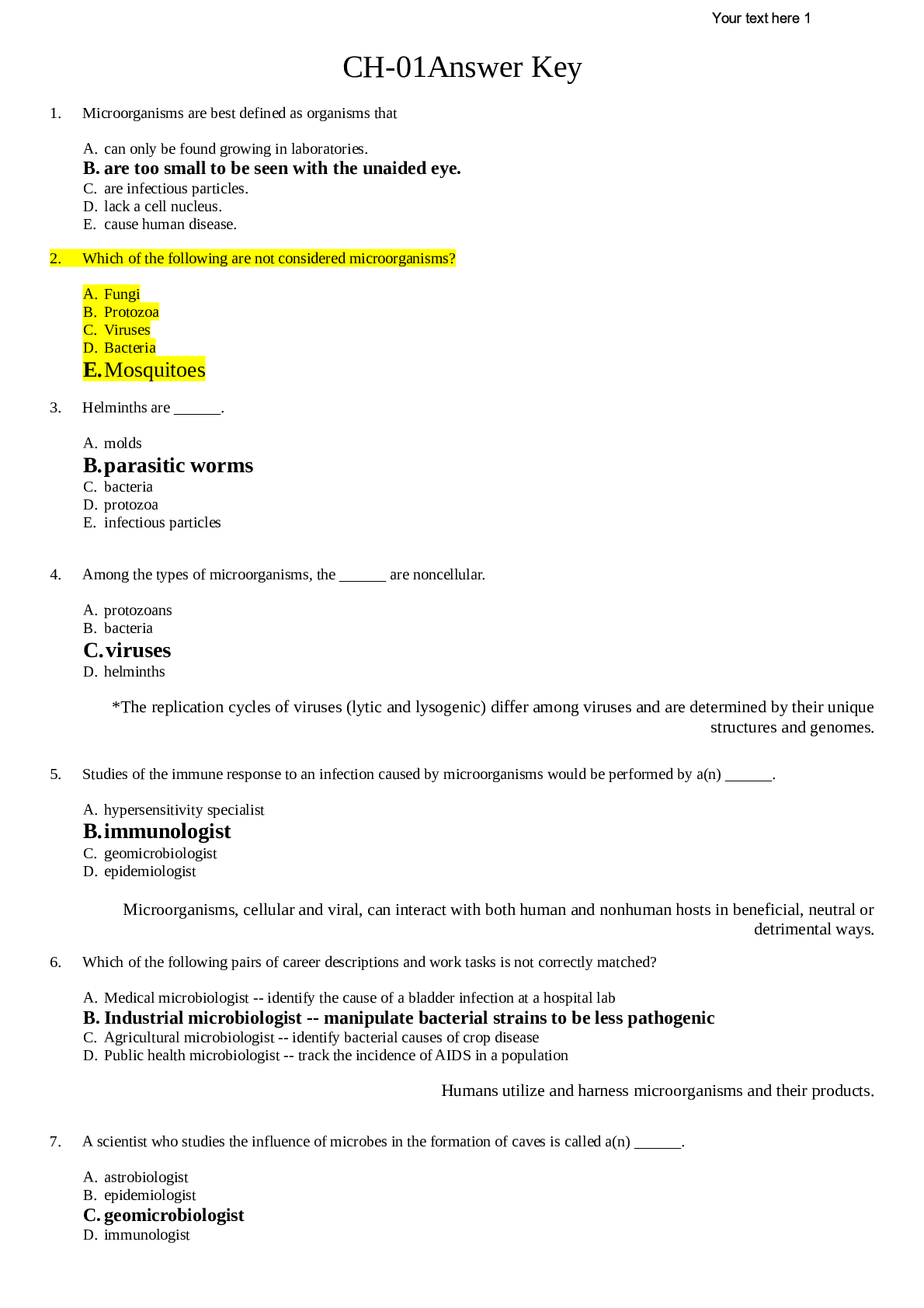




 By Eric Foner (Test Bank).png)