1. (TCO B) Which of the following statements concerning the MM extension with growth is
NOT CORRECT?
(a) The tax shields should be discounted at the unlevered cost of equity.]
(b) The value of a growing tax shield is
...
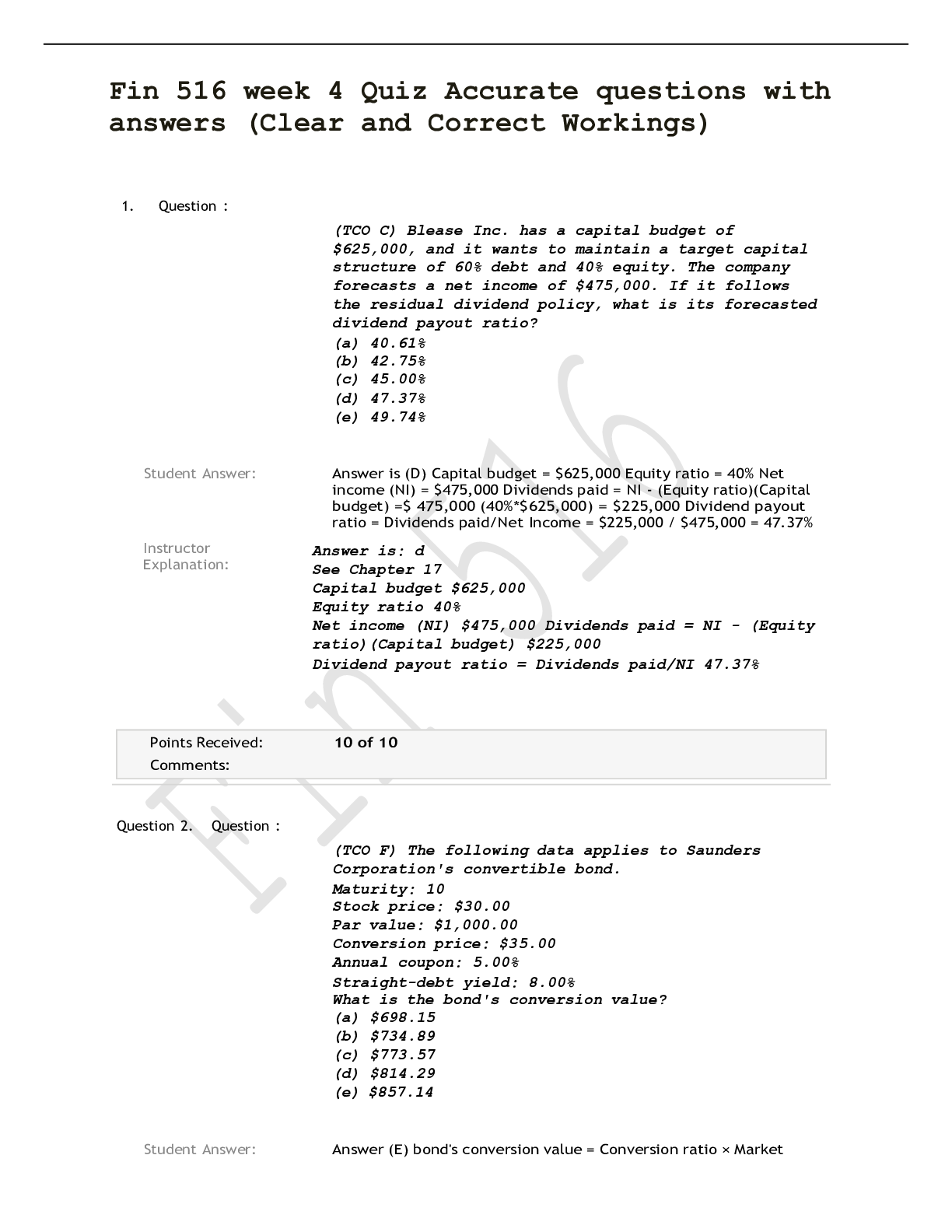
1. (TCO B) Which of the following statements concerning the MM extension with growth is
NOT CORRECT?
(a) The tax shields should be discounted at the unlevered cost of equity.]
(b) The value of a growing tax shield is greater than the value of a constant tax shield.
(c) For a given D/S, the levered cost of equity is greater than the levered cost of equity under
MM’s original (with tax) assumptions.
(d) For a given D/S, the WACC is greater than the WACC under MM’s original (with tax)
assumptions.
(e) The total value of the firm is independent of the amount of debt it uses.
Question 2.2. (TCO D) Which of the following statements is most correct?
(a) In a private placement, securities are sold to private (individual) investors rather than to
institutions.
(b) Private placements occur most frequently with stocks, but bonds can also be sold in a
private placement.
(c) Private placements are convenient for issuers, but the convenience is offset by higher
flotation costs.
(d) The SEC requires that all private placements be handled by a registered investment
banker.
(e) Private placements can generally bring in funds faster than is the case with public
offerings. (Points : 20)
2. (TCO D) Which of the following is generally NOT true and an advantage of going
public?
(a) Facilitates stockholder diversification.
(b) Increases the liquidity of the firm's stock.
(c) Makes it easier to obtain new equity capital.
(d) Establishes a market value for the firm.
(e) Makes it easier for owner-managers to engage in profitable self-dealings.
Question 3.3. (TCO E) Buster’s Beverages is negotiating a lease on a new piece of
equipment that would cost $100,000 if purchased. The equipment falls into the MACRS
3-year class, and it would be used for 3 years and then sold, because the firm plans to
move to a new facility at that time. The estimated value of the equipment after 3 years is
$30,000. If the borrow and purchase option is used, the cash flows would be the
following: (Year 1) -2,400; (Year 2) -3,800; (Year 3) -1,400; (Year 4) -79,600; all of these
cash outflows would be at the beginning of the respective years. Alternatively, the firm
could lease the equipment for 3 years, with annual lease payments of $29,000 per year,
payable at the beginning of each year. The firm is in the 20% tax bracket. If it borrows
and purchases, it could obtain a 3-year simple interest loan, to purchase the equipment
at a before-tax interest rate of 10%. If there is a positive net advantage to leasing, the
firm will lease the equipment. Otherwise, it will buy it. What is the NAL?
(a) $5,736
(b) $6,023
(c) $6,324
(d) $6,640
(e) $6,972 (Points : 20)
Life of equipment: 3 Tax rate: 20%
Loan amount = equipment cost:$100,000 Maintenance costs: $3,000
Interest rate, simple: 10.0% Salvage value: $30,000
Lease Pmt: $29,000
Loan Analysis: 0 1 2 3 Totals
MACRS factor 0.33 0.45 0.15 0.93
Depreciation 33,000 45,000 15,000 93,000
Loan repayment -100,000
Interest -10,000 -10,000 -10,000
Int tax saving (Interest T)) 2,000 2,000 2,000
Maintenance -3,000 -3,000 -3,000
Maint. tax saving (Maint. T) 600 600 600
Depr'n tax saving (Deprn T) 6 ,600 9 ,000 3,000
Net operating CF -2,400 -3,800 -1,400 -105,000
Salvage value before taxes 30,000
Book value (Cost − Total dep'rn) 7,000
Taxable salvage value 23,000
Tax on salvage value -4,600
Salvage value after taxes 25,400
Total Net CF - 2 ,400 -3 ,800 -1 ,400 -79,600
PV cost at I(1 − T) = 8.00% -70,308
Lease Analysis: 0 1 2 3
Lease payment -29,000 -29,000 -29,000
Tax saving on pmt 5 ,800 5 ,800 5 ,800 0
Net cost of lease -23 ,200 -23 ,200 -23 ,200 0
PV cost of leasing at I(1 − T) -64,572
NAL = $5,736
3. (TCO E) Dakota Trucking Company (DTC) is evaluating a potential lease for a truck
with a 4-year life that costs $40,000 and falls into the MACRS 3-year class. If the firm
borrows and buys the truck, the loan rate would be 10%, and the loan would be amortized
over the truck's 4-year life. The loan payments would be made at the end of each year. The
truck will be used for 4 years, at the end of which time it will be sold at an estimated
residual value of $10,000. If DTC buys the truck, its after tax cash flows would be the
following: (Year 1) - 6,339; (Year 2) -4,764; (Year 3)-9,943; (Year 4) -5,640; all occurring
at the end of respective years. The lease terms, call for a $10,000 lease payment (4
payments total) at the beginning of each year. DTC's tax rate is 40%. Should the firm lease
or buy?
(a) $849
(b) $896
(c) $945
(d) $997
(e) $1,047
Life of equipment: 4 Tax rate: 40%
Loan amount = equipment cost:$40,000 Maintenance costs: $1,000
Interest rate: 10.0% Salvage value: $10,000
Lease Pmt: $10,000
Loan amortization for cash payment and interest expense:
Payment: N = 4, I/YR = 10, PV = 40000, FV = 0. PMT = -$12,618.83
Year Beg. Bal. PMT Interest Principal Ending Bal.
1 40,000 12,619 4,000 8,619 31,381
2 31,381 12,619 3,138 9,481 21,900
3 21,900 12,619 2,190 10,429 11,472
4 11,472 12,619 1,147 11,472 0
Loan Analysis: 0 1 2 3 4
MACRS factor 0.33 0.45 0.15 0.07
Depreciation 13,200 18,000 6,000 2,800
Loan Pmt -12,619 -12,619 -12,619 -12,619
Int tax saving (Int. from table T)) 1,600 1,255 876 459
Maintenance -1,000 -1,000 -1,000 -1,000
Maint. tax saving (Maint. T) 400 400 400 400
Depr'n tax saving (Deprn T) 5 ,280 7 ,200 2 ,400 1,120
Net operating CF -6,339 -4,764 -9,943 -11,640
Salvage value 10,000
Tax on residual -4,000
Net residual val 6,000
Total Net CF -6 ,339 -4 ,764 -9 ,943 -5,640
PV cost of buying at I(1 – T) = 6.00% -23,035
Lease Analysis: 0 1 2 3 4
Lease payment -10,000 -10,000 -10,000 -10,000 0
Tax saving on pmt 4 ,000 4 ,000 4 ,000 4 ,000 0
Net cost of lease -6 ,000 -6 ,000 -6 ,000 -6 ,000 0
PV cost of leasing at I(1 – T) -22,038
NAL = $997
[Show More]
.png)









 (1).png)