Chapter 1
Basic and Advanced Interviewing Techniques
Basic maximize patient's comfort, avoid unnecessary changes in position, enhance
clinical efficiency, move head to toe, examine the patient from their right side
A
...
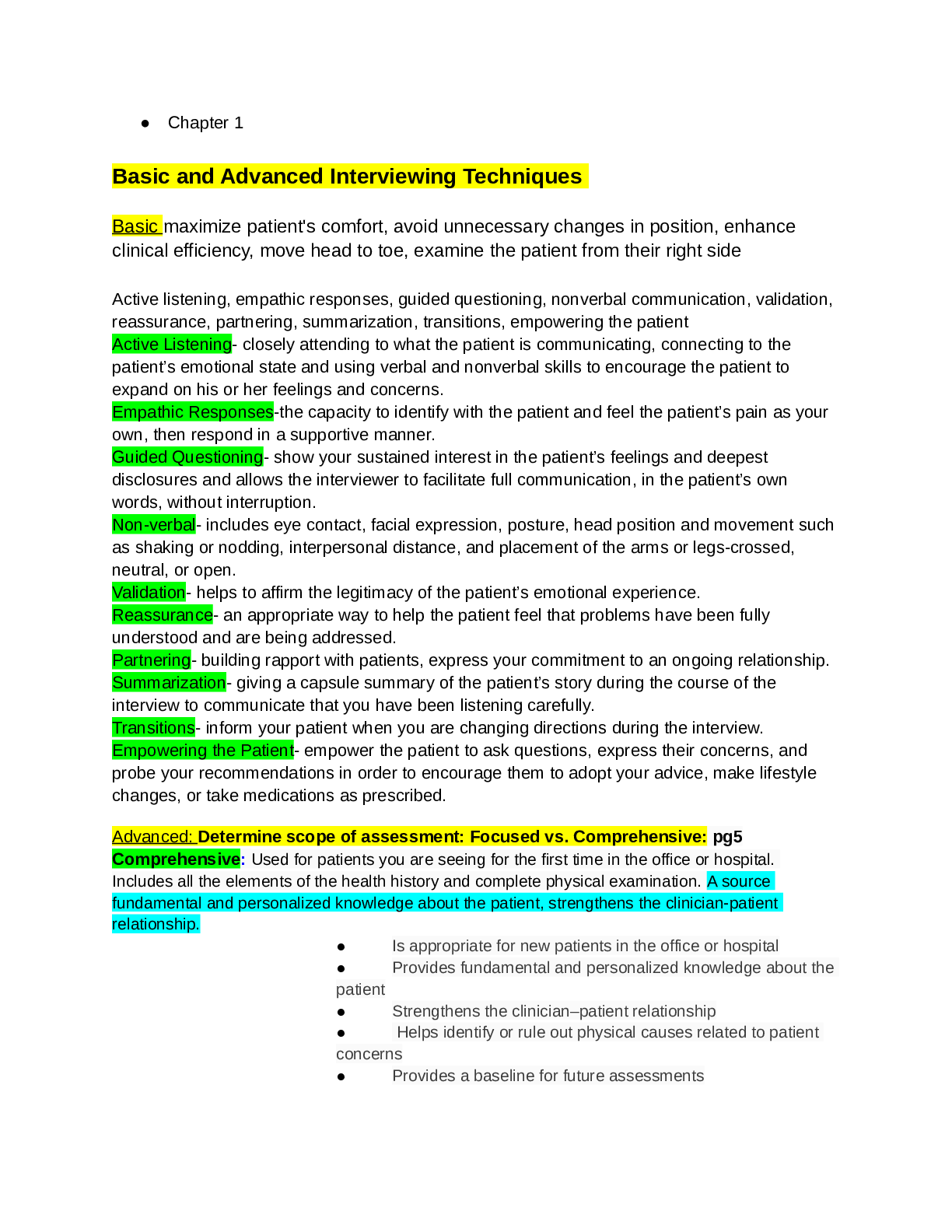
Chapter 1
Basic and Advanced Interviewing Techniques
Basic maximize patient's comfort, avoid unnecessary changes in position, enhance
clinical efficiency, move head to toe, examine the patient from their right side
Active listening, empathic responses, guided questioning, nonverbal communication, validation,
reassurance, partnering, summarization, transitions, empowering the patient
Active Listening- closely attending to what the patient is communicating, connecting to the
patient’s emotional state and using verbal and nonverbal skills to encourage the patient to
expand on his or her feelings and concerns.
Empathic Responses-the capacity to identify with the patient and feel the patient’s pain as your
own, then respond in a supportive manner.
Guided Questioning- show your sustained interest in the patient’s feelings and deepest
disclosures and allows the interviewer to facilitate full communication, in the patient’s own
words, without interruption.
Non-verbal- includes eye contact, facial expression, posture, head position and movement such
as shaking or nodding, interpersonal distance, and placement of the arms or legs-crossed,
neutral, or open.
Validation- helps to affirm the legitimacy of the patient’s emotional experience.
Reassurance- an appropriate way to help the patient feel that problems have been fully
understood and are being addressed.
Partnering- building rapport with patients, express your commitment to an ongoing relationship.
Summarization- giving a capsule summary of the patient’s story during the course of the
interview to communicate that you have been listening carefully.
Transitions- inform your patient when you are changing directions during the interview.
Empowering the Patient- empower the patient to ask questions, express their concerns, and
probe your recommendations in order to encourage them to adopt your advice, make lifestyle
changes, or take medications as prescribed.
Advanced: Determine scope of assessment: Focused vs. Comprehensive: pg5
Comprehensive: Used for patients you are seeing for the first time in the office or hospital.
Includes all the elements of the health history and complete physical examination. A source
fundamental and personalized knowledge about the patient, strengthens the clinician-patient
relationship.
● Is appropriate for new patients in the office or hospital
● Provides fundamental and personalized knowledge about the
patient
● Strengthens the clinician–patient relationship
● Helps identify or rule out physical causes related to patient
concerns
● Provides a baseline for future assessments
● Creates a platform for health promotion through education
and counseling
● Develops proficiency in the essential skills of physical
examination
Flexible Focused or problem-oriented assessment: For patients you know well returning for
routine care, or those with specific “urgent care” concerns like sore throat or knee pain. You will
adjust the scope of your history and physical examination to the situation at hand, keeping
several factors in mind: the magnitude and severity of the patient’s problems; the need for
thoroughness; the clinical setting—inpatient or outpatient, primary or subspecialty care; and the
time available.
● Is appropriate for established patients, especially during
routine or urgent care visits
● Addresses focused concerns or symptoms
● Assesses symptoms restricted to a specific body system
● Applies examination methods relevant to assessing the
concern or problem as thoroughly and carefully as possible
Tangential lighting: JVD, thyroid gland, and apical impulse of heart.
Components of the Health History Jenna/Ashley
Initial information
Identifying data and source of the history; reliability
Identifying data- age, gender, occupation, marital status
Source of history- usually patient. Can be: a family member or friend, letter of referral, or clinical
record.
Reliability- Varies according to the patient’s memory, trust, and mood.
Chief Complaint
Chief Complaint- Make every attempt to quote the patient’s own words.
Present Illness
Complete, clear and chronological description of the problem prompting the patient visit
Onset, setting in which it occurred, manifestations and any treatments
Should include 7 attributes of a symptom:
● Location
● Quality
● Quantity or severity
● Timing, onset, duration, frequency
● Setting in which it occurs
● Aggravating or relieving factors
● Associated manifestations
-Differential diagnosis is derived from the “pertinent positives” and “pertinent negatives” when
doing Review of Systems that are relevant to the chief complaint. A list of potential causes for
the patients problems.
-Present illness should reveal patient’s responses to his or her symptoms and what effect this
has on their life.
-Each symptom needs its own paragraph and a full description.
-Medication should be documented, name, dose, route, and frequency. Home remedies, nonprescriptions drugs, vitamins, minerals or herbal supplements, oral contraceptives, or borrowed
medications.
-Allergies-foods, insects, or environmental, including specific reaction
Tobacco use, including the type. If someone has quit, note for how long
-Alcohol and drug use should always be investigated and is often pertinent to the Presenting
Illness.
Past history
-Childhood Illness: measles, rubella, mumps, whooping cough, chickenpox, rheumatic fever,
scarlet fever, and polio. Also include any chronic childhood illness
-Adult illnesses: Provide information in each of the 4 areas:
● Medical: diabetes, hypertension, hepatitis, asthma and HIV;
hospitalizations; number and gender of sexual partners; and risk
taking sexual practices.
● Surgical: dates, indications, and types of operations
● Obstetric/gynecologic: Obstetric history, menstrual history,
methods of contraception, and sexual function.
● Psychiatric: Illness and time frame, diagnoses,
hospitalizations, and treatments.
-Health Maintenance: Find out if they are up to date on immunizations and screening tests.
Review Tb tests, pap smears, mammograms, stool tests for occult blood, colonoscopy,
cholesterol levels etc..
Family history
Outlines or diagrams age and health, or age and cause of death, of siblings, parents, and
grandparents
Documents presence or absence of specific illnesses in family, such as hypertension, coronary
artery disease, elevated cholesterol levels, stroke, diabetes, thyroid or renal disease, arthritis,
tuberculosis, asthma or lung disease, headache, seizure disorder, mental illness, suicide,
substance abuse, and allergies, and symptoms reported by patient.
Ask about history of breast, ovarian, colon, or prostate cancer
Ask about Genetically transmitted diseases
Personal or social history
Describes educational level, occupation, family of origin, current household, personal interests,
and lifestyle
Capture the patients personality and interests, sources of support, coping style, strengths, and
concerns
Includes lifestyle habits that promote health or create risk, such as exercise and diet, safety
measures, sexual practices, and use of alcohol, drugs, and tobacco
Expanded personal and social history personalizes your relationship with the patient and builds
a rapport
Review of systems pg 11-13
Documents presence or absence of common symptoms related to each of the major body
systems
Understanding and using Review of Systems questions may seem challenging at first. These
“yes-no” questions should come at the end of the inter- view. Think about asking a series of
questions going from “head to toe.” It is helpful to prepare the patient by saying, “The next part
of the history may feel like a hundred questions, but it is important to make sure we have not
missed anything.”
Most Review of Systems questions pertain to symptoms, but on occasion, some clinicians
include diseases like pneumonia or tuberculosis.
Note that as you elicit the Present Illness, you may also draw on Review of Systems questions
related to system(s) relevant to the Chief Complaint to establish “pertinent positives and
negatives” that help clarify the diagnosis.
For example, after a full description of chest pain, you may ask, “Do you have any history of
high blood pressure . . . palpitations . . . shortness of breath . . . swelling in your ankles or feet?”
or even move to questions from the Respiratory or Gastrointestinal Review of Systems
The Review of Systems questions may uncover problems that the patient has overlooked,
particularly in areas unrelated to the Present Illness. Significant health events, such as past
surgery, hospitalization for a major prior illness, or a parent’s death, require full exploration.
Keep your technique flexible.
Remember that major health events discovered during the Review of Systems should be moved
to the Present Illness Past History in your write-up.
Some experienced clinicians do the Review of Systems during the physical examination, asking
about the ears, for example, as they examine them. If the patient has only a few symptoms, this
combination can be efficient. If there are multiple symptoms, however, this can disrupt the flow
of both the history and examination, and necessary note taking becomes awkward
The Review of Systems: Pg. 12-13 ROS Chart Copied from online book
General: Usual weight, recent weight change, clothing that fits more tightly or loosely
than before; weakness, fatigue, or fever. Skin: Rashes, lumps, sores, itching, dryness,
changes in color; changes in hair or nails; changes in size or color of moles.
Head, Eyes, Ears, Nose, Throat (HEENT): Head: Headache, head injury, dizziness,
lightheadedness. Eyes: Vision, glasses or contact lenses, last examination, pain, redness,
excessive tearing, double or blurred vision, spots, specks, flashing lights, glaucoma, cataracts.
Ears: Hearing, tinnitus, vertigo, earaches, infection, discharge. If hearing is decreased, use or
nonuse of hearing aids. Nose and sinuses: Frequent colds, nasal stuffiness, discharge, or
itching, hay fever, nosebleeds, sinus trouble. Throat (or mouth and pharynx): Condition of teeth
and gums, bleeding gums, dentures, if any, and how they fit, last dental examination, sore
tongue, dry mouth, frequent sore throats, hoarseness.
Neck: “Swollen glands,” goiter, lumps, pain, or stiffness in the neck.
Breasts: Lumps, pain, or discomfort, nipple discharge, self-examination practices.
Respiratory: Cough, sputum (color, quantity; presence of blood or hemoptysis), shortness of
breath (dyspnea), wheezing, pain with a deep breath (pleuritic pain), last chest x-ray. You may
wish to include asthma, bronchitis, emphysema, pneumonia, and tuberculosis.
Cardiovascular: “Heart Trouble”; high blood pressure; rheumatic fever; heart murmurs; chest
pain or discomfort; palpitations; shortness of breath; need to use pillows at night to ease
breathing (orthopnea breathing (paroxysmal nocturnal dyspnea); swelling in the hands, ankles,
or feet (edema); results of past electrocardiograms or other cardiovascular tests.
Gastrointestinal: Trouble swallowing, heartburn, appetite, nausea. Bowel move-ments, stool
color and size, change in bowel habits, pain with defecation, rectal bleeding or black or tarry
stools, hemorrhoids, constipation, diarrhea. Abdominal pain, food intolerance, excessive
belching or passing of gas. Jaundice, liver, or gallbladder trouble; hepatitis.
Peripheral vascular: Intermittent leg pain with exertion (claudication); leg cramps; varicose
veins; past clots in the veins; swelling in calves, legs, or feet; color change in fingertips or toes
during cold weather; swelling with redness or tenderness. Urinary: Frequency of urination,
polyuria, nocturia, urgency, burning or pain during urination, blood in the urine (hematuria),
urinary infections, kidney or flank pain, kidney stones, ureteral colic, suprapubic pain,
incontinence; in males, reduced caliber or force of the urinary stream, hesitancy, dribbling.
Genital Male: Hernias, discharge from or sores on the penis, testicular pain or masses, scrotal
pain or swelling, history of sexually transmitted infections and their treatments. Sexual habits,
interest, function, satisfaction, birth control methods, condom use, and problems. Concerns
about HIV infection.
Female: Age at menarche, regularity, frequency, and duration of periods, amount of bleeding;
bleeding between periods or after intercourse, last menstrual period, dysmenorrhea,
premenstrual tension. Age at menopause, menopausal symptoms, postmenopausal bleeding. If
the patient was born before 1971, exposure to diethylstilbestrol (DES) from maternal use during
pregnancy (linked to cervical carcinoma). Vaginal discharge, itching, sores, lumps, sexually
transmitted infections and treatments. Number of pregnancies, number and type of deliveries,
number of abortions (spontaneous and induced), complications of pregnancy, birth-control
methods. Sexual preference, interest, function, satisfaction, any problems, including
dyspareunia. Concerns about HIV infection.
Musculoskeletal: Muscle or joint pain, stiffness, arthritis, gout, backache. If present, describe the
location of affected joints or muscles, any swelling, redness, pain, tenderness, stiffness,
weakness, or limitation of motion or activity; include timing of symptoms (e.g., morning or
evening), duration, and any history of trauma. Neck or low back pain. Joint pain with systemic
symptoms such as fever, chills, rash, anorexia, weight loss, or weakness.
Psychiatric: Nervousness, tension, mood, including depression, memory change, suicidal
ideation, suicide plans or attempts. Past counseling, psycho-therapy, or psychiatric admissions.
Neurologic: Changes in mood, attention, or speech; changes in orientation, memory, insight, or
judgment; headache, dizziness, vertigo, fainting, black-outs; weakness, paralysis, numbness or
loss of sensation, tingling or “pins and needles”.
Subjective vs Objective Data
Subjective- symptoms or what the patient tells you. Apparent only to the person affected;
includes client’s perceptions, feelings, thoughts, and expectations. Cannot be directly observed
and can be discovered only asking questions. Examples: low back pain, fatigue, immunizations,
weight gain, stomach cramps.
Objective- signs or what you observe. Detectable by an observer or can be tested against
acceptable standard; tangible; observable facts; includes observation of client behavior, medical
records, lab and diagnostic tests, data collected by physical exam. Examples: blood pressure,
heart rate, wound appearance, lung sounds, ambulation description.
Subjective Data (symptoms) Objective Data (signs)
What the patient tells you What is observed during physical
examination
Patients history, from Chief Complaint
through Review of Systems
Laboratory information, test data
DocumentationDocumentation needs to be CLEAR, CONCISE, COMPREHENSIVE.
-think order and readability, amount of detail.
- Record: history, PE, and lab findings
- describe what's observed not what was done
-SOAP (subjective, objective, assessment, & plan) note is used for providers of various
backgrounds/specialties to communicate with each other
Chapter 2
Clinical Decision Making ashley
Clinical decision making should be evidence based. The FNP should draw on a full range of knowledge
and experience, and read widely. Clinical decision making is when the reading about diseases and
abnormalities is most useful. By consulting the clinical literature, you are embarking on evidence-based
decision making and clinical practice. There are five steps to generating a clinical hypotheses
1. Select the most specific and critical findings to support your hypothesis
2. Match findings against all the conditions that can produce them.
3. Eliminate the diagnostic possibilities that fail to explain findings.
4. Weigh the competing possibilities and select the most likely diagnosis
5. Give special attention to potentially life-threatening conditions
Once the hypothesis is made it should be tested, this may include further history taking, testing or
physical examination. The next step is to establish a working diagnosis such as “bacterial meningitis,
pneumococcal”. The final step is developing a plan. The plan should make reference to diagnosis,
treatment and patient education. It is important to discuss your assessment with the patient prior to
finalizing the plan to ensure the patient is onboard.
Critical Thinking and Reasoning
Critical thinking- the mental process of actively and skillfully perception, analysis, synthesis and
evaluation of collected information through observation, experience and communication that
leads to a decision for action. The main critical thinking skills in which nursing students should
be exercised during their studies are critical analysis, introductory and concluding justification,
valid conclusion, distinguish between facts and opinions, evaluation the credibility of information
sources, clarification of concepts and recognition of conditions. Critical thinking is an essential
process for the safe, efficient and skillful nursing practice. The nursing education programs
should adopt attitudes that promote critical thinking and mobilize the skills of critical reasoning.
Critical thinking is the disciplined, intellectual process of applying skillful reasoning as a guide to
belief or action. In nursing, critical thinking for clinical decision-making is the ability to think in a
systematic and logical manner with openness to question and reflect on the reasoning process
used to ensure safe nursing practice and quality care. Critical thinking when developed in the
practitioner includes adherence to intellectual standards, proficiency in using reasoning, a
commitment to develop and maintain intellectual traits of the mind and habits of thought and the
competent use of thinking skills and abilities for sound clinical judgments and safe decisionmaking.
Differential Diagnoses (obtained from book and week 1 review) - A list with potential causes of
patient specific problem/CC
-A chief complaint must be identified first.
-Includes all medical diseases that may possibly explain problem/ CC.
-The differential diagnosis list should begin with the most likely explanation or etiology for the
problem/CC. EX: C/O vomiting blood: 1. Peptic ulcer 2.Cirrhosis with bleeding esophageal
varices 3. Acute hemorrhagic gastritis
-Differential diagnostic procedures are used by clinicians to diagnose the specific disease in a
patient, or, at least, to eliminate any imminently life-threatening conditions. The differential
diagnosis list is similar to, but different from, the problem list.
-The differential diagnosis includes all of the medical diseases that may possibly explain the
patient’s chief complaint or principal problem
-A differential diagnosis list is focused on providing an explanation for a specific complaint.
-In order to develop a differential list versus a problem list, you must first identify the chief
complaint. Each differential diagnosis should offer an explanation or etiology for the same chief
complaint.
Pathological and Physiological Processes
Pathologic Process- patient complaints often stem from a pathologic process involving diseases
of a body system or structure. Common Classified: congenital, inflammatory or infectious,
immunologic, neoplastic, metabolic, nutritional, degenerative, vascular, traumatic, and toxic.
Example: Possible pathological causes of a headache include- sinus infection, concussion from
trauma, subarachnoid hemorrhage, or brain tumor.
Problem List
-After you complete the clinical record, it is good clinical practice to generate a
problem list that summarizes the patient’s problems that can be placed in the
front of the office or hospital chart.
-List the most active and serious problems first
and record their date of onset.
- Helps to individualize the patient’s care. On follow-up
visits, provides a quick summary of the patient’s clinical history
and a reminder to review the status of problems the patient may not mention.
-An accurate Problem List allows better population management of patients, by
using EHRs to track patients with specific problems, recall patients who are
behind on appointments, and follow up on specific issues.
-Allows other members of the health care team to learn about the patient’s health
status at a glance.
For example, in a patient who is vomiting blood and is known to have migraines and to be
diabetic, the problem list might read:
1. Hematemesis
2. Diabetes Mellitus
3. Migraine
4. Recent divorce
5. Poverty
Prioritization
Generate problem list with all problems noted, differential diagnoses should cover all possible causes of
chief complaint. Prioritize which complaints/problems are highest priority (urgent) for this visit. (i.e., Tina
has diabetes, htn, and a slew of other issues, but utmost importance is her foot wound and ankle pain)
Chapter 3
**Interpretation and Analysis (Area is lacking information) Heather and Stacy
The clinician must focus on the patient to elicit the full story of the patient's symptoms, but the
clinician must also interpret key information to reach an assessment and plan. Patient-centered
interviews recognize the importance of patients' expressions of personal concerns, feelings, and
emotions and evoke the personal context of the patient's symptoms and disease
Sensitivity- true positive. The probability that a person with disease as a + test.
Specificity- True negative.
SnNOUT- a sensitive test with a negative result rule OUT disease
SpPIN- a specific test with a positive result rules IN disease
Bayes Theorem- one way to use likelihood ratios to revise probabilities for disease
Natural frequencies- represents the joint frequency of two events, such as the number of
patients with disease and the number who have a positive test result.
Kappa score- reproductivity. Measures the amount of agreement that occurs beyond chance.
Precision-reproductivity. Being able to apply the same test to the same unchanged person and
obtain the same results.
Logical Sequence pg 73
In general, an interview moves through several stages. Throughout this sequence, as the clinician you
must remain attuned to the patient’s feelings, help the patient express them, respond to their content, and
validate their significance. As a student, you will concentrate primarily on eliciting the patient’s story and
creating a shared understanding of the patient’s concerns. Later on, as a practicing clinician, reaching an
agreement on a plan for further evaluation and treatment becomes more important. Whether the interview
is comprehensive or focused, pay close attention to the patient’s feelings and affect, always working on
strengthening the relationship as you move through the typical sequence that follows. Including the
patient’s feelings, ideas, and expectations leads to therapeutic interventions best suited to the patient’s
needs, coping skills, and life circumstances.
[Show More]