Guidance Note on Audit of Banks (2021 Edition) (Last date for comments: March 4, 2021)
*NURSING > Quiz > United States University FNP 593: All Quizzes | Complete Questions and Answers | 100% correct Fall 2 (All)
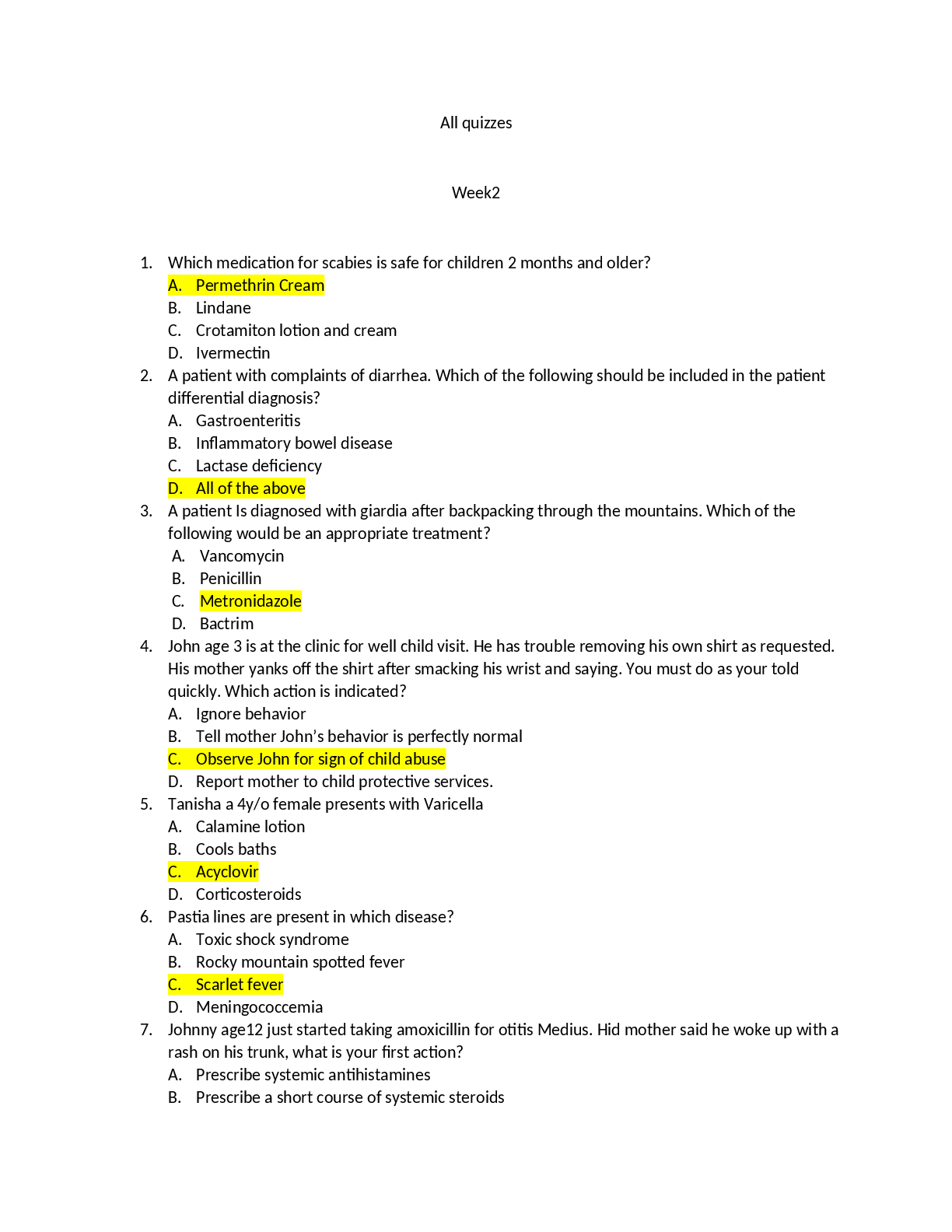
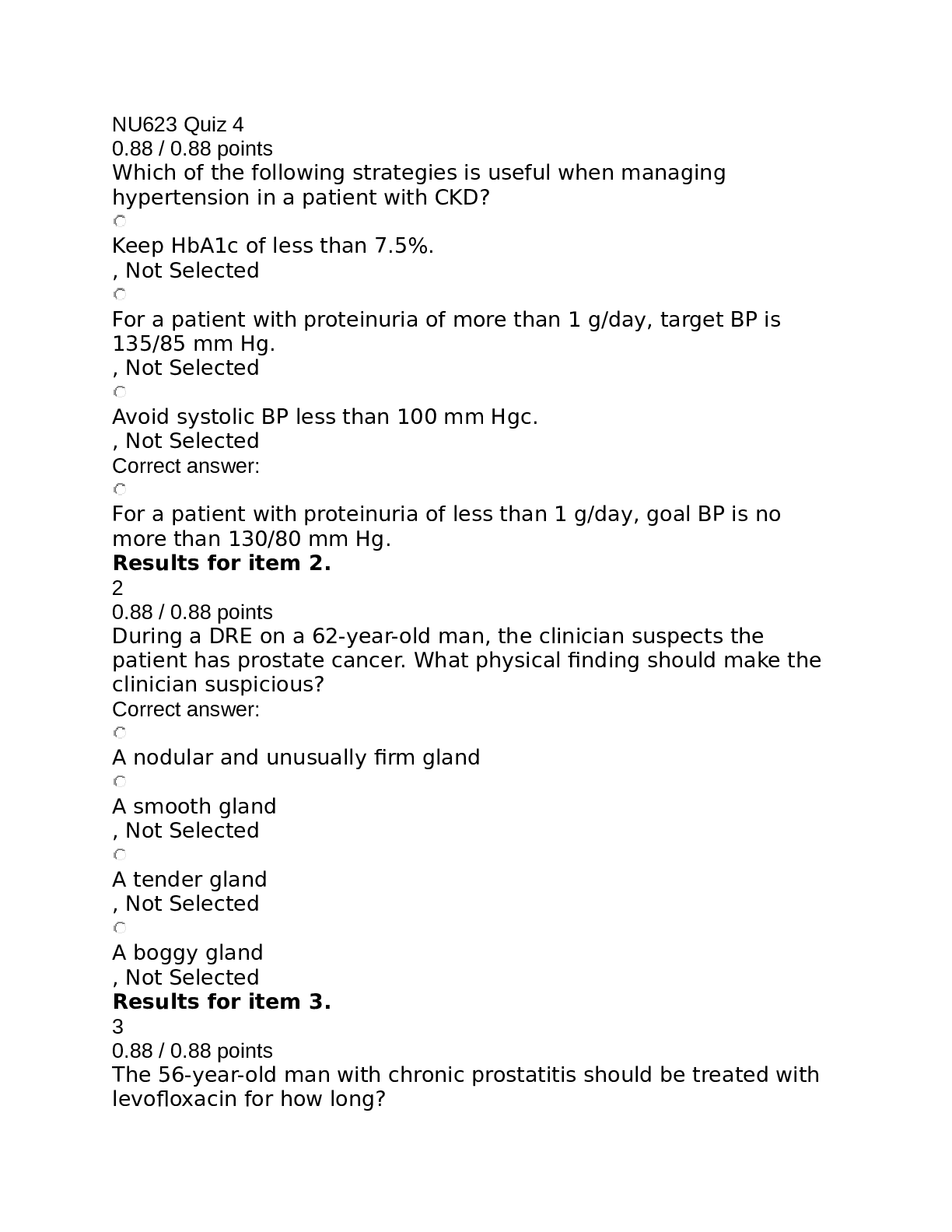
All quizzes Week2 1. Which medication for scabies is safe for children 2 months and older? A. Permethrin Cream B. Lindane C. Crotamiton lotion and cream D. Ivermectin 2. A patient with complaints of d ... iarrhea. Which of the following should be included in the patient differential diagnosis? A. Gastroenteritis B. Inflammatory bowel disease C. Lactase deficiency D. All of the above 3. A patient Is diagnosed with giardia after backpacking through the mountains. Which of the following would be an appropriate treatment? A. Vancomycin B. Penicillin C. Metronidazole D. Bactrim 4. John age 3 is at the clinic for well child visit. He has trouble removing his own shirt as requested. His mother yanks off the shirt after smacking his wrist and saying. You must do as your told quickly. Which action is indicated? A. Ignore behavior B. Tell mother John’s behavior is perfectly normal C. Observe John for sign of child abuse D. Report mother to child protective services. 5. Tanisha a 4y/o female presents with Varicella A. Calamine lotion B. Cools baths C. Acyclovir D. Corticosteroids 6. Pastia lines are present in which disease? A. Toxic shock syndrome B. Rocky mountain spotted fever C. Scarlet fever D. Meningococcemia 7. Johnny age12 just started taking amoxicillin for otitis Medius. Hid mother said he woke up with a rash on his trunk, what is your first action? A. Prescribe systemic antihistamines B. Prescribe a short course of systemic steroidsC. Stop the amoxicillin D. Continue the drugs this is normal 8. Client teaching is an integral part of successfully treating pediculosis. Which of the following statements would you incorporate in your teaching plan? A. It is ok to resume sharing combs after being lice free for 1 month. B. Soak you brushes and combs in rubbing alcohol for 8 hours. C. Itching may continue after successful treatment for up to a week. D. Spraying pesticides is necessary. 9. The Viral exanthem of Koplik spots is present in A. Rubeola B. Rubella C. Fifth disease D. Varicella 10. Which disease usually starts at the cheek and spreads to the arms and trunk? A. Fifth disease B. Rocky mountain spotted fever C. Rubeola D. Rubella 11. Susie age 6 has a Candida infection in the upper diaper area. What do you suggest to the mother? A. Use rubber or plastic pants B. Keep the area as dry as possible C. Use baby powder with cornstarch D. Keep Susie away from other babies until the infection is cleared 12. A common complication of viral gastroenteritis in children is A. Dehydration B. Gastrointestinal bleeding C. Peritonitis D. Bacterial Sepsis 13. Which protozoal infection is the most common intestinal infection in the United States that also occurs worldwide? A. Salmonella B. Giardiasis C. Botulism D. Shigellosis 14. A G1P1AO is breastfeeding her 1-week-old daughter. The baby appears well hydrated, has gained 4 ounces since being discharged from the hospital 3 days ago, but her bilirubin level is 16 mg/dl today. At this point, the best recommendation regarding feeding the newborn is: A. Stop breastfeeding B. Continue breastfeeding every 1-3 hours C. Discontinue breastfeeding for 72 hours. D. Alternate breast milk with formula for every other feeding 15. The most common viral infection causing pediatric diarrhea in the United States isA. Enteric adenovirus B. A Norwalk like virus C. Rotavirus D. Giardia Lamblia 16. Robert, 6 years old returned from central America with traveler’s diarrhea. Which is the best treatment? A. Metronidazole B. Supportive care C. Quinolone D. Gastric lavage 17. “For an uncomplicated Salmonella infection, the antibiotic of choice for 5 years old is” A. Ampicillin B. Amoxicillin C. Trimethoprim-sulfamethoxazole D. No antibiotic is indicated 18. When treating gastroenteritis in a pediatric patient, the nurse practitioner knows that: A. Phenergan is most effective B. Children 40-85 lbs can be given Promethazine 2.5 mg twice daily up to max of 15 mg/dl C. Children >2years old can be given 12.5 to 25 mg by mouth every 12 hours. D. Evidence suggests that the Banana, Rice, Applesauce, Toast diet (BRAT) should be followed for 72 hours. 19. Matt 10 years old recently returned from camping trip with his parents and has gastroenteritis. He says that he has been eating only canned food. Which of the following pathogens do you suspect? A. Campylobacter jejuni B. Clostridium Botulinum C. E Coli D. Staphylococcus 20. David who is 3 years old was brought in by his mother because of sudden abdominal pain with sudden relief of pain. The provider also felt a sausage shaped tumor mass in right abdomen. The Np’s clinical diagnosis should be: A. Appendicitis B. Pyloric stenosis C. Intestinal Obstruction D. Intussusception 21. “In performing assessment of a 3-year-old male child, the nurse practitioner found out that his pulse is thread and his mucous is dry. She will categorize his symptoms as” A. Mild dehydration B. Moderate dehydration C. Severe dehydration D. Normal findings 22. Emancipated minor is per state defined status is (are) A. MarriedB. Member of armed forces C. Self-supporting and living on own D. All of the above 23. A seven-year-old female was brought in by her parents with fever and rashes on hands and mouth for 3 days. Mother is considered that the child has chickenpox. What clinical diagnosis the NP is considering? A. Varicella B. Hand-foot-mouth disease C. German measles D. dermatitis 24. The viral exanthema is caused by herpes virus 6 and 7, with pink macules and papules trunk. The mother is concerned with him having high fever for several days. The diagnosis for this rash is A. Age 12whichRubella B. Fifth disease C. Roseola D. Scarlet fever 25. When using the recommended pharmaceutical treatment for scabies on a young child, the nurse practitioner knows to apply the preparation to A. The entire body from the neck down avoiding the eyes mouth and nose B. The entire body plus the scalp and face C. All areas where the rash is seen D. All areas with either rash or burrow 26. Ted who is 15 years old has just moved into a foster home. No records of immunizations. He needs to be checked before school starts, what does he need? A. Meningococcal B. MMR C. Tdap D. All of the above 27. What age is the first dose of the MMR vaccine routinely given? A. 4 months B. 2 months C. 8 months D. 12 months 28. When considering a person’s risk for measles, mumps, and rubella, the NP considers the following: A. Children should have to doses of measles, mumps, and rubella vaccines before their sixth birthday B. Considerable mortality and morbidity occur with all three diseases C. Most cases in the Unites States occur in infants D. The use of the vaccine is often associated with protracted arthralgia29. A 4year old boy brought in by mother for wellness visit. His mother tells the family nurse practitioner that he had a bad case of chicken pox 1 year ago. Which of the following immunizations are indicated? A. IPV, Hib, hep B B. IPB, Hib, MMR C. DTap, IPV, MMR, hep B D. DTap, IPV 30. A 13-year-old complains of severe sore throat for 3 days along with generalized rash and fever. The skin has the texture of fine sand paper. This best describes: A. Kawasaki disease B. Scarlet fever C. German measles D. Rubeola 31. A viral infection that started with coryza, colds, and conjunctivitis developed a rash that started from the head on down. There is also presence of cervical lymphadenopathy. This best describes: A. Measles (rubeola) B. German measles C. Scarlet fever D. Fifth disease 32. When giving influenza vaccine to a 7-year-old who has not received this immunization in the past, the NP considers that: A. Two doses 4 weeks or more apart should be given B. A single dose is adequate C. Children in this age group have the highest rate of influenza related to hospitalization D. The vaccine should not be given to a child with shellfish allergy 33. Hepatitis B vaccine should not be given to a child with a history of anaphylactic reaction to: A. Egg B. Baker’s yeast C. Neomycin D. Streptomycin 34. Which body mass to (BMI) percentile indicates that an adolescent patient is obese? A. At or above 80% B. At or above 85% C. At or above 90% D. At or above 95% 35. Which pediatric patient requires a length measurement? A. A patient who is 4 years of age B. A patient who is 5 years of age C. A patient who is 18 months of age D. A patient who is 36 months of age 36. Which information noted in the medical history contraindicates breastfeeding the newborn? A. Maternal history includes classic galactosemia B. Maternal history includes a negative varicella titerC. Maternal history is positive for latent tuberculosis (TB) D. Maternal history is positive for human immunodeficiency virus (HIV) 37. Which is the differential diagnosis for atopic dermatitis A. Rubella B. Measles C. Varicella D. Psoriasis 38. Scabies should be retreated with 5% permethrin in how many days? A. 3 B. 5 C. 7 D. 10 39. An 8-month-old brought into the clinic with symptoms of croup. Which of the following symptoms warrant immediate referral to the emergency room for probable admission? A. Respiratory rate of 30/min B. Stridor C. Pulse oximetry reading of 89% D. Hoarse cry 40. Which pediatric patient is at greatest risk for bacterial conjunctivitis? A. The toddler B. The preschooler C. The school age child D. The adolescent child Week 4 quiz 1. Of the following which is the diagnostic criterion bacterial vaginosis? A. Large number of WBCs on vaginal wet prep B. Clue cells C. Presence of hyphae on vaginal wet prep D. Ketone odor 2. A 25-year-old female patient presents with a painful ulcerated vulval lesion. She has multiple sexual partners; The most likely diagnosis would be: A. Syphilis B. HPV C. Herpes D. Chlamydia 3. Which of the following medication(s) is appropriate for empiric treatment of patient with suspected gonorrhea? A. Ceftriaxone and azithromycin B. Azithromycin and doxycycline C. DoxycyclineD. Ceftriaxone 4. Which of the following medications has a disulfiram-type reaction when taken with alcohol? A. Ciproflaxin B. Clindamycin C. Ceftriaxone D. Metronidazole 5. The NP diagnosis a female patient with trichomoniasis. The patient’s chief complaint would probably be: A. A painless, ulcerated vulval lesion with vaginal discharge B. A frothy, greenish vaginal discharge with itching C. Foul-smelling vaginal discharge D. Dyspareunia and lower abdominal pain 6. For pregnant woman diagnosed with gonorrhea what is the treatment of choice? A. Quinolones B. Cephalosporins C. Flagyl D. Penicillin 7. Which of the following physical findings is suggested of PID A. Vaginal discharge mucopurulent B. Right lower quadrant pain C. Vaginal bleeding D. Cervical motion tenderness 8. Complaints of dyspareunia, foul-smelling discharge and post-coital bleeding suggest which condition? A. Bacterial Vaginosis B. Urinary Tract Infection C. Candidiasis D. Trichomoniasis 9. Women who are treated for sexually transmitted diseases should receive education on which of the following: A. Retesting before having intercourse in five days B. Retesting three days after treatment C. Use a backup method of birth control if using oral contraceptives D. Use condoms before the partner is treated 10. Usan is eight weeks pregnant, her last LMP was February 20, 2015. Calculate her EDC using Negele’s Rule. A. November 10, 2015 B. November 27, 2015 C. December 10, 2015 D. December 25, 2015 11. The following are considered non-ulcerating STIs except: A. GonorrheaB. Syphilis C. Chlamydia D. Chancroid 12. The following medications are considered outpatient three regiments for Pelvic inflammatory disease except: A. Ceftriaxone 500mg IM once B. Bactrim DS 1 tab po BID x 7 days C. Doxycycline 100 mg po BID orally x 7 days D. Metronidazole 500mg 1 tab po TID x 7 days 13. CDC considered the following criteria in diagnosing bacterial vaginosis. Select the one that does not belong in the group. A. Copious thin white homogenous discharge B. Fishy odor C. Clue cells D. Vomiting 14. Daisy is 20 weeks pregnant. She saw her OB on 7/5/16. When will be her next prenatal visit? A. 7/26/16 B. July 2, 2016 C. November 26, 2016 D. February 26, 2016 15. Daisy is 26 weeks pregnant. She went to her OB physician for 26-week prenatal care. All of the following prenatal care protocol for 26-week pregnancy are done except: A. Education on the importance of care seat B. 1 hour glucose tolerance test C. Education on how to count the fetal movement D. Repeat HIV testing 16. Having prolonged or excessive vaginal bleeding at regular intervals is called: A. Menometrorrhagia B. Menorrhagia C. Metrorrhagia D. None of the above 17. In providing education to pregnant patient, the NP told her that during early pregnancy HCG double about every: A. 10 hours B. 48 hours C. 12 hours D. 2 hours 18. Normally, HCG levels during the 5th week of pregnancy ranges from: A. 3,640-117,000 B. 25,700-288,000 C. 4,060-165,400 D. 19-7,34019. A 26-year-old woman is seen with complaints if irregular vaginal bleeding. Which of the following tests should be the first priority? A. Pregnancy test B. Pelvic ultrasound C. Endometrial biopsy D. Platelet count 20. Which HPV types are most likely to cause condylomata acuminatum? A. 1,2, and 3 B. 6 and 11 C. 16 and 18 D. 22 and 24 21. NP smith is educating her patient regarding folic acid. She mentioned to the patient that increased folic acid intake before contraception is likely to reduce the risk of which of the following birth defects? A. Congenital cataract B. Pyloric stenosis C. Congenital heart defect D. Open neural tube defect 22. A drug with demonstrated safety for the use in all trimesters or pregnancy is categorized as U.S. Food and Drug Administration (FDA) risk category? A. A B. B C. C D. Dyspareunia and lower abdominal pain 23. The components of HELLP syndrome include all of the following except: A. Hepatic enzyme elevations B. Thrombocytopenia C. Hemolysis D. Eclampsia 24. When is a patient with ectopic pregnancy most likely to present for evaluation? A. 2-4 weeks after contraception B. 4-6 weeks after contraception C. 6-8 weeks after LMP D. 8 or more weeks after LMP Week 6 Quiz 1. 48-year-old women reports 2 hours of retrosternal chest pain. Her ECG reveals 2.5 mm ST segment in leads ll, lll, and AVF. What type of MI is present? A. Acute Anterior MI B. Acute inferior MI C. Acute lateral MI D. Acute anterolateral MI2. In compensating ABG’s, what system can affect change in 15-30 minutes? A. Liver B. Kidneys C. Lungs D. Heart 3. Please identify (metabolic or respiratory, alkalosis or acidosis, compensated or uncompensated): ph=7.6; PCO2=30; HCO3=22 A. Uncompensated Acidosis B. Uncompensated Alkalosis C. Compensated Acidosis D. Compensated Alkalosis 4. Please identify (metabolic or respiratory, alkalosis or acidosis, compensated or uncompensated): ph=7.35; PCO2=50; HCO3=25 A. Uncompensated Acidosis B. Uncompensated Alkalosis C. Compensated Acidosis D. Compensated Alkalosis 5. Please identify (metabolic or respiratory, alkalosis or acidosis, compensated or uncompensated): ph=7.15; PCO2=45; HCO3=22 A. Uncompensated Acidosis B. Uncompensated Alkalosis C. Compensated Alkalosis D. Compensated Alkalosis 6. Virchow triad include the following except A. Hypercoagulability B. Stasis to flow C. Vessel injury D. Allergic response 7. Susan came in to the clinics with initial complaint of shortness of breath. After conducting a thorough physical assessment, the NP diagnosed her with pulmonary embolism. In PB the classic triad of symptoms are following except: A. Dyspnea B. Hemoptysis C. Pleuritic pain D. Fever 8. The acronym FAST in assessing stroke, the T means: A. Thrombolytics B. Treatment C. TimeD. Telemetry 9. The NP is explaining to the NP student that there are several acute symptoms to identify stroke, such as the following except: A. Sudden severe headache B. Sudden difficulty talking C. Sudden weakness of one side of the body D. Sudden tremors 10. The most sensitive and specific test for active Heliobacter pylori infection from the list is: A. Stool gram stain B. Serological testing for antibody related to the infection C. Organism specific stool antigen testing D. Stool Culture 11. In caring for a patient with symptomatic gastroesophageal reflux, you prescribe a PPI to: A. Enhance motility B. Increase PH of the stomach C. Reduce lower esophageal pressure D. Help limit H pylori growth 12. Abdominal pain elicited by: A. Passive extension of the hip B. Passive flexion and internal rotation of the hip C. Deep palpation, asking the patient to cough D. None of the above 13. A 26 y/o man presents with acute abdominal pain. As part of the evaluation for acute appendicitis, the NP order white blood cell count with differential and anticipate the following results: A. Total WBC’s 4500 mm(3); neutrophils, 35%; bands, 2%; lymphocytes, 45% B. Total WBC’s 4500 mm (3); neutrophils, 55%; bands, 3%; lymphocytes, 38% C. Total WBC’s 16,500 mm(3), neutrophils, 66%; bands, 8%; lymphocytes, 22% D. Total WBC’s 18,000 mm (3), neutrophils, 55%; bands, 3%; lymphocytes, 28% 14. Which of the following changes on the 12-lead EKG would you expect to find in a patient with myocardial ischemia? A. ST segment elevation B. Non-specific Q waves C. Non-specific Q waves D. T wave inversion 15. Mr. Heart is having chest pain and being seen in the emergency department. Dr. Cardiology state that he is having anterior myocardial infarction because there are EKG changes on leads A. V5-V6 B. L, AVL, V5, V6 C. ll, lll, AVF D. V3, V4 16. Which of the following is most indicative of GERD?A. Abdominal pain is relieved by bowel movement B. Food intake makes the pain worse C. Pin is relieved by food intake D. Burning, substernal pain is noted 1 hour after eating 17. A 33-year-ol patient who is 4 months pregnant reports heartburn. You suspect that she may have a weakened lower esophageal sphincter, which is a risk factor for GERD. What would you recommend first to alleviate her symptoms? A. Proton pump inhibitor B. H2-receptor antagonist C. Smoking cessation D. Frequent, small meals, elevate head of the bed 18. A person is treated for a partial thickness, second degree burn. This client should be evaluated in 10-14 days for: A. Need for skin grafting B. Pain control C. Swelling D. Allergy to medications 19. Mrs. Smith a 30-year-old housewife has a severe pulsating pain on the left side of the head, which has been present for more than 48 hours with nausea and phonophobia; she has some numbness on the left side of the face. Mrs. Smith reports having this type of headache since she was 18-tears-old and usually has one headache per month. Mrs. Smith’s physical examination results are normal. Which of the following types of primary headache is Mrs., Smith most likely experiencing? A. Cluster headache B. Episodic tension-type headache C. Chronic tension-type headache D. Migraine 20. This burn classification is usually painful and heal in 7-21 days A. First degree burn B. Second degree burn C. Third degree burn D. Sunburn 21. A 43 y/o male came in with several burned areas in his body including his right arm (front area) and right leg (the front and the back). It is required to document the body surfaced burned areas. What is the calculation of the body surface area burned? A. 30% B. 22% C. 15% D. 45% 22. NP is performing a Mini-mental status exam (MMSE) to an elderly patient. The total score od MMSE is 30. Her client received a score of 21 on severity. What does it signify? A. No cognitive impairmentB. Mild cognitive impairment C. Sever cognitive impairment D. Normal result 23. Description of a headache characterized with tight band around the head, usually the frontal and occipital area is called: A. Cluster headache B. Tension headache C. Migraine D. Sinus headache 24. According to the international classification of headache disorder, Migraine without Aura is characterized by all except: A. Unilateral pain B. Pulsating pain C. Moderate-severe pain intensity D. Pain with dizziness 25. John is diagnosed with acute lateral myocardial infarction. The common coronary vessel that is affected will be: A. Right circumflex artery B. Right coronary artery C. Left anterior descending artery D. Femoral artery 26. Which is the most consistent with a patient presenting with acute MI A. A 5min episode of chest tightness brought on by stair climbing and resolved with rest B. A severe, localized pain that penetrates the chest and lasts about 3hours C. Chest pressure lasting 20 minutes that occurs at rest D. Retrosternal diffuse pain for 30 min accompanied by diaphoresis [Show More]
Last updated: 3 months ago
Preview 4 out of 13 pages

Loading document previews ...
Buy this document to get the full access instantly
Instant Download Access after purchase
Buy NowInstant download
We Accept:

Can't find what you want? Try our AI powered Search
Connected school, study & course
About the document
Uploaded On
Sep 03, 2025
Number of pages
13
Written in
All
This document has been written for:
Uploaded
Sep 03, 2025
Downloads
0
Views
45
Scholarfriends.com Online Platform by Browsegrades Inc. 651N South Broad St, Middletown DE. United States.
We're available through e-mail, Twitter, Facebook, and live chat.
FAQ
Questions? Leave a message!
Copyright © Scholarfriends · High quality services·