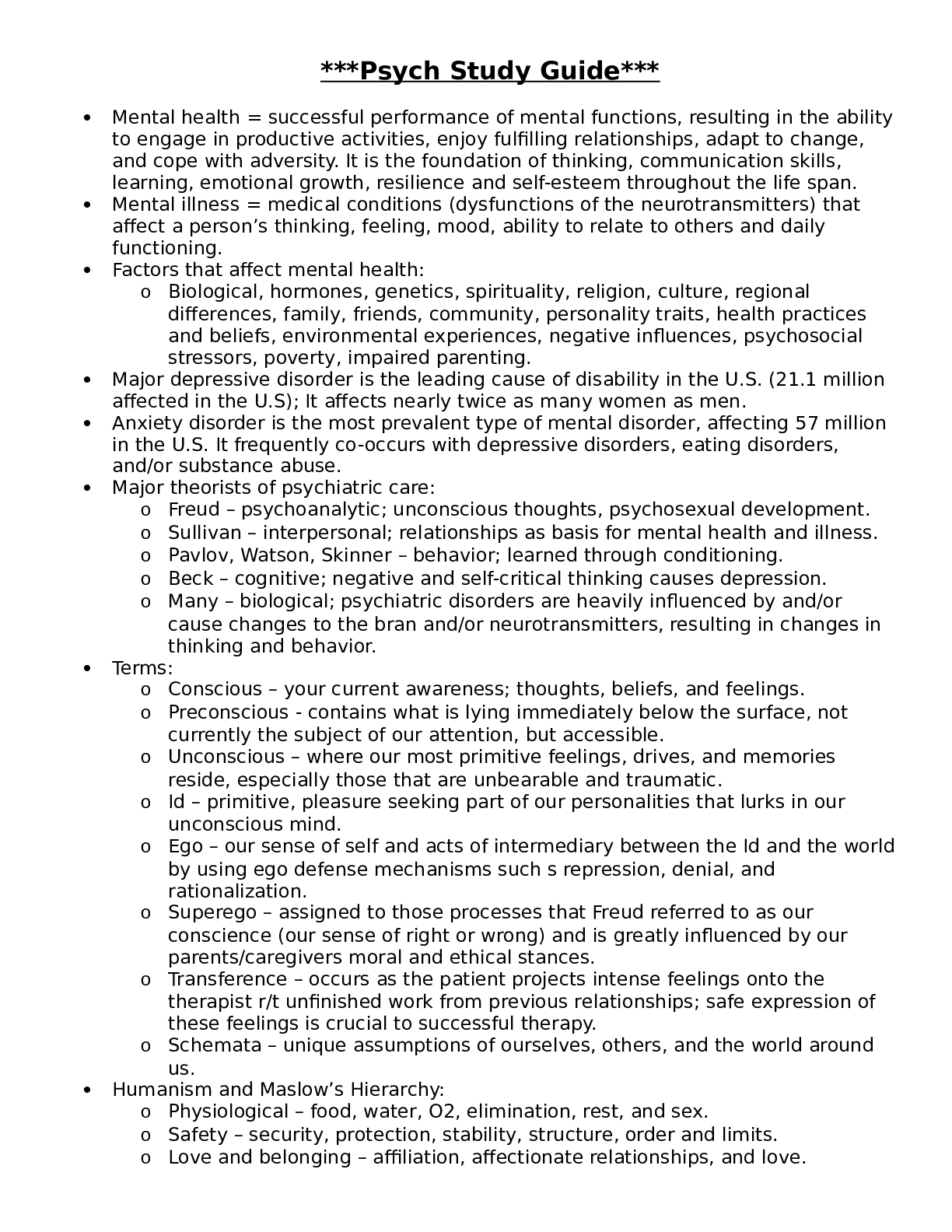
Mental health = successful performance of mental functions, resulting in the ability
to engage in productive activities, enjoy fulfilling relationships, adapt to change,
and cope with adversity. It is the foundation of
...
Mental health = successful performance of mental functions, resulting in the ability
to engage in productive activities, enjoy fulfilling relationships, adapt to change,
and cope with adversity. It is the foundation of thinking, communication skills,
learning, emotional growth, resilience and self-esteem throughout the life span.
Mental illness = medical conditions (dysfunctions of the neurotransmitters) that
affect a person’s thinking, feeling, mood, ability to relate to others and daily
functioning.
Factors that affect mental health:
o Biological, hormones, genetics, spirituality, religion, culture, regional
differences, family, friends, community, personality traits, health practices
and beliefs, environmental experiences, negative influences, psychosocial
stressors, poverty, impaired parenting.
Major depressive disorder is the leading cause of disability in the U.S. (21.1 million
affected in the U.S); It affects nearly twice as many women as men.
Anxiety disorder is the most prevalent type of mental disorder, affecting 57 million
in the U.S. It frequently co-occurs with depressive disorders, eating disorders,
and/or substance abuse.
Major theorists of psychiatric care:
o Freud – psychoanalytic; unconscious thoughts, psychosexual development.
o Sullivan – interpersonal; relationships as basis for mental health and illness.
o Pavlov, Watson, Skinner – behavior; learned through conditioning.
o Beck – cognitive; negative and self-critical thinking causes depression.
o Many – biological; psychiatric disorders are heavily influenced by and/or
cause changes to the bran and/or neurotransmitters, resulting in changes in
thinking and behavior.
Terms:
o Conscious – your current awareness; thoughts, beliefs, and feelings.
o Preconscious - contains what is lying immediately below the surface, not
currently the subject of our attention, but accessible.
o Unconscious – where our most primitive feelings, drives, and memories
reside, especially those that are unbearable and traumatic.
o Id – primitive, pleasure seeking part of our personalities that lurks in our
unconscious mind.
o Ego – our sense of self and acts of intermediary between the Id and the world
by using ego defense mechanisms such s repression, denial, and
rationalization.
o Superego – assigned to those processes that Freud referred to as our
conscience (our sense of right or wrong) and is greatly influenced by our
parents/caregivers moral and ethical stances.
o Transference – occurs as the patient projects intense feelings onto the
therapist r/t unfinished work from previous relationships; safe expression of
these feelings is crucial to successful therapy.
o Schemata – unique assumptions of ourselves, others, and the world around
us.
Humanism and Maslow’s Hierarchy:
o Physiological – food, water, O2, elimination, rest, and sex.
o Safety – security, protection, stability, structure, order and limits.
o Love and belonging – affiliation, affectionate relationships, and love.o Esteem – self esteem r/t competency, achievement and esteem from others.
o Self-actualization – becoming everything one if capable of.
o Self-transcendent needs.
Milieu therapy: a therapeutic milieu, or healthy environment, combined with a
healthy social structure within an inpatient setting or structured outpatient clinic is
essential to supporting and treating those with mental illness.
Group therapy: 6 to 8 members, people can see each other. The group follows a
sequential pattern of growth. Benefits are more efficient, and more people can
engage
[Show More]