Final Study Guide
Reproductive:
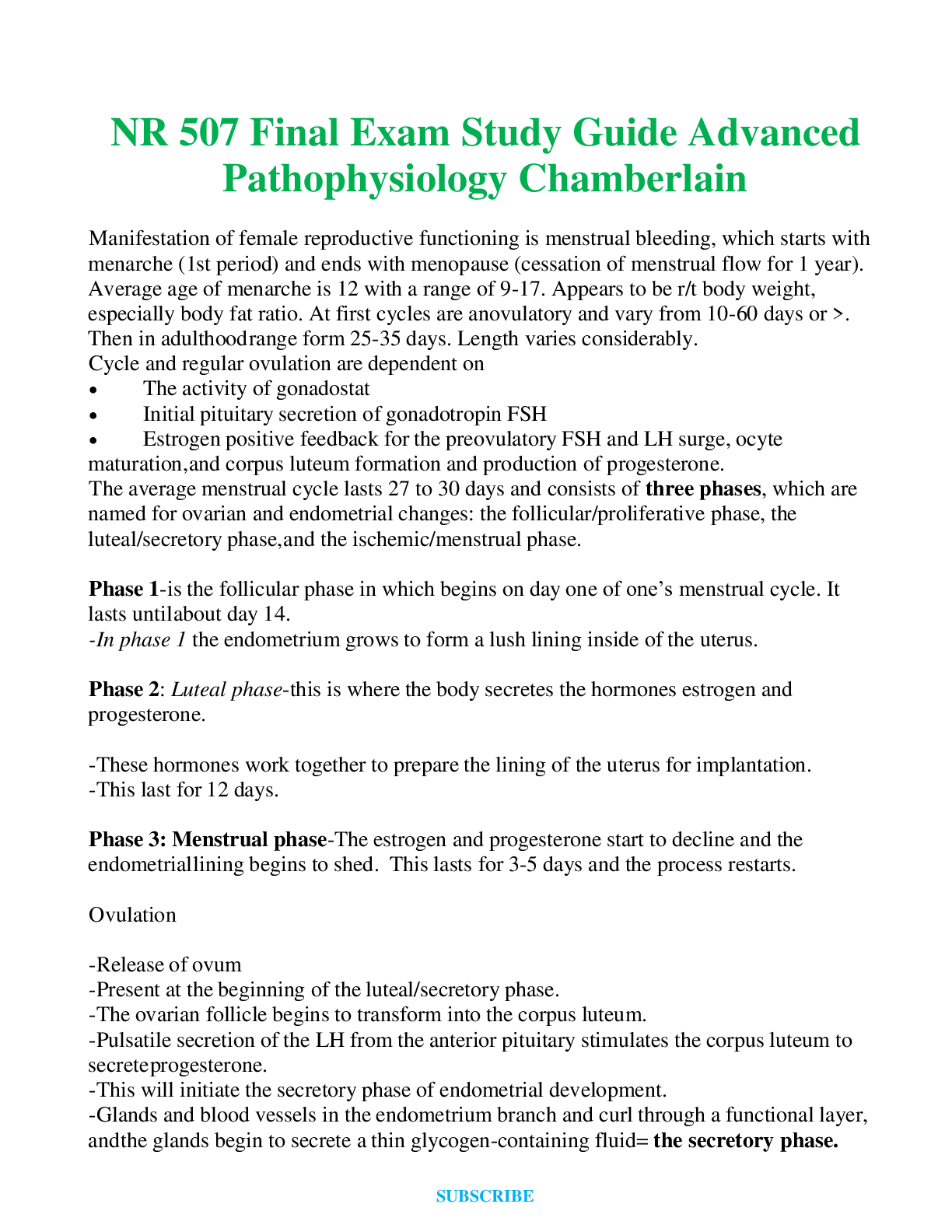
o Endometrial cycle (menstrual cycle) and the occurrence of
ovulation
During menstruation (menses), the functional layer if
endometrium disintegrates and is discharges through the
...
Final Study Guide
Reproductive:
o Endometrial cycle (menstrual cycle) and the occurrence of
ovulation
During menstruation (menses), the functional layer if
endometrium disintegrates and is discharges through the
vagina.
Follicular/proliferative phase - GnRH and a balance
between activin and inhibin from the granulosa cells
contribute to the rise of FSH levels, which stimulates a
number of follicles. The pulsatile secretion of FSH from the
anterior pituitary gland rescues a dominant ovarian follicle
from apoptosis by days 5 to 7 days of the cycle. Together
estrogen and FSH increase FSH receptors in the granulosa
cells of the primary follicle, making them more sensitive to
FSH. FSH and estrogen combine to induce production of LH
receptors on the granulosa cells of the primary follicle, thus
promoting LH stimulation to combine with FSH stimulation,
causing more rapid secretion of follicular estrogen. As
estrogen levels increase, FSH levels drop because of an
increase in inhibin-B secreted by the granulosa cells in the
dominant follicle. This drop in FSH level decreases the
growth of the less-developed follicles. Estrogen causes
cells of the endometrium to proliferate and stimulates
production of LH.
Luteal/secretory phase – ovulation marks the beginning of
this phase. The ovarian follicle begins its transformation
into a corpus luteum. Pulsatile secretion of LH from the
anterior pituitary stimulates the corpus luteum to secrete
progesterone, which in turn initiates the secretory phase of
endometrial development. Glands and blood vessels in the
endometrium branch and curl throughout the functional
layer, and the glands begin to secrete a thin glycogencontaining fluid, the secretory phase. If conception occurs,
the nutrient-laden endometrium is ready for implantation.
Human chorionic gonadotropin (HCG) is secreted 3 days
after fertilization by blastocytes and maintains the corpus
luteum once implantation occurs at about day 6 or 7. HCG
can be detected in maternal blood and urine 8 to 10 days
after ovulation.
Ischemic/menstrual phase
The production of estrogen and progesterone
continues until the placenta can adequately maintain
hormonal production. If conception and implantation
do not occur, the corpus luteum degenerates and
ceases production of progesterone and estrogen.
Without progesterone or estrogen to maintain it, the
endometrium becomes ischemic and disintegrates.
Menstruation then occurs marking the beginning of
another cycle.
Ovulatory cycles appear to have a minimum length of 24 to
26.5 days: the primary ovarian follicle requires 10 to 12.5
days to develop, and the luteal phase appears relatively
fixed at 14 days (+/- 3 days). Menstrual blood flow usually
lasts 3-7 days, but it may last as long as 8 days or stop
after 1 to 2 days and still be considered within normal
limits.
Ovulation – the release of an ovum from a mature follicle
and marks the beginning of the luteal/secretory phase.
o Uterine prolapse
Descent of the cervix or entire uterus into the vaginal
canal.
In severe cases, the uterus falls completely through the
vagina and protrudes from the introitus.
Symptoms of other pelvic floor disorders also may be
present.
Urinary: sensation of incomplete emptying of the
bladder, urinary incontinence, urinary
frequency/urgency, bladder “splinting” to accomplish
voiding
Bowel: constipation or feeling of rectal fullness or
blockage, difficult defecation, stool or flatus
incontinence
Urgency: manual “splinting” of posterior vaginal wall
to accomplish defecation
Pain & Bulging: vaginal, bladder, rectum; pelvic
pressure, bulging, pain, lower back pain
Sexual: dyspareunia, decreased sensation,
lubrication, arousal
Tx:
Kegel exercises
Estrogen to improve tone and vascularity of fascial
support
Pessary
Weight loss
Avoidance of constipation
o Polycystic ovarian syndrome
Most common cause of anovulation and ovulatory
dysfunction in women.
Defined as having at least two of the following three
features: irregular ovulation, elevated levels of androgens
(testosterone), and the appearance of polycystic ovaries on
ultrasound.
Polycystic ovaries do not have to be present to diagnose
PCOS, and conversely their presence alone does not
establish the diagnosis.
Initial identification of genes involved in steroid
biosynthesis, androgen biosynthesis, and insulin receptors
within the ovary indicates genetic involvement.
A hyperandrogenic state is a cardinal feature in the
pathogenesis of PCOS.
However, glucose intolerance/insulin resistance and
hyperinsulinemia often run parallel to and markedly
aggravate the hyperandrogenic state, thus contributing to
the severity of signs and symptoms of PCOS.
Excessive androgens affect follicular growth, and insulin
affects follicular decline by suppressing apoptosis and
enabling follicles to persist.
Weight gain tends to aggravate symptoms, whereas weight
loss may ameliorate some of the endocrine and metabolic
events and thus decrease symptoms.
Women with PCOS tend to have increased leptin levels.
Leptin influences the hypothalamic pulsatility of GnRH and
consequent interaction along the entire HPO axis.
In PCOS there is dysfunction in ovarian follicle
development. Inappropriate gonadotropin secretion
triggers the beginning of a vicious cycle that perpetuates
anovulation.
Typically, levels of FSH are low or below normal and LH
levels and LH bioactivity are elevated. An increased
frequency of GnRH pulses appears to cause increased
frequency of LH pulses. Persistent LH elevation causes a
increase in the levels of androgens. Androgens are
converted to estrogen in peripheral tissues, and increased
testosterone levels cause a significant reduction in SHBG,
which in turn causes increased levels of free estradiol.
Elevated estrogen levels trigger a positive-feedback
response in LH and a negative-feedback response in FSH.
The accumulation of follicular tissue is various stages of
development allows an increased and relatively constant
production of steroids in response to gonadotropin
stimulation. Thus PCOS is characterized by excessive
production of both androgen and estrogen.
In turn, persistent anovulation causes enlarged polycystic
ovaries characterized by a smooth, pearly white capsule.
This characteristic appearance is caused by an increase of
surface area and increased volume of up to 2.8 times,
doubling of growing and atretic follicles, thickening of the
tunica by 50%, increasing cortical stromal thickening by
one-third and a fivefold increase in subcortical stroma, and
escalating hyperplasia.
Manifestations:
Usually appear within 2 years of puberty but may
present after a variable period of normal menstrual
function and possibly pregnancy.
Symptoms are related to anovulation,
hyperandrogenism, and insulin resistance and
include dysfunctional bleeding or amenorrhea,
hirsutism, acne, acanthosis nigricans, and infertility.
Eval & Treatment:
Diagnosis is based on evidence of androgen excess,
chronic anovulation, and sonographic evidence of
polycystic ovaries with at least 2 of the 3 criteria
present.
Tests for impaired glucose tolerance are
recommended.
Evidence of hyperandrogenism must be present
before PCOS is diagnosed in an adolescent female.
Goals of tx: reversing signs and symptoms of
androgen excess, instituting cyclin menstruation,
restoring fertility, and ameliorating any associated
metabolic or endocrine, or both, disturbances.
First line: combined oral contraceptives for
management of symptoms and to establish regular
menses.
For those women with PCOS who are overweight or
obese, lifestyle modifications including regular
exercise and weight loss, also are considered firstline treatment.
[Show More]