Oral and Parenteral Medication Administration
Skills & Reasoning
Suggested Answer Guidelines
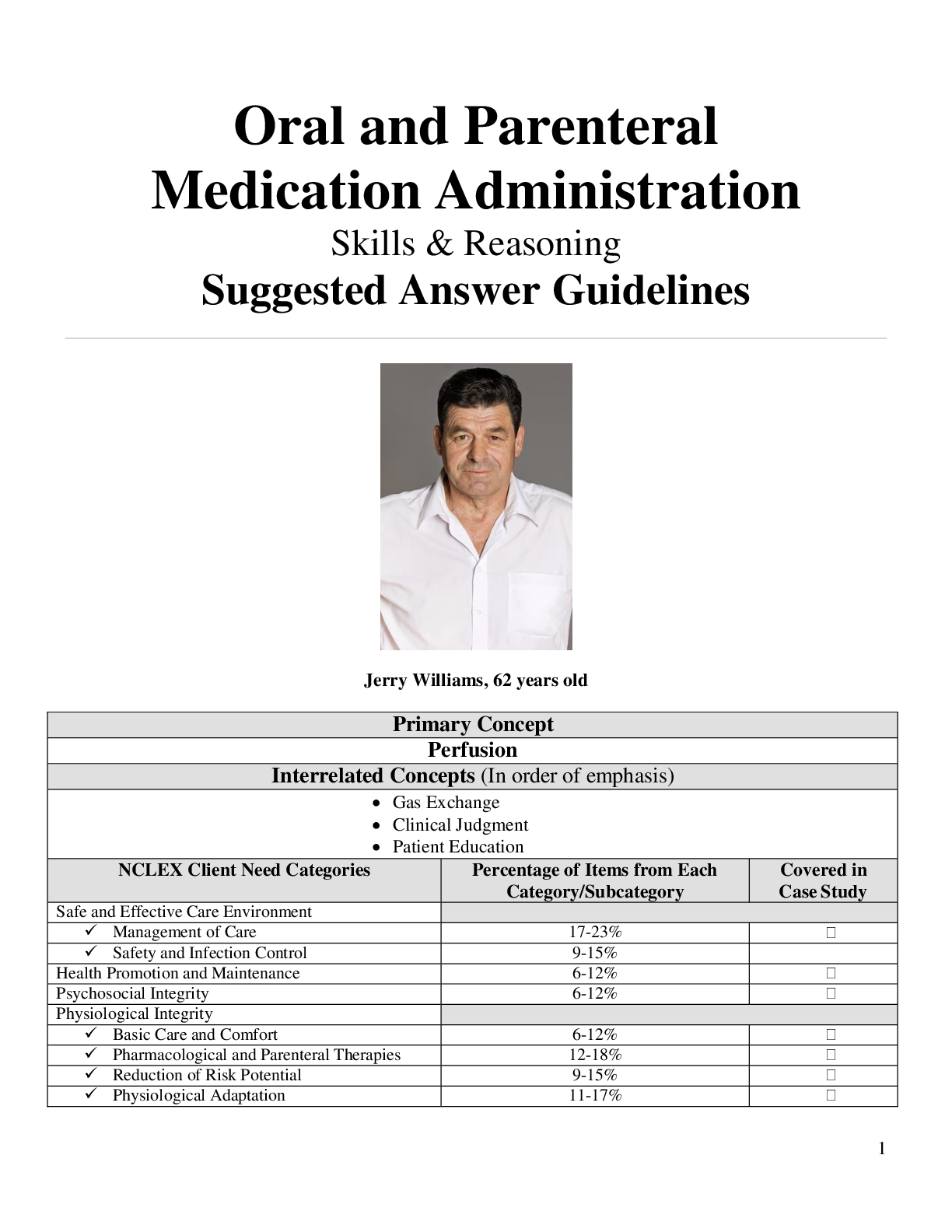
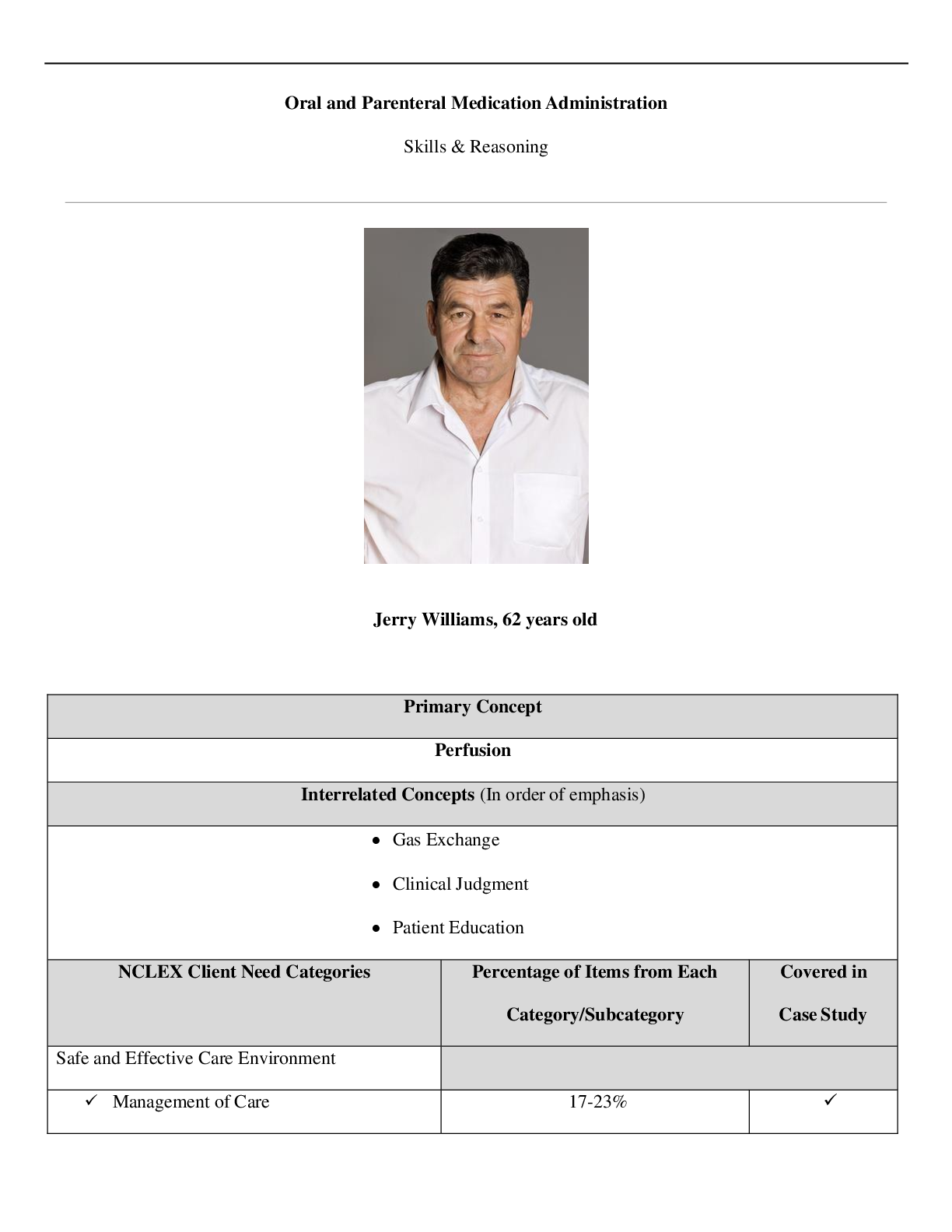
Jerry Williams, 62 years old
Primary Concept
Perfusion
Interrelated Concepts (In order of emphasis)
• Gas Exchan
...
Oral and Parenteral Medication Administration
Skills & Reasoning
Suggested Answer Guidelines
Jerry Williams, 62 years old
Primary Concept
Perfusion
Interrelated Concepts (In order of emphasis)
• Gas Exchange
• Clinical Judgment
• Patient Education
NCLEX Client Need Categories Percentage of Items from Each Category/Subcategory Covered in Case Study
Safe and Effective Care Environment
Management of Care 17-23%
Safety and Infection Control 9-15%
Health Promotion and Maintenance 6-12%
Psychosocial Integrity 6-12%
Physiological Integrity
Basic Care and Comfort 6-12%
Pharmacological and Parenteral Therapies 12-18%
Reduction of Risk Potential 9-15%
Physiological Adaptation 11-17%
History of Present Problem:
Jerry Williams is a 62-year old obese (BMI 35.2) Caucasian male with a history of diastolic heart failure and type II diabetes. Last evening, he began having difficulty breathing with activity. He thought he might be getting a cold because he had a runny nose. He reports more swelling in his lower legs the past couple days. He woke up this morning with increased difficulty breathing when he woke up and his wife called 911.
Paramedics report that his initial VS: HR:92 RR: 28 BP: 172/88 O2 sat: 80% on room air with scattered expiratory wheezing bilat. He was placed on oxygen by facemask and albuterol nebulizer administered with some improvement in his breathing. His RR is now 24 upon arrival to the emergency department ED). His initial labs have resulted; creatinine of 2.5 (last adm. 1.8), K+ 3.5 (last adm. 3.7) and BNP 944 (last adm. 322). Jerry is given furosemide 40 mg IV in the ED and had 800 mL urine output in the last hour. He is admitted to cardiac telemetry, and you are the nurse responsible for his care.
What data from the present problem do you NOTICE as RELEVANT and why is it clinically significant?
(Reduction of Risk Potential/Health Promotion and Maintenance)
RELEVANT Data: Clinical Significance:
History of diastolic heart failure and type II diabetes.
Last evening, he began having difficulty breathing with activity. He thought he might be getting a cold because he had a runny nose. He reports more swelling in his lower legs the past couple days.
He woke up this morning with increased difficulty breathing when he woke up and his wife called 911.
Paramedics report that his initial VS: HR:92 RR: 28 BP: 172/88 O2 sat: 80% on room air with scattered expiratory wheezing bilat.
He was placed on oxygen by facemask and an albuterol nebulizer given with some improvement in his breathing.
His RR is 24 upon arrival.
His initial labs included a creatinine of 2.5 (last adm. 1.8), K+ 3.5 (last adm. 3.7), BNP
944 (last adm. 322). PMH is always relevant and needs to be noted by the nurse. Understanding the pathophysiology of heart failure will help the nurse recognize what clinical data is the most important/relevant in this scenario.
SOB with a history of heart failure is always a clinical RED FLAG and the most likely reason for this chief complaint. Difficulty breathing with activity is an EARLY RED FLAG of decompensating heart failure if that is the primary problem.
His difficulty breathing was significant enough to warrant a 911 call which is another clinical RED FLAG. Difficulty breathing at rest is a progression and worsening that is expected with exacerbation of heart failure.
His RR is too high and his O2 sat too low!
Has no known history of asthma or COPD. Why does he have wheezing? Discuss cardiac asthma and how acute exacerbation of heart failure can cause bronchoconstriction and wheezing with heart failure.
His blood pressure is also too high! Discuss the correlation of systolic blood pressure to afterload and how increased afterload increases the workload of the heart and can continue to exacerbate the underlying problem of heart failure.
If patient has “cardiac asthma” will albuterol help significantly? Not really. EMS decision making is driven by protocol and not always benefits the patient.
His RR has decreased but is still too high at rest. This is a clinical RED FLAG.
• His creatinine is too high and trending upwards. This is a clinical RED FLAG that represents worsening renal function most likely as a result of heart failure exacerbation and impaired diffusion to the kidneys.
• This potassium is within normal limits but is low normal. This is a clinical red flag that needs to be noted because of the loop diuretic that has already been given that will deplete this potassium even
Jerry is given furosemide 40 mg IV in the ED and had 800 mL urine output in the last hour. further and cause possible arrhythmias as a result.
• His BNP is too high and trending upwards. This is a clinical RED FLAG that represents heart failure exacerbation with increased workload of the heart.
Furosemide is a potent loop diuretic. This is a safe dose. 800 mL urine output is adequate and expected response with furosemide. What
electrolytes are depleted with diueresis? Primarily K+ and Mg+. Be sure to note these levels in the chart.
What is the RELATIONSHIP of his past medical history and current medications? Why is your patient receiving these medications? (Which medication treats which condition? Draw lines to connect)
Past Medical History (PMH): Home Medications:
Hyperlipidemia Hypothyroidism Type II diabetes Diastolic heart failure
Chronic kidney disease stage III Furosemide 20 mg PO every morning Atorvastatin 40 mg PO at bedtime Metoprolol 50 mg PO BID Levothyroxine 112 mcg PO daily
Exenatide microspheres 2 mg subq. weekly
• Hyperlipidemia>>> Atorvastatin 40 mg PO at bedtime
• Hypothyroidism>>> Levothyroxine 112 mcg PO daily
• Type II diabetes>>> Exenatide microspheres 2 mg subq. weekly
• Diastolic heart failure>>>Furosemide 20 mg PO every morning/Metoprolol 50 mg PO BID
• Chronic kidney disease stage III>>>none specifically to address and treat
Nursing Assessment Begins:
Current VS: Most Recent in ED: P-Q-R-S-T Pain Assessment:
T: 98.2 F/36.8 C (oral) T: 98.8 F/37.1 C (oral) Provoking/Palliative:
P: 88 (reg) P: 92 (reg) Quality: Denies
R: 24 (reg) R: 24 (reg) Region/Radiation:
BP: 142/76 BP: 148/80 Severity:
O2 sat: 93% 4 liters n/c O2 sat: 94% 4 liters n/c Timing:
Current Assessment:
GENERAL SURVEY: Pleasant, in no acute distress, calm, body relaxed, no grimacing, appears to be resting comfortably.
NEUROLOGICAL: Alert & oriented to person, place, time, and situation (x4); muscle strength 5/5 in both
upper and lower extremities bilaterally.
HEENT: Head normocephalic with symmetry of all facial features. PERRLA, sclera white
bilaterally, conjunctival sac pink bilaterally. Lips, tongue, and oral mucosa pink and moist.
RESPIRATORY: Breath sounds coarse crackles in bases bilat.with equal aeration on inspiration and expiration in all lobes anteriorly, posteriorly, and laterally, nonlabored respiratory effort.
CARDIAC: Pale/pink, warm & dry, 2+ pitting edema in feet and ankles, heart sounds regular, pulses strong, equal with palpation at radial/pedal/post-tibial landmarks, brisk cap refill. Heart tones audible and regular, S1 and S2 noted over A-P-T-M cardiac landmarks with no
abnormal beats or murmurs. Unable to assess JVD due to obesity/thick neck
ABDOMEN: Abdomen round, soft, and nontender. BS + in all four quadrants
GU: Voiding without difficulty, urine clear/yellow
INTEGUMENTARY: Skin warm, dry, intact, normal color for ethnicity. No clubbing of nails, cap refill <3
seconds, Hair soft-distribution normal for age and gender. Skin integrity intact, skin turgor elastic, no tenting present.
What clinical data do you NOTICE that is RELEVANT and why is it clinically significant?
(Reduction of Risk Potential/Health Promotion and Maintenance)
RELEVANT VS Data: Clinical Significance: TREND:
T: 98.2 F/36.8 C (oral)
P: 88 (reg)
R: 24 (reg)
BP: 142/76
O2 sat: 93% 4 liters n/c All VS are vital and need to be noted by the nurse even if they are normal!
Afebrile. No infection likely present influencing SOB Not excessive-high normal. Continue to assess
Too high! Clinical RED FLAG! Continue to assess closely and TREND direction.
Slightly elevated but not critical at this time. Is trending DOWNWARDS
Low normal, but no critical concern Use the initial set of vital signs that the paramedics collected to compare the trend.
Stable Stable
Improving but assess closely
Improving Improving
RELEVANT Assessment Data: Clinical Significance: TREND:
RESPIRATORY: Breath sounds coarse crackles in bases bilat. with equal aeration on inspiration and expiration in all lobes anteriorly, posteriorly, and laterally, nonlabored respiratory effort.
CARDIAC: Pale/pink, warm & dry, 2+ pitting edema in feet and ankles, Unable to assess JVD due to obesity/thick neck Coarse crackles are a clinical RED FLAG and represent fluid in the alveoli due to exacerbation and presence of left-sided heart failure. Wheezing that was present earlier is no longer present. Despite fluid and tachypnea, respirations are nonlabored. This can change so continue to assess closely.
2+ pitting edema consistent with right-sided heart failure A slight change with coarse crackles now present. Assess closely especially with diuresis with furosemide
No change-stable
1. INTERPRETING relevant clinical data, what is the primary problem? What primary health-related concept(s) does this problem represent? (Management of Care/Physiologic Adaptation)
Problem: Pathophysiology of Problem in OWN Words: Primary Concept(s):
Biventricular Heart failure Heart failure (HF) occurs when the heart is unable to pump sufficient blood to meet the metabolic needs of the body. It is the most common cardiovascular disorder. Heart failure results in the inadequate cardiac output (CO) with poor organ perfusion and vascular congestion in the pulmonary or systemic circulation. Heart failure may result from some causes that affect preload (venous return), afterload (resistance the heart has to overcome to eject contents), or contractility (Sommers & Fannin, 2015).
Based on physical assessment findings, this patient is in both left- and right-sided heart failure. Left-sided failure begins when the left ventricle is unable to keep up and left ventricle end diastolic pressures to increase in both the left ventricle/atrium. This causes increased pulmonary venous volume and pressure in the pulmonary veins and
pulmonary circulation that pushes fluid into the alveoli, causing the coarse crackles, which then causes tachypnea and respiratory distress. The alveoli are compromised in Perfusion
their ability to exchange O2 and CO2. The heart rate increases. Pale, cool skin is caused by stimulation of the sympathetic nervous system by the hypoxia.
Right-sided heart failure is present because of the increased pulmonary pressures from the left side that are now crossing over to the right side of the heart. Venous pressures are higher than normal because the right ventricle cannot adequately eject blood. This increased venous pressure causes increased capillary hydrostatic pressure, which causes fluid to be pushed into the interstitial spaces of usually the lower extremities, though edema in severe cases can also be more generalized. Edema that is PITTING is classic for heart failure and this acute fluid accumulation. Non-pitting edema correlates consistently to chronic venous insufficiency, so making this distinction of pitting vs. non-
pitting is a critical nursing assessment. The nurse must also assess for jugular venous distention and determine if central venous pressure is elevated due to volume overload.
2. What nursing priority(ies) will guide your plan of care that determines how you decide to RESPOND?
(Management of Care)
Nursing PRIORITY: • Improve oxygenation and address underlying impaired gas exchange
• Decrease workload of the heart
• Remove excess fluid volume
PRIORITY Nursing Interventions: Rationale: Expected Outcome:
Nursing Interventions:
IMPAIRED GAS EXCHANGE
A-B(airway-breathing): increase O2 if needed and assess response to keep sat >92%
Sit upright
Continually monitor O2 sat Frequently monitor RR and resp status Assess LOC and alertness closely
C(circulation)-place on cardiac monitor
Ensure patency and adequacy of peripheral IV Improve FiO2 to improve oxygenation
Promotes ventilation and improves oxygenation Quickly identify any concerning TRENDS
Same as above
Closely assess LOC that will be depressed with CO2 retention secondary to impaired gas exchange
Quickly identify any concerning trend of INCREASE in HR
Need IV access for IV meds and because is on telemetry O2 sat >92-95%
Oxygenation improved
EARLY recognition of any change of status
Remains alert
HR/rhythm remain stable
IV established
DECREASE WORKLOAD OF HEART
Monitor HR-BP closely–Need to watch AFTERLOAD and reduce!!!
NTG as an IV continuous drip Quickly identify any concerning trend of INCREASE in HR
Decreases PRELOAD through venous dilation as well as some AFTERLOAD reduction by lowering SBP EARLY recognition of any change of status
Decrease in systolic BP. Maintain >100 or per orders
EXCESS FLUID VOLUME
Administer diuretics as ordered Decreases PRELOAD by removing excess fluid volume Decrease in systolic BP. Maintain >100 or
Consider Foley catheter
Closely monitor and assess I&Os
Due to degree of diuresis needed and need to accurately identify urine output
Identify response of diuretics per orders
Increased U/O above prior baseline
Same as above
Medical Management: Admission Medication Orders
Care Provider Orders: Mechanism of Action: Expected Outcome:
Administer the following home medications:
Atorvastatin 40 mg PO daily
Metoprolol 50 mg PO BID
Levothyroxine 112 mcg PO daily
New order:
Heparin 5000 units subq. BID
Inhibits an enzyme that is responsible for catalyzing an early step in the synthesis of cholesterol synthesis.
Ask your students what is a beta blocker blocking? Blocks the stimulation of beta-1 myocardial sympathetic nervous system receptors. Does not usually affect beta-2 or pulmonary receptors.
Replacement or supplementation of thyroid hormone. The principal therapeutic effect increases the metabolic rate of the body and promotes utilization and mobilization of glycogen stores.
In low doses such as with heparin subcutaneous, prevents the conversion of prothrombin to thrombin by its effect on factor Xa.
Lowers total and LDL cholesterol and triglycerides and slightly increases HDL.
Decreases blood pressure and heart rate. Also decreases the rate of heart death mortality and hospitalization in patients with a diagnosis of heart failure
Replacement of hypothyroidism to restore normal hormonal balance
Prevents blood clots from forming including
DVT related to immobility
Medication Administration
1. Identify the “rights” of safe medication administration?
2. Identify essential steps the nurse must implement to safely administer ORAL medications in practice?
(Management of Care)
Essential Steps to Be Safe in Practice:
List the essential steps that you decide to emphasize based on your textbook and curriculum
3. What essential teaching will the nurse reinforce about these medications? (Health Promotion and Maintenance)
Medications: Patient Education:
Atorvastatin 40 mg PO daily • Controls but does not cure elevated serum cholesterol levels. Lifestyle modifications including a low-fat diet, cigarette cessation, and exercise need to be reinforced.
• Can cause a complication called rhabdomyolysis. Signs of this problem include
Metoprolol 50 mg PO BID
Levothyroxine 112 mcg PO daily
New order:
Heparin 5000 units subq. BID unexplained muscle tenderness. Need to notify primary care provider immediately if this symptom develops
• Reinforce the importance of taking daily at the same time. Abrupt withdrawal may cause life-threatening arrhythmias, hypertension, or myocardial infarction
• Teach how to check pulse daily and blood pressure twice a week and to report significant changes to the health care provider
• Change positions slowly to minimize orthostatic hypotension
• Notify primary care provider if develops a slow pulse, difficulty breathing, dizziness or lightheadedness
• Take medication daily at the same time and if more than three doses are missed notify the primary care provider
• Reinforce that medication does not cure hypothyroidism but is a replacement supplement and that therapy with medication is lifelong
• Reinforce the need to contact primary care provider if develops a headache, nervousness, diarrhea, excessive sweating, palpitations or increased heart rate. This cluster of symptoms represents too much of a good thing or too much thyroid hormone!
• Avoid activities that may lead to injury and to use a soft toothbrush and electric razor while receiving heparin
• report any symptoms of unusual bleeding or bruising to nurse immediately
Evaluation: Two Hours Later…
1. What data do you NOTICE as RELEVANT and why is it clinically significant?
(Reduction of Risk Potential/Health Promotion and Maintenance)
RELEVANT Data: Clinical Significance:
Jerry’s respiratory rate has increased to 28, and his O2 sat has dropped to 88-90% on 4 liters n/c.
Coarse crackles are present halfway up bilaterally. He states he has a hard time catching his breath at rest His RR is TRENDING in the wrong direction! The nurse must note the most recent rate of 24 to compare to recognize this concerning trend. The O2 sat is also decreasing despite the O2 being at the same rate.
Increasing the O2 rate is not the answer! The nurse must step back and ask WHY are this trend and clinical data present? Time to get out the stethoscope and auscultate lung fields!
TRENDING this assessment data reveals another clinical RED FLAG! Crackles are creeping upwards! Not good! Also feels more SOB at rest.
It is time for the nurse to ACT and recognize a problem is present.
2. Has the status improved or not as expected to this point? Does your nursing priority or plan of care need to be modified in any way after this evaluation assessment? (Management of Care, Physiological Adaptation)
Evaluation of Current Status: Modifications to Current Plan of Care:
Status has worsened. The nurse needs to do something in addition to improving oxygenation in the immediate present. Contact primary care provider with SBAR. Recommend an additional dose of furosemide due to fluid overload.
Medical Management: New Orders from Primary Care Provider
Care Provider Orders: Rationale/Mechanism of Action: Expected Outcome:
Furosemide 40 mg IV BID
Place on high flow n/c if unable to maintain O2 sat >92% on 6 liters n/c Loop diuretic will aggressively cause diuresis and eliminate excess volume (preload) that is overwhelming heart. Remember the time action profile. If given IV, onset is 5", peaks in 30", and duration is 1-2 hours. Assess effectiveness after 2 hours. If response is poor,( <200-300 mL urine), consider SBAR to a primary care provider for possibly larger dose especially if still in respiratory distress.
Reinforce that K+ is the electrolyte that is depleted most rapidly with furosemide. Need to monitor K+ levels closely, especially if low normal range before diuresis
High flow nasal cannula allows up to 15 L or more of flow with a special set up. Depending on the institution the nurse is trained to set this up, or respiratory therapy needs to be consulted. Delivers higher FiO2 than a traditional nasal cannula without having a facemask which can feel suffocating to the patient. Reinforce that if a high flow nasal cannula is unable to adequately oxygenate the next step would
be BiPAP and possible transfer to ICU. Will have adequate urinary response of at least 400-500 mL in 2 hours after IV dose is given. Ensure that total output is greater than total intake.
O2 sat greater than 92% with high flow nasal cannula if needed
What clinical data do you NOTICE that is RELEVANT and why is it clinically significant?
(Reduction of Risk Potential/Health Promotion and Maintenance)
RELEVANT Data: Clinical Significance:
The site appears moist, cool to the touch with fluid leaking at the insertion site when flushed with saline.
The extension tubing is dangling with one piece of tape holding it to the patient is beginning to peel off. This is a classic and common finding when the IV has infiltrated. It will need to be restarted before the furosemide can be administered.
This is an all too common assessment finding that I see in clinical practice; peripheral IV sites are NOT well secured! As a result, they either “accidentally” pull out entirely or become dislodged and infiltrate when you need them most. Don’t be that nurse! Teach your students that it is the little things such as securing an IV with an extra piece of tape or two that are the
BIG things that make a difference in practice!
Parenteral Medication Administration
1. Identify the essential steps the nurse must implement to safely administer subcutaneous medications?
(Management of Care)
Essential Steps to Be Safe in Practice:
List the essential steps that you decide to emphasize based on your textbook and curriculum
2. Recognizing that the IV has infiltrated, identify the essential steps that the nurse must implement to start an IV?
(Management of Care)
Essential Steps to Be Safe in Practice:
List the essential steps that you decide to emphasize based on your textbook and curriculum If you are in the skills lab, use the arm mannequin to practice this skill
3. Identify the essential steps the nurse must implement to safely administer intravenous medications?
(Management of Care)
Essential Steps to Be Safe in Practice:
List the essential steps that you decide to emphasize based on your textbook and curriculum
4. What will the nurse teach the patient about these medications? Why is he receiving them?
(Health Promotion and Maintenance)
Medications: Patient Education:
Furosemide 40 mg IV BID • Expect frequent urination. When given intravenous expect frequency for the first two hours
• Can deplete potassium and to a lesser extent magnesium levels rapidly, reinforce need to contact nurse if develops muscle weakness and cramps
Use Reflection to THINK Like a Nurse
What did you learn that you can apply to future patients you care for? Reflect on your current strengths and weaknesses this case study identified. What is your plan to make any weakness a future strength?
What Did You Learn? What did you do well in this case study?
What could have been done better? What is your plan to make any weakness a future strength?
Author
Keith Rischer, RN, MA, CEN, CCRN
Reviewers
Tommie Pniewski, RN, MSN, Professor Emeritus, Hopkinsville Community College, Hopkinsville Kentucky
References
Epocrates (2015). Chronic heart failure with acute exacerbation. Retrieved from www.epocrates.com.
Vallerand, A.H., Sanoski, C.A., & Deglin, J.H. (2014) Davis’s drug guide for nurses. (14th ed.). Philadelphia, PA: F.A. Davis Company.
Van Leeuwen, A. & Bladh, M.L. (2015). Davis’s comprehensive handbook of laboratory and diagnostic tests with nursing implications. (6th ed.). Philadelphia, PA: F.A. Davis Company.
Ignatavicius, D.D. Workman, M.L. & Rebar, C. R. (2018). Medical-surgical nursing: Concepts for Interprofessional Care. (9th ed.). St. Louis, MO: Elsevier.
[Show More]




 Correct Study Guide, Download to Score A.png)