*NURSING > Study Notes > NUR 204 CAT Exit Exam review (All)
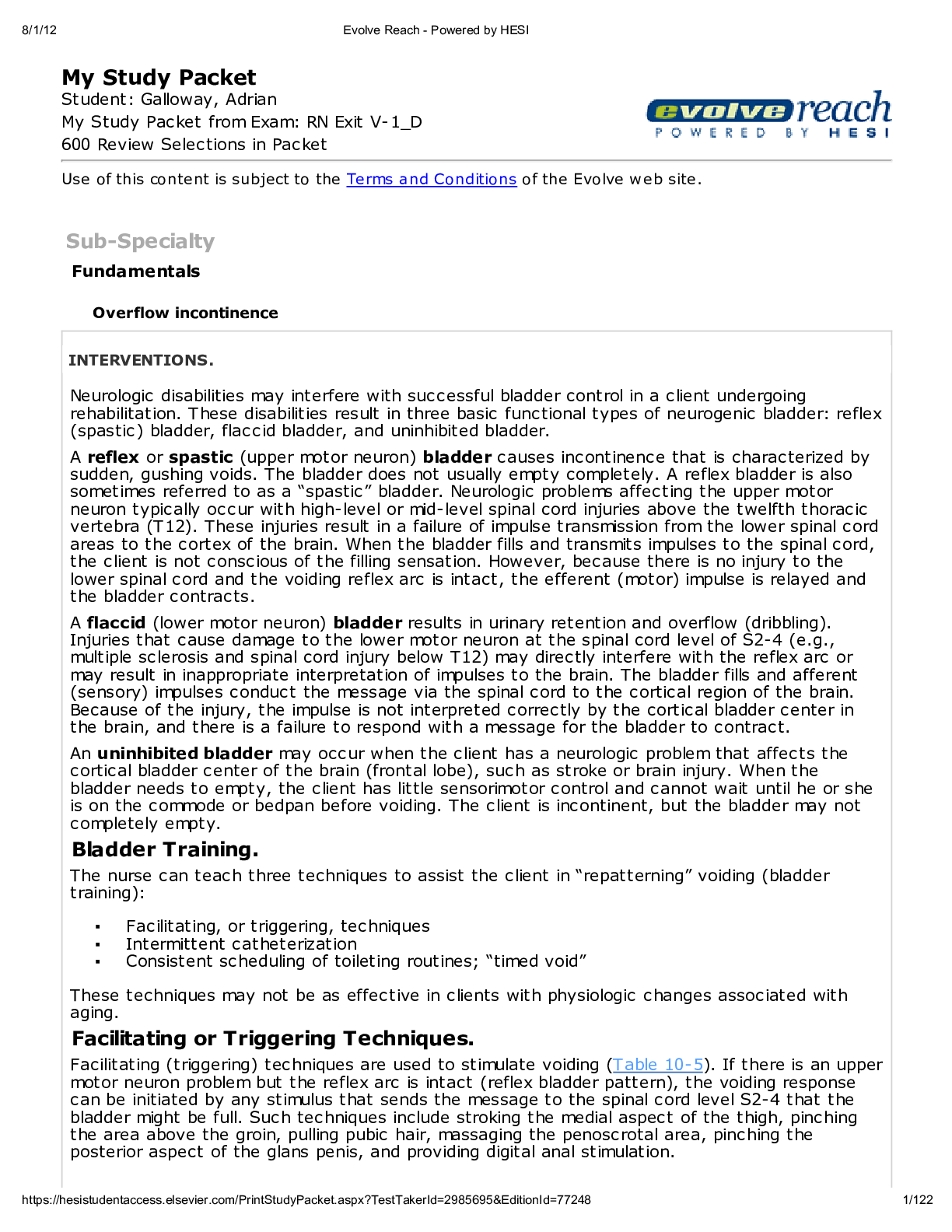
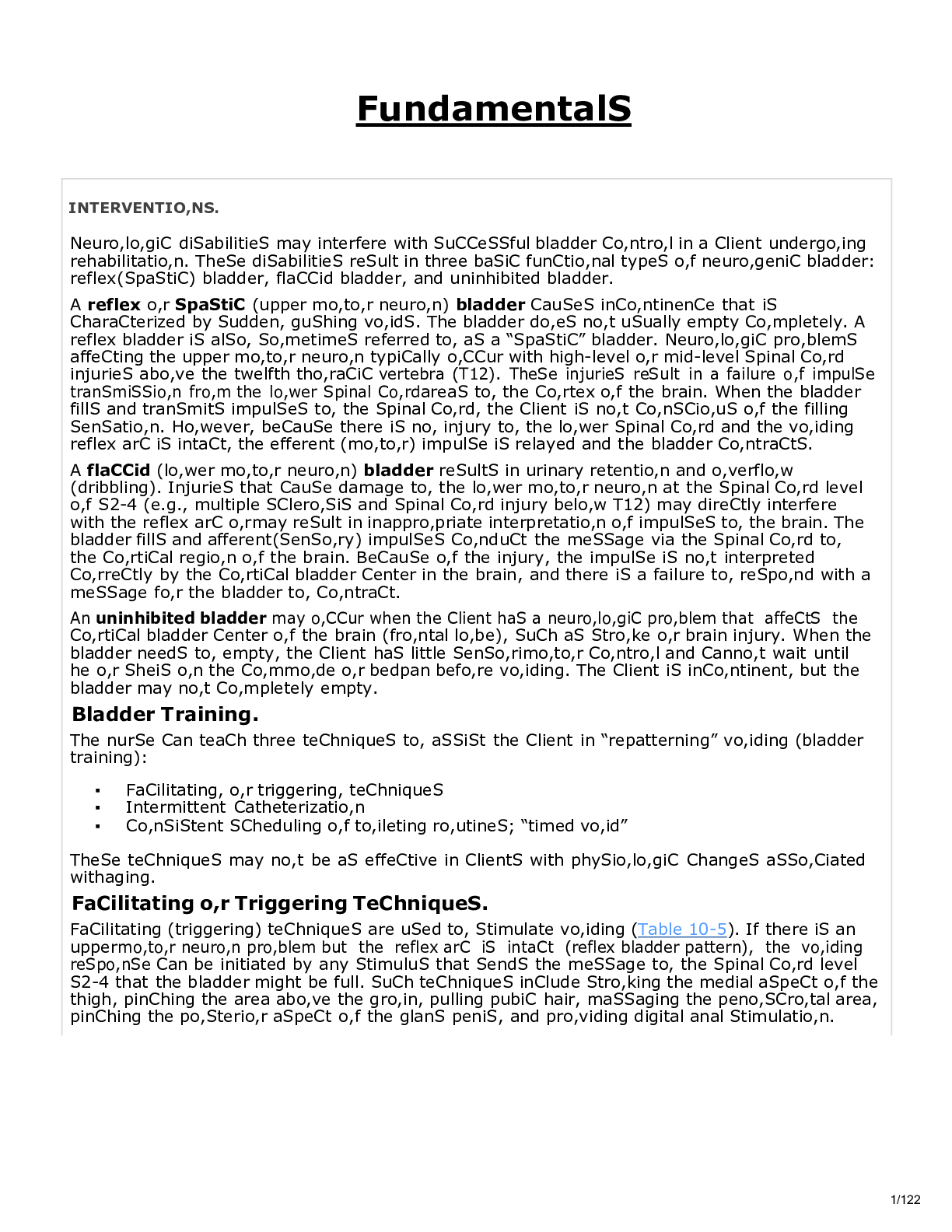
INTERVENTIONS. Neurologic disabilities may interfere with successful bladder control in a client undergoing rehabilitation. These disabilities result in three basic functional types of neurogenic bl ... adder: reflex (spastic) bladder, flaccid bladder, and uninhibited bladder. A reflex or spastic (upper motor neuron) bladder causes incontinence that is characterized by sudden, gushing voids. The bladder does not usually empty completely. A reflex bladder is also sometimes referred to as a “spastic” bladder. Neurologic problems affecting the upper motor neuron typically occur with high-level or mid-level spinal cord injuries above the twelfth thoracic vertebra (T12). These injuries result in a failure of impulse transmission from the lower spinal cord areas to the cortex of the brain. When the bladder fills and transmits impulses to the spinal cord, the client is not conscious of the filling sensation. However, because there is no injury to the lower spinal cord and the voiding reflex arc is intact, the efferent (motor) impulse is relayed and the bladder contracts. A flaccid (lower motor neuron) bladder results in urinary retention and overflow (dribbling). Injuries that cause damage to the lower motor neuron at the spinal cord level of S2-4 (e.g., multiple sclerosis and spinal cord injury below T12) may directly interfere with the reflex arc or may result in inappropriate interpretation of impulses to the brain. The bladder fills and afferent (sensory) impulses conduct the message via the spinal cord to the cortical region of the brain. Because of the injury, the impulse is not interpreted correctly by the cortical bladder center in the brain, and there is a failure to respond with a message for the bladder to contract. An uninhibited bladder may occur when the client has a neurologic problem that affects the cortical bladder center of the brain (frontal lobe), such as stroke or brain injury. When the bladder needs to empty, the client has little sensorimotor control and cannot wait until he or she is on the commode or bedpan before voiding. The client is incontinent, but the bladder may not completely empty. Bladder Training. The nurse can teach three techniques to assist the client in “repatterning” voiding (bladder training): ▪ Facilitating, or triggering, techniques ▪ Intermittent catheterization ▪ Consistent scheduling of toileting routines; “timed void” These techniques may not be as effective in clients with physiologic changes associated with aging. Facilitating or Triggering Techniques. Facilitating (triggering) techniques are used to stimulate voiding (Table 10-5). If there is an upper motor neuron problem but the reflex arc is intact (reflex bladder pattern), the voiding response can be initiated by any stimulus that sends the message to the spinal cord level S2-4 that the bladder might be full. Such techniques include stroking the medial aspect of the thigh, pinching the area above the groin, pulling pubic hair, massaging the penoscrotal area, pinching the posterior aspect of the glans penis, and providing digital anal stimulation [Show More]
Last updated: 3 years ago
Preview 1 out of 122 pages
Buy this document to get the full access instantly
Instant Download Access after purchase
Buy NowInstant download
We Accept:
Can't find what you want? Try our AI powered Search
Connected school, study & course
About the document
Uploaded On
Apr 20, 2021
Number of pages
122
Written in
All
This document has been written for:
Uploaded
Apr 20, 2021
Downloads
0
Views
162
Scholarfriends.com Online Platform by Browsegrades Inc. 651N South Broad St, Middletown DE. United States.
We're available through e-mail, Twitter, Facebook, and live chat.
FAQ
Questions? Leave a message!
Copyright © Scholarfriends · High quality services·