Simple Harmonic Motion
Name: Stephanie Tran
Date:
TA’s Name:
Learning Objectives:
1. Design an experiment to find an unknown quantity.
2. Use Hooke’s law to determine the spring constant of a spring.
3. Calculate
...
Simple Harmonic Motion
Name: Stephanie Tran
Date:
TA’s Name:
Learning Objectives:
1. Design an experiment to find an unknown quantity.
2. Use Hooke’s law to determine the spring constant of a spring.
3. Calculate and measure the period for an oscillating mass and spring system.
4. Understand the dependence of period of a simple harmonic oscillator on the amplitude.
Apparatus: Spring, metal stand and fixing bracket, mass hanger, set of weights, meter stick, stopwatch.
Overview: In this experiment you will investigate simple harmonic motion for a spring and mass system. You will
design an experiment to determine the spring constant of a given spring and use that to predict the period of
oscillations. You will then measure the oscillation behavior of the spring and mass system.
Part A: Finding the spring constant, k
1. The force exerted by a spring, Fsp , is always in a direction to restore the spring to its unstretched and
uncompressed length. This is called a restoring force. An ideal spring is one where the magnitude of this
spring force is directly proportional to how far the spring is stretched or compressed, d . This
relationship is called Hooke’s Law and can be written as Fsp=kd . The constant, k , tells us the
stiffness of the spring and is called the spring constant. We want to design an experiment to determine the
spring constant k . A starting point may be to hang a mass from the spring as shown in the figure and to
investigate the equilibrium of spring and mass system for this case. To develop your procedure, begin by
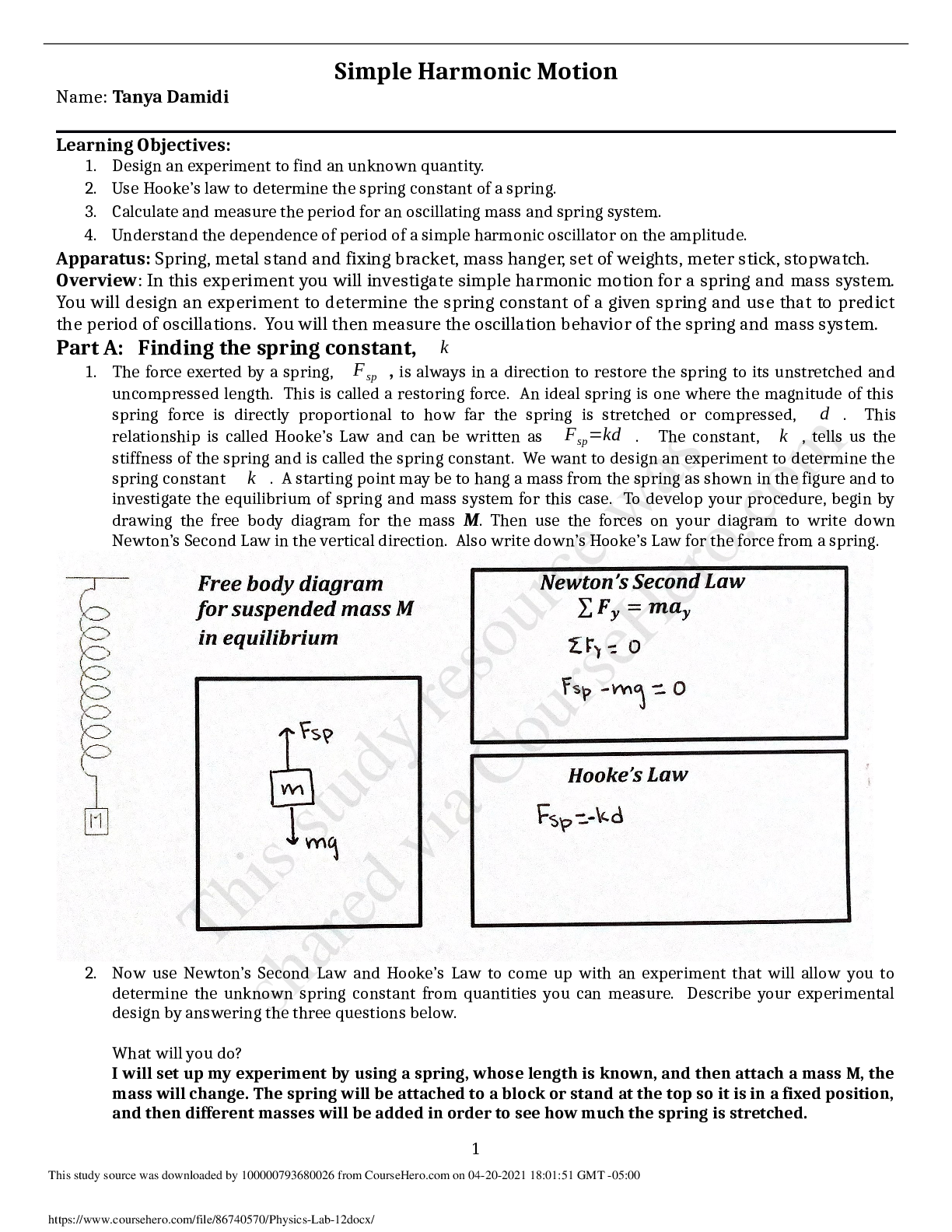
drawing the free body diagram for the mass M. Then use the forces on your diagram to write down
Newton’s Second Law in the vertical direction. Also write down’s Hooke’s Law for the force from a spring.
Free body diagram Newton’s Second Law
for suspended mass M ∑F y=m ay
in equilibrium Σ F y=⃗Fs p−⃗ w=0
Hooke’s Law Fs=kx
1
This study source was downloaded by 100000793680026 from CourseHero.com on 04-20-2021 14:42:07 GMT -05:00
https://www.coursehero.com/file/70050735/Simple-Harmonic-Motion-Labdocx-docx/
This study resource was
shared via CourseHero.com2. Now use Newton’s Second Law and Hooke’s Law to come up with an experiment that will allow you to
determine the unknown spring constant from quantities you can measure. Describe your experimental
design by answering the three questions below.
What will you do?
I will used different masses and pull the spring down different lengths to determine the spring
constant using Hooke’s Law.
What data will you collect?
The different masses will be recorded and the displacement of the mass from the spring to find the
spring constant.
How you will analyze the data?
I will analyze it by using it to calculate the spring constant and compare and contrast which values
have an effect on the spring constant.
3. Now label the axes of the graph you plan to construct and sketch your prediction of the data you will get.
Next to your predicted graph, show how you will determine the spring constant from the data.
2
This study source was downloaded by 100000793680026 from CourseHero.com on 04-20-2021 14:42:07 GMT -05:00
https://www.coursehero.com/file/70050735/Simple-Harmonic-Motion-Labdocx-docx/
This study resou
[Show More]


.png)
.png)
.png)

.png)
.png)
.png)
.png)