Maternity - HESI
HESI HINT: 1
Anatomy and Physiology of Reproduction and Antepartum
The menstrual phase varies in length in most women
HESI HINT: 2
Anatomy and Physiology of Reproduction and Antepartum
Between ovul
...
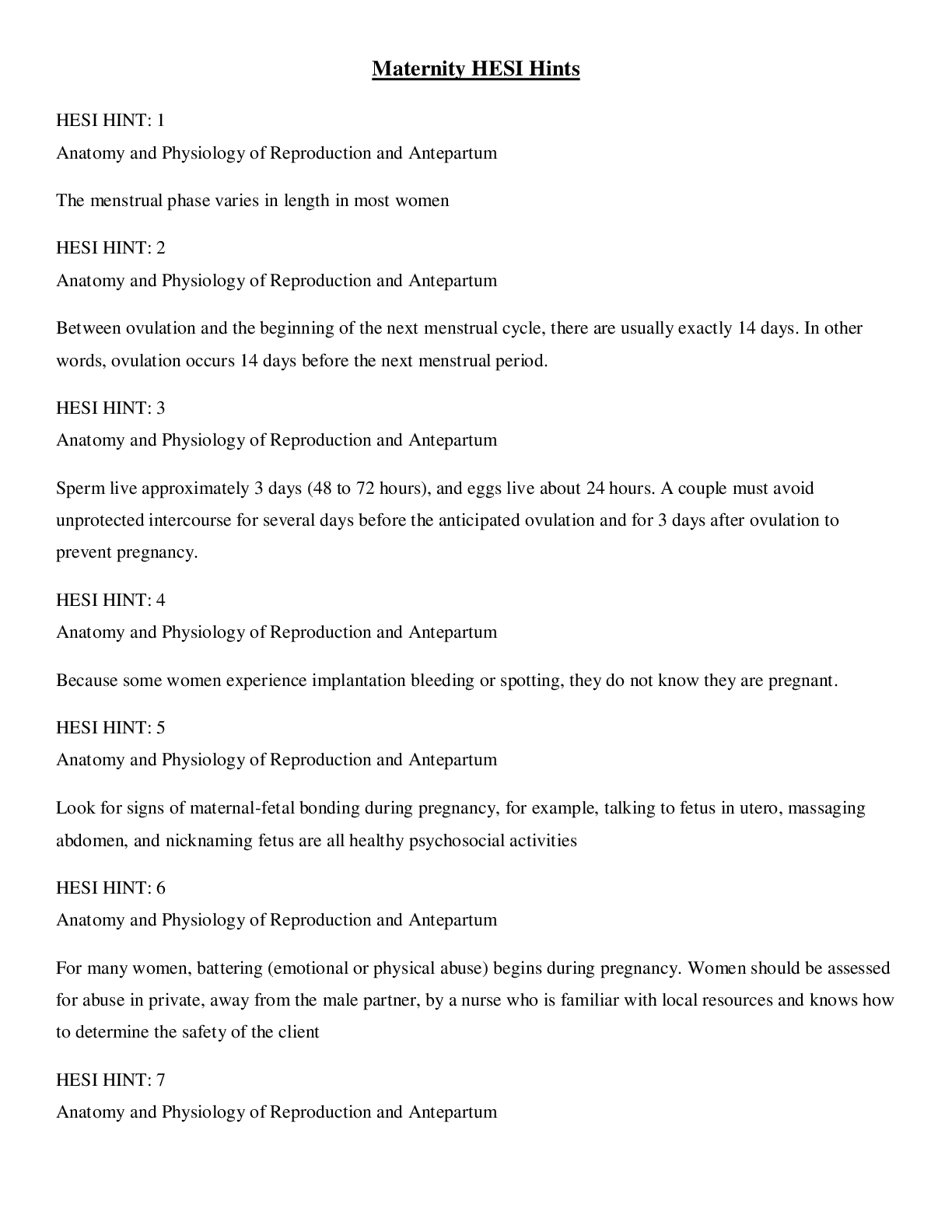
Maternity - HESI
HESI HINT: 1
Anatomy and Physiology of Reproduction and Antepartum
The menstrual phase varies in length in most women
HESI HINT: 2
Anatomy and Physiology of Reproduction and Antepartum
Between ovulation and the beginning of the next menstrual cycle, there are usually exactly 14 days. In other words,
ovulation occurs 14 days before the next menstrual period.
HESI HINT: 3
Anatomy and Physiology of Reproduction and Antepartum
Sperm live approximately 3 days (48 to 72 hours), and eggs live about 24 hours. A couple must avoid unprotected
intercourse for several days before the anticipated ovulation and for 3 days after ovulation to prevent pregnancy.
HESI HINT: 4
Anatomy and Physiology of Reproduction and Antepartum
Because some women experience implantation bleeding or spotting, they do not know they are pregnant.
HESI HINT: 5
Anatomy and Physiology of Reproduction and Antepartum
Look for signs of maternal-fetal bonding during pregnancy, for example, talking to fetus in utero, massaging abdomen,
and nicknaming fetus are all healthy psychosocial activities
HESI HINT: 6
Anatomy and Physiology of Reproduction and Antepartum
For many women, battering (emotional or physical abuse) begins during pregnancy. Women should be assessed for
abuse in private, away from the male partner, by a nurse who is familiar with local resources and knows how to
determine the safety of the client
HESI HINT: 7
Anatomy and Physiology of Reproduction and Antepartum
Practice determining gravidity and parity, A women who is 6 weeks pregnant has the following maternal history:
-2-year-old healthy daughter
-miscarriage at 10 weeks
-abortion at 6 weeks, 5 years earlier
-Current pregnancy, she is gravida 4, para 1, (only 1 delivery after 20 weeks gestation)
GTPAL = 4-1-0-2-1
HESI HINT: 8
Anatomy and Physiology of Reproduction and Antepartum
Practice calcualting EDB. If the first day of a women's last normal menstrual period was October 17, what is her ED,
busing Nagele rule? July 24.
Count back 3 months and add 7 days (always give February 28 days)
HESI HINT: 9
Anatomy and Physiology of Reproduction and Antepartum
At approximately 28 to 32 weeks' gestation, a plasma volume increase of 25%-40% occurs, resulting in normal
hemodilution of pregnancy and Hct values of 32%-42%. High Hct values may look good, but in reality, they represent a
gestational hypertension disorder and a depleted vascular space
HESI HINT: 10
Anatomy and Physiology of Reproduction and Antepartum
Hgb and Hct data can be used to evaluate nutritional status. Example: A 22-year old primigravida at 12 weeks gestation
has a Hgb of 9.6 and Hct of 31%. She has gained 3 pounds during the first trimester. A weight gain of 2-4 pounds during
the 1st trimester is recommended and this client is anemic. Supplemental iron and a diet high in iron are needed.
High iron foods:
-fish and red meats
-cereals and yellow vegetables
-green leafy vegetables and citrus fruits
-egg yolks and dried fruits
HESI HINT: 11
Anatomy and Physiology of Reproduction and Antepartum
As pregnancy advances, the uterus presses on abdominal vessels (vena cava and aorta) Teach the woman that a left sidelying position relieves supine hypotension and increases perfusion to uterus, placenta, and fetus
HESI HINT: 12
Anatomy and Physiology of Reproduction and Antepartum
Fetal well-being is determined by assessing fundal height, fetal heart tones and rate, fetal movement, and uterine activity
(contractions). Changes in FHR are the first and most important indicators of compromised blood flow to the fetus and
these changes require action!
Remember: normal FHR is 110-160
HESI HINT: 13
Anatomy and Physiology of Reproduction and Antepartum
Teach clients to report immediately any of the following danger signs. Early intervention can optimize maternal and fetal
outcome. Possible indications of preeclampsia and eclampsia are:
-Visual disturbances
-Swelling of face, fingers, or sacrum
-Severe, continuous headache
-Persistent vomiting
-Epigastric pain
[Show More]