Communication > INSTRUCTOR MANUALS > Instructor’s manual with Test Bank for Articulation and Phonology in Speech Sound Disorders A Clin (All)
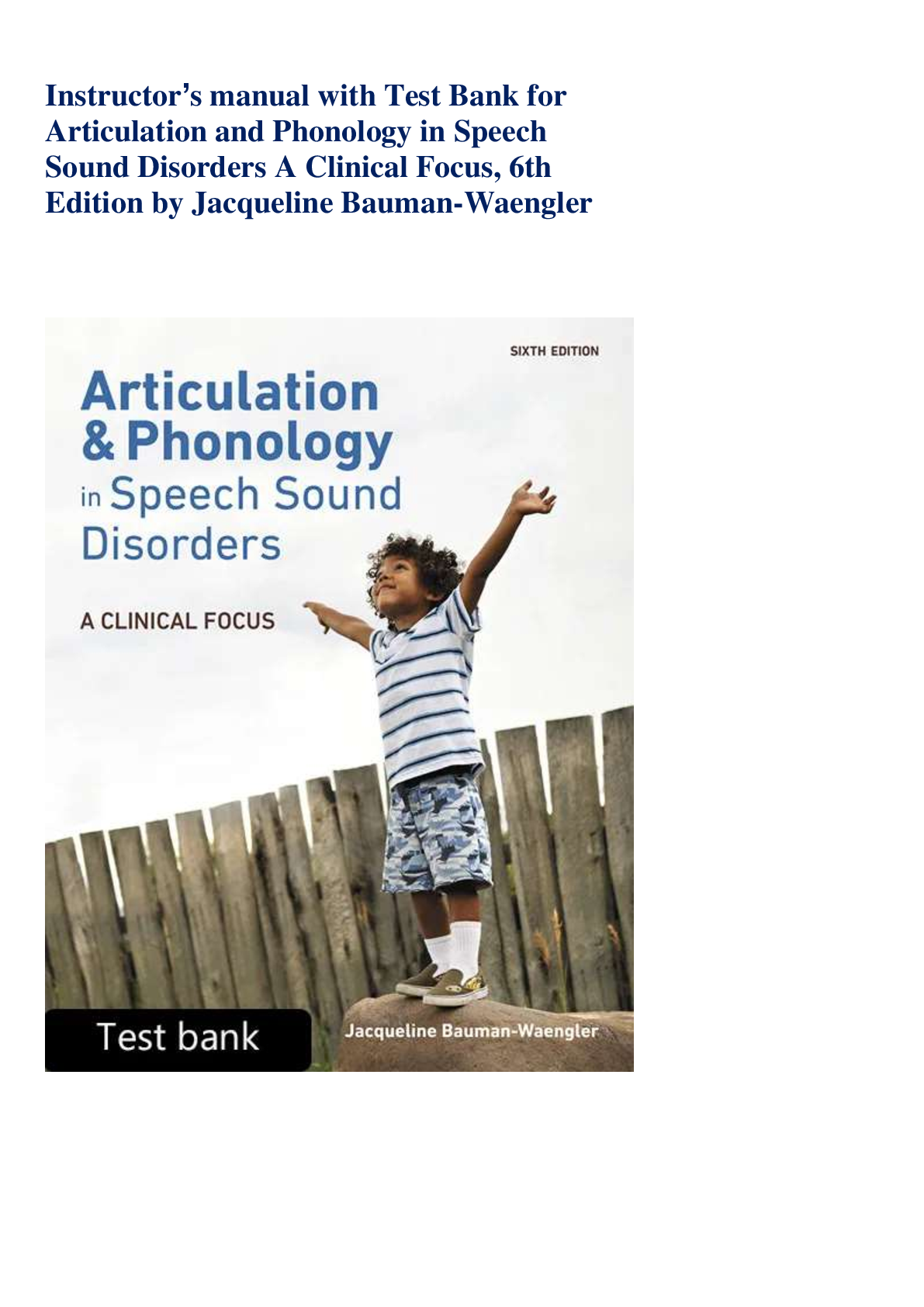
Instructor’s manual with Test Bank for Articulation and Phonology in Speech Sound Disorders A Clinical Focus, 6th Edition by Jacqueline Bauman-Waengler
Document Content and Description Below
Instructor’s manual with Test Bank for Articulation and Phonology in Speech Sound Disorders A Clinical Focus, 6th Edition by Jacqueline Bauman-Waengler LEARNING OBJECTIVES When you have finishe ... d this chapter, you should be able to: • Define communication, speech, and language. • Define disorders of communication, speech, and language. • Distinguish between articulation and speech sounds (phones), phonology, and phonemes. • Define speech sound disorder and understand its relationship to articulation and phonological disorders. • Classify speech sound disorders according to specific parameters. CHAPTER OVERVIEW This chapter introduced the reader to several fundamental terms that are important when assessing and treating speech sound disorders. Introductory terms such as communication, speech, and language were defined based on their normal processes and what a disorder of each would entail. Language divisions of phonology, morphology, syntax, semantics, and pragmatics provided a further delineation which could aid the reader in understanding these basic concepts. Speech sound form versus linguistic function were used to distinguish between the speech sound and the phoneme. Also new to this chapter is the definition of Speech Sound Disorders (ASHA practice portal, n.d. American Speech-LanguageHearing Association). Based on this definition, a differentiation between speech sound, articulation, and phonological disorders were presented as well as nomenclature that is widely used in clinic and research relative to these terms. New to this chapter are two ways that speech sound disorders can be classified. The first is based on subtypes and etiological factors (Shriberg et al., 2010) and the second is a differential diagnosis system which was proposed by Dodd (1995, 2005). Both of these systems were examined, their clinical applicability discussed. 2 Copyright © 2020, 2016, 2012 Pearson Education, Inc. All Rights Reserved PRESENTATION OUTLINES 1. Review basic terms and concepts, such as communication, language, and speech. These terms were defined according to their professional usage, for example, as referenced by the American Speech-Language-Hearing Association (n.d.), and their practical application. 2. Examine the subdivisions of language: phonology, morphology, syntax, semantics, and pragmatics. Definitions were given as well as the application of these terms to the specific areas of language. 3. Define the broader term communication disorder as well as speech sound and language disorder. These divisions will be relevant within our clinical practice. 4. Introduce the concepts of articulation and speech sounds versus phonology and phonemes. This is a delineation which will be important in the discussion of speech sound disorders as well as phonological disorders. 5. Define and delineate the phoneme, allophone, phonotactics and minimal pairs as they apply to phonology. 6. Classify speech sound disorders according to subtypes and etiological factors (Shriberg et al., 2010) and a differential diagnosis system (Dodd, 1995, 2005). 7. Define several terms that are used in clinical and research settings to discuss speech sounds and speech sound disorders. KEYWORD DEFINITIONS Communication is any act in which information is given to or received from another person concerning facts, thoughts, ideas, and feelings (p. 1). Communication refers to any way that we convey information from one person to another. Speech is the communication or expression of thoughts in spoken language (p. 1). It is oral, verbal communication. Speech can be further divided into articulation, fluency, and voice. Language can be defined as a complex and dynamic system of conventional symbols that is used in various modes for thought and communication (p. 3). It is rule governed, includes variability and change, and can be used to communicate in many different ways. Language is described by at least five linguistic parameters: phonology, morphology, syntax, semantics, and pragmatics. Phonology is the study of the sound system of language, and includes the rules that govern its spoken form (p. 2). Phonology a) analyzes which sound units are within a language, b) examines how these sounds are arranged, their systematic organization and rule system. Morphology studies the structure of words; it analyzes how words are built out of morphemes, the basic unit of morphology (p. 2). Morpheme is the smallest meaningful unit of a language (p. 2). Syntax consists of organizational rules denoting word, phrase, and clause order. It also examines the organization and relationship between words, word classes, and other sentence elements (p. 2). 3 Copyright © 2020, 2016, 2012 Pearson Education, Inc. All Rights Reserved Semantics is the study of linguistic meaning and includes the meaning of words, phrases, and sentences (p. 2). Pragmatics is the study of language used to communicate within various situational contexts (p. 2). Pragmatics examines language use in context. Communication disorder is the impairment in the ability to receive, send, process, and comprehend concepts including verbal, nonverbal, and graphic symbol systems (p. 3). Speech disorder indicates oral, verbal communication that is so deviant from the norm that it is noticeable or interferes with communication (p. 3). According to the American Speech-Language-Hearing Association (1993), speech disorders are divided into articulation, fluency, and voice disorders. Language disorder refers to impaired comprehension and/or use of spoken, written, and/or other symbol systems (p. 3). A language disorder may involve one or more of the following areas: phonology, morphology, syntax, semantics, and pragmatics. Hearing impairment results from impaired auditory sensitivity (p. 3). Individuals with hearing impairments are typically classified as either hard of hearing or deaf. Central auditory processing disorder result in difficulties with information processing of auditory signals that are not related to impaired sensitivity of the auditory system. Articulation refers to the totality of motor processes that result in speech (p. 4). It represents a highly complex activity in which - respiratory, phonatory, resonatory, and articulatory mechanisms included - as many as 100 muscles may be involved. In the articulatory mechanism alone up to 22 muscles may alter their degree of tension many times during the utterance of a simple sentence (Hanson, 1983). The sequencing and timing of speech muscle activity is an integral portion of articulation. Speech sounds represent physical sound realities; they are end products of articulatory motor processes (p. 5). Phones are another name for speech sounds (p. 5). They also represent physical sound realities Phoneme is the smallest linguistic unit that is able, when combined with other such units, to establish word meanings and distinguish between them (p. 5). For example, in General American English /p/ and /s/ are phonemes because they function to distinguish between words such as "pat" and "sat". On the other hand, in General American English the aspiration of stop/plosives does not have phonemic relevance. The two words [phit] and [pit], in spite of their differences in production, do not result in two words with different meanings. However, aspiration versus nonaspiration of stop/plosives is phonemically relevant in many languages. For example, in Swahili [pɑ] is the word for "climb", however, with an aspirated [phɑ], signifies the name for a specific type of antelope. As linguistic units, phonemes characterize how speech sounds function within a language to differentiate word meaning. In everyday usage, professionals often do not distinguish between the terms speech sound and phoneme. One could hear someone say that they transcribed a particular phoneme, for example. However, theoretical and definitional differences do exist; these terms represent two distinct concepts. While the technical term speech sound stands for the physical reality of sound form, the term phoneme refers exclusively to how these forms function within a given language as linguistic units to differentiate between word meanings. [Show More]
Last updated: 6 days ago
Preview 5 out of 184 pages

Loading document previews ...
Buy this document to get the full access instantly
Instant Download Access after purchase
Buy NowInstant download
We Accept:

Reviews( 0 )
$7.50
Can't find what you want? Try our AI powered Search
Document information
Connected school, study & course
About the document
Uploaded On
Dec 09, 2025
Number of pages
184
Written in
All

Additional information
This document has been written for:
Uploaded
Dec 09, 2025
Downloads
0
Views
36