PSY290 INTRODUCTION TO NEUROSCIENCE TERM TEST1 MUTIPLE CHOICE QUESTIONS WITH 100% CORRECT ANSWERS
1. Behavioral neuroscience
a. is concerned with how the structure and function of the brain underlies behavior.
...
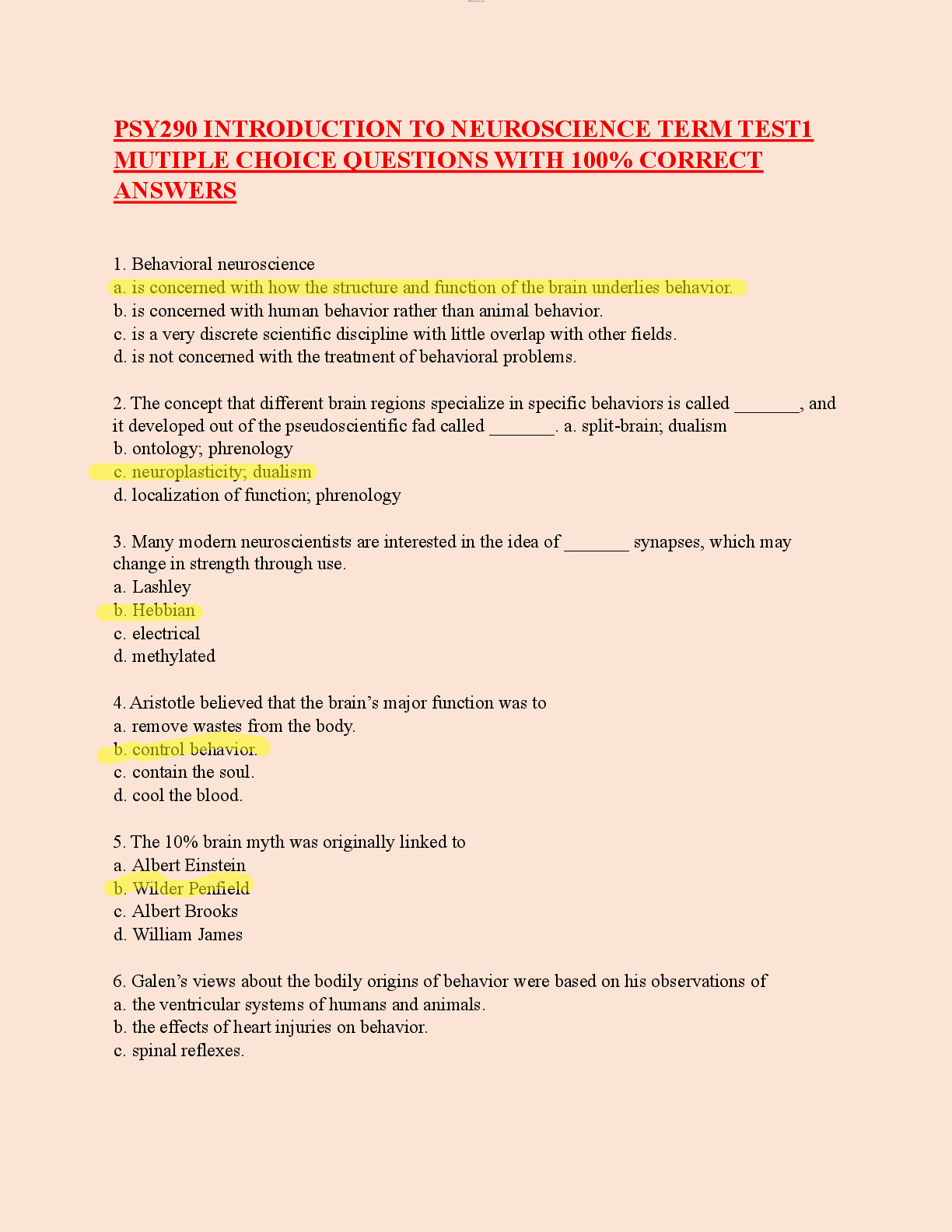
PSY290 INTRODUCTION TO NEUROSCIENCE TERM TEST1 MUTIPLE CHOICE QUESTIONS WITH 100% CORRECT ANSWERS
1. Behavioral neuroscience
a. is concerned with how the structure and function of the brain underlies behavior.
b. is concerned with human behavior rather than animal behavior.
c. is a very discrete scientific discipline with little overlap with other fields.
d. is not concerned with the treatment of behavioral problems.
2. The concept that different brain regions specialize in specific behaviors is called _______, and it developed out of the pseudoscientific fad called _______. a. split-brain; dualism
b. ontology; phrenology
c. neuroplasticity; dualism
d. localization of function; phrenology
3. Many modern neuroscientists are interested in the idea of _______ synapses, which may change in strength through use.
a. Lashley
b. Hebbian
c. electrical
d. methylated
4. Aristotle believed that the brain’s major function was to
a. remove wastes from the body.
b. control behavior.
c. contain the soul.
d. cool the blood.
5. The 10% brain myth was originally linked to
a. Albert Einstein
b. Wilder Penfield
c. Albert Brooks
d. William James
6. Galen’s views about the bodily origins of behavior were based on his observations of
a. the ventricular systems of humans and animals.
b. the effects of heart injuries on behavior.
c. spinal reflexes.
d. the effects of head injuries in gladiators.
7. The notion of dualism as proposed by Descartes stated that
a. the mind and the brain are one and the same.
b. humans have a nonmaterial soul and a material body that are not the same.
c. humans have a nonmaterial soul and a material body that are one and the same.
d. science and the church are one and the same.
8. If I was to say that you were “kindhearted” I would be echoing this ancient notion a. the brain hypothesis.
b. the neuron doctrine.
c. trephening.
d. the cardiac hypothesis.
9. The scientific method is
a. a protocol for use of animals in laboratory testing.
b. a formal system of testing hypotheses to answer scientific questions.
c. the testing of an established theory to back it up.
d. the comparison of different scientific tests in order to choose the most probable.
10. The first researcher to propose the idea that memory is not localized to only one region of the brain was
a. Roger Sperry.
b. Karl Lashley.
c. Thomas Mann.
d. René Descartes.
11. The output zone of the neuron is the
a. axon terminal.
b. dendrites.
c. axon.
d. soma.
12. Which pathway represents the most common sequence of information flow through a neuron?
a. Cell body → axon → axon hillock → axon terminal
b. Dendrite → cell body → axon → axon hillock
c. Dendrite → cell body → axon hillock → axon
d. Dendrite → axon terminal → cell body → axon
13. Which statement about neurons is true?
a. All neurons have the same four functional zones.
b. Multipolar neurons can have many dendrites and many axons.
c. Some interneurons lack a nucleus.
d. Unipolar neurons are especially common in the visual system.
14. Preventing the formation of _______ on dendrites would decrease the space available for synapses.
a. synaptic vesicles
b. dendritic spines
c. the myelin sheath
d. the axon hillock
15. Axon terminals typically form synapses on the cell body or dendrites of a(n) a. postsynaptic neuron.
b. presynaptic neuron.
c. oligodendrocyte.
d. Schwann cell.
16. When you reach out for your pen and feel its shape in your hand, which type of neurons are conveying the sensation in your fingers to your spinal cord? a. Multipolar
b. Bipolar
c. Unipolar
d. Depolarized
17. Bipolar neurons have _______ at one of the cell and _______ at the other end.
a. many dendrites; a single axon
b. a single dendrite; a single axon
c. many dendrites; branching axons
d. a single dendrite; axon terminals
18. The Spanish anatomist Santiago Ramón y Cajal showed that
a. neurons are continuous with one another and are functionally dependent.
b. neurons are continuous with one another but are functionally independent.
c. although neurons come very close together, they are not continuous with one another, but they are functionally dependent on one another.
d. although neurons come very close together, they are not continuous with one another and are functionally independent.
19. The major function of Schwann cells is
a. transmission of nutrients to neurons.
b. myelination of peripheral nerve fibers.
c. scavenging of cellular debris.
[Show More]