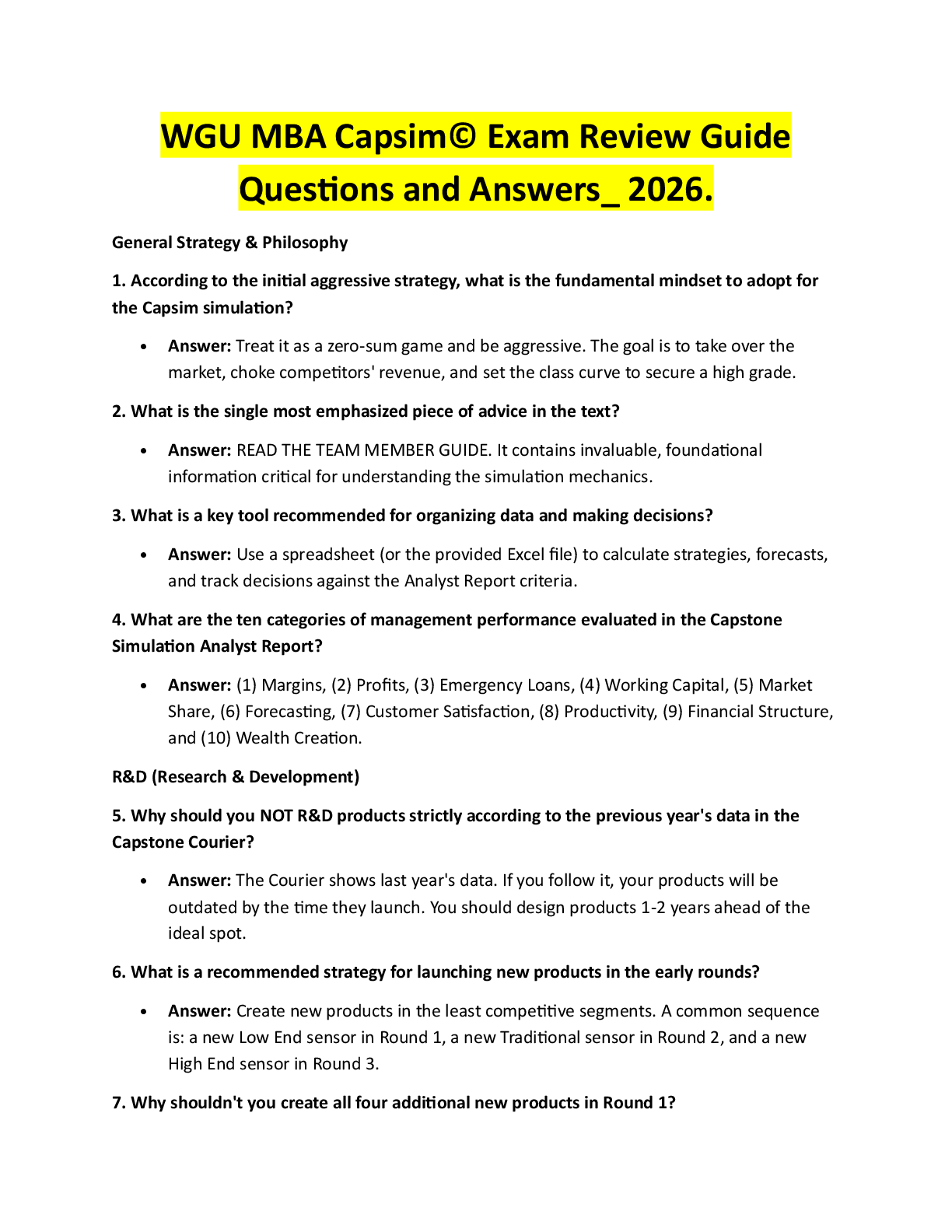
1. Avoid loans at all costs during the initail rounds. These will weigh your company down in
later rounds and destroy your future margins.
2. Release products in low tech segments such that they form a horizontal perce
...
1. Avoid loans at all costs during the initail rounds. These will weigh your company down in
later rounds and destroy your future margins.
2. Release products in low tech segments such that they form a horizontal perceptual map
of high tech and low tech products. Ideally, one product should be launched before year 3
and 2 after that.
3. Low tech products launched initially would move to low tech segments. Keep revising old
products to hold market share
4. Production automation - AVOID!!! this is a waste of money because the simulation does
not allow for a long enough time period to offset the costs of further automation
5. Target 75% awareness, this will provide you with the greatest cost to awareness ratio, and
the additional awareness will not benefit you adequately.
Round when the product is launched - 900
Subsequent rounds till awareness reaches 75% - 1200
After awareness reaches 75% - 1800 to maintain dominance
Target 75% accessibility and keep spending on sales till you reach this stage. The spending
could follow this
Round when the product is launched - 3000
Subsequent rounds till awareness reaches 75% - 3500
After acessibility reaches 75% -3000 to maintain 75%
6. 1500-1800 is the maximum market share for a product in a competitive market.
7. Sales forecast can be determined by taking the total of potentials for each segment of
your product * 2 (this is the secret to winning because you cannot underrate the amount of
product that you will sell. It will hinder you in early rounds and you will not be able to catch
up)
8. Give dividends immediately, this will keep shareholders happy and provide you a positive
boost to your initial stock prices which will allow it to be sold for a high price.
9. Whenever cash available, give additional dividends. These are key to getting a high score
on this simulation.
10. At each round, keep an eye on Balanced score card proforma. Your target in each round
can be
Rounds 1-3 : 40+
Rounds 4-6: 70+
Rounds 7-8: 85+
READ THE TEAM MEMBER GUIDE
I cannot stress the above more. Whether you follow my strategies or not, you NEED to read
the team member guide because it provides you with invaluable information. A lot of
capsim can be applied to real life business. Since you WILL need to learn those things, you
may as well start now.
1) R&D
R&D is the backbone of your company. Whatever strategies you use, you need to
R&D something every year. If you're ever not R&Ding something, then you're doing
something wrong.
First of all, do NOT R&D your products according to the Capstone Courier.
Why? Because Capstone Courier gives you the data for LAST YEAR's products. If you
follow it, then your products are outdated. You should R&D the products to its ideal
spots 1 or 2 year in advance, according to several factors.
Invent new products in the least competitive segment. This is self-explanatory. At
Round 1 or 2 you may not know which segment is the least competitive, but by
Round 3 you should be able to with the help of Courier. The more products you have
earlier, the greater advantage you'll be in in the future.
However do NOT invent all 4 additional products in Round 1 because you won't have
the budget for it.
2) Marketing
This section is probable the most important aspect of Capsim. It deals with your
pricing, marketing & sales budget as well as your sales forecast, which will be shown
in Proforma Income Statement.
Pricing: Price your Low End at the bottom third of the price range, your Traditional at
middle range and your High End/Size/Performance at max price. Try not to get into
price war early because it'll kill both you and your competitors. Lose-lose.
Some of you may wonder why not simply set the lowest price for Low End,
considering price is 47% of the Buying Criteria. During my simulations, I found out it
is not decision. For example the price range is $10 - 20. My competitors set price at
$10 while I set mine at $11.50. He sells 2800 units while I sell 2600 units. Yes his
sales is bigger, but I rake a lot more profits than him. It is simply not worth to set the
lowest price while getting only a bit more sales. This also works in reverse on why I
said set max price for High End/Size/Performance products. By lowering the price you
can sell a bit more, but your overall profit will go down.
Promo & Sales Budget: Promo budget raises your product's awareness while Sales
budget increase your product's segment accessibility. Noticed the difference? Promo
budget is according to EACH product while Sales budget for each SEGMENT. If you've
4 products in Traditional segment, you may need to spend $1400 Promo budget for
each product, but you can set $1000 Sales budget for a combined $4000 Sales
budget in Traditional Segment.
There is a diminishing amount for both budgets. Found out more in your Team
Member Guide. I purposely do not include the figures to force you to read (you'll
thank me).
If Advanced Marketing module is activated, do not worry because it is essentially the
same thing. Refer to the end of this entry for more info.
Sales Forecast: NEVER EVER USE the computer prediction for your sales forecast,
except may be in Round 1 but even then it is not reliable. How do you do a sales
forecast then? This depends on so many variables that it's impossible for me to
provide you with a magic formula. However there is one simple way to set
a benchmark. Here's how:
Read up Courier and scroll down to your product's segment. Look at "Total Industry
Unit Demand". Get this number and multiply it by the 1+growth rate to know the
demand next year. Now scroll down to "Market Share" report and look at your
product's POTENTIAL market share. Sometimes it can have % in different segments,
but just take the biggest number. This percentage multiply by the industry demand
we calculated next year will give you a rough idea on how many units you will sell. Of
course this depends if you can maintain the same percentage of buying criteria and
whether your competitors improve or not.
Why do you need to get the numbers right? 2 BIG reasons: Production & Proforma
Income Statement. If you estimate you'll sell 1,000 units, you can tell Production to
produce 1,000 units. If in fact the demand is only 500 units, you LOSE
MONEYbecause you need to store those extra units somewhere. If it turns out the
demand is greater than 1,000 units, you LOSE POTENTIAL MONEY. Either case is
bad for you. The second reason is your Sales Forecast determine
your PROJECTEDprofit/loss. One word of advice: if your projected profit is $10,000,
expect your actual profits to be only 50% of that. You make financing decisions based
on your projected profit/loss, hence why Marketing is the most important
decisionfunction of Capsim.
3) Production
Production is an extension of Marketing. You get Marketing right, Production is easy
for most parts.
You do a worst-best case scenario with Marketing and Production. If you expect to sell
1,000 units, but feel at worst you'll sell 800 units and at best you sell 1,200 units, you
can enter both. Under Marketing, you input 800 units and under Production you
produce 1,200 units. This way your projected profit/loss is the worst case.
This section is self-explanatory. You take the amount of units you expect to sell and
minus it by inventory on hand. The adjusted number is the actual number of products
you'll get minus a few defect products, but it's only like 0.89% lower so don't bother
yourself with the number.
The big thing about Production is Capacity and Automation Rating. Remember
you can employ 2nd shift workers to produce double your capacity. Having too much
capacity is not an efficient way to run your company while having too many is also
bad investment. Remember any additional Capacity and Automation Rating will take
place NEXT ROUND AND NOT IMMEDIATELY. Plan ahead.
Automation Rating is a complicated. The higher the rating, the more machines you
use and the less workers you need. Less workers mean less wages, which means
cost-savings on your part. However higher automation rating also means longer R&D
cycle. You can safely set 10 for Low End and Traditional. However for High
End/Size/Performance, 10 may or may not be a good thing, depending your strategy.
Continued
[Show More]
Preview 10 out of 118 pages