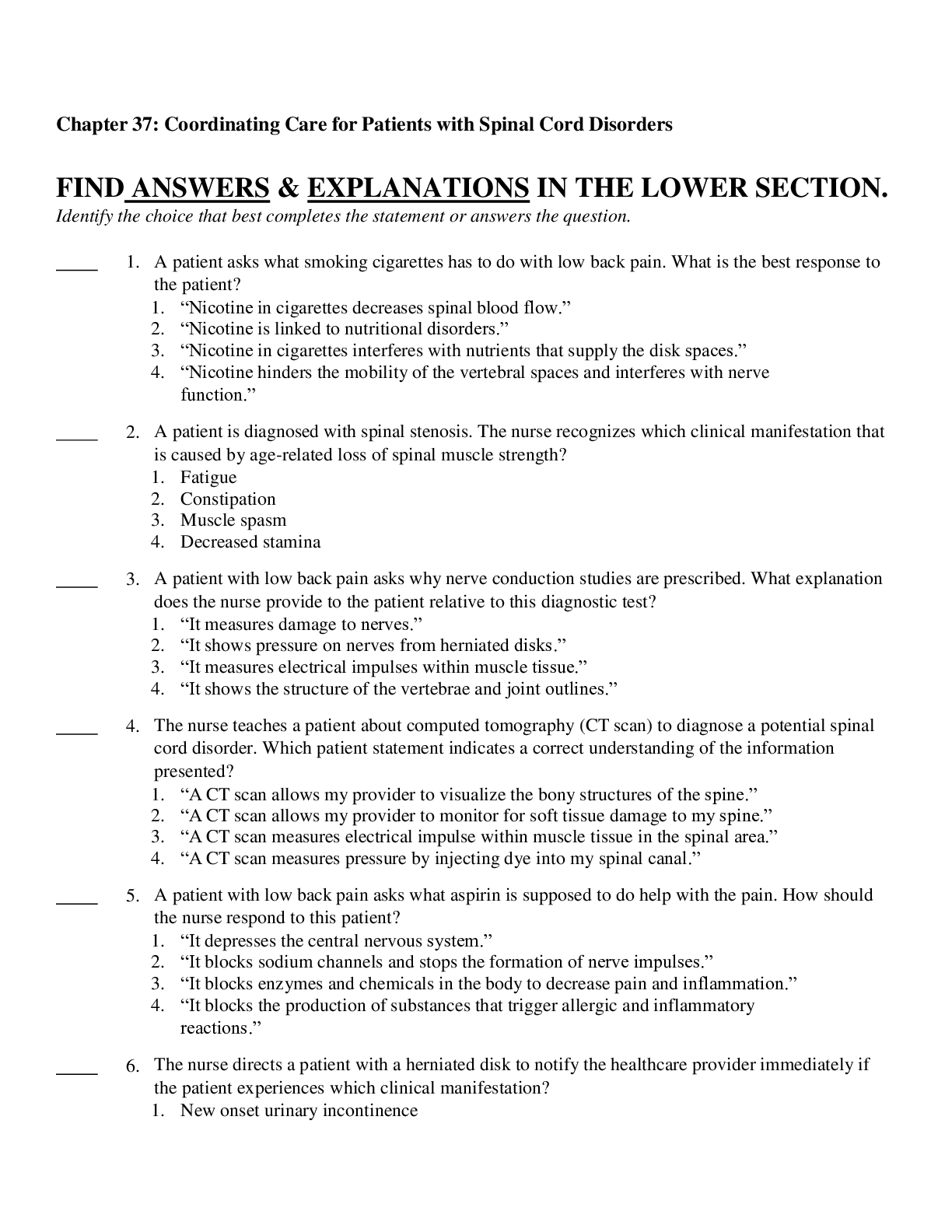
Chapter 37: Coordinating Care for Patients with Spinal Cord Disorders
FIND ANSWERS & EXPLANATIONS IN THE LOWER SECTION.
Identify the choice that best completes the statement or answers the question.
1.
2.
3.
4.
5.
...
Chapter 37: Coordinating Care for Patients with Spinal Cord Disorders
FIND ANSWERS & EXPLANATIONS IN THE LOWER SECTION.
Identify the choice that best completes the statement or answers the question.
1.
2.
3.
4.
5.
6.
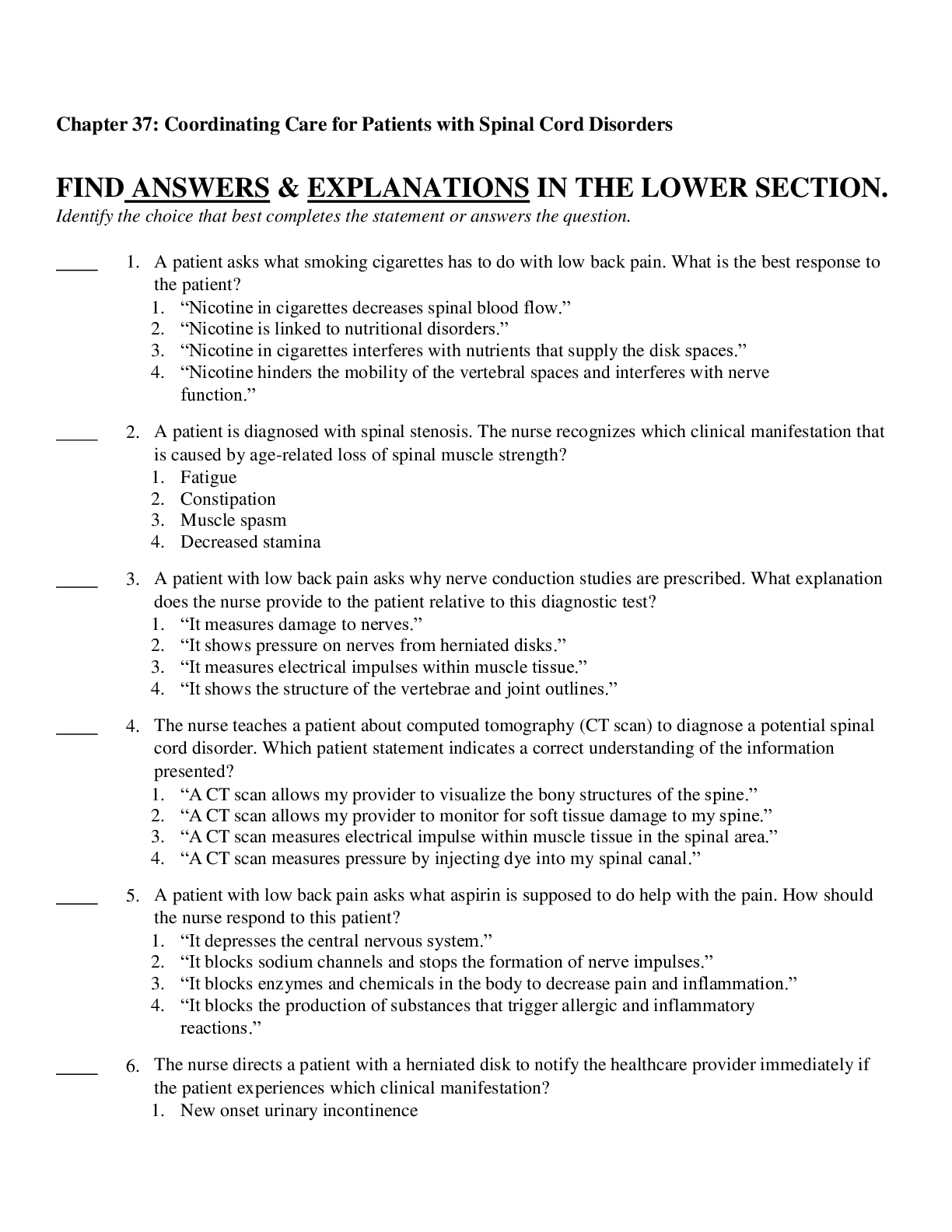
A patient asks what smoking cigarettes has to do with low back pain. What is the best response to
the patient?
1. “Nicotine in cigarettes decreases spinal blood flow.”
2. “Nicotine is linked to nutritional disorders.”
3. “Nicotine in cigarettes interferes with nutrients that supply the disk spaces.”
4. “Nicotine hinders the mobility of the vertebral spaces and interferes with nerve
function.”
A patient is diagnosed with spinal stenosis. The nurse recognizes which clinical manifestation that
is caused by age-related loss of spinal muscle strength?
1. Fatigue
2. Constipation
3. Muscle spasm
4. Decreased stamina
A patient with low back pain asks why nerve conduction studies are prescribed. What explanation
does the nurse provide to the patient relative to this diagnostic test?
1. “It measures damage to nerves.”
2. “It shows pressure on nerves from herniated disks.”
3. “It measures electrical impulses within muscle tissue.”
4. “It shows the structure of the vertebrae and joint outlines.”
The nurse teaches a patient about computed tomography (CT scan) to diagnose a potential spinal
cord disorder. Which patient statement indicates a correct understanding of the information
presented?
1. “A CT scan allows my provider to visualize the bony structures of the spine.”
2. “A CT scan allows my provider to monitor for soft tissue damage to my spine.”
3. “A CT scan measures electrical impulse within muscle tissue in the spinal area.”
4. “A CT scan measures pressure by injecting dye into my spinal canal.”
A patient with low back pain asks what aspirin is supposed to do help with the pain. How should
the nurse respond to this patient?
1. “It depresses the central nervous system.”
2. “It blocks sodium channels and stops the formation of nerve impulses.”
3. “It blocks enzymes and chemicals in the body to decrease pain and inflammation.”
4. “It blocks the production of substances that trigger allergic and inflammatory
reactions.”
The nurse directs a patient with a herniated disk to notify the healthcare provider immediately if
the patient experiences which clinical manifestation?
1. New onset urinary incontinence
7.
8.
9.
2. Sleepiness and weakness
3. Difficulty with having a bowel movement
4. Transient pain with walking and changing position
The nurse provides care for a patient who is 4 hours postoperative after surgery to correct a
herniated nucleus pulposus. Which assessment finding causes the nurse to notify the healthcare
provider?
1. The patient is drowsy.
2. The patient’s respiratory rate is nine breathes per minute.
3. The patient reports pain of 5 on a scale of 1 to 10.
4. The patient’s dressing has serosanguinous drainage.
The nurse is caring for a patient with unrelenting low back pain caused by a herniated disk. What
instruction does the nurse provide to this patient to help with the pain?
1. Sit with the legs elevated
2. Reduce the intake of fluids
3. Limit activity until the pain subsides
4. Bend at the knees with a straight back
A patient with multiple sclerosis experiences exacerbations of new symptoms that last a few days
and then disappear. The nurse correlates these clinical manifestations to which type of multiple
sclerosis?
1. Relapsing-remitting
2. Primary progressive
3. Progressive relapsing
4. Secondary progressive
10. Which statement by the patient with multiple sclerosis (MS) indicates the need for additional
teaching?
1. “MS causes my nerves to die.”
2. “There is no cure for MS.”
3. “MS is caused by damage to the covering of the spinal cord.”
4. “Physical therapy may help me with my MS.”
11. The nurse correlates which clinical manifestation to a definitive diagnosis of multiple sclerosis?
1. Onset of double vision
2. Loss of bowel and bladder control
3. Numbness and tingling of one limb
4. Magnetic resonance imaging (MRI) changes in two separate locations
12. In providing care to a patient with multiple sclerosis who is developing speech difficulties, the
nurse correlates this new finding to which factor?
1. Depression
2. Medications
3. Nerve regeneration
4. Mental status changes
[Show More]

![Preview of eBook [PDF] Barash, Cullen, and Stoelting's Clinical Anesthesia 9th Edition By Bruce F. Cu](https://browseimages.nyc3.digitaloceanspaces.com/paper-images/2024/Aug/29/8DF2QRTq2024-08-29-10-3966d0259b7c4b5.png)
![Preview of eBook [PDF] Fundamentals of Nursing 3rd Edition By Joanne Tollefson, Sue C. DeLaune, Patri](https://browseimages.nyc3.digitaloceanspaces.com/paper-images/2024/Aug/26/U6SQ8mmq2024-08-26-01-4766cc5d40d7385.png)
![Preview of eBook [PDF] Burns' Pediatric Primary Care 7th Edition BY Dawn Lee Garzon Maaks,, Nancy Bar](https://browseimages.nyc3.digitaloceanspaces.com/paper-images/2024/Aug/26/WR2rowXX2024-08-26-02-0966cc625bea839.png)




 HESI VI EXIT EXAM.png)
.png)