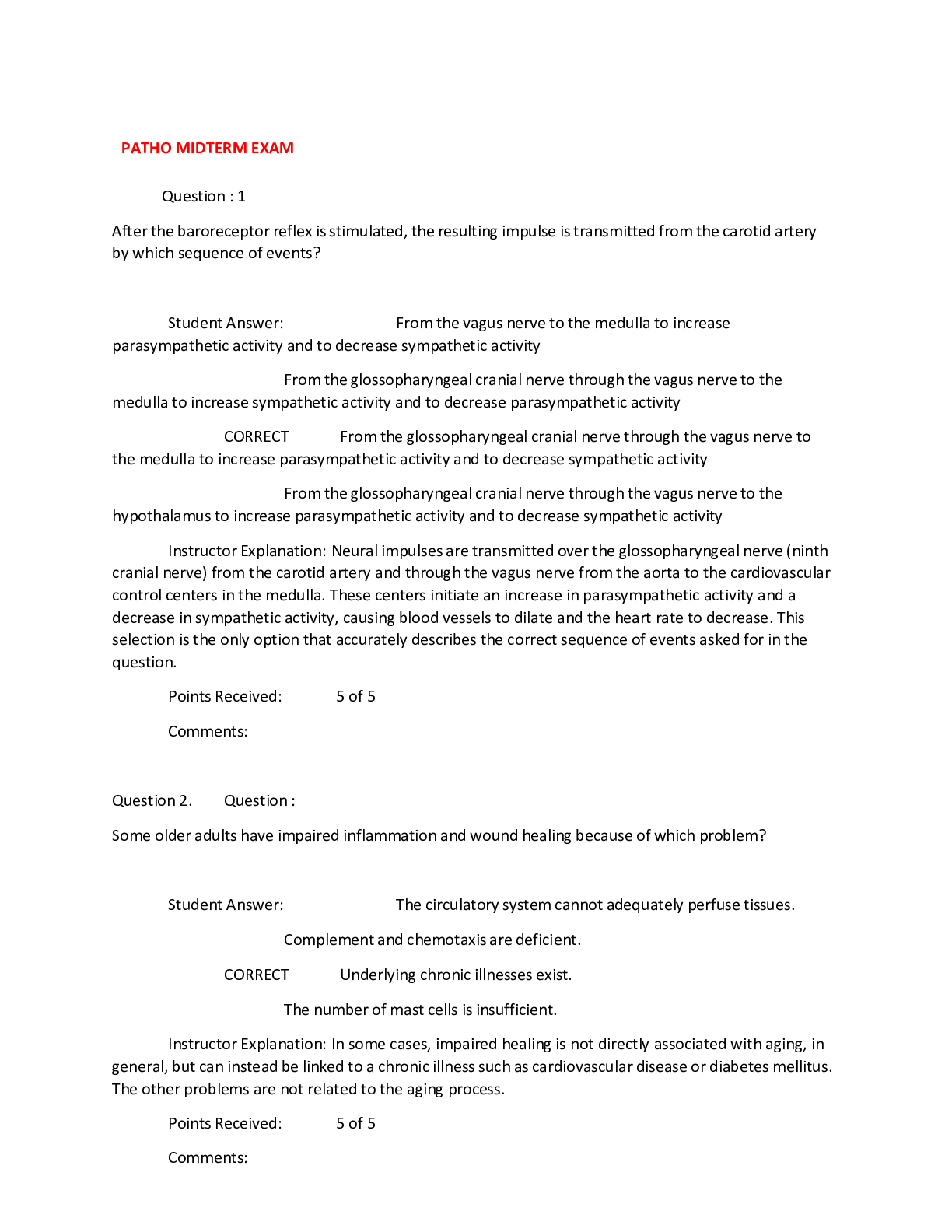
A patient asks what smoking cigarettes has to do with low back pain. What is the best response to
the patient?
1. “Nicotine in cigarettes decreases spinal blood flow.”
2. “Nicotine is linked to nutritional disorders.”
...
A patient asks what smoking cigarettes has to do with low back pain. What is the best response to
the patient?
1. “Nicotine in cigarettes decreases spinal blood flow.”
2. “Nicotine is linked to nutritional disorders.”
3. “Nicotine in cigarettes interferes with nutrients that supply the disk spaces.”
4. “Nicotine hinders the mobility of the vertebral spaces and interferes with nerve
function.”
A patient is diagnosed with spinal stenosis. The nurse recognizes which clinical manifestation that
is caused by age-related loss of spinal muscle strength?
1. Fatigue
2. Constipation
3. Muscle spasm
4. Decreased stamina
A patient with low back pain asks why nerve conduction studies are prescribed. What explanation
does the nurse provide to the patient relative to this diagnostic test?
1. “It measures damage to nerves.”
2. “It shows pressure on nerves from herniated disks.”
3. “It measures electrical impulses within muscle tissue.”
4. “It shows the structure of the vertebrae and joint outlines.”
The nurse teaches a patient about computed tomography (CT scan) to diagnose a potential spinal
cord disorder. Which patient statement indicates a correct understanding of the information
presented?
1. “A CT scan allows my provider to visualize the bony structures of the spine.”
2. “A CT scan allows my provider to monitor for soft tissue damage to my spine.”
3. “A CT scan measures electrical impulse within muscle tissue in the spinal area.”
4. “A CT scan measures pressure by injecting dye into my spinal canal.”
A patient with low back pain asks what aspirin is supposed to do help with the pain. How should
the nurse respond to this patient?
1. “It depresses the central nervous system.”
2. “It blocks sodium channels and stops the formation of nerve impulses.”
3. “It blocks enzymes and chemicals in the body to decrease pain and inflammation.”
4. “It blocks the production of substances that trigger allergic and inflammatory
reactions.”
The nurse directs a patient with a herniated disk to notify the healthcare provider immediately if
the patient experiences which clinical manifestation?
1. New onset urinary incontinence
7.
8.
9.
2. Sleepiness and weakness
3. Difficulty with having a bowel movement
4. Transient pain with walking and changing position
The nurse provides care for a patient who is 4 hours postoperative after surgery to correct a
herniated nucleus pulposus. Which assessment finding causes the nurse to notify the healthcare
provider?
1. The patient is drowsy.
2. The patient’s respiratory rate is nine breathes per minute.
3. The patient reports pain of 5 on a scale of 1 to 10.
4. The patient’s dressing has serosanguinous drainage.
The nurse is caring for a patient with unrelenting low back pain caused by a herniated disk. What
instruction does the nurse provide to this patient to help with the pain?
1. Sit with the legs elevated
2. Reduce the intake of fluids
3. Limit activity until the pain subsides
4. Bend at the knees with a straight back
A patient with multiple sclerosis experiences exacerbations of new symptoms that last a few days
and then disappear. The nurse correlates these clinical manifestations to which type of multiple
sclerosis?
1. Relapsing-remitting
2. Primary progressive
3. Progressive relapsing
4. Secondary progressive
10. Which statement by the patient with multiple sclerosis (MS) indicates the need for additional
teaching?
1. “MS causes my nerves to die.”
2. “There is no cure for MS.”
3. “MS is caused by damage to the covering of the spinal cord.”
4. “Physical therapy may help me with my MS.”
11. The nurse correlates which clinical manifestation to a definitive diagnosis of multiple sclerosis?
1. Onset of double vision
2. Loss of bowel and bladder control
3. Numbness and tingling of one limb
4. Magnetic resonance imaging (MRI) changes in two separate locations
12. In providing care to a patient with multiple sclerosis who is developing speech difficulties, the
nurse correlates this new finding to which factor?
1. Depression
2. Medications
3. Nerve regeneration
4. Mental status changes
13. The nurse is caring for a patient with multiple sclerosis. What actions does the nurse implement to
increase venous return, prevent stiffness, and maintain muscle strength and endurance?
1. Administer interferon
2. Administer corticosteroids
3. Turn and reposition every 2 hours
4. Encourage range-of-motion exercises
14. A patient with amyotrophic lateral sclerosis is prescribed riluzole (Rilutek). What statement by the
patient indicates that further teaching is needed about this treatment?
1. “This medication will cure my disease.”
2. “This medication may delay the need to be on a ventilator.”
3. “This medication works on nerve conduction.”
4. “This medication may decrease the progression of my disease.”
15. A patient recently diagnosed with amyotrophic lateral sclerosis is having difficulty with
swallowing and has been choking and coughing excessively at mealtimes. The nurse implements
which action first?
1. Initiating low-flow oxygen therapy
2. Suctioning the oropharynx
3. Auscultating breath sounds
4. Assessing neurological status
16. The nurse is reviewing orders written for a patient with a new spinal cord injury. Which order does
the nurse question?
1. Place on air mattress
2. Insert a nasogastric tube and attach to low intermittent suction
3. Insert indwelling urinary catheter; strict intake and output
4. Dexamethasone (Decadron) 10 mg IVP now and repeat in 4 hours
17. The nurse correlates which clinical manifestations to autonomic dysreflexia in a patient with a
spinal cord injury?
1. Hypertension with tachycardia
2. Hypertension with bradycardia
3. Hypotension with bradycardia
4. Hypotension with tachycardia
18. The latest blood pressure reading for a patient with a spinal cord injury is 210/140 mm Hg. What
action should the nurse take first?
1. Palpating for bladder distention
2. Assessing for a bowel impaction
3. Remeasuring the blood pressure
4. Raising the head of the bed 45 degrees
19. A patient has arrived by ambulance at the emergency department after a cervical spinal cord injury.
Which assessment is a priority for the nurse to perform at this time?
1. Mental status and blood pressure
2. Heart rate and rhythm
3. Muscle strength and reflexes
4. Respiratory pattern and airway
20. The nurse notes crusting of secretions around the pins of a patient with a halo device. What action
is indicated for this finding?
1. Wrapping the pins with gauze soaked with normal saline
2. Gently picking the crusting off of the pins with a dry gauze pad
3. Applying gauze soaked with hydrogen peroxide around the pins
4. Using a syringe to apply half-strength hydrogen peroxide and sterile water to the
crusted areas
21. The nurse correlates the new onset of back pain radiating down the left leg to which neurological
disorder?
1. Meningitis
2. Spinal cord tumor
3. Multiple sclerosis
4. Amyotrophic lateral sclerosis
22. A patient has a 4 cm spinal cord tumor located at T10. Which statement by the patient indicates the
patient understands the treatment options?
1. “Surgery is the best treatment for this tumor.”
2. “I will need radiation therapy before surgery.”
3. “This tumor can be treated with chemotherapy.”
4. “The only treatment for this tumor is stereotactic radiosurgery.”
23. The nurse is reviewing orders written for a patient returning from surgery to remove a spinal cord
tumor. Which order is the priority at this time?
1. Administer pain medications
2. Have the patient use the incentive spirometer
3. Administer dexamethasone (Decadron) 10 mg IVP now
4. Monitor urine output
Multiple Response
Identify one or more choices that best complete the statement or answer the question.
24. A patient with low back pain asks what nonmedical treatments can be used to help with the
discomfort. Which complementary and alternative therapies does the nurse discuss with patient?
Select all that apply.
1. Yoga
2. Qi gong
3. Acupuncture
4. Massage therapy
5. Chiropractic treatments
25. The nurse is concerned that a patient is at risk for a lumbar disk herniation. The nurse correlates
this to which assessment data? Select all that apply.
1. Age 25
2. Body mass index 32.3
3. Smokes 1 pack of cigarettes per day
4. Works in an automotive factory
5. Prolonged sitting
26. The nurse monitors for which clinical manifestations in the patient with low back pain secondary
to radiculopathy? Select all that apply.
1. Pain
2. Edema in lower extremities
3. Weakness
4. Numbness
5. Paralysis
27. A patient with a herniated disk is prescribed conservative treatment. The nurse includes instruction
in which activities based on this treatment plan? Select all that apply.
1. Reducing body weight
2. Avoiding painful positions
3. Engaging in aerobic activities
4. Electrical nerve stimulation
5. Taking corticosteroids as prescribed
28. The nurse monitors for which clinical manifestation in the patient diagnosed with multiple
sclerosis (MS)? Select all that apply.
1. Paralysis
2. Dizziness
3. Double vision
4. Unsteady gait
5. Radicular pain
29. The nurse provides education to a patient who is newly diagnosed with multiple sclerosis (MS).
Which patient statements indicate the need for additional teaching? Select all that apply.
1. “I may experience visual disturbances.”
2. “I may experience urinary incontinence.”
3. “I should not exercise because this may trigger an exacerbation.”
4. “I should alternate the eye patch every other day to help with the double vision.”
5. “I need to check the water temperature before I take a bath.”
30. A patient with amyotrophic lateral sclerosis (ALS) is being prepared for discharge. What teaching
would be essential for the family to receive before taking the patient home? Select all that apply.
1. Skin care
2. Aspiration precautions
3. Recognizing exacerbations
4. Lower extremity circulation
5. Strategies to lose weig
[Show More]








.png)


.png)
.png)


.png)