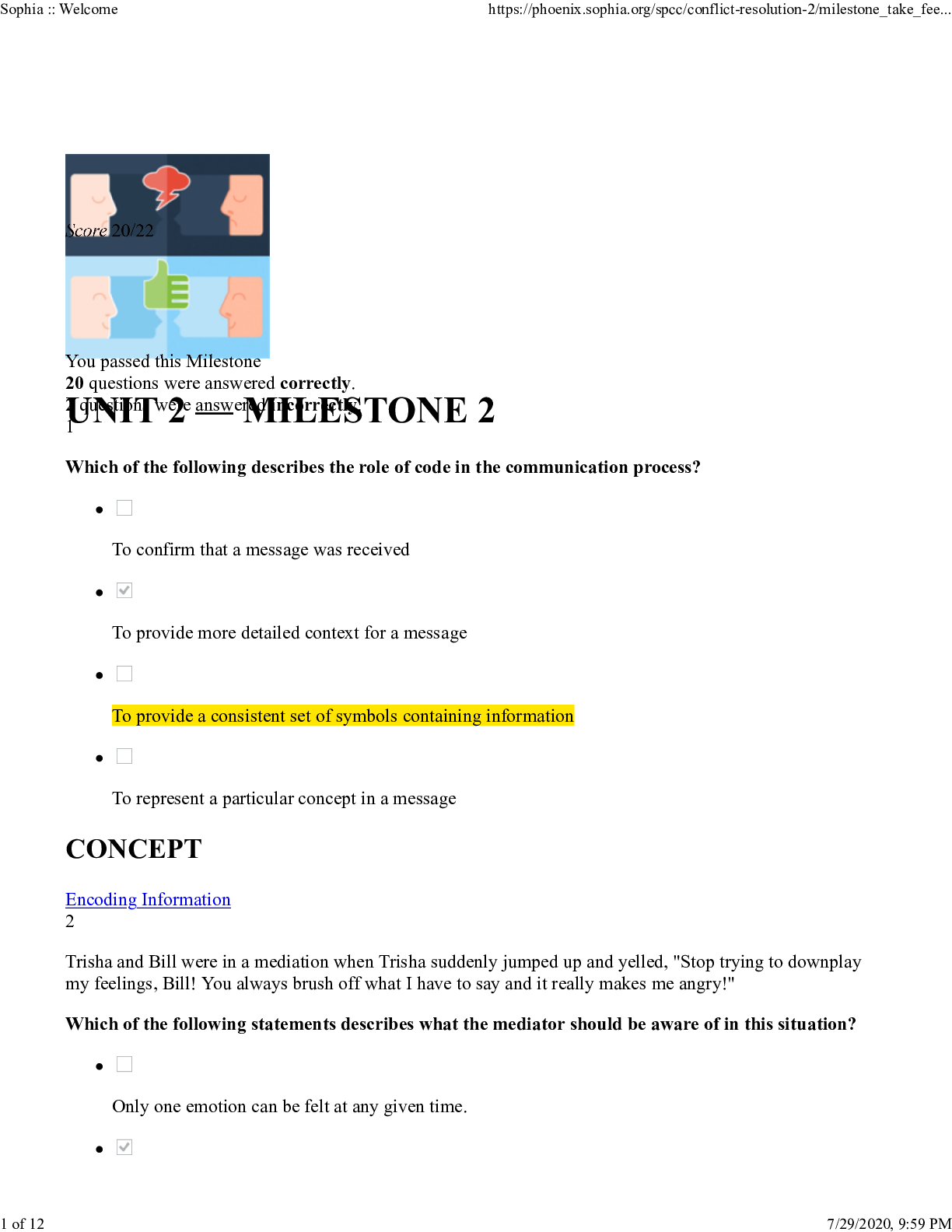
What are rules or norms developed around in an organizational culture?
Factors that directly or indirectly impact the specific goal or purpose of the organization
What the boss or CEO thinks is right
The g
...
What are rules or norms developed around in an organizational culture?
Factors that directly or indirectly impact the specific goal or purpose of the organization
What the boss or CEO thinks is right
The goals or purposes of competing organizations
The results of a general vote by all employees
CONCEPT
Cultural Model Applied to Smaller Groups 2
Which of the following statements would likely be said by a low context communicator?
I heard a new coffee shop opened up around the corner; it's supposed to be really good.
Burr, winter sure arrived quick! A hot cup of coffee sounds great about now.
Perhaps you would like to get a cup of coffee sometime, when you aren't too busy.
Let's meet for coffee tomorrow at noon.
CONCEPT
High and Low Context Communication 3
Which of the following is traditionally perceived as gender inappropriate in U.S. culture?
A woman using a compromising conflict style
A woman using an avoiding conflict style
A man using a competing conflict style
A woman using a competing conflict style
CONCEPT
Gender and Conflict Style 4
In a culture, the worldview is to all members.
constant
different
common
ambiguous
5
Which of the following statements regarding gender role changes is FALSE?
Gender roles remain the same over time.
Not all members of a culture change at the same time.
Perceptions of gender role changes can cause cognitive dissonance.
Gender roles evolve over time.
CONCEPT
Conflict Over Gender Role Changes 6
Which of the following sayings would most likely be from a collectivist culture?
“Be your own man.”
“Stand on your own two feet.”
“Be a leader, not a follower.”
“There is no 'I' in team.”
CONCEPT
Individualism and Collectivism 7
Which of the following would be an expected behavior from a person whose culture has a high tolerance for ambiguity?
An attitude of deference and deep respect to social superiors
Comfort in situations with flexible or ill-understood rules
Unwillingness to abandon long-standing traditions as context changes
A direct way of speaking
CONCEPT
Tolerance for Ambiguity 8
Which of the following examples demonstrates a high power distance culture?
..................................Cont........................
[Show More]