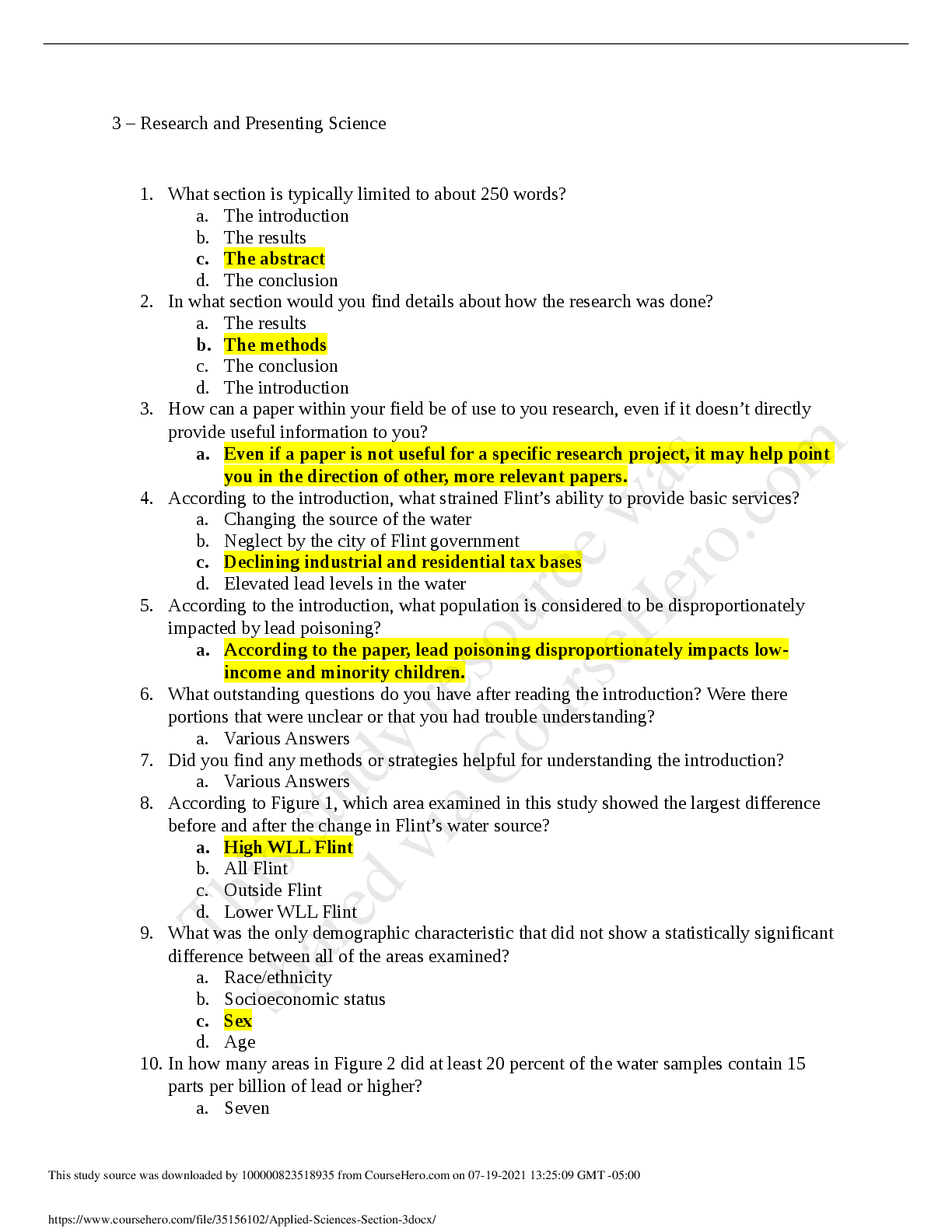
Business > QUESTIONS & ANSWERS > University of WaterlooMATBUS 470HullOFOD9eSolutionsCh25 (All)
University of WaterlooMATBUS 470HullOFOD9eSolutionsCh25
Document Content and Description Below
Last updated: 7 months ago
Preview 1 out of 10 pages
Instant download

Buy this Document to get the Full Access Instantly
Provided by Students Who Aced it
We Verify Document Content to Gurantee Accuracy
Reviews( 0 )
Document information
Connected school, study & course
About the document
Uploaded On
Apr 25, 2021
Number of pages
10
Written in
All

Additional information
This document has been written for:
Uploaded
Apr 25, 2021
Downloads
0
Views
118
Topic Tags
Recommended For You
Get more on QUESTIONS & ANSWERS »
SOLUTIONS MANUAL Ordering and Payment Page | SEARCH FOR YOUR S...

Test Bank for Labour Relations 6th Canadian Edition by Larry S...

Test Bank for Byrd & Chen's Canadian Tax Principles (Volume 1...

Test Bank For Business Marketing Management: B2B 13th Edition...

Business Marketing Management B2B 13th Edition Michael D. Hutt...

Solutions Manual For Business Marketing Management B2B, 13th E...

Solution Manual For Business Marketing Management B2B, 13th Ed...

Test Bank For Business Marketing Management B2B, 13th Edition...

Test Bank for Global Business Competing in the International M...
BUSINESS 520 Directed Study 3 Chapter 1-9 Strayer University,...
Instructor Manual M Organizational Behavior 2024 Release By St...

Business Marketing Management B2B 13th Edition By Michael Hutt...


 Charles Herrick - 100 Q&A About Alcoholism & Drug Addiction-Jones and Bartlett Publishers, Inc.png)