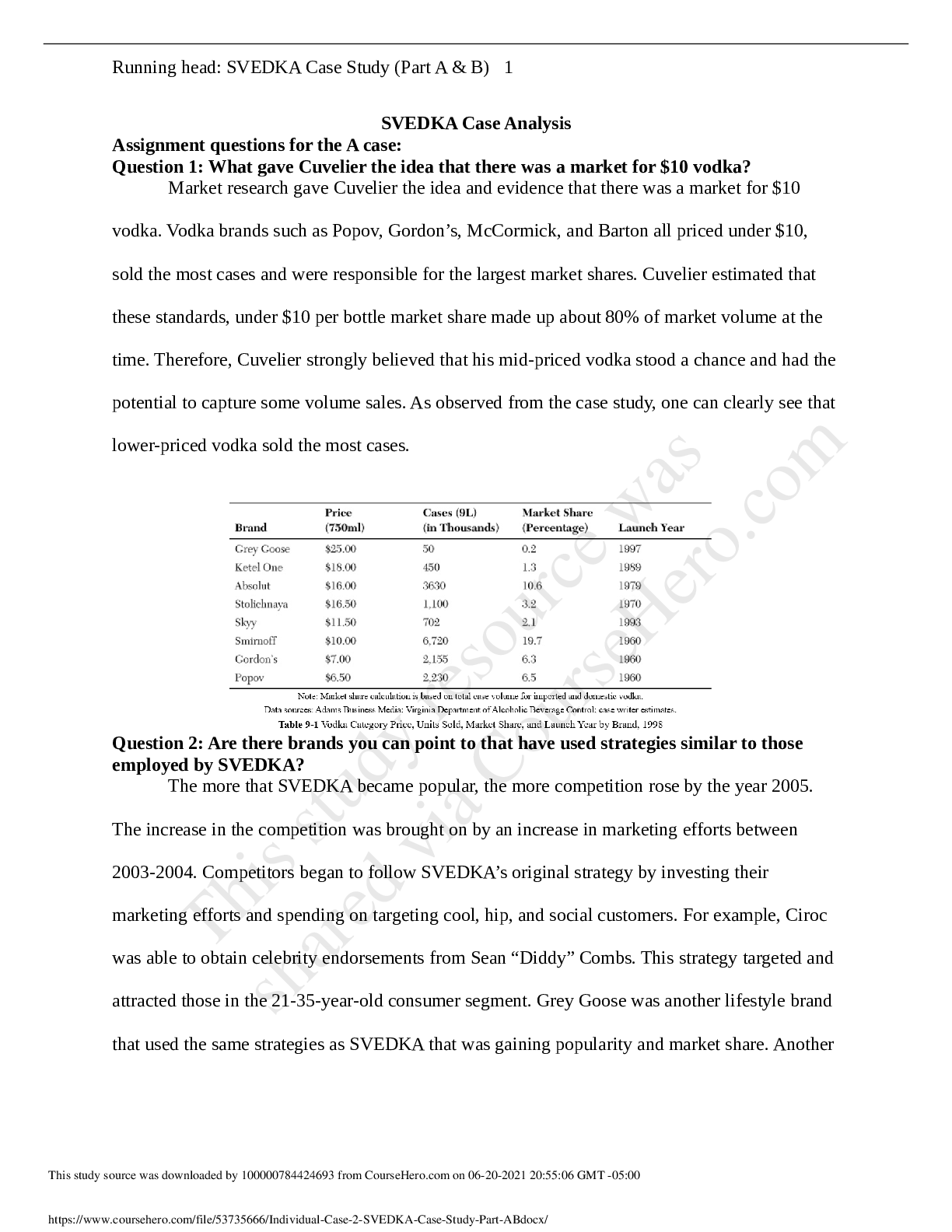
TOPIC 7.1 Introduction to Natural Selection
ENDURING UNDERSTANDING EVO-1 Evolution is characterized by a change in the genetic makeup of a population over time and is supported
by multiple lines of evidence.
LEARNING
...
TOPIC 7.1 Introduction to Natural Selection
ENDURING UNDERSTANDING EVO-1 Evolution is characterized by a change in the genetic makeup of a population over time and is supported
by multiple lines of evidence.
LEARNING OBJECTIVE
EVO-1.C Describe the causes of natural
selection.
ESSENTIAL KNOWLEDGE
EVO-1.C.1 Natural selection is a major
mechanism of evolution.
EVO-1.C.2 According to Darwin’s theory
of natural selection, competition for
limited resources results in differential
survival. Individuals with more favorable
phenotypes are more likely to survive and
produce more offspring, thus passing traits
to subsequent generations.
LEARNING OBJECTIVE
EVO-1.D Explain how natural selection
affects populations.
ESSENTIAL KNOWLEDGE
EVO-1.D.1 Evolutionary fitness is
measured by reproductive success.
EVO-1.D.2 Biotic and abiotic
environments can be more or less
stable/fluctuating, and this affects the rate
and direction of evolution; different
genetic variations can be selected in each
generation
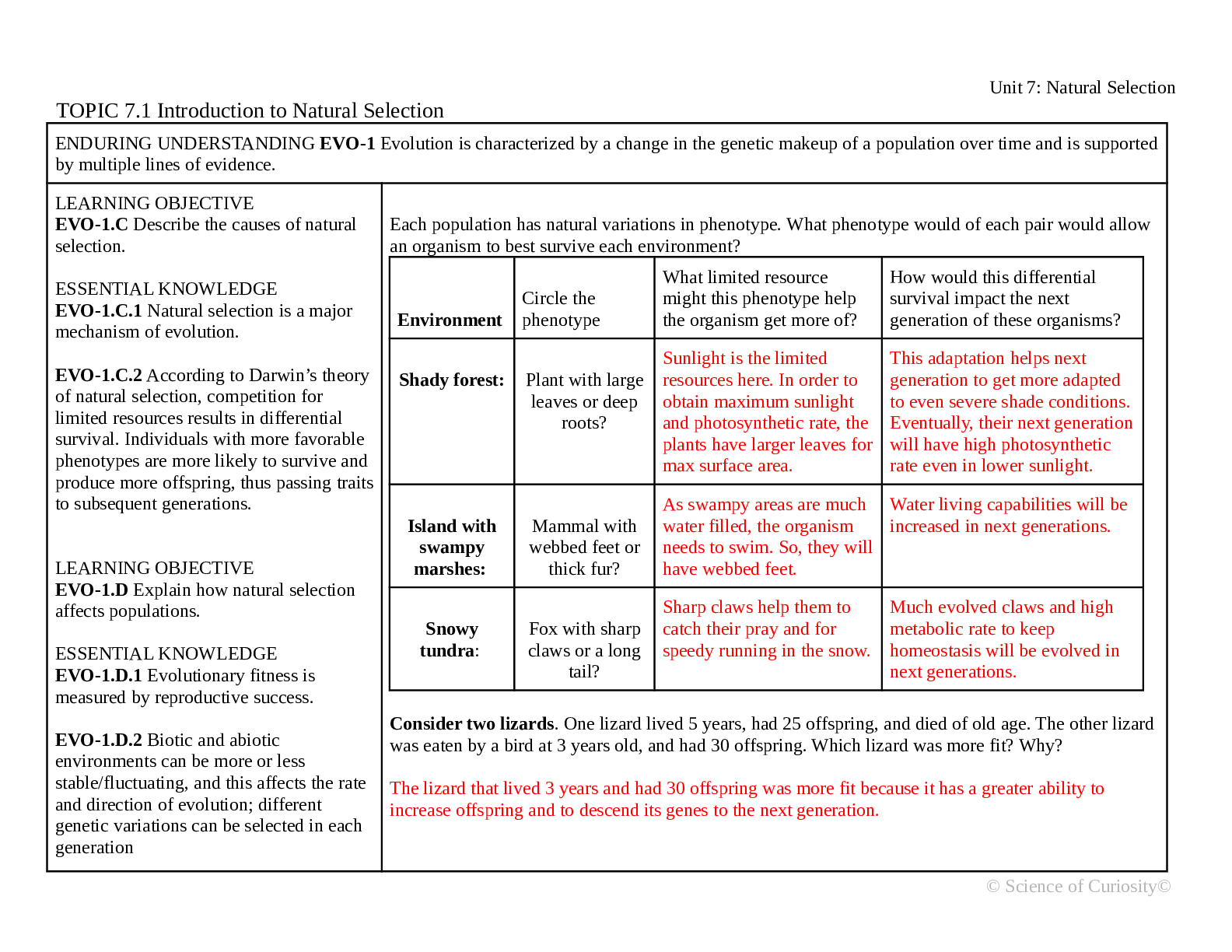
Each population has natural variations in phenotype. What phenotype would of each pair would allow
an organism to best survive each environment?
Environment
Circle the
phenotype
What limited resource
might this phenotype help
the organism get more of?
How would this differential
survival impact the next
generation of these organisms?
Shady forest: Plant with large
leaves or deep
roots?
Sunlight is the limited
resources here. In order to
obtain maximum sunlight
and photosynthetic rate, the
plants have larger leaves for
max surface area.
This adaptation helps next
generation to get more adapted
to even severe shade conditions.
Eventually, their next generation
will have high photosynthetic
rate even in lower sunlight.
Island with
swampy
marshes:
Mammal with
webbed feet or
thick fur?
As swampy areas are much
water filled, the organism
needs to swim. So, they will
have webbed feet.
Water living capabilities will be
increased in next generations.
Snowy
tundra:
Fox with sharp
claws or a long
tail?
Sharp claws help them to
catch their pray and for
speedy running in the snow.
Much evolved claws and high
metabolic rate to keep
homeostasis will be evolved in
next generations.
Consider two lizards. One lizard lived 5 years, had 25 offspring, and died of old age. The other lizard
was eaten by a bird at 3 years old, and had 30 offspring. Which lizard was more fit? Why?
The lizard that lived 3 years and had 30 offspring was more fit because it has a greater ability to
increase offspring and to descend its genes to the next generation.
© Science of Curiosit
[Show More]