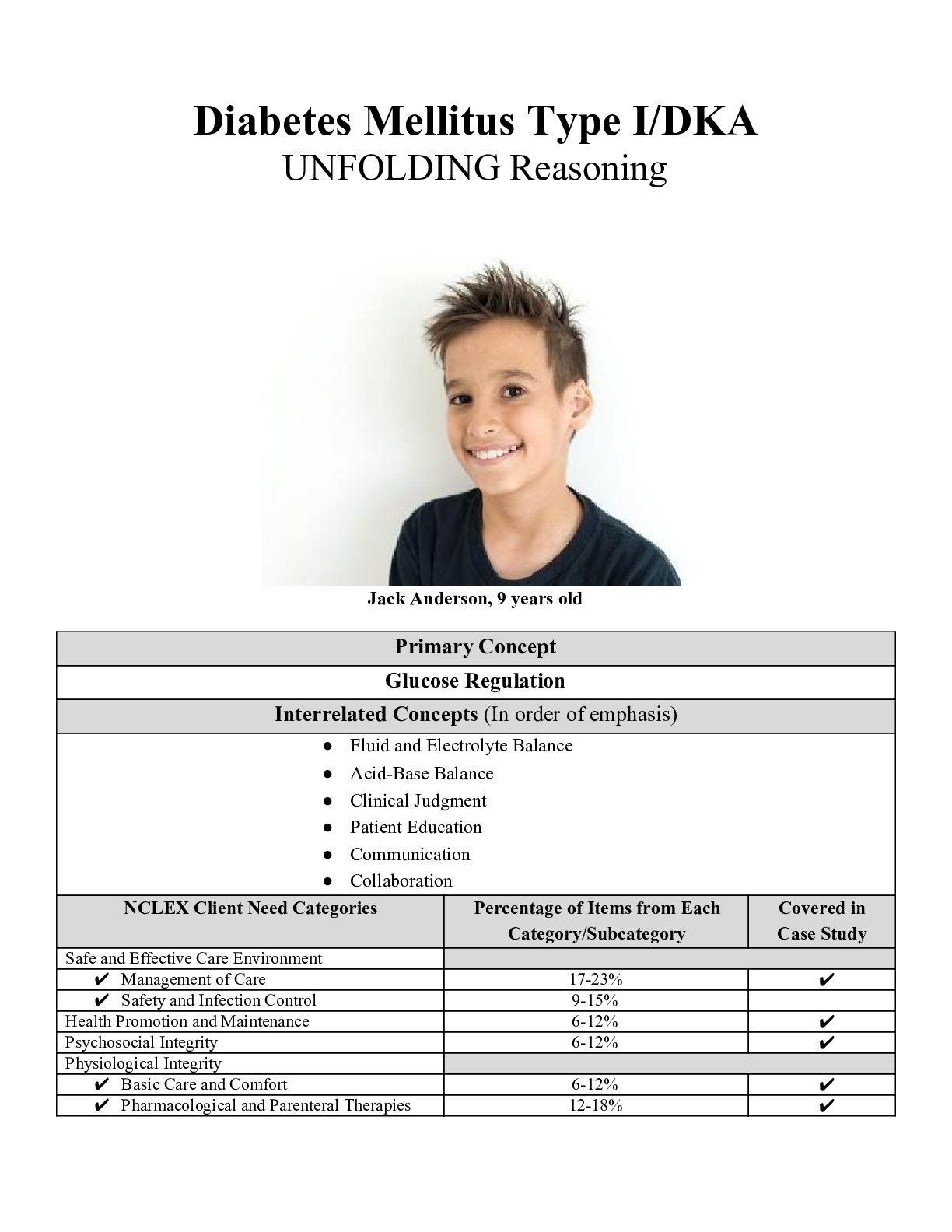
Primary Concept
Glucose Regulation
Interrelated Concepts (In order of emphasis)
● Fluid and Electrolyte Balance
● Acid-Base Balance
● Clinical Judgment
● Patient Education
● Communication
● Collaboration
NCLEX C
...
Primary Concept
Glucose Regulation
Interrelated Concepts (In order of emphasis)
● Fluid and Electrolyte Balance
● Acid-Base Balance
● Clinical Judgment
● Patient Education
● Communication
● Collaboration
NCLEX Client Need Categories Percentage of Items from Each
Category/Subcategory
Covered in
Case Study
Safe and Effective Care Environment
✔ Management of Care 17-23% ✔
✔ Safety and Infection Control 9-15%
Health Promotion and Maintenance 6-12% ✔
Psychosocial Integrity 6-12% ✔
Physiological Integrity
✔ Basic Care and Comfort 6-12% ✔
✔ Pharmacological and Parenteral Therapies 12-18% ✔
✔
R
e
du
c
t
i
o
n
o
f
R
i
s
k
P
o
t
e
n
t
i
a
l
9
-
1
5
%
✔
✔
P
h
y
s
i
o
l
o
g
i
c
a
l
A
d
ap
t
a
t
i
o
n
1
1
-
1
7
%
✔
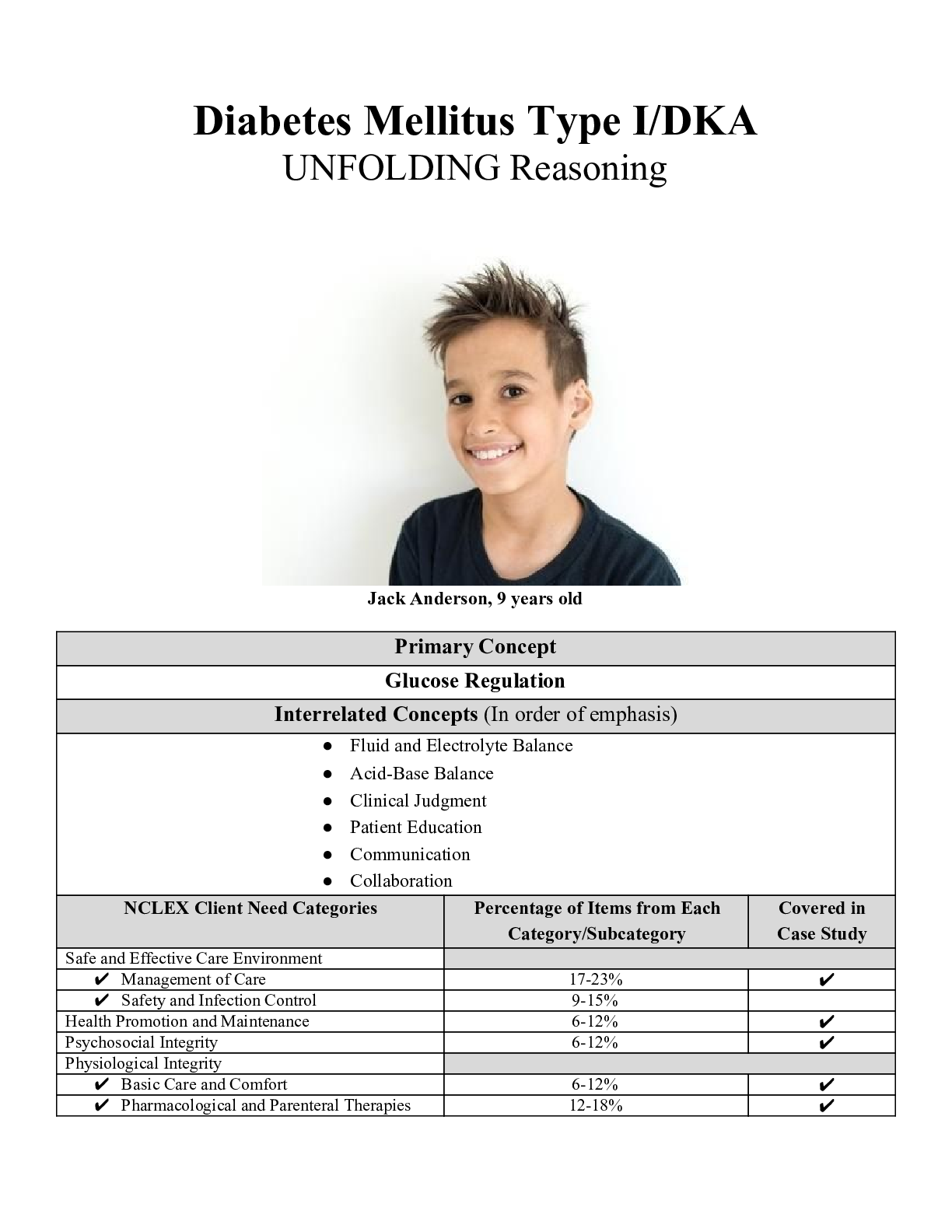
History of Present Problem:
Jack Anderson is a 9-year-old boy who presents to the emergency department because he has been more sleepy and his
breathing is “not normal;” it is deeper and faster, according to his parents. Jack was sick with a respiratory virus two
weeks ago but has since recovered. Jack began feeling more tired a few days ago when he started to complain of
abdominal pain, headache, muscle aches, and consistently being hungry and thirsty. He is urinating more frequently
during the day and at night. His mother reports a normal full-term pregnancy and Jack has been healthy with no known
medical conditions.
Personal/Social History:
Jack lives with both parents and two siblings; a younger sister four years old and a 12-year-old brother. Both parents work
as middle school teachers in the community. Jack is in the 4th grade and earns above-average marks. He is physically
active and plays soccer on the school team.
What data from the histories are RELEVANT and must be interpreted as clinically significant by the nurse?
(NCSBN: Step 1 Recognize cues/NCLEX Reduction of Risk Potential Reduction of Risk Potential)
RELEVANT Data from Present Problem: Clinical Significance:
He's more sleepy
His breathing is "not normal" it's deeper and faster
Was sick with a respiratory virus 2 weeks ago
Always hungry and thirsty
Fatigue is a common symptom and can result from high blood sugar levels
Kussmaul breathing is rapid or labored breathing, a symptom of DKA
Lack of insulin or insulin resistance helping convert food to energy causes
increased hunger and thirst
RELEVANT Data from Social History: Clinical Significance:
Has a support system from family
Physically active, plays soccer
Shows he will get the care he needs with his support system
Being active can lead to hypoglycemia once he manages his diabetes
Patient Care Begins:
Current VS: P-Q-R-S-T Pain Assessment:
T: 100.4 F/38.0 C (oral) Provoking/Palliative: Made worse with solid food.
P: 136 (regular) Quality: Dull and aching
R: 44 (deep/rapid) Region/Radiation: Confined to abdomen, generalized within abdominal region
BP: 80/48 Severity: He states his pain is a 4/10 on the numeric scale.
O2 sat: 98% on RA Timing: States, “All the time”
Weight: 64.0 lbs/29.1 kg
What VS data are RELEVANT and must be interpreted as clinically significant by the nurse?
(NCSBN: Step 1 Recognize cues/NCLEX Reduction of Risk Potential Reduction of Risk Potential/Health Promotion and Maintenance)
RELEVANT VS Data: Clinical Significance:
T: 100.4 F (oral)
P: 136 (regular)
R: 44 (deep/rapid)
BP: 80/48
Pain: Made worse with solid
food, dull and aching,
generalized within abdominal
region, states pain is all the
time
High temperature could be a sign of infection
Tachycardia is present
Kussmaul respirations is present
Very low blood pressure, could be a sign of dehydration with the excessive urination
Abdominal pain could be a side effect of not getting enough insulin
Current Assessment:
GENERAL SURVEY: Lying on the bed with eyes closed, whimpers with touch, recognizes mom and dad. Fruity
odor to the breath.
NEUROLOGICAL: Lethargic, responding to parents with one-word phrases. Alert & oriented to person, place,
time, and situation (x4); muscle strength 5/5 in both upper and lower extremities
bilaterally.
HEENT: Head normocephalic with symmetry of all facial features. PERRLA, sclera white
bilaterally, conjunctival sac pink bilaterally. Eyes appear “sunken,” mucus membranes
dry, tacky mucosa, chapped lips.
RESPIRATORY: Breath sounds clear with equal aeration on inspiration and expiration in all lobes
anteriorly, posteriorly, and laterally, respirations are deep and rapid
CARDIAC: Pink, warm & dry, no edema, heart sounds regular, pulses slightly weak/thready, equal
with palpation at radial/pedal/post-tibial landmarks, cap refill 2 seconds. Heart tones
audible and regular, S1 and S2, noted over A-P-T-M cardiac landmarks with no abnormal
beats or murmurs.
ABDOMEN: Abdomen round, soft, and tender to light palpation. BS active in all four quadrants,
feeling nauseated
GU: Voiding large amounts of clear light yellow urine
INTEGUMENTARY: Skin warm, dry, itchy, flushed, intact, normal color for ethnicity. No clubbing of nails,
cap refill <3 seconds, Hair soft-distribution normal for age and gender. Skin integrity
intact, skin turgor nonelastic, tenting present.
What assessment data is RELEVANT and must be interpreted as clinically significant by the nurse?
(NCSBN: Step 1 Recognize cues/NCLEX Reduction of Risk Potential Reduction of Risk Potential/Health Promotion & Maintenance)
RELEVANT Assessment Data: Clinical Significance:
General Survey – whimpers with touch,fruity
odor to the breath
Neurological – lethargic
HEENT – eyes appear sunken, mucus
membranes dry, tacky mucosa, chapped lips
Respiratory – respirations are deep and rapid
Abdomen – tender to light palpation, feeling
nauseated
GU – voiding large amounts of clear light
yellow urine
Integumentary – warm, dry, itchy, flushed,
turgor nonelastic, tenting present
Fruity odor to breath is when ketones rise to unsafe levels
Lethargic is caused by dehydration
Sunken eyes, mucus membranes dry, tacky mucosa, and chapped lips are caused by
dehydration
Weak/thready pulse and possibly cap refill being slow is caused by dehydration
Being tender is a sign of insulin deficiency
Urinating a lot is a sign of diabetes
All of these are an indication of dehydration
[Show More]












.png)
.png)

