INSTANT PDF DOWNLOAD—This comprehensive study guide is specifically designed for child welfare professionals preparing for the Florida Child Protective Investigator (CPI) Certification Exam for the 2026/2027 testing cycl
...
INSTANT PDF DOWNLOAD—This comprehensive study guide is specifically designed for child welfare professionals preparing for the Florida Child Protective Investigator (CPI) Certification Exam for the 2026/2027 testing cycle . This resource contains expertly verified practice questions and 100% correct answers with detailed rationales to help you master core concepts and achieve a top score (Grade A+) .
This comprehensive guide covers all major topics tested on the CPI certification exam :
Legal Hierarchy & Key Legislation
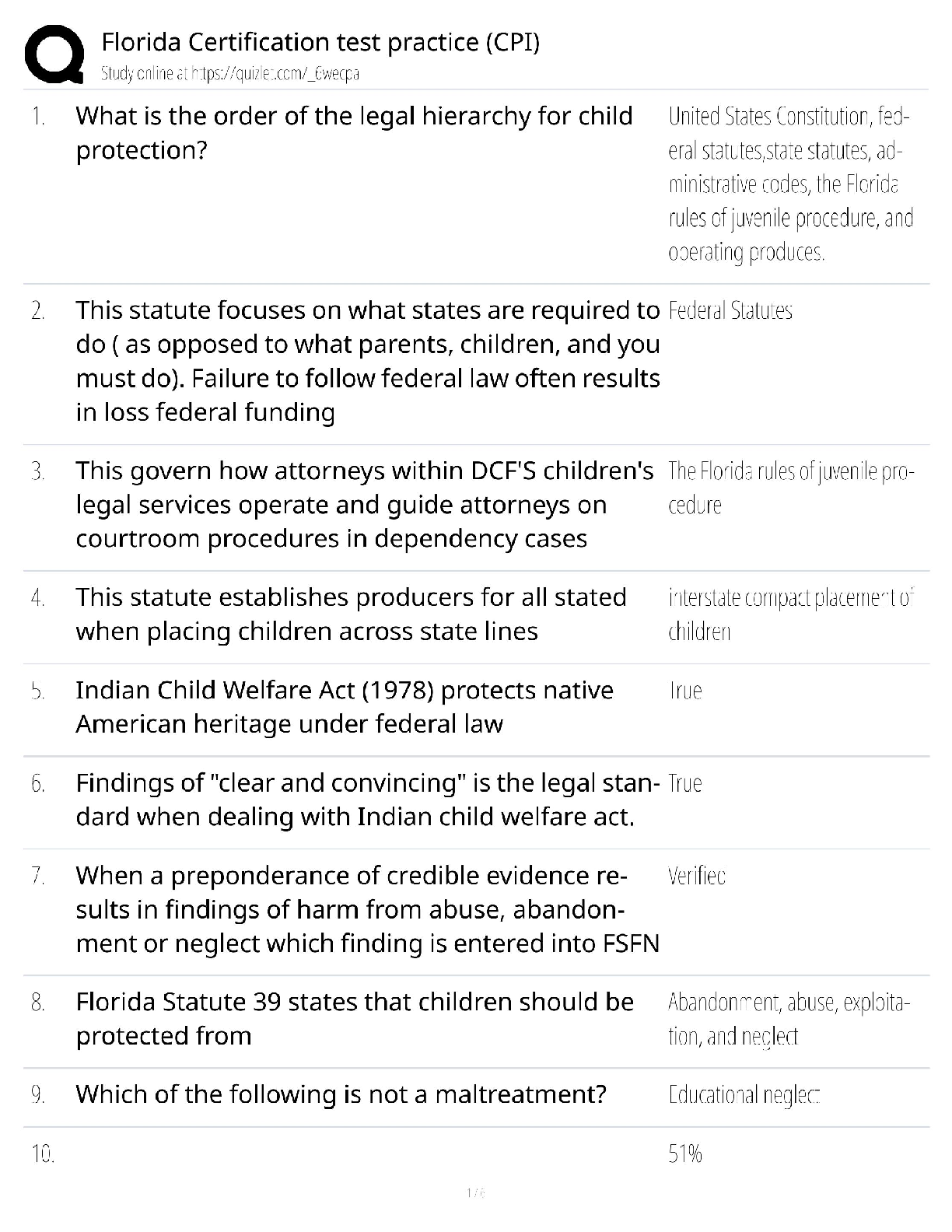
Correct legal hierarchy: Constitution → Federal Statutes → State Statutes → Administrative Codes → Rules of Juvenile Procedure → Operating Procedure
Adoptions and Safe Families Act (ASFA) 1997 : Established mandates for preserving/reunifying families, timely placement, and finalizing permanent placement within 12 months (does NOT require asking about child's birthplace)
Adam Walsh Child Protection and Safety Act 2006 : Requires fingerprint-based checks of national crime information databases for prospective foster or adoptive parents
Interstate Compact on the Placement of Children (ICPC) : Establishes procedures for all states when placing children across state lines
Child Abuse Prevention Act (CAPTA) : Expanded federal involvement in child welfare
Multi-Ethnic Placement Act (MEPA) and Indian Child Welfare Act (ICWA) : Address potential placements of children
Investigation Procedures & Response Times
Present Danger : Immediate, significant threat requiring response ASAP
Impending Danger : Suspected threat requiring face-to-face contact within 24 hours
Shelter Hearing : Must be held within 24 hours after child removal
Family Time : Must be facilitated with parents and siblings within 72 hours of physical removal
Family Functioning Assessment (FFA) : Used to determine child safety and develop case plan; completed within 14 days
Ethical Principles & Code of Ethics
Conflict of Interest : Personal relationship with case family (e.g., former high school best friend) requires recusal
Misrepresentation/Misuse of Position : Acting with power beyond authority (e.g., searching homes without consent like law enforcement) violates ethical principles
Three Core Conditions of Engagement : Respect, Empathy, Genuineness
Maltreatment Definitions & Findings
Findings : Verified, Not Substantiated, No Indicators
Standard of Proof for Shelter : Clear and convincing
Neglect : Most common maltreatment among infants
Sexual Molestation : Touching over clothes
Anal Temperature : NOT considered sexual abuse (medical necessity)
Child Development & Trauma
Age Group Most in Child Welfare System : Birth to five
Four Developmental Domains : Physical, Cognitive, Social, Emotional
Brain Development : Brain is only organ not fully developed at birth; critical periods include teen years
Trauma Signs : Regression (e.g., wetting pants after previously being toilet-trained) may indicate traumatic experience
ACE Study : Adverse Childhood Experience
Generational Trauma : Passed down through duplicating actions or coping mechanisms
NCTSN : National Children Traumatic Stress Network
Safety Planning & Protective Capacities
Three-Tiered Hierarchy of Safety : Physical safety → Social safety → Emotional safety
Protective Capacities : Personal characteristics directly related to protecting one's child
Six Protective Factors : Nurturing and attachment, knowledge of parenting and child development, parental resilience, social connections, concrete supports, social and emotional competence of children
Safety Plan Purpose : Control for danger (present or impending)
Family Systems & Engagement
Three Basic Concepts of Family Systems : Interactions, Interdependence, Balance
Cultural Sensitivity : Awareness that cultural differences impact perception of family values
Four Phases of Interviewing : Opening, Information Collection, Planning, Closing
Baker Act & Mental Health
Florida Baker Act : Provides legal procedures for mental health examination and treatment (voluntary admission, involuntary examination, involuntary inpatient/outpatient placement) – does NOT include commitment to jail/prison
Most Common Mental Health Disorder : Anxiety
Postpartum Depression : Can diminish caregiver capacity and limit attachment
DOCUMENT ACCESS:
This study guide is available as an instant digital download (PDF) immediately upon purchase. Fully text-searchable, printable, and accessible anytime through your user account. 100% satisfaction guarantee. Trusted by thousands of child welfare professionals for CPI certification exam preparation and mastering Florida child protective investigator competencies .
[Show More]