TEAS Science Practice Test
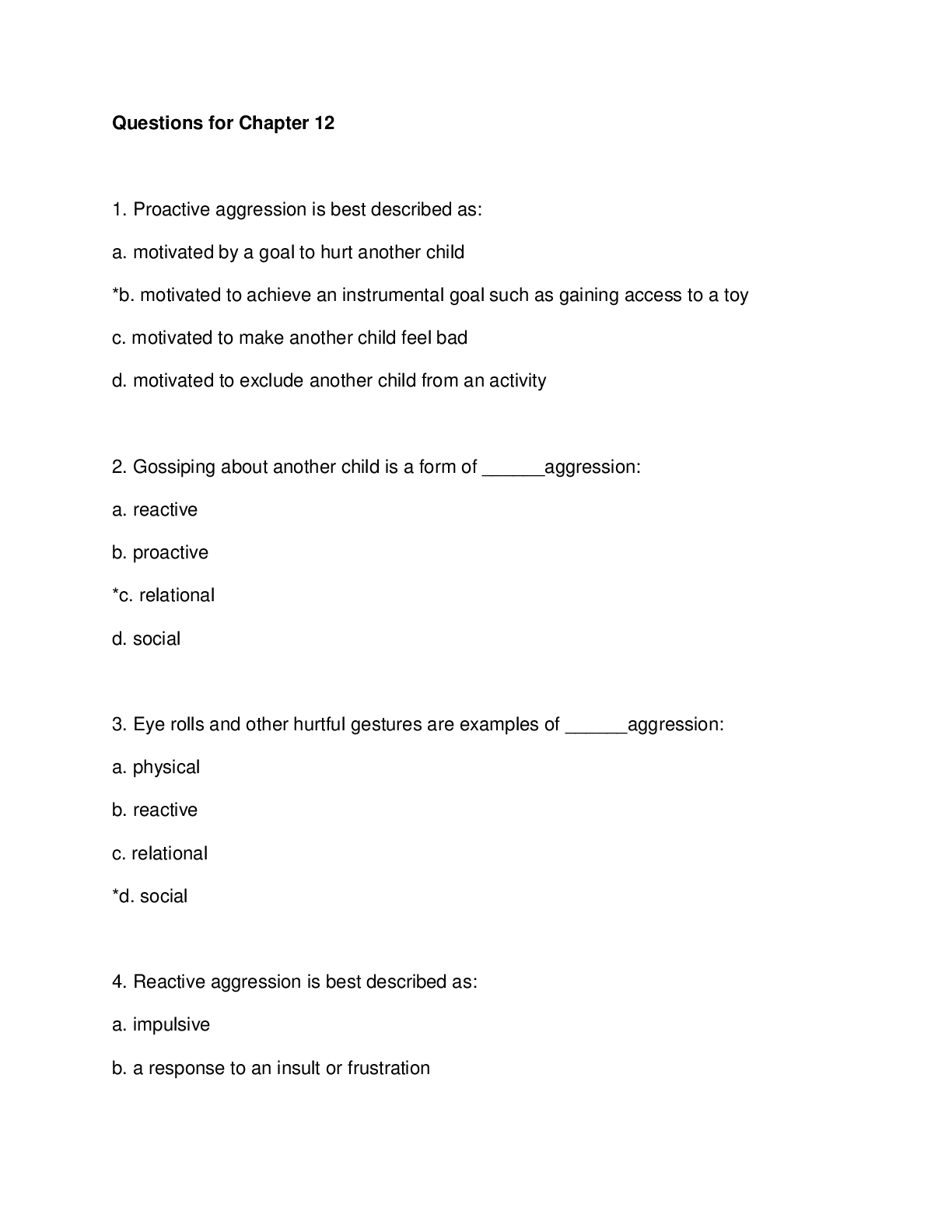
1.) According to Mendel’s first law, what does an individual gamete contain?
a.) A gene.
b.) A pair of genes.
c.) One allele of a gene.
d.) A pair of alleles of the same gene.
.
2.) Whic
...
TEAS Science Practice Test
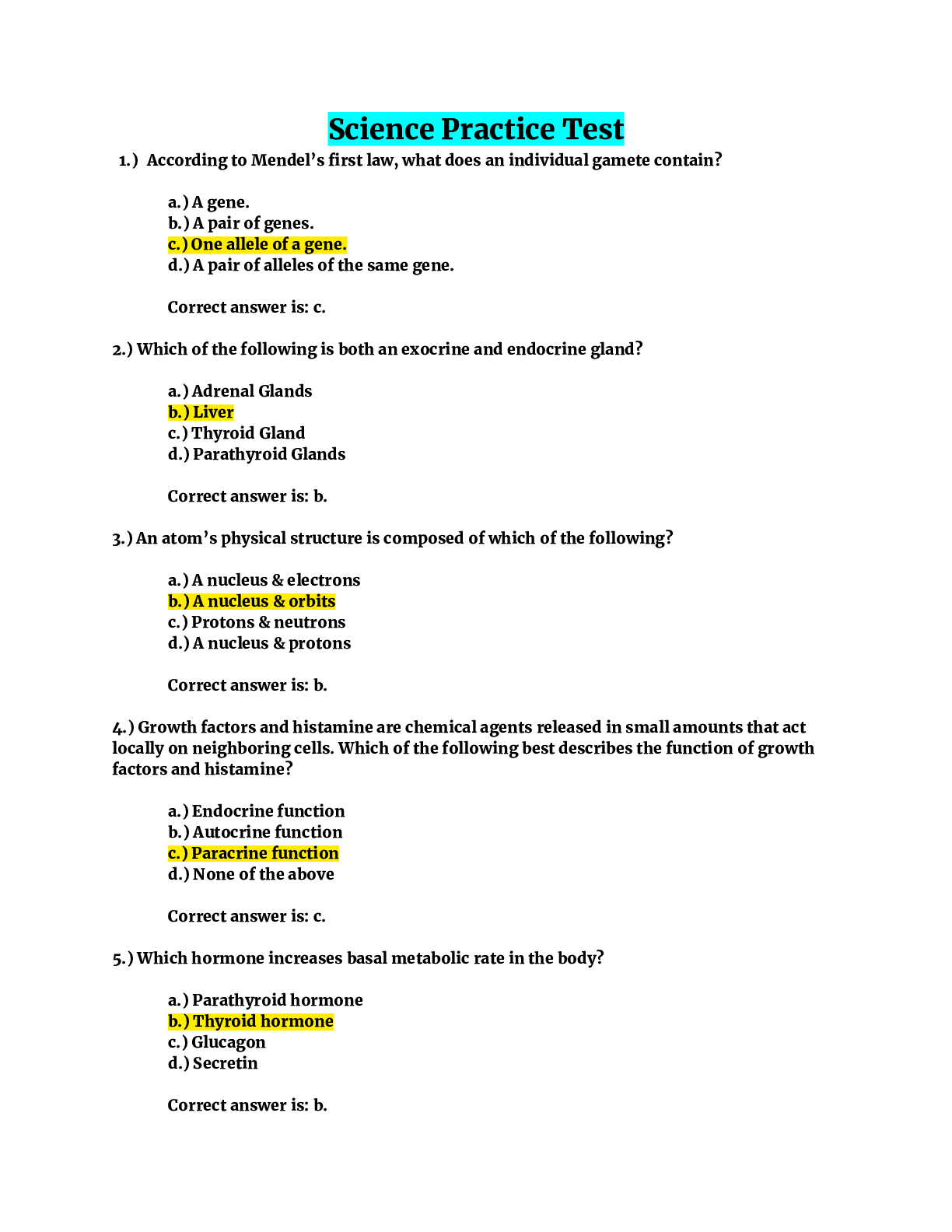
1.) According to Mendel’s first law, what does an individual gamete contain?
a.) A gene.
b.) A pair of genes.
c.) One allele of a gene.
d.) A pair of alleles of the same gene.
.
2.) Which of the following is both an exocrine and endocrine gland?
a.) Adrenal Glands
b.) Liver
c.) Thyroid Gland
d.) Parathyroid Glands
.
3.) An atom’s physical structure is composed of which of the following?
a.) A nucleus & electrons
b.) A nucleus & orbits
c.) Protons & neutrons
d.) A nucleus & protons
.
4.) Growth factors and histamine are chemical agents released in small amounts that act
locally on neighboring cells. Which of the following best describes the function of growth
factors and histamine?
a.) Endocrine function
b.) Autocrine function
c.) Paracrine function
d.) None of the above
.
5.) Which hormone increases basal metabolic rate in the body?
a.) Parathyroid hormone
b.) Thyroid hormone
c.) Glucagon
d.) Secretin
.
6.) Which of the following hormones would be expected to increase if you were studying all
day for a test and skipped breakfast & lunch?
a.) Calcitonin
b.) Insulin
c.) Glucagon
d.) Growth Hormone
.
7.) Hormones travel through the bloodstream and bind to receptors located on target cells.
Which of the following would NOT bind to transmembrane proteins on the target cells?
a.) Antidiuretic Hormone
b.) Prolactin
c.) Insulin
d.) Estrogen
8.) A weak bond in DNA often includes a(n) ____ atom?
a.) Oxygen
b.) Nitrogen
c.) Thymine
d.) Hydrogen
9.) Which of the following produces NADH and FADH2 for the electron transport chain
during cellular respiration?
a.) Metabolism
b.) Glycolysis
c.) Metabolic pathways
d.) Krebs Cycle
10.) Why is it important to replicate DNA before a cell divides in mitosis?
a.) for genetic information to be transferred into daughter cells.
b.) for the cell to be able to increase in size.
c.) for the DNA to be contained in the nucleus.
d.) for the cell to re-order the DNA sequencing in the new cells.
11.) In a cell, movement of molecules from an area of low concentration to an area of high
concentration…?
a.) uses facilitated diffusion
b.) requires cellular energy
c.) needs associated (peripheral) proteins
d.) requires no energy
Correct answer: b.
12.) The function of the central vacuole in plant cells include _____.
a.) Storing food.
b.) Storing waste products.
c.) Maintaining the right amount of pressure to support the plant structure.
d.) All the above.
13.) The thoracic cage is a structural unit important for __.
a.) digestion
b.) menstruation
c.) respiration
d.) secretion of wastes
.
14.) Salivary amylase secreted into the oral cavity starts the digestion of _____.
a.) starch
b.) proteins
c.) amino acids
d.) lipids
15.) The ____ holds the replicated sister chromatids together?
a.) centriole
b.) chromosomes
c.) centromere
d.) cycles
.
16.) Which two hormones does the anterior pituitary secrete?
a.) growth hormone and glucagon
b.) oxytocin and melatonin
c.) growth hormone and luteinizing hormone
d.) luteinizing hormone and epinephrine
.
17.) The cardiovascular system transports ______.
a.) Hormones
b.) All of the above
c.) Lymph
d.) Red blood cells
.
18.) In addition to the genitourinary system, the kidneys are related to which of the
following systems?
a.) cardiovascular
b.) reproductive
c.) digestive
d.) none of the above
19.) Which hormone aids in a positive feedback response?
a.) insulin
b.) glucagon
c.) melatonin
d.) oxytocin
20.) _____ are long bundles of axons that transmit signals from the neuromuscular
system allowing involuntary and voluntary muscle movement?
a.) sarcomeres
b.) nerves
c.) cell body
d.) dendrites
.
21.) The exchange of nutrients between tissue & blood primarily occurs in which of the
following locations?
a.) capillaries
b.) bone
c.) large arteries
d.) none of the above
22.) What type of immunity is blood transfusion?
a.) passive natural immunity
b.) active artificial immunity
c.) passive artificial immunity
d.) active natural immunity
.
23.) What type of muscle is the uterus?
a.) skeletal
b.) smooth
c.) cardiac
d.) irregular
.
24.) Which cells within the pancreas release glucagon in response to low blood glucose
levels?
a.) Alpha cells
b.) Beta cells
c.) Leukocytes
d.) Erythrocytes
25.) Which describes the shape of a skeletal muscle cell?
a.) Elongated
b.) Branched
c.) Short
d.) Spindle
26.) What structure is the integration center between the endocrine and nervous systems?
a.) pons
b.) spinal meninges
c.) hypothalamus
d.) pituitary
.
27.) What body system is the skeletal system most closely associated with when
hematopoiesis happen?
a.) Cardiovascular system
b.) Digestive system
c.) Muscular system
d.) Urinary System
28.) The type of muscle that is involuntary and is found in the heart and can also be
described as striated is called?
a.) skeletal
b.) cardiac
c.) smooth
d.) neuron
.
29.) What does the replication of DNA during interphase ensure?
a.) that crossing-over occurs prior to cell division.
b.) mutations are corrected before the cell divides.
c.) genetic variation is created in daughter cells.
d.) each daughter cell gets an exact copy of the cell’s DNA.
30.) Lower motor neurons (motoneurons) that exit the spinal cord to stimulate skeletal
muscle contraction are activated by all of the following influences except:
a.) sensory feedback from the muscles and tendons
b.) firing of autonomic motor neurons to skeletal muscles
c.) excitatory effects from higher motor neurons
d.) inhibitory effects from higher motor neurons
.
31.) Which of the following structures is located in the axial skeleton and lined with mucus
membrane?
a.) sinus
b.) mandible
c.) sternum
d.) hyoid bone
32.) Mineral resorption is caused by which of the following?
a.) osteoclasts
b.) hydroxyapatite
c.) osteoblasts
d.) osteoporosis
33.) Secreted by the heart to increase sodium secretion by the kidneys, decrease extracellular
fluid (decreases BP)?
a.) ACTH (adrenocorticotropic hormone)
b.) ANP (Atrial Natriuretic Peptide)
c.) Epinephrine and Norepinephrine
d.) T3 (Triiodothyronine) and T4 (Thyroxine)
.
34.) Bone healing steps:
1. Fibroblasts secrete matrix forming cartilage for new bone to build off if.
2. Inflammation and clotting.
3. Osteoblasts will secrete new bone spindle, where osteocytes will maintain the
bone.
4. Clasts will dissolve cartilage and replace it with bone.
Which order is correct?
a.) 4, 3, 1, 2
b.) 2, 1, 3, 4
c.) 2, 1, 4, 3
d.) 1, 2, 3, 4
.
35.) Cholecystokinin is a production of?
a.) Bile Salts
b.) Blood
c.) Gastric juice
d.) Iron
36.) (T4) Thyroxine is secreted by what Gland?
a.) Pineal
b.) Parathyroid
c.) Thyroid
d.) Pituitary
.
37.) During the Krebs Cycle of cellular respiration, glucose molecules are consumed. For
every single consumed glucose molecule, what is produced?
a.) Six carbon-dioxide molecules and six NADH molecules.
b.) Six ATP molecules, six carbon-dioxide molecules, and six NADH molecules.
c.) Two ATP molecules, six carbon-dioxide molecules, and six NADH molecules.
d.) Two ATP molecules and six carbon-dioxide molecules.
.
38.) Tiny air-sacs in the lungs where the exchange of O2 and CO2 takes place are known as
which of the following?
a.) Bronchioles
b.) Bronchi
c.) Larynx
d.) Alveoli
39.) Atoms are made up of all EXCEPT which of the following?
a.) Protons
b.) Neutrons
c.) Isotopes
d.) Electrons
.
40.) The pH scale ranges from 0 to 14, where 0 is more _____ and 14 is more ______?
a.) Basic , Acidic
b.) Acidic , Neutral
c.) Basic , Neutral
d.) Acidic , Basic
41.) Cells with a high rate of protein synthesis generally have a large number of which of the
following cellular structures?
a.) Ribosomes
b.) Golgi Apparatus
c.) Mitochondria
d.) Chloroplasts
Correct answer: a.
42.) Hair and nails are a part of which body system?
a.) Skeletal system
b.) Neuromuscular system
c.) Integumentary system
d.) Immune system
.
43.) The mitral valve is a heart valve that allows oxygen-rich blood from the lungs pass from
which of the following?
a.) The left atrium into the left ventricle.
b.) The left ventricle into the aorta.
c.) The right ventricle into the pulmonary veins.
d.) The right atrium into the right ventricle.
44.) In mitosis, the two resulting daughter cells are..?
a.) different from the parent cell & identical to each other.
b.) different from the parent cell & different from each other.
c.) identical to the parent cell & different from each other.
d.) identical to the parent cell & identical to each other.
45.) The parathyroid gland is an endocrine system gland located behind the thyroid gland.
What does the parathyroid gland help the body control?
a.) metabolism
b.) calcium & phosphorus levels
c.) carbohydrate & fat utilization
d.) blood sugar
.
46.) To which system does cartilage belong?
a.) skeletal
b.) integumentary
c.) respiratory
d.) neuromuscular
47.) Which of the following is the sphincter muscle that regulates the movement of chyme
into the small intestine?
a.) esophageal
b.) pyloric
c.) ileocecal
d.) urethral
.
48.) Which of the following structure is severed and tied off as part of a vasectomy
procedure?
a.) seminal vesicle
b.) vas deferens
c.) epididymis
d.) testes
.
49.) _____ gland secretes follicle-stimulating hormones?
a.) Parathyroid gland
b.) Pineal gland
c.) Anterior Pituitary gland
d.) Thyroid gland
.
50.) Function of PORES and molecular membrane is?
a.) activating transcription factors.
b.) permitting passage of molecules
c.) preventing the molecules from overheating
d.) blocking pathogens from entry
.
51.) The “fight or flight response” is a function of the peripheral nervous system. Is this
True or False?
a.) True
b.) False
52.) An overactivation of which of the following could lead to osteoporosis?
a.) Osteon
b.) Osteoblast
c.) Osteoclast
d.) Osteocyte
.
53.) Which of the following can digest an enzyme?
a.) Endonucleases
b.) Lipases
c.) Proteases
d.) Kinases
.
54.) Which of the following is NOT classified as a synovial joint?
a.) Femur & Pelvis
b.) Skull Bones
c.) Humerus & Ulna
d.) Humerus & Scapula
.
55.) A macrophage, a type of immune cell responsible for phagocytosis and digesting
pathogens, is likely to contain more of which of the following organelles?
a.) Mitochondria
b.) Centrosomes
c.) Ribosomes
d.) Lysosomes
56.) A buildup of urea, a nitrogenous waste product of protein metabolism in the body, is
most likely due to the failure of which organ system?
a.) Urinary
b.) Endocrine
c.) Digestive
d.) Immune
57.) Which of the following cells type is responsible for secreting acid to dissolve the bony
matrix?
a.) osteoclasts
b.) canaliculi
c.) endosteum
d.) 0steoblasts
58.) _________ are substances that protect the skin from ultrasound radiation?
a.) Melanin
b.) Kerantin
c.) Seburm
d.) Dermis
59.) The hormone that stimulates the kidney to retain sodium ions, which draw with them
water, when BP drops is called?
a.) Luteinizing
b.) FSH
c.) insulin
d.) aldosterone
60.) What is a series of events that a cell goes through as they grow & divide?
a.) cell division
b.) cell cycle
c.) cytokinesis
d.) mitosis
.
61.) Drugs that increase urine production by blocking the release of ADH is called?
a.) nephritis
b.) filtration
c.) diuretics
d.) osmoreceptors
.
62.) The erythrocyte of blood do which of the following?
A- Initiate the blood clotting mechanism
B- Transport Oxygen and some carbon dioxide
C- Initiate the conduction system of the heart
D- Defend the body against pathogens
.
63.) When does the nuclear division of somatic cells take place during cellular reproduction?
a.) meiosis
b.) cytokinesis
c.) interphase
d.) mitosis
64.) The gland in the neck that secretes hormones that regulate growth, development, &
metabolic wastes?
a.) thyroid gland
b.) cartilage
c.) pineal gland
d.) adrenal gland
Correct answer: a.
65.) Which of the following is exchanged between two or more atoms that undergo ionic
bonding?
a.) electrical charges
b.) valence electrons
c.) transitory electrons
d.) neutrons
.
66.) What is the longest phase of the cell cycle?
a.) interphase
b.) prophase
c.) anaphase
d.) metaphase
67.) Where does a cell contain its genetic material?
a.) nucleus
b.) nucleolus
c.) cytoskeleton
d.) golgi
68.) Prokaryote & eukaryote cells are similar in having which of the following? (SELECT ALL
THAT APPLY)
a.) membrane-bound organelles
b.) presence of a nucleus
c.) integral membrane proteins in the plasma membrane
d.) DNA
& d.
69.) What are groups of cells that perform the same function called?
a.) tissues
b.) plastids
c.) organs
d.) molecules
70.) The rate of a chemical reaction depends on all of the following except ____?
a.) presence of catalysts
b.) surface area
c.) amount of mass lost
d.) temperature
.
71.) Which of the answer choices provided best defines the following statement?
For a given mass & constant temperature, an inverse relationship exists between the volume
and pressure of a gas.
a.) Stefan-Boltzmann Law
b.) Boyle’s Law
c.) Charles’ Law
d.) Ideal Gas Law
.
72.) The adrenal glands are part of the ____?
a.) endocrine system
b.) immune system
c.) respiratory system
d.) emphatic system
73.) What is the role of ribosomes?
a.) storage
b.) transport
c.) waste removal
d.) protein synthesis
74.) If a cell is placed in a hypertonic solution, what will happen to the cell?
a.) it does not affect the cell.
b.) it will shrink.
c.) it will swell.
d.) it will stay the same.
.
75.) Which group of major parts & organs make up the immune system?
a.) heart, veins, arteries, & capillaries.
b.) brain, spinal cord, & nerve cells.
c.) lymphatic system, spleen, tonsils, thymus, & bone marrow.
d.) nose, trachea, bronchial tubes, lungs, alveolus, & diaphragm.
.
76.) Which of the following correctly lists the cellular hierarchy from the simplest to the
most complex structure?
a.) tissue, cell, organ, organ system, organism
b.) cell, tissue, organ, organ system, organism
c.) organism, organ system, organ, tissue, cell
d.) none of the above
.
77.) During what phase of the cell cycle is DNA replicated?
a.) S phase
b.) G1 phase
c.) G2 phase
d.) M phase
78.) The first set of seven vertebrae that form the neck; also known as C1 - C7.
a.) cervical vertebrae
b.) dendritic cell
c.) clavicle
d.) sternum
79.) A molecule that can bond to identical molecules to form a polymer is called?
a.) monomers
b.) organic molecule
c.) antigen
d.) sarcomere
Correct answer: a.
80.) A toxin that stimulates an immune response in the body?
a.) ghrelin
b.) barrier
c.) enzymes
d.) antigen
81.) The hormone that stimulates male SECONDARY sexual characteristics?
a.) FSH
b.) Melatonin
c) Testosterone
d.) Oxytocin
.
82.) Following the ingestion of a fatty meal, what hormone is secreted by the duodenum
mucosa to stimulate contraction of the gallbladder?
a.) Calcitonin
b.) Cholecystokinin
c.) Insulin
d.) Glucagon
.
83.) A substance that increases the rate of a chemical reaction without undergoing
permanent chemical change is called?
a.) enzyme
b.) catalyst
c.) hormone
d.) plasma
.
84.) The stage of the heart cycle in which the heart muscle contracts & the chambers pump
blood?
a.) diastole
b.) pericardium
c.) SA node
d.) systole
85.) An enzyme that regulates arterial blood pressure is called?
a.) amylase
b.) maltase
c.) catalase
d.) renin
86.) The amount of air that is inhaled & exhaled during normal breathing?
a.) vital volume
b.) residual volume
c.) tidal volume
d.) maximal exhalation
.
87.) Long bone function is to?
a.) support the weight of the body & facilitate movement.
b.) protect internal organs such as the heart & brain.
c.) provide stability & movement, such as carpals of the wrist.
d.) none of the above.
Correct answer: a.
88.) Which layer of the skin contains hair follicles, sweat glands, and nerves?
a.) the basal layer
b.) the subcutaneous layer
c.) the epidermis
d.) the dermis
89.) Sickle-cell anemia is an autosomal recessive disorder. Knowing this information, what
are the chances that a child will NOT have the recessive allele if both of his parents are
carriers?
a.) 50%
b.) 25%
c.) 75%
d.) 100%
.
90.) What set of signals is the vagus nerve responsible for conveying?
a.) signals from abdominal organs
b.) balance signals from the inner ear
c.) signals from the eye
d.) signals from the jaw
91.) Simple covalent compounds show which of the following properties?
a.) they are soluble in organic solvents (ex: ethanol)
b.) they have high melting & boiling points
c.) they are solids at room temperature
d.) they conduct electricity when dissolved in water
92.) Which of the following is FALSE regarding blood cells?
a.) WBCs are larger & less abundant than RBCs
b.) Phagocytes & lymphocytes are the most numerous types of WBCs.
c.) Mature RBCs are bi-concave discs that have a nucleus & long
life-span.
d.) Mature RBCs are oval, bi-concave discs that have extruded their
nucleus.
.
93.) Follicle-stimulating hormone (FSH) is produced by which gland in the body?
a.) posterior lobe of the pituitary gland
b.) pineal gland
c.) anterior lobe of the pituitary gland
d.) thyroid gland
.
94.) The autonomic nervous system can be divided into two branches, the sympathetic and
parasympathetic division. TRUE or FALSE, the parasympathetic nervous system is
responsible for “fight or flight”?
a.) TRUE
b.) FALSE
.
95.) Food moves in the gastrointestinal tract by which of these processes?
a.) peristalsis of the voluntary muscles
b.) voluntary muscle movements
c.) peristalsis of the circular & longitudinal muscles
d.) voluntary movements of the longitudinal muscles only
.
96.) Which structure is NOT part of the rib cage?
a.) the lumbar vertebrae
b.) the thoracic vertebrae
c.) sternum
d.) costal cartilage
97.) Progesterone is produced by the _________?
a.) pituitary gland
b.) thyroid glands
c.) ovaries, placenta, & adrenal glands
d.) none of the above
.
98.) In the collecting duct, what is reabsorbed?
a.) Ions such as Na+ & Clb.) Nutrients like glucose & amino acids
c.) substances like drug metabolites & waste
d.) water
99.) 0.7% NaCl is isotonic to RBCs. Which of these describes what would happen to the RBCs
if placed in a 7.0% solution instead?
a.) The cells exposed to the solution will burst.
b.) The cells exposed to the solution will shrink.
c.) The cells will remain the same size.
d.) The cells exposed to the solution will expand but not burst.
Correct answer: b.
100.) How does the glomerulus filter blood into the Bowman’s capsule?
a.) high pressure
b.) concentration gradient
c.) active transport
d.) passive transport
Correct answer: a.
[Show More]