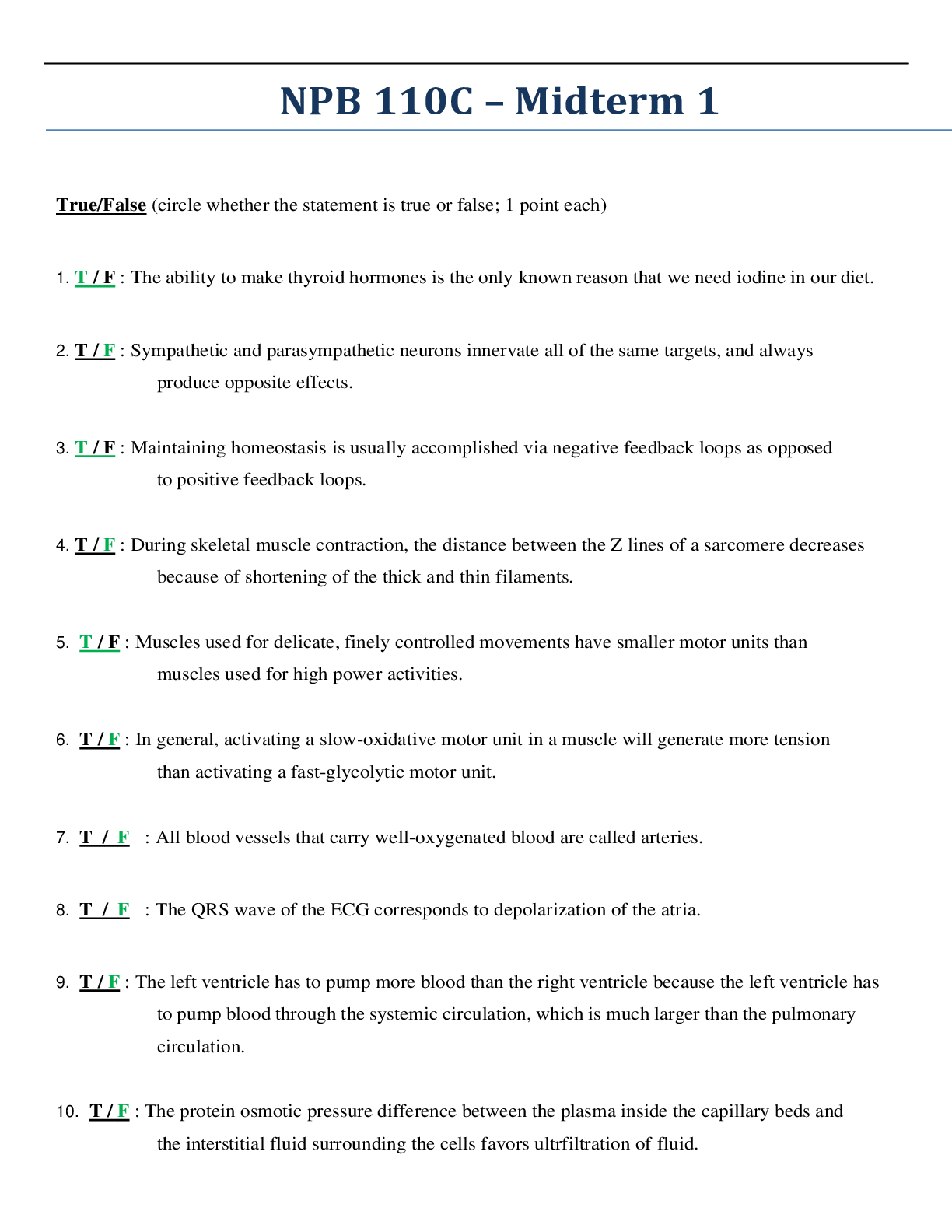
NPB 110C – Midterm 1
True/False (circle whether the statement is true or false; 1 point each)
1. T / F : The ability to make thyroid hormones is the only known reason that we need iodine in our diet.
2. T / F :
...
NPB 110C – Midterm 1
True/False (circle whether the statement is true or false; 1 point each)
1. T / F : The ability to make thyroid hormones is the only known reason that we need iodine in our diet.
2. T / F : Sympathetic and parasympathetic neurons innervate all of the same targets, and always produce opposite effects.
3. T / F : Maintaining homeostasis is usually accomplished via negative feedback loops as opposed to positive feedback loops.
4. T / F : During skeletal muscle contraction, the distance between the Z lines of a sarcomere decreases because of shortening of the thick and thin filaments.
5. T / F : Muscles used for delicate, finely controlled movements have smaller motor units than muscles used for high power activities.
6. T / F : In general, activating a slow-oxidative motor unit in a muscle will generate more tension than activating a fast-glycolytic motor unit.
7. T / F : All blood vessels that carry well-oxygenated blood are called arteries.
8. T / F : The QRS wave of the ECG corresponds to depolarization of the atria.
9. T / F : The left ventricle has to pump more blood than the right ventricle because the left ventricle has to pump blood through the systemic circulation, which is much larger than the pulmonary circulation.
10. T / F : The protein osmotic pressure difference between the plasma inside the capillary beds and the interstitial fluid surrounding the cells favors ultrfiltration of fluid.
Multiple choice (circle the best answer; 2 points each)
11. Which of the following statements are TRUE for the sympathetic nervous system and FALSE for the parasympathetic nervous system?
a. It is characterized by relatively long preganglionic neurons and relatively short postganglionic neurons.
b. It uses acetylcholine as an important neurotransmitter.
c. It uses a different neurotransmitter released from the preganglionic neurons versus the neurotransmitter released from the postganglionic neuron.
d. It is an important regulator of heart rate.
e. It is most active during “rest and digest” states of the body.
12. Which of the following hormones is most likely to use a nuclear receptor as its primary mechanism of action at target cells?
a. Thyroid hormone
b. Epinephrine
c. Vasopressin
d. Dopamine
13. Which of the following statements describes an important feature of hormones?
a. They can be secreted by neurons.
b. The same molecule can function as a hormone or a neurotransmitter
c. Most hormones are peptide hormones.
d. The rate at which they are metabolized and excreted by the body contributes to the level of circulating hormones in blood.
e. All of the above are correct; they all describe important features of hormones.
14. Which of the following is NOT currently considered a unifying concept in physiology?
a. Communication between cells, tissues and organs is critical for body functions.
b. “Vital forces”, instead of the laws of chemistry, biology and physics, explain body functions.
c. Cells are functionally compartmentalized by membranes, which are associated with several important physiological functions including transport and signaling.
d. Homeostasis is achieved through the functions of nearly all organ systems.
15. Which of the following symptoms would be consistent with administration of a drug that inhibits the actions of parasympathetic efferents to target organs?
a. Decreased heart rate
b. Decreased movement and secretions in the digestive system
c. Narrowing (constriction) of lung airways
d. Decreased epinephrine secretion from the adrenal gland
16. Which of the following affects the force-generating capability of a muscle?
a. the muscle length and cross-sectional area
b. the distance from the joint center to the muscle’s tendon attachment to bone
c. the length of the muscle’s tendon
d. the number of sarcomeres aligned in series in the muscle fibers.
e. all of the above
17. Which of the following factors does NOT influence the amount of torque produced by muscles at a joint?
a. the magnitude of forces generated by the muscles b. the mass of the limb segments
c. the velocity of the limb movement
d. the moment arm lengths of the muscles
e. the direction of muscle force pulling on the bone
18. What will happen to the center of mass of a human body if the arms are raised up overhead and there are no other changes to body position?
a. it will move up toward the head
b. it will move down toward the feet
c. it will not change
d. it will move toward the front, but remain at the same height in the body
e. none of the above.
19. Binding of ________ to myosin permits cross-bridge _____________ between actin and myosin in skeletal muscle cells.
A. ATP; attachment B. ATP; detachment
C. calcium; attachment
D. calcium; detachment
E. actin; detachment
20. The removal of calcium ions from the cytosol of skeletal muscle causes
A. the myosin binding sites on actin to be uncovered by tropomyosin.
B. tropomyosin to change conformation and thereby move troponin molecules over cross-bridge binding sites.
C. troponin to change conformation and thereby expose cross-bridge binding sites. D. the myosin binding sites on actin to be covered by tropomyosin.
E. None of the choices is correct.
21. What is the function of the transverse tubules in a skeletal-muscle fiber?
A. They store the calcium ions that are the main source of activation for the cross-bridge cycle.
B. They form the Z lines that mark the end of each sarcomere.
C. They allow action potentials to propagate deep into the center of skeletal muscle cells.
D. They manufacture and store ATP.
E. They run in parallel with the myofibrils, and have abundant Ca2+-ATPase proteins for pumping Ca2+ back into the sarcoplasmic reticulum.
22. What is the best description of a tetanic contraction in a skeletal muscle cell?
A. A single action potential in the motor neuron causes a sustained contraction. B. Multiple action potentials in the motor neuron cause a sustained contraction.
C. The action potential in the muscle cell is prolonged to last as long as the contraction.
D. Repeated action potentials from the motor neuron summate into a sustained depolarization of the motor end plate, causing a sustained contraction. **Answer also accepted
E. A very large amplitude action potential in the motor neuron causes a very strong contraction in the skeletal muscle cell.
23. Which of the following statements about different kinds of skeletal muscle fibers is TRUE?
A. Slow-oxidative fibers have a greater abundance of glycogen than do fast-glycolytic fibers.
B. Fast-glycolytic fibers have a greater abundance of myoglobin than do slow-oxidative fibers. C. A fast-glycolytic fiber can generate greater tension than a slow-oxidative fiber.
D. Fast-glycolytic fibers and slow-oxidative fibers are innervated by alpha motor neurons of the same diameter.
E. To generate ATP, fast-glycolytic fibers depend mainly on oxidative phosphorylation while slow- oxidative fibers depend mainly on glycolysis.
24. Which of the following changes would most increase the resistance to blood flow in a blood vessel?
A. halving the diameter of the vessel
B. doubling the diameter of the vessel
C. halving the length of the vessel
D. doubling the length of the vessel
E. decreasing the hematocrit from 50% to 40%
25. The plateau of the action potential in cardiac ventricular cells results from the opening of voltage-gated long-lasting ___________ channels in the plasma membrane of the cell.
A. Na+
B. K+
C. Ca2+
D. Cl-
E. glucose
26. What is indicated by a heart murmur detected between the first and second heart sounds?
A. insufficiency of a semilunar valve or stenosis of an AV valve B. insufficiency of an AV valve or stenosis of a semilunar valve
C. heart failure
D. AV nodal conduction block
E. a myocardial infarction
27. Which best defines the cardiac output?
A. the end-diastolic volume minus the end-systolic volume
B. the output of the aortic arch baroreceptors
C. the volume of blood in the arterial tree at any moment in time
D. the stroke volume divided by the heart rate
E. the product of the heart rate and the volume ejected from the ventricle during a cardiac cycle
28. According to the Frank-Starling mechanism of the heart:
A. the left ventricle ejects a larger volume of blood with each systole than the right ventricle.
B. the intrinsic rate of the heart's pacemaker is 100 beats/min.
C. cardiac output increases with increased heart rate.
D. stroke volume increases with increased venous return.
E. both ventricles contract simultaneously.
29. Which of the following is a result of increased sympathetic stimulation of vascular smooth muscle?
A. Filtration of fluid from capillaries to interstitial fluid increases.
B. Total peripheral resistance (TPR) decreases.
C. The percentage of blood volume in the veins increases.
D. Blood flow to the brain decreases.
E. Venous return of blood to the heart increases.
30. Which of the following statements concerning the capillaries is FALSE?
A. Increasing capillary hydrostatic pressure decreases the likelihood that filtration will occur.
B. Velocity of blood flow is slower in the capillaries than in the arteries.
C. It is possible for a capillary to filter fluid at its arterial end and absorb fluid at its venous end.
D. The diameter of a capillary is slightly smaller than that of a red blood cell.
E. There are more capillaries than arterioles in the body.
Short Essay Questions (25 points each)
1. Muscle accounts for ~1/2 of the body’s weight and allows animals to move body parts, manipulate external objects, propel contents through hollow internal organs, and empty contents of certain organs to the external environment.
a. Draw a skeletal muscle sarcomere in two states, during relaxation and contraction. Be sure to label the filament types and the names of prominent lines, bands, and zones.
b. Skeletal muscle, cardiac muscle and smooth muscle all depend on Ca++ for normal functioning. For skeletal muscle, describe 4 separate processes that involve Ca++ and are part of the cascade of events that lead to muscle contraction and/or the termination of contraction. Your answer can begin with motor neurons. Short Essay Questions (Cont.)
2. A pheochromocytoma is a tumor of the adrenal medulla strongly increases its secretion rate in an unregulated fashion. It is a benign tumor, which ordinarily does not spread to other parts of the body, yet nonetheless unless treated it can eventually lead to life threatening cardiovascular and other organ system symptoms.
a) Name the normal secretion products of the adrenal medulla, and describe the neural pathway for how their secretion is normally regulated.
b) Describe the effects that this tumor would have on the cardiovascular system (think about heart rate, stroke volume, vasoconstriction/dilation, blood pressure) and whether or not the baroreceptor reflex would bring values back to normal.
[Show More]