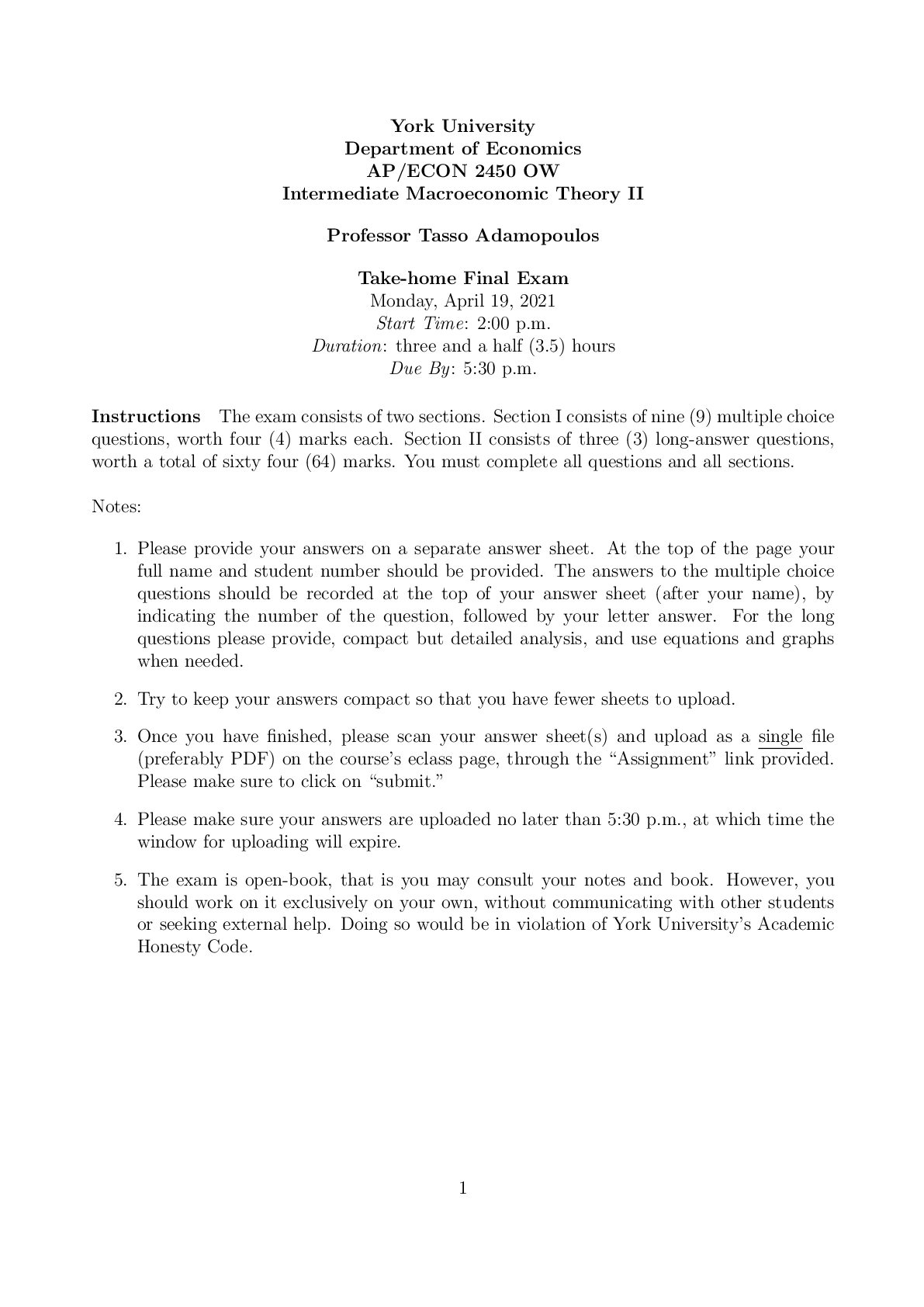
York University
Department of Economics
AP/ECON 2450 OW
Intermediate Macroeconomic Theory II
Professor Tasso Adamopoulos
Take-home Final Exam
Monday, April 19, 2021
Start Time: 2:00 p.m.
Duration: three and a hal
...
York University
Department of Economics
AP/ECON 2450 OW
Intermediate Macroeconomic Theory II
Professor Tasso Adamopoulos
Take-home Final Exam
Monday, April 19, 2021
Start Time: 2:00 p.m.
Duration: three and a half (3.5) hours
Due By: 5:30 p.m.
Instructions The exam consists of two sections. Section I consists of nine (9) multiple choice
questions, worth four (4) marks each. Section II consists of three (3) long-answer questions,
worth a total of sixty four (64) marks. You must complete all questions and all sections.
Notes:
1. Please provide your answers on a separate answer sheet. At the top of the page your
full name and student number should be provided. The answers to the multiple choice
questions should be recorded at the top of your answer sheet (after your name), by
indicating the number of the question, followed by your letter answer. For the long
questions please provide, compact but detailed analysis, and use equations and graphs
when needed.
2. Try to keep your answers compact so that you have fewer sheets to upload.
3. Once you have finished, please scan your answer sheet(s) and upload as a single file
(preferably PDF) on the course’s eclass page, through the \Assignment" link provided.
Please make sure to click on \submit."
4. Please make sure your answers are uploaded no later than 5:30 p.m., at which time the
window for uploading will expire.
5. The exam is open-book, that is you may consult your notes and book. However, you
should work on it exclusively on your own, without communicating with other students
or seeking external help. Doing so would be in violation of York University’s Academic
Honesty Code.
1Section I: Multiple Choice Questions
1. If diminishing returns to capital set in slower and the demand for investment goods is
independent of the real interest rate, then:
(a) the output supply curve is steeper and output demand curve is flatter.
(b) both the output supply curve and the output demand curve are flatter.
(c) the output supply curve is flatter and output demand curve is steeper.
(d) both the output supply curve and the output demand curve are steeper.
2. At the zero lower bound, under a liquidity trap, all of the following monetary policy tools
might work in affecting the price level except:
(a) the use money to purchase long-term government debt.
(b) the use money to purchase short-term government debt.
(c) a negative nominal interest rate.
(d) quantitative easing.
3. According to the Permanent Income Hypothesis, a temporary increase in taxes will:
(a) have no effect on current and future consumption but will reduce savings.
(b) reduce both current and future consumption, and may increase savings.
(c) increase future consumption, reduce current consumption, and may increase savings.
(d) reduce current consumption, future consumption, and savings.
4. According to the Ricardian Equivalence result, the equilibrium real interest rate of 5%
will not change if a current tax increase of 120 units is accompanied by:
(a) a future tax increase of 126 units.
(b) a future tax decrease of 126 units.
(c) a future tax increase of 114.3 units.
(d) a future tax increase of 114.3 units.
5. When the real interest rate is lower than the population growth rate and the mandated
social security savings are higher than what consumers would have saved on their own
(in the absence of a social security system):
(a) both the pay-as-you-go and the fully funded system raise welfare.
(b) the pay-as-you go system does not raise welfare, but the fully funded system does.
(c) neither the pay-as-you-go, nor the fully funded system raise welfare.
(d) the pay-as-you go system raises welfare, but the fully funded system does not.
2
[Show More]