Respiratory 21-23
A nursing student is studying the respiratory airways in the lungs, in particular the alveoli. A fellow student asks which of the following cells is most instrumental in the destruction of foreign subs
...
Respiratory 21-23
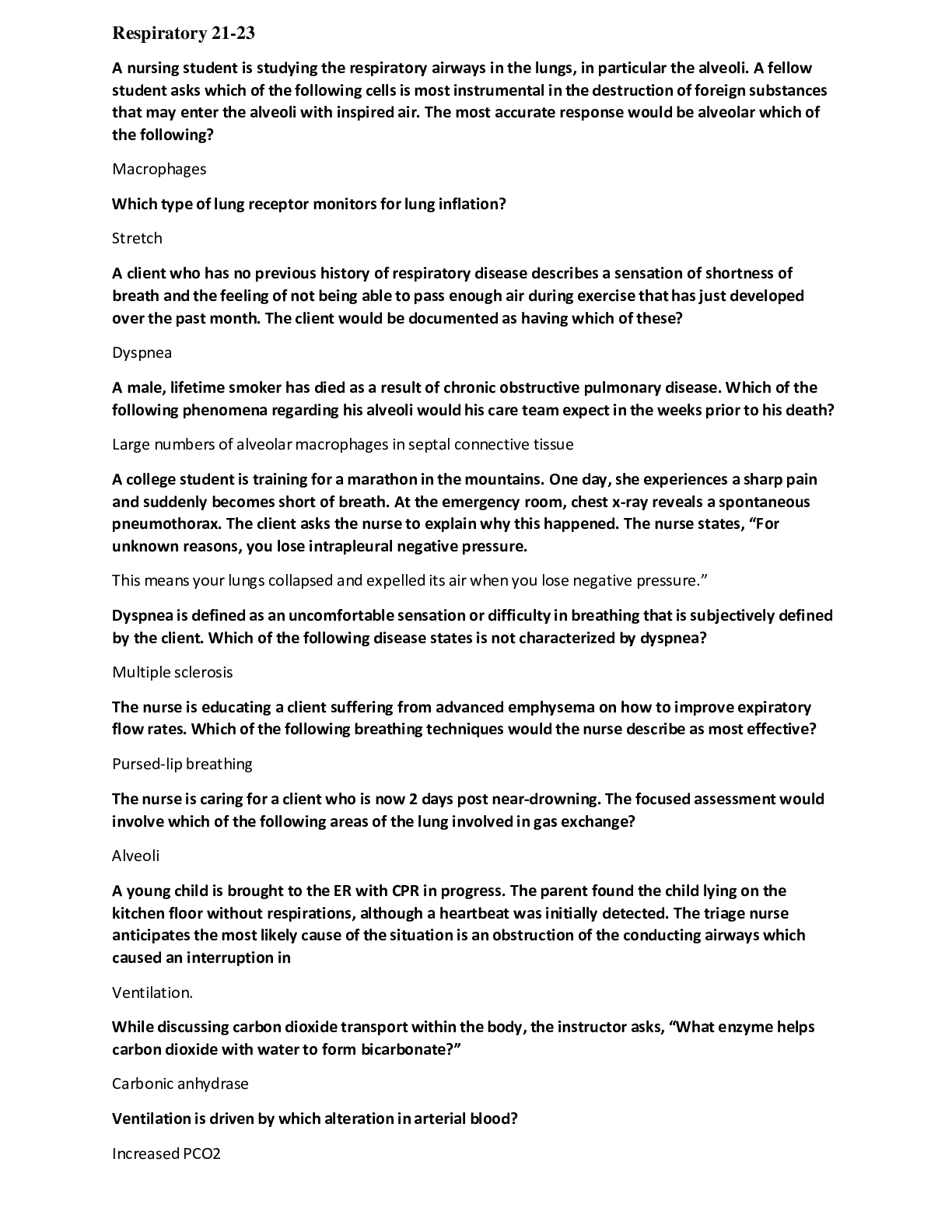
A nursing student is studying the respiratory airways in the lungs, in particular the alveoli. A fellow student asks which of the following cells is most instrumental in the destruction of foreign substances that may enter the alveoli with inspired air. The most accurate response would be alveolar which of the following?
Which type of lung receptor monitors for lung inflation?
A client who has no previous history of respiratory disease describes a sensation of shortness of breath and the feeling of not being able to pass enough air during exercise that has just developed over the past month. The client would be documented as having which of these?
A male, lifetime smoker has died as a result of chronic obstructive pulmonary disease. Which of the following phenomena regarding his alveoli would his care team expect in the weeks prior to his death?
A college student is training for a marathon in the mountains. One day, she experiences a sharp pain and suddenly becomes short of breath. At the emergency room, chest x-ray reveals a spontaneous pneumothorax. The client asks the nurse to explain why this happened. The nurse states, “For unknown reasons, you lose intrapleural negative pressure.
Dyspnea is defined as an uncomfortable sensation or difficulty in breathing that is subjectively defined by the client. Which of the following disease states is not characterized by dyspnea?
The nurse is educating a client suffering from advanced emphysema on how to improve expiratory flow rates. Which of the following breathing techniques would the nurse describe as most effective?
The nurse is caring for a client who is now 2 days post near-drowning. The focused assessment would involve which of the following areas of the lung involved in gas exchange?
A young child is brought to the ER with CPR in progress. The parent found the child lying on the kitchen floor without respirations, although a heartbeat was initially detected. The triage nurse anticipates the most likely cause of the situation is an obstruction of the conducting airways which caused an interruption in
While discussing carbon dioxide transport within the body, the instructor asks, “What enzyme helps carbon dioxide with water to form bicarbonate?”
Ventilation is driven by which alteration in arterial blood?
A client admitted to the hospital with an exacerbation of COPD asks the nurse what can be done to decrease the dyspnea. The nurse instructs the client to use pursed-lip breathing (PLB) to help keep airways open by:
A client is suffering from GERD and has been admitted to the hospital with a diagnosis of pneumonia. Which of the following would be the most likely cause for the development of pneumonia?
When thinking in terms of airway radius with regard to resistance, the lung structure responsible for the most airway resistance to airflow would be:
While working in the newborn ICU, the nurses receive a call that an infant, gestational age of 23, is being air-flighted to their level three trauma nursery. The priority intervention for this infant would be:
Reviewing pathology for an exam on pulmonary vasculature, the nursing student states that blood enters the right side of the heart via vena cava’s, then to the right atrium, right ventricle, and then which vessel carries the deoxygenated blood into the pulmonary system?
The nurse is explaining to the parents of a 23-week premature infant the reason their baby needs to be on mechanical ventilation. The education is successful when the parents state that they understand their baby was born before the type II alveolar cells could mature which has caused a
A patient diagnosed with asthma is scheduled for a pulmonary function test. During the test, the technician instructs the patient to forcefully exhale air for 1 second to evaluate:
During the admission interview the client, who is admitted with bacterial pneumonia, reveals a 20 pack per year smoking history. The nurse relates the possible cause of this pneumonia to the decreased defense of the pulmonary system caused by cigarette smoking. Smoking affects the pulmonary defense system by which of these?
The client ask the nurse how influenza is spread from person-to-person. The nurse educates her client that influenza is transmitted by:
Which of the following patients who presented to a walk-in medical clinic is most likely to be diagnosed with a rhinosinusitis rather than a common cold?
While educating a smoking cessation class, a client asks the nurse, "If I can still get lung cancer, what should I be looking for?" Which response by the nurse is best?
A client arrives in the clinic with a cough, fever, and chest discomfort and is diagnosed with community acquired pneumonia. What education does the nurse anticipate providing prior to discharging the client from the clinic
A 6-hour-old newborn develops a critical respiratory problem and is rushed to the ICU. The ICU nurses suspect the infant has respiratory distress syndrome (RDS) based on which findings? Select all that apply.
A client recovered from influenza two days ago and informs the nurse that she is feeling better but now has a fever, chills, pain when breathing, and a productive cough. What complication does the nurse anticipate the client will be treated for?
A client was admitted 3 days ago and is developing signs and symptoms of pneumonia. Select the correct documentation of the diagnosis.
The neonatal ICU nurse is aware that Type II alveolar cells produce surfactant and they usually develop at how many weeks gestation?
An adult comes to the urgent care clinic reporting facial pain, headache, and copious amounts of thick purulent nasal discharge. Based on these symptoms, the nurse practitioner suspects the client is experiencing which condition?
A nurse is providing care for an older, previously healthy adult male who has been diagnosed today with pneumococcal pneumonia. Which of the following signs and symptoms is the nurse most likely to encounter?
The nurse is assigned to care for four clients on a medical floor. Which client is most at risk for viral pneumonia after influenza?
A client has developed bacterial pneumonia and is admitted to the hospital. The nurse obtains sputum cultures upon admission. What bacteria does the nurse anticipate finding when the results are complete?
A client hospitalized for 72 hours has developed symptoms of a lower respiratory tract infection. Sputum cultures reveal S. aureus as the infectious organism. The nurse explains to the client that which of the following is the most likely cause of this infection?
An infant who was born prematurely and developed respiratory distress syndrome was placed on mechanical ventilation for several weeks. What condition should the nurse monitor the infant for related to the long-term ventilatory support?
A mother in premature labor asks the nurse why her doctor has prescribed corticosteroids. The nurse's response is based on the fact that:
A client asks the nurse if it is possible to contract influenza by being exposed to wound secretions. On what knowledge should the nurse base her response to the client?
Which of the following phenomena is most likely occurring during a child’s alveolar stage of lung development?
A child has developed respiratory stridor and is displaying a crowing sound. The parents ask the nurse what is causing this sound. The best response would be:
Which assessment findings may indicate that the acute rhinosinusitis is experiencing a complication? Select all that apply.
A patient is admitted for a relapse for sarcoidosis. Knowing this is usually caused by an inflammatory process, the nurse can anticipate administering:
.
A 10-year-old male is experiencing an acute exacerbation of his asthma. The most appropriate treatment for this client would be:
A car accident client is admitted with a chest tube following pneumothorax. He also has an elevated blood alcohol level. When the nurse enters his room, she notes the client is dyspneic, short of breath, and holding his chest tube in his hand. When the nurse pulls the linens back, she finds a “sucking” chest wound. After calling a “code blue,” the next priority intervention would be to:
There can be many reasons for a client to present with hypoxemia. For a client’s PO2 to fall, a respiratory disease is usually involved. Often, clients have involvement from more than one mechanism. Which of the following will result in hypoxemia? (Select all that apply.)
A client with primary lung disease has developed right heart failure. The health care provider would document this as:
A child is brought to the emergency department struggling to breathe with a prolonged bronchospasm and severe hypoxemia. Assessment revealed the use of accessory muscles, a weak cough, audible wheezing sound, moist skin, and tachycardia. Which of the following is the most likely diagnosis?
Which organisms create chronic infection in a child with cystic fibrosis?
Which of the following clients is at risk for developing acute respiratory failure?
The nurse determines that the client has clubbing of the fingertips. Which is the best intervention?
While rock climbing, a 22 year-old male has endured a severe head injury. Which of the following statements best captures expected clinical manifestations and treatments for his immediate condition?
When CO2 levels in the blood rise, a state of hypercapnia occurs in the body. What factors contribute to hypercapnia? (Select all that apply.)
A 51 year-old female client who is two days post-operative in a surgical unit of a hospital is at risk of developing atelectasis as a result of being largely immobile. Which of the following teaching points by her nurse is most appropriate?
A patient experiencing immotile cilia syndrome should be frequently assessed by the nurse for which priority complication?
A patient diagnosed with congestive heart failure has an arterial blood oxygen level (PaO2) of 89%. Which of the following terms should the nurse use to document a reduced oxygenation of arterial blood?
COPD is a combination of disease processes. What disease processes have been identified as being part of COPD?
The parents of a child diagnosed with cystic fibrosis (CF) ask about the risk of any future children having the condition. How should the nurse respond?
The nurse is caring for the following clients. Select the client at highest risk for the development of atelectasis.
[Show More]





 (1).png)
.png)