A Self-learning Module for BS Criminology
COURSE CODE: Forensic 3
Forensic Chemistry and Toxicology
(Source: University of Central Oklahoma, 2020)
Prepared by;
RAMIL M. LAS-IGAN RCrim, CCS, MSCJSC
COURS
...
A Self-learning Module for BS Criminology
COURSE CODE: Forensic 3
Forensic Chemistry and Toxicology
(Source: University of Central Oklahoma, 2020)
Prepared by;
RAMIL M. LAS-IGAN RCrim, CCS, MSCJSC
COURSE INTRODUCTION
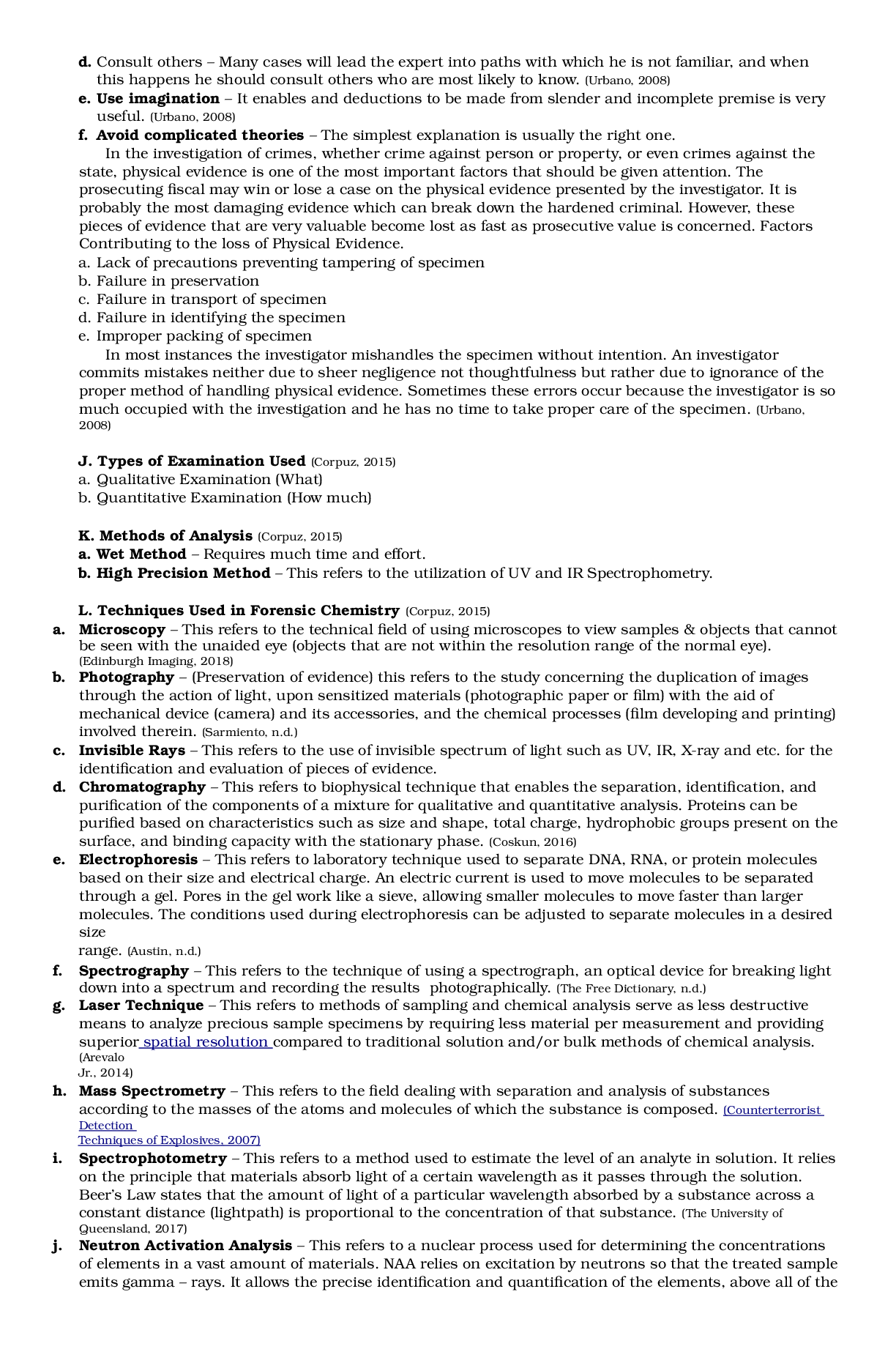
“Forensic chemistry” is a broad term that, if taken literally, would encompass most of the functions
within a crime laboratory. Techniques used in forensic chemistry are also used by the toxicology and trace
analysis sections. However, forensic chemistry generally refers to controlled substance or drug analysis.
Traditionally, an examiner enters a crime laboratory career through the forensic chemistry door. Working in
this area provides the opportunity for the new examiner to develop the tools required to move on to more
complex and subjective examinations. He has the opportunity to learn and master the fundamentals of
evidence handling, note taking, and report writing by processing the large volume of cases that pass through
this section. Similarly, the examiner also has the opportunity to learn and hone testimony skills. The
analysis of controlled substance exhibits is pretty straightforward. The examiner uses a series of nonspecific
tests and deductive reasoning to form an opinion concerning the contents of the exhibit under examination.
He supports his opinion using modern instrumentation that provides documentable confirmation. The
thought process learned and developed performing these black and white examinations will be invaluable
experience to the examiner as he moves onto types of examinations whose results are, at best, seen as
shades of gray.
COURSE DESCRIPTION
This course provides an overview of the major disciplines of forensic chemistry and forensic toxicology,
with examples to demonstrate their specific contributions to identification, collection, preservation,
investigation, presentation, and biological and chemical analyses of physical evidence for the effective
dispensation of justice.
COURSE OUTLINE
CHAPTER I
• Module 1: Basic concepts of forensic chemistry and toxicology
CHAPTER II
• Module 2: History of Forensic Chemistry and Toxicology
Qualities of Light
CHAPTER III
• Module 3: Principles of forensic chemistry and toxicology
Chapter IV
• Module 4: Significance and value of forensic science in criminal investigation
Chapter V
• Module 5: Crime scene protocol on Forensic Chemistry related evidence Chapter VI
• Module 6: Tests on Biological evidence:
✓ Blood and Blood Stains
✓ Semen
✓ Hair and Fibers
✓ Saliva, Urine and Feces
✓ DNA
Chapter VII
• Module 7: Tests on Physical Evidence:
✓ Gunpowder Residue
✓ Explosives
✓ Dust, dirt, debris, soil analysis
✓ Metallurgy
✓ Casting and Moulage
✓ Glass and Glass Fragments
✓ Inks and Paper
✓ Restoration of Tampered Serial Numbers
Chapter VIII
• Module 13: Drug Analysis
• Module 14: Nature of Toxicology
• Module 15: Poisons and its Classification
• Module 16: Antidotes and its Types
Chapter IX
• Module 17: Instrumentation in Forensic Chemistry and Toxicology
• Module 18: Documentation for case report
• Module 19: Legal aspect of Forensic Chemistry
OVERVIEW
The development of scientific crime detection is comparatively recent although this aspect of police
work has long been exploited in fiction, notably by Conan Doyle’s masterly creation of Sherlock Holmes.
Scientific crime detection as such may well be described as owing its birth to the St. Valentine’s Day
massacre which occurred in Chicago on February 14, 1929. A group of public minded individual was
responsible for the establishment of a scientific crime laboratory in that city which today has taken in the
historical annals of police science.
In the Philippines the first public recognition of the value of science in the proper administration of
justice was made when the position of “Medicos Titulares” was created in the Philippines by virtue of the
Royal Decree No. 188 of Spain to perform public sanitary duties and at the same time medico – legal aids
to the administration of justice. On December 15, 1884, Governor General Joaquin Javellar created a
committee to study the mineral waters of Luzon and appointed Anacleto del Rosario as chemist. Realizing
the importance of this work, the government established in September 13, 1887 the “Laboratorio Municipal
de Manila” under the inspection of the “Direccion General de Administration Civil” and the control of the
“Gobierno de Provincias” The functions of the laboratory were to make analysis, not only for food, water
and others from the standpoint of public health and legal medicine, but also of specimens for clinical
purposes. Anacleto del Rosario was appointed director after a competitive examination in June 17, 1888.
DISCUSSION OF TOPICS
PART I
Chapter I History of Forensic Chemistry
Development of the Scientific Crime Laboratory in the Philippines (Urbano, 2008)
History of Crime Laboratory (Corpuz, 2015)
1858 The first medical textbook printed including pertinent instructions related to
medico-legal practice by Spanish physician, Dr. Rafael Genard y Mas a Chief
Army Physician, the book entitled “Manual de Medicina Domestica”.
1871 Teaching of forensic medicine was included as an academic subject in the foundation
of the School of Medicine of the Real y Pontifica Universidad de Santo Tomas on
March 31.
March 31, 1876 By virtue of the Royal Decree No. 188 of the king of Spain, the position of Medico
Titulares was created and made in charge of public sanitation and at the same time
medico-legal in the administration of justice.
December 15, 1884 Creation of a committee to study mineral waters of Luzon by Gen. Joaquin Jovellar
and Anacleto del Rosario as the chemist
September 13, 1887 Laboratorio Municipal de Manila was created that has the following functions;
Analysis of: a. Food
b. Water
c. Materials from standpoint of Public Health and Legal
Medicine
d. Specimens for Clinical Purposes
June 17, 1888 Appointment of Anacleto del Rosario as Director
1894 1. Rules regulating the services of “Medico Titulares y
Forences”
2. Creation of Laboratorio Medico – legal under Judicial branch of government,
under the direction of a physician assisted by a pharmacist – chemist, Ulpiano
Rodriguez as first chemist.
1895 1. Antonio Luna established a clinical laboratory that has the function of
Chemical Analysis paralyzed in 1896 because of the revolution.
2. Medico – legal laboratory was established in the City of Manila and extended at
the same time its services to the provinces.
1898 Preservation of the Spanish Forensic Medicine System by the American Civil
Government.
1899 Establishment of the first Crime Laboratory by the U.S. Army.
The development of scientific crime detection is comparatively recent although this aspect of police
work has long been exploited in fiction, notably by Conan Doyle’s masterly creation of Sherlock Holmes.
[Show More]