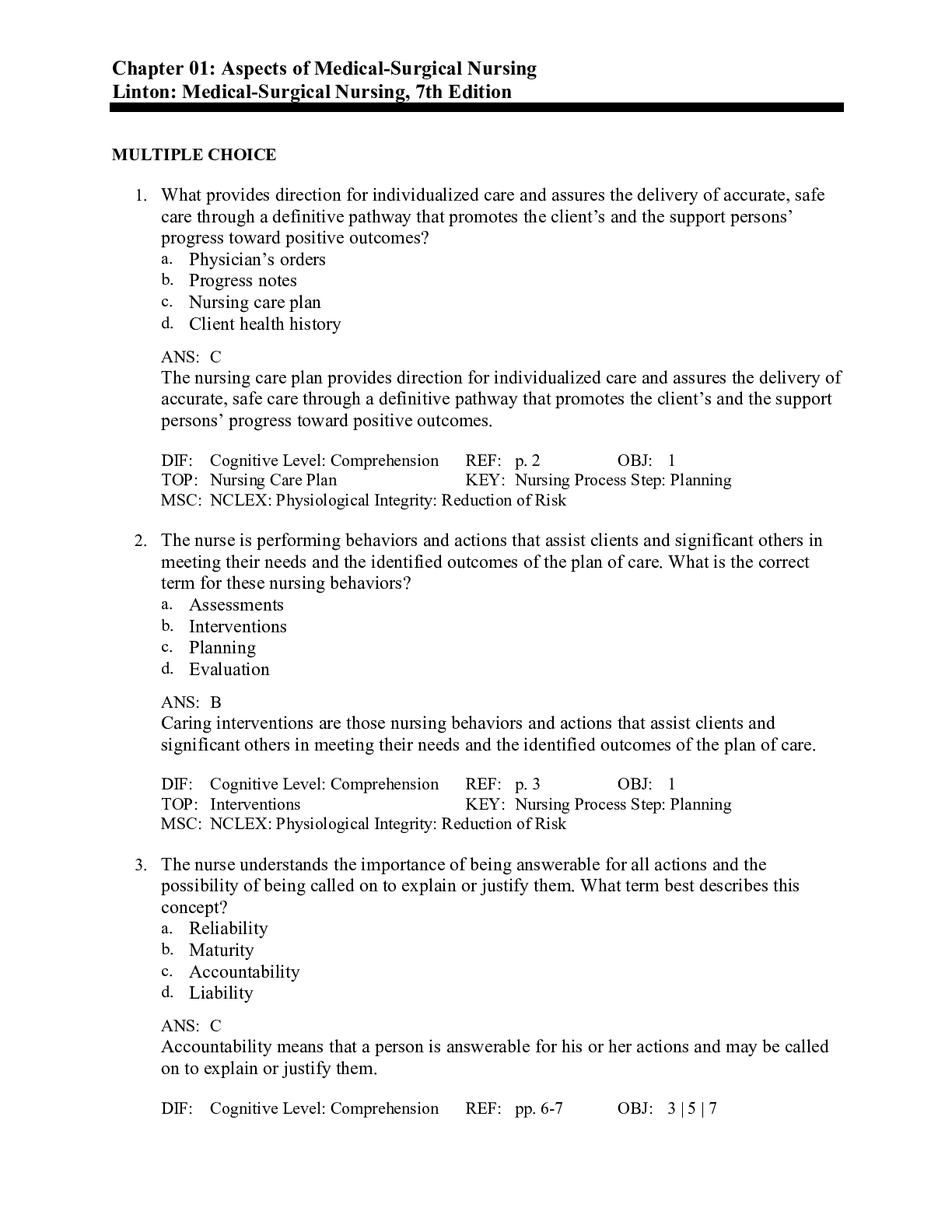
ATI MEDSURG REVISION STUDY GUIDE (CARDIOVASCULAR SYSTEM) A client admitted to the hospital with chest pain and a history of type 2 diabetes mellitus is scheduled for cardiac catheterization. Which medication would need t
...
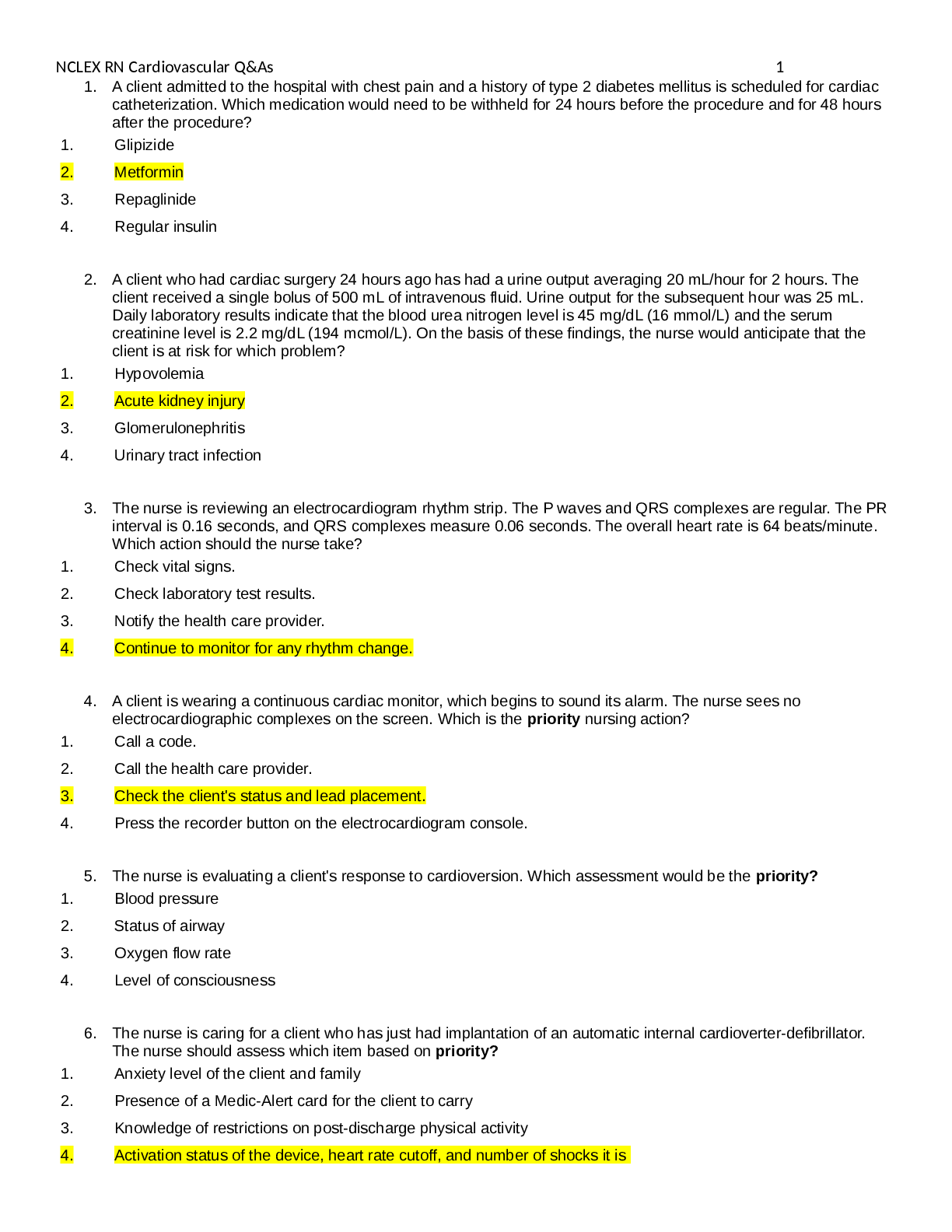
ATI MEDSURG REVISION STUDY GUIDE (CARDIOVASCULAR SYSTEM) A client admitted to the hospital with chest pain and a history of type 2 diabetes mellitus is scheduled for cardiac catheterization. Which medication would need to be withheld for 24 hours before the procedure and for 48 hours after the procedure? 1. Glipizide 2. Metformin 3. Repaglinide 4. Regular insulin A client who had cardiac surgery 24 hours ago has had a urine output averaging 20 mL/hour for 2 hours. The client received a single bolus of 500 mL of intravenous fluid. Urine output for the subsequent hour was 25 mL. Daily laboratory results indicate that the blood urea nitrogen level is 45 mg/dL (16 mmol/L) and the serum creatinine level is 2.2 mg/dL (194 mcmol/L). On the basis of these findings, the nurse would anticipate that the client is at risk for which problem? 1. Hypovolemia 2. Acute kidney injury 3. Glomerulonephritis 4. Urinary tract infection The nurse is reviewing an electrocardiogram rhythm strip. The P waves and QRS complexes are regular. The PR interval is 0.16 seconds, and QRS complexes measure 0.06 seconds. The overall heart rate is 64 beats/minute. Which action should the nurse take? 1. Check vital signs. 2. Check laboratory test results. 3. Notify the health care provider. 4. Continue to monitor for any rhythm change. A client is wearing a continuous cardiac monitor, which begins to sound its alarm. The nurse sees no electrocardiographic complexes on the screen. Which is the priority nursing action? 1. Call a code. 2. Call the health care provider. 3. Check the client's status and lead placement. 4. Press the recorder button on the electrocardiogram console. The nurse is evaluating a client's response to cardioversion. Which assessment would be thepriority? 1. Blood pressure 2. Status of airway 3. Oxygen flow rate 4. Level of consciousness A client's electrocardiogram strip shows atrial and ventricular rates of 110 beats/minute. The PR interval is 0.14 seconds, the QRS complex measures 0.08 seconds, and the PP and RR intervals are regular. How should the nurse correctly interpret this rhythm? 1. Sinus tachycardia 2. Sinus bradycardia 3. Sinus dysrhythmia 4. Normal sinus rhythm The nurse is assessing the neurovascular status of a client who returned to the surgical nursing unit 4 hours ago after undergoing aortoiliac bypass graft. The affected leg is warm, and the nurse notes redness and edema. The pedal pulse is palpable and unchanged from admission. How should the nurse correctly interpret the client's neurovascular status? 1. The neurovascular status is normal because of increased blood flow through the leg. 2. The neurovascular status is moderately impaired, and the surgeon should be called. 3. The neurovascular status is slightly deteriorating and should be monitored for another hour. 4. The neurovascular status is adequate from an arterial approach, but venous complications are arising. The nurse is evaluating the condition of a client after pericardiocentesis performed to treat cardiac tamponade. Which observation would indicate that the procedure was effective? 1. Muffled heart sounds 2. A rise in blood pressure 3. Jugular venous distention 4. Client expressions of dyspnea A client with variant angina is scheduled to receive an oral calcium channel blocker twice daily. Which statement by the client indicates theneed for further teaching? 1. "I should notify my doctor if my feet or legs start to swell." 2. "My doctor told me to call his office if my pulse rate decreases below 60." 3. "Avoiding grapefruit juice will definitely be a challenge for me, since I usually drink it every morning with breakfast." 4. "My spouse told me that since I have developed this problem, we are going to stop walking in the mall every morning." The nurse is monitoring a client with acute pericarditis for signs of cardiac tamponade. Which assessment finding indicates the presence of this complication? 1. Flat neck veins 2. A pulse rate of 60 beats/minute 3. Muffled or distant heart sounds 4. Wheezing on auscultation of the lungs The home care nurse is providing instructions to a client with an arterial ischemic leg ulcer about home care management and self-care management. Which statement, if made by the client, indicates a need for further instruction? 1. "I need to be sure not to go barefoot around the house." 2. "If I cut my toenails, I need to be sure that I cut them straight across." 3. "It is all right to apply lanolin to my feet, but I shouldn't place it between my toes." 4. "I need to be sure that I elevate my leg above the level of my heart for at least an hour every day." The nurse is providing instructions to a client with a diagnosis of hypertension regarding high-sodium items to be avoided. The nurse instructs the client to avoid consuming which item? 1. Bananas 2. Broccoli 3. Antacids 4. Cantaloupe The nurse is preparing discharge instructions for a client with Raynaud's disease. The nurse should plan to provide which instruction to the client? 1. Use nail polish to protect the nail beds from injury. 2. Wear gloves for all activities involving the use of both hands. 3. Stop smoking because it causes cutaneous blood vessel spasm. 4. Always wear warm clothing, even in warm climates, to prevent vasoconstriction. The nurse is developing a plan of care for a client with varicose veins in whom skin breakdown occurred over the varicosities as a result of secondary infection. Which is a priorityintervention? 1. Keep the legs aligned with the heart. 2. Elevate the legs higher than the heart. 3. Clean the skin with alcohol every hour. 4. Position the client onto the side during every shift. The nurse in the medical unit is reviewing the laboratory test results for a client who has been transferred from the intensive care unit (ICU). The nurse notes that a cardiac troponin T assay was performed while the client was in the ICU. The nurse determines that this test was performed to assist in diagnosing which condition? 1. Heart failure 2. Atrial fibrillation 3. Myocardial infarction 4. Ventricular tachycardia The nurse is caring for a client with cardiac disease who has been placed on a cardiac monitor. The nurse notes that the client has developed atrial fibrillation and has a rapid ventricular rate of 150 beats/minute. The nurse should next assess the client for which finding? 1. Hypotension 2. Flat neck veins 3. Complaints of nausea 4. Complaints of headache The nurse is performing an assessment on a client with a diagnosis of left-sided heart failure. Which assessment component would elicit specific information regarding the client's left-sided heart function? 1. Listening to lung sounds 2. Palpating for organomegaly 3. Assessing for jugular vein distention 4. Assessing for peripheral and sacral edema The nurse is participating in a class on rhythm strip interpretation. Which statement by the nurse indicates an understanding of a PR interval of 0.20? 1. "This is a normal finding." 2. "This is indicative of atrial flutter." 3. "This is indicative of atrial fibrillation." 4. "This is indicative of impending reinfarction." The nurse in the medical unit is assigned to provide discharge teaching to a client with a diagnosis of angina pectoris. The nurse is discussing lifestyle changes that are needed to minimize the effects of the disease process. The client continually changes the subject during the teaching session. The nurse interprets that this client's behavior is most likely related to which problem? 1. Anxiety related to the need to make lifestyle changes 2. Boredom resulting from having already learned the material 3. An attempt to ignore or deny the need to make lifestyle changes 4. Lack of understanding of the material provided at the teaching session and embarrassment about asking questions The nurse is developing a plan of care for a client who will be admitted to the hospital with a diagnosis of deep vein thrombosis (DVT) of the right leg. The nurse develops the plan, expecting that the health care provider (HCP) will most likely prescribe which option? 1. Maintain activity level as prescribed. 2. Maintain the affected leg in a dependent position. 3. Administer an opioid analgesic every 4 hours around the clock. 4. Apply cool packs to the affected leg for 20 minutes every 4 hours. A client with a diagnosis of varicose veins is scheduled for treatment by sclerotherapy and is receiving education about the procedure from the nurse. Which statement by the client indicates that the teaching has been effective? 1. "It involves tying off the veins so that circulation is redirected in another area." 2. "It involves surgically removing the varicosity, so anesthesia will be required." 3. "It involves tying off the veins to prevent sluggishness of blood from occurring." 4. "It involves injecting an agent into the vein to damage the vein wall and close it off." A client calls the nurse at the clinic and reports that ever since the vein ligation and stripping procedure was performed, she has been experiencing a sensation as though the affected leg is falling asleep. The nurse should make which response to the client? 1. "Apply warm packs to the leg." 2. "Keep the leg elevated as much as possible." 3. "Your health care provider needs to be contacted to report this problem." 4. "This normally occurs after surgery and will subside when the edema goes down." The registered nurse (RN) is educating a new RN about the use of oxygen for clients with angina pectoris. Which statement by the new nurse indicates that the teaching has been effective? 1. "Oxygen has a calming effect." 2. "Oxygen will prevent the development of any thrombus." 3. "The pain of angina pectoris occurs because of a decreased oxygen supply to heart cells." 4. "Oxygen dilates the blood vessels so that they can supply more nutrients to the heart muscle." A client with a diagnosis of angina pectoris is hospitalized for an angioplasty. The client returns to the nursing unit after the procedure, and the nurse provides instructions to the client regarding home care measures. Which statement, if made by the client, indicates an understanding of the instructions? 1. "I need to cut down on cigarette smoking." 2. "I am so relieved that my heart is repaired." 3. "I need to adhere to my dietary restrictions." 4. "I am so relieved that I can eat anything I want to now." The nurse is caring for a client with a diagnosis of myocardial infarction (MI) and is assisting the client in completing the diet menu. Which beverage should the nurse instruct the client to select from the menu? 1. Tea 2. Cola 3. Coffee 4. Raspberry juice The nurse is performing an admission assessment on a client with a diagnosis of angina pectoris who takes nitroglycerin for chest pain at home. During the assessment the client complains of chest pain. The nurse should immediately ask the client which question? 1. "Where is the pain located?" 2. "Are you having any nausea?" 3. "Are you allergic to any medications?" 4. "Do you have your nitroglycerin with you?" The nurse has provided dietary instructions to a client with coronary artery disease. Which statement by the client indicates an understanding of the dietary instructions? 1. "I'll need to become a strict vegetarian." 2. "I should use polyunsaturated oils in my diet." 3. "I need to substitute eggs and whole milk for meat." 4. "I should eliminate all cholesterol and fat from my diet." A client is admitted to the visiting nurse service for assessment and follow-up after being discharged from the hospital with new-onset heart failure (HF). The nurse teaches the client about the dietary restrictions required with HF. Which statement by the client indicates that further teaching is needed? 1. "I'm not supposed to eat cold cuts." 2. "I can have most fresh fruits and vegetables." 3. "I'm going to weigh myself daily to be sure I don't gain too much fluid." 4. "I'm going to have a ham and cheese sandwich and potato chips for lunch." The nurse is performing a health screening on a 54-year-old client. The client has a blood pressure of 118/78 mm Hg, total cholesterol level of 190 mg/dL (4.9 mmol/L), and fasting blood glucose level of 184 mg/dL (10.2 mmol/L). The nurse interprets this to mean that the client has which modifiable risk factor for coronary artery disease (CAD)? 1. Age 2. Hypertension 3. Hyperlipidemia 4. Glucose intolerance The home care nurse has taught a client with a problem of inadequate cardiac output about helpful lifestyle adaptations to promote health. Which statement by the client best demonstrates an understanding of the information provided? 1. "I will eat enough daily fiber to prevent straining at stool." 2. "I will try to exercise vigorously to strengthen my heart muscle." 3. "I will drink 3000 to 3500 mL of fluid daily to promote good kidney function." 4. "Drinking 2 to 3 oz of liquor each night will promote blood flow by enlarging blood vessels." A client has been experiencing difficulty with completion of daily activities because of underlying cardiovascular disease, as evidenced by exertional fatigue and increased blood pressure. Which observation by the nurse bestindicates client progress in meeting goals for this problem? 1. Ambulates 10 feet (3 meters) farther each day 2. Verbalizes the benefits of increasing activity 3. Chooses a healthy diet that meets caloric needs 4. Sleeps without awakening throughout the night The health care provider (HCP) has written a prescription for a client to have an echocardiogram. Which action should the nurse take to prepare the client for the procedure? 1. Questions the client about allergies to iodine or shellfish 2. Has the client sign an informed consent form for an invasive procedure 3. Tells the client that the procedure is painless and takes 30 to 60 minutes 4. Keeps the client on nothing by mouth (NPO) status for 2 hours before the procedure A client with coronary artery disease is scheduled to have a diagnostic exercise stress test. Which instruction should the nurse plan to provide to the client about this procedure? 1. Eat breakfast just before the procedure. 2. Wear firm, rigid shoes, such as work boots. 3. Wear loose clothing with a shirt that buttons in front. A client is scheduled for a cardiac catheterization to diagnose the extent of coronary artery disease. The nurse places highest priority on telling the client to report which sensation during the procedure? 1. Chest pain 2. Urge to cough 3. Warm, flushed feeling 4. Pressure at the insertion site A client recovering from pulmonary edema is preparing for discharge. What should the nurse plan to teach the client to do to manage or prevent recurrent symptoms after discharge? 1. Weigh self on a daily basis. 2. Sleep with the head of the bed flat. 3. Take a double dose of the diuretic if peripheral edema is noted. 4. Withhold prescribed digoxin if slight respiratory distress occurs. A client is scheduled to undergo cardiac catheterization for the first time, and the nurse provides instructions to the client. Which client statement indicates an understanding of the instructions? 1. "It will really hurt when the catheter is first put in." 2. "I will receive general anesthesia for the procedure." 3. "I will have to go to the operating room for this procedure." 4. "I probably will feel tired after the test from lying on a hard x-ray table for a few hours." A client admitted to the hospital with coronary artery disease complains of dyspnea at rest. The nurse caring for the client uses which item as the best means to monitor respiratory status on an ongoing basis? 1. Apnea monitor 2. Oxygen flowmeter 3. Telemetry cardiac monitor 4. Oxygen saturation monitor The nurse is listening to a lecture about angina. Which statement by the nurse indicates that the teaching has been effective? 1. "Stable angina is chronic." 2. "Variant angina is caused by emotional stress." 3. "Unstable angina is not a life-threatening condition." 4. "Intractable angina rarely limits the client's lifestyle." The nurse has completed an educational course covering first-degree heart block. Which statement by the nurse indicates that teaching has been effective? 1. "Presence of Q waves indicates first-degree heart block." 2. "Tall, peaked T waves indicate first-degree heart block." 3. "Widened QRS complexes indicate first-degree heart block." 4. "Prolonged, equal PR intervals indicates first-degree heart block." The nurse is teaching the client with angina pectoris about disease management and lifestyle changes that are necessary to control disease progression. Which statement by the client indicates a need for further teaching? 1. "I will avoid using table salt with meals." 2. "It is best to exercise once a week for 1 hour." 3. "I will take nitroglycerin whenever chest discomfort begins." 4. "I will use muscle relaxation to cope with stressful situations." The ambulatory care nurse is working with a client who has been diagnosed with Prinzmetal's (variant) angina. What should the nurse plan to teach the client about this type of angina? 1. It is most effectively managed by beta-blocking agents. 2. It has the same risk factors as stable and unstable angina. 3. It can be controlled with a low-sodium, high-potassium diet. 4. Generally it is treated with calcium channel–blocking agents. The nurse working in a long-term care facility is assessing a client who is experiencing chest pain. The nurse should interpret that the pain is most likely caused by myocardial infarction (MI) on the basis of what assessment finding? 1. The client is not experiencing dyspnea. 2. The client is not experiencing nausea or vomiting. 3. The pain has not been relieved by rest and nitroglycerin tablets. 4. The client says the pain began while she was trying to open a stuck dresser drawer. A client with myocardial infarction (MI) has been transferred from the coronary care unit (CCU) to the general medical unit. What activity level should the nurse encourage for the client immediately after transfer? 1. Ad lib activities as tolerated 2. Strict bed rest for 24 hours after transfer 3. Bathroom privileges and self-care activities 4. Unsupervised hallway ambulation for distances up to 200 feet (60 meters) A client with no history of heart disease has experienced acute myocardial infarction and has been given thrombolytic therapy with tissue plasminogen activator. What assessment finding should the nurse identify as an indicator that the client is experiencing complications of this therapy? 1. Tarry stools 2. Nausea and vomiting 3. Orange-colored urine 4. Decreased urine output The nurse is discussing smoking cessation with a client diagnosed with coronary artery disease (CAD). Which statement should the nurse make to try to motivate the client to quit smoking? 1. "None of the cardiovascular effects are reversible, but quitting might prevent lung cancer." 2. "Because most of the damage has already been done, it will be all right to cut down a little at a time." 3. "If you totally quit smoking right now, you can cut your cardiovascular risk to zero within a year." 4. "If you quit now, your risk of cardiovascular disease will decrease to that of a nonsmoker in 3 to 4 years." A client has experienced an episode of pulmonary edema. The nurse determines that the client's respiratory status is improving after this episode if which breath sounds are noted? 1. Rhonchi 2. Wheezes 3. Crackles in the bases 4. Crackles throughout the lung fields A hospitalized client has been diagnosed with heart failure as a complication of hypertension. In explaining the disease process to the client, the nurse identifies which chamber of the heart as primarily responsible for the symptoms? 1. Left atrium 2. Right atrium 3. Left ventricle 4. Right ventricle The nurse has just completed education on myocardial infarction (MI) to a group of new nurses. Which statement made by one of the nurses indicates that the teaching has been effective? 1. "Chest pain is caused by tissue hypoxia in the myocardium." 2. "Chest pain is caused by tissue hypoxia in the vessels of the heart." 3. "Chest pain is caused by tissue hypoxia in the parietal pericardium." 4. "Chest pain is caused by tissue hypoxia in the visceral pericardium." The registered nurse (RN) is educating a new nurse on mitral stenosis. Which statement by the new nurse indicates that the teaching has been effective? 1. "Left ventricle to aorta narrowing will impede flow of blood." 2. "Left atrium to left ventricle narrowing will impede flow of blood." 3. "Right atrium to right ventricle narrowing will impede flow of blood." 4. "Right ventricle to pulmonary artery narrowing will impede flow of blood." The registered nurse (RN) is educating a new nurse about aortic regurgitation. Which statement by the new nurse indicates that the teaching has been effective? 1. "Failure of the aortic valve to close completely allows blood to flow retrograde through the aorta to the left ventricle." 2. "Failure of the aortic valve to close completely allows blood to flow retrograde through the left ventricle to the left atrium." 3. "Failure of the aortic valve to close completely allows blood to flow retrograde through the right ventricle to the right atrium." 4. "Failure of the aortic valve to close completely allows blood to flow retrograde through the pulmonary artery to the right ventricle." The nurse educator is teaching the new registered nurse (RN) how to care for clients with a decrease in blood pressure. Which statement by the new RN indicates the need for further instruction? 1. "Decreased contractility occurs." 2. "Decreased heart rate is not a side effect." 3. "Decreased myocardial blood flow is not a concern." 4. "Increased resistance to electrical stimulation often occurs." The nurse educator is lecturing new registered nurses (RNs) about serum calcium levels. Which statement by one of the new RNs indicates that teaching has been effective? 1. "Calcium has no effect on the risk for stroke." 2. "Low calcium levels can lead to cardiac arrest." 3. "Low calcium levels cause high blood pressure." 4. "Calcium has no effect on urinary stone formation." The nurse is reinforcing instructions to a hospitalized client with heart block about the fundamental concepts regarding the cardiac rhythm. The nurse explains to the client that the normal site in the heart responsible for initiating electrical impulses is which site? 1. Bundle of His 2. Purkinje fibers 3. Sinoatrial (SA) node 4. Atrioventricular (AV) node A nursing instructor asks a nursing student to describe the structure and function of the coronary arteries. Which response by the student indicates a need for further teaching on the anatomy and physiology of the heart? 1. "The coronary arteries branch from the aorta." 2. "The coronary arteries supply the heart muscle with blood." 3. "The left coronary artery provides blood for the left atrium and the left ventricle." 4. "The left coronary artery supplies the right atrium and right ventricle with blood." CONTINUED.....................................................................................................................................DOWNLOAD FOR MORE REVISION.....................................................
[Show More]

x.png)


![Preview of NUR2488 / NUR 2488 Exam 2 Study Guide [In Class Review] : Mental Health Nursing - Rasmuss](https://scholarfriends.com/storage/Mental Health Exam 2 Study Guide [In class review] MY21.png)