SOLUTIONS TO PRACTICE PROBLEMS FOR CHAPTERS 20-25
Problem 3 of Sample Final:
Suppose U is an n-dimensional vector space over R and V is an m-dimensional
vector space over R, and M is the matrix associated to a linear
...
SOLUTIONS TO PRACTICE PROBLEMS FOR CHAPTERS 20-25
Problem 3 of Sample Final:
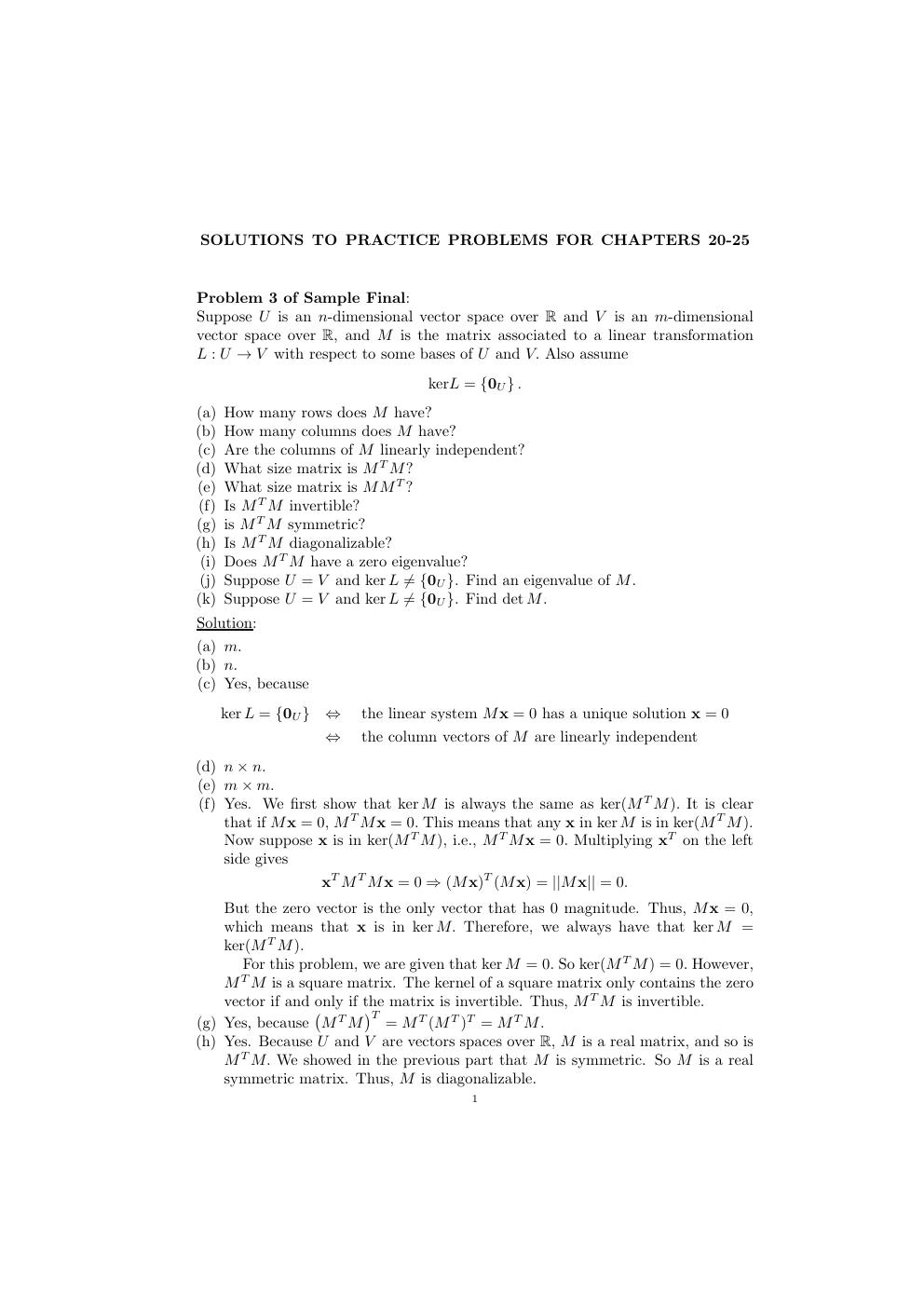
Suppose U is an n-dimensional vector space over R and V is an m-dimensional
vector space over R, and M is the matrix associated to a linear transformation
L : U → V with respect to some bases of U and V. Also assume
kerL = {0U} .
(a) How many rows does M have?
(b) How many columns does M have?
(c) Are the columns of M linearly independent?
(d) What size matrix is MT M?
(e) What size matrix is MMT ?
(f) Is MT M invertible?
(g) is MT M symmetric?
(h) Is MT M diagonalizable?
(i) Does MT M have a zero eigenvalue?
(j) Suppose U = V and ker L ∕= {0U}. Find an eigenvalue of M.
(k) Suppose U = V and ker L ∕= {0U}. Find det M.
Solution:
(a) m.
(b) n.
(c) Yes, because
ker L = {0U} ⇔ the linear system Mx = 0 has a unique solution x = 0
⇔ the column vectors of M are linearly independent
(d) n × n.
(e) m × m.
(f) Yes. We first show that ker M is always the same as ker(MT M). It is clear
that if Mx = 0, MT Mx = 0. This means that any x in ker M is in ker(MT M).
Now suppose x is in ker(MT M), i.e., MT Mx = 0. Multiplying xT on the left
side gives
xT MT Mx = 0 ⇒ (Mx)T (Mx) = ||Mx|| = 0.
But the zero vector is the only vector that has 0 magnitude. Thus, Mx = 0,
which means that x is in ker M. Therefore, we always have that ker M =
ker(MT M).
For this problem, we are given that ker M = 0. So ker(MT M) = 0. However,
MT M is a square matrix. The kernel of a square matrix only contains the zero
vector if and only if the matrix is invertible. Thus, MT M is invertible.
(g) Yes, because MT MT = MT (MT )T = MT M.
(h) Yes. Because U and V are vectors spaces over R, M is a real matrix, and so is
MT M. We showed in the previous part that M is symmetric. So M is a real
symmetric matrix. Thus, M is diagonalizable.
1
2 SOLUTIONS TO PRACTICE PROBLEMS FOR CHAPTERS 20-25
(i) No. Note that 0 is an eigenvalue of a matrix A ⇔ det(0I-A) = 0 ⇔ det(A) = 0
⇔ A is not invertible.
Since in part (f) we showed that MT M is invertible, 0 cannot be an eigenvalue of MT M.
(j) Since U = V , M is a square matrix. We have ker M ∕= {0U} if and only if M
is not invertible. As we argued in part (i), 0 is an eigenvalue of M if and only
if M is not invertible. So M must have 0 as an eigenvalue.
(k) Again using the argument in part (i), we should have that det M = 0.
Problem 13 of Sample Final:
Let L: V → W be a linear transformation between finite-dimensional vector spaces
V and W, and let M be a matrix for L (with respect to some basis for V and some
basis for W). We know that L has an inverse if and only if it is bijective, and we
know a lot of ways to tell whether M has an inverse. In fact, L has an inverse if
and only if M has an inverse:
(a) Suppose that L is bijective (i.e., one-to-one and onto).
i. Show that dim V = rank L = dim W.
ii. Show that 0 is not an eigenvalue of M.
iii. Show that M is an invertible matrix.
(b) Now, suppose that M is an invertible matrix.
i. Show that 0 is not an eigenvalue of M.
ii. Show that L is injective.
iii. Show that L is surjective.
Solution:
(a) We suppose that L is bijective.
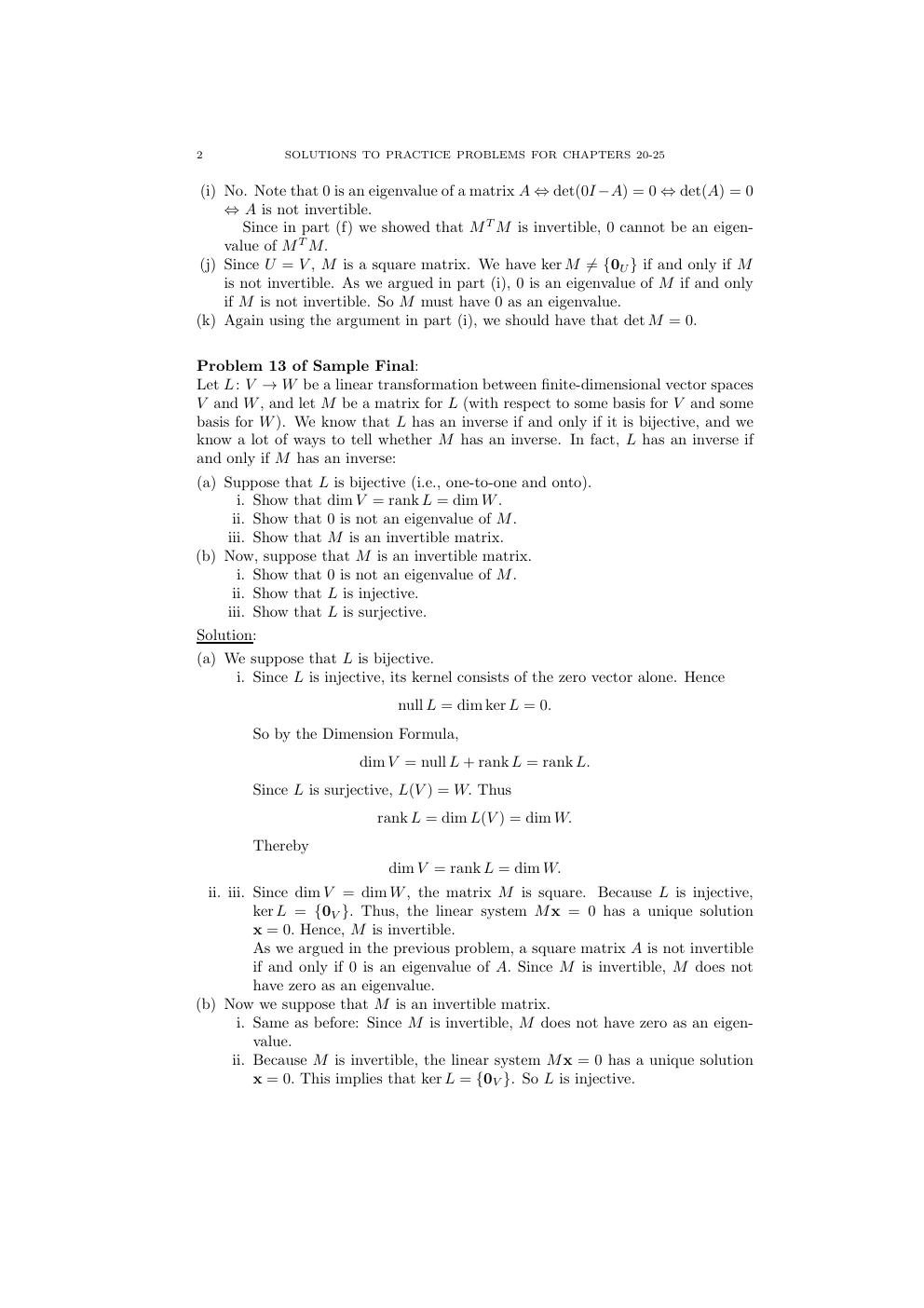
i. Since L is injective, its kernel consists of the zero vector alone. Hence
null L = dim ker L = 0.
So by the Dimension Formula,
dim V = null L + rankL = rankL.
Since L is surjective, L(V ) = W. Thus
rank L = dim L(V ) = dim W.
Thereby
dim V = rank L = dim W.
ii. iii. Since dim V = dim W, the matrix M is square. Because L is injective,
ker L = {0V }. Thus, the linear system Mx = 0 has a unique solution
x = 0. Hence, M is invertible.
As we argued in the previous problem, a square matrix A is not invertible
if and only if 0 is an eigenvalue of A. Since M is invertible, M does not
have zero as an eigenvalue.
(b) Now we suppose that M is an invertible matrix.
i. Same as before: Since M is invertible, M does not have zero as an eigenvalue.
ii. Because M is invertible, the linear system Mx = 0 has a unique solution
x = 0. This implies that ker L = {0V }. So L is injective.
SOLUTIONS TO PRACTICE PROBLEMS FOR CHAPTERS 20-25 3
iii. Since M is invertible, M has to be a square matrix. Hence, we must have
that dim V = dim W. By the Dimension Formula, we have
dim V = null L + rankL
and since kerL = {0V } we have null L = dim ker L = 0, so
dim W = dim V = rankL = dim L(V ).
Since L(V ) is a subspace of W with the same dimension as W, it must be
equal to W. To see why, pick a basis B of L(V ). Each element of B is a
vector in W, so the elements of B form a linearly independent set in W.
Therefore B is a basis of W, since the size of B is equal to dim W. So
L(V ) = span B = W. So L is surjective.
Remark: This problem showed that L is bijective if and only if M is invertible.
Because we know that L is bijective if and only if L has an inverse. We conclude
that L has an inverse if and only M is invertible.
Problem 15 of Sample Final:
Use Gram–Schmidt to find an orthonormal basis for
span
1 1 1 1
,
1 0 1 1
,
0 0 1 2
.
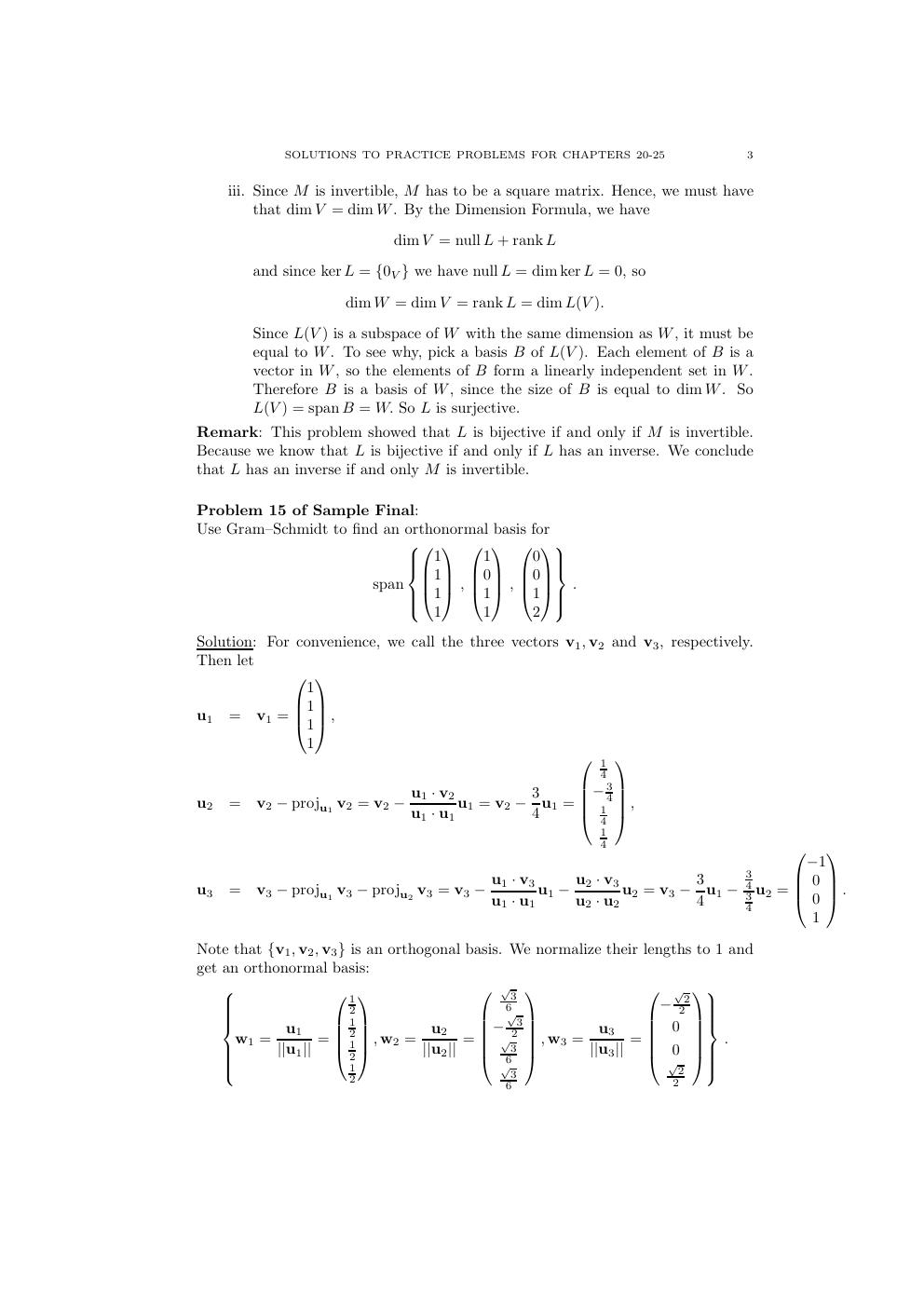
Solution: For convenience, we call the three vectors v1, v2 and v3, respectively.
Then let
u1 = v1 =
1 1 1 1
,
u2 = v2 - proju1 v2 = v2 -
u1 · v2
u1 · u1
u1 = v2 -
3 4
u1 =
1 4 -
3 4
1 4 1 4
,
u3 = v3 - proju1 v3 - proju2 v3 = v3 -
u1 · v3
u1 · u1
u1 -
u2 · v3
u2 · u2
u2 = v3 -
3 4
u1 -
3 4 3 4
u2 =
-1
0 0 1
.
Note that {v1, v2, v3} is an orthogonal basis. We normalize their lengths to 1 and
get an orthonormal basis:
w1 =
u1
||u1|| =
1 2 1 2 1 2 1 2
, w2 =
u2
||u2|| =
√3
6
-
√3
2
√3
6 √
3
6
, w3 =
u3
||u3|| =
-
√2
2
0 0 √2 2
.
4 SOLUTIONS TO PRACTICE PROBLEMS FOR CHAPTERS 20-25
Problem 16 of Sample Final:
Let M be the matrix of a linear transformation L : V → W in given bases for V
and W. Fill in the blanks below with one of the following six vector spaces: V , W,
kerL, kerL⊥, imL, imL⊥.
(a) The columns of M span in the basis given for .
(b) The rows of M span in the basis given for .
Suppose
M =
1 2 1 3
2 1 -1 2
1 0 0 -1
4 1 -1 0
is the matrix of L in the bases {v1, v2, v3, v4} for V and {w1, w2, w3, w4} for W.
Find bases for kerL and imL. Use the dimension formula to check your result.
Solution:
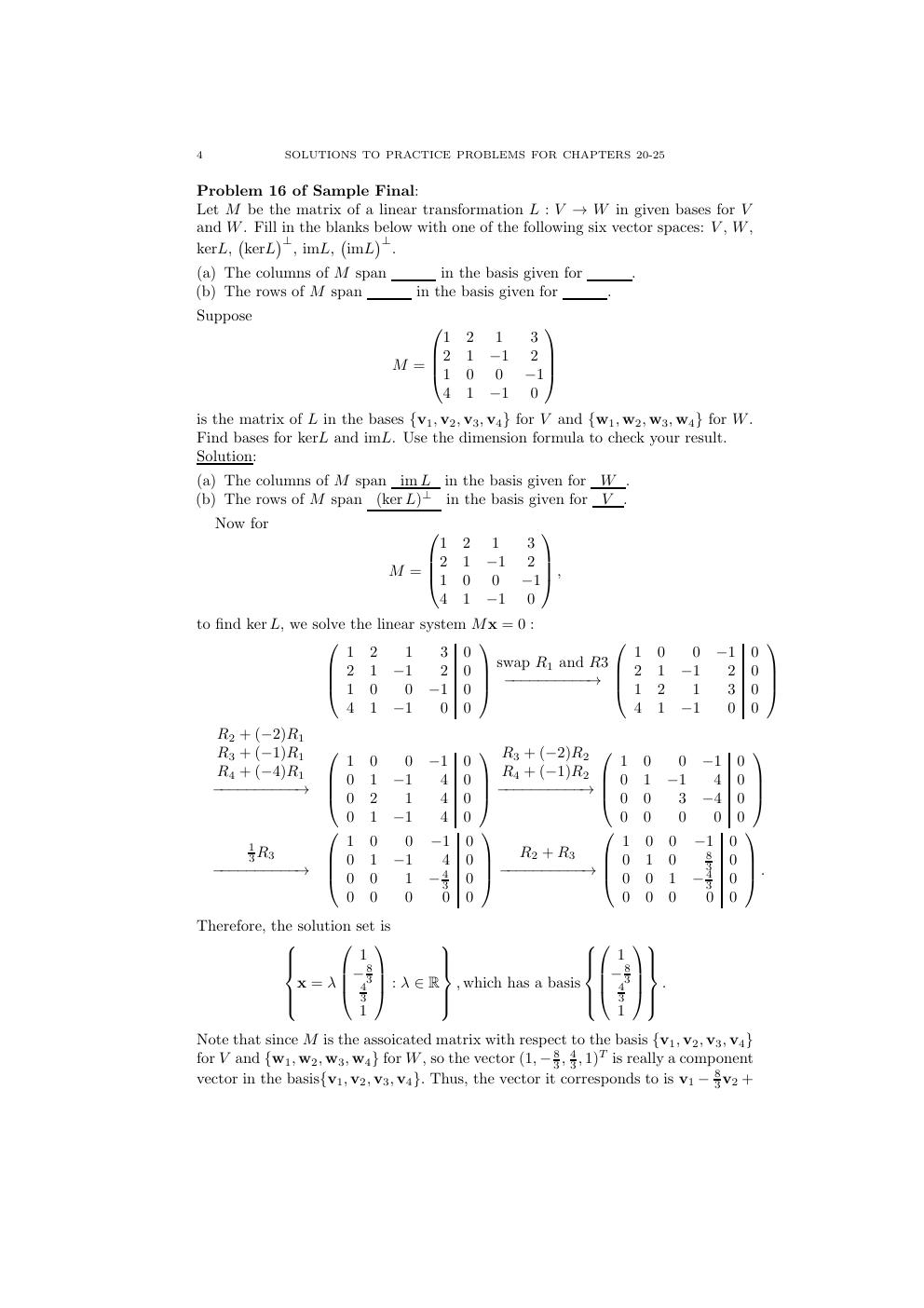
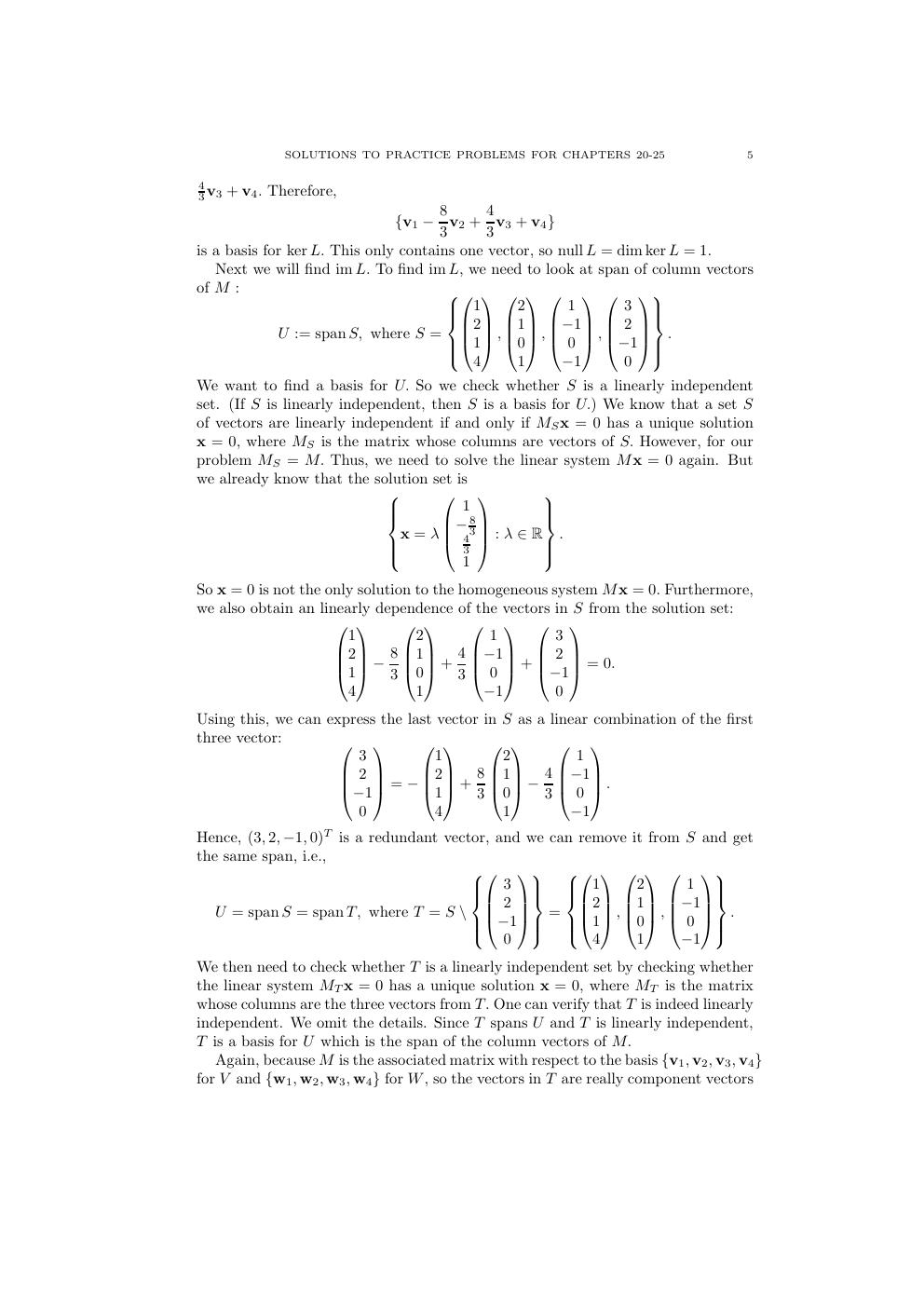
(a) The columns of M span im L in the basis given for W .
(b) The rows of M span (ker L)⊥ in the basis given for V .
Now for
M =
1 2 1 3
2 1 -1 2
1 0 0 -1
4 1 -1 0
,
to find ker L, we solve the linear system Mx = 0 :
[Show More]