·Question 1
4 out of 4 points
During the hot Texas summers, what percentage of municipal water supplies is often used for
watering lawns?
a.
40 percent
b.
14 percent
c.
65 percent
d.
25 percent
...
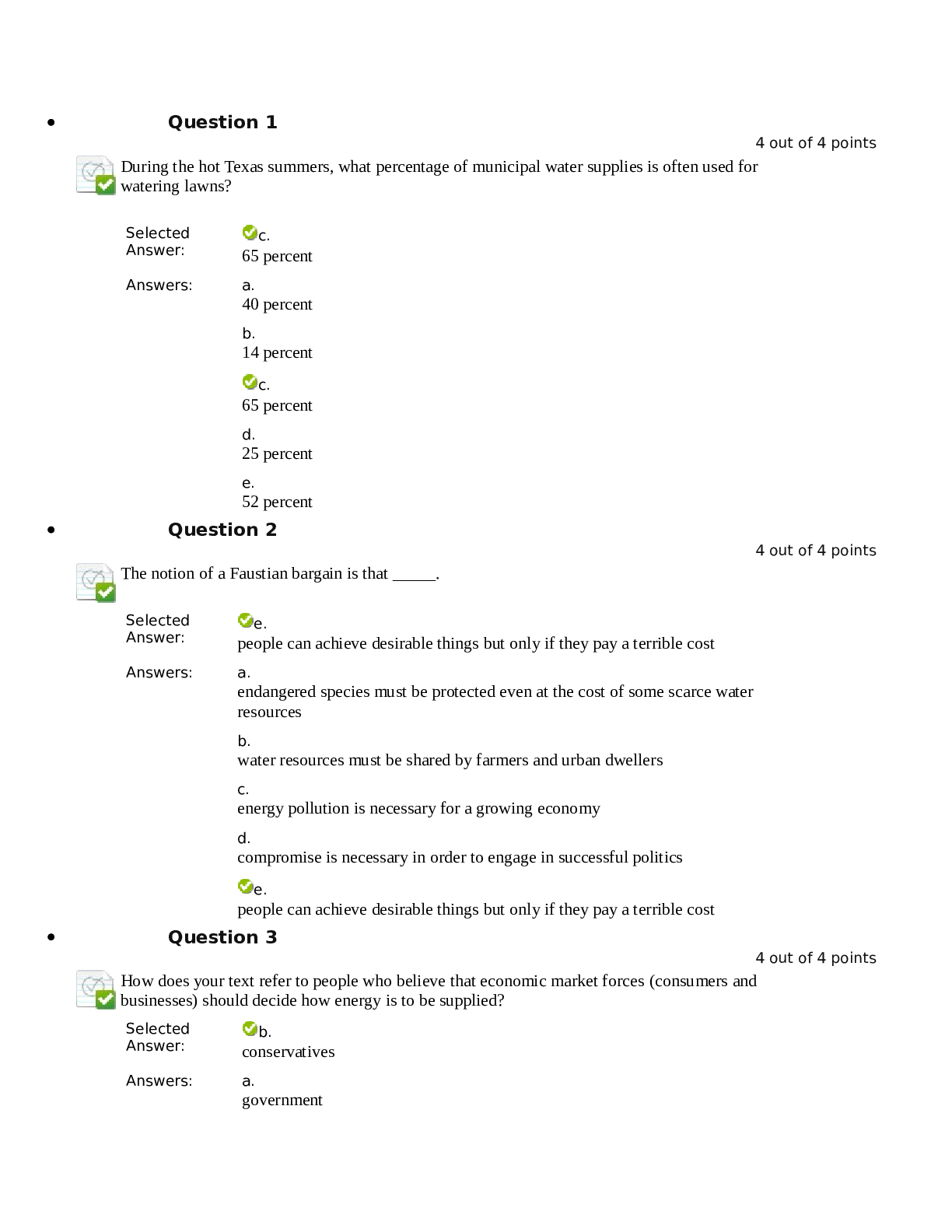
·Question 1
4 out of 4 points
During the hot Texas summers, what percentage of municipal water supplies is often used for
watering lawns?
a.
40 percent
b.
14 percent
c.
65 percent
d.
25 percent
e.
52 percent
·Question 2
4 out of 4 points
The notion of a Faustian bargain is that _____.
a.
endangered species must be protected even at the cost of some scarce water
resources
b.
water resources must be shared by farmers and urban dwellers
c.
energy pollution is necessary for a growing economy
d.
compromise is necessary in order to engage in successful politics
e.
people can achieve desirable things but only if they pay a terrible cost
·Question 3
4 out of 4 points
How does your text refer to people who believe that economic market forces (consumers and
businesses) should decide how energy is to be supplied?
a.
government
b.
conservatives
c.
environmentalists
d.
Texans
e.
liberals
·Question 4
4 out of 4 points
How does your text refer to people who believe the government should regulate and subsidize
the energy market to protect the environment and public safety, and to protect the country from
coercion by foreign governments?
a.
Texans
b.
conservatives
c.
liberals
d.
businesses
e.
government
·Question 5
4 out of 4 points
Which of these correctly identifies the peak of Texas oil production?
a.
turn of the twenty-first century
b.
the 1970s
c.
end of World War I
d.
around 2025
e.
the 1950s
·Question 6
4 out of 4 points
Why is Texas’s oil industry likely to continue to be a major force in the state and national
economies?
a.
Texas still possesses just under a quarter of all U.S. reserves of crude oil.
b.
Refineries in the Houston area make up the largest refining complex in the
country.
c.
Texas’s Gulf Coast refineries account for more than a quarter of the nation’s
refining capacity.
d.
Texas has about 28 percent of all the country’s producing wells.
e.
All of these are reasons why Texas is likely to remain a major force.
·Question 7
4 out of 4 points
Which of these is not a major advantage of oil as a source of energy?
a.
It is relatively cheap.
b.
It is relatively easy to transport (through pipelines).
c.
The state and nation possesses a wealth of infrastructure (refineries, pipelines,
and gas stations) that make it easy to use oil for energy needs.
d.
It is an important driver of the Texas economy.
e.
We are dependent on it and often must rely on oil found in politically unstable
regions of the world.
·Question 8
4 out of 4 points
When the term Faustian bargain is applied in the text's discussion of the oil and natural gas
industries, it refers to the idea that _____.
a.
the price of oil in a technical, short-term sense is low, but the price in a broad,
difficult-to-define, long-term environmental sense is high
b.
the state must make tradeoffs between the oil industry and the natural gas
industry
c.
the state must plan to transition to other industries as it runs out of oil and natural
gas
d.
the state's tax structure overrelies on taxes from the oil and natural gas industries
e.
all of these
·Question 9
4 out of 4 points
Pumping water, sand, and chemicals into the ground to recover more oil or natural gas from the
ground is a technology called _____.
a.
pump-priming
b.
fracking
c.
flaring
d.
wildcat drilling
e.
Enhanced Recovery Technology (ERT)
·Question 10
4 out of 4 points
What advantages does natural gas have for the state of Texas?
a.
As a source of fuel for electric utilities, natural gas is a far cleaner source of
energy than coal is.
b.
Since Texas has such a large supply of natural gas, it will have a great deal of
control over policies governing the industry.
c.
Since Texas has such a large supply of natural gas, the supply of gas does
not depend on the stability of international politics.
d.
It is one of the cheapest sources of energy.
e.
All of these are advantages.
·Question 11
4 out of 4 points
Which of these best describes the "Faustian bargain" when discussing natural gas?
a.
Texas produces roughly 30 percent of the nation’s total natural gas used, but most
of Texas's natural gas is used in other states.
b.
Although natural gas is cheaper and cleaner than other energy sources, it is
extremely explosive and there are serious concerns about pollution.
c.
Natural gas is a hydrocarbon that releases greenhouse gases and other pollutants
when burned.
d.
Natural gas is cheaper than oil but has more environmental side effects.
e.
Natural gas is dirtier and more expensive than sources of renewable energy.
·Question 12
4 out of 4 points
Which energy resource is predicted to be the least costly per kilowatt hour in 2016?
a.
wind
b.
geothermal
c.
nuclear
d.
solar
e.
natural gas
·Question 13
4 out of 4 points
Which of these is not an argument for the use of coal to provide energy for Texas?
a.
It does not explode like natural gas or melt down and release radioactivity
like uranium.
b.
Instead of bringing up the coal from underground, companies may choose
to “strip mine.”
c.
It is cheap to mine, transport, and burn.
d.
Within the borders of the United States lies enough coal to power the country
for centuries.
e.
Americans who rely on burning coal for their energy need never worry about
having their supply disrupted by a hostile foreign government.
·Question 14
4 out of 4 points
If coal were to be made in a more environmentally friendly manner, would that make it better
for Texas?
a.
No, because current technology does not exist to make coal "cleaner."
b.
Yes, because it would compete with other fossil fuels and drive energy prices
lower.
c.
No,because it is so expensive to make coal cleaner that the costs would erase the
reason people chose it in the first place.
d.
Yes, because most of the coal mined in Texas is lignite, the highest grade of coal.
e.
Yes, because Texas consumes more coal than any of the other forty-nine states,
and Texas would import less of it from Wyoming.
·Question 15
4 out of 4 points
Most of the coal mined in Texas is of what variety?
a.
anthracite
b.
bituminous
c.
graphite
d.
stalagmite
e.
lignite
·Question 16
4 out of 4 points
The two nuclear energy plants in Texas, Comanche Peak and South Texas Nuclear Project,
produce what percentage of Texas electricity?
a.
90 percent
b.
25 percent
c.
48 percent
d.
10 percent
e.
70 percent
·Question 17
4 out of 4 points
Which of these is a major problem associated with nuclear power?
a.
Sources of nuclear fuel are, for the most part, only available in other nations, and
disposing of the radioactive waste by-products is difficult politically.
b.
It is a very dirty energy, throwing hydrocarbons into the air, and there is a
potential that a “meltdown” would release radioactivity into the air.
c.
There is a potential that a “meltdown” would release radioactivity into the air,
and disposing of the radioactive waste by-products is difficult politically.
d.
It is a very dirty energy, throwing hydrocarbons into the air, and sources of
nuclear fuel are, for the most part, only available in other nations.
e.
There is a potential that a “meltdown” would release radioactivity into the air,
and sources of nuclear fuel are, for the most part, only available in other nations.
·Question 18
0 out of 4 points
Which of these best explains the benefits of nuclear power?
a.
It is cheap and produces little pollution.
b.
The supply of nuclear power can be made stable, and international politics will not
affect the supply, since the system does not rely on external resources.
c.
The storage of radioactive waste is relatively easy to achieve.
d.
It is cheap and produces little pollution, the supply of nuclear power can be made
stable, and international politics will not affect the supply, since the system does
not rely on external resources.
e.
It is cheap and produces little pollution; the supply of nuclear power can be made
stable; international politics will not affect the supply, since the system does not
rely on external resources; and the storage of radioactive waste is relatively easy to
achieve.
·Question 19
4 out of 4 points
What is meant by the term renewables?
a.
nuclear power
b.
the continuing damage done to land and water from fracking
c.
the contracts that consumers have with energy companies to deliver the
consumers' electricity
d.
sources of energy that come directly from nature, such as power from wind and
the sun
e.
a renewed debate between citizens as to the environmental impact of oil and
natural gas
·Question 20
4 out of 4 points
Of renewable energy sources, which is the most realistic short-term alternative to
nonrenewables?
a.
wind
b.
ocean tidal
c.
natural gas
d.
geothermal
e.
solar
·Question 21
4 out of 4 points
What is the best assessment of the "Faustian bargain" when it comes to wind and solar energy?
a.
Texans, as citizens, prefer to invest in the oil and gas industry.
b.
The advantages of using energy with little air or water pollution may not be
worth the high price of wind and solar energy.
c.
Texas has invested too much in the infrastructure of the oil and gas industry.
d.
Because they rely on nature, wind and solar energy are inexpensive forms of
energy.
e.
Wind and solar energy are based upon the weather.
·Question 22
4 out of 4 points
Why don't state and federal governments force people to be more efficient in their use of
energy?
a.
Taxes that would discourage energy use are regressive taxes, which hit poor and
middle-class people the hardest.
b.
People resent taxes, so elected leaders are unlikely to support them.
c.
Regulations and subsidies may not work well enough to encourage people to
change their energy use.
d.
Many consumers and businesses, especially in Texas, do not support
government intervention in the economy.
e.
All of these are reasons.
·Question 23
4 out of 4 points
The line, extending roughly between the eastern edge of the Panhandle down to the Rio Grande
northwest of Laredo and marking the area where agriculture is not possible without irrigation, is
the _____ meridian.
a.
120th
b.
80th
c.
110th
d.
100th
e.
90th
·Question 24
4 out of 4 points
In terms of water supply over the last twenty years in Texas, _____.
a.
there have been severe and repeated droughts
b.
there has been severe and repeated flooding
c.
during any given year, it has been almost possible to predict with confidence
that there would be too
much or not enough water in Texas
d.
all of these
e.
none of these
·Question 25
4 out of 4 points
In Texas, surface water is controlled by _____ while underground water is controlled by _____.
a.
public authorities; the person or business that owns the land above it
b.
state and local authorities; the federal government
c.
whomever owns the land around it or above it; whomever owns the land
around or above it
d.
state and local authorities; state authorities
e.
individuals or businesses; state authorities
[Show More]