1.
2. ____ drill motors are are recommended for use on projects around flammable materials. Pneumatic
3. ___ powered drill motors pose a fire hazard due to sparks. Electric
4. 'Smiley faces' are caused when: the r
...
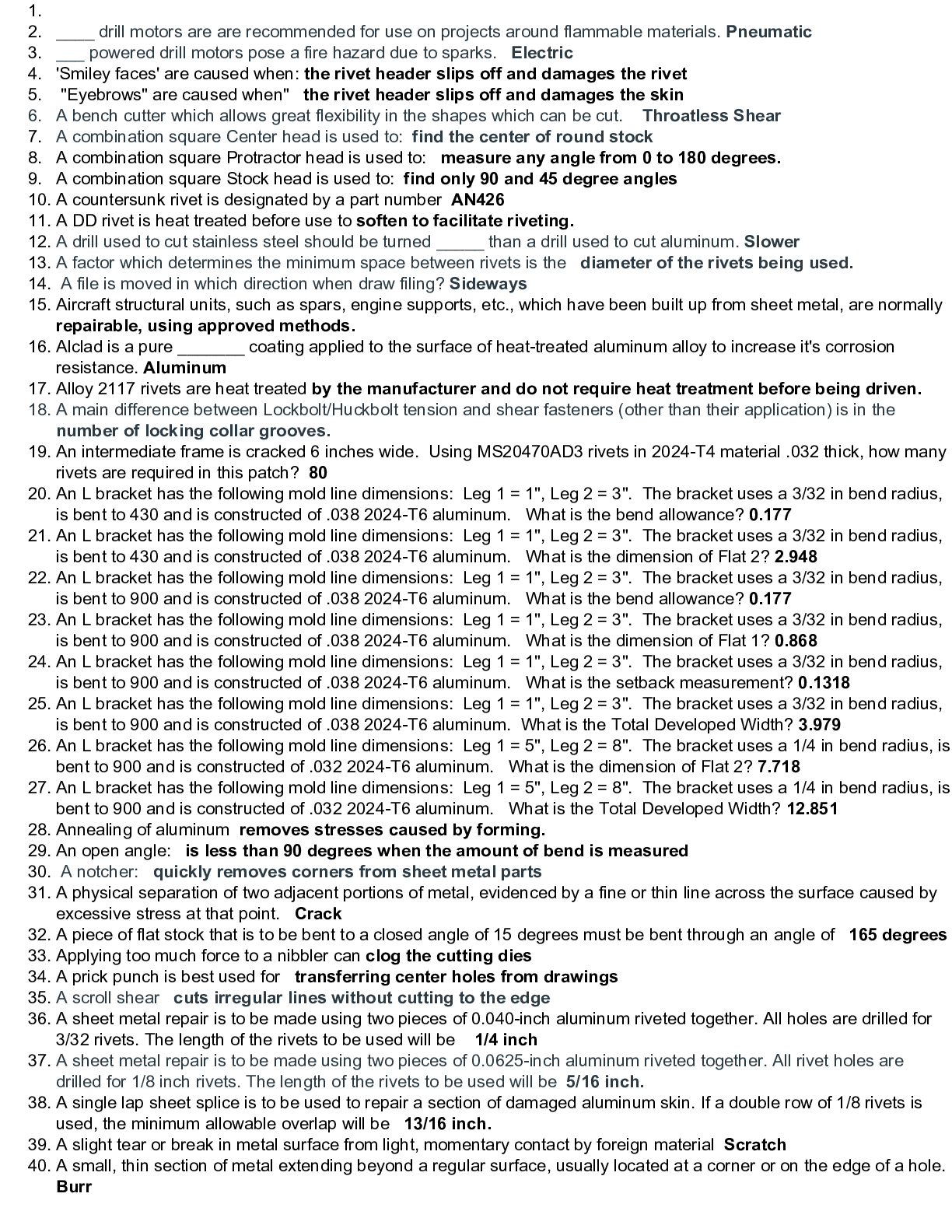
1.
2. ____ drill motors are are recommended for use on projects around flammable materials. Pneumatic
3. ___ powered drill motors pose a fire hazard due to sparks. Electric
4. 'Smiley faces' are caused when: the rivet header slips off and damages the rivet
5. "Eyebrows" are caused when" the rivet header slips off and damages the skin
6. A bench cutter which allows great flexibility in the shapes which can be cut. Throatless Shear
7. A combination square Center head is used to: find the center of round stock
8. A combination square Protractor head is used to: measure any angle from 0 to 180 degrees.
9. A combination square Stock head is used to: find only 90 and 45 degree angles
10. A countersunk rivet is designated by a part number AN426
11. A DD rivet is heat treated before use to soften to facilitate riveting.
12. A drill used to cut stainless steel should be turned _____ than a drill used to cut aluminum. Slower
13. A factor which determines the minimum space between rivets is the diameter of the rivets being used.
14. A file is moved in which direction when draw filing? Sideways
15. Aircraft structural units, such as spars, engine supports, etc., which have been built up from sheet metal, are normally
repairable, using approved methods.
16. Alclad is a pure _______ coating applied to the surface of heat-treated aluminum alloy to increase it's corrosion
resistance. Aluminum
17. Alloy 2117 rivets are heat treated by the manufacturer and do not require heat treatment before being driven.
18. A main difference between Lockbolt/Huckbolt tension and shear fasteners (other than their application) is in the
number of locking collar grooves.
19. An intermediate frame is cracked 6 inches wide. Using MS20470AD3 rivets in 2024-T4 material .032 thick, how many
rivets are required in this patch? 80
20. An L bracket has the following mold line dimensions: Leg 1 = 1", Leg 2 = 3". The bracket uses a 3/32 in bend radius,
is bent to 430 and is constructed of .038 2024-T6 aluminum. What is the bend allowance? 0.177
21. An L bracket has the following mold line dimensions: Leg 1 = 1", Leg 2 = 3". The bracket uses a 3/32 in bend radius,
is bent to 430 and is constructed of .038 2024-T6 aluminum. What is the dimension of Flat 2? 2.948
22. An L bracket has the following mold line dimensions: Leg 1 = 1", Leg 2 = 3". The bracket uses a 3/32 in bend radius,
is bent to 900 and is constructed of .038 2024-T6 aluminum. What is the bend allowance? 0.177
23. An L bracket has the following mold line dimensions: Leg 1 = 1", Leg 2 = 3". The bracket uses a 3/32 in bend radius,
is bent to 900 and is constructed of .038 2024-T6 aluminum. What is the dimension of Flat 1? 0.868
24. An L bracket has the following mold line dimensions: Leg 1 = 1", Leg 2 = 3". The bracket uses a 3/32 in bend radius,
is bent to 900 and is constructed of .038 2024-T6 aluminum. What is the setback measurement? 0.1318
25. An L bracket has the following mold line dimensions: Leg 1 = 1", Leg 2 = 3". The bracket uses a 3/32 in bend radius,
is bent to 900 and is constructed of .038 2024-T6 aluminum. What is the Total Developed Width? 3.979
26. An L bracket has the following mold line dimensions: Leg 1 = 5", Leg 2 = 8". The bracket uses a 1/4 in bend radius, is
bent to 900 and is constructed of .032 2024-T6 aluminum. What is the dimension of Flat 2? 7.718
27. An L bracket has the following mold line dimensions: Leg 1 = 5", Leg 2 = 8". The bracket uses a 1/4 in bend radius, is
bent to 900 and is constructed of .032 2024-T6 aluminum. What is the Total Developed Width? 12.851
28. Annealing of aluminum removes stresses caused by forming.
29. An open angle: is less than 90 degrees when the amount of bend is measured
30. A notcher: quickly removes corners from sheet metal parts
31. A physical separation of two adjacent portions of metal, evidenced by a fine or thin line across the surface caused by
excessive stress at that point. Crack
32. A piece of flat stock that is to be bent to a closed angle of 15 degrees must be bent through an angle of 165 degrees
33. Applying too much force to a nibbler can clog the cutting dies
34. A prick punch is best used for transferring center holes from drawings
35. A scroll shear cuts irregular lines without cutting to the edge
36. A sheet metal repair is to be made using two pieces of 0.040-inch aluminum riveted together. All holes are drilled for
3/32 rivets. The length of the rivets to be used will be 1/4 inch
37. A sheet metal repair is to be made using two pieces of 0.0625-inch aluminum riveted together. All rivet holes are
drilled for 1/8 inch rivets. The length of the rivets to be used will be 5/16 inch.
38. A single lap sheet splice is to be used to repair a section of damaged aluminum skin. If a double row of 1/8 rivets is
used, the minimum allowable overlap will be 13/16 inch.
39. A slight tear or break in metal surface from light, momentary contact by foreign material Scratch
40. A small, thin section of metal extending beyond a regular surface, usually located at a corner or on the edge of a hole.
Burr
[Show More]




.png)





.png)
.png)






.png)


