Purpose
The Review of Knowledge (ROK) focuses on course outcomes, unit outcomes and key concepts to enhance student success on exams. Use this document as a focused guide for study in conjunction with assigned reading
...
Purpose
The Review of Knowledge (ROK) focuses on course outcomes, unit outcomes and key concepts to enhance student success on exams. Use this document as a focused guide for study in conjunction with assigned readings, PowerPoint presentations, and other course resources. Supplement this document by outlining your own notes from the textbook chapters and place your expanded more detailed notes in the Student Notes column. This document should NOT be used as a substitute for completing the assigned readings.
Key Concepts Chapters Student Notes
Pharmacologic Chapter 2 Principles
Identify the 4 phases of pharmacokinetics, and explain briefly what occurs in each phase.
1. Absorption (p. 22-25)
2. Distribution (p.26)
3. Metabolism (p.27)
4. Excretion (p. 27-28)
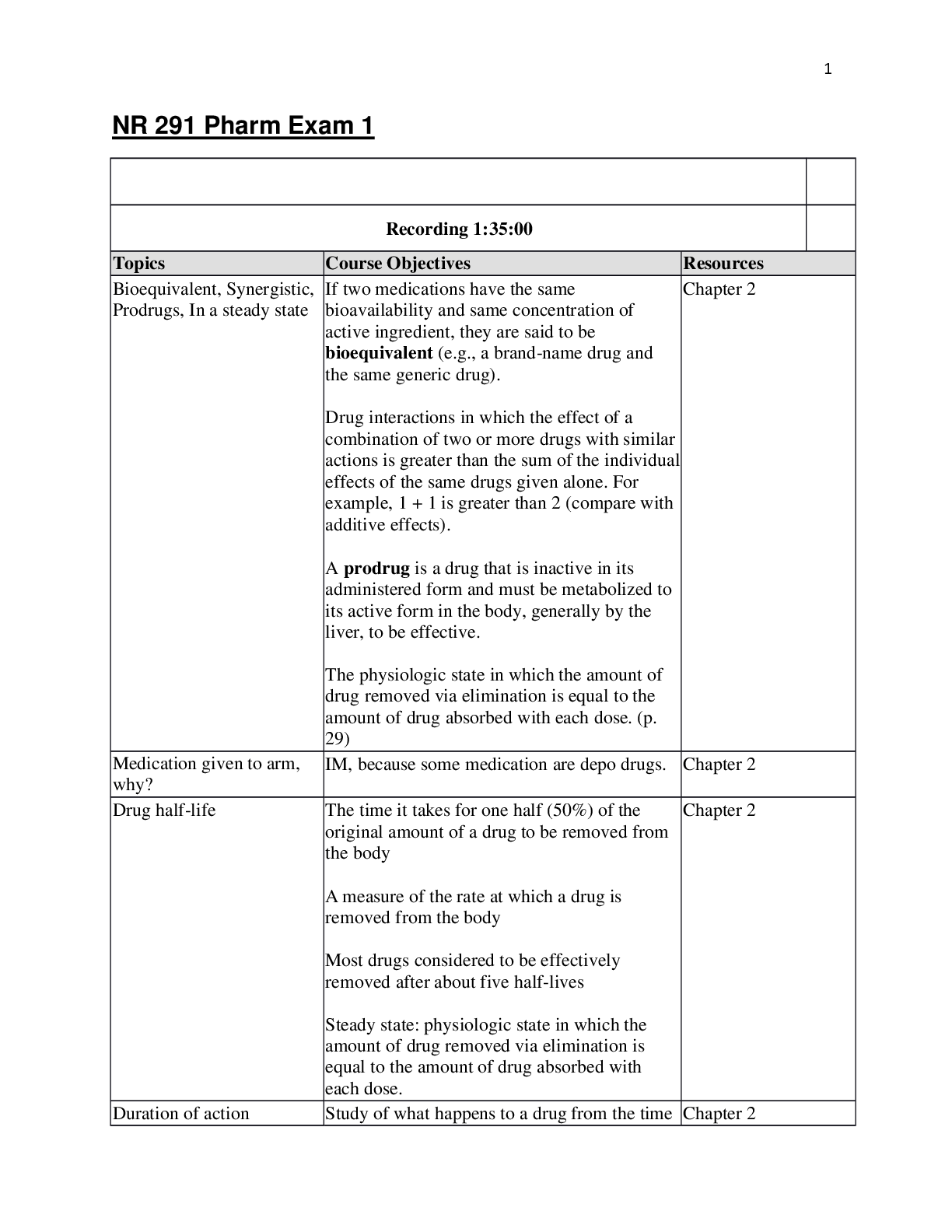
The half-life of a drug is the time required for one-half (50%) of a given drug to be removed from the body. It is a measure of the rate at which the drug is eliminated from the body. For instance, if the peak level of a particular drug is 100 mg/L & the measured drug level is 50 mg/L in 8 hours, then the estimated half-life of that drug is 8 hours. (Lilley, Collins, & Snyder, 2014, p. 28)
Fill in the boxes: 3 hours 6 hours 9 hours 12 hours
Half- life is 3
hours X dose 200 100 50 25 12.5
Drug
mg 250 125 62.5 31.25
Drug X dose 500
mg
Route of Administration: The parenteral route is the fastest route by which a drug can be absorbed, followed by the enteral and topical routes. Parenteral is a general term meaning any route of administration other than the GI tract. It most commonly refers to injection. Intravenous injection delivers the drug directly.into the circulation, where it is distributed with the blood throughout the body. Drugs given by intramuscular injection and subcutaneous injection are absorbed more slowly than those given intravenously.
ROUTE Examples of Formulations
Enteral Tablets, capsules, oral soluble wafers, pills, timed- release capsules, timed-release tablets, elixirs, suspensions, syrups, emulsions, solutions, lozenges or troches, rectal suppositories, sublingual or buccal tablets
Parente Injectable forms, solutions, suspensions, emulsions, powders for reconstitution ral
Topical Aerosols, ointments, creams, pastes, powders, solutions, foams, gels, transdermal patches, inhalers, rectal and vaginal suppositories
Why can’t extended release or enteric coated oral medications be crushed? “could cause accelerated release of drug from the dosage form and possible toxicity” (Lilley et al., p. 21)
How can you help a client who has swallowing difficulties take their oral medication? “The ability to crush a tablet or open a capsule can facilitate drug administration when patients are unable or unwilling to swallow a tablet or capsule and also when medications need to be given through an enteral feeding tube. Capsules, powder, or liquid contents can often be added to soft foods such as applesauce or pudding, or dissolved in a beverage. Granules contained in capsules are usually for extended drug release and normally should not be crushed or chewed by the patient. However, they can often be swallowed when sprinkled on one of the soft foods. Consultation with a pharmacist, reading the product literature, or use of other suitable source is necessary if any question exists as to whether a drug can be crushed or mixed with specific food or beverages”. (Lilley, et al. pg 21)
[Show More]