Lesson 1- Ethics, Bioethics, and Theology: Exploring the Basics
What is Ethics?
Socrates asked practical questions not theoretical – “what ought one to do?”
Ethical deliberations basic questions
Example: on cro
...
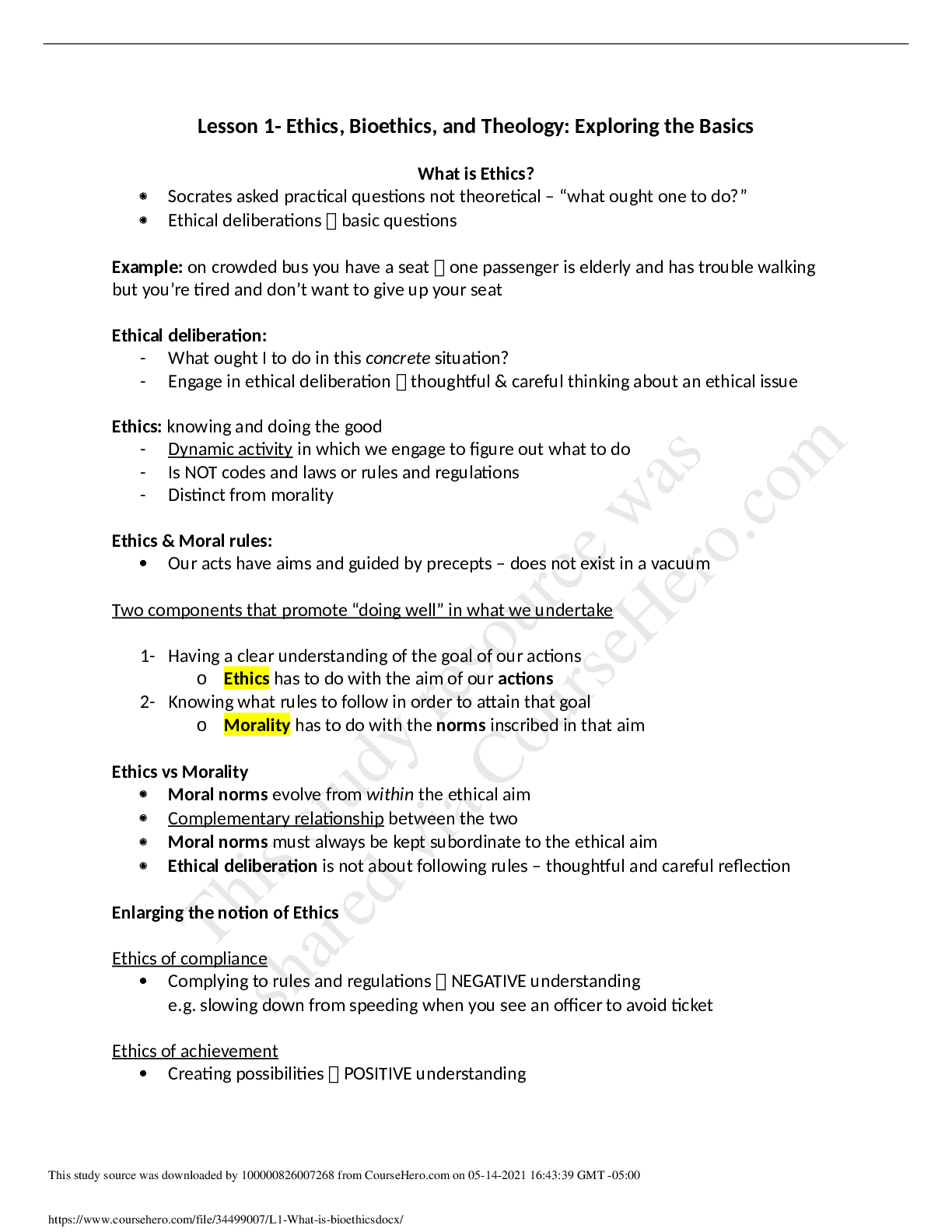
Lesson 1- Ethics, Bioethics, and Theology: Exploring the Basics
What is Ethics?
Socrates asked practical questions not theoretical – “what ought one to do?”
Ethical deliberations basic questions
Example: on crowded bus you have a seat one passenger is elderly and has trouble walking
but you’re tired and don’t want to give up your seat
Ethical deliberation:
- What ought I to do in this concrete situation?
- Engage in ethical deliberation thoughtful & careful thinking about an ethical issue
Ethics: knowing and doing the good
- Dynamic activity in which we engage to figure out what to do
- Is NOT codes and laws or rules and regulations
- Distinct from morality
Ethics & Moral rules:
Our acts have aims and guided by precepts – does not exist in a vacuum
Two components that promote “doing well” in what we undertake
1- Having a clear understanding of the goal of our actions
o Ethics has to do with the aim of our actions
2- Knowing what rules to follow in order to attain that goal
o Morality has to do with the norms inscribed in that aim
Ethics vs Morality
Moral norms evolve from within the ethical aim
Complementary relationship between the two
Moral norms must always be kept subordinate to the ethical aim
Ethical deliberation is not about following rules – thoughtful and careful reflection
Enlarging the notion of Ethics
Ethics of compliance
Complying to rules and regulations NEGATIVE understanding
e.g. slowing down from speeding when you see an officer to avoid ticket
Ethics of achievement
Creating possibilities POSITIVE understanding
This study source was downloaded by 100000826007268 from CourseHero.com on 05-14-2021 16:43:39 GMT -05:00
https://www.coursehero.com/file/34499007/L1-What-is-bioethicsdocx/
This study resource was
shared via CourseHero.com
e.g. the purpose of speeding limits? The goal is not the limitation but the achievement
of a safe driving experience
Ethics as heuristic
Heuristic: from ancient Greek meaning “to find”
-related to word EUREKA!
Concrete experience guided by moral norms (laws rules…) decision
Moral Horizon
Physical horizon – the limit or boundary of your world
Moral horizon – what is important to you
-largely inherited from culture, family etc…
-contains mistakes (we are immersed in it so unaware of it)
-can expand with experience
What is Bioethics?
Bioethics: a branch of ethics that investigates problems arising from healthcare, medicine, and
biological sciences and related technology
Both an academic discipline and a professional practice
A dialogue involving a multitude of voices
Tool that facilitates thinking about how best to make decisions in the context of
medicine and the life sciences (biology, biochemistry, biotechnology)
Subfield of broader field of ethics
Prefix “bio” focuses one on the life sciences in exploring the “good”
Clinical Ethics: bioethics in a clinical setting – bioethics moves into wards in hospitals and into
clinics
The systematic, critical, reasoned evaluation and justification of right and wrong, good
and evil in clinical practice
The study of the kinds of person’s healthcare professionals ought or ought not to
become
Encounter between healthcare professionals and patient (and family)
Wider than “medical ethics” concerns also nurses, physicians assistants, dentists,
psychologists, other healthcare practitioners
Activities of clinical ethics:
- Ethics consultations
- Education
- Policy development and review
- Research ethics and ethics research
This study source was downloaded by 100000826007268 from CourseHero.com on 05-14-2021 16:43:39 GMT -05:00
https://www.coursehero.com/file/34499007/L1-What-is-bioethicsdocx/
This study resource was
shared via CourseHero.com
Historical background to bioethics
Problem or a dilemma always underlies ethical questions
Emergence of discipline in the 1960s
Born from challenges posed by scientific and technological breakthroughs and “loss” of
traditional authority
Bioethics emerged out of this authority vacuum
“discoveries and applications began to outpace our ability to reflect on them, and
everyone was reeling from the biological revolution.”
“They decide who lives, who dies”
How to choose who lives and who dies with first dialysis machine
Criteria: age, gender, marital status, number of dependents, income, future potential,
references etc..
Committee was nicknamed “the god committee
First human heart transplant – Dr. Christiaan Barnard (1967)
Prominent Canadian Cases
1980 Decision-Removed consent from reasonable physician’s standard to reasonable
patient standard focused on what would a reasonable patient needs to know to make
a decision?
The matter of Stephen Dawson (1983)
The 1986 Case of Eve
Nancy B. 1992
Dialectic between Potential and Concern
Each application/breakthrough in science raises as many problems as it solves
Human Genome Project
Completed in 2003 – the international genome sequencing consortium was completed
Increased ability to understand and treat diseases
New challenges in delivery to healthcare
Genetic testing for late onset diseases is different because it provides diagnosis with late
onset “not yet ill” social category
Nanotechnology
Study and application of extremely small things that can be used across all other science
fields
What does theology have to do with bioethics?
Issues theology might raise in bioethics:
Human dignity
This study source was downloaded by 100000826007268 from CourseHero.com on 05-14-2021 16:43:39 GMT -05:00
https://www.coursehero.com/file/34499007/L1-What-is-bioethicsdocx/
This study resource was
shared via CourseHero.com
Meaning of suffering
Biological determinism and the problem of freedom
What it means to be human
Common good
-human beings are intrinsically social and so there is a moral imperative to promote the
common good
-theological reverence for the dignity of every human person serves the common good
regardless of political, social and religious concerns
-ethics is about the good we build and sustain with others
-theology and bioethics thus both recognize the interconnectedness of the dignity of the
human person and the common good
-Christian social teachings stems from a theory of justice founded on recognition of humanities
essential relatedness bioethics shares same recognition of an essential relatedness
Theological Questions
In reflecting on how we have structured our societies and our global order, how might
we consider these social structures from a perspective that transcends self-interest and
even the interest of a particular social order?
How do we transcend our biases to evaluate societal and global social structures and to
discern whether, in the long term, they are promoting progress or decline? How is this
impacting both individuals and society?
How do we promote this level of analysis in a global order that shapes our
understanding of what it means to be human and what our responsibility is toward
others?
Readings
“Theology’s Role in Public Bioethics” – Lisa Sowle Cahill
- secular bioethics can work to exclude religious groups (37)
-secular sphere is not neutral – all participants come from communities of identity
-liberals shy away from life affirming values found in religious communities one reason why
Bush won (39)
-theology helps establish a moral point of view in which certain attitudes and dispositions
inform the debate e.g. attitude of respect for God and human life (54)
[Show More]






.png)
.png)

