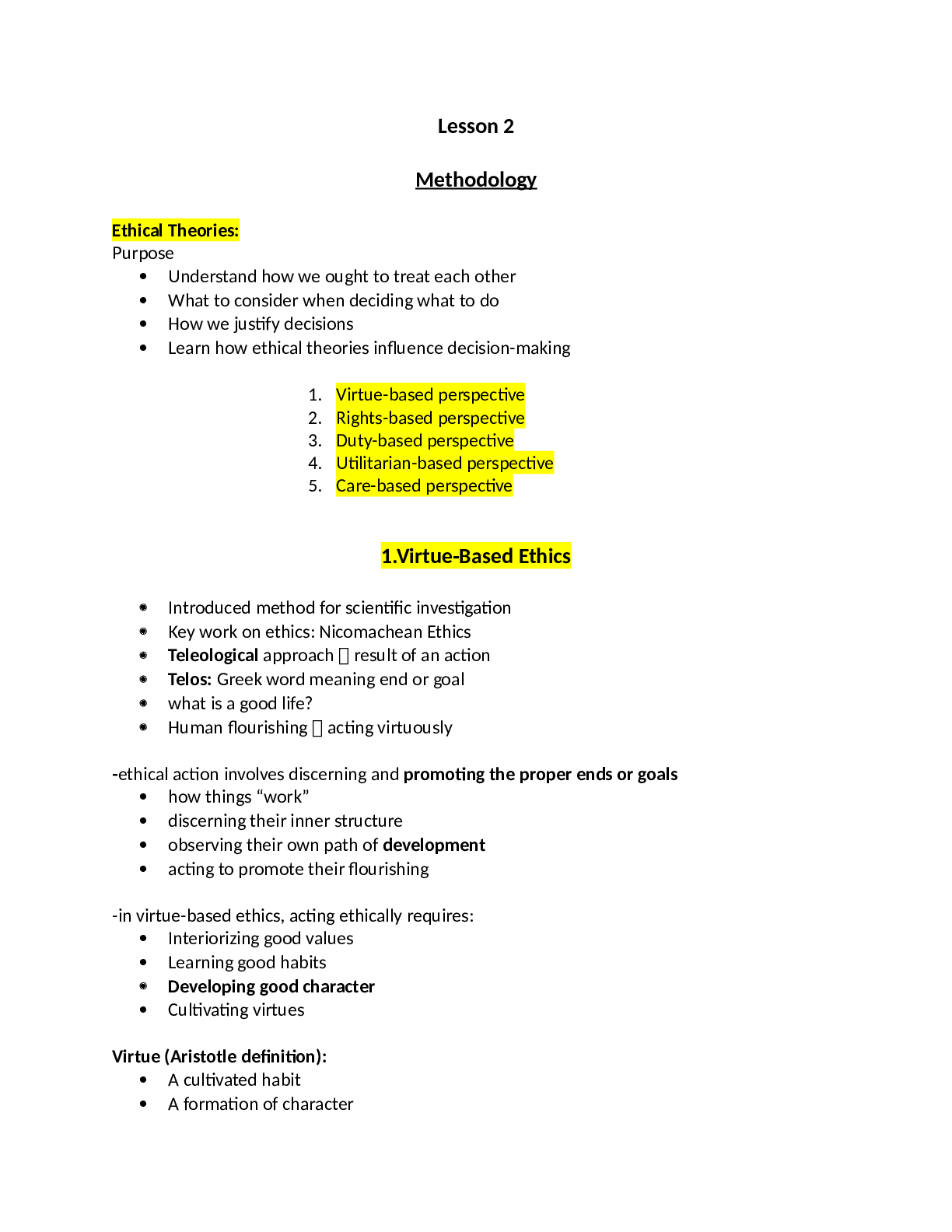
Ethical Theories:
Purpose
Understand how we ought to treat each other
What to consider when deciding what to do
How we justify decisions
Learn how ethical theories influence decision-making
1. Virtue-based
...
Ethical Theories:
Purpose
Understand how we ought to treat each other
What to consider when deciding what to do
How we justify decisions
Learn how ethical theories influence decision-making
1. Virtue-based perspective
2. Rights-based perspective
3. Duty-based perspective
4. Utilitarian-based perspective
5. Care-based perspective
1.Virtue-Based Ethics
Introduced method for scientific investigation
Key work on ethics: Nicomachean Ethics
Teleological approach result of an action
Telos: Greek word meaning end or goal
what is a good life?
Human flourishing acting virtuously
-ethical action involves discerning and promoting the proper ends or goals
how things “work”
discerning their inner structure
observing their own path of development
acting to promote their flourishing
-in virtue-based ethics, acting ethically requires:
Interiorizing good values
Learning good habits
Developing good character
Cultivating virtues
Virtue (Aristotle definition):
A cultivated habit
A formation of character
A type of habitual dedication that enables us and directs us
o To be attentive & good
o To care for it
o To understand it
o To act in an informed and responsible way
The Golden Mean
Middle way between extremes of excess & deficiency
States of character finding expression in purpose & action
Virtue is deliberate & involves appropriate emotional responses
The intermediate depends on the situation, not an exact science
“What should I do?”
Refers to one’s character
What promotes the development of virtue throughout a person’s life
Strengths:
Insistence on careful reflection
Balanced outcome
Recognize the limitations of human acting
Promotes development of virtue throughout person’s life
Limitations:
Strangers must rely on rules & obligations, not character evaluation
Evaluating ones’ character seems trivial when faced with immediate, challenging
decisions
Insufficiency of virtue – good people with good intentions can perform wrong actions
2.Rights-Based Ethics
Jean-Jaques Rousseau & John Locke
Response to unjust class structures and authoritarian rule
Rights are understood to be “natural rights” of all human beings
Allow everybody full liberty & full participation in society
Paved way to American Revolution & French Revolution
The universal declaration of human rights bases itself on rights-based ethics
Rights-based ethics of John Locke
Highest faculty is reason
o Natural rights to use it to determine how we will live
Use reason to establish and live according to social contracts
Social contracts allow us to
o Design own customs, rules, traditions, social structures
Agreement to hand-over some natural rights to the state to guarantee liberty against
intrusion by others
The Two Spheres of Rights-Based Ethics
The Public:
Rights prevail
Obligation is to avoid infringing on the rights of others
Enforced by courts of law
The Private:
Goal of rights in public realm ensures maximal liberty for our own personal ethical &
religious convictions
“What should I do?”
What are my rights?
In bioethics there is a correlation between rights and human dignity
o Human dignity based on right to live as we choose as long as it does not interfere
with others
Limitations:
Extreme individualism
Focus on the individual at expense of community
Adversarial nature of rights
3.Duty-Based Ethics
Immanuel Kant
Concerned with “the search for a single supreme principle of morality”
Non-religious ground for duty
o Duty-centred ethics
Duty comes from rational capacity
Cornerstone to morality is freedom
o We are free
o We have free will to choose how to act
o We are accountable and responsible for our actions
Source of duties and obligation is human reason
o Our capacity for reason “commands” us to act in a responsible manner
Deontological ethics
Deon: Greek word for duty
Ethics is understood as:
o Personal duty
o Obligation
o Individual conviction
o Rational decision making
Rooted in the private realm
Identified with inner, individual life of:
o Personal conviction
o Rational autonomy
Kant’s Two Categorical Imperatives
-our duty is to act according to principles that must be applicable to all.
Categorical imperatives:
1. Principle of Universality: act only in accordance with the maxim through which you can
at the same time will that it become a universal law
Intention of action, not consequence
Concern is with what our will is intending
Consistency of willing
Consistent = rational
Rationality is the origin of morality
2. Principle of Autonomy: respect of others “never act in such a way as to treat humanity,
whether in ourselves or in others, as a means only but always as an end in itself”
Dignity is grounded in autonomy
“There is nothing it is possible to think of anywhere in the world, or indeed anything at all
outside it, that can be held to be good without limitation, excepting only a good will.”
Deontological Ethics
“What should I do?”
Consider the problem in light of the prior, fixed (rational) criteria
Is this something that everyone should be allowed to do in every case?
The good is what can be universally applied
Dignity of the person is paramount
Limitations:
Conflicting obligation
Overemphasis on law, under emphasis on relationships
Contradiction between will and actions, not black and white
Abstract and impractical
Sometimes the best intentions can lead to the worst outcomes
4.Consequence-Based Ethics
John Stuart Mill
-Utilitarian Ethics or Teleological Ethics
o Humans naturally tend to pursue personal happiness
o However social life requires common action
o Obligation:
o Pursue the greatest good for the greatest number
Utilitarian Ethics
-judges the moral worth of actions in terms of the consequences of those actions
point of preference- consequences of an action
if the consequence of an action is the source drawn on to make a decision at an
individual level, the criterion is happiness
If the end result promotes happiness, then it is good
The ethical act is what brings about happiness
Ethics has to do with personal preference
Utilitarianism: an expression of personal preference
Individual action is right if it increases happiness more than unhappiness
Cost-Benefit analysis
What will it cost?
What is the benefit?
Does the benefit outweigh the cost?
What should I do?
What is wanted?
What most satisfies ones’ desire?
How efficiently can I get it?
The good is what maximizes the satisfaction of personal desire or social goals
Limitations:
Who determines the good?
How is the good decided?
Majority interests outweighs minority – tends to exclude most vulnerable
Sometimes horrible actions can lead to positive results – for example, does murdering a
brutal dictator justify murder?
5.Care-Based Ethics
Carol Gilligan & Nel Noddings
Most contemporary ethical tradition
Feminist thinkers
Focused on female ways of moral knowing
Women operate out of a different set of values
Relationship-based reasoning
Care-based ethics
-challenge abstract forms of reasoning
-communitarian in nature
-allows for uniqueness of individuals
-focus on responsiveness in an interconnected network of need, care, and prevention of harm
-sees caring as the ethical ideal
-need to focus attention on the concrete needs of those close to us
-no core principles
Mothering is not a role, but a relationship
Caring simply because of duty has an impersonal dimension
Acting out of duty is different than acting out of love and care
Christian ethics, which promotes universal love, is rejected by care-based ethics
o How can we possibly care for all human beings?
o Universal ethics is seen as just another abstraction
“What should I do?”
Must focus on the concrete needs of those we love and care for
Limitations:
Ethics needs to:
Go beyond the face-to-face encounter to involve appeals to justice
Complement moral sentiment with reason
[Show More]





















.png)
.png)

