NURSING FN NURS 6640 FINAL
EXAM
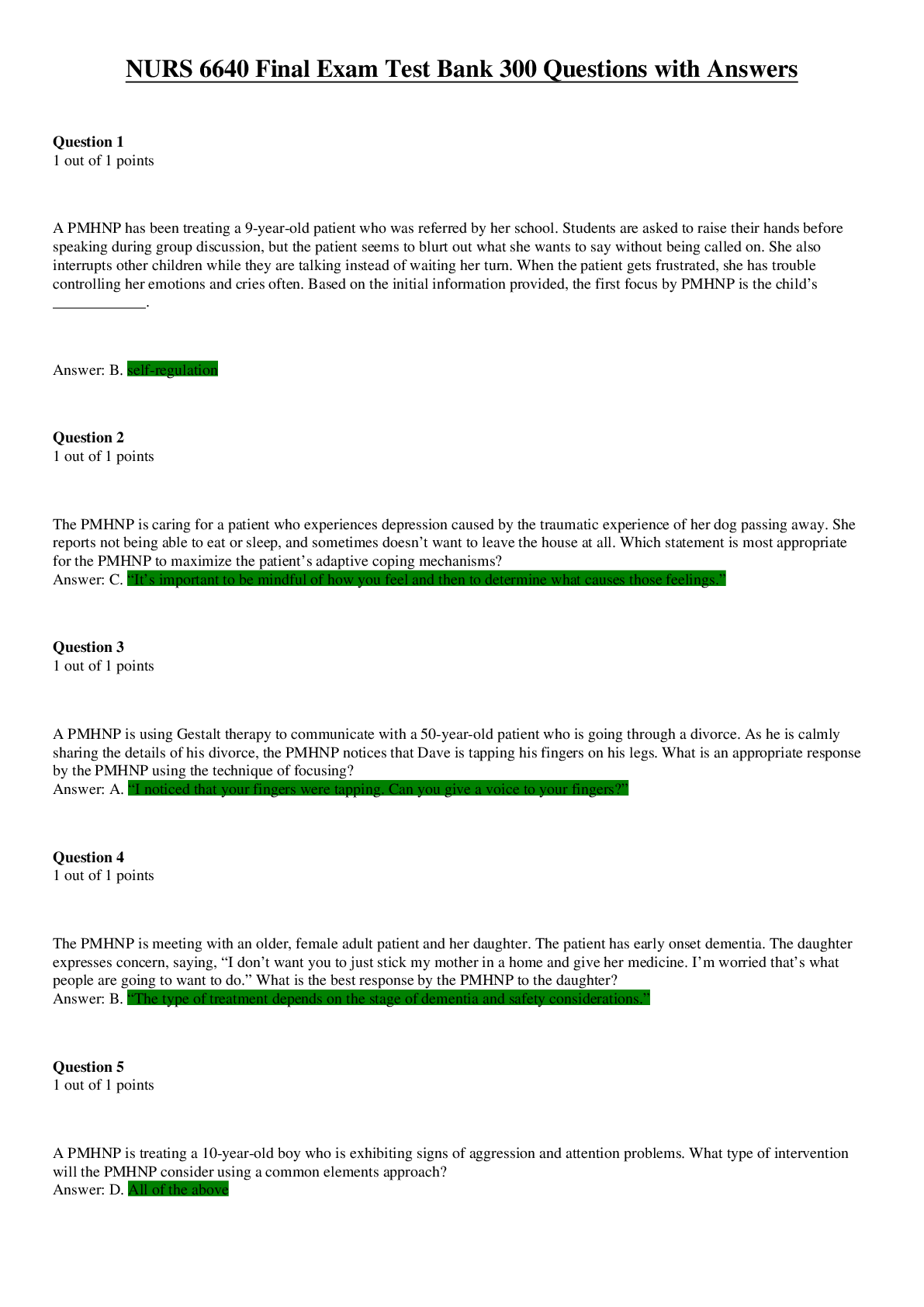
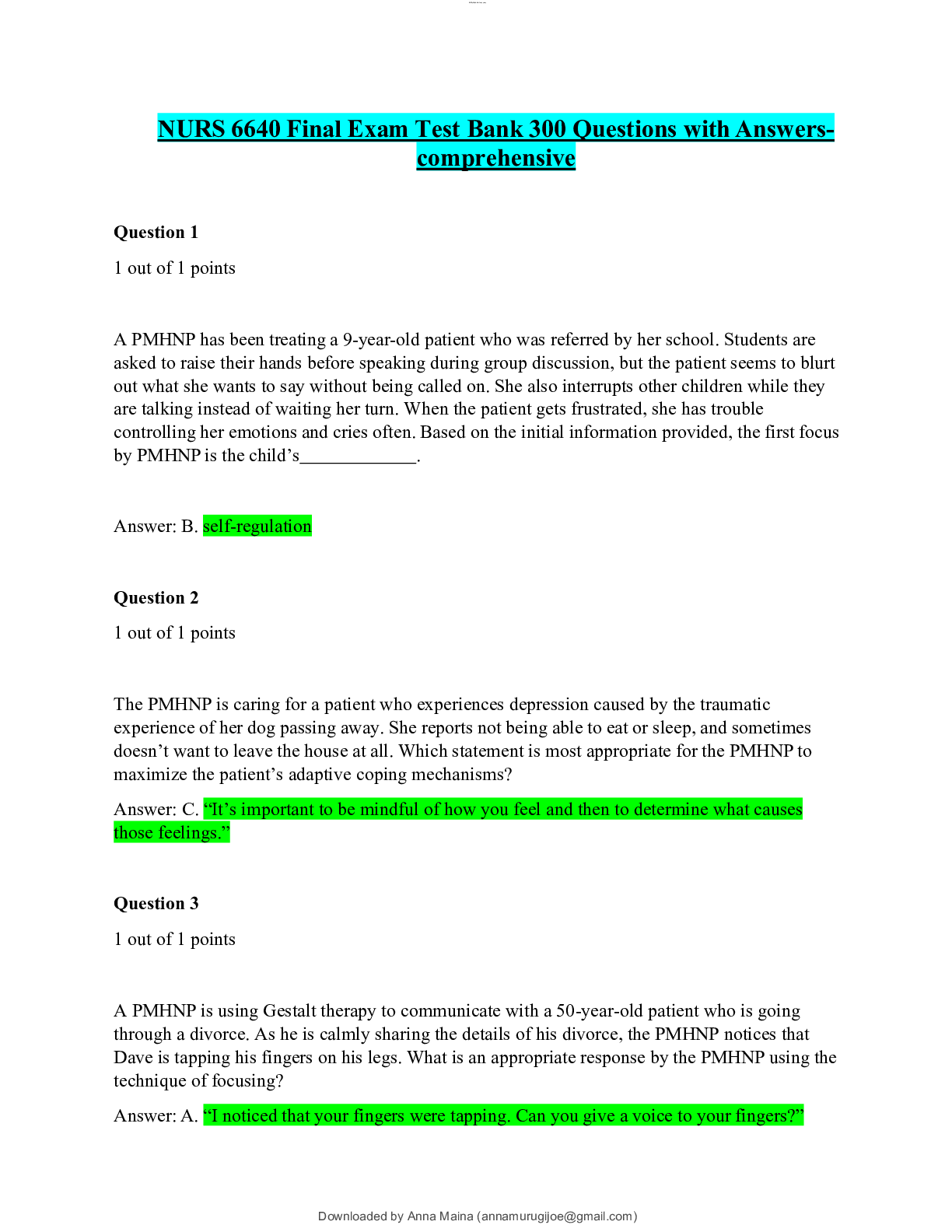
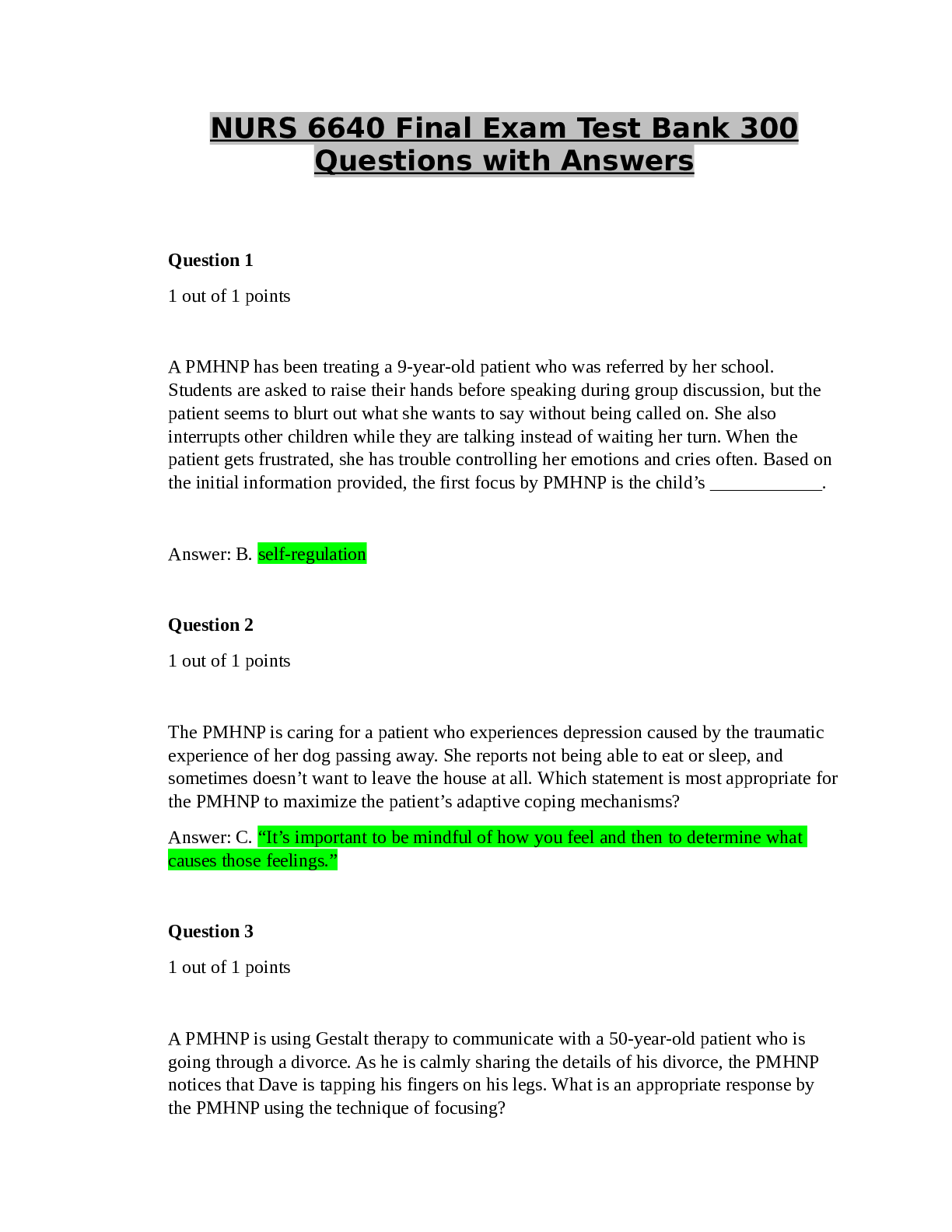
Question 1
1 out of 1 points
A PMHNP has been treating a 9-year-old patient who was referred by her school. Students are asked to
raise their hands before speaking during group discus
...
NURSING FN NURS 6640 FINAL
EXAM
Question 1
1 out of 1 points
A PMHNP has been treating a 9-year-old patient who was referred by her school. Students are asked to
raise their hands before speaking during group discussion, but the patient seems to blurt out what she
wants to say without being called on. She also interrupts other children while they are talking instead of
waiting her turn. When the patient gets frustrated, she has trouble controlling her emotions and cries
often. Based on the initial information provided, the first focus by PMHNP is the child’s ____________.
Selected Answer:
B.
self-regulation
Question 2
1 out of 1 points
The PMHNP is caring for a patient who experiences depression caused by the traumatic experience of
her dog passing away. She reports not being able to eat or sleep, and sometimes doesn’t want to leave
the house at all. Which statement is most appropriate for the PMHNP to maximize the patient’s
adaptive coping mechanisms?
Selected Answer:
C. “It’s important to be mindful of how you feel and then to determine what causes those feelings.”
Question 3
1 out of 1 points
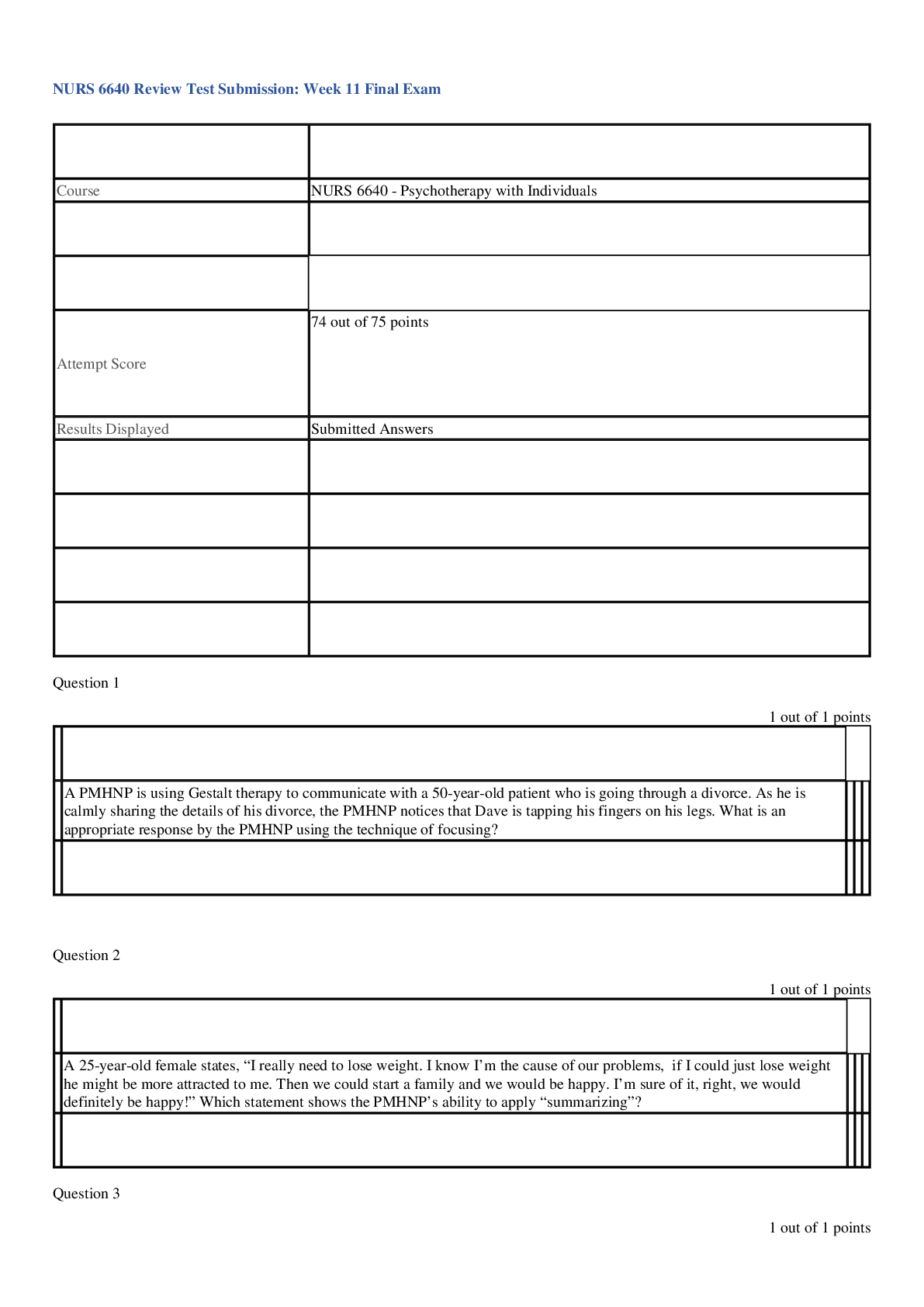
A PMHNP is using Gestalt therapy to communicate with a 50-year-old patient who is going through a
divorce. As he is calmly sharing the details of his divorce, the PMHNP notices that Dave is tapping his
fingers on his legs. What is an appropriate response by the PMHNP using the technique of focusing?Selected Answer:
A. “I noticed that your fingers were tapping. Can you give a voice to your fingers?”
Question 4
1 out of 1 points
The PMHNP is meeting with an older, female adult patient and her daughter. The patient has early onset
dementia. The daughter expresses concern, saying, “I don’t want you to just stick my mother in a home
and give her medicine. I’m worried that’s what people are going to want to do.” What is the best
response by the PMHNP to the daughter?
Selected Answer:
B. “The type of treatment depends on the stage of dementia and safety considerations.”
Question 5
1 out of 1 points
A PMHNP is treating a 10-year-old boy who is exhibiting signs of aggression and attention problems.
What type of intervention will the PMHNP consider using a common elements approach?
Selected Answer:
D. All of the above
Question 6
1 out of 1 points
A 35-year-old male patient is being treated for alcohol addiction. He asks for the PMHNP’s cell phone
number to use in case of an emergency. When the PMHNP responds that giving her number would be
against therapeutic rules, the patient threatens an act of violence to the therapist. What would be the
most appropriate response by the PMHNP?
Selected Answer:
A. Immediately report the threat to the local police department
Question 7
0 out of 1 points
The PMHNP is caring for an adult male patient whose wife left him several months ago. He recently
learned that his ex-wife is dating someone much younger. The man feels belittled, sad, and lonely. Hetalks about trying to meet other women, but says, “I can’t compete with the younger guys these days,
with the cool clothes and the vegan diets. I’m bald and overweight, and what woman is going to want to
be with me?” How does the PMHNP help raise the man’s self-esteem?
Selected Answer:
A. Correcting cognitive distortions
Question 8
1 out of 1 points
The PMHNP uses therapeutic communication skills while ensuring that the patient understands that he
has choices. The PMHNP comprehends and practices motivational interviewing. This is best understood
as which of the following?
Selected Answer:
B. A statement that both challenges the patient’s resistance and offers an opportunity to discuss the
issues allows the patient to argue with him/herself to help produce a desired change.
Question 9
1 out of 1 points
The PMHNP is terminating treatment for a patient who has been receiving eye movement
desensitization and reprocessing (EMDR) therapy. What action does the PMHNP take at the final session
to terminate treatment?
Selected Answer:
B. Discusses all issues that have been addressed
Question 10
1 out of 1 points
The PMHNP is assessing an older adult male patient with depression and comorbidities. According to the
medical chart, the patient takes medication to manage joint and bone pain. The patient reports feeling
“forgetful” and complains that he has a hard time remembering where he puts things. What is the
primary action by the PMHNP?
Selected Answer:
C. Determining if the patient’s medications can be causing memory problems
Question 111 out of 1 points
A 21-year-old patient has been having trouble adjusting to college life. She tells the PMHNP that she had
five alcoholic drinks at a party this past weekend. She also acknowledges that she drank the same
amount of alcohol at a party the previous month. Based on this information, what would the PMHNP
most likely recommend?
Selected Answer:
D. None of the above
Question 12
0 out of 1 points
The PMHNP is assessing a new geriatric patient who reports symptoms of depression. The PMHNP
wants to identify the patient’s symptom severity over time. Which assessment tool will the PMHNP use
to collect this data on the patient?
Selected Answer:
C.
AB Clinician Depression Screen
Question 13
1 out of 1 points
How does the PMHNP approach termination with the patient who has been receiving intermittent
therapy?
Selected Answer:
D. A and C
Question 14
0 out of 1 points
A 55-year-old patient recovering from substance abuse tells the PMHNP, “It’s impossible to meet new
people. I really hate being single.” Using existential psychotherapy, what might the PMHNP say next?Selected Answer:
B. “So you feel frustrated and unhappy being single. Is that right?”
Question 15
1 out of 1 points
The PMHNP is assessing a patient who requires cognitive behavioral therapy (CBT). Which of the
following statements made by the PMHNP approach the termination phase for this patient?
Selected Answer:
A. “Although it’s your first session, we will discuss how termination of your treatment will go.”
Question 16
1 out of 1 points
The PMHNP is caring for a patient who is histrionic. Using the supportive psychodynamic therapy model,
what is the best statement made by the PMHNP?
Selected Answer:
B. “Let’s not think too much about emotion right now. Let’s focus on what got you upset in the first
place.”
Question 17
1 out of 1 points
The PMHNP uses the cognitive behavioral therapy model with Gerald, an older adult patient who is
being treated for depression and mood disorder. What will the PMHNP do with the patient during the
first three sessions?
Selected Answer:
A. Build a therapeutic alliance
Question 18
1 out of 1 points
A PMHNP is using emotion-focused therapy to help a 38-year-old patient who says, “I’ve been feeling
angry lately, but I’m not sure why.” The first attempt by the PMHNP is to say:
Selected Answer:A. “Focus on your anger, take a deep breath, and allow an image to emerge.”
Question 19
1 out of 1 points
Following an attempted suicide, Mr. Durham was admitted to an acute psychiatric facility. After 4 weeks
in treatment, he is preparing for discharge. He is beginning to miss individual and group therapy sessions
and has refused medications twice in the past 2 days. The PMHNP demonstrates understanding in this
phase by saying which of the following statements?
Selected Answer:
B. “Have you thought of how you will continue your treatment plans?”
Question 20
1 out of 1 points
The PMHNP is communicating with a middle-aged male patient who has a history of addiction to
Percocet (acetaminophen/oxycodone). The patient suddenly yells, “I do not have a problem with pain
pills! I’ve never had an overdose and no one even knows that I take them unless I tell them.” The
PMHNP understands that there are phases of change and can best demonstrate “focusing” by
responding with:
Selected Answer:
D. “I am wondering if your use of pain medication has ever prompted you to seek medical attention.”
Question 21
1 out of 1 points
While assessing a patient using a humanistic-existential approach, a patient tells the PMHNP, “For the
past few weeks, I’ve felt anxious almost every single day.” What would be an appropriate next step by
the PMHNP?
Selected Answer:
D. Encourage the patient to clarify by asking, “You constantly feel anxious?”
Question 22
1 out of 1 pointsThe PMHNP is working with a patient who describes having a painful and traumatic childhood
experience, which causes her to have anxiety as an adult. When asked how she manages her anxiety,
the patient dismisses it and denies that it is a problem. Using the supportive psychotherapy approach,
the PMHNP will do which of the following when assessing the patient’s ego strength?
Selected Answer:
A. Identify the primary defenses the patient uses to ward off anxiety
Question 23
1 out of 1 points
A 38-year-old patient tells the PMHNP that her father went to jail for selling drugs when she was a child.
The patient is visibly upset when discussing what happened. Using a humanistic-existential approach to
psychotherapy, which of the following is the most appropriate response by the PMHNP?
Selected Answer:
B. “What are you experiencing now as you share this story?”
Question 24
0 out of 1 points
A PMHNP has been working with a 50-year-old patient who has a stressful job and goes to the casino on
weekends to play poker with his friends, which he says relieves his stress. Tim admits that he sometimes
misses work on Monday when he stays out too late at the casino on Sunday nights. In addition, he once
was an avid runner, and has given up running to spend more time gambling.
True or false: According to the PMHNP, the desired goal after treatment is not complete abstinence
from gambling, but reaching a healthy level of the behavior.
Selected Answer:
False
Question 25
1 out of 1 points
The PMHNP is interviewing a patient with a history of substance abuse. He has attempted to stop
abusing drugs three times before. He states to the PMHNP, “I just cannot change. How can you help
me?!” As it applies to change, the PMHNP understands the principle of evocation to mean:
Selected Answer:B. The patient already has everything needed and the PMHNP would like to help him facilitate his own
inner coping.
Question 26
0 out of 1 points
The PMHNP is in the process of terminating treatment with a patient who witnessed the death of her
parent who used to sexually abuse her. What does the PMHNP understand about terminating this
patient?
Selected Answer:
C. The patient can be weaned off from therapy, but cannot receive treatment indefinitely.
Question 27
0 out of 1 points
The PMHNP has been providing interpersonal psychotherapy (IPT) for a patient who the PMHNP
observes implementing new ways of being, such as interacting more with peers and being less isolated
in social scenarios. The PMHNP understands that the patient is approaching termination. How does the
PMHNP address termination with this patient?
Selected Answer:
A. Give the patient an option about terminating the therapy
Question 28
1 out of 1 points
A 19-year-old female patient named Anna, who was the victim of child abuse and neglect, is also in
treatment for substance abuse. At her most recent appointment, Anna confesses to the PMHNP that she
is having romantic fantasies about him, and explains the he is one of the few people she trusts. She
believes that he is interested in her as well. What is the most appropriate response by the PMHNP in
this situation?
Selected Answer:
C. Guide the patient to examine her feelings and explore the underlying meaning
Question 29
1 out of 1 pointsA 38-year-old patient has been having trouble communicating with his teenage daughter. Using a
solution-focused therapy approach, the PMHNP responds by saying, “When was a time that a
communication problem could have occurred, but did not?” In this case, what type of question is the
PMHNP asking?
Selected Answer:
C. Exception question
Question 30
1 out of 1 points
The PMHNP is treating an older adult patient who reports symptoms of late-life anxiety. What type of
treatment(s) will the PMHNP consider?
Selected Answer:
A. Employ cognitive behavioral therapy
Question 31
1 out of 1 points
A cocaine-addicted female patient is entering residential treatment for substance abuse. Using the 10
guiding principles of recovery, an appropriate step by the PMHNP is to ______________.
Selected Answer:
B. integrate services that encompass mind, body, spirit, and community
Question 32
0 out of 1 points
A PMHNP is using motivational interviewing (MI) with a 50-year-old patient named Dave to commit to a
healthy drug-free lifestyle. By using “change talk,” the PMHNP hopes to help the patient build selfesteem and hope.
True or false: If Dave is resisting change, the PMHNP should challenge his resistance in order for MI to
be successful.
Selected Answer:
True
Question 33
1 out of 1 pointsA 21-year-old patient is worried about starting a new job. She talks about her fears of failure and not
making friends at the office. Using a person-centered approach, an appropriate response by the PMHNP
is to ______________.
Selected Answer:
C. ask the patient to reflect on and explore what she is experiencing
Question 34
1 out of 1 points
The PMHNP is initiating a plan of care for a patient who requires comprehensive psychotherapy to
manage his depression and mood disorder. Throughout the initial sessions, the patient reports feeling as
though he cannot be helped. The PMHNP is concerned about premature termination initiated by the
patient. What strategy can the PMHNP employ to prevent or reduce premature termination?
Selected Answer:
D. All of the above
Question 35
1 out of 1 points
A PMHNP has been treating a 14-year-old patient using interpersonal psychotherapy. The patient has
been depressed since the death of his grandmother. To help the patient recover, the PMHNP has told
the parents:
Selected Answer:
B. “Modify your expectations at home and school until the depression lifts.”
Question 36
1 out of 1 points
The PMHNP is caring for an older adult patient who presents with mixed dysphoric states and whose
daughter reports “is becoming more irritable more easily.” When talking with the patient, the PMHNP
also recognizes displays of cognitive dysfunction. Which treatment options will the PMHNP most likely
suggest?
Selected Answer:
D. Combination of CBT and medicationQuestion 37
0 out of 1 points
The PMHNP is caring for a geriatric patient who expresses symptoms of gastrointestinal problems, aches
and pains, and loss of appetite. The patient reports feeling lonely, as more of his friends have been
passing away over the recent months and years. The PMHNP focuses on which therapeutic approach for
this patient?
Selected Answer:
C. Cognitive behavioral therapy
Question 38
1 out of 1 points
An 8-year-old has been having trouble making friends at school. His parents initiated treatment when he
also started acting out at home. Which is the most appropriate step that the PMHNP takes during the
assessment process when using an integrated approach?
Selected Answer:
D. All of the above
Question 39
1 out of 1 points
A PMHNP is using interpersonal psychotherapy with a 40-year-old patient having relationship problems
with his extended family. The patient shares that he has been using the strategies they identified to
reduce his distress, but they have not been helping. He is frustrated and is considering stopping
treatment. What would be an appropriate step by the PMHNP?
Selected Answer:
A. Encourage the patient to continue treatment by using alternative strategies
Question 40
1 out of 1 points
The PMHNP is assessing a patient who has been receiving months of outpatient psychotherapy.
According to the PMHNP’s assessment, the patient is nearing the termination phase of their therapeutic
relationship because the patient’s symptoms have improved, and the patient shows progress managingbehaviors and decision-making abilities according to the diagnosis. How does the PMHNP approach
termination with this patient?
Selected Answer:
B. Manage termination issues as part of the treatment
Question 41
1 out of 1 points
When recalling the phases of change, the PMHNP demonstrates “open questioning” in the
“engagement” phase by making which statement?
Selected Answer:
B. “What occurred to cause you to seek treatment?”
Question 42
1 out of 1 points
A 12-year-old girl was referred for treatment after witnessing the physical abuse of her sibling by their
mother. The patient has been anxious and irritable since the experience. What evidence-based
treatment would be most appropriate for the PMHNP to use?
Selected Answer:
A. Trauma-focused CBT
Question 43
1 out of 1 points
Linda is a 65-year-old patient who has completed initial treatment for alcohol addiction and anxiety
problems. She is motivated to continue her treatment gains and have a healthy lifestyle. How would the
PMHNP apply a mindfulness approach to this case?
Selected Answer:
A. Help Linda develop an awareness of triggers in order to have greater control over physical and
emotional responses
Question 44
1 out of 1 pointsThe PMHNP assesses a 27-year-old patient named Jeff, who was a victim of child abuse and neglect. Jeff
says that he remembers a traumatic situation that he wants to share, but is having trouble talking about
it. Which statement made by the PMHNP demonstrates the use of emotion-focused therapy?
Selected Answer:
A. “Let’s see if we can come up with some ideas for you to feel safe telling your story.”
Question 45
1 out of 1 points
The PMHNP is caring for an older patient with major depressive disorder, seasonal pattern. The patient
has been resolute about not taking medication to manage the depression brought on by his illness,
stating that it is against his yogic lifestyle. In addition to psychotherapy, what can the PMHNP suggest to
this patient?
Selected Answer:
A. “You may want to look into therapeutic oils and aromatherapy as an alternative to medication.”
Question 46
1 out of 1 points
The PMHNP initiates feeling-state therapy to help a 25-year-old patient named Monique who has a
compulsive urge to exercise. Using the Feeling-State Addiction Protocol, what is an appropriate next
step the PMHNP should take after identifying the specific positive feeling linked with the addictive
behavior and its Positive Feeling Score level?
Selected Answer:
C. Locate and identify any physical sensations created by the positive feelings
Question 47
1 out of 1 points
A patient’s depression is affecting her relationship with her spouse. What might the PMHNP ask during
the initial sessions of interpersonal psychotherapy treatment?
Selected Answer:
D. All of the above.
Question 48
1 out of 1 pointsA PMHNP is assessing a 60-year-old patient named Carlos. He has severe PTSD and mild substance abuse
issues. The most appropriate setting to treat Carlos would be a _________.
Selected Answer:
D. mental health system of care
Question 49
1 out of 1 points
The PMHNP continues to meet with Gerald, who is the patient with depression and mood disorder. The
PMHNP uses the CBT approach. Gerald is now meeting with the PMHNP for his fifth session and feels
comfortable with how the therapy works. What does the PMHNP plan to do with Gerald over the course
of the next several sessions?
Selected Answer:
C. Develop cognitive skills to challenge Gerald’s negative thinking
Question 50
1 out of 1 points
A PMHNP is treating a 25-year-old patient who has a compulsive urge to exercise to excess. When asked
to describe why she does so much exercise, she says, “I like the compliments I receive from others on
my new level of fitness, and the excitement of getting more attention.” The PMHNP can use feelingstate therapy to help Monique ___________.
Selected Answer:
D. all of the above
Question 51
1 out of 1 points
A 43-year-old single mother is seeing the PMHNP at the request of her sister. “My sister thinks I need to
come here to talk about my feelings,” the patient reports. The PMHNP learns that the patient has three
children from three different men, but is unable to collect appropriate child support payments from any
of the biological fathers. Additionally, the woman is barely able to afford her apartment or utilitiespayments. What is the appropriate response from the PMHNP when using the psychodynamic
psychotherapy technique?
Selected Answer:
C. Suggesting that the patient seek professional legal help
Question 52
1 out of 1 points
The PMHNP meets with a 31-year-old woman who reports feeling as though she is “at her breaking
point” with work. The PMHNP learns that the woman works 12-hour days, including one day on the
weekend, because she is nervous about company layoffs. “I feel like I need to work myself to death in
order to prove that I am valuable to the organization,” the woman says. Using the supportive
psychodynamic therapy approach, how does the PMHNP respond?
Selected Answer:
D. “That must be a very tiring work schedule. How do you feel about working so much?”
Question 53
1 out of 1 points
A 13-year-old patient and his parents are meeting with a PMHNP. When the PMHNP says hello, the boy
just nods. His parents tell the PMHNP that he didn’t want to come to the session, but they insisted. They
explain that their son has been moody and depressed at home, but is still getting good grades at school.
Which of the following would be the best response by the PMHNP?
Selected Answer:
C. Compliment the patient on his academic achievement
Question 54
1 out of 1 points
The PMHNP is treating an older adult patient who reports experiencing nightmares associated with an
automobile accident he was in 20 years ago. As the PMHNP formulates the case using the dynamic
supportive therapy model, what questions will the PMHNP use during the session?Selected Answer:
C. “Let’s talk about what kinds of things are triggering you now.”
Question 55
1 out of 1 points
The PMHNP is caring for an older adult patient who is in the acute phase of schizophrenia. Which
therapeutic model will the PMHNP employ with this patient?
Selected Answer:
D. None of the above
Question 56
1 out of 1 points
The PMHNP has been providing supportive psychodynamic psychotherapy to a patient and is nearing
the termination stage. The PMHNP will use which criteria for determining that the patient is ready for
termination?
Selected Answer:
B. Symptoms have improved.
Question 57
0 out of 0 points
When completing this exam, did you comply with Walden University’s Code of Conduct including the
expectations for academic integrity?
Selected Answers:
Yes
Question 58
1 out of 1 pointsA patient is finishing the active treatment phase of interpersonal psychotherapy (IPT). After the PMHNP
reminds the patient that she has three sessions left, the patient says nothing, but looks distressed. What
would be the best reply by the PMHNP following IPT protocol?
Selected Answer:
D. “You seem upset. Tell me what seems to be bothering you.”
Question 59
0 out of 1 points
The PMHNP has been treating a patient who is now being transferred to another provider. What is the
appropriate action made by the PMHNP?
Selected Answer:
A. Introducing the patient to the new provider
Question 60
1 out of 1 points
The PMHNP who practices motivational interviewing understands its relationship to patient behaviors
and/or outcomes to mean which of the following?
Selected Answer:
D. There is a lower incidence of inconsistent behaviors with motivational interviewing. This is related to
client engagement and better outcomes.
Question 61
1 out of 1 points
A PMHNP is treating a 12-year-old girl who witnessed the physical abuse of her sibling. She has been
anxious and irritable since the experience. After speaking with the PMHNP, the patient says she keeps
having anxiety-causing thoughts about the experience. Using the PRACTICE technique, which skill will
best help the patient interrupt these negative thoughts?
Selected Answer:
B.
Affect modulationQuestion 62
0 out of 1 points
The PMHNP is caring for a young adult patient with whom the PMHNP decides to use a dynamic
supportive therapy approach in addition to pharmacological intervention. Which therapeutic action will
the PMHNP take to employ the strategy of holding and containing the patient?
Selected Answer:
A. Encouraging and nurturing the patient
Question 63
1 out of 1 points
The PMHNP is meeting with a patient who has been diagnosed with depression. The patient is having
trouble adjusting to her new job and hasn’t made any new friends there. What would an appropriate
response be by the PMHNP using the interpersonal psychotherapy approach?
Selected Answer:
C. “Tell me more about why you’re having trouble making new friends at work.”
Question 64
1 out of 1 points
The PMHNP is initiating a plan of care for Holly, a 73-year-old female patient who has late-life bipolar
disorder and reports consuming alcoholic beverages four times per week. What is the focus of Holly’s
therapy going to be?
Selected Answer:
D. All of the above
Question 65
1 out of 1 points
The PMHNP is interviewing a patient who is in the process of successfully completing a substance abuse
program. During the interview, the patient states, “I wish I was strong enough to keep the same friends I
had before I came here for treatment. I’m really afraid of being discharged because I’ll probably run into
my old friends again.” The PMHNP offers a complex reflection when she states the following:
Selected Answer:C. “You’d like to keep your old friends but know being around them may lead you to abuse substances
again.”
Question 66
0 out of 1 points
In the planning phase of change, a 42-year-old male client who struggles with gambling discusses how
he plans to abstain from gambling. He tells the PMHNP, “I am no longer going to carry cash to the casino
because you can’t spend what you don’t have.” The PMHNP uses an affirming communication skill when
she states:
Selected Answer:
C. “This is a great technique, though it may not work if there is an ATM in the casino you go to.”
Question 67
1 out of 1 points
A PMHNP is assessing a 40-year-old patient named Sarah who has a severe cocaine addiction and mild
depression. Using the four-quadrant model, what would be the most appropriate setting to help the
patient?
Selected Answer:
C. Substance abuse treatment system
Question 68
0 out of 1 points
Mia is a 75-year-old patient who has completed initial treatment for depression. What might a PMHNP
ask Mia when using a solution-focused therapy approach?
Selected Answer:
A. “What specific improvements have you noticed in your mood since you made the call to see me?”
Question 69
1 out of 1 points
A PMHNP is using Gestalt therapy to communicate with a 42-year-old patient who is upset with her
mother. She says, “I want to tell her how hurt I feel when she doesn’t call me, but I don’t want to upset
her.” What technique can the PMHNP use to help Sasha express herself?Selected Answer:
B. Empty-chair dialogue
Question 70
0 out of 1 points
As part of the PMHNP’s role in the clinic, the PMHNP oversees students that gain clinical experience at
the agency. The student is instructed to use the supportive psychodynamic therapy approach with the
patient. Which action made by the student causes the PMHNP to intervene, after observing the student
interacting with the patient?
Selected Answer:
C. Inviting the patient to emote about thoughts and fantasies
Question 71
1 out of 1 points
The PMHNP is assessing a 30-year-old client who reports feeling stressed out due to his current
employment situation. When asked about how he manages this work-related stress, the patient says
that exercise helps him feel less anxious, so he often spends 2 or more hours at the gym each night.
After completing the patient assessment, the PMHNP has determined that an existential psychotherapy
approach may best benefit this client. What is the PMHNP’s goal in employing this treatment approach?
Selected Answer:
B. Help the patient be aware of his anxiety and embrace it
Question 72
1 out of 1 points
When preparing to terminate a patient, what does the PMHNP do to organize thoughts about the
patient’s progress made during treatment?
Selected Answer:
B. Reviews the patient’s file to identify issues and important themes that were highlighted throughout
treatment
Question 73
1 out of 1 pointsThe PMHNP uses the Adult Attachment Interview (AAI) with a male patient who reports having had a
difficult time being separated from his parents during his childhood. He explains that going to school or
visiting his relatives without his parents was troublesome. The PMHNP characterizes the patient as
unresolved/disorganized, according to his outcomes on the AAI. What does the PMHNP anticipate from
the patient?
Selected Answer:
A. He will have lapses in his memory of his childhood.
Question 74
0 out of 1 points
The PMHNP is terminating treatment with a patient who is aggressive and has a history of anger. What
does the PMHNP do when terminating treatment with this patient?
Selected Answer:
A. Makes a list of all the positive things the patient gained from treatment
Question 75
0 out of 1 points
The PMHNP is actively listening to Ms. Thomas who is detoxing from alcohol. Ms. Thomas is currently
discussing with the PMHNP the reasons why she feels guilty about her drinking. Ms. Thomas tearfully
states, “I have driven my family and friends away with this terrible habit. I have no one left. I had more
than enough chances and now my children won’t even talk to me.” Which of the following statements
demonstrate a simple reflection?
Selected Answer:
C. “You feel that your use of alcohol is a terrible habit.”
Question 76
0 out of 1 points
A 25-year-old female states, “I really need to lose weight. I know I’m the cause of our problems, if I
could just lose weight he might be more attracted to me. Then we could start a family and we would be
happy. I’m sure of it, right, we would definitely be happy!” Which statement shows the PMHNP’s ability
to apply “summarizing”?
Selected Answer:
A. “You believe that your weight is a cause of your marital problems.”
[Show More]