ATI PRACTICE’
… A.
1. A nurse is reviewing the medical record of a client who has a prescription for
morphine. Which of the following findings should the nurse report to the
provider?
a. Urinary retention
b. The nu
...
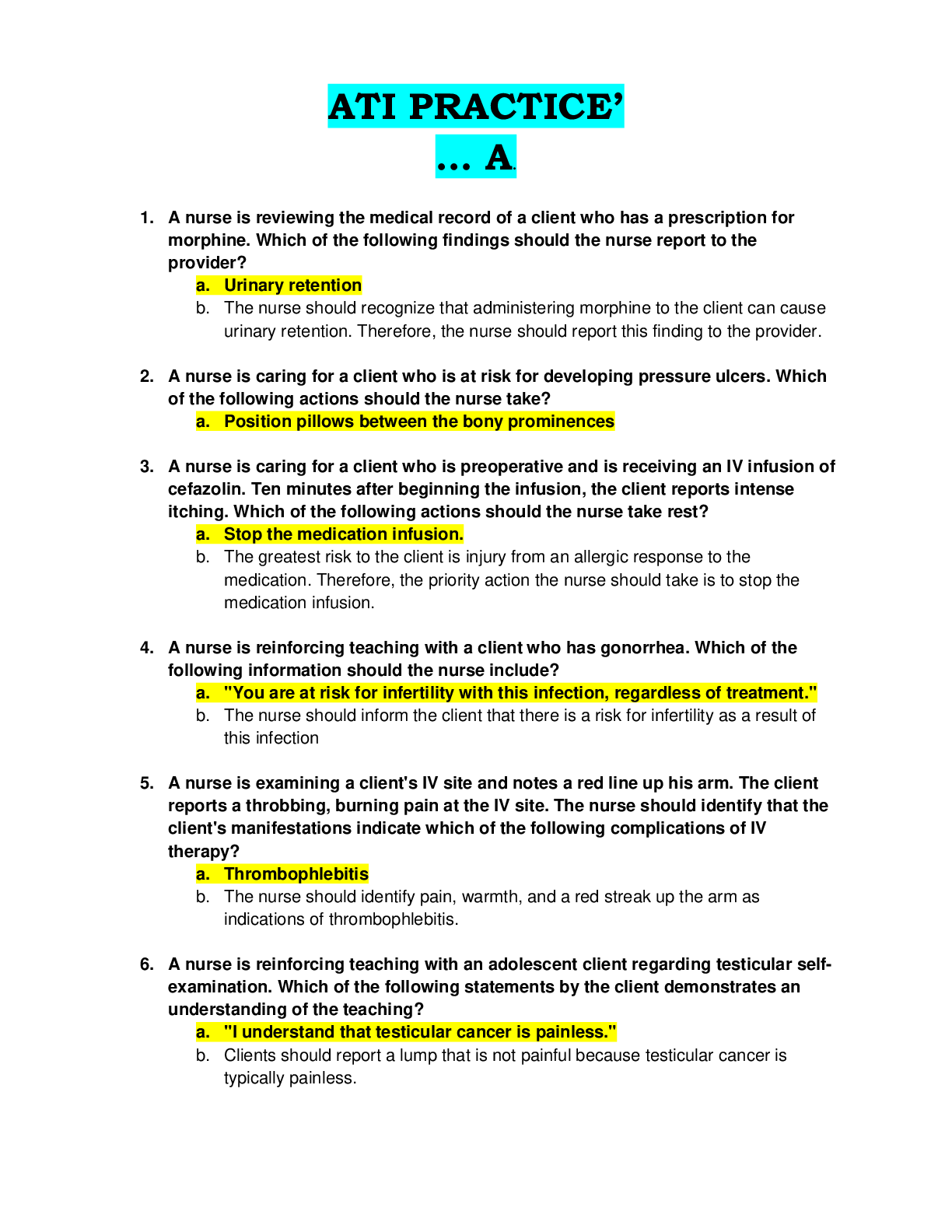
ATI PRACTICE’
… A.
1. A nurse is reviewing the medical record of a client who has a prescription for
morphine. Which of the following findings should the nurse report to the
provider?
a. Urinary retention
b. The nurse should recognize that administering morphine to the client can cause
urinary retention. Therefore, the nurse should report this finding to the provider.
2. A nurse is caring for a client who is at risk for developing pressure ulcers. Which
of the following actions should the nurse take?
a. Position pillows between the bony prominences
3. A nurse is caring for a client who is preoperative and is receiving an IV infusion of
cefazolin. Ten minutes after beginning the infusion, the client reports intense
itching. Which of the following actions should the nurse take rest?
a. Stop the medication infusion.
b. The greatest risk to the client is injury from an allergic response to the
medication. Therefore, the priority action the nurse should take is to stop the
medication infusion.
4. A nurse is reinforcing teaching with a client who has gonorrhea. Which of the
following information should the nurse include?
a. "You are at risk for infertility with this infection, regardless of treatment."
b. The nurse should inform the client that there is a risk for infertility as a result of
this infection
5. A nurse is examining a client's IV site and notes a red line up his arm. The client
reports a throbbing, burning pain at the IV site. The nurse should identify that the
client's manifestations indicate which of the following complications of IV
therapy?
a. Thrombophlebitis
b. The nurse should identify pain, warmth, and a red streak up the arm as
indications of thrombophlebitis.
6. A nurse is reinforcing teaching with an adolescent client regarding testicular selfexamination. Which of the following statements by the client demonstrates an
understanding of the teaching?
a. "I understand that testicular cancer is painless."
b. Clients should report a lump that is not painful because testicular cancer is
typically painless.7. A nurse in a long-term care facility is collecting data from a client who reports
fullness in the rectum and abdominal cramping. Which of the following findings
should indicate to the nurse that the client might have a fecal impaction?
a. Small liquid stools
b. Small liquid stools can be the result of fecal material being expelled around an
impaction
8. A nurse in an oncology clinic is reinforcing teaching about Mohs surgery with a
client who has skin cancer. Which of the following information should the nurse
include in the teaching?
a. Mohs surgery is a horizontal shaving of thin layers of the tumor.
b. Mohs surgery is performed to treat basal and squamous cell carcinoma. The
procedure, which involves a horizontal shaving of thin layers of a tumor, has a
high treatment rate.
9. A nurse is reinforcing teaching about gastroesophageal reflux disease (GERD)
with a client. Which of the following statements by the client indicates an
understanding of the teaching?
a. "I should wait at least 2 hours after eating before going to bed."
b. The client should wait to lie down or go to bed at least 2 hr after eating to
minimize reflux
10. A nurse is assisting with the care of a client who is receiving 0.9% sodium
chloride by continuous IV infusion. The client reports pain and swelling at the IV
site. In which order should the nurse perform the following steps? (Move the
steps into the box on the right, placing them in the order of performance. Use all
the steps.)
a. check the IV site, stop the infusion, remove the IV catheter, elevate the affected
extremity, notify the charge nurse.
11. A nurse is contributing to the plan of care for an older adult client who is at risk
for osteoporosis. Which of the following interventions should the nurse include to
prevent bone loss?
a. Encourage weight-bearing exercises.
b. Weight-bearing exercises, such as walking, can maintain bone mass by reducing
bone demineralization, thus helping to prevent osteoporosis.
12. A nurse is assisting with the care of a client who had a cardiac catheterization via
the right femoral artery. Which of the following actions should the nurse take to
prevent post procedure complications? (Select all that apply.)
a. Monitor the insertion site for bleeding is correct. The nurse should monitor the
client's insertion site for manifestations of hemorrhaging.Maintain the pressure
dressing is correct. The nurse should maintain the client's pressure dressing to
prevent hemorrhaging and allow for the cannulation site to heal. Check the
client's peripheral pulses is correct. The nurse should assess the client's
peripheral pulses to help identify signs of arterial occlusion.13. A nurse is caring for a client who is 1 day postoperative following a hip
arthroplasty. The client is exhibiting hypotension, tachycardia, and tachypnea.
The nurse should recognize that these findings indicate which of the following
complications?
a. Pulmonary embolism
b. Manifestations of a pulmonary embolism include hypotension, tachycardia, and
tachypnea.
14. A nurse is reinforcing discharge teaching with a client who has hearing loss.
Which of the following actions should the nurse take when communicating with
the client?
a. Rephrase client instructions when not understood.
b. When communicating with a client who has hearing loss, the nurse should
rephrase, rather than repeat, discharge instructions when they are not
understood.
15. A nurse is caring for a client who is postoperative and has an epidural infusion.
Which of the following findings should the nurse recognize as the priority?
a. Dyspnea.
b. When using the airway, breathing, circulation approach to client care, the nurse
should determine that the priority nding is dyspnea, which is a complication of the
epidural infusion
16. A nurse is preparing to administer phytonadione 7 mg subcutaneously to a client
who has an INR of 4. Available is phytonadione 10 mg/mL. How many mL should
the nurse administer? (Round the answer to the nearest tenth. Use a leading zero
if it applies. Do not use a trailing zero.)
a. 0.7
17. A nurse is reinforcing teaching with a client who has multiple sclerosis and a new
prescription for baclofen. Which of the following instructions should the nurse
include in the teaching?
a. Avoid stopping this medication suddenly.
b. The nurse should instruct the client to avoid stopping baclofen suddenly because
it can result in adverse reactions, including seizures, paranoia, and
hallucinations.
18. A nurse is planning to implement droplet precautions for a client who has
manifestations of pertussis. Which of the following interventions should the nurse
include when contributing to the plan of care?
a. Apply a mask on the client if transport is needed.b. The nurse should apply a mask to the client who has manifestations of pertussis
during transport to prevent exposure to others.
19. A nurse is caring for an older adult client who has a reddened area over the
sacrum. Which of the following actions should the nurse take?
a. Minimize the time the head of the bed is elevated.
b. The nurse should minimize the time the head of the bed is elevated to reduce
pressure on the sacral area.
20. A nurse is collecting data from a client and notices several skin lesions. Which of
the following findings should the nurse report as possible melanoma?
a. Irregular borders.
b. The nurse should report irregular borders of a skin lesion to the provider because
it can indicate malignant melanoma.
21. A nurse is reinforcing teaching with a client who is on a low-sodium diet and asks
about how to improve the taste of bland food. Which of the following should the
nurse recommend?
a. Lemon juice.
b. The nurse should recommend that the client use lemon juice to favor his food
because it is low in sodium.
22. A nurse is assisting with the discharge planning for a client who is postoperative
following a total hip arthroplasty. Which of the following instructions should the
nurse include in the discharge plan?
a. Obtain a raised toilet seat.
b. The nurse should instruct the client to use a raised toilet seat to avoid flexing the
hip more than 90° , which increases the risk for dislocation.
23. A nurse is caring for a client who has meningococcal pneumonia. Which of the
following personal protective equipment should the nurse use?
a. Mask.
b. The nurse should identify that a client who has Meningococcal pneumonia
requires droplet precautions, which include wearing a mask when providing care
within 3 feet of the client.
24. A nurse is reinforcing teaching with a client who has asthma. Which of the
following client statements indicates an understanding of the use of budesonide
and albuterol inhalers? (Select all that apply.)
a. "I never forget to rinse my mouth after using my budesonide inhaler" is
correct. The client should rinse his mouth after using a budesonide inhaler to
reduce the risk for oral fungal infection. "Between office visits, I keep a record
of how many times I use my albuterol inhaler" is correct. The client should
record the number of times that he uses his albuterol inhaler. This information
can assist the provider to determine the effectiveness of the medication. "I usemy albuterol inhaler before I go swimming" is correct. The client should use
the albuterol inhaler before exercise to prevent exercise-induced
bronchospasms.
25. A nurse is caring for a client who has a compound fracture of the femur and was
placed in balanced suspension skeletal traction 4 days ago. Which of the
following actions should the nurse take?
a. Perform pin site care daily.
b. The nurse should perform pin site care daily with chlorhexidine solution or use a
solution according to facility protocol. The nurse should also monitor the pin sites
for manifestations of infection.
26. A nurse is preparing to auscultate the bowel sounds of a client who has a
mechanical bowel obstruction in the descending colon. When listening in the left
upper quadrant, the nurse should identify this sound as which of the following?
(Click on the audio button to listen to the clip.)
a. Hyperactive bowel sounds.
b. A mechanical bowel obstruction prevents a portion or all of the bowel contents
from moving forward through the bowel. The nurse should expect to auscultate
high-pitched, hyperactive bowel sounds above the point of the intestinal
obstruction as the intestines attempt to propel the blockage forward.
27. A nurse is contributing to the plan of care for a client who was admitted to the
neurological unit following a stroke 3 hr ago. Which of the following interventions
should the nurse identify as the priority?
a. Keep the client in a side-lying position.
b. The greatest risk to the client following a stroke is aspiration. The nurse should
position the client in a lateral, or side-lying position, which will allow any
secretions to drain out of the mouth, decreasing the risk for aspiration.
Additionally, the nurse should have suction available in the event that any
secretions are present in the oral cavity.
28. A nurse is collecting data from a client who has hypokalemia. Which of the
following findings should the nurse identify as the priority?
a. Dysrhythmia.
b. When using the airway, breathing, circulation approach to client care, the nurse
should identify that the priority nding for a client who has hypokalemia is
dysrhythmia.
29. A nurse is reinforcing teaching about dietary changes with a client who has
cardiovascular disease. Which of the following images indicates the type of
cooking fat the nurse should recommend the client use when preparing meals?
a. Olive Oil.
b. The nurse should instruct the client who has cardiovascular disease to consume
foods which contain primarily monounsaturated and polyunsaturated fats, such
as olive oil or other vegetable oils, rather than foods that are high in saturated fat.
The nurse should reinforce that oils high in monounsaturated fats help decrease
the client's cardiovascular risk by lowering LDL cholesterol and triglyceride levels.30. A nurse is reviewing the laboratory results of a client who has chronic kidney
failure and is receiving epoetin alfa. The nurse should identify that which of the
following laboratory values indicates the treatment is effective?
a. Hgb 11 g/dL.
b. Epoetin alfa stimulates the production of erythropoietin and red blood cells,
resulting in increased hemoglobin levels. Therefore, a hemoglobin level of 11
g/dL indicates the epoetin alfa treatment is effective
31. A nurse is assisting in the plan of care regarding bowel retraining for a client who
has a cervical spinal cord injury. Which of the following interventions should the
nurse plan to implement the first?
a. Determine the client's daily elimination habits.
b. The first action the nurse should take using the nursing process is to collect data
on the client's daily bowel elimination habits to establish a routine defecation
time.
32. A nurse is contributing to the plan of care for a client who has peripheral arterial
disease (PAD) of the lower extremities. Which of the following interventions
should the nurse include?
a. Dangle the extremities on the side of the bed.
b. The nurse should include in the plan of care to have the client dangle the lower
extremities on the side of the bed to aid in reducing pain by increasing arterial
blood flow. The client should not raise the lower extremities above the level of the
heart when resting in bed because it impairs arterial blood flow.
33. A nurse is caring for a client who is receiving chemotherapy. The client mentions
that she has a loss of appetite because she has sores in her mouth and that food
no longer tastes good. Which of the following suggestions to the client should the
nurse make?
a. Eat several, small-portioned meals daily.
b. Clients who have difficulty eating because of pain or anorexia can usually
tolerate small amounts of food at one time. Eating several small meals daily can
increase the client's caloric intake.
34. A nurse is caring for a client who is 24 hr postoperative following abdominal
surgery and has an NG tube. Which of the following actions should the nurse plan
to take to decrease the risk of postoperative complications?
a. Encourage the client to use an incentive spirometer every hour while
awake.
b. The nurse should assist the client to use the incentive spirometer in addition to
coughing and deep breathing every hour while awake for the first 24 hr
postoperatively and at least every 2 hr while awake thereafter. An incentive
spirometer will inate the client's alveoli and improve ventilation to prevent
postoperative pneumonia.
35. A nurse is participating in a health fair for older adult clients. Which of the
following immunizations should the nurse recommended for this age group?
a. Herpes zoster.b. The nurse should recommend the herpes zoster immunization for adults 60 years
of age and older.
36. A nurse is reinforcing discharge teaching with a client who has cirrhosis. Which
of the following instructions should the nurse include?
a. "Consume foods low in sodium.
b. The nurse should instruct the client to consume foods low in sodium to reduce
the development of edema and ascites.
37. A nurse is reinforcing teaching with a client who has mitral valve disease. Which
of the following statements by the client indicates an understanding of the
disease process?
a. "I should call my doctor if my ankles swell."
b. Swelling of the ankles can indicate heart failure. The client should report this
finding to the provider.
38. A nurse is discussing health screening guidelines with an older adult client.
Which of the following statements should the nurse include?
a. "You should have a pneumococcal immunization every 10 years."
b. The nurse should remind the client to have a pneumococcal immunization at age
65 and every 10 years thereafter to protect her from acquiring pneumonia.
39. A nurse is contributing to the plan of care for a client who is postoperative
following a total knee arthroplasty. The client is using a continuous passive
motion (CPM) machine. Which of the following interventions should the nurse
recommend for the plan of care?
a. Keep a sheepskin pad between the client's extremity and the CPM.
b. The nurse should plan to keep a sheepskin pad between the client's extremity
and the CPM machine to protect the client's skin. The nurse should check the
client's skin condition frequently while the client is using the CPM.
40. A nurse is assisting the charge nurse with developing an in-service about caring
for clients who have internal sealed radiation implants. Which of the following
information should the nurse include?
a. Dispose of radiation implants in a lead container.
b. Lead impairs the emission of radiation. Therefore, the nurse should dispose of
radiation implants in a lead container in accordance with facility protocol.
41. A nurse is preparing to suction a client who has a tracheostomy. Which of the
following actions should the nurse take first?
a. Ventilate with 100% oxygen
42. A nurse is assisting in the care of a client who has manifestations of sepsis.
Which of the following provider prescriptions should the nurse implement first?
a. Initiate oxygen at 4 L/min via nasal cannula.43. A nurse is caring for a client and administers penicillin IM. The client begins
exhibiting hives and has severe difficulty breathing. After establishing a patent
airway, which of the following actions should the nurse take next?
a. The greatest risk to the client is death from anaphylaxis.
b. Therefore, the nurse should administer epinephrine to reduce bronchospasms
and laryngeal edema.
44. A nurse is monitoring an older adult client who has a history of an enlarged
prostate and is experiencing suprapubic discomfort. Which of the following
actions should the nurse take first?
a. Palpate the abdomen.
b. When providing client care, the nurse should first use the least restrictive
intervention. Therefore, the nurse should palpate the abdomen to determine if the
client has a distended bladder from urinary retention.
45. A nurse is reinforcing teaching with the family of a client who has a cervical injury
and has a halo vest in place. Which of the following safety precautions should the
nurse include in the teaching?
a. Change the sheepskin liner weekly.
b. The nurse should provide instruction regarding the care and maintenance of the
vest. The instruction should include changing the sheepskin liner when soiled, or
at least once per week, to prevent skin irritation.
46. A nurse is caring for a client who had an acute ischemic stroke 1 day ago. Which
of the following actions should the nurse take to reduce the risk for aspiration?
a. Allow for 30 min of rest before meals.
47. A nurse is preparing to administer furosemide to a client who has heart failure.
Which of the following findings should the nurse report before administering the
medication?
a. Decreased potassium.
b. The nurse should notify the provider immediately of a decreased potassium level
because potassium is lost when a diuretic such as furosemide is administered,
which can cause hypokalemia.
48. A nurse is caring for a client who has a prescription for phenazopyridine. Which of
the following findings should the nurse identify as a therapeutic effect of the
medication?
a. Decreases pain during urination.
b. Phenazopyridine reduces pain and burning during urination by exerting an
anesthetic effect on the mucosa of the urinary tract.
49. A nurse is reinforcing discharge teaching about wound care with a family member
of a client who is postoperative. Which of the following should the nurse include
in the teaching?a. Report purulent drainage to the provider.
b. The nurse should remind the family member to report signs of infection, including
purulent drainage
50. A nurse is providing discharge teaching for the family of a client who has
Parkinson's disease. Which of the following information should the nurse include
in the teaching?
a. Remind the client to avoid watching her feet when walking.
b. The nurse should instruct the client's family to frequently remind the client to
maintain correct posture and prevent falls by not watching her feet when walking.
51. A nurse is contributing to the plan of care for a client who has a methicillinresistant Staphylococcus aureus (MRSA) infection and is on contact isolation
precautions. Which of the following actions should the nurse take
a. Have a designated stethoscope in the client's room.
b. The nurse should designate equipment to leave in the client's room to avoid
cross-contamination. The designated equipment should be disposed of or
decontaminated before leaving the client’s room.
52. A nurse is preparing to administer scheduled medications to a client. Which of the
following prescriptions should the nurse verify with the provider? (Click on the
"Exhibit" button for additional information about the client. There are three tabs
that contain separate categories of data.)
a. Ceftriaxone
b. Clients who have a severe sensitivity to penicillin can have a cross-sensitivity
reaction to ceftriaxone, a cephalosporin. Therefore, the nurse should contact the
provider to clarify the prescription.
53. A nurse is caring for a client who is in Buck's traction. Which of the following
interventions should the nurse perform to reduce skin breakdown?
a. Keep the skin dry and free of perspiration.
54. A nurse is reviewing the laboratory results of a client who is scheduled for a CT
scan with an IV contrast agent. Which of the following laboratory findings should
the nurse report to the provider prior to the procedure?
a. Creatinine 1.9 mg/dL.
b. Creatinine 1.9 mg/dL is not within the expected reference range. Therefore, the
nurse should report the findings to the provider before the client has a CT scan
with an IV contrast agent. This finding places the client at risk for developing
contrast-induced nephropathy.55. A nurse is reinforcing teaching about joint protection with a client who has an
acute exacerbation of rheumatoid arthritis. Which of the following information
should the nurse include in the teaching?
a. Apply cold packs to the inflamed joints.
56. A nurse is contributing to the plan of care for a client who has a new prescription
for nystatin suspension for oral candidiasis. Which of the following interventions
should the nurse include in the plan?
a. Instruct the client to swish the medication in her mouth.
b. The nurse should instruct the client to place half the dose in each side of her
mouth, swish the medication, and then swallow. This action will allow the
medication to coat the entire oral mucosa and treat the fungal infection.
57. A nurse is caring for a client who has a history of breast cancer. The client asks
the nurse about birth control. Which of the following methods of birth control is
contraindicated for this client?
a. Combination oral contraceptives.
b. The nurse should identify that combination oral contraceptives are
contraindicated for this client because they increase estrogen levels, which can
stimulate the growth of any remaining cancerous breast cells.
58. A nurse is caring for a client who has difficulty swallowing. Which of the following
actions should the nurse implement to prevent aspiration?
a. Give the client liquids with increased viscosity.
b. Thickened liquids are easier for the client to swallow and can prevent aspiration.
59. A nurse is contributing to the plan of care for a client who is having difficulty
eating following a stroke. Which of the following interventions should the nurse
plan to implement first?
a. Recommend a referral for a speech language pathologist.
60. A nurse is performing an ECG on a client who is scheduled for surgery the
following morning. In which of the following locations should the nurse place the
V1 electrode? (You will find hot spots to select in the artwork below. Select only
the hot spot that corresponds to your answer.)
a. C
61. A nurse is caring for a client who has bacterial meningitis. Upon monitoring the
client, which of the following findings should the nurse expect?
a. Red macular rash.
b. The nurse should expect to find a red macular rash, sometimes called a petechial
rash, which is a manifestation of meningococcal meningitis.
62. Following a blood draw procedure for a fasting blood sugar (FBS) test, a client
tells the nurse, "I'm glad they took my blood because I'm really hungry. All I'vehad since midnight is water and some juice." Which of the following actions
should the nurse take?
a. Reschedule the FBS test for early the next morning.
b. An FBS test requires the client to have no food or juice for at least 8 hr. The
result of the FBS test would be invalid because the client drank juice during the
fasting time period. The nurse should reinforce with the client to only drink water
and have no food or other beverages for 8 hr before the phlebotomist obtains the
blood specimen.
63. A nurse is caring for a client who has acute pancreatitis. While providing care, the
nurse observes ecchymosis around the umbilicus. The nurse should identify that
this is a manifestation of which of the following?
a. Intra-abdominal bleeding.
b. Ecchymosis around the umbilicus is a sign of intra-abdominal bleeding, which is
a finding consistent with pancreatitis.
64. A nurse is monitoring a client who recently had a cast placed on the right lower
extremity for a bone fracture. Which of the following findings should the nurse
recognize as abnormal?
a. Lack of sensation between the first and second toes.
b. Lack of sensation between the toes indicates peripheral nerve impairment and is
an abnormal finding that can indicate the client has compartment syndrome. The
nurse should notify the provider immediately.
65. A nurse enters the room of a client whose transfusion of packed RBCs was
initiated 15 min ago by the RN. The client reports dyspnea and urticaria. Which of
the following actions should the nurse perform first?
a. Stop the infusion.
b. Evidence-based practice indicates the nurse should stop the infusion of the blood
product as soon as manifestations occur because they can indicate a transfusion
reaction.
66. A nurse is collecting data from a client who has hypothyroidism. Which of the
following manifestations should the nurse anticipate?
a. Bradycardia
b. The nurse should identify that bradycardia is a manifestation of hypothyroidism
that is caused by a decrease in the client's metabolic rate.
67. A nurse is reinforcing teaching about management of constipation with a client
who has hypothyroidism. Which of the following should the nurse include in the
teaching?
a. Increase intake of fiber-rich foods.
b. The nurse should instruct the client to increase the amount of fiber-rich foods in
his diet. Dried beans and brown rice are examples of fiber-rich foods.68. A nurse is reinforcing teaching with a client who has systemic lupus
erythematosus (SLE) and is to begin taking methylprednisolone orally. Which of
the following statements should the nurse include in the teaching?
a. “Limit contact with large groups of people."
b. Glucocorticoids cause immunosuppression and may mask infection. The client
should limit contact with sources of possible infections, such as large groups of
people.
69. A home health nurse is reinforcing teaching with a client about preventing
complications of peripheral vascular disease. Which of the following statements
indicates that the client is adhering to the nurse's instructions?
a. "I don't cross my legs anymore."
b. Clients who have peripheral vascular disease should not cross their legs
because it can impede circulation.
70. A nurse is reinforcing teaching with a client who is taking insulin glargine. Which
of the following information should the nurse include in the teaching?
a. "This type of insulin should be given at the same time every day."
b. Insulin glargine is released in the body over a 24 hr period. The nurse should
instruct the client to administer the insulin at the same time each day to maintain
consistent serum levels for optimal therapeutic effect.
71. A nurse is reinforcing teaching about home care with a client who had a knee
arthroplasty. Which of the following factors should the nurse identify as an
indication that a barrier to learning might be present?
a. The client stops the nurse and asks for pain medication.
b. The nurse should identify that a client who is in pain will not be able to
concentrate, which can interfere with his ability to learn.
72. A nurse is collecting data from a client who has heart failure and is taking digoxin.
Which of the following outcomes from the medication should the nurse expect?
a. Decreased shortness of breath
b. The nurse should expect the client to have decreased shortness of breath.
Digoxin increases the contractility of the heart, which decreases pulmonary
congestion.
73. A nurse is caring for a client who is 3 days postoperative following a total right hip
arthroplasty. Which of the following actions should the nurse take?
a. Maintain abduction of the client's right leg while in bed.
b. The nurse should maintain abduction of the client's right leg to prevent
dislocation of the affected hip by placing an abductor pillow between the client's
legs when resting in bed.
74. A nurse observes a client who is lying in bed experiencing a tonic-clonic seizure.
Which of the following actions should the nurse take?
a. Loosen clothing around the client's neckb. The nurse should loosen clothing around the client's neck to maintain an open
airway and prevent aspiration.
75. A nurse is reinforcing teaching with a client who has heart failure and a new
prescription for hydrochlorothiazide. Which of the following findings should the
nurse instruct the client to report to the provider?
a. Onset of nausea
b. The nurse should instruct the client to report a new onset of nausea, which can
be an indication of hyponatremia or hypokalemia resulting from the diuretic
effects of the hydrochlorothiazide.
76. A nurse is preparing to remove a client's NG tube. Which of the following
interventions should the nurse take to decrease the risk of aspiration?
a. Pinch the NG tube.
b. The nurse should pinch the NG tube to prevent secretions from draining into the
client's throat, which can cause aspiration.
77. A nurse is reinforcing discharge teaching to prevent dumping syndrome for a
client following a partial gastrectomy for ulcers. Which of the following
information should the nurse include in the teaching?
a. Avoid liquids at mealtimes.
b. The nurse should remind the client to avoid drinking liquids at mealtimes to
prevent the food from emptying into the small bowel too quickly.
78. A nurse is assisting a client who reports difficulty falling asleep. Which of the
following activities should the nurse recommend to promote sleep?
a. Listen to soft music before sleeping.
b. Listening to soft music can help the client to relax and reduces environmental
stressors.
79. A nurse is caring for a client who is scheduled for surgery and is experiencing
anxiety. Which of the following interventions should the nurse identify as the
priority?
a. Determine the client's understanding of the procedure.
b. Using the nursing process, the first action the nurse should take is to collect data
from the client. Therefore, the nurse should determine the client's understanding
of the procedure to provide necessary teaching, which can help manage his
anxiety.80. A nurse is reinforcing teaching about glycosylated hemoglobin (HbA1c) testing
with a client who has diabetes mellitus. Which of the following statements
indicates that the client understands the teaching?
a. "I will have my HbA1c checked twice per year."
b. An HbA1c test provides the client's average glucose level for the preceding 3
months. The nurse should instruct the client to have her HbA1c tested twice
yearly to manage her glucose.
81. A nurse is contributing to the plan of care for a client who has chronic obstructive
pulmonary disease (COPD) and is dyspneic. Which of the following interventions
should the nurse include in the plan?
a. Encourage abdominal breathing
b. The nurse should encourage abdominal breathing, which reduces the workload
on the accessory muscles of respiration during dyspneic episodes.
82. A nurse is monitoring a client who is taking acarbose. Which of the following
findings should the nurse identify as an adverse effect of the medication?
a. Abdominal cramps
b. Acarbose affects the gastrointestinal system. Therefore, the nurse should
monitor the client for abdominal cramping, rumbling bowel sounds, and diarrhea
as adverse effects of this medication.
83. A nurse is collecting data from a 55-year-old female client who reports vaginal
dryness and hot flashes. The client is interested in trying hormone replacement
therapy (HRT). Which of the following should the nurse recognize as a
contraindication to HRT?
a. History of treatment for blood clots
b. Estrogen increases the risk of blood clots. Therefore, a woman who has a history
of blood clots should not receive HRT.
84. A nurse is reinforcing discharge instructions with a client who is postoperative
following a right hip arthroplasty. Which of the following statements should the
nurse make?
a. "Avoid bending your hips more than 90 degrees."
b. The nurse should instruct the client to avoid bending her hips more than 90° to
prevent dislocation of the replacement hip.
85. A nurse is collecting data from a client who has chronic kidney disease with
hyperkalemia. Which of the following findings should the nurse expect related to
hyperkalemia?
a. Bradycardia
b. The client who has hyperkalemia can have an irregular, slow heart rate, known
as bradycardia86. A nurse is caring for a client who has a methicillin-resistant Staphylococcus
aureus (MRSA) infection in a surgical wound. Which of the following information
should the nurse plan to share with visitors?
a. Visitors must don a gown and gloves prior to entering the client's room.
b. The nurse should provide teaching to the visitors regarding the infection control
measures for a client who is on contact isolation precautions. Contact
precautions require visitors to put on a gown and gloves prior to entering the
room of a client who has MRSA to prevent the spread of infection.
87. A nurse is contributing to the plan of care for a client who has multiple sclerosis
and is taking dantrolene to manage muscle spasms. Which of the following
interventions should the nurse include?
a. Encourage the client to complete ADLs.
b. The nurse should encourage the client to complete ADLs and provide assistance
as needed. Performing self-care increases the client's independence, strength,
and level of functioning.
88. A nurse is reviewing the laboratory results of a client who has type 2 diabetes
mellitus. The nurse should identify that which of the following laboratory values
indicates the client is at risk for delayed wound healing?
a. Prealbumin 12 mg/dL
b. This laboratory value is below the expected reference range, indicating that the
client's protein status is inadequate and that he is at risk for delayed wound
healing due to malnutrition.
89. A nurse is caring for a client who has terminal pancreatic cancer. The client
states, "I don't think I can go on any longer." Which of the following responses
should the nurse make?
a. "Tell me more about the way you are feeling."
b. The nurse is establishing a trusting relationship by seeking clarification and
encouraging the client to verbalize feelings.
90. A nurse is collecting data on a client who is scheduled for a cardiac
catheterization. Which of the following laboratory levels should the nurse review
prior to the procedure?
a. BUN
b. BUN levels indicate kidney function. Contrast media used during cardiac
catheterization can cause renal failure. The nurse should review this laboratory
level to determine if the client can tolerate the IV contrast dye during the
procedure.
[Show More]