1
ECON 324 Intermediate Macro Midterm
Multiple Choice
Identify the choice that best completes the statement or answers the question.
____ 1. ________ variables are parameters to the model and generally are fixed over
...
1
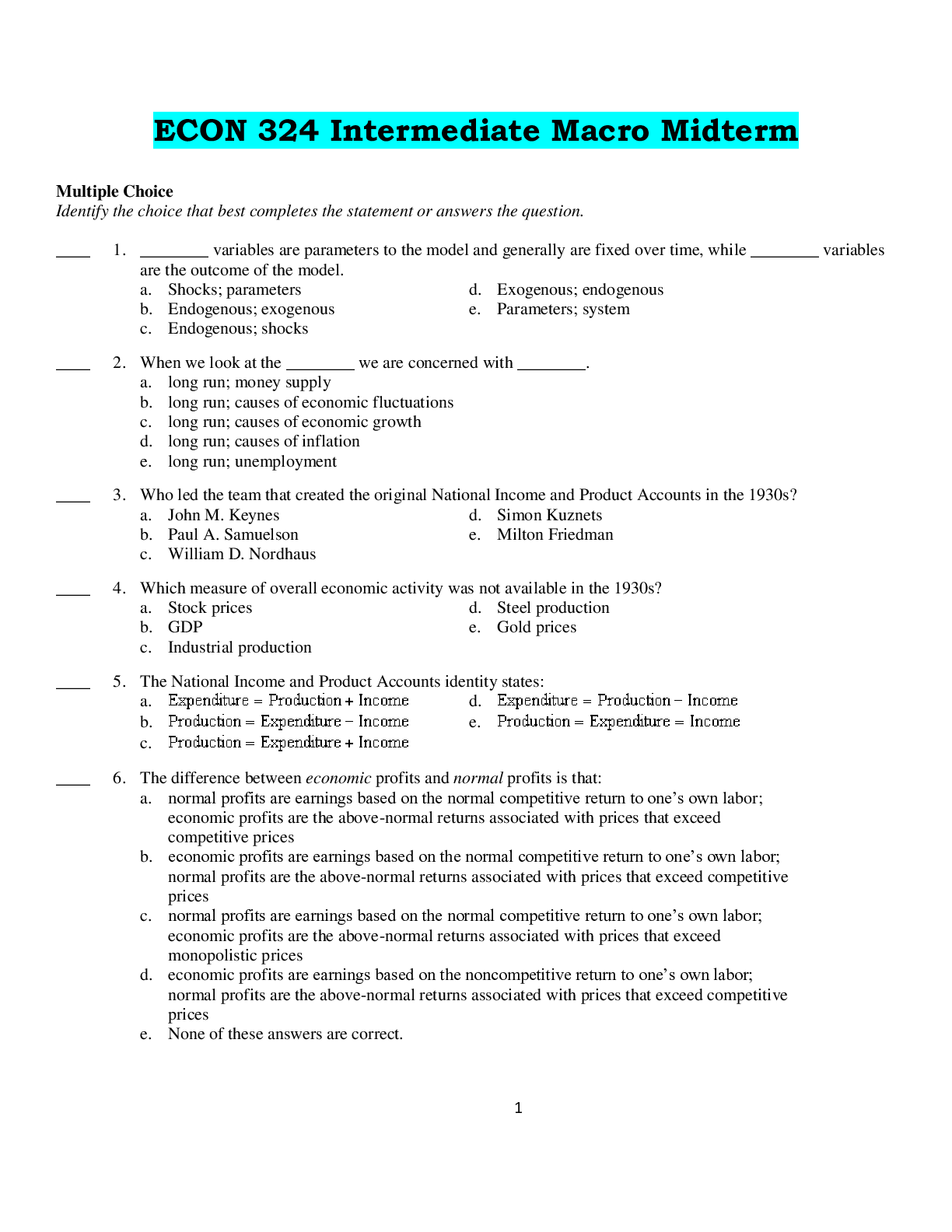
ECON 324 Intermediate Macro Midterm
Multiple Choice
Identify the choice that best completes the statement or answers the question.
____ 1. ________ variables are parameters to the model and generally are fixed over time, while ________ variables
are the outcome of the model.
a. Shocks; parameters d. Exogenous; endogenous
b. Endogenous; exogenous e. Parameters; system
c. Endogenous; shocks
____ 2. When we look at the ________ we are concerned with ________.
a. long run; money supply
b. long run; causes of economic fluctuations
c. long run; causes of economic growth
d. long run; causes of inflation
e. long run; unemployment
____ 3. Who led the team that created the original National Income and Product Accounts in the 1930s?
a. John M. Keynes d. Simon Kuznets
b. Paul A. Samuelson e. Milton Friedman
c. William D. Nordhaus
____ 4. Which measure of overall economic activity was not available in the 1930s?
a. Stock prices d. Steel production
b. GDP e. Gold prices
c. Industrial production
____ 5. The National Income and Product Accounts identity states:
a. d.
b. e.
c.
____ 6. The difference between economic profits and normal profits is that:
a. normal profits are earnings based on the normal competitive return to one’s own labor;
economic profits are the above-normal returns associated with prices that exceed
competitive prices
b. economic profits are earnings based on the normal competitive return to one’s own labor;
normal profits are the above-normal returns associated with prices that exceed competitive
prices
c. normal profits are earnings based on the normal competitive return to one’s own labor;
economic profits are the above-normal returns associated with prices that exceed
monopolistic prices
d. economic profits are earnings based on the noncompetitive return to one’s own labor;
normal profits are the above-normal returns associated with prices that exceed competitive
prices
e. None of these answers are correct.2
____ 7. According to the expenditure approach, if Y is GDP, C is consumption, I is investment, G is government
purchases, and NX is net exports, the national income identity can be written as:
a. d.
b. e.
c.
____ 8. In 2012, government expenditures accounted for about ________ of total GDP.
a. 5 percent d. 13 percent
b. 4 percent e. 20 percent
c. 66 percent
____ 9. Net exports are also called:
a. capital outflows d. foreign aid
b. the trade balance e. government transfers
c. the current account
____ 10. By how much does the current GDP rise in the following scenario? A real estate agent sells a house for
$250,000 that the previous owners had purchased 10 years earlier for $90,000. The real estate agent earns a
commission of $10,000.
a. $160,000 d. $90,000
b. $250,000 e. $260,000
c. $10,000
____ 11. Nominal GDP is the ________ of all goods and services produced in a period of time using ________ prices.
a. value; 1945 d. value; current
b. summation; current e. summation; base year
c. value; a previous year’s
____ 12. The percent change in the nominal GDP is given as:
a. percent change in the price level + percent change in real GDP
b. percent change in the price level – percent change in real GDP
c. percent change in the price level percent change in real GDP
d. percent change in the price level ÷ percent change in real GDP
e. price level percent change in real GDP
____ 13. If the percent change in the price level is ________ than the percent change in ________, ________.
a. smaller; nominal GDP; real GDP shrinks
b. greater; nominal GDP; real GDP shrinks
c. greater; real GDP; nominal GDP shrinks
d. greater; real GDP; nominal GDP always stays the same
e. Not enough information is given.
____ 14. If we calculate the real GDP using the initial period’s prices, we are using a ________ index. If, instead, we
use the final period’s prices, we are using a ________ index.
a. Paasche; chain-weighted d. Paasche; Laspeyres
b. Laspeyres; chain-weighted e. chain-weighted; Fisher
c. Laspeyres; Paasche
____ 15. If the nominal GDP rises by 3 percent and the price level rises by 5 percent, then the real GDP ________ by
________.
a. rises; 8 percent d. falls; 2 percent3
b. falls; 8 percent e. None of these answers are correct.
c. rises; 2 percent
Refer to the following table when answering the next four questions.
Table 2.4: U.S. and Eurozone Nominal GDP in 2011
2011
Eurozone nominal GDP (€ billions) €13,144
U.S. nominal GDP ($ billions) $15,100
Dollar/euro exchange rate $1.28/€1
PEZ /PUS 0.96
____ 16. Consider the data in Table 2.4. The value of Eurozone nominal GDP in U.S. dollars is:
a. $15,729 billion d. $10,269 billion
b. $11,797 billion e. $17,525 billion
c. $16,824 billion
____ 17. According to historical data, the wages in ancient Greece and Rome were ________ in sixteenth-century
Britain or eighteenth-century France.
a. somewhat lower than d. about the same as
b. a lot higher than e. None of these answers are correct.
c. a lot lower than
____ 18. The birthplace of modern economic growth was in ________ during the ________ century.
a. Japan; mid-twentieth d. China; late twentieth
b. the United States; mid-nineteenth e. Germany; early nineteenth
c. the United Kingdom; mid-eighteenth
____ 19. Defining per capita GDP in 2013 as y2013 and per capita GDP in 2014 as y2014, the growth rate of per capita
GDP, , from 2013 to 2014 is given by:
a. d.
b. e.
c.
____ 20. According to the constant growth rate rule, if a variable starts at some initial value y0 at t = 0 and grows at
at a constant rate then the value of the variable in three periods is given by:
a. d.
b. e.
c.
____ 21. The compression of the vertical axis at “key doubling points” is called:
a. the quadratic scale d. the ratio scale
b. the logarithmic scale e. the geometric scale
c. the exponential scale
____ 22. Suppose there are L0 people in the world today. If the population growth rate equals , then in 50 years, the
world population will be:4
a. d.
b. e.
c.
____ 23. When a lower-income economy’s GDP is able to “catch up” with a higher-income economy’s GDP, this
behavior is related to an important concept in the study of economic:
a. growth d. fluctuations
b. divergence e. asset markets
c. convergence
____ 24. Between 1960 and 2010, the fraction of the world’s population that lived on $5 a day or less ________. This
can be attributed to, in part, ________.
a. fell; a shrinking global population
b. stayed about the same; global warming
c. fell; economic growth in China and India
d. rose; rising oil prices
e. rose; the financial crisis
____ 25. Which of the following is/are the benefit(s) of economic growth?
a. an expansion in the range of goods and services available
b. shorter expected lifespans
c. more pollution
d. lower government deficits
e. lower productivity
____ 26. A model is a ________ representation of ________ world that we use to study economic phenomena.
a. false; a toy d. mathematical; the real
b. mathematical; a toy e. accurate; a toy
c. accurate; the real
____ 27. The following equation is an example of ________: .
a. a consumption function d. the production possibilities frontier
b. a utility function e. a growth model
c. a production function
____ 28. In the equation , the “bar” over the A means that it is:
a. a parameter that is endogenous
b. a variable that is fixed but not exogenous
c. a parameter that is variable or exogenous
d. a variable that is endogenous
e. a parameter that is fixed and exogenous
____ 29. The two main inputs we consider in a simple production function are:
a. land and labor d. utilities and capital
b. capital and land e. natural resources and labor
c. capital and labor
____ 30. Consider two countries, labeled 1 and 2. Each has the production function , i = 1, 2. If the only
difference between the two countries is that A1 > A2,5
a. Country 2 will not produce anything, ceteris paribus.
b. Country 2 will produce more than Country 1, ceteris paribus.
c. Country 1 will produce more than Country 2, ceteris paribus.
d. Each will produce the same amount, ceteris paribus.
e. Not enough information is given.
____ 31. The equation is called:
a. the Lucas production function
b. the Keynesian production function
c. the Friedman-Schwartz production function
d. the Cobb-Douglas production function
e. the Glass-Steagall production function
____ 32. Which of the following production functions exhibits constant returns to scale?
a. d.
b. e. All of these answers are correct.
c.
____ 33. The solution to the firm’s maximization problem is:
a. how much capital and labor to hire given the rental rate of capital and labor’s wage rate
b. how much capital and labor to hire given the rental rate of capital only
c. how much capital to hire given the rental rate of capital
d. how much capital and labor to hire regardless of the rental rate of capital and labor’s wage
rate
e. how much labor to hire given labor’s wage rate
____ 34. The marginal product of labor is defined as:
a. output divided by labor
b. the additional output generated by hiring an additional unit of labor
c. the additional output generated by hiring an additional unit of labor and capital
d. the additional output generated by hiring an additional unit of capital
e. the additional revenue generated by hiring an additional unit of labor
Refer to the following figure when answering the next two questions.
Figure 4.2: The Production Function6
____ 35. Consider Figure 4.2. The shape of this production function suggests:
a. a constant marginal product of capital
b. a diminishing marginal product of capital
c. a diminishing marginal product of labor
d. an increasing marginal product of capital
e. Not enough information is given.
____ 36. If MPK > r, the firm:
a. should hire more labor
b. should hire more capital until MPK = 0
c. should get rid of some capital until MPK = r
d. should hire more capital until MPK = r
e. has the optimal amount of capital
____ 37. The marginal product of labor is measured in:
a. dollars d. units of capital per dollar
b. units of output e. units of labor per dollar
c. units of output per dollar
____ 38. In models with perfect competition:
a. economic profits are always positive
b. accounting profits are zero
c. income paid to labor is the same as is paid to capital
d. the real interest rate is equal to the nominal interest rate
e. economic profits are zero
____ 39. In 1960, the Phillipines had a per capita income ________ South Korea. In 2010, ________.
a. lower than; this situation had reversed
b. lower than; per capita income was equal in both countries
c. equal to; South Korea had relatively higher per capita income
d. higher than; this situation had reversed
e. higher than; this difference was even more pronounced
____ 40. In the corn farm example, corn can be used as:
a. only investment d. either consumption or investment7
b. either saving or depreciation e. tax revenue
c. only consumption
____ 41. If Ct denotes consumption, It denotes investment, and Yt is output, the resource constraint in the Solow model
is:
a. Yt = Ct It d.
b. e. None of these answers are correct.
c.
____ 42. In the Solow model, in every period, a fraction of total output ________ next period’s capital stock, which
________.
a. is saved; reduces d. is consumed; adds to
b. depreciates; adds to e. is consumed; reduces
c. is saved; adds to
____ 43. In the Solow model, if investment is ________ depreciation, the capital stock ________.
a. less than; grows d. equal to; declines
b. greater than; grows e. equal to; grows
c. greater than; declines
____ 44. The Solow model assumes the saving rate is:
a. zero d. increasing as income increases
b. constant e. larger as the interest rate rises
c. decreasing as income increases
____ 45. The steady state is defined as the point where capital accumulation, Kt, is equal to:
a. the saving rate d. the productivity growth rate
b. zero e. the population growth rate
c. the depreciation rate
____ 46. In the Solow model, the steady-state level of output per worker is a function of:
a. productivity and the initial capital stock
b. the initial capital stock, productivity, and the saving rate
c. the initial capital stock, productivity, and the depreciation rate
d. the initial capital stock and the steady-state level of capital stock
e. productivity, the depreciation rate, and the saving rate
Refer to the following figure when answering the next two questions.
Figure 5.3: Solow Diagram8
____ 47. In Figure 5.3, at K1, the difference between and is ________ and the difference between Y
and is ________.
a. output; investment d. output; consumption
b. net investment; consumption e. depreciation; gross investment
c. gross investment; consumption
____ 48. The key difference between the Solow model and the production model is:
a. the Solow model endogenizes the process of capital accumulation
b. the standard model endogenizes the process of capital accumulation
c. the Solow model uses different values for the capital share
d. the Solow model does not contain a productivity measure
e. the Solow model exogenizes the process of capital accumulation
____ 49. An implication of the Solow model is that once an economy reaches the steady state,
a. per capita consumption is constant
b. per capita output is constant, but per capita capital is not
c. per capita capital is variable
d. per capita consumption continues to grow
e. per capita consumption is growing
____ 50. In Romer’s influential paper he divided the economic world into:
a. resources and ideas d. utilities and objects
b. objects and resources e. None of these answers are correct.
c. objects and ideas
____ 51. According the text, there are approximately ________ different coherent paragraphs written with 100 words
or less in the English language.
a. 1020,000 d. 10430
b. 20,000 e. 4 1077
c. 10330
____ 52. Which of the following is a nonrival good?
a. a peanut butter sandwich
b. orange juice
c. a jacket
d. All of these answers are correct.9
e. None of these answers are correct.
____ 53. Increasing returns to scale is characterized by:
a. constantly declining fixed costs
b. diseconomies of scale; that is, the average cost falls as output rises
c. economies of scale; that is, the average cost rises as output rises
d. diseconomies of scale; that is, the average cost is constant as output rises
e. economies of scale; that is, the average cost falls as output rises
____ 54. If there are large fixed costs due to research and development, perfect competition does not generate new
ideas because:
a. firms need to recoup these costs through higher profits
b. with monopolistic competition, prices are equal to the marginal cost
c. with monopolistic competition, prices are equal to the marginal cost minus a markup
d. perfectly competitive firms always set prices lower than the marginal cost
e. the government does not adequately fund innovation
____ 55. Which of the following can be used to give firms incentive to innovate?
a. patents d. subsidies
b. copyrights e. All of these answers are correct.
c. prizes
____ 56. In the Romer model, what two key goods are produced?
a. a government good and new ideas
b. a consumption good and new ideas
c. a consumption good and total factor productivity
d. a consumption good and capital
e. None of these answers are correct.
____ 57. In the knowledge production function represents:
a. natural resources
b. the cost of producing new ideas
c. the marginal cost of labor
d. how good an economy is at generating knowledge
e. labor’s wage
____ 58. In the Romer model, ________ is the resource constraint.
a. and d.
b. e. There is no resource constraint.
c.
____ 59. In the Romer model, output is increasing in ________ and decreasing in ________.
a. the saving rate; the depreciation rate
b. the research share; the growth rate of knowledge
c. the growth rate of knowledge; the fraction of population in the ideas sector
d. the growth rate of knowledge; the depreciation rate
e. the saving rate; the growth rate of knowledge
____ 60. Idea accumulation in the Romer model exhibits:
a. increasing returns to capital10
b. diminishing returns in the stock of ideas
c. negative returns in the stock of ideas
d. no diminishing returns in the stock of ideas
e. diminishing returns to labor
____ 61. The quote “Inflation is always and everywhere a monetary phenomenon” is attributed to:
a. Karl Marx d. Alan Greenspan
b. Thomas Sargent e. David Ricardo
c. Milton Friedman
____ 62. If Pt is the price level in time t, inflation is calculated as:
a. 1/Pt d.
b. e.
c.
____ 63. Money that has no intrinsic value except as money is called ________ money.
a. bonded d. intrinsic
b. commodity e. None of these answers are correct.
c. fiat
____ 64. The monetary base consists of:
a. reserves and currency
b. M1 plus M2
c. only M1
d. gold reserves plus currency
e. a country’s holdings of foreign and domestic currencies
____ 65. The velocity of money can be calculated from the quantity equation with:
a. PtYt d. PtYt/Mt
b. PtYt Mt e. Mt
c. Mt /PtYt
____ 66. You are the head of the central bank and you want to maintain 2 percent long-run inflation, using the quantity
theory of money. If the real GDP growth is 4 percent and velocity is constant, you suggest a:
a. 6 percent interest rate d. 0 percent money supply growth
b. 6 percent money supply growth e. 2 percent interest rate
c. 2 percent money supply growth
____ 67. The proposition that changes in money have no real effect on the economy and affect only prices is called:
a. inflation d. the neutrality of money
b. the classical dichotomy e. the quantity theory
c. the quantity equation
____ 68. If the inflation rate is larger than the nominal interest rate:
a. unemployment rises
b. the real interest rate is zero
c. the real interest rate is negative
d. the real interest rate is larger than the nominal interest rate
e. Not enough information is given.
____ 69. Inflation ________ price volatility and ________ allocative efficiency.11
a. decreases; increases d. increases; decreases
b. decreases; leaves unchanged e. leaves unchanged; increases
c. increases; leaves unchanged
Answers
1 D
2 C
3 D
4 B
5 E
6 A
7 E
8 E
9 A
10 C
11 D
12 A
13 B
14 C
15 D
16 C
17 D
18 C
19 D
20 C
21 D
22 B
23 C
24 C
25 A
26 B
27 C
28 E
29 C
30 C
31 D
32 E
33 A
34 B
35 C
36 D12
37 B
38 E
39 C
40 D
41 B
42 C
43 B
44 B
45 B
46 E
47 B
48 A
49 A
50 C
51 D
52 E
53 E
54 A
55 E
56 B
57 D
58 B
59 C
60 D
61 C
62 E
63 C
64 A
65 D
66 B
67 D
68 C
69 D
[Show More]

.png)
.png)