HESI Practice
2017 Mental Health PN Hesi Specialty V1
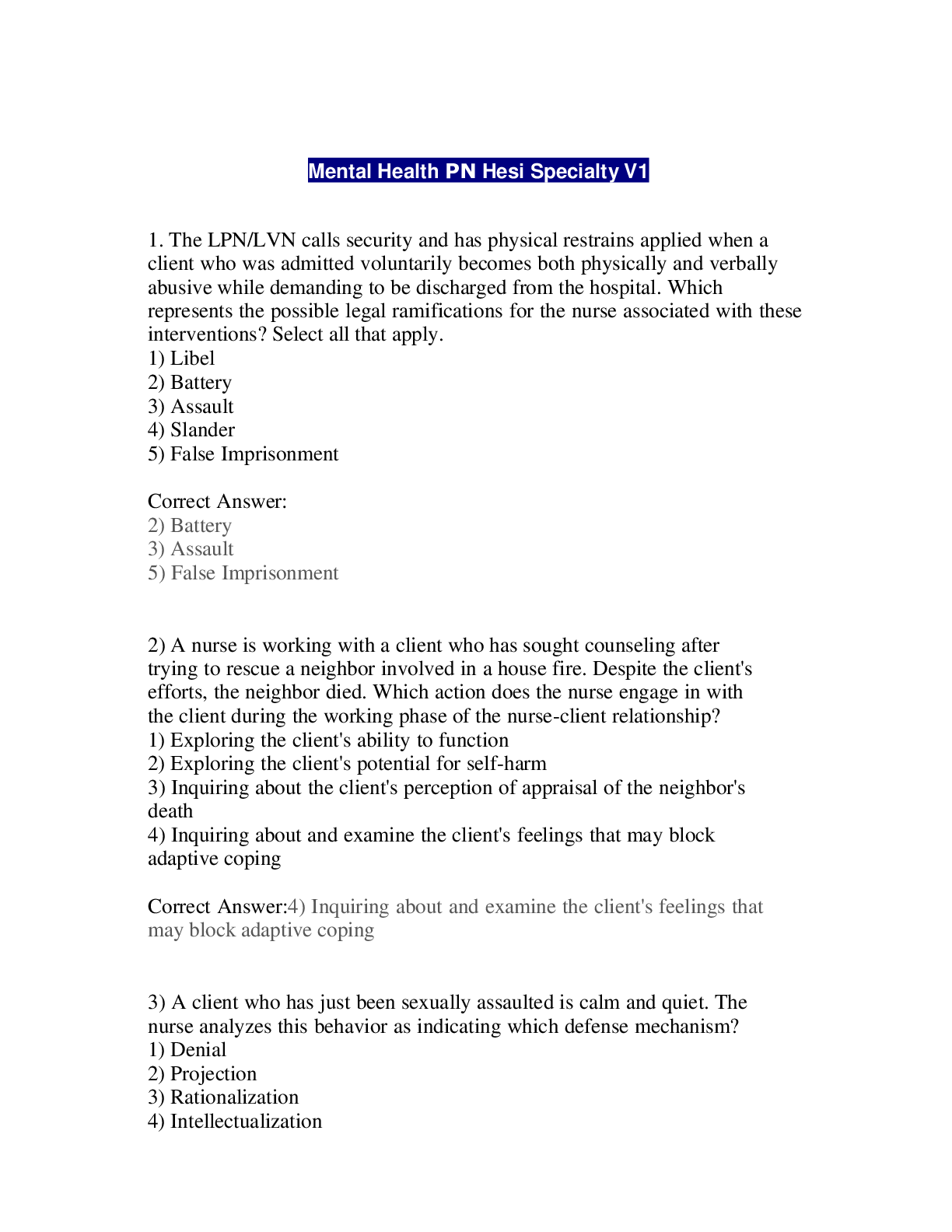
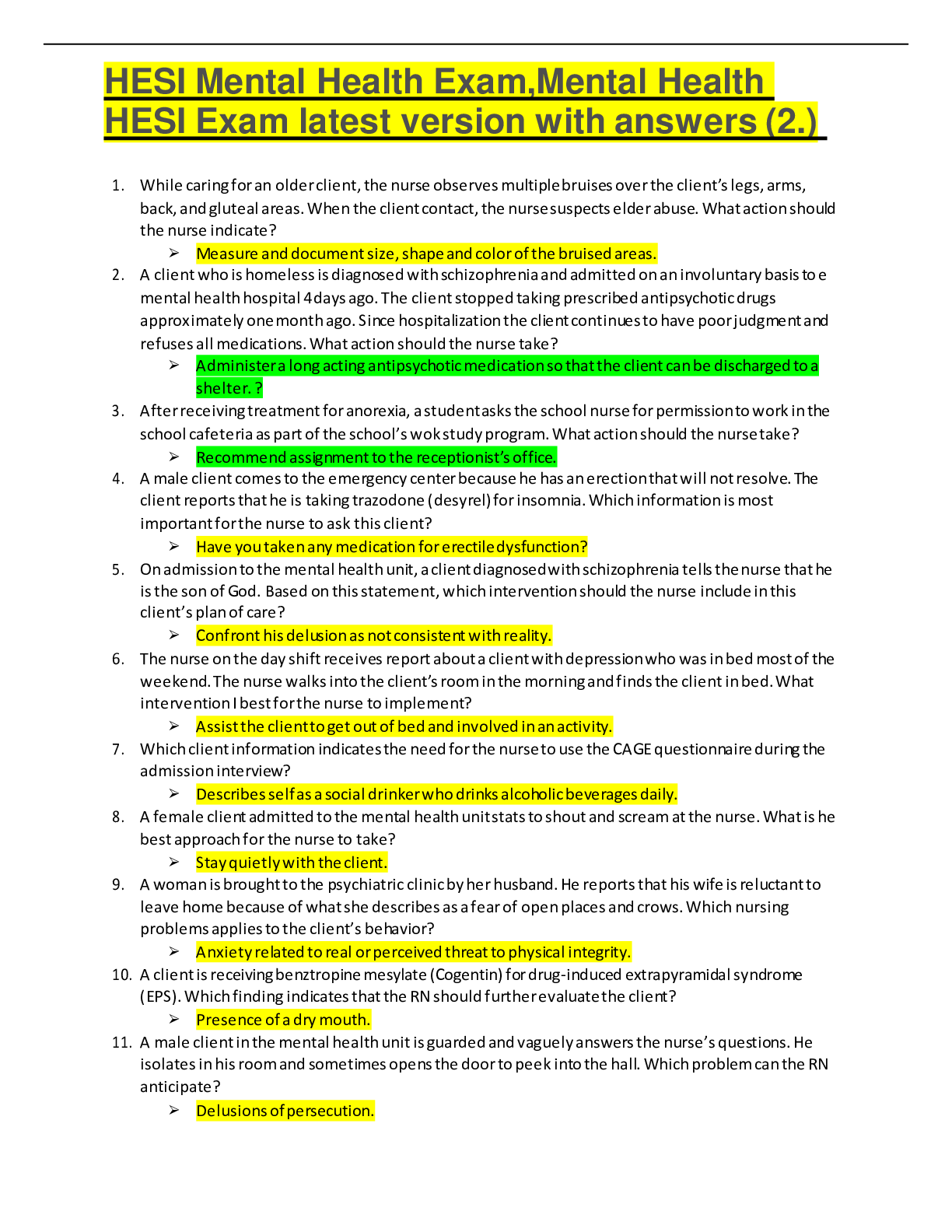
1. The LPN/LVN calls security and has physical restrains applied when a
client who was admitted voluntarily becomes both physically and verbally
abusive while dem
...
HESI Practice
2017 Mental Health PN Hesi Specialty V1
1. The LPN/LVN calls security and has physical restrains applied when a
client who was admitted voluntarily becomes both physically and verbally
abusive while demanding to be discharged from the hospital. Which
represents the possible legal ramifications for the nurse associated with these
interventions? Select all that apply.
1) Libel
2) Battery
3) Assault
4) Slander
5) False Imprisonment
Correct Answer:
2) Battery
3) Assault
5) False Imprisonment
2) A nurse is working with a client who has sought counseling after
trying to rescue a neighbor involved in a house fire. Despite the client's
efforts, the neighbor died. Which action does the nurse engage in with
the client during the working phase of the nurse-client relationship?
1) Exploring the client's ability to function
2) Exploring the client's potential for self-harm
3) Inquiring about the client's perception of appraisal of the neighbor's
death
4) Inquiring about and examine the client's feelings that may block
adaptive coping
Correct Answer:4) Inquiring about and examine the client's feelings that
may block adaptive coping
3) A client who has just been sexually assaulted is calm and quiet. The
nurse analyzes this behavior as indicating which defense mechanism?
1) Denial
2) Projection
3) Rationalization
4) IntellectualizationCorrect Answer:1) Denial
4) Unresolved feelings related to loss most likely may be recognized
during which phase of the therapeutic nurse-client relationship?
1) Working
2) Trusting
3) Orientation
4) Termination
Correct Answer: 4) Termination
5) Which statement demonstrates the best understanding of the nurse's
role regarding ensuring that each client's rights are respected?
1) "Autonomy is the fundamental right of each and every client."
2) "A client's rights are guaranteed by both state and federal laws."
3) "Being respectful and concerned will ensure that I'm attentive to my
clients' rights."
4) "Regardless of the client's condition, all nurses have the duty to
respect client rights."
Correct Answer: 3) "Being respectful and concerned will ensure that I'm
attentive to my clients' rights."
6) A LPN/LVN employed in a mental health unit of a hospital is the
leader of a group psychotherapy session. The nurses's role in the
termination stage of group development is to:
1) Encourage problem solving
2) Encourage accomplishment of the group's work
3) Acknowledge the contributions of each group member
4) Encourage members to become acquainted with one another
Correct Answer: 3) Acknowledge the contributions of each group member
7) A male client with delirium becomes disoriented and confused in his
room at night. The best initial nursing intervention is to:
1) Move the client next to the nurse's station2) Use an indirect light source and turn off the television
3) Keep the television and a soft light on during the night
4) Play soft music during the night, and maintain a well-lit room
2) Use an indirect light source and turn off the television
8) A client is admitted to a medical nursing unit with a diagnosis of
acute blindness. Many tests are performed, and there seems to be no
organic reason why this client cannot see. The client became blind after
witnessing a hit-and-run car accident, when a family of three was killed.
A LPN/LVN suspects that the client may be experiencing a:
1) Psychosis
2) Repression
3) Conversion Disorder
4) Dissociative Disorder
Correct Answer: 3) Conversion Disorder
9) A manic client announces to everyone in the day room that a stripper
is coming to perform this evening. When a nurse firmly states that this
is inappropriate and will not happen, the client becomes verbally
abusive and threatens physical violence to the nurse. Based on the
analysis of this situation, the LPN/LVN determines that the appropriate
action would be to:
1) Orient the client to time, person, and place
2) Tell the client that the behavior is inappropriate
3) Escort the manic client to her room, with assistance
4) Tell the client that smoking privileges are revoked for 24 hours
Correct Answer: 3) Escort the manic client to her room, with assistance
10) A LPN/LVN observes that a client is pacing, agitated, and
presenting aggressive gestures. The client's speech pattern is rapid, and
affect is belligerent. Based on these observations, the nurse's immediate
priority of care is to:
1) Provide safety for the client and other clients on the unit
2) Provide the clients on the unit with a sense of comfort and safety
3) Assist the staff in caring for the client in a controlled environment
4) Offer the client a less stimulated area to calm down and gain controlCorrect Answer: 1) Provide safety for the client and other clients on the unit
11) Select the nursing interventions for a hospitalized client with mania
who is exhibiting manipulative behavior. Select all that apply.
1) Communicate expected behaviors to the client
2) Ensure that the client knows that he or she is not in charge of the
nursing unit
3) Assist the client in identifying ways of setting limits on personal
behaviors
4) Follow through about the consequences of behavior in a non punitive
manner
5) Enforce rules and inform the client that he or she will not be allowed
to attend therapy groups
6) Be clear with the client regarding the consequences of exceeding
limits that have been set regarding behavior
Correct Answer:
1) Communicate expected behaviors to the client
3) Assist the client in identifying ways of setting limits on personal
behaviors
4) Follow through about the consequences of behavior in a non punitive
manner
6) Be clear with the client regarding the consequences of exceeding limits
that have been set regarding behavior
12) A nurse determines that the wife of an alcoholic client is benefitting
from attending an Al-Anon group when the nurse hears the wife say:
1) "I no longer feel that I deserve the meetings my husband inflicts on
me."
2) "My attendance at the meetings has helped me to see that I provoke
my husbands violence."
3) "I enjoy attending the meetings because they get me out of the house
and away from my husband."
4) "I can tolerate my husband's destructive behaviors now that I know
they are common with alcoholics."
Correct Answer: 1) "I no longer feel that I deserve the meetings my husband
inflicts on me."13) An LPN/LVN is reviewing the assessment data of a client admitted
to the mental health unit. The nurse notes that the admission nurse
documented that the client is experiencing anxiety as a result of a
situational crisis. The nurse determines that this type of crisis is caused
by:
1) Witnessing a murder
2) The death of a loved one
3) A fire that destroyed the client's home
4) A recent rape episode experienced by the client
Correct Answer: 2) The death of a loved one
14) An LPN/LVN is conducting an initial assessment on a client in
crisis. When assessing the client's perception of the precipitating
event that lead to the crisis, the appropriate question to ask is:
1) "With whom do you live?"
2) "Who is available to help you?"
3) "What leads you to seek help now?"
4) "What do you usually do to feel better?"
Correct Answer: 3) "What leads you to seek help now?"
15) A moderately depressed client who was hospitalized 2 days ago
suddenly begins smiling and reporting that the crisis is over. The client
says to a nurse "I'm finally cured." The LPN/LVN interprets this
behavior as a cue to modify the treatment plan by:
1) Suggesting a reduction of medication
2) Allowing increased "in-room" activities
3) Increasing the level of suicide precautions
4) Allowing the client off-unit privileges as needed
Correct Answer: 3) Increasing the level of suicide precautions
16) An emergency department nurse is caring for an adult client who is
a victim of family violence. Which priority instruction would be
included in the discharge instructions?
1) Information regarding shelters
2) Instructions regarding calling the police3) Instructions regarding self-defense classes
4) Explaining the importance of leaving the violent situation
Correct Answer: 1) Information regarding shelters
17) A female victim of sexual assault is being seen in the crisis center.
The client states that she still feels "as though the rape just happened
yesterday," even though it has been a few months since the incident.
The appropriate nursing response is which of the following?
1) "You need to try and be realistic. The rape did not just occur."
2) "It will take some time to get over these feelings about your rape."
3) "Tell me more about the incident that causes you to feel like the rape
just occurred."
4) "What do you think that you can do to alleviate some of your fears
about being raped again?"
Correct Answer: 3) "Tell me more about the incident that causes you to feel
like the rape just occurred."
18) A LPN/LVN is preparing to care for a dying client, and several family
members are at the client' bedside. Select the therapeutic techniques that the
nurse would use when communicating with the family. Select all
that apply.
1) Discourage reminiscing
2) Make decisions for the family
3) Encourage expression of feelings, concerns, and fears
4) Explain everything that is happening to all family members
5) Touch and hold the client's or family member's hands if appropriate
6) Be honest and let the client and family know that they will not be
abandoned by the nurse
Correct Answer:
3) Encourage expression of feelings, concerns, and fears 5) Touch and hold
the client's or family member's hands if appropriate
6) Be honest and let the client and family know that they will not be
abandoned by the nurse
19) A client's medication sheet contains a prescription for sertraline
(Zoloft). To ensure safe administration of the medication, a nurse wouldadminister the dose:
1) On an empty stomach
2) At the same time each evening
3) Evenly spaced around the clock
4) As needed when the client complains of depression
Correct Answer: 2) At the same time each evening
20) A LPN/LVN is preforming a follow-up teaching session with a
client discharged 1 month ago. The client is taking fluoxetine (Prozac).
What information would be important for the nurse to obtain during this
client visit regarding the side effects of the medication?
1) Cardiovascular symptoms
2) Gastrointestinal dysfunctions
3) Problems with mouth dryness
4) Problems with excessive sweating
Correct Answer: 2) Gastrointestinal dysfunctions
21) A LVN/LPN is caring for a client with anorexia nervosa. The nurse
is monitoring the behavior of the client and understands that a client
with anorexia nervosa manages anxiety by:
1) Engaging in immoral acts
2) Always reinforcing self-approval
3) Observing rigid rules and regulations
4) Having the need always to make the right decision
Correct Answer: 3) Observing rigid rules and regulations
22) A LPN/LVN is caring for a suicidal client. The appropriate
nursing intervention in dealing with this client is to:
1) Demonstrate confidence in the client's ability to deal with stressors
2) Provide hope and reassurance that the problems will resolve
themselves
3) Display an attitude of detachment, confrontation, and efficiency
4) Provide authority, action, and participation
Correct Answer: 4) Provide authority, action, and participation23) A client in a long-term care facility who has multiple sclerosis is
embarrassed about the need to use a wheelchair and the muscle spasms
that are readily visible in her legs. Which approach is therapeutic in
assisting the client to cope?
1) Keep the client in her room as much as possible
2) Assist the client with all activities of daily living
3) Tell the client that many of the people in the facility have these same
sorts of problems
4) Encourage and praise perseverance in performing ADLs, and assist
the client to dress and groom daily
Correct Answer: 4) Encourage and praise perseverance in performing ADLs,
and assist the client to dress and groom daily
24) On admission assessment, the nurse is obtaining subjective data
about a client's sexual and reproductive status. The client states, "I don't want
to discuss this; it's private and personal." Which response by the LVN/LPN
is the most therapeutic?
1) "I'd hate being asked these sorts of questions too, but it's a necessary
part of providing you with the best care."
2) "This is difficult for you to speak about, but I need this information
from you in order to perform a complete assessment."
3) "I am a professional registered nurse, and, as such, I'll have you know
that all your information is certainly kept confidential."
4) "I know that some of these questions are difficult for you, but, as a
professional nurse, I am obligated to respect your confidentiality."
Correct Answer: 4) "I know that some of these questions are difficult for
you, but, as a professional nurse, I am obligated to respect your
confidentiality."
25) The LPN/LVN should include which information in the nursing plan
of care for a client with obsessive-compulsive disorder (OCD)? Select
all that apply.
1) The medical diagnosis of the client
2) Individualized goals and objectives
3) Attendance at group therapy sessions
4) Self-care measures to improve hygiene
5) Interruption of all compulsive behaviorsCorrect Answer:
2) Individualized goals and objectives
3) Attendance at group therapy sessions
4) Self-care measures to improve hygiene
26) A client in the mental health unit believes that the food is being
poisoned. What intervention(s) would be helpful when attempting to
encourage the client to eat? Select all that apply.
1) Use open-ended questions to encourage client dialogue
2) Offer opinions about the necessity for adequate nutrition
3) Focus on the client's self-disclosure about food preferences
4) Identify the reasons the client has for not wanting to eat
5) Offer the client food in closed containers, such as in cans that have to
be opened
Correct Answer:
1) Use open-ended questions to encourage client dialogue
5) Offer the client food in closed containers, such as in cans that have to be
opened
27) A client with a leg amputation is upset about his appearance. The LPN/
LVN intends to address which most closely associated psychosocial
problem?
1) Inability to be mobile
2) Isolating self from others
3) Inability to tolerate activity
4) Concern about body persona
Correct Answer: 4) Concern about body persona
28) A client with an eating disorder is planning to attend group meetings
with Overeaters Anonymous. The LPN/LVN describes this group to the
client, knowing that which finding(s) are characteristic of this form of
self-help group? Select all that apply.
1) A common goal is shared by all members
2) Members are required to remain anonymous
3) The leader is a professional mental health care provider
4) Attendance must be prescribed by the health care provider5) The program is designed to provide support and bring about personal
change
6) The group is composed of individuals who are experiencing similar
problems
Correct Answer:
1) A common goal is shared by all members
5) The program is designed to provide support and bring about personal
change
6) The group is composed of individuals who are experiencing similar
problems
29) A client with schizophrenia is experiencing distressful thoughts
secondary to paranoia. Which intervention(s) should the LPN/LVN
include in the plan of care? Select all that apply.
1) Avoid laughing when near the client
2) Whisper when communicating near the client
3) Increase socialization of the client among his peers
4) Have the client sign a written release of information form
5) Provide food items that are in containers that need to be opened
6) Begin to educate the client about social supports in the community
Correct Answer:
1) Avoid laughing when near the client
5) Provide food items that are in containers that need to be opened
30) A client is preparing to attend at Gamblers Anonymous meeting for
the first time. The prototype used by this group is the 12-step program
developed by Alcoholics Anonymous. Number in order of priority how
the steps would be addressed.
1) Admitting to oneself and to another human being the exact nature of
one's wrongs
2) Acknowledging that one is entirely ready to have his or her defects of
character removed
3) Admitting that oneself is powerless over gambling and that one's life
has become unmanageable
4) Making an effort to practice the 12-step principles in all affairs, and
to carry out this message to other compulsive gamblers
5) Making direct amends wherever possible to all people that have been
hurt, expect when to do so would further harm them or othersCorrect Answer:
3) Admitting that oneself is powerless over gambling and that one's life has
become unmanageable
1) Admitting to oneself and to another human being the exact nature of one's
wrongs
2) Acknowledging that one is entirely ready to have his or her defects of
character removed
5) Making direct amends wherever possible to all people that have been hurt,
expect when to do so would further harm them or others
4) Making an effort to practice the 12-step principles in all affairs, and to
carry out this message to other compulsive gamblers
31) An outpatient clinic who has been receiving haloperidol (Haldol) for
2 days develops muscular rigidity, altered consciousness, a temperature
of 103, and trouble breathing on day 3. The LPN/LVN interest these findings
as indicating which of the following.
1) Neuroleptic Malignant Syndrome
2) Tardive dyskinesia
3) Extrapyramidal adverse effects
4) Drug-induced parksonism
Correct Answer: 1) Neuroleptic Malignant Syndrome
32) A newly admitted client describes her mission in life as one of
saving her son by eliminating the "provocative sluts" of the world.
There are several attractive young women on the unit. What should the
LPN/LVN do first?
1) Ask the client for her definition of "provocative sluts"
2) Ask the young female clients on the unit to dress less provocatively
3) Ask the client to discuss her concerns in the next group session
4) Ask the client to inform the staff if she has negative thoughts about
other clients
Correct Answer: 4) Ask the client to inform the staff if she has negative
thoughts about other clients
33) The wife of a client diagnosed with paranoid schizophrenia visits 2
days after her husband;s admission and states to the nurse, "Why isn' heeating? He's still talking about his food being poisoning." With of
the following appraisals by the LPN/LVN is most accurate?
1) The wife's inquiry is reasonable
2) Education about her husband's medication is needed
3) Her expectations of her husband are realistic
4) An increase in the client's medication is needed
Correct Answer: 2) Education about her husband's medication is needed
34) A client states that she hears God's voice telling her that she has
sinned and needs to punish herself. Which response by the LPN/LVN is
most important?
1) "How do you think you will be punished?"
2) "Please tell staff when you think you need to punish yourself."
3) "What exactly do you think you have done to be punished?"
4) "Let's talk about your strengths"
Correct Answer: 2) "Please tell staff when you think you need to punish
yourself."
35) A client diagnosed with paranoid schizophrenia is still withdrawn,
unkept, and unmotivated to get out of bed. A mental health aide asks the
nurse why the client is this way after being on fluphenazine (Prolix) 10
mg for 7 days. The LPN/LVN should tell the health aide:
1) "Prolixin is the most effective with positive symptoms of
schizophrenia."
2) "The client will be less withdrawn and unmotivated when the
Prolixin takes effect."
3) "The client's Prolix dose probably needs to be increased again."
4) "Lack of motivation is a common side effect of the Prolixin."
Correct Answer: 1) "Prolixin is the most effective with positive symptoms of
schizophrenia."
36) A client is being successfully treated with clozapine (Clozaril).
Which of the following statements by the client reflects a need for
further teaching about managing the drug's adverse effects?
1) "If I eat too many fruits, I'll get constipated."
2) I need to take the medicine with food to avoid nausea."3) "I have to get up slowly so I don't get dizzy."
4) "Sometimes I have to push myself because I'm sleepy."
Correct Answer: 1) "If I eat too many fruits, I'll get constipated."
37) The LPN/LVN is assessing a client who is taking an antipsychotic
medication. Which of the following symptoms is uniquely indicative of
neuroleptic malignant syndrome (NMS) and requires immediate
attention?
1) Very high temperature
2) Muscular rigidity
3) Tremors
4) Altered consciousness
Correct Answer: 1) Very high temperature
38) A client diagnosed with undifferentiated schizophrenia is being
discharged on aripiprazole (Ability) 5 mg every night. When developing
the teaching plan about the most common adverse effects, which of the
following should the nurse include? Select all that apply.
1) Headaches that will subside in a few weeks
2) Transient mild anxiety
3) Insomnia
4) Torticollis
Correct Answer:
4) Pill rolling movements
1) Headaches that will subside in a few weeks
2) Transient mild anxiety
3) Insomnia
39) An elderly client was prescribed Ativan 1 mg three times a day to
help calm her anxiety after her husband's death. The next day the client
calls her daughter asking when she is picking her up to go to the
graveside. The client says she has been walking up and down the
driveway for the past hour waiting for her daughter. Noting the client's
agitation, hyperactivity, and instance, the daughter calls the nurse to
report her mother's behavior. Which of the following would the nurse
suspect as the cause of the mother's behavior and what action should shesuggest?
1) The client is manic and may need a sleeping pill
2) The client is experiencing a medication interaction and should go to
the ED
3) The client is experiencing a paradoxical reaction to the Ativan and
should stop the new medication immediately
4) The client is overcome by grief and probably needs an antidepressant
Correct Answer:
3) The client is experiencing a paradoxical reaction to the Ativan and should
stop the new medication immediately
40) When caring for a client who has overdosed on PCP, the nurse
should be especially caucus about which of the following client
behaviors?
1) Visual hallucinations
2) Violent behavior
3) Bizarre behavior
4) Loud screaming
41) A client who is being treated with lithium carbonate for bipolar
disorder develops diarrhea, vomiting, and drowsiness. What action
should the LPN/LVN take?
1) Notify the healthcare provider immediately and prepare for
administration of an antidote.
2) Notify the healthcare provider of the symptoms prior to the next
administration of the drug.
3) Record the symptoms as normal side effects and continue
administration of the prescribed dosage.
4) Hold the medication and refuse to administer additional amounts of
the drug.
Correct Answer(s): 2) Notify the healthcare provider of the symptoms
prior to the next administration of the drug.
42) The parents of a 14-year-old boy bring their son to the hospital. He
is lethargic, but responsive. The mother states, "I think he took some ofmy pain pills." During initial assessment of the teenager, what
information is most important for the nurse to obtain from the parents?
1) If he has seemed depressed recently.
2) If a drug overdose has ever occurred before.
3) If he might have taken any other drugs.
4) If he has a desire to quit taking drugs.
Correct Answer(s): 3) If he might have taken any other drugs.
43) The wife of a male client recently diagnosed with schizophrenia
asks the nurse, "What exactly is schizophrenia? Is my husband all
right?" Which response is best for the LPN/LVN to provide to this
family member?
1) It sounds like you're worried about your husband. Let's sit down and
talk.
2) It is a chemical imbalance in the brain that causes disorganized
thinking.
3) Your husband will be just fine if he takes his medications regularly.
4) I think you should talk to your husband's psychologist about this
question.
Correct Answer(s): 2) It is a chemical imbalance in the brain that causes
disorganized thinking.
44) The community health nurse talks to a male client who has bipolar
disorder. The client explains that he sleeps 4 to 5 hours a night and is
working with his partner to start two new businesses and build an
empire. The client stopped taking his medications several days ago.
What nursing problem has the highest priority?
1) Excessive work activity.
2) Decreased need for sleep.
3) Medication management.
4) Inflated self-esteem.
Correct Answer(s): 3) Medication management.
45) At a support meeting of parents of a teenager with polysubstancedependency, a parent states, "Each time my son tries to quit taking
drugs, he gets so depressed that I'm afraid he will commit suicide." The
nurse's response should be based on which information?
1) Addiction is a chronic, incurable disease.
2) Tolerance to the effects of drugs causes feelings of depression.
3) Feelings of depression frequently lead to drug abuse and addiction.
4) Careful monitoring should be provided during withdrawal from the
drugs.
Correct Answer(s): 4) Careful monitoring should be provided during
withdrawal from the drugs.
46) The LPN/LVN observes a female client with schizophrenia
watching the news on TV. She begins to laugh softly and says, "Yes,
my love, I'll do it." When the nurse questions the client about her
comment she states, "The news commentator is my lover and he speaks
to me each evening. Only I can understand what he says." What is the
best response for the nurse to make?
1) What do you believe the news commentator said to you?
2) Let's watch news on a different television channel.
3) Does the news commentator have plans to harm you or others?
4) The news commentator is not talking to you.
Correct Answer(s): 1) What do you believe the news commentator said to
you?
47) At the first meeting of a group of older adults at a daycare center for
the elderly, the LPN/LVN asks one of the members what kinds of
things she would like to do with the group. The older woman shrugs her
shoulders and says, "You tell me, you're the leader." What is the best
response for the nurse to make?
1) Yes, I am the leader today. Would you like to be the leader
tomorrow?
2) Yes, I will be leading this group. What would you like to accomplish
during this time?
3) Yes, I have been assigned to be the leader of this group. I will be here
for the next six weeks.
4) Yes, I am the leader. You seem angry about not being the leaderyourself.
Correct Answer(s): 2) Yes, I will be leading this group. What would you
like to accomplish during this time?
48) The LPN/LVN is planning discharge for a male client with
schizophrenia. The client insists that he is returning to his apartment,
although the healthcare provider informed him that he will be moving to
a boarding home. What is the most important nursing diagnosis for
discharge planning?
1) Ineffective denial related to situational anxiety.
2) Ineffective coping related to inadequate support.
3) Social isolation related to difficult interactions.
4) Self-care deficit related to cognitive impairment.
Correct Answer(s): 1) Ineffective denial related to situational anxiety.
49) Which diet selection by a client who is depressed and taking the
MAO inhibitor tranylcypromine sulfate (Parnate) indicates to the nurse
that the client understands the dietary restrictions imposed by this
medication regimen?
1) Hamburger, French fries, and chocolate milkshake.
2) Liver and onions, broccoli, and decaffeinated coffee.
3) Pepperoni and cheese pizza, tossed salad, and a soft drink.
4) Roast beef, baked potato with butter, and iced tea.
Correct Answer(s): 4) Roast beef, baked potato with butter, and iced tea.
50) An elderly female client with advanced dementia is admitted to the
hospital with a fractured hip. The client repeatedly tells the staff, "Take
me home. I want my Mommy." Which response is best for the LPN/
LVN to provide?
1) Orient the client to the time, place, and person.
2) Tell the client that the nurse is there and will help her.
3) Remind the client that her mother is no longer living.
4) Explain the seriousness of her injury and need for hospitalization.Correct Answer(s): 2) Tell the client that the nurse is there and will help
her.
51) The LPN/LVN is assessing a client's intelligence. Which factor
should the nurse remember during this part of the mental status exam?
1) Acute psychiatric illnesses impair intelligence.
2) Intelligence is influenced by social and cultural beliefs.
3) Poor concentration skills suggests limited intelligence.
4) The inability to think abstractly indicates limited intelligence.
Correct Answer(s): 2
52) The LPN/LVN should include which interventions in the plan of
care for a severely depressed client with neurovegetative symptoms?
(Select all that apply.)
1) Permit rest periods as needed.
2) Speaking slowly and simply.
3) Place the client on suicide precautions.
4) Allow the client extra time to complete tasks.
5) Observe and encourage food and fluid intake.
6) Encourage mild exercise and short walks on the unit
Correct Answer(s): 1, 2, 4, 5, 6
53) An 86-year-old female client with Alzheimer's disease is wandering
the busy halls of the extended care facility and asks the nurse, "Where
should I stand for the parade?" Which response is best for the LPN/
LVN to provide?
1) Anywhere you want to stand as long as you do not get hurt by those
in the parade.
2) You are confused because of all the activity in the hall. There is no
parade.
3) Let us go back to the activity room and see what is going on in there.
4) Remember I told you that this is a nursing home and I am your nurse.Correct Answer(s): 3) Let us go back to the activity room and see what is
going on in there.
54) Based on non-compliance with the medication regimen, an adult
client with a medical diagnosis of substance abuse and schizophrenia
was recently switched from oral fluphenazine HCl (Prolixin) to IM
fluphenazine decanoate (Prolixin Decanoate). What is most important to
teach the client and family about this change in medication regimen?
1) Signs and symptoms of extrapyramidal effects (EPS).
2) Information about substance abuse and schizophrenia.
3) The effects of alcohol and drug interaction.
4) The availability of support groups for those with dual diagnoses.
Correct Answer(s): 3) The effects of alcohol and drug interaction.
55) An adult male client who was admitted to the mental health unit
yesterday tells the nurse that microchips were planted in his head for
military surveillance of his every move. Which response is best for the
LPN/LVN to provide?
1) You are in the hospital, and I am the nurse caring for you.
2) It must be difficult for you to control your anxious feelings.
3) Go to occupational therapy and start a project.
4) You are not in a war area now; this is the United States.
Correct Answer(s): 3) Go to occupational therapy and start a project.
[Show More]







.png)