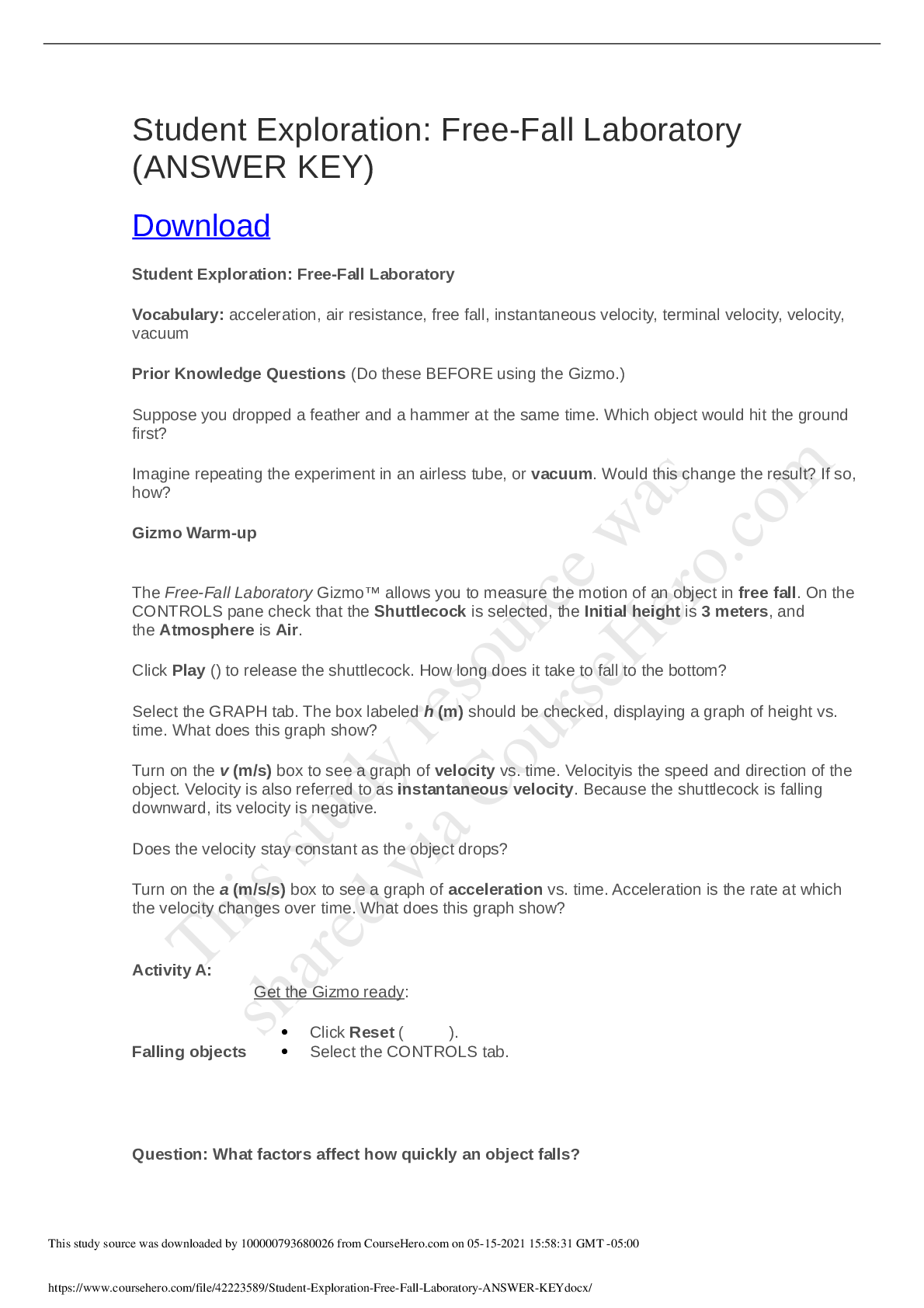
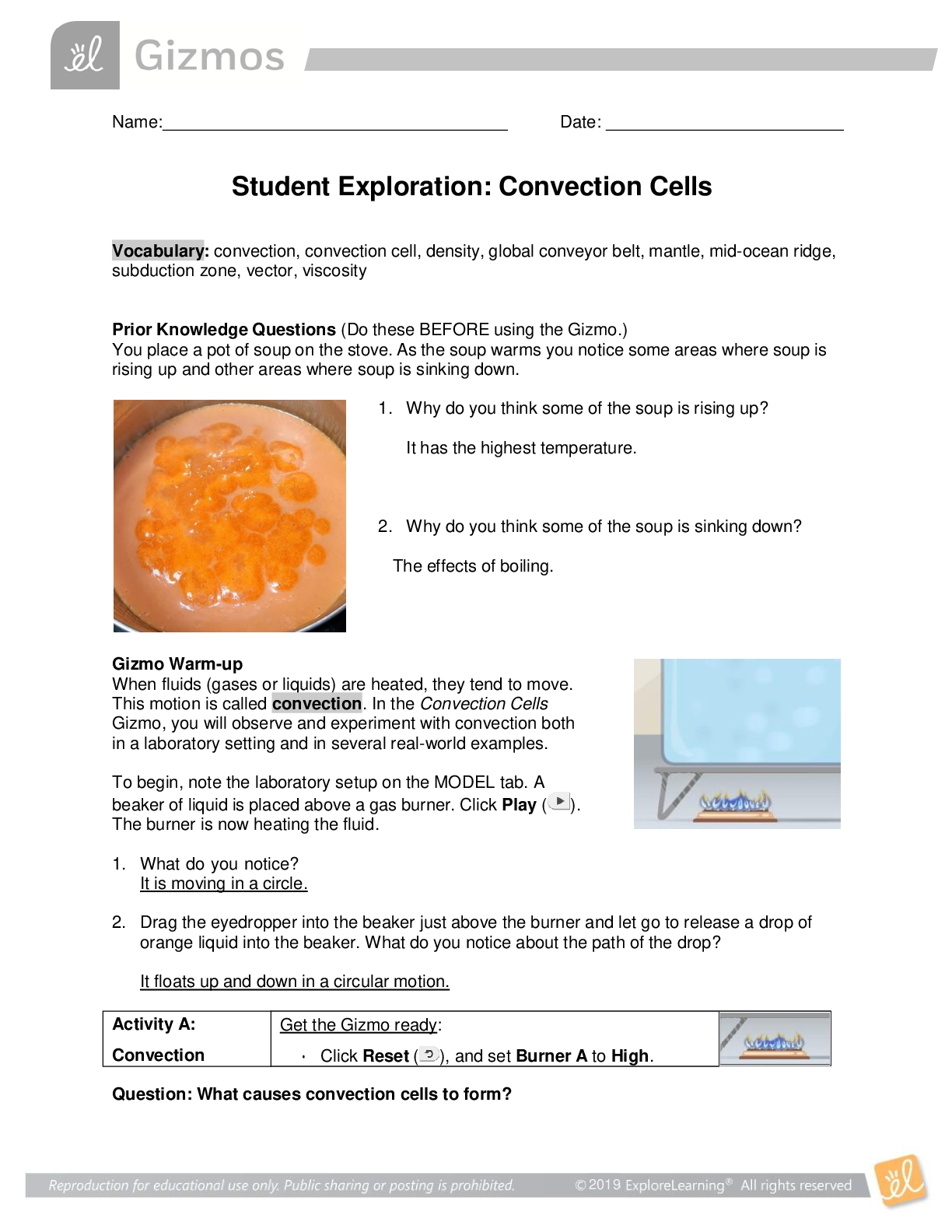
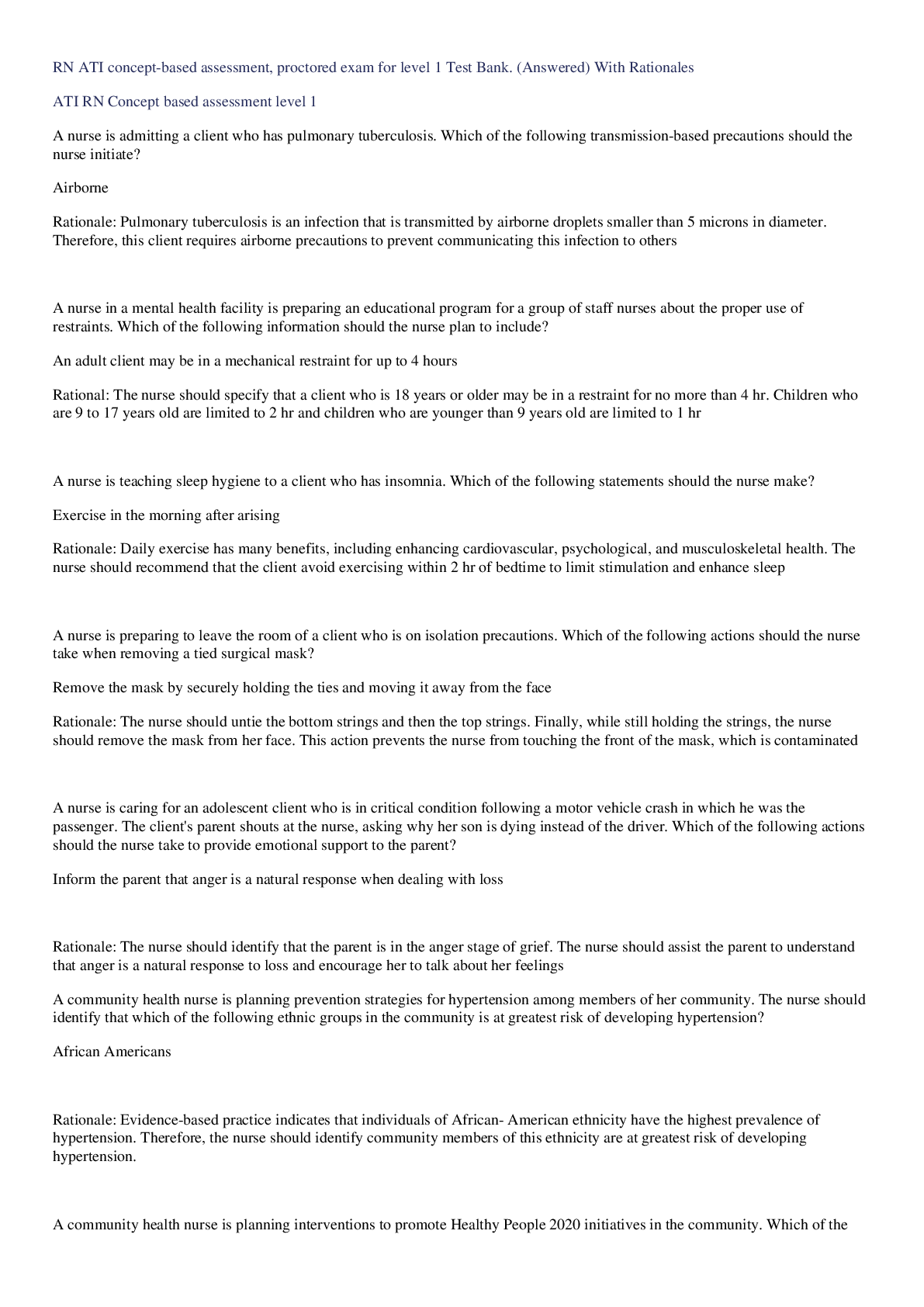
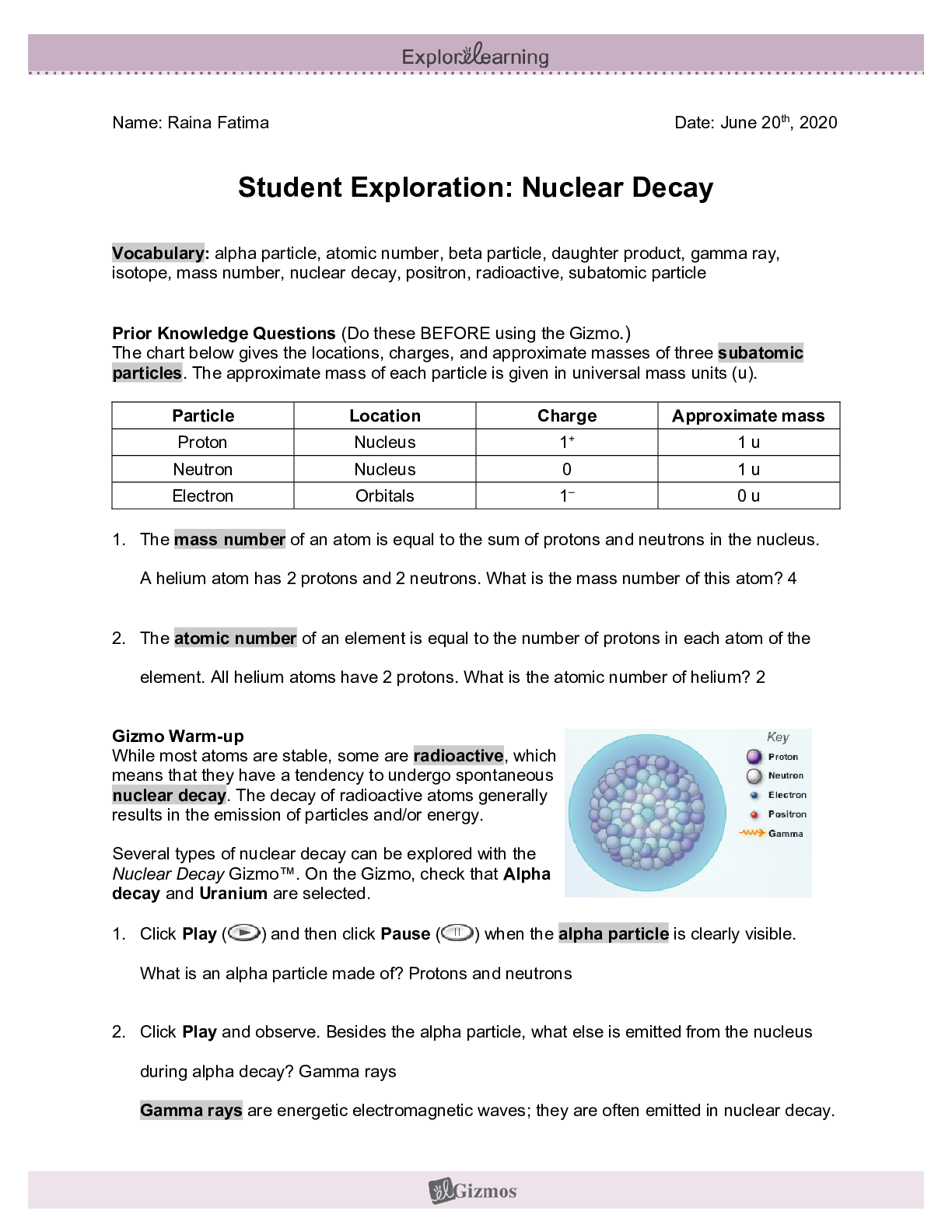
Student Exploration: Free-Fall Laboratory
(ANSWER KEY)
Download
Student Exploration: Free-Fall Laboratory
Vocabulary: acceleration, air resistance, free fall, instantaneous velocity, terminal velocity, velocity,
vac
...
Student Exploration: Free-Fall Laboratory
(ANSWER KEY)
Download
Student Exploration: Free-Fall Laboratory
Vocabulary: acceleration, air resistance, free fall, instantaneous velocity, terminal velocity, velocity,
vacuum
Prior Knowledge Questions (Do these BEFORE using the Gizmo.)
Suppose you dropped a feather and a hammer at the same time. Which object would hit the ground
first?
Imagine repeating the experiment in an airless tube, or vacuum. Would this change the result? If so,
how?
Gizmo Warm-up
The Free-Fall Laboratory Gizmo™ allows you to measure the motion of an object in free fall. On the
CONTROLS pane check that the Shuttlecock is selected, the Initial height is 3 meters, and
the Atmosphere is Air.
Click Play () to release the shuttlecock. How long does it take to fall to the bottom?
Select the GRAPH tab. The box labeled h (m) should be checked, displaying a graph of height vs.
time. What does this graph show?
Turn on the v (m/s) box to see a graph of velocity vs. time. Velocityis the speed and direction of the
object. Velocity is also referred to as instantaneous velocity. Because the shuttlecock is falling
downward, its velocity is negative.
Does the velocity stay constant as the object drops?
Turn on the a (m/s/s) box to see a graph of acceleration vs. time. Acceleration is the rate at which
the velocity changes over time. What does this graph show?
Activity A:
Falling objects
Get the Gizmo ready:
Click Reset ( ).
Select the CONTROLS tab.
Question: What factors affect how quickly an object falls?
This study source was downloaded by 100000793680026 from CourseHero.com on 05-15-2021 15:58:31 GMT -05:00
https://www.coursehero.com/file/42223589/Student-Exploration-Free-Fall-Laboratory-ANSWER-KEYdocx/
This study resource was
shared via CourseHero.comObserve: Drop each item through Air from a height of 3 meters. Record how long it takes to fall
below. For the tennis ball, try to click Pause () when it hits the ground.
Form a hypothesis: Why do some objects fall faster than others?
Predict: A vacuum has no air. How do you think the results will change if the objects fall through a
vacuum?
Experiment: On the Atmosphere menu, select None. Drop each item again, and record the results
below.
Analyze: What happened when objects fell through a vacuum?
Draw conclusions: Objects falling through air are slowed by the force of air resistance. Which
objects were slowed the most by air resistance? Why do you think this is so?
(Activity A continued on next page)
Activity A (continued from previous page)
Calculate: Select the Shuttlecock. Check that the Initial height is 3 meters and
the Atmosphere is None. Click Play and wait for the Shuttlecock to fall. Select the BAR CHART tab
and turn on Show numerical values.
How long did it take the shuttlecock to fall to the bottom?
What was the acceleration of the shuttlecock during its fall?
What was the velocity of the shuttlecock when it hit the bottom?
(Note: This is an example of instantaneous velocity.)
What is the mathematical relationship between these three values?
Make a rule: If the acceleration is constant and the starting velocity is zero, what is the relationship
between the acceleration of a falling body (a), the time it takes to fall (t), and its instantaneous
velocity when it hits the ground (v)?
Express your answer as an equation relating v, a, and t:
Test: Click Reset. On the CONTROLS tab, set the Initial height to 12 meters. Click Play.
How long did it take for the shuttlecock to fall 12 meters?
Assuming the acceleration is still -9.81 m/s2, what is the instantaneous velocity of the shuttlecock
when it hits the ground? Show your work below.
Select the BAR CHART tab. What is the final velocity of the shuttlecock?
Does this agree with your calculated value?
Activity B: Get the Gizmo ready:
[Show More]