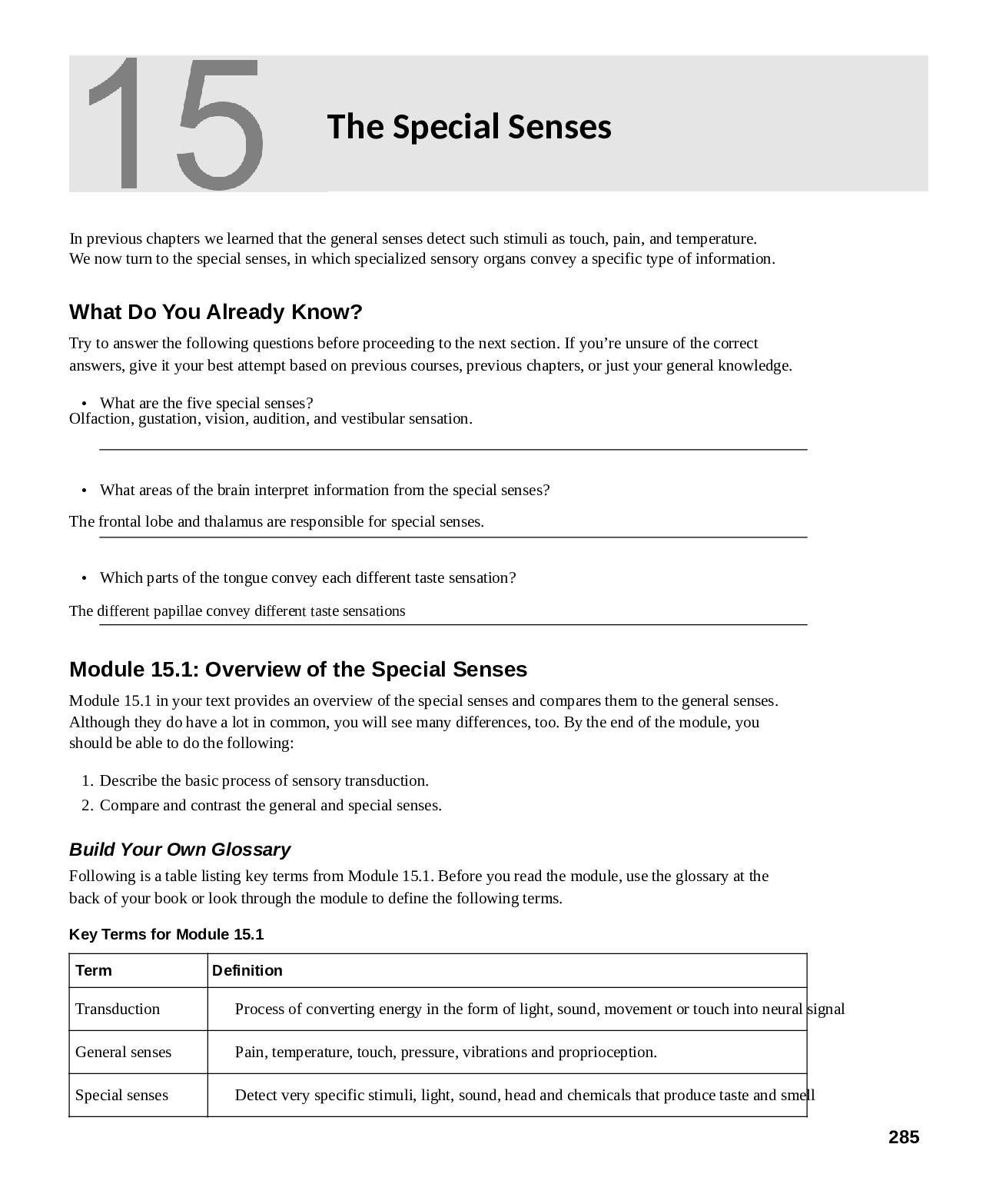
The Special Senses
In previous chapters we learned that the general senses detect such stimuli as touch, pain, and temperature.
We now turn to the special senses, in which specialized sensory organs convey a specific t
...
The Special Senses
In previous chapters we learned that the general senses detect such stimuli as touch, pain, and temperature.
We now turn to the special senses, in which specialized sensory organs convey a specific type of information.
What Do You Already Know?
Try to answer the following questions before proceeding to the next section. If you’re unsure of the correct
answers, give it your best attempt based on previous courses, previous chapters, or just your general knowledge.
• What are the five special senses?
Olfaction, gustation, vision, audition, and vestibular sensation.
• What areas of the brain interpret information from the special senses?
The frontal lobe and thalamus are responsible for special senses.
• Which parts of the tongue convey each different taste sensation?
The different papillae convey different taste sensations
Module 15.1: Overview of the Special Senses
Module 15.1 in your text provides an overview of the special senses and compares them to the general senses.
Although they do have a lot in common, you will see many differences, too. By the end of the module, you
should be able to do the following:
1. Describe the basic process of sensory transduction.
2. Compare and contrast the general and special senses.
Build Your Own Glossary
Following is a table listing key terms from Module 15.1. Before you read the module, use the glossary at the
back of your book or look through the module to define the following terms.
Key Terms for Module 15.1
Term Definition
Transduction Process of converting energy in the form of light, sound, movement or touch into neural signal
General senses Pain, temperature, touch, pressure, vibrations and proprioception.
Special senses Detect very specific stimuli, light, sound, head and chemicals that produce taste and smell
285286 Active-Learning Workbook
Survey It: Form Questions
Before you read the module, survey it and form at least two questions for yourself. When you have finished
reading the module, return to these questions and answer them.
Question 1: Is temperature a general or special sense?
Answer: General
Question 2: Where is the location of special sense organs?
Answer: They are all housed in the head.
Key Concept: How is a physical stimulus transduced into a neural signal?
Physical stimulus is converted into an action potential that can be interpreted by the brain.
Key Concept: How are the special senses different from general sensation?
Special senses only detect specific stimuli and special sense receptors are not neurons like they are for general senses.
Module 15.2: Olfaction
Now we look at how our sense of smell allows us to detect the presence of chemicals in the air and transduces
them into signals our brain can interpret. When you finish this module, you should be able to do the following:
1. Describe and identify the location of olfactory receptors.
2. Explain how odorants activate olfactory receptors.
3. Describe the path of action potentials from the olfactory receptors to various parts of the brain.
Build Your Own Glossary
The following table is a list of key terms from Module 15.2. Before you read the module, use the glossary at the
back of your book or look through the module to define the following terms.
Key Terms for Module 15.2
Term Definition
Odorants Chemicals in the air
Olfaction The sense of smell
Chemoreceptors Sensory receptor responds to a change in the concentration of a specific chemical in the air
Olfactory bulb A structure located in the brain just superior to the ethmoid bone and inferior to frontal lobeChapter 15 The Special Senses 287
Survey It: Form Questions
Before you read the module, survey it and form at least three questions for yourself. When you have finished
reading the module, return to these questions and answer them.
Question 1: What do basal cells develop in to?
Answer: Stem cells that develop into olfactory neurons
Question 2: What give olfactory epithelium its color?
Answer: Supporting cells
Question 3: What is the first step when an odorant reaches their receptors?
Answer: Binding of odorant to its receptor activates g protein
Key Concept: How is binding of an odorant to an olfactory receptor transduced into a neural impulse?
It activates the g-protein which triggers enzyme adenylate cyclase to convert ATP into cyclic AMP, which then opens to channel ions that
allow sodium and calcium to enter cell.
Identify It: Olfactory Epithelium and Olfactory Neurons
Identify each component of olfactory epithelium and olfactory neurons in Figure 15.1. Then, list the main
function and/or a short description of each component.
Figure 15.1 Olfactory epithelium and olfactory neurons.
Key Concept: How are olfactory stimuli interpreted by the brain? What is the importance of the connection
of the stimuli with the limbic system?
Once chemicals in the air are detected neurons of the olfactory system transduce the chemicals signals of the
odorants into electrical signals that out brain can interpret.
Olfactory bulb
Mitral cell
Olfactory tract
Dendrite
Olfactory cillia
Olfactory epithelium
Cribriform plate
Axon of olfactory neuron
Olfactory gland
Olfactory
neuron
Supporting cell288 Active-Learning Workbook
Module 15.3: Gustation
This module explores taste sensation, from the detection of chemical molecules on the tongue to the processing
of neural signals in various regions of the brain. When you complete this module, you should be able to do the
following:
1. Describe the location and structure of taste buds.
2. Explain how chemicals dissolved in saliva activate gustatory receptors.
3. Trace the path of action potentials from the gustatory receptors to various parts of the brain.
4. Describe the five primary taste sensations.
Build Your Own Glossary
Below is a table listing key terms from Module 15.3. Before you read the module, use the glossary at the
back of your book or look through the module to define the following terms.
Key Terms of Module 15.3
Term Definition
Gustation The sense of tast
[Show More]

.png)


![Preview of [SOLVED] Liberty University HIEU 201 / HIEU201 Chapter 15 Quiz (LATEST 2022)](https://scholarfriends.com/storage/HIEU_201_Chapter_15_Quiz.png)
.png)



.png)
.png)


