. The nurse knows that which statement by the mother indicates that
the mother understands safety precautions with her four month-old
infant and her 4 year-old child?
A) "I strap the infant car seat on the front seat
...
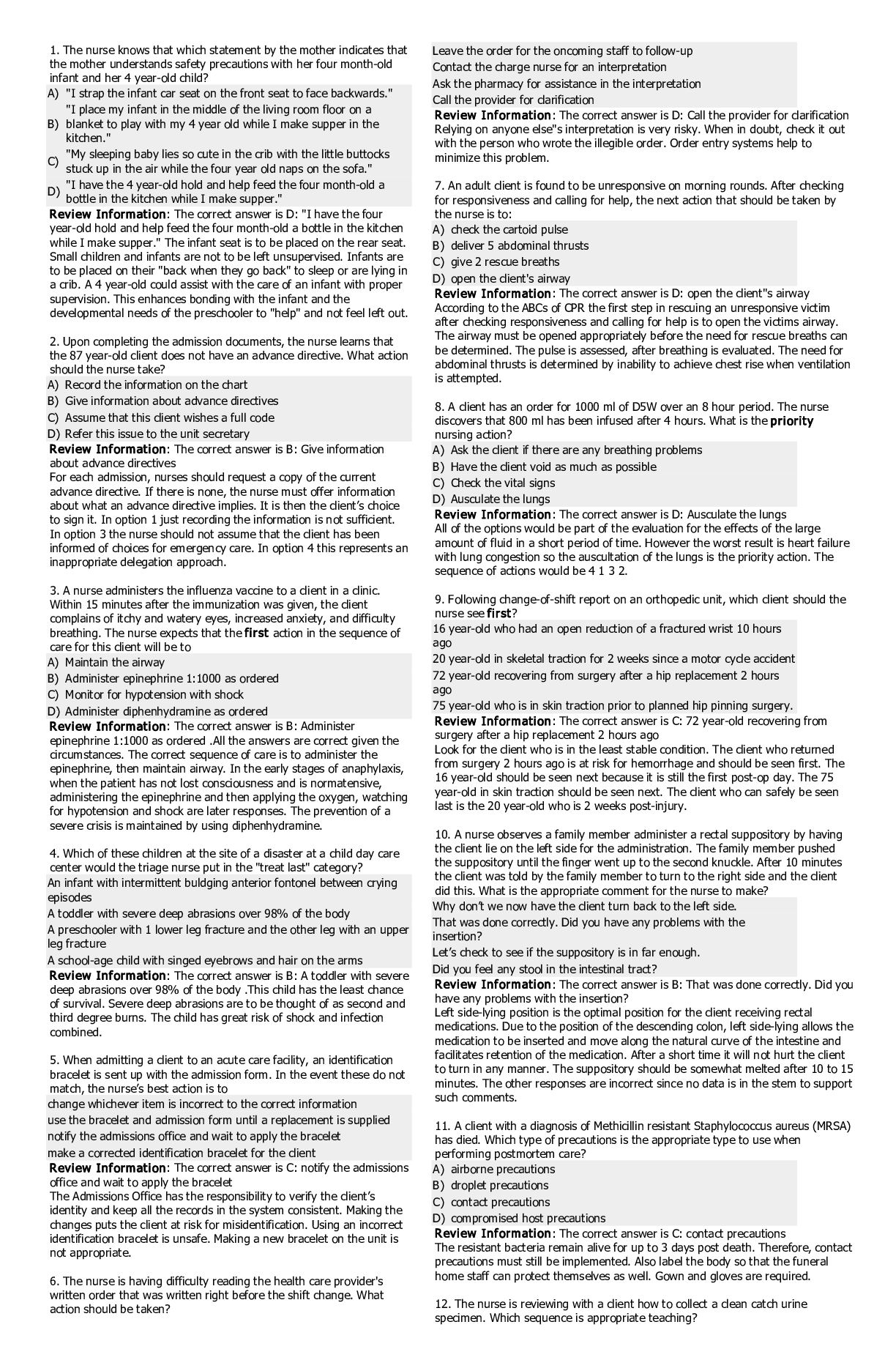
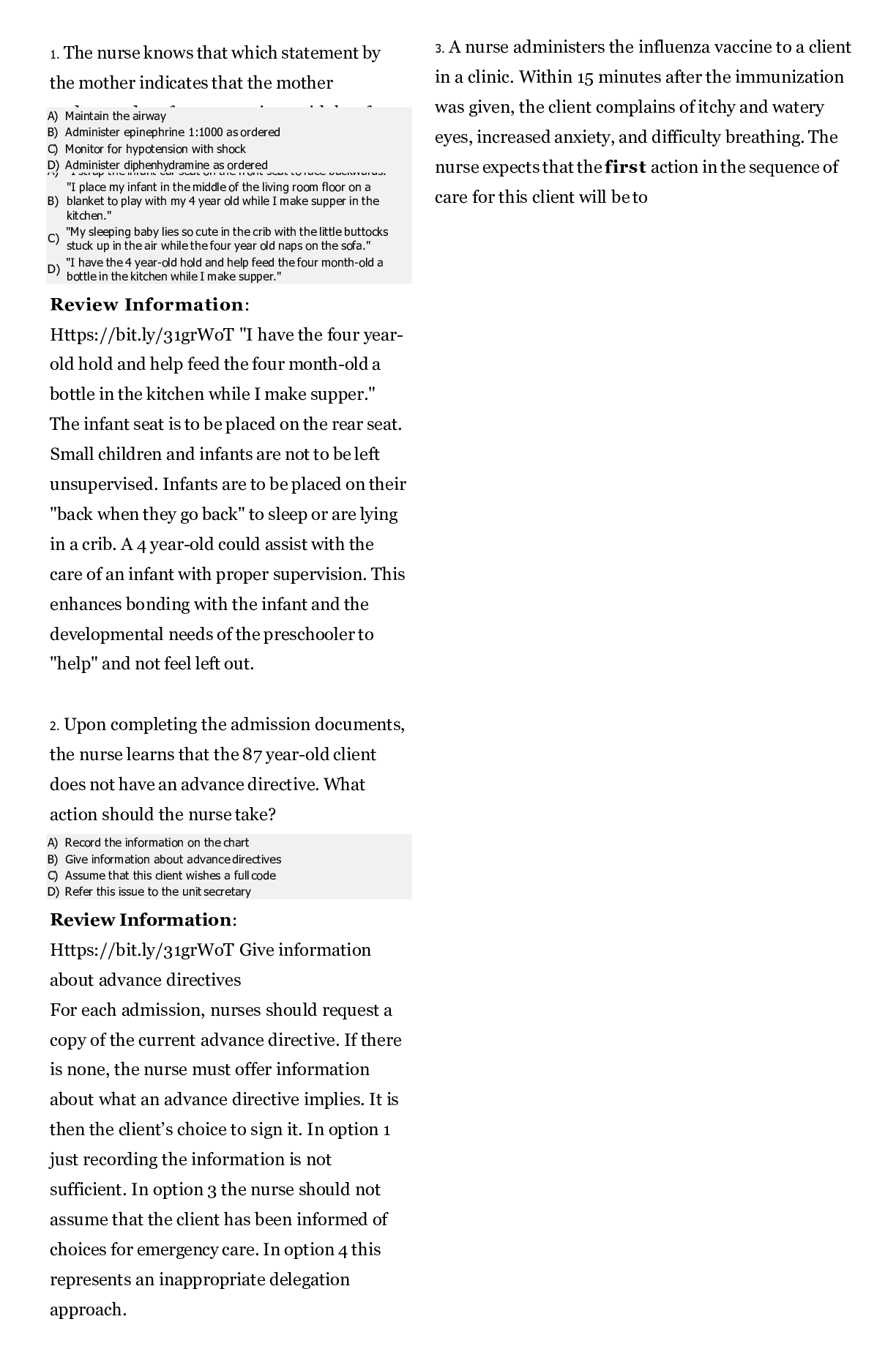
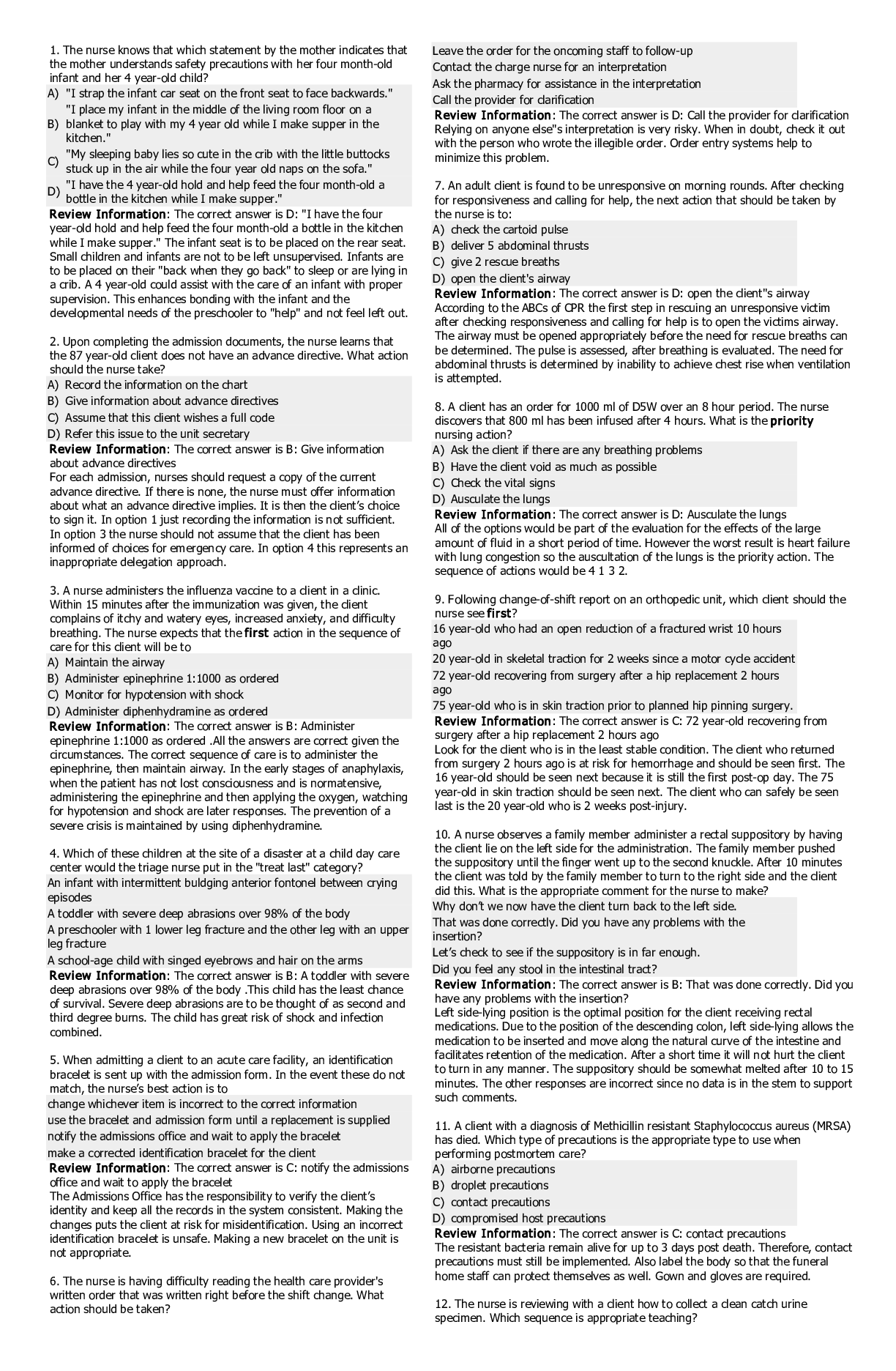
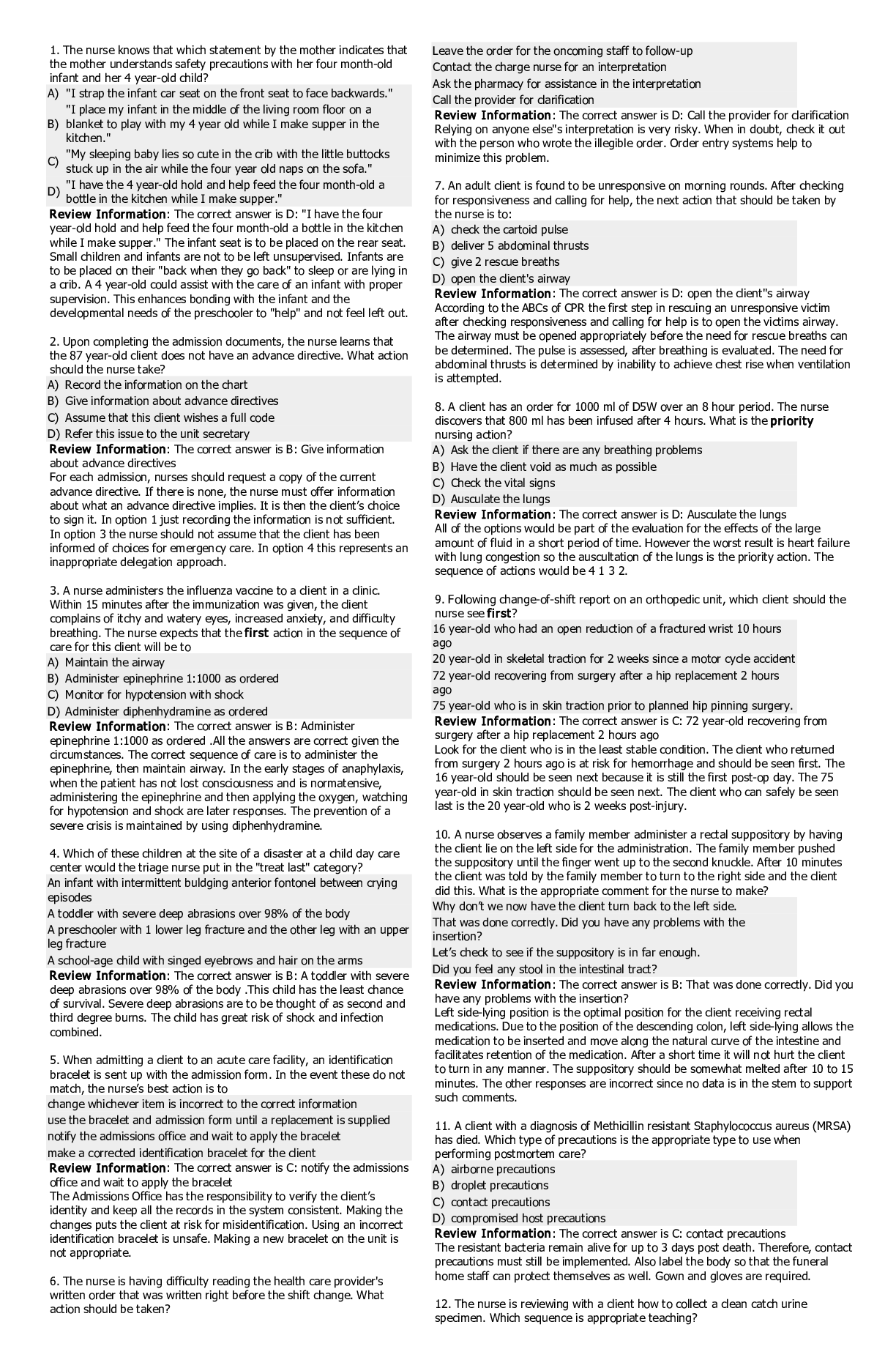
. The nurse knows that which statement by the mother indicates that
the mother understands safety precautions with her four month-old
infant and her 4 year-old child?
A) "I strap the infant car seat on the front seat to face backwards."
B)
"I place my infant in the middle of the living room floor on a
blanket to play with my 4 year old while I make supper in the
kitchen."
C) "My sleeping baby lies so cute in the crib with the little buttocks
stuck up in the air while the four year old naps on the sofa."
D) "I have the 4 year-old hold and help feed the four month-old a
bottle in the kitchen while I make supper."
Review Information: The correct answer is D: "I have the four
year-old hold and help feed the four month-old a bottle in the kitchen
while I make supper." The infant seat is to be placed on the rear seat.
Small children and infants are not to be left unsupervised. Infants are
to be placed on their "back when they go back" to sleep or are lying in
a crib. A 4 year-old could assist with the care of an infant with proper
supervision. This enhances bonding with the infant and the
developmental needs of the preschooler to "help" and not feel left out.
2. Upon completing the admission documents, the nurse learns that
the 87 year-old client does not have an advance directive. What action
should the nurse take?
A) Record the information on the chart
B) Give information about advance directives
C) Assume that this client wishes a full code
D) Refer this issue to the unit secretary
Review Information: The correct answer is B: Give information
about advance directives
For each admission, nurses should request a copy of the current
advance directive. If there is none, the nurse must offer information
about what an advance directive implies. It is then the client’s choice
to sign it. In option 1 just recording the information is not sufficient.
In option 3 the nurse should not assume that the client has been
informed of choices for emergency care. In option 4 this represents an
inappropriate delegation approach.
3. A nurse administers the influenza vaccine to a client in a clinic.
Within 15 minutes after the immunization was given, the client
complains of itchy and watery eyes, increased anxiety, and difficulty
breathing. The nurse expects that the first action in the sequence of
care for this client will be to
A) Maintain the airway
B) Administer epinephrine 1:1000 as ordered
C) Monitor for hypotension with shock
D) Administer diphenhydramine as ordered
Review Information: The correct answer is B: Administer
epinephrine 1:1000 as ordered .All the answers are correct given the
circumstances. The correct sequence of care is to administer the
epinephrine, then maintain airway. In the early stages of anaphylaxis,
when the patient has not lost consciousness and is normatensive,
administering the epinephrine and then applying the oxygen, watching
for hypotension and shock are later responses. The prevention of a
severe crisis is maintained by using diphenhydramine.
4. Which of these children at the site of a disaster at a child day care
center would the triage nurse put in the "treat last" category?
An infant with intermittent buldging anterior fontonel between crying
episodes
A toddler with severe deep abrasions over 98% of the body
A preschooler with 1 lower leg fracture and the other leg with an upper
leg fracture
A school-age child with singed eyebrows and hair on the arms
Review Information: The correct answer is B: A toddler with severe
deep abrasions over 98% of the body .This child has the least chance
of survival. Severe deep abrasions are to be thought of as second and
third degree burns. The child has great risk of shock and infection
combined.
5. When admitting a client to an acute care facility, an identification
bracelet is sent up with the admission form. In the event these do not
match, the nurse’s best action is to
change whichever item is incorrect to the correct information
use the bracelet and admission form until a replacement is supplied
notify the admissions office and wait to apply the bracelet
make a corrected identification bracelet for the client
Review Information: The correct answer is C: notify the admissions
office and wait to apply the bracelet
The Admissions Office has the responsibility to verify the client’s
identity and keep all the records in the system consistent. Making the
changes puts the client at risk for misidentification. Using an incorrect
identification bracelet is unsafe. Making a new bracelet on the unit is
not appropriate.
6. The nurse is having difficulty reading the health care provider's
written order that was written right before the shift change. What
action should be taken?
Leave the order for the oncoming staff to follow-up
Contact the charge nurse for an interpretation
Ask the pharmacy for assistance in the interpretation
Call the provider for clarification
Review Information: The correct answer is D: Call the provider for clarification
Relying on anyone else''s interpretation is very risky. When in doubt, check it out
with the person who wrote the illegible order. Order entry systems help to
minimize this problem.
7. An adult client is found to be unresponsive on morning rounds. After checking
for responsiveness and calling for help, the next action that should be taken by
the nurse is to:
A) check the cartoid pulse
B) deliver 5 abdominal thrusts
C) give 2 rescue breaths
D) open the client's airway
Review Information: The correct answer is D: open the client''s airway
According to the ABCs of CPR the first step in rescuing an unresponsive victim
after checking responsiveness and calling for help is to open the victims airway.
The airway must be opened appropriately before the need for rescue breaths can
be determined. The pulse is assessed, after breathing is evaluated. The need for
abdominal thrusts is determined by inability to achieve chest rise when ventilation
is attempted.
8. A client has an order for 1000 ml of D5W over an 8 hour period. The nurse
discovers that 800 ml has been infused after 4 hours. What is the priority
nursing action?
A) Ask the client if there are any breathing problems
B) Have the client void as much as possible
C) Check the vital signs
D) Ausculate the lungs
Review Information: The correct answer is D: Ausculate the lungs
All of the options would be part of the evaluation for the effects of the large
amount of fluid in a short period of time. However the worst result is heart failure
with lung congestion so the auscultation of the lungs is the priority action. The
sequence of actions would be 4 1 3 2.
9. Following change-of-shift report on an orthopedic unit, which client should the
nurse see first?
16 year-old who had an open reduction of a fractured wrist 10 hours
ago
20 year-old in skeletal traction for 2 weeks since a motor cycle accident
72 year-old recovering from surgery after a hip replacement 2 hours
ago
75 year-old who is in skin traction prior to planned hip pinning surgery.
Review Information: The correct answer is C: 72 year-old recovering from
surgery after a hip replacement 2 hours ago
Look for the client who is in the least stable condition. The client who returned
from surgery 2 hours ago is at risk for hemorrhage and should be seen first. The
16 year-old should be seen next because it is still the first post-op day. The 75
year-old in skin traction should be seen next. The client who can safely be seen
last is the 20 year-old who is 2 weeks post-injury.
10. A nurse observes a family member administer a rectal suppository by having
the client lie on the left side for the administration. The family member pushed
the suppository until the finger went up to the second knuckle. After 10 minutes
the client was told by the family member to turn to the right side and the client
did this. What is the appropriate comment for the nurse to make?
Why don’t we now have the client turn back to the left side.
That was done correctly. Did you have any problems with the
insertion?
Let’s check to see if the suppository is in far enough.
Did you feel any stool in the intestinal tract?
Review Information: The correct answer is B: That was done correctly. Did you
have any problems with the insertion?
Left side-lying position is the optimal position for the client receiving rectal
medications. Due to the position of the descending colon, left side-lying allows the
medication to be inserted and move along the natural curve of the intestine and
facilitates retention of the medication. After a short time it will not hurt the client
to turn in any manner. The suppository should be somewhat melted after 10 to 15
minutes. The other responses are incorrect since no data is in the stem to support
such comments.
11. A client with a diagnosis of Methicillin resistant Staphylococcus aureus (MRSA)
has died. Which type of precautions is the appropriate type to use when
performing postmortem care?
A) airborne precautions
B) droplet precautions
C) contact precautions
D) compromised host precautions
Review Information: The correct answer is C: contact precautions
The resistant bacteria remain alive for up to 3 days post death. Therefore, contact
precautions must still be implemented. Also label the body so that the funeral
home staff can protect themselves as well. Gown and gloves are required.
12. The nurse is reviewing with a client how to collect a clean catch urine
specimen. Which sequence is appropriate teaching?
[Show More]