Public Economics, Fall 2016
Midterm Solutions
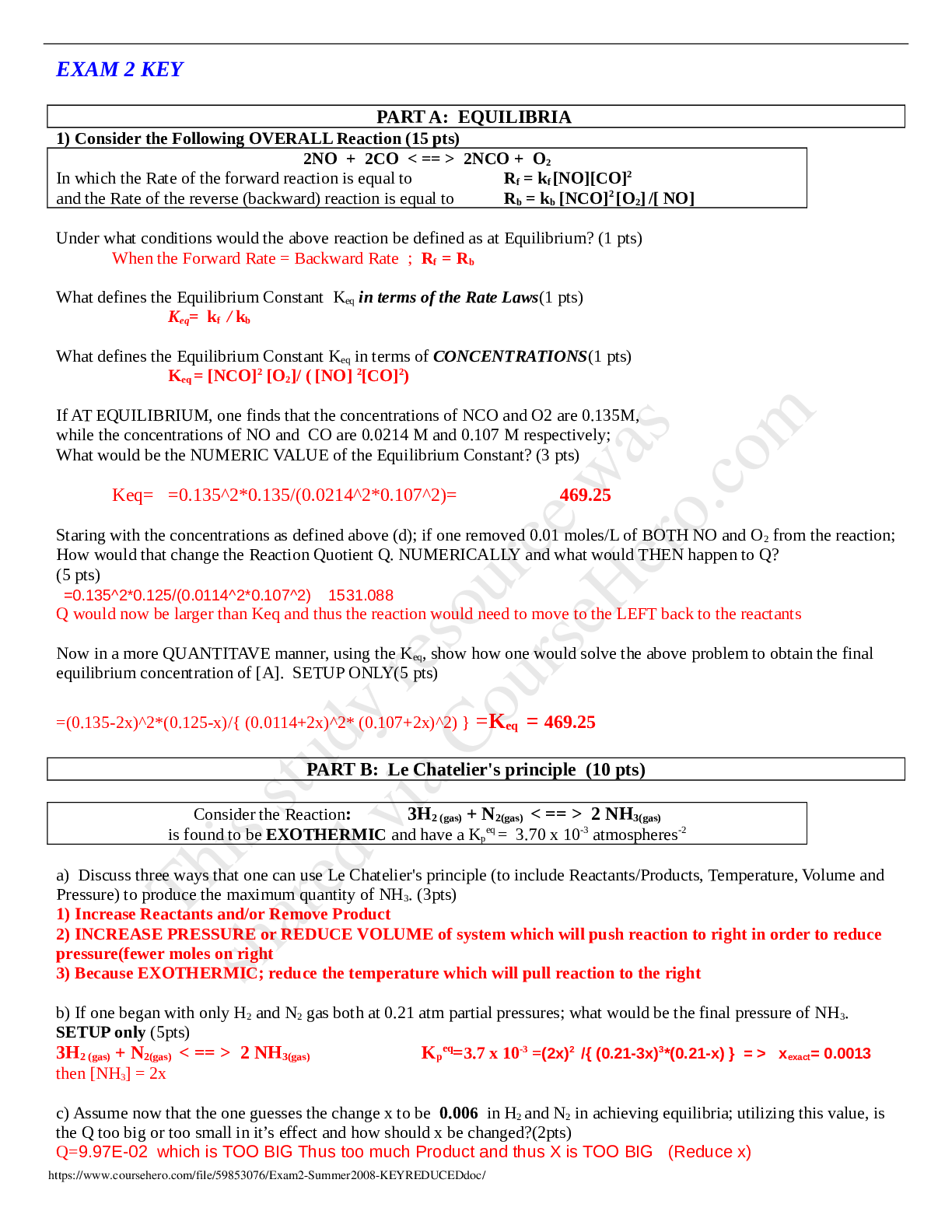
1. Suppose an insurance company offers a standardized health insurance contract (i.e., we are not going to consider
the possibility of changing contract features such as t
...
Public Economics, Fall 2016
Midterm Solutions
1. Suppose an insurance company offers a standardized health insurance contract (i.e., we are not going to consider
the possibility of changing contract features such as the extent coverage, deductibles, network of doctors etc.).
There are 800 potential buyers of health insurance. At price p, minf1000 − p; 800g of them are interested in buying
the insurance (in particular, everybody will buy if the price is lower than 200). Buyers are not identical | they
differ with respect to their health. Hence, the cost of serving them depends on how many individuals buy insurance.
Suppose that the total cost of serving the first q customers is given by 900q − 3 8q2.
(a) (5 points) What is the supply curve here assuming that the firm makes zero profits (because there is free entry
into the industry)?
If free entry drives profits to zero, then the supply curve of the typical insurance company in this market is
given by the AC curve. This is because under the zero profit condition, firm profits are pq−TC = pq−ACq =
(p − AC)q = 0 =) p = AC.
Computing the AC curve we get that the supply curve is therefore:
AC(q) = TC=q = 900 − 3q=8
(b) (5 points) What is the equilibrium price and the number of insurance policies sold?
We can rearrange the demand curve as p = 1000 − q, for q ≤ 800. Setting this equal to the AC curve, we can
solve for the equilibrium in this market:
AC(q) = D(q) () 900 − 3q=8 = 1000 − q =) q∗ = 160; p∗ = 840
(c) (5 points) What is the efficient (i.e. full information) number of insured individuals?
The efficient quantity of contracts occurs at the point where the marginal willingness to pay is equal to the
marginal cost (demand = MC).
MC(q) = 900 − 3q=4
MC(q) = D(q) () 900 − 3q=4 = 1000 − q =) qeff = 400 ; peff = 600
(d) (5 points) Calculate the deadweight loss corresponding to the equilibrium provision.
To compute the deadweight loss, we first need to solve for the marginal cost to providing an additional
contract at the equilibrium quantity:
MC(q∗) = 900 − 3(160)=4 = 780
The deadweight loss (DWL) is given by the area of the triangle formed by the points AC(q∗); MC(q∗); peff .
DW L = 1
2�AC(q∗) − MC(q∗)��qeff − q∗� = 12(840 − 780)(400 − 160) = 7200
[Show More]
.png)







.png)
.png)












.png)

.png)