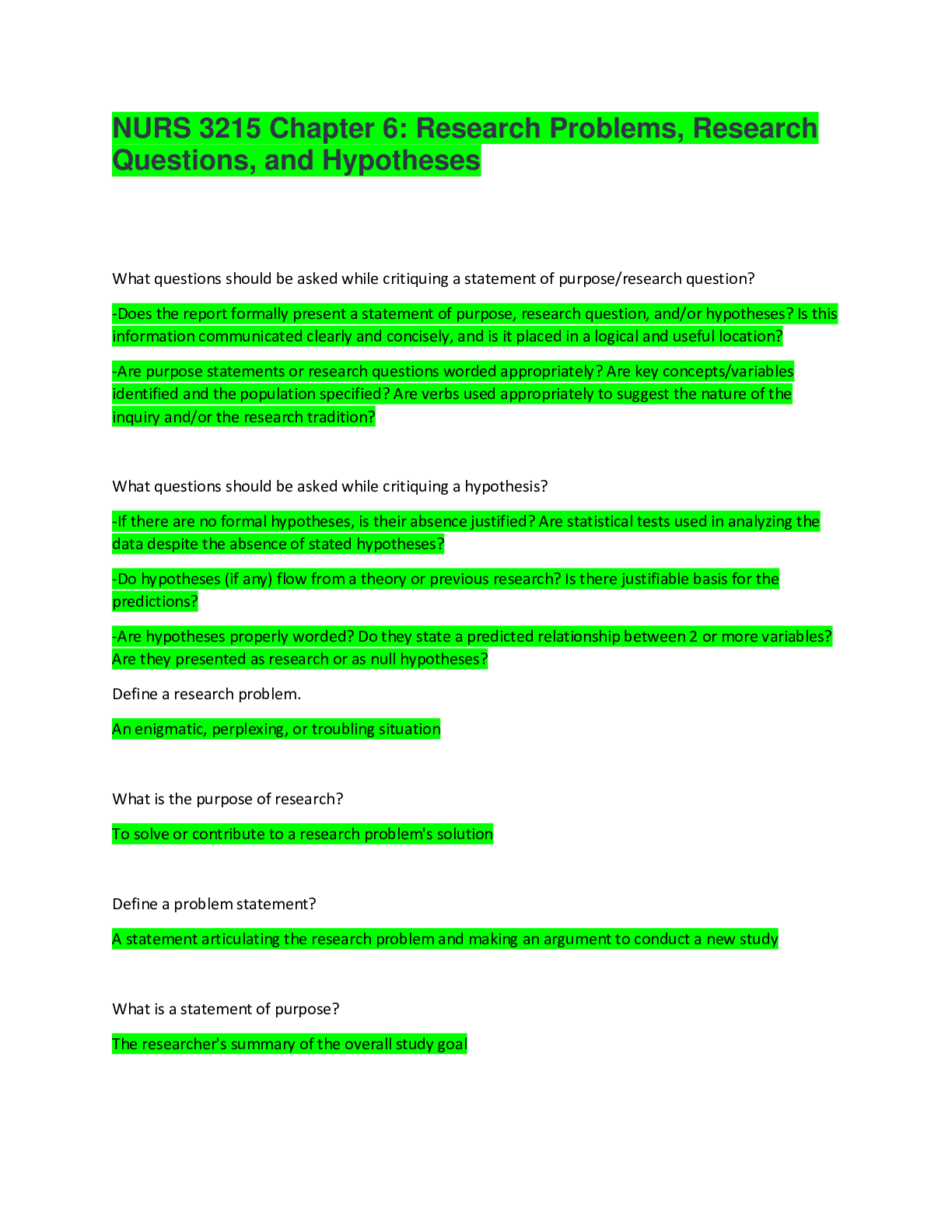
What questions should be asked while critiquing a statement of purpose/research question?
What questions should be asked while critiquing a hypothesis?
Define a research problem.
What is the purpose of research?
...
What questions should be asked while critiquing a statement of purpose/research question?
What questions should be asked while critiquing a hypothesis?
Define a research problem.
What is the purpose of research?
Define a problem statement?
What is a statement of purpose?
What are research aims or objectives?
Define research questions.
What is a hypothesis?
Is the following statement an example of a topic, research problem/problem statement, statement of purpose, research question, or hypothesis? : Side effects of chemotherapy
Is the following statement an example of a topic, research problem/problem statement, statement of purpose, research question, or hypothesis? : Nausea and vomiting are common side effects among patients on chemotherapy, and interventions to date have been only moderately successful in reducing these effects. New interventions that can reduce or prevent these side effects need to be identified.
Is the following statement an example of a topic, research problem/problem statement, statement of purpose, research question, or hypothesis? : the purpose of the study is to test an intervention to reduce chemotherapy induced side effects- specifically, to compare the effectiveness of patient controlled and nurse administered antiemetic therapy for controlling nausea and vomiting in patients on chemotherapy.
Is the following statement an example of a topic, research problem/problem statement, statement of purpose, research question, or hypothesis? : what is the relative effectiveness of patient controlled antiemetic therapy versus nurse controlled antiemetic therapy with regard to medication of consumption and control of nausea and vomiting in patients on chemotherapy?
Is the following statement an example of a topic, research problem/problem statement, statement of purpose, research question, or hypothesis? : Subjects receiving antiemetic therapy by a patient controlled pump will be less nauseated, vomit less, and consume less medication than subjects receiving nurse administered therapy.
What kind of research problems are best suited for quantitative studies?
What kind of research problems are best suited for qualitative studies?
Problems about poorly understood phenomenons for which the researcher seek to develop a rich and context bound understanding
List some sources of research problems.
-Clinical experience
-Nursing literature
-Social issues (global health/political issues of relevance to health care)
-Theories
-Ideas from external sources
Explain why a research problem shouldn't be too broad or too specific.
It must be broad enough to include central concerns, but narrow enough to serve as a guide to study design.
What are the 6 components of a problem statement in a quantitative study?
-Identification of the problem: what is wrong with the current situation?
-Background: what is the nature or context of the problem?
-Scope: how big is the problem, how many people are affected?
-Consequences: what are the consequences of not fixing the problem?
-Knowledge gaps: what information about the problem is lacking?
-Proposed solution: how will the study contribute to the problem's situation?
Where can a reader usually find the problem statement of a research report?
The first sentance
What does the statement of purpose identify in a quantitative study?
The key study variables, possible relationships among variables, and the population of interest (PICO elements), nature of inquiry
What does the statement of purpose identify in a qualitative study?
The central phenomenon, suggest the research tradition, and indicates the group/community/setting of interest, nature of inquiry
Is the following statement an example of a statement of purpose for a quantitative or a qualitative study? : the purpose of this study was to investigate the effectiveness of chilled and unchilled baby oil therapy for treating uremic pruritus in hemodialysis patients.
Quantitative
Is the following statement an example of a statement of purpose for a quantitative or a qualitative study? : The purpose of this study was to explore the experiences of Latina mothers who immigrated to the US without legal documentation and without their children.
Qualitative
What key verbs are used to suggest the nature of the inquiry in a quantitative study?
To test, to compare, to evaluate
What key verbs are used to suggest the nature of the inquiry in a qualitative study?
To describe, to discover, to explore
What buzz words are found in a statement of purpose that are associated with the traditions of a grounded theory study?
Processes, social structures, social interactions
What buzz words are found in a statement of purpose that are associated with the traditions of a phenomenological study?
Experience, lived experience, meaning, essence
What buzz words are found in a statement of purpose that are associated with the traditions of an ethnographic study?
Culture, roles lifeways, cultural behavior
What buzz words are found in a statement of purpose that are associated with the traditions of an experimental study?
Test/ evaluate
What buzz words are found in a statement of purpose that are associated with the traditions of a nonexperimental study?
Examine/ explore
If the buzz word "compare" is found in a statement of purpose in a study, what kind of study/tradition is it probably associated with?
Quantitative, but not sure if experimental or nonexperimental because it could be either. Ex. Could be to compare alternative treatments (experimental) or compare preexisting groups (nonexperimental)
Why shouldn't words such as "prove", "demonstrate", or show" be included in a statement of purpose?
They suggest a bias and do not connote objectivity
Explain why a statement of purpose is sometimes left out.
They are often just another way of stating the research question.
What is the purpose of research questions?
To reword, clarify or lend specificity to the purpose statement
What kind of inquiries do research questions pose for a quantitative study? Why are these questions asked?
Pose queries about the relationships among variables. They think in terms of variables to help guide researchers decisions about how to operationalize them.
Translate the following EBP question into a quantitative research question: In (population), what is the effect of (intervention) on (outcome)?
In (population), what is the effect of (independent variable) on (dependent variable)?
Write a template for an intervention/therapy quantitative research question.
In (population), what is the effect of (independent variable: intervention vs. alternative) on (dependent variable)?
Write a template for a prognosis quantitative research question.
In (population), does (independent variable: disease or illness versus its absence) increase the risk of (dependent variable)?
Write a template for an etiology/harm quantitative research question.
In (population), does (independent variable: exposure versus non exposure) increase risk of (DV)?
What kind of inquiries do research questions pose for a qualitative study?
Often pose queries linked to the research tradition, or simply pose questions about describing the phenomenon
Are process questions typically associated with grounded theory, phenomenology, or ethnography studies?
Grounded theory
Are meaning questions typically associated with grounded theory, phenomenology, or ethnography studies?
Phenomenology
Are cultural description questions typically associated with grounded theory, phenomenology, or ethnography studies?
Ethnography
What kind of study is the following research question from? : what is the lived experience and personal meaning of hereditary breast cancer risk and surveillance?
Qualitative- Phenomenology
Where are the statement of purpose and research question usually found?
At the end of the introduction or immediately after the review of literature
Explain why qualitative researchers typically do not formulate a hypothesis.
They want the inquiry to be guided by the participants viewpoints rather than by their own hunches
Given the following research question, formulate an appropriate hypothesis: does sexual abuse in childhood affect the development of irritable bowel syndrome in women?
Women (P) who were sexually abused in childhood (I) have a higher incidence of irritable bowel syndrome (O) than women who were not abused (C)
Why would a hypothesis be used to evaluate a theory?
Theories are too abstract to test directly, but predictions based on it can be tested. If the hypotheses are supported with real data, the theories gain support.
Suggest a hypothesis for the given theory : The theory of reinforcement states that behavior that is positively reinforced/rewarded tends to be learned/repeated.
Pediatric patients who are given a reward (watching TV) for cooperating during nursing procedures tend to be more cooperative than non-rewarded peers.
If a preceding hypothesis is not confirmed in a study, what must researchers do?
-Analyze theory or previous research critically
-Review study limitations
-Explore alternative explanations for the findings
What must a hypothesis include in order to be testable and concrete?
Terms that indicated a relationship, ex. more than, less than, different from, associated wtht, related to
What should hypotheses be based on? How are they tested?
Based on previous research findings or deduced from a theory. Tested through statistical procedures
Define a directional hypothesis.
Specifies not only the existence of but also the expected direction of the relationship between variables.
Define a non-directional hypothesis.
Predicts the existence of a relationship, but does not stipulate the direction of the relationship.
Is the following hypothesis directional or nondirectional? : Older patients are more likely to fall than younger patients.
Directional
Is the following hypothesis directional or nondirectional? : There is a relationship between a patients age and the likelihood of falling.
Nondirectional
Is the following hypothesis directional, nondirectional, or null? : The older the patient, the greater the likelihood that she or he will fall.
Directional
Is the following hypothesis directional, nondirectional, or null? : Older patients differ from younger ones with respect to their risk of falling.
Nondirectional
Is the following hypothesis directional, nondirectional, or null? : Younger patients are at lower risk of falling than older patients.
Directional
Is the following hypothesis directional, nondirectional, or null? : The risk of falling increases with age of the patient.
Directional
Is the following hypothesis directional, nondirectional, or null? : Older patients are just as likely as younger patients to fall.
Null
Define a research hypothesis.
Actual predictions/ expected relationships between variables
Define a null hypothesis.
Express the absence of a relationship between variables
When should a null hypothesis be used?
With statistical testing/ procedures
Explain why hypotheses are never proved or disproved.
Statistical hypothesis testing cannot provide absolute proof. It can only provide probabilistic information to
-accept/support an inference that a hypothesis is probably correct
-reject a hypothesis that is probably incorrect.
What questions should be asked while critiquing a research problem?
-What is the research problem? Is the problem statement easy to locate and is it clearly stated? Does the problem statement build a cogent and persuasive argument for the new study?
-Does the problem have significance for nursing? How might the research contribute to nursing practice, administration, education, or policy?
-Is there a good fit between the research problem and the paradigm within which the research was conducted? Is there a good fir with the qualitative research tradition (if applicable)?
[Show More]