o these functional areas of the heart. )
Requires both for detection of changes by ETT Easier to detect by ETT
...
o these functional areas of the heart. )
Requires both for detection of changes by ETT Easier to detect by ETT
Question 29
.
Question :
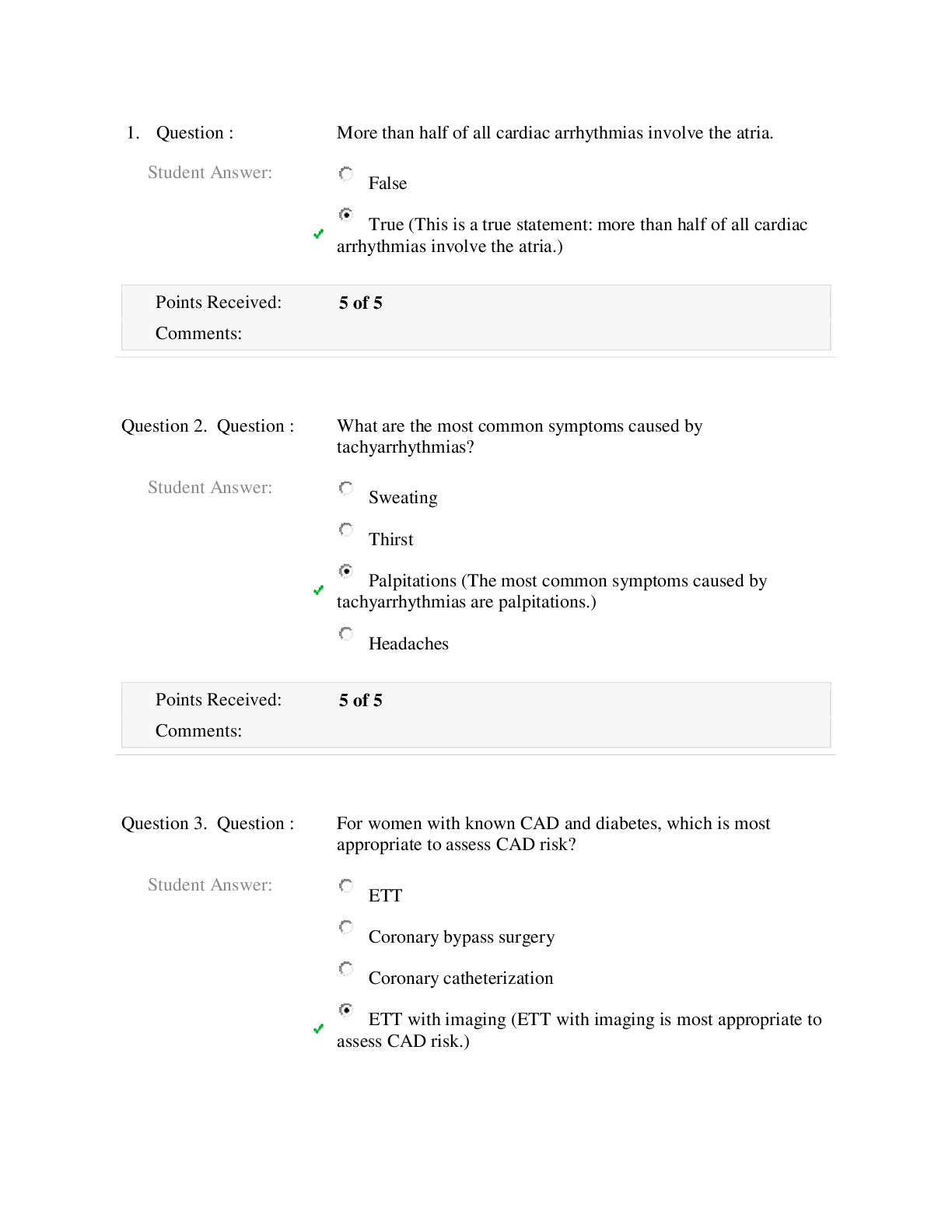
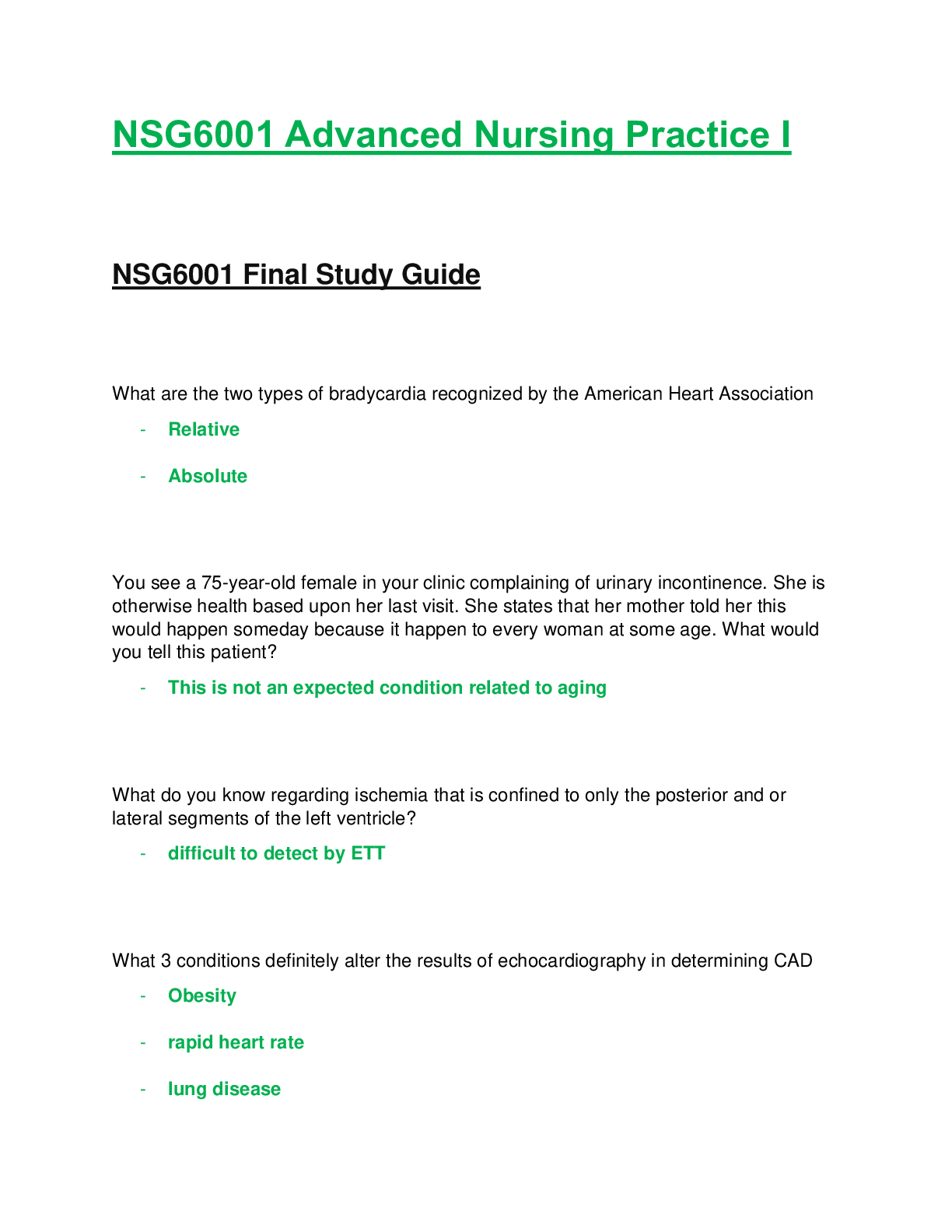
What three conditions definitely alter the results of
echocardiography in determining CAD?
Student Answer: Obesity, rapid heart rate and lung disease (Obesity, rapid
heart rate and lung disease definitely alter the results of
echocardiography in determining CAD.)
Diabetes, kidney disease and tooth decay
Obesity, slow heart rates and hypertension
Previous MI, hypotension and diabetes
Question 30
.
Question :
Specifically, when is an ETT considered to be negative?
Student Answer: Patient has ST-segmental changes with down sloping of
greater than 1 mm at 50% of age-predicted maximum heart rate
Patient exercises to 85% of age predicted maximum heart
rate without evidence of induced ischemia (An ETT is considered to be negative when the patient exercises to 85% of age predicted maximum heart rate without evidence of induced ischemia. )
Patient exercises to 20% maximum age-predicted heart rate
without induced ischemia
Patient exercises until tired without evidence of induced
ischemia
-514937583 MultipleChoice 25 True
0 -514937583 MultipleChoice 25
Question 31
.
Question :
All patients, even is asymptomatic, require risk stratification according to the Farmingham risk score. At present, ACC/AHA guidelines, however, do not normally support stress tests for asymptomatic patients without addiitonal justification. From the list below, what could be used to justify a ETT in an asymptomatic patient?
Student Answer: A smoker of 3 weeks A member of congress
Sedentary and wishes to begin aggressive exercise (Many
patients have underlying CAD but remain asymptomatic. Before beginning any new vigorous activities after years of sedentary lifestyle, it is recommended to obtain a ETT to rule out underlying CAD.)
Developmentally challenged
-514937582 MultipleChoice 49 True
0 -514937582 MultipleChoice 49
Question 32
.
Question :
BPH is not a risk factor for Prostate cancer. Is this statement true or false?
Student Answer: True (This is a true statement: BPH is not a risk factor for
Prostate cancer.) False
-514937581 MultipleChoice 89 False
0 -514937581 MultipleChoice 89
Question 33
.
Question :
Spread of genital herpes only occurs during the time period with active lesions. Is this statement true or false?
Student Answer: False (This is a false statement: spread of genital herpes only
occurs during the time period with active lesions.) True
-514937580 MultipleChoice 99 True
0 -514937580 MultipleChoice 99
Question 34
.
Question :
Abdominal aortic aneurysms are often asymptomatic. What percent of AAA’s are discovered in asymptomatic patients?
Student Answer: 40%
20%
10%
75% (75% of abdominal aortic aneurysms are discovered in asymptomatic patients.)
-514937579 MultipleChoice 60 True
0 -514937579 MultipleChoice 60
Question 35
.
Question :
Improvements in the delivery and management of healthcare are necessary if we are to improve the overall health of this nation’s population. Which of the following are identified in your readings as strategic in the movement to improve the healthcare system?
Student Answer: President and Congress
Population management and healthcare practice (Population
management and healthcare practice are strategic in the movement to improve the nation’s healthcare system. )
Socialized medicine and governmental controls
Monetary savings and limited disruption in healthcare delivery
-514937578 MultipleChoice 5 True
0 -514937578 MultipleChoice 5
Question 36
.
Question :
What are the two main types of heart failure?
Student Answer: Systolic and diastolic (The two main types of heart failure are
systolic and diastolic.) Hopeless and severe
Left sided and main
End diastolic and pressure related
-514937577 MultipleChoice 81 False
0 -514937577 MultipleChoice 81
Question 37
.
Question :
The majority of all strokes are non-ischemic. Is this statement true or false?
Student Answer: False (This statement is false: the majority of all strokes are
non-ischemic.) True
-514937576 MultipleChoice 79 True
0 -514937576 MultipleChoice 79
Question 38
.
Question :
When a murmur is first heard, it is important to determine if it is due to a pathological condition or benign. For an experienced practitioner, it is always easy to determine the cause of a murmur merely by listening to the sound. Is this statement true or false?
Student Answer: True
False (This statement is false: for an experienced practitioner,
it is always easy to determine the cause of a murmur merely by listening to the sound)
-514937575 MultipleChoice 85 True
0 -514937575 MultipleChoice 85
Question 39
.
Question :
Maintenance of an Isometric ST-segment during exercise is the response of?
Student Answer: A normal heart (Maintenance of an Isometric ST-segment
during exercise is the response of a normal heart. ) Hypo profusion
An abnormal heart CAD
Question 40
.
Question :
The goal of self-management is to specifically do what?
Student Answer: Engage patients in their own care (The goal of self-
management is to engage patients in their own care.)
Engage insurance providers in patient care
Engage providers in patient care
Engage government in greater involvement in patient care
-514937573 MultipleChoice 52 True
0 -514937573 MultipleChoice 52
Question 41
.
Question :
Your 56-year old patient presents with bradycardia with a rate of 55 and first degree AV block. The patient is hemodynamically stable and is not experiencing any syncope or chest pain. History includes previous myocardial infarction. Home medications include beta blockers, daily aspirin. Lab work is non-significant for electrolyte imbalance. You decided to treat this patient for the arrhythmia to prevent future destabilization. From the choices below, which might be the appropriate first measure to consider?
Student Answer: Add digitalis to control the heart rate
Consult cardiologist immediately for guidance
Discontinue Beta Blocker and replace with another therapy if
necessary (The appropriate first measure to consider is to discontinue the beta blocker and replace with another therapy if necessary.)
Atropine injections
-514937572 MultipleChoice 77 True
0 -514937572 MultipleChoice 77
Question 42
.
Question :
Your patient is morbidly obese and cannot sit on a bicycle or walk
a treadmill. She also has marked and severe emphysema. You need to make an assessment of the risk of significant CAD and your patient’s family says that their relative had their diagnosis based on an ultrasound echocardiography. What facts would influence your decision regarding the family request for echo assessment?
Student Answer: Sensitivity would be increased because of lung disease
Specificity would be increased because of obesity Sensitivity would be reduced because of obesity and lung
disease (Sensitivity would be reduced because of obesity and lung disease.)
Specificity would be reduced because of obesity and lung
disease
-514937571 MultipleChoice 36 True
0 -514937571 MultipleChoice 36
Question 43
.
Question :
You are in the clinic with your mentor observing the Echocardiogram exercise test of a 45-year old male that has been experiencing slight chest pressure almost daily during exercise. While observing your patient, your mentor points out that the left ventricle wall is thinning and there is some hyperkinesias of the ventricular wall. From your time in the clinic, you know that this test will be considered to be what type of result?
Student Answer: Negative Impossible
Positive (From your time in the clinic, you know because of
wall thinning and hyperkinesis that this test will be considered to be positive.)
Non-readable
-514937570 MultipleChoice 37 True
0 -514937570 MultipleChoice 37
Question 44
.
Question :
Your patient is newly diagnosed with persistent Atria Fibrillation. You consider electrocardioversion. Before undergoing this procedure you should order the following examination to assess thrombus risk.
Student Answer: X-Ray of chest
Tranesophageal echocardiography (Before undergoing this
procedure you should order tranesophageal echocardiography to assess thrombus risk.)
Ultrasound of chest CT Scan
Question 45
.
Question :
Tachyarrhythmias cause a drop in commonly blood pressure,
cardiac output, syncope, shortness of breath, and chest pain. What
phenomenon most often occurs during these arrhythmias to cause
these symptoms?
Student Answer: Shortened diastole (The phenomenon that most often occurs
during these arrhythmias to cause these symptoms is shortened diastole related to the rapid heart rate. Typically, a shortened systolye would not cause as severe symptoms.)
Lengthened diastole Lengthened systole Shortened systole
Question 46
.
Question :
At what age is atria fibrillation most common?
Student Answer: In childhood
60 years or older (Atria fibrillation most common in persons
60 years or older.)
30 years
45 years
Question 47
.
Question :
Automaticity is a property common to all cardiac cells. Is this statement true or false?
Student Answer: True (This is a true statement: automaticity is a property
common to all cardiac cells.) False
-514937566 MultipleChoice 68 True
0 -514937566 MultipleChoice 68
Question 48
.
Question :
Your patient has a maximum age-predicted heart rate of 180. During the exercise he reaches a heart rate of 140 and then states he can no longer exercise. You see evidence of ischemic changes on the ECG. This would be predictive of what condition?
Student Answer: Stroke
Significant CAD (This scenario is predictive of significant CAD.)
Impending death Low risk of CAD
Question 49
.
Question :
You tell a patient that he has a murmur. He says he has been told
this before, but wonders what causes the unique sounds of a murmur. Which of the following would be your best option?
Student Answer: Turbulent flow of blood (The best answer is turbulent flow of blood.)
High pressures caused from HTN There is no reason, it just happens Almost always from a sclerotic valve
[Show More]