CHAPTER 7- CELLULAR DIVISION
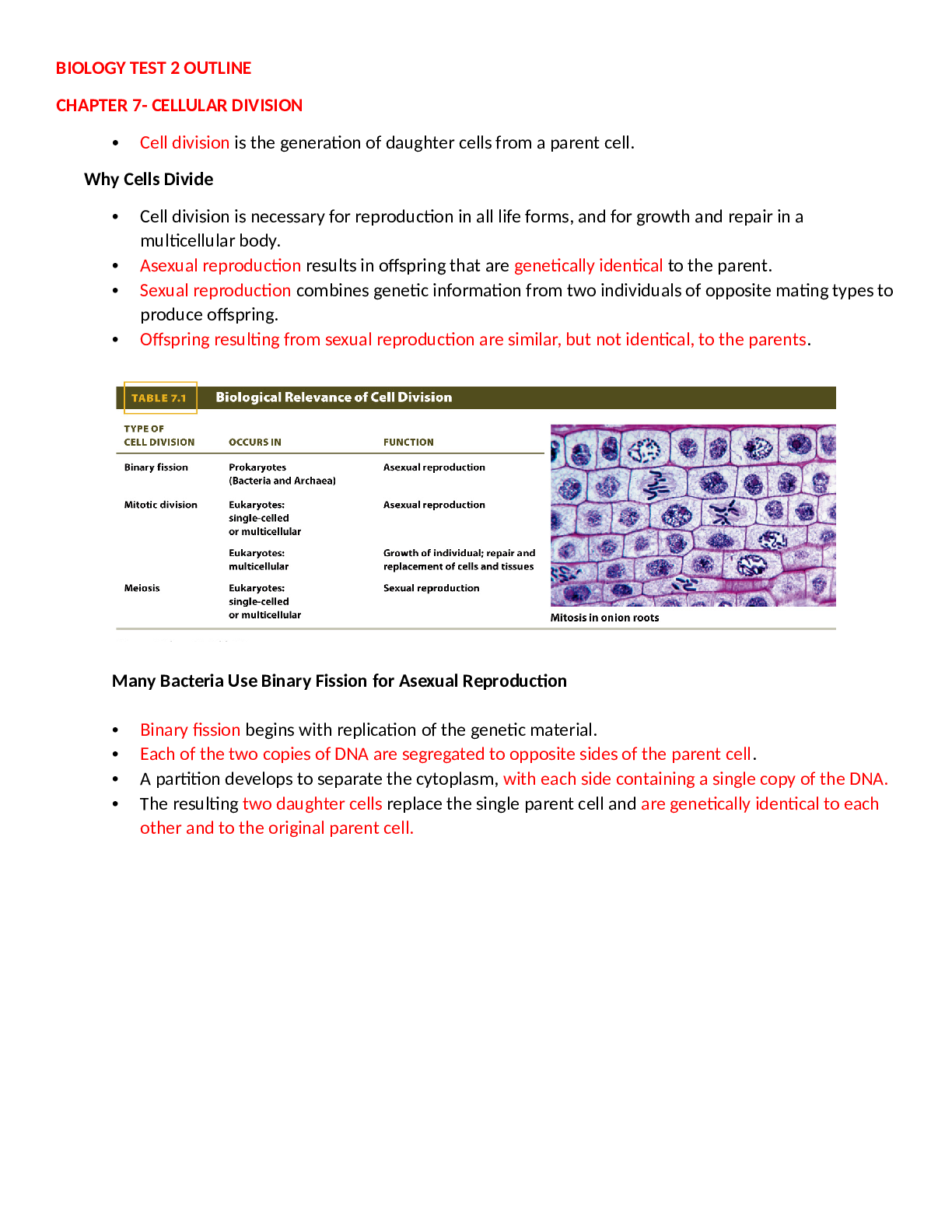
• Cell division is the generation of daughter cells from a parent cell.
Why Cells Divide
• Cell division is necessary for reproduction in all life forms, and for growth and repair in a
mu
...
CHAPTER 7- CELLULAR DIVISION
• Cell division is the generation of daughter cells from a parent cell.
Why Cells Divide
• Cell division is necessary for reproduction in all life forms, and for growth and repair in a
multicellular body.
• Asexual reproduction results in offspring that are genetically identical to the parent.
• Sexual reproduction combines genetic information from two individuals of opposite mating types to
produce offspring.
• Offspring resulting from sexual reproduction are similar, but not identical, to the parents.
Many Bacteria Use Binary Fission for Asexual Reproduction
• Binary fission begins with replication of the genetic material.
• Each of the two copies of DNA are segregated to opposite sides of the parent cell.
• A partition develops to separate the cytoplasm, with each side containing a single copy of the DNA.
• The resulting two daughter cells replace the single parent cell and are genetically identical to each
other and to the original parent cell.
Eukaryotes Use Mitosis to Produce Identical Daughter Cells
• Mitotic division is the process in eukaryotes that generates two genetically identical daughter
cells from a single parent cell.
• Mitotic cell division involves the even distribution of replicated DNA into new daughter cells.
• During a mitotic division, the nucleus divides in a process called mitosis, followed by a division
of the cytoplasm called cytokinesis.
Meiosis is Necessary for Sexual Reproduction
• Meiosis is a specialized form of cell division that is needed to make gametes (sex cells).
• Meiosis in female animals results in gametes that will mature into eggs.
• Meiosis in male animals produces gametes called sperm.
• Meiosis reduces the genetic information passed to the daughter cells by half (n).
• The fusion of information from the egg (n) and information from the sperm (n) restores a full set
of genetic information (2n) in the zygote (fertilized egg).
[Show More]



 Introduction & History of Microbiology Professor Md.png)


.png)

